The Tennis Prince Won Europe’s Heart, But the Quiet Girl Secretly Controlled His Royal Future.
Chapter 1
The Tennis Prince Won Europe’s Heart, But the Quiet Girl Secretly Controlled His Royal Future.
Prince Edward was supposed to be impossible to reach.
That was what every magazine said.
He was the royal tennis prince of Ardenmere, twenty-nine years old, tall, handsome, and always dressed like every camera had been waiting for him since sunrise. He had won charity tournaments across Europe, smiled beside prime ministers, shaken hands with billionaires, and never once let the public see him lose control.
To the world, he was perfect.
To Clara Hayes, he was just the man who had stopped celebrating.
She was standing near the medical tent at the Royal Children’s Charity Cup when it happened.
Edward had just won the final point.
The stadium exploded.
Cameras flashed. The crowd rose. His team rushed toward him with towels, water bottles, and loud congratulations.
But Edward did not lift his racket.
He did not wave first.
He turned.
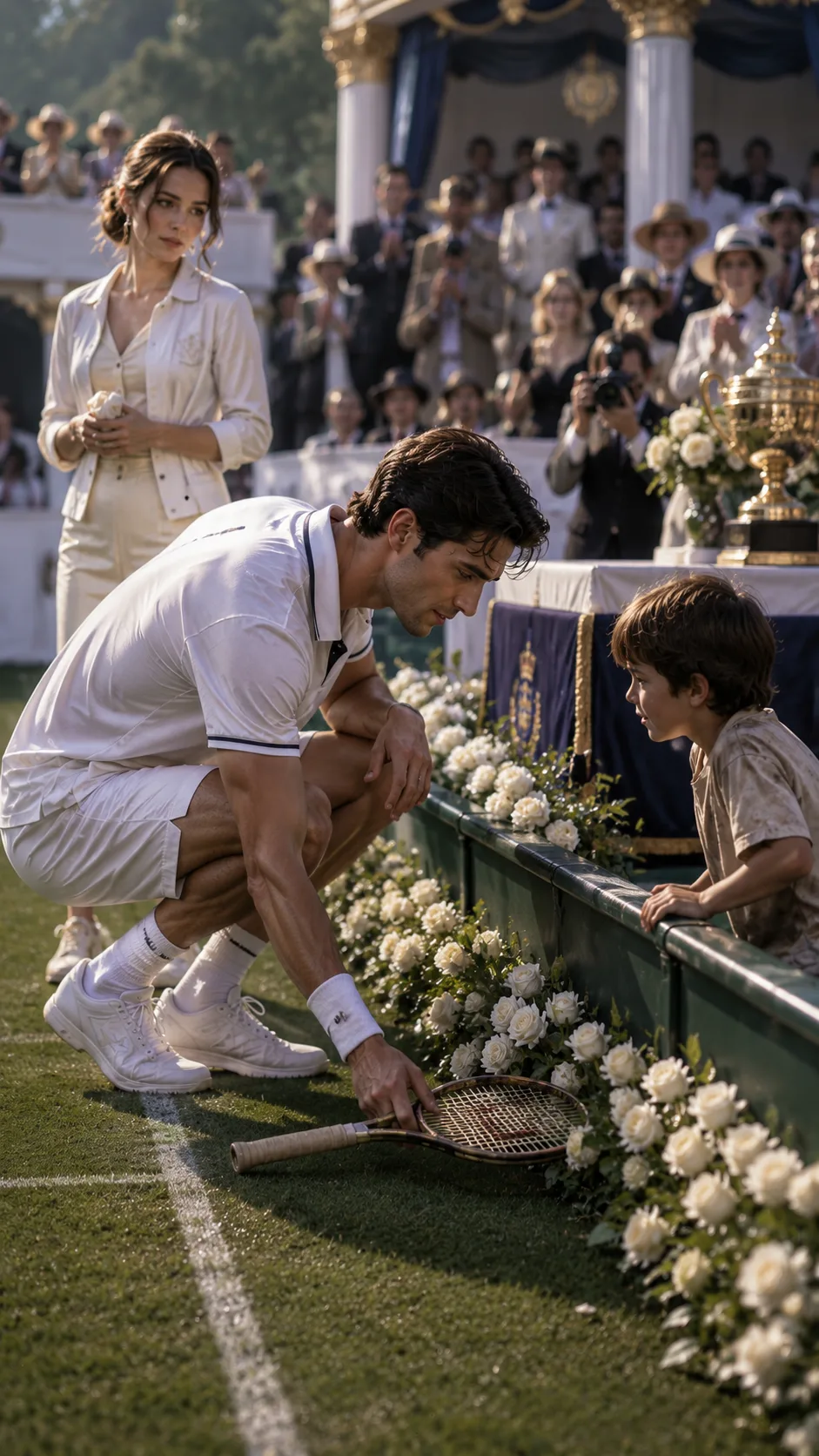
At the edge of the court, a little boy
in worn sneakers had dropped a cracked tennis racket through the barrier. Security moved forward, ready to push him back.
Edward saw it.
He crossed the court, picked up the racket himself, and handed it back to the boy.
Then he crouched so they were at eye level.
The boy whispered something Clara could not hear.
Edward smiled.
Not the royal smile. Not the practiced smile.
A real one.
Then he took his own winning racket, signed the handle, and gave it to the boy too.
The stadium went quiet for half a second.
Then the applause came harder.
Clara stood frozen beside the white medical tent, one hand still holding a roll of bandage.
Her stomach dropped.
She had seen handsome men before. She had seen rich men before. She had grown up around men who donated money with one hand and humiliated people with the other.
But Edward
had forgotten the cameras.
That was what caught her.
He forgot the cameras.
From that moment, Clara loved him quietly.
Not loudly. Not foolishly. Not in the way tabloids wrote about girls who wanted crowns.
She loved him the way someone loves a song playing from another room.
Close enough to hear.
Too far to touch.
Clara was not part of the royal crowd. Not officially.
She wore a simple cream dress under a volunteer medical jacket, tied her dark blonde hair neatly behind her shoulders, and kept her visitor badge tucked under the collar because she hated being noticed.
People saw her and forgot her.
That had always been useful.
For three days, she worked quietly at the tournament. She treated small cuts. She handed ice packs to ball kids. She helped an elderly donor sit down when the heat became too much.
Edward noticed her on the second
day.
Not because she wanted him to.
Because she was the only person in the VIP medical area who did not look at him like he was a prize.
He came in after a practice set with a bleeding knuckle.
His coach wanted a palace doctor. His aide wanted a private room. His security chief wanted to clear the entire medical tent.
Edward said, “No. This is fine.”
Clara looked up.
For one second, she forgot how to breathe.
He was taller up close. Sunlight caught the sweat along his dark hairline. His white tennis shirt was still damp from the court. His expression was calm, but his eyes were tired.
She washed the scrape on his hand.
He watched her hands.
“You’re very quiet,” he said.
Clara did not look up. “You’re very observed.”
That made him smile.
“Fair.”
She wrapped his knuckle with clean gauze.
“You should stop gripping the racket so hard,” she said.
“My coach says the same thing.”
“Your coach is right.”
“You don’t sound impressed by me.”
“I’m impressed by the boy you gave your racket to.”
Edward’s smile faded slightly.
Something softer replaced it.
“You saw that?”
“Everyone saw that.”
“No,” he said. “Everyone saw a photograph. You saw the boy.”
Clara finally looked at him.
There was a pause.
Outside the tent, the crowd roared for another match. Inside, the air felt still.
Then a sharp voice cut through the entrance.
“Edward.”
Queen Helena stood there.
She was not his mother.
Everyone knew that.
Edward’s real mother had died when he was fifteen. Two years later, his father remarried Helena, a woman with perfect posture, perfect pearls, and eyes that never warmed no matter how brightly she smiled for cameras.
She wore a pale blue suit and a diamond brooch shaped like a crown.
Every volunteer in the tent straightened.
Clara lowered her eyes.
Edward did not.
“I was looking for you,” Helena said. “Princess Marielle is waiting near the sponsors’ balcony.”
Edward’s jaw tightened.
“I injured my hand.”
Helena glanced at the bandage like it offended her.
“It seems minor.”
“It is.”
“Then you can join her.”
Clara tied off the gauze.
Edward did not move.
Helena’s eyes shifted to Clara.
Just once.
That was enough.
Clara felt the temperature drop.
“And you are?” Helena asked.
“Clara Hayes, Your Majesty. Volunteer medical support.”
“Of course.”
Two words.
A dismissal.
Edward took his hand back gently.
“Thank you, Clara.”
Helena heard him say her name.
Her eyes sharpened.
That was the first mistake Edward made.
The second was looking back before he left.
The third was smiling.
By evening, Clara’s volunteer access had been reduced.
No one said Helena had done it.
No one needed to.
The next morning, Clara was moved away from the royal medical area to the public first-aid booth near the east gate. Her badge no longer opened the staff corridor. Her name was removed from the courtside rotation.
The woman managing volunteers looked embarrassed.
“I’m sorry,” she whispered. “Orders from above.”
Clara nodded.
She had survived worse than being moved to another tent.
She kept working.
But Edward noticed.
Of course he noticed.
At noon, he walked past three security guards and found her near the east gate, kneeling beside a little girl who had twisted her ankle.
Clara looked up and saw him.
“Your Highness,” she said softly.
“You disappeared.”
“I was reassigned.”
“By whom?”
“You know by whom.”
Edward’s eyes hardened.
The little girl stared at him with wide eyes.
Clara gently finished taping the ankle.
Edward waited until the girl left.
Then he said, “I’m sorry.”
Clara stood. “You don’t need to apologize for other people.”
“I do when they use my name to hurt someone.”
“It wasn’t hurtful.”
“It was.”
She said nothing.
He stepped closer, lowering his voice.
“Would you have dinner with me?”
Clara almost laughed.
Not because it was funny.
Because it was impossible.
“Prince Edward, your stepmother just moved me across the tournament because you smiled at me.”
“I know.”
“And you think dinner is a reasonable next step?”
“I think dinner is the first honest thing I’ve wanted all week.”
Clara looked at him.
Behind him, cameras were already turning.
A royal aide hurried toward them.
“Your Highness,” the aide warned.
Edward did not look away from Clara.
“Tomorrow night,” he said. “After the donor reception. The south garden.”
Clara should have refused.
She knew that.
Instead, she asked, “Why?”
Edward’s answer came quietly.
“Because when you looked at me, you did not see a crown.”
Clara’s throat tightened.
“No,” she said. “I saw a man who gave a child his racket.”
For one second, Edward looked like he had been struck.
Then he bowed his head slightly.
“Tomorrow night.”
He left before she could answer.
But she went.
The south garden of the palace tennis club was small, hidden behind ivy walls and old stone fountains. It smelled like wet grass and white roses.
Edward was already there.
Not in a tuxedo. Not in royal formalwear.
Just dark trousers, a white shirt, and the same bandage on his hand.
“You came,” he said.
“You sounded lonely.”
“I am.”
The honesty of it broke something in her.
They walked beneath the garden lights.
He told her about his mother. About how she used to sit in the third row at every match, never in the royal box because she said mothers should cheer, not pose.
He told her that tennis had been freedom once. A court. A ball. A clean line. A place where rules made sense.
Then his father became ill.
Then Helena took control of the palace image.
Then every match became a campaign.
Every donation became a photograph.
Every smile became a headline.
Clara listened.
She did not interrupt.
When he stopped, he looked embarrassed.
“I don’t usually say this much.”
“I don’t usually let princes talk this long.”
He laughed softly.
The sound warmed the garden.
For three weeks after the tournament, they met in secret.
Not in hotels. Not in hidden cars.
They met at libraries, charity clinics, and once at a small public court where Edward wore a cap low over his face and taught children how to serve.
Clara watched him there and loved him more.
He was patient. Gentle. Funny in a dry, quiet way.
And every time someone praised him too much, he looked uncomfortable.
That was when Clara understood.
Edward did not want to be adored.
He wanted to be known.
But Helena had other plans.
The engagement announcement came on a Tuesday morning.
Not Edward’s engagement to Clara.
His engagement to Princess Marielle of Bellmont.
It appeared on every royal news page before Edward had even called her.
Clara saw it on a television screen inside a children’s clinic.
Prince Edward and Princess Marielle Expected to Announce Formal Engagement at Charity Gala.
Under the headline was a photograph of Edward standing beside Marielle on the sponsors’ balcony.
They looked perfect.
They looked expensive.
They looked arranged.
Clara’s hand went cold.
Her phone rang one minute later.
Edward.
She did not answer.
He called again.
She stared at the screen until it went dark.
By afternoon, Helena’s private secretary arrived at the clinic.
A thin man in a black suit handed Clara a cream envelope.
No greeting.
No apology.
Inside was a nondisclosure agreement and a check.
The number was insulting only because it assumed she had a price.
Clara read the first page.
Then she looked up.
“What is this?”
The secretary’s expression did not change.
“A private settlement.”
“For what?”
“For your discretion.”
Clara almost smiled.
“My discretion about what?”
“Your brief personal association with His Royal Highness.”
“Brief,” Clara repeated.
“The palace appreciates your cooperation.”
“I haven’t agreed to cooperate.”
The secretary leaned closer.
“Miss Hayes, women like you often mistake royal attention for royal intention.”
There it was.
The sentence Helena had sent him to deliver.
Clara folded the papers neatly.
Then she put them back in the envelope.
“Tell Queen Helena I decline.”
The secretary’s smile became cold.
“That would be unwise.”
Clara held out the envelope.
“No,” she said. “What’s unwise is assuming quiet means powerless.”
The secretary blinked.
For the first time, he looked uncertain.
Clara walked away before he could ask what she meant.
That evening, Edward came to the clinic in person.
No aides. No security inside. Just one car waiting outside in the rain.
Clara found him standing near the back entrance, soaked through his coat.
“You shouldn’t be here,” she said.
“I know.”
“Did you know about the announcement?”
“No.”
“Did you know about the check?”
His face changed.
“What check?”
Clara believed him.
That made it worse.
Because he was trapped too.
She opened the clinic door wider.
He stepped inside.
For a moment, neither of them spoke.
Rain tapped against the windows.
Edward looked exhausted.
“My father signed the engagement discussions months ago,” he said. “Helena pushed it through the royal council this week. They’re calling it a public image alliance.”
“With Marielle?”
“She’s not cruel. She knows what this is.”
“But she’ll do it.”
“She wants the attention.”
Clara looked down.
Edward stepped closer.
“I won’t marry her.”
“Can you stop it?”
“Yes.”
“Can you stop Helena?”
That question stayed between them.
Edward did not answer quickly enough.
Clara nodded once.
“There it is.”
“Clara—”
“You’re a prince,” she said. “But you still ask permission to be honest.”
His face tightened.
“That’s not fair.”
“No. It’s not. None of this is fair.”
He reached for her hand.
She let him.
For one second.
Then she pulled away.
“I won’t be hidden,” Clara said.
“I’m not trying to hide you.”
“You are if you love me in gardens and let them announce another woman in ballrooms.”
Edward looked like the words physically hurt.
“I need time.”
Clara whispered, “So did I.”
He froze.
“What does that mean?”
“It means there are things you don’t know about me.”
“Then tell me.”
She almost did.
She almost told him everything.
That her full legal name was Clara Hayes Whitmore.
That her late grandfather had founded the Whitmore Foundation, the biggest private donor behind the Royal Children’s Charity Cup.
That the foundation owned the tournament’s media sponsorship rights, controlled the main charity contracts, and had quietly funded three of the palace’s largest public relations campaigns.
That she was not a volunteer because she needed a badge.
She was a volunteer because her grandfather taught her never to trust reports written from balconies.
She wanted to see where the money actually went.
She wanted to see whether the royal family cared about children when the cameras turned away.
And Edward had passed the test before he even knew there was one.
But she did not tell him.
Not yet.
Because if he chose her only after knowing her power, it would ruin the only beautiful thing between them.
So Clara said, “It means I know what it feels like to be used for someone else’s image.”
Edward stared at her.
Then he nodded slowly.
“I’ll fix this.”
Clara wanted to believe him.
But royal promises were made in private and broken in public.
The gala came three nights later.
The Royal Children’s Charity Gala was held inside the glass pavilion beside the main tennis court. The entire venue had been transformed into a palace of light: white roses, crystal chandeliers, polished floors, gold sponsor banners, champagne towers, and a stage facing three hundred donors.
Reporters crowded the back.
Every camera pointed toward the royal table.
Edward arrived in a black tuxedo, tall and pale under the flashes.
Princess Marielle stood beside him in a silver gown, beautiful and bored.
Queen Helena entered last.
She wore emerald satin and diamonds, smiling like she had already won.
Clara arrived through the side entrance.
Not as medical staff.
Not as a guest.
As the legal representative and hidden heir of the Whitmore Foundation.
For the first time that week, she did not hide her badge.
It was black with a gold seal.
Full access.
Helena saw her across the room.
The queen’s smile did not move.
But her eyes did.
Clara knew then.
Helena did not know who she was.
Not fully.
Good.
The evening moved like a staged performance.
There were speeches about compassion.
Videos of children smiling.
Applause from people who had never visited the clinics their money supposedly supported.
Edward spoke beautifully. Too beautifully.
He thanked sponsors, doctors, coaches, volunteers.
When he said “volunteers,” his eyes found Clara.
The room noticed.
Helena noticed more.
Then Helena rose.
A palace aide handed her a microphone.
“My dear friends,” she said, her voice bright and controlled, “tonight is not only a celebration of charity. It is a celebration of unity. Of legacy. Of the bright future of Ardenmere.”
Clara’s pulse slowed.
She knew what was coming.
Edward did too.
He stood suddenly.
Helena ignored him.
“It is my joy,” Helena continued, “to confirm that His Royal Highness Prince Edward and Her Serene Highness Princess Marielle have entered the final stage of formal engagement discussions.”
The room erupted.
Applause.
Camera flashes.
Gasps.
Marielle smiled for the cameras.
Edward did not.
He turned toward Helena, furious.
“Stop.”
The microphone caught it.
The applause faltered.
Helena smiled harder.
“My dear Edward—”
“I said stop.”
The room went silent.
Clara’s breath caught.
Edward stepped toward the stage.
“This announcement was made without my consent.”
A shock moved through the donors.
Reporters lifted their cameras higher.
Helena’s eyes flashed.
Then she laughed softly into the microphone.
“Emotions run high at family events.”
Edward reached for the microphone.
Helena pulled it back.
That small movement told the whole room everything.
She still thought she controlled him.
Then Helena looked at Clara.
And decided to destroy her publicly.
“Perhaps,” Helena said, still smiling, “my stepson has been confused recently by attention from people who do not understand the responsibilities of a crown.”
Edward’s face darkened.
“Do not.”
Helena’s voice sharpened.
“Some girls see kindness and mistake it for invitation. Some volunteers forget their place.”
Every head turned.
Toward Clara.
The humiliation was deliberate.
Public.
Clean.
Expensive.
Clara stood alone near the sponsor table, wearing a simple ivory satin dress, no crown, no diamonds, no royal title visible to anyone who mattered.
For a moment, she was seventeen again.
Standing in her grandfather’s boardroom while men twice her age assumed she was there to pour water.
She felt the old anger rise.
But she did not move yet.
Helena continued.
“The monarchy cannot be influenced by quiet girls who wander too close to power.”
Edward stepped off the stage.
“Enough.”
Helena lifted her chin.
“Return to your seat.”
“No.”
The word landed harder than a slap.
Marielle stopped smiling.
The donors whispered.
Edward walked across the ballroom, past his security, past the royal council, past the woman he was supposed to marry.
He stopped beside Clara.
Not in front of her.
Beside her.
That was the difference.
“I won’t let you insult her,” Edward said.
Helena’s lips thinned.
“And I won’t let you throw away a kingdom for a nobody.”
The word hit the room.
Nobody.
Clara heard several people inhale.
Edward looked at Helena like he no longer recognized her.
Clara touched his sleeve lightly.
Not to stop him.
To tell him she could stand.
Then she stepped forward.
The entire room watched.
Clara took the microphone from the stunned event director at the sponsor table.
Her hand was steady.
She looked at Helena.
“My name is Clara Hayes Whitmore.”
The room shifted.
A man near the front dropped his champagne glass.
It shattered across the marble floor.
Helena blinked.
For the first time all night, she looked truly confused.
Clara continued.
“I am the sole voting heir of the Whitmore Foundation.”
The silence became absolute.
Edward turned toward her slowly.
He had not known.
Clara felt that look like a hand around her heart.
But she kept speaking.
“The Whitmore Foundation funds this tournament, the children’s clinics attached to it, and the media contracts your palace has used for five years to polish its public image.”
Helena’s face drained of color.
Clara lifted a black leather folder from the sponsor table.
“I came here as a volunteer because my grandfather taught me that power should inspect itself from the ground.”
Then she opened the folder.
“Tonight, I have seen enough.”
Helena stepped down from the stage.
“Miss Whitmore, this is inappropriate.”
Clara looked directly at her.
“No. Calling a woman nobody in a room paid for by her family is inappropriate.”
The room went still.
Edward stared at Clara like the world had just rearranged itself.
Clara’s voice did not shake.
“Effective immediately, the Whitmore Foundation is suspending all palace-controlled media contracts connected to this tournament pending a full ethics review.”
A reporter gasped.
Someone whispered, “She can do that?”
The chairman of the charity board stood slowly.
“Yes,” he said. “She can.”
Helena turned on him.
“You knew?”
The chairman swallowed. “The foundation requested confidentiality.”
Clara closed the folder.
“I also request that the children’s funding continue without interruption. The clinics will not suffer because the palace forgot humility.”
That was when the applause started.
Not loud at first.
One person.
Then another.
Then half the room.
Then all the volunteers near the back.
Edward did not clap.
He was looking at Clara with pain, pride, and something deeper than surprise.
Helena stood between the stage lights and the cameras, stripped of the one thing she valued most.
Control.
“You lied to us,” Helena said.
Clara shook her head.
“No. You never asked who I was. You only asked what place you could put me in.”
Edward stepped closer.
“Clara…”
She turned to him.
For the first time, her voice softened.
“I didn’t tell you because I needed to know whether you would choose me when you thought I had nothing.”
Edward’s eyes shone.
“And did I?”
Clara looked around the ballroom.
At the cameras.
At Marielle watching quietly.
At Helena shaking with rage.
At the broken glass on the floor.
Then back at Edward.
“You stood beside me before you knew my name.”
Edward took a breath.
Then he turned toward the room.
“I will not marry Princess Marielle.”
Marielle lifted her glass slightly.
“Thank God,” she said.
A nervous laugh broke through the room.
Edward almost smiled.
Then he faced Helena.
“And I will not let this palace use charity as a mirror.”
Helena’s mouth opened.
No words came.
Edward reached for Clara’s hand.
This time, she let him.
But she did not let him pull her behind him.
They stood side by side.
The next morning, every newspaper in Europe printed the same photograph.
Prince Edward standing beside the quiet girl his stepmother had called nobody.
Only now, the caption was different.
Clara Hayes Whitmore, heiress of the Whitmore Foundation, suspends palace media contracts after public insult.
The royal council demanded damage control.
Helena demanded an apology.
Edward refused both.
For the first time in years, his father summoned him privately.
King Arthur had grown weaker since his illness, but his eyes remained clear.
He watched Edward enter the old library where portraits of former kings stared down from dark walls.
“I saw the gala,” the king said.
Edward stood straight.
“I know.”
“Helena embarrassed the crown.”
“Yes.”
“So did you.”
Edward’s jaw tightened.
“I told the truth.”
The king was silent for a long time.
Then he nodded.
“Yes. That is often embarrassing for crowns.”
Edward looked at him.
The king sighed.
“I loved your mother because she told me when I was becoming a statue.”
Edward’s throat tightened.
“Clara does that.”
“I noticed.”
The king turned toward the window.
“Bring her here properly. Not as a scandal. Not as a secret.”
“And Helena?”
The king’s voice hardened.
“Helena will learn that a crown is not a weapon.”
Three months later, the Royal Children’s Charity Cup returned.
But everything had changed.
The media contract was rewritten. Palace control was removed. Volunteer reports were made public. Clinics received direct funding. Children’s programs expanded into poor districts the cameras had never visited.
Helena did not attend opening day.
Princess Marielle did.
She sat beside Clara, wearing sunglasses and a lazy smile.
“You saved me from a very boring engagement,” Marielle said.
Clara laughed.
“You’re welcome.”
Edward played the final match again.
And won again.
The crowd cheered.
But this time, when the final point ended, Edward did not look toward the royal box.
He looked toward the public seats.
Where Clara sat beside the same little boy with the signed racket.
Edward walked across the court.
The cameras followed.
Clara stood slowly.
He stopped before her, still breathing hard from the match.
Then he held out his hand.
Not like a prince offering favor.
Like a man asking.
The stadium went quiet.
Clara looked at his hand.
Then at his face.
“Are you sure?” she asked.
Edward smiled.
“I was sure before I knew your last name.”
Clara placed her hand in his.
The crowd erupted.
But Edward leaned close enough that only she could hear him.
“You were never the quiet girl.”
Clara smiled.
“No?”
“No,” he said. “You were the only person in the room who didn’t need to raise her voice to take back power.”
And for once, the photograph told the truth.
THE END.
Chapter complete
You have reached the end of this chapter.
Continue reading
A few more worlds to get lost in after this chapter.