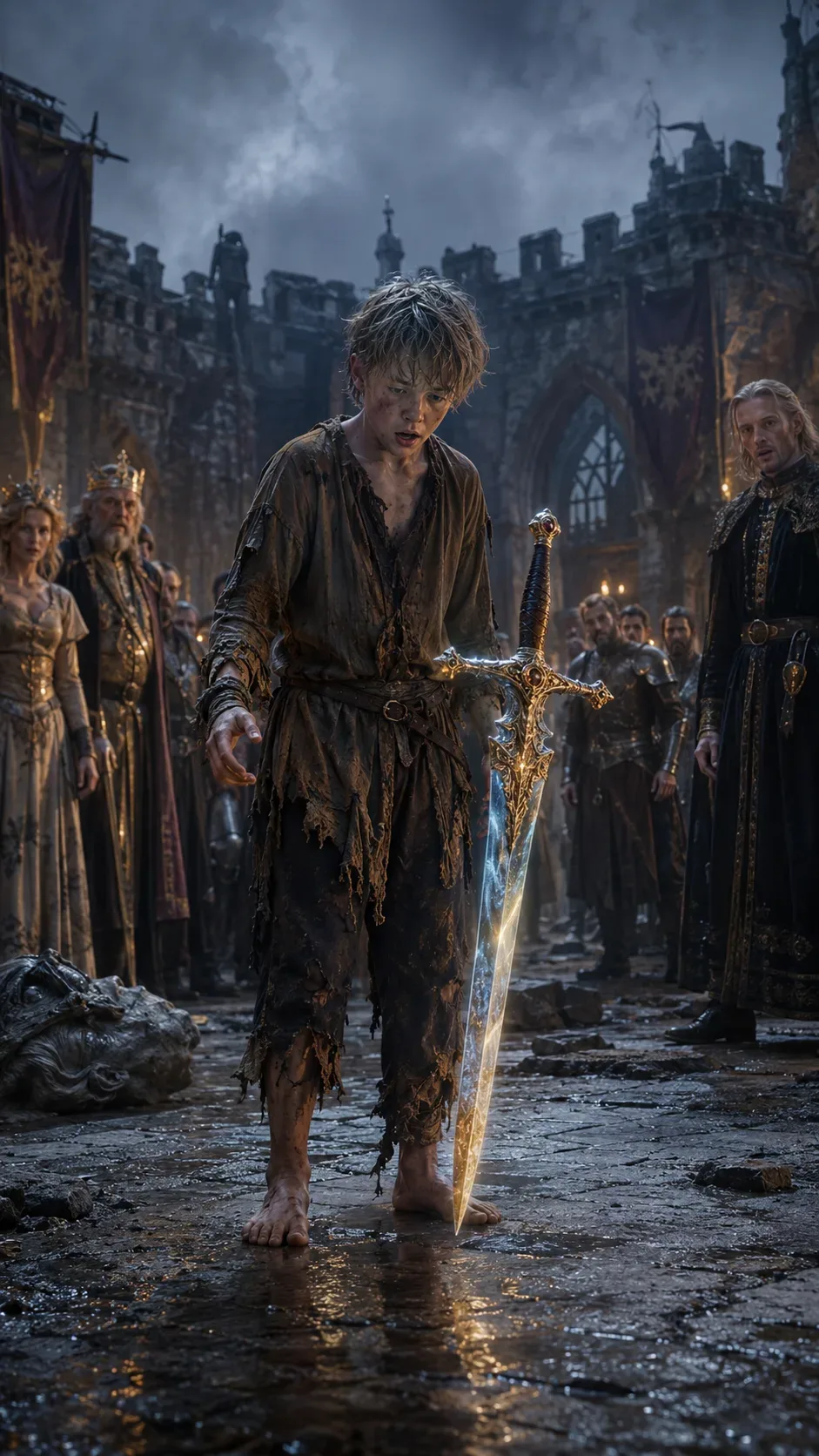
At dawn, the bells of Aldenfall rang for the first time in fourteen years.
Chapter 3
At dawn, the bells of Aldenfall rang for the first time in fourteen years.
Not for a wedding.
Not for a prince’s victory.
For judgment.
The great hall filled with nobles, knights, priests, merchants, and commoners from every street of the capital. The forgotten sword rested across the old marble table, still glowing faintly whenever King Marcellus looked at it.
He stood without his crown.
His royal cloak had been removed.
His rings were gone.
For the first time, he looked smaller than the throne behind him.
Sir Rowan presented the evidence: the queen’s pendant, sealed letters from servants who had vanished after the winter rebellion, records of payments made to Duke Varian’s soldiers, and the sword’s oath burned into the courtyard stone for all to witness.
One by one, the lies fell apart.
The royal nurse had not died in the rebellion. She had escaped with the child and hidden him in the lower city before Marcellus’s men found her. A stable woman
raised Bastian for three years before fever took her. After that, he disappeared into the alleys, nameless and unprotected.
But alive.
The son of King Elias had survived.
Bastian listened from beside Sir Rowan, wearing borrowed clothes that still felt too clean on his skin. Every time someone called him “Your Highness,” he flinched.
He did not feel royal.
He remembered digging through market trash for bread. He remembered guards kicking him away from palace gates. He remembered nobles stepping over him as if he were dirt.
Now those same nobles could not meet his eyes.
Prince Cedric stood apart from his father, pale and silent.
When the final witness finished speaking, the High Priest turned to Marcellus.
“Do you deny these charges?”
Marcellus looked at the sword.
Then at Bastian.
His hatred was still there, but it had nowhere left to stand.
“I did what I had to do,”
Marcellus said. “Elias was weak. He loved peasants more than power. He would have emptied the treasury feeding beggars.”
Bastian’s fingers curled.
Marcellus laughed bitterly. “Look at you. A king’s son raised in filth. Do you think that makes you noble? Blood does not teach rule.”
“No,” Bastian said quietly. “Suffering does.”
The hall fell silent.
Bastian stepped forward.
“My father fed the hungry,” he said. “You hunted a baby because you feared what mercy would do to your throne.”
Marcellus’s mouth twisted. “Mercy makes kingdoms weak.”
Bastian looked toward the open doors of the hall.
Beyond them, hundreds of common people stood in the courtyard, soaked from rain, waiting to know whether anything would truly change.
“No,” Bastian said. “Mercy is why they remember my father. Fear is why they will forget you.”
The High Council declared Marcellus guilty of regicide, treason, and the attempted murder of the rightful
heir.
Duke Varian was stripped of title and lands. His fortune was seized to rebuild the lower city he had spent years abusing. The guards who had carried out the old orders were dismissed and tried by law. The servants who had protected Bastian as a baby were honored by name.
Marcellus was not executed.
Bastian refused it.
Instead, the fallen king was sent to the northern monastery of Greywatch, where rulers who betrayed their oaths lived without crowns, servants, or gold until death.
Before he was taken away, Marcellus looked back at Bastian.
“You will fail,” he said. “They will never love a street rat.”
Bastian looked at the crowd beyond the doors.
Then he looked at the sword.
“I don’t need them to love a street rat,” he said. “I need them to remember why they created one.”
For the first time, Marcellus had no answer.
Three days later, the coronation took place in the same ruined courtyard where Bastian had been mocked.
The broken statues had not been repaired yet. The banners were still torn. The stones still bore the burned words that exposed Marcellus’s crimes.
Bastian asked that they remain.
“Let the kingdom see what happens when truth is buried,” he said.
He wore no heavy gold armor.
Only a simple dark-blue tunic, a silver cloak, and the restored pendant of his mother around his neck.
When the High Priest lifted the crown, Bastian stopped him.
The crowd tensed.
Bastian turned to the street children gathered near the front. Thin boys. Barefoot girls. Faces he recognized from alleys and market corners.
He walked down the steps and knelt before them.
Gasps rippled through the nobles.
A king kneeling to beggars.
Bastian removed a small loaf of bread from the coronation table and placed it in the hands of the youngest child.
“I was not saved by palaces,” he said. “I was saved by people who had nothing and still shared.”
Then he stood and faced the kingdom.
“My first command is this: no child in Aldenfall sleeps hungry again. The royal granaries open tonight. The seized lands of traitors will fund homes, schools, and healers for the lower city. Any noble who calls mercy weakness may surrender his title and leave my court.”
No one moved.
Sir Rowan smiled.
Prince Cedric stepped forward then, shocking everyone.
He removed his ceremonial sword and laid it at Bastian’s feet.
“I was raised to believe the throne belonged to me,” Cedric said. His voice shook. “But it never did. I cannot undo my father’s crimes. I can only refuse to continue them.”
Bastian studied him.
The hall waited.
Finally, Bastian nodded.
“Then earn your place by serving the people your father ignored.”
Cedric bowed.
Not as a prince.
As a man asking for a chance to become better.
The crown was placed on Bastian’s head.
The forgotten royal sword rose beside him, not kneeling now, but standing upright in the air like a guardian.
The people did not cheer at first.
They cried.
Then one voice shouted, “Long live King Bastian!”
Another followed.
Then another.
Soon the ruined courtyard shook with it.
“Long live King Bastian!”
The boy who had entered the courtyard as a thief stood beneath stormlight as a king.
Years later, people would tell the story many ways.
Some said the sword chose him because of his blood.
Some said it chose him because of his courage.
Some said Queen Amara’s spirit guided it through the rain.
But Bastian knew the truth was simpler.
The sword had not turned a street rat into a king.
It had forced the kingdom to see the king it had abandoned.
And under his rule, Aldenfall changed.
The lower city was rebuilt. The orphan houses were warm in winter. Noble courts were opened to common witnesses. No child could be arrested for stealing bread without first being asked why they were hungry.
The burned words in the courtyard stone were never removed.
KINSLAYER.
USURPER.
CHILD HUNTER.
They remained beside a new inscription carved beneath them:
A KINGDOM THAT MOCKS THE HUNGRY WILL ONE DAY KNEEL BEFORE THEM.
On the tenth anniversary of his coronation, King Bastian returned alone to the courtyard at dusk.
The sword rested in his hand.
Rain mist floated through the broken arches, just as it had the night everything changed.
He looked at the place where he had once stood barefoot and trembling while nobles laughed.
Then he smiled softly.
Not because the pain was gone.
Because it no longer owned him.
Behind him, children from the royal school ran laughing across the wet stones, their coats warm, their bellies full, their futures no longer decided by the streets they came from.
Bastian watched them until the last torch was lit.
Then he turned back toward the palace.
This time, the gates opened for him.
And no one in Aldenfall ever called him a street rat again.
THE END
Chapter complete
You have reached the end of this chapter.
Continue reading
A few more worlds to get lost in after this chapter.




