I noticed the tie first.
Chapter 1
I noticed the tie first.
It was lying across the white marble counter beside the fruit bowl, folded exactly the way Julian liked it, the narrow end tucked beneath the wide end so it would not crease before he put it on.
Navy silk.
Silver diagonal stripe.
I had chosen it for him the night before because he said the blue made him look trustworthy on camera.
Trustworthy.
I stood barefoot in our penthouse kitchen with one hand on the espresso machine and watched coffee drip into a white porcelain cup I had bought in Florence during the first year of our marriage. Back then, Julian still called me from airports. He still sent photos of hotel windows and conference rooms and badly plated business dinners. He still said, “I wish you were here.”
Now he sent calendar invites.
At the far end of the kitchen, the city sat under a pale morning haze. Downtown
glass towers caught the first thin light. Everything looked expensive and clean. That was the trick with Julian’s world. It made damage look like design.
My phone vibrated beside the cup.
Unknown number.
I almost ignored it.
Julian’s schedule was already open on the screen because I had been checking the time of the Q3 shareholder meeting. Ten o’clock. Sterling Empire Grand Auditorium. Five hundred investors, board members, senior directors, select press, internal recording crew.
The meeting of the year.
The meeting Julian had been rehearsing for in front of our bedroom mirror for three weeks.
I tapped the message.
No greeting.
No name.
Just a video file.
Below it, one sentence.
“So you can see what your husband really does on his strategic business trips.”
The espresso machine hissed once, then stopped.
I did not move.
For a few seconds, the screen only showed a blurred thumbnail of a
hotel room. Tall windows. Cream curtains. Warm lamps. A bed in the corner with white sheets pulled loose. There was a man near the window, his shirt unbuttoned at the collar, his tie hanging from one hand.
My finger pressed play.
The man turned.
Julian.
My Julian.
The CEO everyone called disciplined, polished, inevitable.
He laughed at something the woman said off camera. Not a polite laugh. Not the restrained one he used at galas when donors told old jokes. This was careless. Young. Private.
Then she stepped into frame.
Blonde hair. Red nails. A silk robe slipping from one shoulder.
Vanessa Hale.
Director of Corporate Communications.
The woman who had written Julian’s speech about integrity.
The woman who had sat across from me at last month’s Sterling gala and said, “Claire, you must be so proud to be married to a man who carries legacy so gracefully.”
She had
hugged me after that.
Her perfume had stayed on my dress until I sent it to the cleaner.
I watched the video once.
Then again.
Then a third time.
Not because I needed proof.
Because some things have to be seen more than once before the body accepts them.
The master bathroom shower turned off.
I locked the phone.
My coffee sat untouched. A thin skin of foam shifted on top.
Julian came out twelve minutes later in a white shirt and dark trousers, hair still damp, jaw freshly shaved. He looked like the man on magazine covers. He looked like the man my mother used to point to with quiet relief after the wedding and say, “At least you’ll never have to fight alone.”
She had been gone four years.
She did not get to see this morning.
Julian picked up the navy tie and looked toward me through the reflection in the glass cabinet.
“Big day,” he said.
His voice was easy.
That was the first real cut.
Not the video. Not Vanessa. Not the hotel room.
The ease.
A man can betray you and still look guilty. Julian looked rested.
I crossed the kitchen and took the tie from his hand.
He smiled.
“You’re quiet.”
“Thinking.”
“About?”
I looped the silk beneath his collar. My fingers did not shake.
“Your speech.”
He gave a satisfied little nod. “Good. I changed the opening last night. Less numbers. More vision.”
“Vision matters.”
He looked at himself in the cabinet glass.
“It does today.”
I tightened the knot. Perfect triangle. Smooth fabric. No crease.
His phone buzzed on the counter. He glanced down, then turned it over.
Too fast.
I saw only one letter before the screen went dark.
V.
His hand stayed on the phone for half a second.
Mine stayed on his tie.
“Ready?” he asked.
“Yes.”
He leaned forward and kissed my forehead.
I stood still.
He smelled like cedar soap and the expensive hotel shampoo he claimed he hated because it dried his scalp.
At 8:03, my phone vibrated again.
Same unknown number.
“If you have any dignity, file for divorce quietly before the meeting. Julian has already chosen.”
I stared at the message until the words stopped moving.
Then I typed six words.
“Thanks for the heads up, Vanessa.”
No response came.
That told me enough.
Julian was in the bedroom checking his cufflinks when I picked up my bag.
“I’m leaving early,” I said.
He did not turn.
“Have Marcus bring the car around?”
“I’ll drive myself.”
That made him glance over.
Only briefly.
“Suit yourself. Sit near the back today, okay? Cameras might pan across the front rows.”
Optics.
He did not say the word, but I heard it anyway.
I had been trained in optics for seven years. Where to stand. How to smile. Which charities to mention. When not to correct his mother. How to look supportive without looking ambitious.
Victoria Sterling had taught me the family rules with a pearl necklace at her throat and a knife tucked somewhere behind every compliment.
“Claire, dear, wives in our circle don’t compete with their husbands.”
“Claire, investors like stability. Don’t wear anything too bold.”
“Claire, your father’s company was charming, but Sterling Empire saved it from irrelevance.”
That last one had stayed.
My father had built Rowan Systems from a borrowed warehouse, three engineers, and a lunch table with one broken leg. Sterling Empire had acquired it after his stroke, during those ugly months when hospital bills came faster than legal advice. The contract had looked generous. The language had looked clean.
Arthur Bell had warned me.
My father’s old advisor.
I was twenty-two then, standing in a conference room too large for me, signing documents because my father could no longer hold a pen steady and Julian’s family promised protection.
Protection came with polished teeth.
By the time I understood what had been taken, my father was dead and the Rowan name was gone from every subsidiary report.
Julian told me not to dwell.
“Business is consolidation,” he had said. “Don’t make grief into strategy.”
That morning, I drove myself to Sterling headquarters with Vanessa’s message open on the passenger seat.
The building rose out of downtown like black glass sharpened into a blade. The Sterling name sat above the lobby in silver letters. Men in suits crossed the plaza with coffee cups and leather briefcases. A camera crew unloaded equipment near the side entrance.
I bypassed the main lobby.
My access card still worked in the private garage because, on paper, I was chair of the Sterling Family Cultural Foundation. A decorative title. Useful for charity luncheons. Harmless.
Nobody stopped a harmless woman.
The elevator opened on the fourteenth floor.
Arthur Bell’s office sat at the end of the west corridor behind a heavy oak door that looked older than the building. He was not a Sterling, which meant the Sterlings never fully trusted him. But they needed him. He knew where the original documents were buried. He knew which signatures mattered. He knew who had lied before the lie became official.
His assistant stood when she saw me.
“Mrs. Sterling—”
“I need five minutes.”
She looked toward the closed door.
“He’s reviewing—”
I opened it anyway.
Arthur was at his desk with a stack of binders and a fountain pen in his right hand. He was fifty-eight, silver-haired, lean, always dressed as if court might begin at any moment. He looked up, annoyed at first.
Then he saw my face.
“Claire.”
I shut the door.
He placed the pen down.
“What happened?”
I took out my phone, walked to his desk, and played the video.
He watched it in silence.
The room made small sounds around us. The old clock on his wall. The distant elevator chime. A vent clicking open.
When the video ended, Arthur did not speak for several seconds.
He removed his glasses and folded them.
“Who sent this?”
“Vanessa.”
“You’re certain?”
“She wanted credit.”
His mouth hardened.
“Of course she did.”
I locked the phone.
“I need backdoor access to the main auditorium projector.”
Arthur looked at me for a long time.
“No.”
I expected that.
“I’m not asking as Julian’s wife.”
“That makes it worse.”
“I’m asking as my father’s daughter.”
That changed the room.
Only slightly.
Arthur leaned back. His eyes moved to the framed photograph on his bookshelf. My father in a gray suit, laughing with one hand on Arthur’s shoulder outside the original Rowan Systems building.
“He would not want you destroyed by this family,” Arthur said.
“He already was.”
Arthur’s jaw flexed.
“I warned him about the acquisition.”
“I know.”
“I warned you.”
“I know that too.”
He looked back at the phone in my hand.
“If you do this today, Julian falls publicly. Vanessa falls with him. Victoria will come after you with everything she has.”
“She already took everything she could reach.”
“No,” Arthur said. “She took what you allowed her to take because you were young, grieving, and married to her son. That is not everything.”
The words landed without softness.
He opened the top drawer and took out a black access card.
Still, he did not hand it to me.
“Claire, there is another way. Quiet legal proceedings. Private leverage. Board pressure. We can remove him without spectacle.”
“That’s what Vanessa told me to do.”
Arthur stopped.
I held his gaze.
“She told me to divorce him quietly.”
The card slid across the desk.
The sound was small.
It felt final.
At 8:34, Arthur called the head technician from a secure line and asked him to come upstairs with his laptop. He did not explain over the phone. Men like Arthur knew better than to leave emotion in records.
The technician arrived three minutes later, young, nervous, carrying a tablet and a bottle of water he never opened.
His name was Caleb. I remembered him from last year’s holiday event because he had spent twenty minutes fixing Victoria’s microphone while she complained about “invisible staff.”
Caleb looked at me, then at Arthur.
“Is there a problem with the Q3 file?”
Arthur stood.
“There is now.”
We did not use the full video.
I insisted on that.
No graphic humiliation. No spectacle of bodies. No giving Vanessa exactly the kind of filth she thought would break me.
Caleb extracted still frames and a short blurred sequence: the hotel room, Julian’s face clear enough, Vanessa’s profile clear enough, the tie, the timestamp, the internal travel booking confirmation, the corporate card charge at the hotel, and Vanessa’s own message telling me to divorce him quietly.
Evidence.
Not pornography.
Not revenge for clicks.
A record.
Arthur added one more file.
A scanned memo from two years earlier, signed by Julian, approving Vanessa’s promotion to Director of Corporate Communications three days after a “strategic retreat” in Miami.
I looked at him.
“You had this?”
“I had questions.”
“You never told me.”
“You were still trying to survive the marriage.”
That was the first sentence that almost broke my face.
Almost.
Caleb’s hands moved quickly over the laptop. He swapped the original montage file in the auditorium queue with our edited reel. He renamed it exactly as Vanessa had named hers.
Q3_Strategic_Montage_Final_FINAL_v6.
I stared at the filename.
“She really named it that?”
Caleb swallowed.
“Yes, ma’am.”
I laughed once.
Dry. Small. Wrong in the room.
Arthur looked at me.
“You can still leave.”
“No.”
“You don’t have to watch.”
“I do.”
At 8:57, I entered the Grand Auditorium through the rear doors.
The room was already half full.
Rows of investors in dark suits. Board members speaking in low voices. Assistants placing folders on chairs. Camera operators checking angles. The giant screen behind the podium still displayed the Sterling Empire logo, silver on black.
No one turned when I walked in.
That was useful.
I took a seat in the back row, slightly right of center. From there, I could see the podium, the side entrance, the front row where Victoria would sit, and the technical booth above the rear doors.
Caleb did not look at me.
Good.
My phone rested in my lap.
The black access card sat inside my bag like a second pulse.
At 9:12, Victoria arrived.
She wore ivory. Of course she did. Ivory suit, pearl earrings, hair swept back, a diamond brooch shaped like a small bird pinned near her collarbone. She greeted three board members with the same smile she used for donors and funeral directors.
Then she saw me.
Her eyes moved over my cream blouse, my dark trousers, my empty hands.
No jewelry except my wedding ring.
She turned away.
A verdict.
At 9:26, Vanessa entered through the side doors.
Red dress.
Not burgundy. Not wine. Red.
The kind of red meant to be noticed by men who liked to pretend they did not notice such things.
She carried a slim tablet against her chest and walked with the calm of someone who believed the room belonged to the man who belonged to her.
When her eyes found me, she paused.
Only one step.
Then she smiled.
Not wide enough for anyone else to see.
Enough for me.
I did not smile back.
Her chin lifted, and she went to speak with Julian’s chief of staff near the stage.
At 9:40, Julian walked in.
Applause started before he reached the podium.
He had that effect on rooms. He knew how to let admiration arrive before he did. He shook hands. Touched shoulders. Remembered names. Tilted his head at older investors. Laughed at quiet jokes. Looked serious whenever someone mentioned market volatility.
He was performance made flesh.
I watched him kiss Victoria’s cheek.
Watched Vanessa adjust the corner of his cue card stack.
Watched his fingers brush hers.
Fast.
Careless.
Public if you knew where to look.
I knew.
The auditorium lights dimmed at 10:00.
Julian stepped onto the stage.
“Good morning, everyone.”
The room settled around his voice.
It was a beautiful voice. That had been one of the first things I loved about him. It could make an apology sound like a promise. It could make a lie sound like weather.
He began with gratitude.
Then vision.
Then legacy.
He spoke of Sterling Empire’s discipline in uncertain markets, its commitment to innovation, its unwavering leadership standards. Cameras recorded him from three angles. Investors nodded. Board members turned pages in the printed deck.
Victoria watched her son with open pride.
Vanessa stood near the side of the stage, tablet in hand, her expression polished into admiration.
I sat in the back.
Still.
Every few minutes, Julian glanced toward the audience, but never at me. He looked over me. Through me. Past me.
That, too, was useful.
By the twenty-third minute, he reached the section Arthur had marked in his printed copy.
Communications Overview.
Vanessa shifted her weight.
Julian smiled.
“Before we move into the Q3 performance breakdown,” he said, “our Communications team has prepared a short strategic montage.”
His hand lifted toward the screen behind him.
Vanessa’s mouth curved.
The investors adjusted in their seats.
Julian turned slightly, showing his best side to the center camera.
“This piece reflects not only where Sterling Empire has been,” he said, “but where we are going.”
My thumb touched the side of my phone.
Not a button.
Just the edge.
The lights dimmed further.
The screen went black.
For one breath, the auditorium held nothing but projector hum.
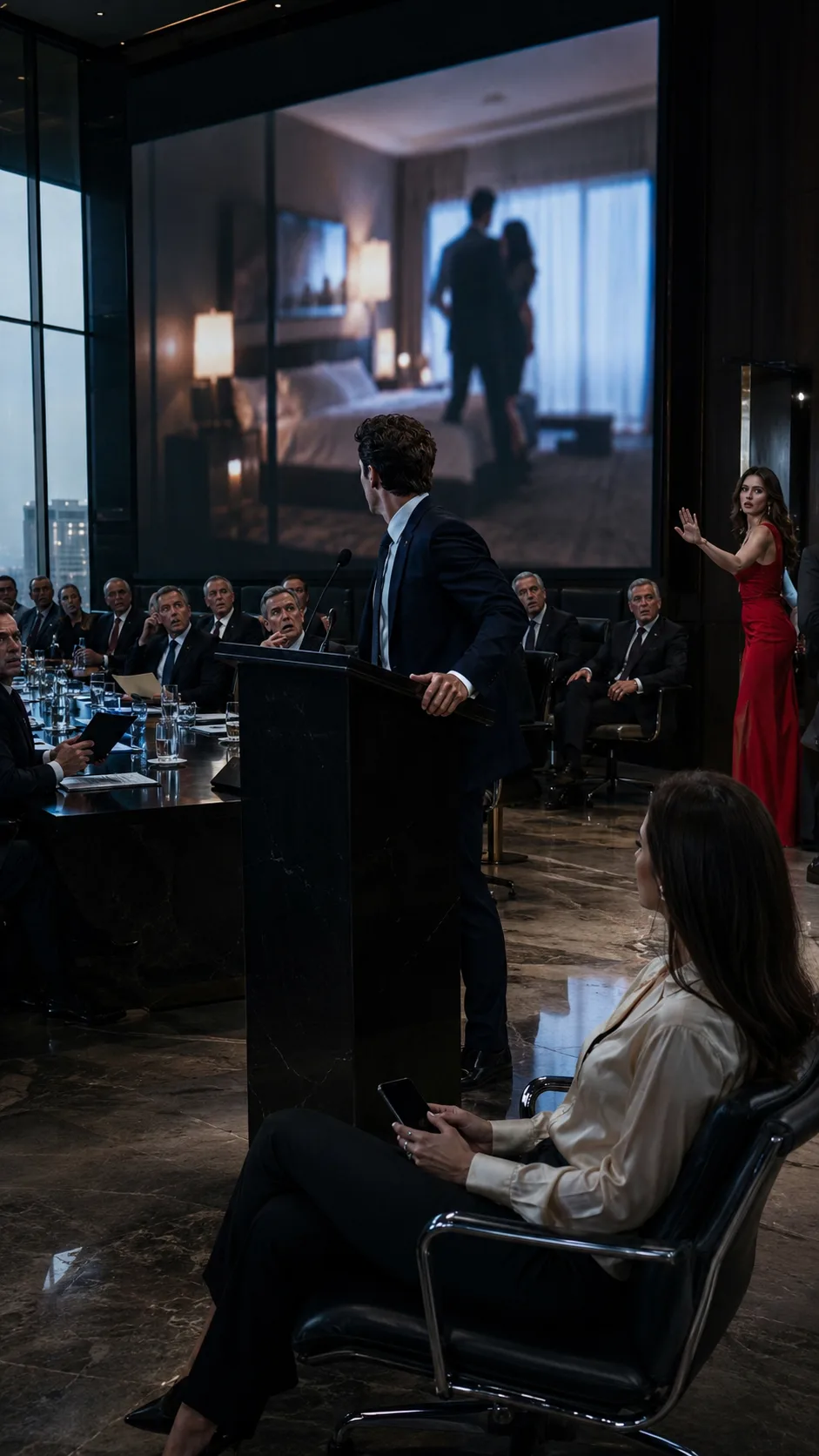
Then the first image appeared.
A hotel room.
Tall curtains.
Cream walls.
Warm lamps.
The blue tie on the floor.
Julian did not move at first.
The room did not understand quickly. Rooms like that resist scandal. They try to make every image into a chart, every surprise into a technical error.
Then Julian’s face appeared on the screen.
Clear.
Laughing.
Unbuttoned collar.
Vanessa’s profile moved into frame beside him.
A glass fell somewhere near the front row. It hit carpet, so it did not shatter. It rolled beneath a chair with a dull little sound.
Julian turned toward the screen.
His hand gripped the podium.
The next image appeared.
Vanessa’s text message.
“If you have any dignity, file for divorce quietly before the meeting. Julian has already chosen.”
The words were enlarged across fifty feet of wall.
Readable from every seat.
The room changed.
Not loudly.
That came later.
First came the silence of calculation. Investors leaning forward. Board members looking at one another. Assistants freezing with pens in hand. The camera crew lowering one lens, then raising it again because nobody had told them to stop recording.
Victoria stood.
Not fully.
Just enough for her pearls to shift.
“Julian,” she said.
Her voice did not carry to the microphones, but I saw his name form in her mouth.
Vanessa rushed two steps toward the technical booth.
“Cut it,” she snapped.
The microphone on Julian’s podium caught her voice.
Everyone heard it.
That made it worse.
Caleb did not cut it.
The next slide appeared.
Corporate travel receipt.
Hotel booking.
Executive account charge.
Timestamp.
Then the promotion memo.
Vanessa Hale — Director of Corporate Communications.
Signed: Julian Sterling.
Date: three days after Miami.
A board member in the second row closed his folder.
That sound carried more weight than shouting.
Julian turned from the screen to the room.
“There has been a technical error,” he said.
His voice cracked on “technical.”
No one helped him.
Vanessa looked at him then. Not at the screen. Not at the investors. At him. Her face asked for rescue.
He did not move toward her.
That was the kind of man he was.
A woman could help him burn the house down, but if smoke filled the room, he would point to the match in her hand.
The screen went black.
Caleb had ended the file exactly where I asked him to.
No more.
No less.
Julian swallowed.
“Ladies and gentlemen,” he said, “I apologize for this inappropriate breach. We will investigate immediately.”
Arthur stood from the aisle seat near the rear.
He had entered sometime after the meeting began. I had not seen him. That was like Arthur.
“No need,” he said.
The room turned.
Arthur walked down the aisle slowly, a black folder in one hand.
Julian’s face changed.
It was small. A tightening around the eyes. A loss of blood beneath the skin.
“Arthur,” he said.
Arthur reached the front row and handed the folder to the independent board chair, Margaret Voss, a woman with silver hair and no fondness for public embarrassment unless it served governance.
Margaret opened it.
Read the first page.
Then the second.
Victoria stepped toward her.
“Margaret, this is a family matter.”
Margaret did not look up.
“No, Victoria. It appears to be a board matter.”
That was when the room began to breathe again.
Whispers spread row by row.
“Corporate funds?”
“Promotion approval?”
“Was compliance aware?”
“Is the recording still running?”
Julian’s hand left the podium.
He looked toward Vanessa.
She had stopped near the side door, one hand braced against the wall, the red dress bright against the dark wood paneling. Her mouth opened as if she might speak, but the room no longer belonged to her words.
Then Julian saw me.
Finally.
Back row. Cream blouse. Phone in hand.
For seven years, he had looked at me as if I were part of the room.
A chair.
A lamp.
A wife.
Now he saw a person.
“Claire,” he said.
The microphone carried it.
Every head turned.
I stood.
Not fast.
My legs felt steady under me, though I could feel my pulse in my wrists.
I walked down the center aisle.
No one spoke.
The floor reflected the overhead lights in long white strips. My heels sounded too loud. Somewhere to my left, an investor moved his chair back to give me space.
Julian watched me approach with the stunned concentration of a man watching an elevator cable snap.
I stopped ten feet from the podium.
Not beside him.
Not beneath him.
In front of him.
He stepped away from the microphone.
“This isn’t what you think,” he said.
A few people heard. Enough.
I looked at the screen, now black behind him.
Then at Vanessa.
Then back at Julian.
“I think you brought your mistress into the company, promoted her, used corporate funds to support the affair, let her threaten your wife before a shareholder meeting, and then expected me to sit in the back for optics.”
The words did not come out loud.
They did not need to.
The microphone picked up every one.
Julian’s mouth tightened.
“Claire, stop.”
There it was.
Not an apology.
An instruction.
I removed my wedding ring.
The room was so quiet I heard the small scrape of metal against skin.
Victoria’s hand flew to her throat.
Julian stared at the ring in my palm.
“Don’t do this here,” he said.
I placed the ring on the podium.
“Where would you prefer?” I asked. “A hotel room?”
Someone in the back made a sound and covered it quickly.
Vanessa’s face went hard.
“You had no right to use private material.”
I turned to her.
She should have stayed quiet.
She had built a career telling powerful people what not to say in public. Panic had made her forget her own profession.
“You sent it to me.”
Her lips parted.
I held up my phone.
“Along with instructions.”
Margaret Voss closed Arthur’s folder.
“Mr. Sterling,” she said, “step away from the podium.”
Julian looked at her as if she had spoken in another language.
“I am the CEO.”
“For the next ten minutes, perhaps.”
Victoria moved then, sharp and furious.
“This is absurd. My son built—”
Arthur cut her off.
“Your son inherited leverage and confused it with competence.”
The front row went still.
Victoria turned on him.
“You have waited years to say that.”
“Yes,” Arthur said. “I have.”
Margaret signaled to security near the side wall.
Not to drag anyone out.
Not yet.
Just to stand closer.
That was enough.
Julian looked around the room, searching for loyalty. He found risk assessments instead. Men who had praised him over lunch now looked at their legal counsel. Women who had smiled at Vanessa over cocktails now looked at the screen as if it might produce more evidence.
Power can empty quickly when liability enters the room.
Julian stepped down from the podium.
One step.
Then another.
Vanessa moved toward him.
He did not take her hand.
That broke something in her face more cleanly than the screen had.
“Julian,” she said.
He kept his eyes on Margaret.
“I want counsel present.”
“You should,” Margaret said.
The internal cameras were finally shut off.
The red recording light disappeared.
The room still felt recorded.
Victoria came toward me.
Her heels struck the floor with old authority.
“You stupid girl.”
There she was.
Not the polished matriarch. Not the charity chair. Not the mother of a visionary. Just a woman whose kingdom had been scratched in front of witnesses.
I met her halfway.
She lowered her voice.
“You have no idea what you’ve done.”
“For once,” I said, “I do.”
Her eyes moved to my bare hand.
“You will regret humiliating this family.”
I looked toward the black screen.
“No. I regret protecting it.”
Arthur came to stand beside me, not too close, not shielding me. Just present.
Margaret stepped back to the microphone.
“This meeting is suspended pending emergency board review.”
The gavel sound came from nowhere official. Just her ring tapping the table once.
It ended the performance.
The room broke apart.
Not chaos. Worse.
Orderly retreat.
Investors gathered folders. Assistants whispered into phones. Board members clustered in corners. Security escorted Vanessa toward a side hall after she tried to approach Caleb in the technical booth. Julian stood near the stage with two lawyers already forming around him like a wall.
He looked smaller without the podium.
That surprised me.
I had spent years making him large in my mind.
He was only a man in a navy suit with a ring on the podium and no speech left.
I walked out before anyone could ask me for a statement.
Arthur followed me into the corridor.
The door closed behind us, cutting off the murmurs.
For the first time that morning, my hands shook.
Not much.
Enough.
Arthur saw. He did not comment.
We stood beside a wall of framed Sterling history: factory openings, ribbon cuttings, black-tie galas, smiling men beside larger smiling men. My father was not in any of them.
I touched the empty place on my finger where the ring had been.
The skin beneath it was pale.
Arthur looked at it too.
“There will be calls,” he said.
“I know.”
“Legal pressure.”
“I know.”
“Media.”
“I know.”
He nodded once.
Then he handed me another folder.
I did not take it immediately.
“What is that?”
“Copies of the original Rowan Systems acquisition documents. The ones your father’s attorney should have received and did not.”
The corridor seemed to narrow.
Arthur’s face stayed composed, but his hand held the folder tighter than before.
“I found them six months ago,” he said. “I was waiting for the correct moment.”
I looked back toward the auditorium doors.
Behind them, Sterling Empire was rearranging itself around the wound.
“This is the moment?”
Arthur’s eyes softened in a way I had never seen.
“No. This is the first one.”
I took the folder.
It was heavier than I expected.
By noon, Julian’s statement went out.
He called the incident a malicious breach of privacy and announced he would temporarily step back while the board reviewed “mischaracterized personal matters.”
By one, three investors had requested emergency governance calls.
By three, Vanessa’s company email stopped working.
By five, Victoria called me seventeen times.
I did not answer.
At 6:40, I returned to the penthouse.
The city looked different from the windows. Not kinder. Not freer. Just less owned by him.
Julian’s tie was no longer on the counter.
The coffee cup from the morning was still there, untouched, a brown ring dried at the bottom.
I picked it up and carried it to the sink.
For a while, I stood there with the water running.
Then I turned it off.
My phone lit up again.
Julian.
This time, I answered.
He breathed once into the line.
“Claire.”
I said nothing.
“You don’t understand what you’ve started.”
I looked at the folder Arthur had given me, now lying on the kitchen counter beside the place where his tie had been.
“I’m starting to.”
“We can fix this.”
I almost smiled.
There it was again.
We.
A word men like Julian used when consequences finally arrived.
“No,” I said.
His voice lowered.
“After everything I gave you?”
I looked around the penthouse. The marble. The glass. The art chosen by designers. The wedding photo in a silver frame near the hallway, both of us smiling like people in an advertisement for a life we did not have.
“You gave me a seat in the back.”
Silence.
Then his voice sharpened.
“You’ll be alone.”
I picked up the wedding photo and laid it face down.
“Good.”
I ended the call.
That night, I slept in the guest room because the master bedroom still smelled like his cedar soap.
Not well.
But enough.
The next morning, I met Arthur at my father’s old warehouse.
It was no longer Rowan Systems. Sterling had turned it into storage for obsolete hardware and archived promotional displays. Dust sat on the windowsills. Someone had left a broken office chair near the entrance, one wheel missing.
A lunch table with a scratched metal edge still stood near the back wall.
Arthur noticed me looking at it.
“Your father refused to throw that out.”
“He said it reminded him not to become expensive furniture.”
Arthur almost smiled.
We opened the folder on that table.
Page by page.
Signature by signature.
Clause by clause.
The theft had not been dramatic. That was the ugliest part. It had been done with clean margins, polite emails, missing disclosures, a valuation adjusted during a medical emergency, and one board consent form my father never saw.
Julian had not built Sterling Empire.
His family had perfected the art of taking things from people too tired to fight.
I placed both hands flat on the table.
The metal was cold.
Arthur waited.
Outside, traffic moved beyond the old loading doors. Inside, dust floated through a strip of morning light.
I thought about the video.
Vanessa’s smirk.
Julian’s blue tie.
Victoria calling me stupid.
The screen turning on.
The room finally seeing what I had been living beside.
Then I thought of my father, hunched over circuit boards in this warehouse, eating noodles from a paper cup because payroll mattered more than dinner.
I closed the folder.
“What happens now?” Arthur asked.
I looked at the old Rowan Systems sign leaning against the wall, half-covered by a tarp.
The letters were faded.
Still readable.
“Now,” I said, “we put my father’s name back where it belongs.”
Chapter complete
You have reached the end of this chapter.
Continue reading
A few more worlds to get lost in after this chapter.




