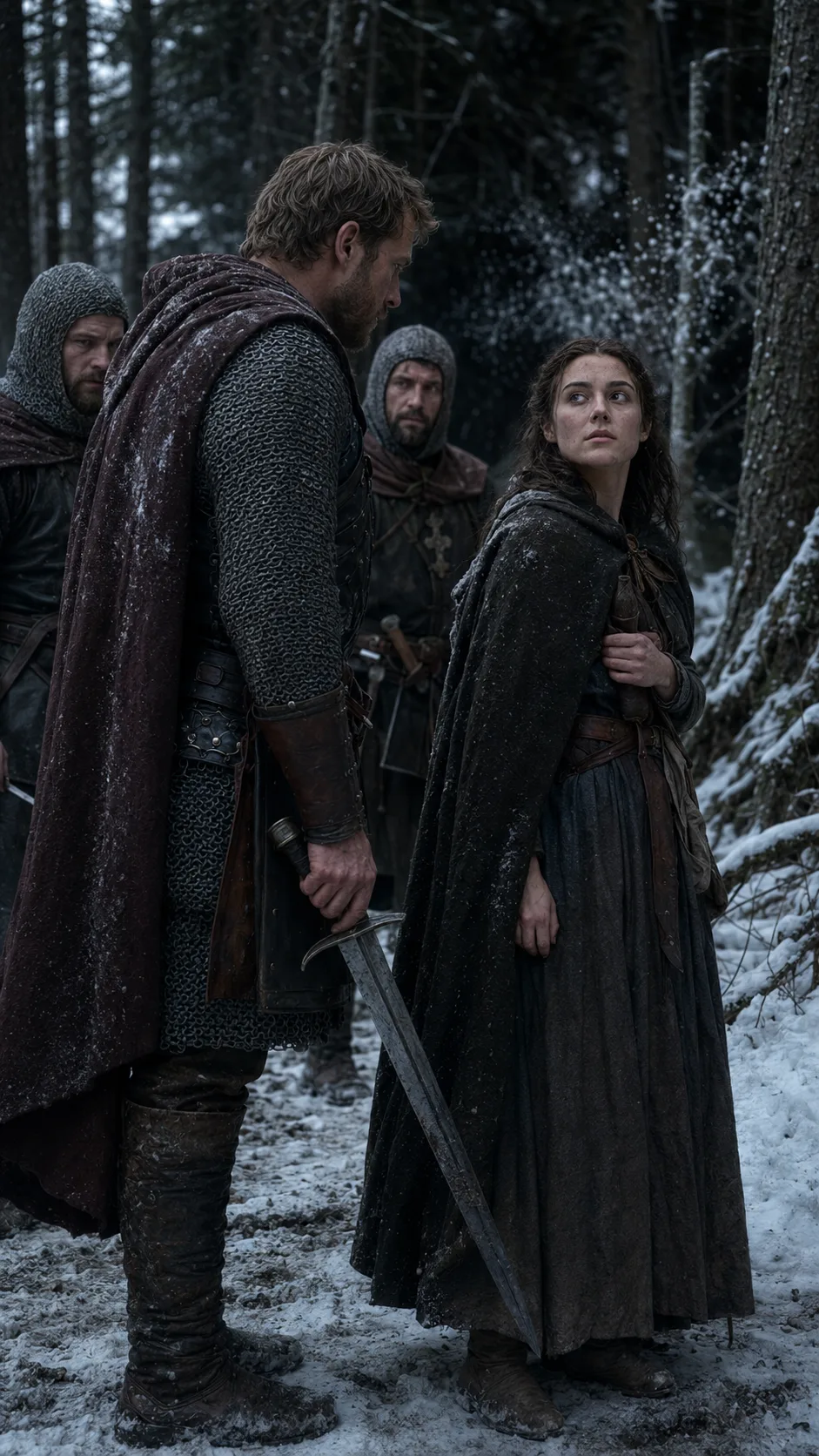
Mairead kept one hand under her cloak and the other pressed against the bark of a black pine while the horses passed below the ridge.
Chapter 1
Mairead kept one hand under her cloak and the other pressed against the bark of a black pine while the horses passed below the ridge.
There were four of them on the road.
English.
She could tell before she saw the cross stitched into the wet cloth at the shoulder of the nearest rider. She could tell by the way they rode, spread loose and careless, as if the winter road belonged to them because nobody had yet made them bleed for using it.
The snow had hardened during the night. Every hoofbeat cracked through the crust and carried too far between the trees. Mairead held her breath until the sound faded south, then waited longer.
A raven landed above her.
It did not call.
That bothered her more than the riders.
The old women in her village used to say ravens grew noisy when death came near. Mairead had stopped believing most old-women things after she watched English fire take the roofs off two homes and leave the saints on the church wall untouched.
But the raven was silent, black against the white sky, and its head followed her when she moved.
She eased herself down from the ridge and checked the knot beneath her cloak.
The message pouch was still there.
Small. Greased leather. Tied flat against her ribs with a strip of linen so it would not swing when she ran. Inside was a folded strip of lambskin, sealed once in dark wax and then wrapped again in cloth. She had not read it. She had been told not to read it.
“North,” Ewan had said when he put it in her hand before dawn. “Past the Forth. Not the bridge road. Not the open road. The forest.”
He had been bleeding through his sleeve when he said it.
Mairead had looked at the blood before she looked at the pouch.
“Who is it for?”
Ewan had shut her fingers around the
leather. “A man who still remembers what he promised.”
That was all.
By noon, she had stopped asking herself why he had chosen her. Men chose girls like her for errands because girls like her were easy to overlook. A shepherd’s daughter. A widow’s niece. A woman with no clan banner flying above her, no husband beside her, no brother left to speak her name loudly in a hall.
That made her useful.
That also made her disposable.
She moved north through the trees, keeping off the white open places where footprints could betray her from a hilltop. Her boots were damp. Her left heel had split where the leather bent. Every few hundred steps, she tucked her fingers under the pouch, not to check if it was there anymore, but because touching it reminded her she had not yet failed.
The forest deepened after midday.
The pines grew closer
together. Their trunks stood black and wet, patched with snow, like old men in torn cloaks. The air changed under them. The wind dropped. Sound narrowed.
Even her own steps began to feel too loud.
She found the first sign near a frozen burn.
A strip of red wool caught on a thorn.
Mairead crouched.
It was not hers. The weave was finer than anything she owned, and one end had been cut clean with a blade. She looked up through the trees. No movement. No breath. No horse.
She should have left it.
Instead, she reached out and freed the cloth from the thorn.
A twig snapped behind her.
Mairead ran.
She did not turn to see who had made the sound. Turning wasted time. She crossed the burn in two steps, slipped on the far bank, caught herself with one hand in the snow, and kept moving.
“Girl!”
The voice came from behind her.
Too close.
Another voice laughed. “She runs like a hare.”
Mairead drove herself between the pines. Branches scratched her cheek. Snow fell down the back of her neck. The pouch slammed once against her ribs, and pain flashed through her side.
Three men.
She could hear three sets of boots now. One heavy and steady. One uneven, cursing when roots caught him. One fast enough to make her change direction twice.
They were not riders anymore. They had left the horses.
That meant they wanted her badly enough to come into the trees.
Or they thought she was easy enough to catch.
The forest dipped, then rose toward a tangle of stone and roots where the old path vanished beneath snow. Mairead knew that place. Everyone near the Forth knew of it, though few entered it after dusk. The pines there were older, packed tight around a hollow where the snow never lay smooth for long.
Her grandmother had called it the Watcher’s Ground.
Mairead had laughed at that when she was twelve.
She did not laugh now.
A hand caught the back of her cloak.
She twisted out of it, tearing the wool at the collar, but the motion cost her speed. The heavy-footed soldier came around the left side of a pine and blocked the narrow gap ahead.
He was tall. Broad through the shoulders. Chainmail showed under a dark leather jerkin, wet with snow. His beard was pale at the chin where frost clung to it. His sword was already drawn, but he held it low, with the confidence of a man who did not need to raise it yet.
Mairead stopped.
Behind her, the other two soldiers closed in.
One had a split lip and a red scarf tied around his wrist. The same red wool she had found at the burn. The other was younger, narrow-eyed, breathing through his mouth, holding a short blade as if he wished it were longer.
The tall one looked Mairead up and down.
Not quickly.
That was the part she hated.
His eyes stopped at the place where her hand had gone beneath her cloak.
“There,” he said.
The soldier with the red scarf stepped forward. “Told you she was carrying something.”
Mairead kept her hand flat over the pouch.
The tall soldier smiled.
“Name.”
She said nothing.
He raised the sword slightly, not toward her face, but toward the torn edge of her cloak. With the tip, he lifted the wool away from her side.
Mairead stepped back.
The younger soldier moved behind her.
No road.
No village smoke.
No sound of horses now.
The forest had swallowed everything except their breathing.
“Name,” the tall soldier said again.
“Mairead.”
“Pretty.”
She watched his sword hand, not his mouth.
He noticed.
“You know what happens to girls carrying messages in war?”
The red-scarf soldier laughed once. “Same thing that happens to boys carrying them.”
The tall soldier did not laugh. He looked past her shoulder, checking the trees behind her, then the spaces between the trunks.
Nobody came.
That satisfied him.
He stepped closer.
Mairead could smell wet leather, iron, and the sour ale on his breath.
“Give me what you’re carrying.”
“No.”
The word came out before she could stop it.
The younger soldier behind her made a small sound through his teeth. The red-scarf one shifted his grip on his blade.
The tall soldier’s smile thinned.
“No?”
Mairead’s fingers pressed harder against the pouch.
He leaned down, close enough that his shadow cut across her face.
“You’ve been running north with something under your cloak, through woods no decent girl enters alone, and you think no is still yours to use?”
She did not answer.
A faint creak moved through the trees behind him.
All three soldiers missed it.
Mairead did not.
The tall one lifted his free hand, slow, as if he meant to brush snow from her shoulder. She knew that kind of slowness. Men used it when they wanted fear to arrive before pain.
She moved her shoulder away.
His hand stopped in the air.
The forest went still.
Too still.
Even the raven was gone.
The tall soldier looked at her hand again.
“Last chance.”
Mairead swallowed. Her throat had gone dry from running, but her voice came out level.
“You should leave.”
For the first time, his face changed.
Not fear. Not yet.
Insult.
The red-scarf soldier barked a laugh. “Hear that? She warns us.”
The younger one shifted behind her. “Maybe there are more of them.”
The tall soldier glanced at him, and the boy shut his mouth.
Then the tall soldier stepped close enough that Mairead had to tilt her head to keep his face in view.
“No one knows you’re here, girl.”
He said it with care.
As if each word was a stone placed on the lid of a grave.
Mairead did not look at him.
She did not look at the sword.
She looked past his shoulder.
Into the trees.
The tall soldier followed her eyes halfway, then stopped himself, annoyed that she had made him move.
“What?”
Mairead’s hand loosened slightly over the pouch.
Behind him, a branch trembled.
There was no wind.
A soft sheet of snow fell from the pine needles and struck the ground near the red-scarf soldier’s boots. He looked down first, then up.
The younger soldier turned his head.
The tall soldier still watched Mairead.
Her face had changed only a little. Her jaw was set. Her breath came slow. Her eyes were fixed on the darkness between two pines behind him.
He frowned.
“What are you looking at?”
Mairead said nothing.
The trees answered with another creak, deeper this time.
Not branch.
Weight.
The red-scarf soldier took one step back and caught his heel on a root. He cursed under his breath and lifted his blade toward the dark.
The tall soldier’s confidence began to rearrange itself into irritation.
He pointed the sword at Mairead’s chest.
“Enough.”
Mairead finally looked at him.
Only for a moment.
Then she looked past him again and said, “He does.”
The words were quiet.
The forest heard them anyway.
Something moved between the pines.
At first, it was only a pale shift in the mist. A long line of silver that could have been snow sliding from a fallen trunk. Then the shape rose higher, and higher still, until it filled the space between two black trees.
The younger soldier stopped breathing through his mouth.
Two eyes opened in the dark.
Not fire. Not magic.
Pale, cold, alive.
The tall soldier turned all the way then.
His sword did not rise.
That was the first sign that he understood.
A massive silver shoulder passed through the mist. Frost clung to the fur in sharp white threads. The creature stepped forward without hurry, one paw sinking into the snow with a soft, heavy sound.
It was a wolf.
And not a wolf.
No animal in Mairead’s life had ever stood so tall. Its back rose above the soldiers’ shoulders. Its head was broad, ancient, scarred across the muzzle by some old wound that had healed white against white. Snow gathered along its mane and did not melt. When it breathed, the air rolled from its jaws like smoke.
The red-scarf soldier made a small broken sound.
The wolf looked at him.
He stopped.
The tall soldier lifted his sword halfway.
The wolf’s lip did not curl. It did not snarl. It did not need to.
Mairead stood behind the soldiers now from the wolf’s point of view, but she did not move to hide. She kept one hand over the pouch, the other at her side.
“The forest heard you,” she said.
The tall soldier flicked his eyes toward her.
That was when the younger one stepped back.
One step.
Then another.
The red-scarf soldier copied him. His boot slid in the snow, and his blade dipped. Neither of them looked at Mairead anymore.
The tall soldier tried to hold the center.
Men like him always did.
His fingers tightened around the sword. His shoulders squared. His jaw pushed forward.
But his left foot moved back before the rest of him agreed.
The wolf saw it.
So did Mairead.
The forest seemed to lean in around them. Branches lowered under the snow. The mist gathered behind the wolf’s legs. Somewhere far off, a horse cried out, high and sharp, then fell silent.
The tall soldier swallowed.
“What is that?”
Mairead stepped sideways, just enough that the wolf could move between her and the soldiers if it chose.
She did not look away from him.
“Older than your king.”
The red-scarf soldier whispered something in English too low for Mairead to catch.
The wolf took another step.
Not fast.
Not threatening in the way men threatened.
It simply occupied more of the world.
The tall soldier’s sword lowered another inch.
Mairead watched his hand. Watched the small tremor move from his thumb into the hilt. Watched him become aware, piece by piece, that his body had already begun to retreat.
He looked at the pouch beneath her cloak.
Then at the wolf.
Then back at her.
Whatever he had planned for the message died behind his eyes.
“Go,” Mairead said.
The word surprised even her.
The soldiers did not move.
The wolf’s head lowered.
Not to attack.
To look at them level.
The younger soldier turned first. He did not run. He backed away three steps, then five, then turned hard enough that his shoulder struck a tree. The red-scarf soldier followed, stumbling once, breathing too loudly.
The tall soldier remained.
Pride held him there longer than sense.
Mairead took one step toward him.
The wolf moved with her.
That broke him.
He lowered the sword fully and stepped back. Once. Twice. His boot slid over a buried root, and he caught himself with one hand against a pine. His face twisted, not with pain, but with the knowledge that Mairead had seen it.
He turned and followed the others into the trees.
None of them ran until they thought she could no longer see.
The forest swallowed the sound of their retreat.
Mairead stood still for a long time after they were gone.
Her knees wanted to fold.
She did not let them.
The wolf remained beside her, its shoulder nearly level with her head. Up close, its fur was not simply silver. There were darker threads beneath, gray like old ash, and scars hidden under the winter coat. One ear had a notch torn from the edge. Its eyes were pale, but not empty.
They watched her.
Mairead removed her hand from the pouch.
“I have to take it north,” she said.
The wolf blinked once.
Snow moved in the branches above them.
She almost laughed then, but the sound caught in her throat and became something smaller. She pressed her fingers against the bark of the nearest pine until the roughness steadied her.
“I know,” she said, though no one had spoken.
The wolf turned away from the path the soldiers had taken and faced north.
The message pouch felt heavier now.
Mairead adjusted the torn edge of her cloak, tucked the leather packet deeper beneath the wool, and stepped after the wolf.
They moved through parts of the forest she had never seen. The ground rose and dipped under snow. Once, they passed a circle of stones half-buried in white, each marked with carvings too old for any priest’s book. Once, she saw three riderless horses standing near a frozen stream, reins trailing, sides lathered, eyes rolling at the sight of the wolf.
English saddles.
The wolf did not look at them.
Mairead did.
One horse had a strip of red wool caught on its buckle.
She kept walking.
By dusk, the trees opened onto a narrow glen where smoke rose from a hidden camp. Men stood when they saw her. One reached for his blade. Another lifted a bow.
Then the wolf stepped from the trees behind her.
Every hand stopped.
An older man came forward from the firelight.
He had gray in his beard and a blue cloak patched at both elbows. He did not look like a lord. He did not look like anyone who belonged in a chronicle.
But when Mairead saw the mark carved into the wooden clasp at his throat, she knew.
A wolf’s head.
The same shape stamped faintly into the dark wax of the message pouch.
She untied the packet with fingers stiff from cold and held it out.
The old man did not take it immediately.
He looked at the wolf.
Then he bowed his head.
Not to Mairead.
To the creature beside her.
Only then did he accept the message.
The wax cracked under his thumb. He read by the fire while the men around him stood in silence. No one asked Mairead her name. No one asked what had happened in the forest. They looked at the torn collar of her cloak, the mud on her dress, the wolf standing behind her, and they found enough answers there.
The old man folded the message again.
“Did Ewan live long enough to send you?”
Mairead looked down at the fire.
“Yes.”
The lie came easily.
The old man heard it anyway.
He nodded once.
Behind her, the wolf exhaled, and the flames leaned sideways.
The message changed hands twice before midnight. Men left the hidden camp in pairs, carrying orders Mairead would never hear. By morning, the glen was almost empty.
The old man offered her a place near the fire.
Mairead sat with her torn cloak wrapped around her shoulders and her boots steaming faintly at the soles. A woman she did not know gave her oatcake and a cup of something hot enough to burn her tongue.
She ate without speaking.
At the edge of the camp, the silver wolf lay beneath the pines, eyes open.
No one went near it.
Near dawn, Mairead woke to find the pouch beside her hand.
Empty now.
The old man was gone. So were most of the fighters. Only footprints remained, leading north, west, and east into snow that had begun falling again.
The wolf stood at the tree line.
Waiting.
Mairead rose.
Her body hurt in ordinary places now: heel, ribs, shoulder, lungs. Ordinary pain was almost a mercy.
She walked to the edge of the trees and looked back once at the hidden camp. The fire had burned low. The cup she had used sat on a flat stone, a thin ring of frozen tea dark at the bottom.
A useless detail.
She would remember it longer than the old man’s face.
The wolf turned north.
Mairead followed until the forest thinned and the first gray light touched the hills.
There, at the edge of open ground, the wolf stopped.
It looked toward the road.
South, somewhere beyond the trees, English men would find horses without riders. They would write down what served them. Wolves, perhaps. Bandits. Weather. Scottish tricks.
They would not write Mairead’s name.
That was fine.
Names in records could be hunted.
The wolf lowered its head until its pale eyes met hers.
Mairead reached out, then stopped before her fingers touched its fur.
Some things were not meant to be owned, even by gratitude.
The wolf stepped back into the trees.
One breath.
Then it was gone.
Mairead stood alone at the forest edge with her torn cloak, empty pouch, and boots ruined by snow.
The road north waited.
She tied the empty pouch beneath her cloak anyway.
Then she walked.
Chapter complete
You have reached the end of this chapter.
Continue reading
A few more worlds to get lost in after this chapter.