The Sister Chose the Wrong Prince, But the Prince Had Already Chosen the One Who Walked Away
Princess Margaret learned very early that silence could hurt more than shouting.
Chapter 1
The Sister Chose the Wrong Prince, But the Prince Had Already Chosen the One Who Walked Away
Princess Margaret learned very early that silence could hurt more than shouting.
In the palace of Eldenwick, every word became a weapon if enough people heard it. A smile could become a promise. A glance could become a rumor. A dance could become an engagement before the music ended.
Margaret knew that better than anyone.
She was the elder daughter of King Edmund’s younger brother, a princess by blood, but never the loudest person in any room. She had been raised to stand straight, speak carefully, and never ask twice for something that should have been given freely.
Her younger sister, Princess Alice, had been raised in the same palace.
But Alice had learned a different lesson.
She learned that tears opened doors. That beauty made people forgive lies. That if she laughed softly enough and lowered her eyes at the right moment, men would call it innocence instead of calculation.
The whole court adored her.
Alice had golden curls, porcelain skin,
and the kind of smile that made older duchesses touch their pearls and whisper, “What a sweet girl.”
Margaret was beautiful too, but in a quieter way. Dark hair. Clear eyes. A calm face that rarely gave away pain. She wore satin gowns without needing to be noticed in them.
Alice wanted to be seen.
Margaret wanted to be respected.
And both sisters loved Prince Arthur.
Arthur was not just any prince. He was the second son of the Northern Kingdom of Valemont, twenty-nine years old, tall, broad-shouldered, and disciplined from years of military service. He had dark blond hair, serious gray eyes, and a reputation for saying very little unless the words mattered.
He arrived at Eldenwick for a diplomatic season that was supposed to end with a treaty.
Instead, it became a season of whispers.
The first time Margaret met him, it was raining.
She was in the
palace library, returning a stack of history books the court tutors had left open on a table. Most princesses avoided that room unless painters were present. Margaret went there because it was the only place in the palace where silence felt honest.
Arthur stood near the tall windows, looking at a map of the northern border.
“You are reading the old treaty lines wrong,” Margaret said before she could stop herself.
He turned.
Most men would have smiled politely and dismissed her.
Arthur did not.
He looked back at the map. “Then show me.”
So she did.
She walked to his side and pointed to the inked border where the mountain pass split into two routes.
“The court always talks about the eastern road,” she said. “But in winter, it closes. The western road matters more.”
Arthur studied the map. “And no one mentions that?”
“They mention what sounds impressive
in council.”
“And you mention what is useful.”
Margaret glanced at him.
His expression had not changed, but something in his eyes had.
That was the beginning.
Not a ball. Not a dance. Not a stolen kiss in a garden.
A map.
For three weeks, Margaret and Arthur found themselves in the same rooms by accident, then by habit, then by choice. They spoke of trade routes, ruined castles, military hospitals, public schools, and the dangerous habit of old kings making young people pay for their pride.
Arthur never praised her beauty.
He listened to her mind.
That frightened Margaret more than any compliment could have.
Because a compliment could be polite.
Listening was personal.
Alice noticed.
Of course she noticed.
Alice noticed everything that threatened her.
At first, she laughed it off.
“How serious you two look,” she said one afternoon, drifting into the garden pavilion where Margaret and Arthur were discussing relief funding for flooded villages. “Anyone would think you were already running a kingdom together.”
Margaret closed the ledger on the table.
Arthur looked at Alice with formal courtesy. “Princess Alice.”
Alice smiled as if he had called her beloved.
“Please,” she said, sitting without being invited. “We are all family here, aren’t we?”
Margaret saw it then.
The tilt of Alice’s head. The softening of her voice. The hand placed carefully near Arthur’s sleeve but not touching it.
It was a performance.
And Arthur was the audience she wanted.
From that day on, Alice appeared everywhere.
If Arthur walked through the gallery, Alice was admiring a portrait nearby. If he attended chapel, Alice arrived late enough for every head to turn. If he visited the stables, Alice suddenly loved horses.
At dinner, she dropped her napkin and let Arthur pick it up.
At the charity concert, she pretended to feel faint so Arthur would offer his arm.
In the ballroom, she laughed at everything he said, even when he had not meant to be funny.
The court loved it.
“They look perfect together,” Lady Brenton whispered.
“Alice would make a radiant princess of Valemont,” said another.
“She has that softness men need.”
Margaret heard every word.
She kept her face still.
But her stomach dropped each time.
Arthur never encouraged Alice openly. But he never humiliated her either. He was too controlled for that. Too aware of every eye.
And Alice used that restraint like a ladder.
One evening, during a rehearsal dinner for the treaty celebration, Alice stepped beside Margaret before entering the dining hall.
She smelled of rose perfume and victory.
“You should stop embarrassing yourself,” Alice whispered.
Margaret turned slowly. “Excuse me?”
Alice smiled at the doors ahead, where Arthur was speaking with the king.
“You think he wants a woman who debates border laws over breakfast?” Alice said. “Men like Arthur marry women who make them feel powerful. Not women who correct maps in libraries.”
Margaret’s fingers tightened around her gloves.
Alice leaned closer.
“I know you like him. Everyone knows. It’s sad, really.”
Margaret said nothing.
Alice’s smile became sweeter.
“Do not worry. When I am Princess of Valemont, I will invite you to visit.”
Then the doors opened.
Alice glided inside.
Margaret followed with her head high, while something inside her cracked quietly.
That night, Alice made her move.
During dessert, she let her wine glass tip just enough to spill red wine across the sleeve of Arthur’s uniform.
Gasps moved around the table.
“Oh!” Alice cried, pressing one hand to her mouth. “Your Highness, I am so sorry.”
Arthur stood.
“It is only cloth,” he said.
But Alice had already taken a napkin and was dabbing his sleeve with trembling fingers.
“I ruin everything,” she whispered loudly enough for half the table to hear. “I try so hard to be useful, and I only make a mess.”
Her eyes filled with tears.
The queen mother softened immediately.
“Poor child.”
Arthur gently took the napkin from her. “There is no harm done.”
Alice looked up at him.
The whole table watched.
Margaret looked away.
She knew what the court saw: a beautiful young princess, fragile and sweet, being comforted by a noble prince.
They did not see Alice’s hand, hidden by the tablecloth, squeezing the napkin until her knuckles went white with control.
After dinner, the rumor spread before the candles burned out.
Prince Arthur had comforted Princess Alice.
Prince Arthur had looked at Princess Alice tenderly.
Prince Arthur would surely choose Princess Alice.
By morning, the palace had decided for him.
Margaret did not ask Arthur if it was true.
She wanted to.
She almost did.
She found him in the west corridor, standing beneath a row of silver-framed windows. He turned when he saw her.
“Margaret.”
Her name in his voice nearly stopped her.
But pride moved her forward.
“I leave for Rosemere tomorrow,” she said.
His expression changed. Barely. But she saw it.
“Rosemere?”
“My mother’s old estate. The schools there need supervision. The flood funds must be managed.”
“That can be handled by ministers.”
“Yes,” she said. “But ministers often handle the poor very badly.”
He took one step toward her. “Is that the only reason you are leaving?”
Margaret looked at him.
For one foolish second, she wanted to say everything.
I cannot watch her take you.
I cannot stand in a ballroom and beg to be chosen.
I thought you saw me.
But she had learned long ago that a princess should not bleed in public.
So she said, “There is nothing for me here.”
Arthur’s jaw tightened.
“Nothing?”
The word was quiet, but it cut.
Margaret looked away first.
“Goodbye, Your Highness.”
She walked past him.
He did not stop her.
That hurt most of all.
Rosemere was cold that season.
The estate sat near the river, far from the palace, surrounded by wet fields and villages that had survived the flood but not the neglect that followed. Margaret worked from dawn until night. She visited schoolrooms where children shared broken books. She sat with widows whose homes still smelled of river mud. She argued with suppliers, dismissed corrupt clerks, and reopened the old infirmary.
The work helped.
Not enough.
News from the palace arrived in folded letters.
Alice had become Arthur’s constant companion.
Alice had sung at the winter concert.
Alice had been seen wearing Valemont blue.
Alice had charmed the Northern delegation.
Alice had cried in the chapel because she was “afraid she could never be worthy of such a noble future.”
Margaret burned that letter.
Not because she was jealous.
Because she was tired of being expected to applaud her own replacement.
Then came the royal summons.
King Edmund requested Margaret’s return for the final council of the treaty season.
The message was formal.
Her father added one private line beneath it.
Come home. Alice has asked the council to approve her as Arthur’s bride.
Margaret sat very still.
Outside, rain tapped against the glass.
For a moment, she felt nothing.
Then her hands began to shake.
She folded the letter.
She wanted to refuse.
But refusal would look like defeat. And Margaret had not left because she was weak.
She had left because she refused to fight like Alice.
So she returned.
The palace looked brighter than she remembered. Too polished. Too golden. Too full of people pretending not to stare.
Alice met her at the top of the marble stairs.
She wore a pale blue gown that matched the Valemont flag, pearl earrings, and a diamond comb in her hair. She looked like a bride rehearsing her portraits.
“Margaret,” Alice said warmly. “You came.”
Margaret removed her gloves. “The king summoned me.”
“Of course.”
Alice stepped closer, lowering her voice.
“I hope this will not be painful for you.”
Margaret looked at her sister’s face. “What exactly?”
Alice smiled.
“Watching me become what you wanted.”
The room seemed to narrow.
Margaret’s heart hit once, hard.
Then she said, “Be careful, Alice.”
Alice laughed softly. “Of what?”
“Winning something you do not understand.”
For the first time, Alice’s smile flickered.
Then the herald announced the council.
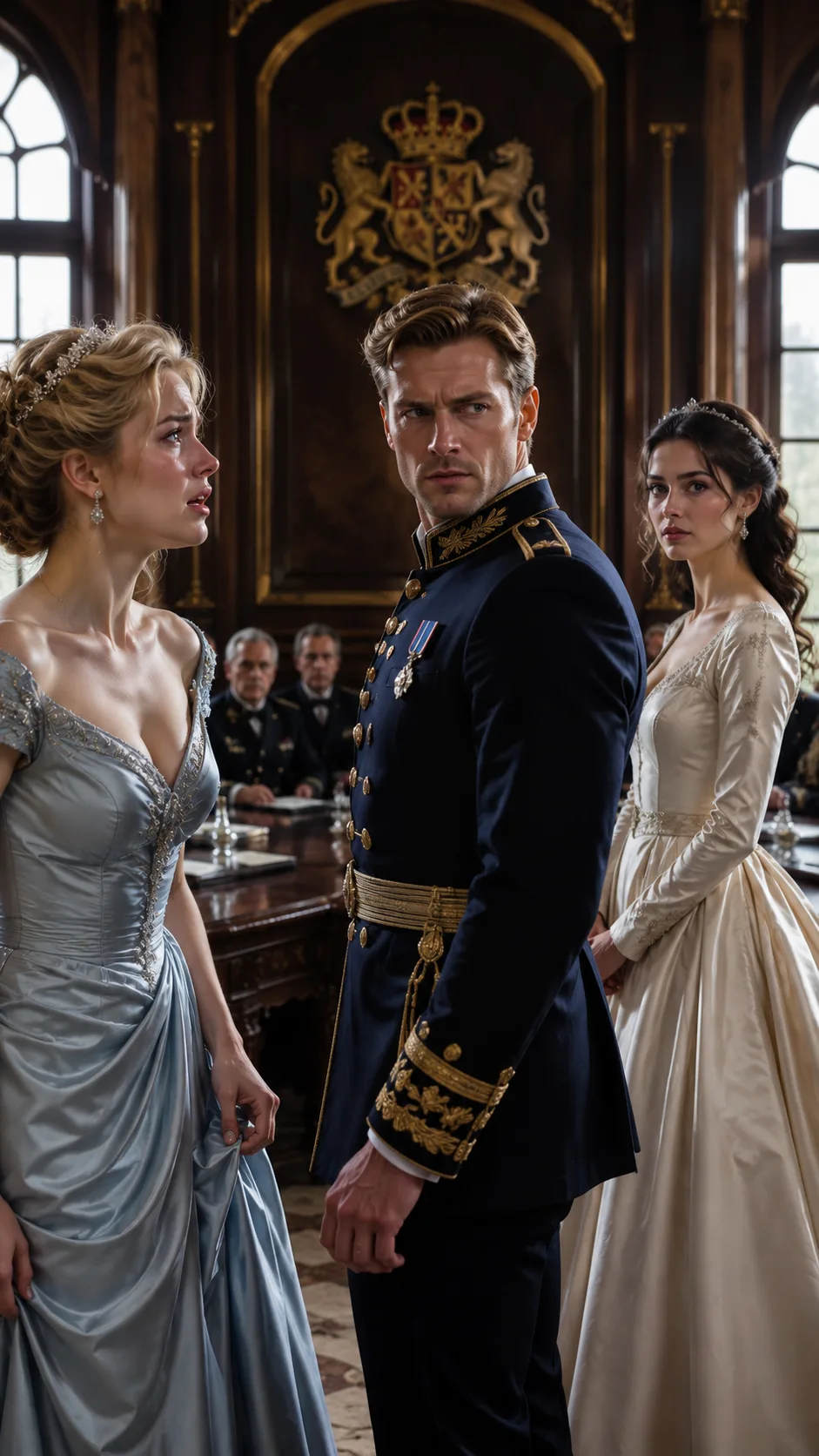
The royal council chamber was older than the palace itself. Dark wood walls. Tall arched windows. A long table beneath the crest of Eldenwick. On one side sat King Edmund, Queen Helena, the ministers, and the elder nobles. On the other stood the Northern delegation.
Prince Arthur stood near the center in a navy royal uniform, his posture straight, his face unreadable.
Alice entered like a woman walking toward a crown.
Margaret entered behind her.
No one expected Margaret to matter.
She could feel it.
That was the strange freedom of being underestimated.
King Edmund opened the session.
“We gather to finalize the alliance between Eldenwick and Valemont,” he said. “A marriage bond has been proposed to strengthen this treaty.”
Alice lowered her eyes perfectly.
The queen mother smiled.
Arthur did not.
Lord Waverly, the oldest minister, cleared his throat. “Princess Alice has expressed her willingness to accept Prince Arthur’s hand, should His Highness agree.”
Alice looked at Arthur with shining eyes.
The room waited.
Arthur looked at Alice.
“Before I answer,” he said, “I request permission to ask Princess Alice a few questions before the council.”
A murmur moved through the chamber.
Alice blinked. “Questions?”
King Edmund frowned slightly. “For what purpose?”
Arthur’s voice remained calm. “Marriage into Valemont is not ceremonial. A princess of Valemont may be asked to advise on military relief, winter provisions, and border policy. I would prefer clarity before I bind two kingdoms.”
Alice’s face tightened for half a second.
Then she smiled.
“Of course. I have nothing to hide.”
Margaret’s breath caught.
Arthur stepped toward the table.
“Princess Alice,” he said, “you told the Northern envoys last week that you had studied the western pass dispute.”
Alice smiled wider. “Yes.”
“Then tell the council which route remains open during winter flooding.”
Silence.
Alice’s eyes moved once toward Margaret.
Margaret looked back.
Alice gave a delicate laugh. “Your Highness, surely such details are better left to commanders.”
Arthur did not smile.
“You also told Lady Brenton that you personally organized relief shipments to Rosemere.”
Alice’s hand tightened around her skirt.
“I supported the effort.”
Arthur turned to Lord Waverly. “Read the shipping ledger.”
Lord Waverly opened a folder.
Alice’s smile vanished.
He read, “All flood relief requests, supplier negotiations, medical staffing orders, and school reconstruction approvals were signed by Princess Margaret.”
The room went silent.
Arthur looked back at Alice.
“Did you visit Rosemere after the flood?”
Alice’s voice sharpened. “I prayed for them.”
“That was not my question.”
A few nobles exchanged glances.
Alice swallowed.
“No.”
Arthur took another step closer.
“And the children’s hospital you claimed to have sponsored?”
Alice’s cheeks flushed.
“I intended to.”
Lord Waverly read again. “Funded by Princess Margaret’s personal dowry reserve.”
Margaret closed her eyes for one second.
She had never told anyone that.
Arthur had found it anyway.
Alice’s face changed.
The softness disappeared first.
Then the innocence.
Then the sweetness.
What remained was anger.
“This is cruel,” Alice said, her voice trembling. “You invited me here to humiliate me.”
Arthur’s eyes stayed cold. “No. I allowed you to speak for weeks. You chose what to say.”
Alice turned to the king.
“Your Majesty, I have done nothing but try to serve this alliance.”
Arthur said, “You tried to wear it.”
The words landed like glass breaking.
Alice stared at him.
Then she made her worst mistake.
She turned on Margaret.
“This is because of her,” Alice snapped. “She has poisoned you against me.”
Margaret stood completely still.
Alice pointed at her.
“She always does this. She stands there pretending to be noble while judging everyone. She left because she lost. Now she comes back and acts like silence is dignity.”
Arthur’s face hardened.
Alice’s voice rose.
“She wanted you. She just did not know how to keep you.”
The chamber froze.
Margaret felt every eye turn toward her.
For a second, the old pain came back.
The library. The corridor. The goodbye.
But before she could speak, Arthur did.
“Do not speak of her like that.”
His voice was low.
Not loud.
Worse.
Alice looked stunned.
Arthur turned fully toward the council.
“I have made my decision.”
Alice’s lips parted.
The queen mother leaned forward.
Arthur said, “I will not marry Princess Alice.”
Alice looked as if he had struck the crown from her head.
Then Arthur turned toward Margaret.
The entire council followed his gaze.
Margaret stopped breathing.
Arthur walked to her, slowly, in front of everyone.
Not like a prince claiming a prize.
Like a man approaching someone he had almost lost.
He stopped an arm’s length away.
“I knew what Princess Alice wanted,” he said. “I needed the council to see it.”
Margaret’s voice came out quiet. “So you let me leave.”
Pain moved across his face.
“I was wrong to let you leave without the truth.”
Alice whispered, “No.”
Arthur did not look at her.
“I do not want the woman who fought for my title,” he said. “I want the woman who walked away rather than lower herself to win it.”
Margaret’s heart broke open in the middle of the room.
Arthur lowered his head, not as a performance, but with respect.
“Princess Margaret,” he said, “if you can forgive my silence, I would ask for the honor of courting you properly. Not as a treaty. Not as a prize. As my choice.”
The room went silent again.
But this silence was different.
It was not mockery.
It was recognition.
Margaret looked at Alice.
Her sister stood pale and shaking, with all her beauty and none of her power.
For years, Alice had believed that being chosen meant defeating another woman.
Margaret finally understood.
Being chosen meant nothing if the man choosing you did not know your worth.
She turned back to Arthur.
“I will not be used to clean up a scandal,” she said.
A faint breath moved through the council.
Arthur nodded once. “Then let the scandal remain mine.”
Margaret studied him.
There was no arrogance in his face. No demand. No expectation.
Only truth.
So she said, “You may write to me at Rosemere.”
Arthur’s eyes softened.
Alice let out a broken laugh. “A letter? That is all?”
Margaret finally turned to her.
“No, Alice,” she said calmly. “That is the difference between us.”
Alice’s face twisted.
Margaret continued, “You wanted a crown before you knew the man. I wanted the man before I cared about the crown.”
No one spoke.
Margaret took one step toward the council table.
“And for the record,” she said, “I did not lose Prince Arthur. I released a contest I never agreed to enter.”
Arthur’s mouth tightened, almost a smile.
King Edmund sat back in his chair, looking at Margaret as if seeing her for the first time.
The treaty still passed.
But not through Alice.
Not through manipulation.
Arthur returned to Valemont two days later, and the first letter arrived before the week ended.
It was not romantic nonsense.
It contained three pages about winter roads, hospital funding, and an apology written without excuses.
Margaret read it twice.
Then she answered.
For six months, they wrote.
Then Arthur came to Rosemere, not with a royal parade, but with two wagons of medical supplies and a team of builders for the school roof.
That was when Margaret knew.
Not in a ballroom.
Not beneath chandeliers.
In a muddy village yard, watching a prince roll up his sleeves beside common laborers while children stared at him in awe.
Alice did not attend the wedding the following spring.
Some said she had gone abroad.
Some said she had refused to stand behind Margaret in the procession.
Margaret did not ask.
On her wedding day, she wore ivory satin and pearl earrings. Arthur wore the navy uniform of Valemont. The palace chapel was filled with nobles who once whispered that Alice would make the better bride.
Now they lowered their eyes when Margaret passed.
Arthur took her hand at the altar.
Not tightly.
Not possessively.
With trust.
And when the priest asked if she accepted him, Margaret looked at the man who had learned, painfully and publicly, that love without respect was only vanity.
“I do,” she said.
Arthur’s thumb brushed once across her knuckles.
The room went silent.
This time, Margaret did not mind.
Because silence no longer felt like something she had to survive.
It felt like the whole kingdom finally listening.
THE END.
-Princess Margaret thought walking away would protect what was left of her pride.-
Chapter complete
You have reached the end of this chapter.
Continue reading
A few more worlds to get lost in after this chapter.