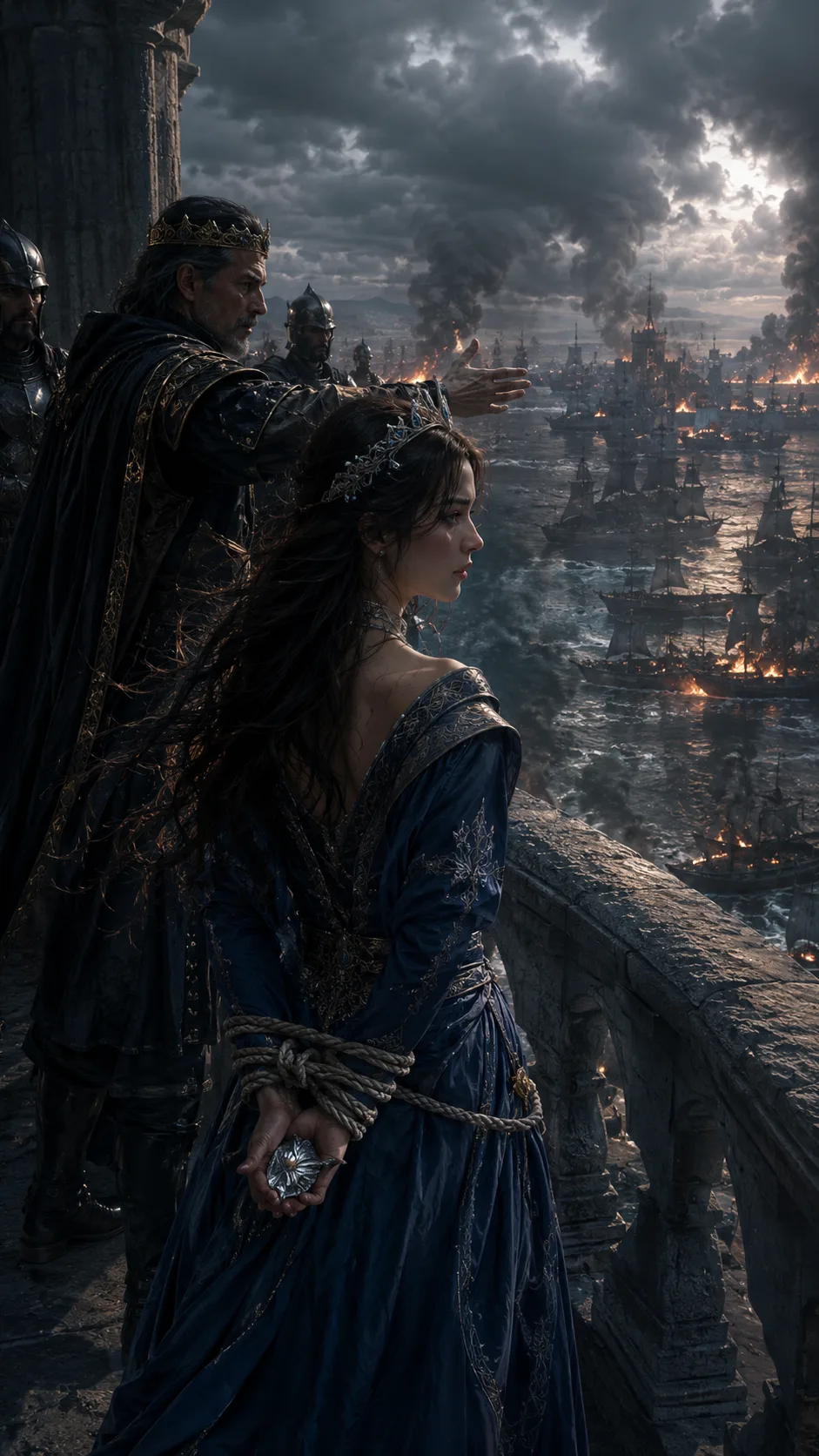
Aveline’s wrists were already raw by the time they fastened the ceremonial cuffs over the rope.
Chapter 1
Aveline’s wrists were already raw by the time they fastened the ceremonial cuffs over the rope.
The iron had been polished until it shone like silver, because King Varos would not allow ugliness in front of witnesses. Even punishment, in his court, had to look lawful. Even cruelty had to be dressed properly.
The guards did not meet her eyes as they tightened the knots beneath the cuffs. One of them, a younger man with a scar along his chin, adjusted the rope twice, then looked away when it bit deeper. The other kept his hand on the hilt of his sword and stared at the black marble floor.
Aveline stood still.
The Hall of Tides stretched around her in blue stone and white flame. Seashell mosaics covered the vaulted ceiling. Her father had once told her that every shell in the pattern had been placed by hand after the First Storm War, when the old kings made peace with the sea.
Now Varos sat beneath
that ceiling in her father’s chair.
He wore the crown as if it had grown out of his skull.
“Princess Aveline,” he said, and the court turned with him. “Daughter of the late King Edric. Last remaining blood of the western coast.”
No one moved.
He smiled.
“Your loyalty has been questioned.”
Aveline looked past him to the high windows. Beyond them, gulls cut across the pale morning sky, white wings flashing in the light. The harbor bells had not rung yet. That was wrong.
The harbor bells rang at dawn every day.
Her father had insisted on it.
Varos lifted a folded document from the arm of the throne. He did not open it. He did not need to. The court had already been told what it said.
“She has conspired with foreign captains,” he continued. “She has refused the regency’s lawful authority. She has endangered the capital during
a time of war.”
A murmur passed through the nobles.
Not loud.
Enough.
Aveline’s fingers flexed once behind her back. The rope held.
Across the hall, Lord Maerin lowered his gaze to the floor. He had eaten at her father’s table for twenty years. His wife had sent Aveline sugared pears when she was ten and feverish. Now he studied the floor as if it contained the law.
Varos stood.
The hall obeyed the movement before he spoke. Nobles straightened. Guards shifted. Even the torches seemed to lean toward him.
“By order of the regency,” he said, “Princess Aveline will be taken to the sea tower at dusk. There she will witness the consequences of treason.”
Aveline looked at him then.
He wanted fear.
He had prepared for it. The chained wrists. The court. The polished accusations. He had built the morning like a stage and placed her at the
center of it.
She gave him nothing.
His smile narrowed.
“Do you deny the charges?”
Aveline let her eyes move from him to the crown. It sat slightly crooked, though no one had dared tell him.
“Yes,” she said.
A few faces lifted.
Varos tilted his head.
“That is all?”
Aveline’s mouth was dry, but her voice did not break. “You lied poorly.”
The hall changed.
Not enough for rebellion. Not enough for rescue. But enough for Varos’s left hand to close around the carved arm of the throne.
The younger guard behind Aveline breathed in once.
Varos stepped down from the dais.
He did not hurry. Men like him never hurried in public. He crossed the distance between them with the slow certainty of a man who believed every floor belonged beneath his boots.
When he reached her, he stopped close enough that only the front rows could hear his next words.
“Your father made the same mistake.”
Aveline did not move.
Varos smiled again, smaller this time. “He thought the sea remembered blood.”
A candle on the nearest pillar guttered in the draft.
Aveline’s right sleeve brushed against her bound fingers. Inside the lining, hidden beneath layers of blue silk and salt-stiff thread, something small and hard pressed against her skin.
The shell.
Her mother’s shell.
Aveline had not touched it since the night of the funeral.
The last memory came back in pieces, as memories do when they are too heavy to carry whole.
Her mother’s hand closing over hers.
A bedchamber lit by green glass lamps.
The smell of rain in the open window.
A silver seashell placed in Aveline’s palm.
Not yet, her mother had said.
Aveline had asked what that meant.
Queen Maris had smiled, though her lips were pale. The sea does not answer fear. Only command.
Then the doors had opened, and Varos had entered with physicians and priests and a face arranged into grief.
Aveline had never seen her mother alive again.
“Take her,” Varos said.
The guards moved at once.
The younger one took her elbow with care. The older one did not. The court watched her being led from the Hall of Tides, past the old banners, past the nobles who had once bowed to her father, past the sea-glass windows where the missing bells still waited in silence.
Only one sound followed her.
Varos’s voice.
“At dusk, princess. The kingdom will learn what loyalty costs.”
The corridor outside the hall smelled of wet stone.
Aveline walked between the guards with the measured steps her tutor had beaten into every royal child. Back straight. Chin level. Do not give the watching walls a reason to pity you.
There were fewer servants than usual.
The ones who remained had been placed too deliberately. A maid near the stairwell with empty hands. Two pages near the eastern arch pretending to carry messages. A kitchen boy standing beside a cold brazier.
Witnesses.
Varos liked witnesses.
Halfway down the corridor, the younger guard’s hand loosened on Aveline’s arm.
She glanced at him.
He did not look back.
But his thumb moved once against the rope near her wrist, pressing something flat beneath the cuff.
A scrap of cloth.
No. Paper.
Aveline did not react.
The older guard shoved the door open ahead of them, and the wind hit like a slap.
They crossed the outer bridge toward the sea tower. Below, waves broke white against the fortress cliffs. The tower rose from the far edge of the stone causeway, older than the palace, older than the throne room, older than the crown Varos wore.
Its walls were carved with sea creatures no living sculptor had seen.
Long-backed whales.
Crowned serpents.
Human figures kneeling before something that had no face, only waves for shoulders and stars for eyes.
Aveline had loved those carvings as a child. Her father had hated letting her climb the tower, but her mother always allowed it.
Let her learn the height, Maris would say.
Now the tower doors groaned open for her punishment.
They locked her in a small chamber below the summit until dusk. No food. No water. No court priest to instruct her. Varos had no patience for rituals he had not invented.
The chamber contained a narrow bench, a rusted brazier, and a slit window facing the sea.
Aveline waited until the guard footsteps faded.
Then she twisted her wrist.
The paper beneath the cuff tore at the edge before she got it free. It was not larger than two fingers, folded once, darkened with sweat from the guard’s palm.
She unfolded it carefully.
Three words.
Bells are chained.
Aveline read it twice.
Then she turned toward the slit window.
The harbor bells had not rung at dawn because someone had stopped them.
Not broken.
Chained.
Her father’s bells were not only bells. Every child in the coastlands knew the story, though most adults treated it like ornament. When the First Storm War ended, the royal family had cast twelve bells from bronze, silver, and deep-sea iron. They were hung across the harbor towers and rung every dawn to honor the pact.
A symbol, the tutors said.
Aveline’s mother had said nothing.
She had only listened to the bells with her hand on the silver shell at her throat.
Aveline closed her fingers around the hidden shell in her sleeve.
Bells are chained.
Not destroyed.
The miniatures on old maps came back to her: twelve bells, twelve towers, twelve lines of sight facing the harbor mouth. A warning system, yes. A signal, yes.
Maybe more.
The chamber door opened before she could think further.
The older guard entered first. Behind him came Varos.
He had changed for dusk. Black cloak. Gold collar. Crown straightened. No sword at his hip. He wanted to look unafraid.
Aveline rose from the bench.
Varos looked at her wrists, then her face.
“You have always been better at silence than your father.”
She said nothing.
He stepped into the chamber and glanced toward the slit window. “He was loud at the end.”
The shell under her sleeve felt suddenly colder.
Varos saw something in her face. Not emotion. Not enough. But something.
His eyes sharpened.
“There it is,” he said. “The daughter still pretending the dead can answer.”
Aveline’s cuff scraped the wall as her hand shifted.
Varos looked down.
For one thin second, she thought he had seen the shell.
But he only smiled at the rope.
“Bring her up.”
The stairs to the summit wrapped around the tower’s hollow core. Wind moaned through arrow slits. Every turn revealed a different piece of the burning sky.
Orange in the west.
Black smoke over the harbor.
A gull trapped in a violent current, fighting to stay above the tower wall.
Aveline climbed.
The guards stayed close.
Varos followed three steps behind, his boots striking the stone with even, patient sounds.
At the top, the world opened.
The summit balcony circled the tower beneath a broken stone crown. From there, the entire harbor lay exposed below them.
Aveline stopped at the rail.
For a moment, even Varos did not speak.
The capital was burning.
Not all of it. Not yet. But enough.
Warehouses along the lower docks had collapsed into flame. Fishing boats lay overturned near the eastern pier. The royal fleet, what remained of it, had been driven back toward the inner harbor, where smoke swallowed the masts and spat them out in broken silhouettes.
Beyond the harbor mouth, enemy warships moved in formation.
Black sails.
Red lanterns.
Too many.
The last ship flying her father’s flag leaned hard against the wind, its sails torn, its hull blackened along one side. It was trying to turn back toward the city.
It would not make it.
Varos came to stand beside her.
“Look carefully,” he said.
The words carried over the balcony, meant for the guards, meant for the soldiers on the lower platform, meant for anyone who would repeat them later.
“This is your kingdom dying.”
Aveline looked at the harbor.
She did not answer.
The wind snapped her hair across her cheek. Salt gathered on her lips. Smoke dragged over the water and broke apart in strips.
Varos lifted one hand toward the burning city.
“You wanted them to resist me,” he said. “You let them believe the coast would rise for a girl with no crown and no army.”
Below, the last royal ship took a hit near its stern. Fire crawled along the deck. Men moved like insects against the light.
Aveline’s bound hands tightened behind her back.
The shell pressed into her palm through the sleeve lining.
Varos leaned closer.
“You have no throne left to save.”
The younger guard, the one with the scar, stood to Aveline’s right. His jaw tightened. He did not look at her.
The older guard moved behind her and reached for her arm.
Aveline planted her feet.
Stone under her soles.
Wind at her back.
Fire ahead.
The guard stopped, uncertain.
Varos turned his head slowly.
“All you can do now is watch.”
Aveline moved her thumb beneath the cuff.
The rope tore at her skin. The movement was small, hidden by the folds of her gown, but pain sharpened everything around it: the hiss of distant flames, the wet slap of waves against the cliff, the breath caught in the younger guard’s throat.
The shell slid fully into her fingers.
Cold.
Smooth.
Waiting.
Her mother’s voice returned, not as memory now, but as weight.
The sea does not answer fear.
Aveline curled her hand until the edge of the shell bit into her palm.
Not enough.
Varos was still speaking.
“The fleet at the harbor mouth belongs to Lord Caerwyn now,” he said. “By sunrise, his men will hold the docks. By noon, the council will sign what I place in front of them. By evening, your father’s name will be removed from every oath in this city.”
The younger guard looked down.
That was all Aveline needed.
The court was not united.
The soldiers were not all his.
The bells were chained.
The pact had not been broken.
It had been gagged.
Aveline pressed harder.
A fine, sharp sting cut across her palm. Warmth touched the shell.
Varos stopped speaking.
The shell moved.
Not in her hand.
Through it.
A pulse passed from the silver into her bones, deep enough that her teeth ached. She kept her fingers closed. She kept her face toward the burning harbor.
The wind shifted.
It did not slow. It changed direction all at once.
Smoke that had been pouring toward the city rolled backward over the water. Varos’s cloak snapped hard against his side. The older guard staggered and caught the balcony rail.
Aveline breathed once.
Low.
Steady.
Varos looked toward the harbor.
“What was that?”
The question was too quiet for a king.
Aveline turned her face toward him.
“Then watch with me.”
The first bell rang.
Not from the harbor.
From beneath the sea.
A sound rolled up through the tower stones and into the soles of their feet. The balcony trembled. Dust fell from the old carvings above the archway. Far below, the surface of the water between the enemy warships darkened and drew inward, forming a wide, impossible hollow in the middle of the harbor mouth.
The black-sailed ships shifted.
Not by sail.
By pull.
Their formation bent toward the hollow.
A shout rose from below. Then another. Then hundreds.
Varos gripped the rail.
The younger guard stepped back from Aveline, not away from her, but away from what she held.
The shell glowed blue between her bound fingers.
Varos saw it.
His face changed by the smallest amount.
Enough.
“You,” he said.
Aveline lifted her hands as far as the rope allowed. The silver shell caught the storm light, wet with seawater that had not touched it and warm with the blood he had forced from her bound wrists.
The second bell sounded.
Then the third.
Across the harbor, one by one, the chained bells began to answer.
Not loudly. Not cleanly. Their tones were muffled by iron and rope and whatever Varos had used to silence them. But they rang. Under restraint. Under smoke. Under siege.
They rang anyway.
The water hollow widened.
A column erupted from the center of the enemy fleet, white and violent and high enough to hide the burning docks behind it. Ships rolled away from the blast, their sails snapping loose, their lanterns swinging wildly in the storm air.
Varos stumbled back from the rail.
No one reached to steady him.
A shape moved inside the rising water.
At first it looked like a cliff.
Then a shoulder.
Then an arm larger than a watchtower broke through the sea, covered in stone-gray armor, coral scars, and strands of ancient kelp. Water poured from it in sheets. The arm struck the surface, not against a ship, not yet, but the wave alone sent half the enemy line scattering.
The Sea Titan rose.
No story had made it large enough.
Its head emerged through the collapsing column, crowned with jagged stone and shells older than the kingdom’s first wall. Green-blue light burned in the deep hollows where its eyes should have been. Barnacles covered its chest like old medals. Around its wrists hung chains that had snapped long ago, each link bigger than a man.
The tower fell silent.
Even the fire seemed distant.
The Titan turned.
Slowly.
Toward the balcony.
Varos stepped behind the older guard without noticing he had done it.
Aveline raised the shell.
The rope pulled at her wrists. Her shoulders burned. She did not lower her hand.
The Sea Titan’s glowing eyes fixed on her.
Then, before the city, before the fleet, before the man wearing her father’s crown, the ancient thing bowed its head.
Not to the crown.
Not to the throne.
To her.
The younger guard dropped to one knee.
The older one did not move, but his hand left his sword.
Varos’s mouth opened.
Nothing came out.
Aveline lowered the shell toward the harbor.
Her voice carried strangely in the changed wind.
“Break them.”
The Titan answered with a sound that moved through water, stone, bone, and memory.
It lifted one massive hand from the sea. Not fast. Not wild. There was no rage in the movement that needed to be performed. It had been called. It had heard. It obeyed.
The hand came down before the lead enemy ship.
Not on men.
On the water.
A wall of white surged up and threw the warship sideways, snapping its mast and scattering its formation. Other ships turned hard, colliding with one another in the chaos. Sailors cut lines. Lanterns vanished. The black sails that had seemed unstoppable only minutes before twisted like torn cloth in a basin.
The harbor cheered from behind the smoke.
Not many voices at first.
Then more.
Then the bells, still chained, rang harder.
Varos turned toward the stairs.
The younger guard stood.
He did not draw his sword.
He simply moved between Varos and the doorway.
The older guard looked at him.
For a moment, the old chain held.
Then he stepped aside from Aveline and away from Varos.
The king stared at them both.
“You will hang for this.”
His voice had lost its shape.
The younger guard looked at the crown on Varos’s head and then at the glowing shell in Aveline’s hand.
“No,” he said.
One word.
The tower heard it.
Varos reached for the guard’s sword.
Aveline stepped forward before the older guard could move. The rope at her wrists dragged against the stone. The shell’s glow strengthened until blue light washed over the black-and-gold thread of Varos’s cloak.
“Do not touch what no longer answers you,” she said.
Varos froze.
Below, the Titan moved again. Waves crashed outward, driving the enemy fleet away from the harbor mouth. The city, wounded and burning, began to make sound again: bells, shouts, orders, wheels grinding over stone, sailors calling from surviving decks.
Life returning in pieces.
Aveline held the shell until her fingers shook.
Then she lowered it.
The glow faded to silver.
The Sea Titan remained in the harbor, half-risen from the deep, its enormous head lowered like a guardian at the gate.
Varos stood with the crown still on his head.
It looked smaller now.
The younger guard cut the rope from Aveline’s wrists with a short blade. The older guard watched the stairs. Neither man spoke.
When the cuffs fell away, Aveline did not rub her wrists.
She walked to Varos.
He looked at her then. Not at the shell. Not at the Titan. At her.
For the first time that day, he saw who was standing in front of him.
Aveline reached up and took the crown from his head.
He did not stop her.
The gold was heavier than she remembered. Her father had worn it easily, but perhaps that had never been ease. Perhaps he had simply understood weight better than Varos did.
She turned and placed the crown on the stone rail between them.
Not on her head.
Not yet.
The younger guard lowered his blade.
Varos swallowed. “The council will never accept this.”
Aveline looked down at the harbor.
The chained bells kept ringing.
“They heard,” she said.
By nightfall, the fires along the docks had been contained.
Not extinguished. Not all of them. Smoke still crawled over the lower city, and some streets near the harbor were blocked by fallen beams and broken carts. The wounded were carried into the western temple, where the sea-priests opened their doors without waiting for royal permission.
The enemy fleet retreated beyond the outer reefs.
The Titan remained until the last black sail crossed the horizon. Then it lowered slowly into the sea, leaving behind waves that rolled through the harbor like the breathing of something asleep again.
Aveline stood on the lower quay when the first bell was unchained.
The workers did it without ceremony. Three dockhands climbed the tower frame with saws and hammers while half the city watched from below. When the final chain fell, the bell swung free and struck once from its own weight.
The sound crossed the water.
People stopped moving.
A woman holding a bandage to her husband’s shoulder lowered her hand. A boy with soot on his cheek looked up. A sailor from the burned royal ship sat on the dock with a blanket around his shoulders and closed his fingers around a piece of broken flag.
Aveline stood among them, not above them.
No one had brought her a cloak, so the younger guard, whose name turned out to be Tarren, placed his own around her shoulders. It smelled of rain, iron, and smoke.
“You should sit,” he said.
Aveline looked at the bell.
“Soon.”
Varos was held in the east tower, the smaller one without a sea view. He had demanded a trial before the council. He had demanded his seal, his papers, his physicians, his personal guard.
By midnight, only the physicians had come.
By morning, three council members arrived at the quay and knelt without being asked. Lord Maerin came last. His robe was stained with ash at the hem. He removed his signet ring and placed it on the wet boards at Aveline’s feet.
She looked at it.
Then at him.
His mouth opened around an apology he had not earned yet.
Aveline stepped past the ring.
“Unchain the rest,” she said.
For two days, the city worked.
They freed the bells.
They pulled the dead ships away from the pier and tied red cloth around the masts of those that could be repaired. They opened the storehouses Varos had locked for military tribute and carried grain into the lower districts. The priests washed soot from the temple steps. Children gathered silver fish thrown onto the stones by the strange tide and carried them home in buckets.
On the third day, Aveline returned to the Hall of Tides.
This time, no ropes waited.
The nobles stood when she entered.
Some because they respected her.
Some because the soldiers did.
Some because the memory of the Sea Titan still sat behind their eyes.
Aveline wore the same blue gown. Cleaned, mended, but not replaced. The silver embroidery still bore small dark marks where smoke had settled too deeply into the thread.
In her hand, she carried the shell.
The crown waited on the throne.
She walked past it.
A murmur moved through the hall.
Aveline climbed the dais, turned, and faced the court.
“My father trusted many of you,” she said.
No one answered.
“My mother trusted fewer.”
A few eyes dropped.
Aveline placed the silver shell on the arm of the throne.
“I will not begin my reign by pretending I do not remember who stood silent.”
Lord Maerin closed his eyes.
“But the harbor still stands,” she said. “The bells still ring. And silence, when broken properly, can become useful.”
She looked toward Tarren, standing at the lower steps in borrowed ceremonial armor.
“Bring the prisoner.”
Varos entered without the crown.
That alone changed him.
He wore plain black. His beard had been trimmed poorly. Two guards walked beside him, but neither touched him. He moved like a man still expecting someone to make room.
No one did.
He stopped below the dais.
Aveline did not sit.
“You will be tried,” she said. “Not by rumor. Not by my anger. By record.”
Varos looked around the hall. Some old instinct made him search for allies. The room gave him polished faces and closed hands.
He looked back at Aveline.
“You think the sea makes you queen.”
Aveline picked up the crown.
The hall held still.
“No,” she said.
She descended the dais with the crown in both hands.
At the foot of the steps, she turned toward the high windows where the harbor bells were visible in the distance, freed and bright in the morning light.
“The sea answered because the pact was kept,” she said. “Not because I asked nicely. Not because I bled. Not because I was born.”
She looked at Varos.
“Because you broke faith in front of witnesses.”
His jaw worked once.
No words came.
Aveline turned back to the court and lifted the crown.
This time, she placed it on her own head.
The bells rang.
Not chained.
Not muffled.
Not distant.
Clear enough to make the shell on the throne hum in answer.
Varos lowered his eyes first.
Years later, children would climb the sea tower again.
They would run their hands over the old carvings and argue about which one showed the Titan. Some would insist it was the figure with waves for shoulders. Others would point to the faceless guardian beneath the stars. Their tutors would tell them not to lean over the balcony, and they would lean anyway.
The harbor below would be rebuilt with wider piers and stronger watchtowers. The bells would ring every dawn. No council would ever again be allowed to chain them without the queen’s seal and the harbor master’s public consent.
Varos would live long enough to hear those bells from a stone room facing inland.
That was mercy.
Aveline never called it that.
On the first anniversary of the siege, she returned alone to the tower at dusk. No guards followed her up the stairs. No court waited at the summit. The city below glowed with lanterns instead of fire.
She stood at the same rail.
The wind lifted her hair.
In her palm, the silver shell rested quiet and cold.
For a while, she watched the sea.
Then she placed the shell inside a small hollow in the stone, where one of the ancient carvings showed a queen holding out her hand to the waves.
The shell fit perfectly.
Aveline stepped back.
Below, the first harbor bell rang for evening.
The shell answered once.
Then it slept.
Chapter complete
You have reached the end of this chapter.
Continue reading
A few more worlds to get lost in after this chapter.