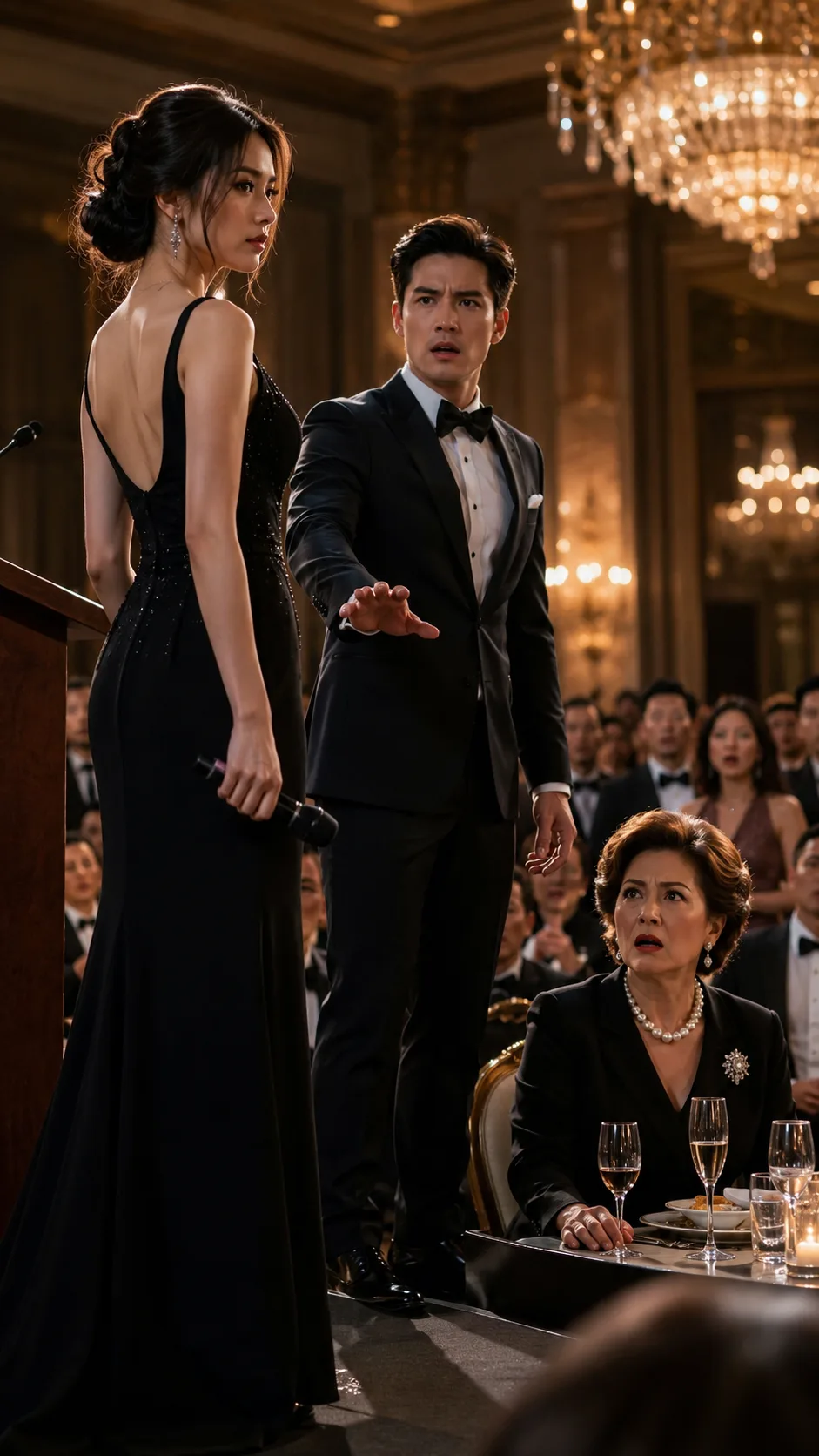
The Silent Divorce That Brought Down His Empire
Chapter One: The Wife They Erased
Elena Vale signed the divorce papers without asking for a single dollar.
Chapter 1
Elena Vale signed the divorce papers without asking for a single dollar.
That was the first thing everyone remembered afterward.
Not the rain beating against the glass walls of the penthouse. Not the way the city lights trembled below like broken jewelry scattered across Chicago. Not even the pale red mark on her cheek where Beatrice Marlow’s hand had struck her less than an hour earlier.
What they remembered was the silence.
Elena did not cry.
She did not plead.
She did not ask Preston Marlow if he had ever loved her.
She simply sat at the foot of the bed in the master suite, wearing a gray sweater and dark trousers, her hair pulled back loosely as if she had been interrupted in the middle of an ordinary evening. In front of her lay a stack of papers thick enough to end three years of marriage, and beside them sat a gold fountain pen with Preston’s initials engraved into the cap.
P.M.
Preston Marlow.
The man whose name had opened doors across the city.
The man whose family had built Marlow Industries from a factory on the South Side into a national empire of steel, machinery, logistics, and political influence.
The man who had once stood in front of a tiny Italian restaurant, holding Elena’s cold hands between his own, and told her, “With me, no one will ever make you feel small again.”
Now he stood near the fireplace, silent, while his mother made Elena feel smaller than dust.
“Sign there,” Beatrice Marlow said, tapping one manicured finger against the first page. “Then there. Then initial the bottom.”
Elena looked down.
The letters blurred for a moment, not because she did not understand them, but because everything in that room felt unreal.
Divorce agreement.
Waiver of spousal support.
Voluntary relinquishment.
No claim to marital assets.
No claim to residence.
No
claim to company equity.
No contest.
No public statement.
No future contact except through counsel.
A clean disposal.
That was what they had prepared for her.
Preston’s attorney, Mr. Harlan, stood beside the door with a leather briefcase clasped in both hands. He would not meet Elena’s eyes. He had been kind to her once, long ago, at a company Christmas party, when Beatrice “accidentally” introduced Elena as Preston’s assistant instead of his wife. Mr. Harlan had corrected the mistake gently in front of six executives.
Tonight, he said nothing.
No one said anything unless it was to instruct her.
Beatrice stood beside the bed like a woman supervising a stain being removed from expensive fabric. She was fifty-five, tall, elegant, wrapped in cream silk and diamonds, with silver-blonde hair swept into a smooth twist at the back of her head. Her face was calm, almost beautiful, but her eyes
had never once been warm to Elena.
From the day Preston brought Elena into the Marlow world, Beatrice had treated her as a temporary embarrassment.
A girl with no visible family.
A woman who had worked as a translator and private hospitality coordinator before marrying rich.
A quiet nobody who should have been grateful enough not to breathe too loudly at the dinner table.
“Elena,” Preston said at last.
His voice was soft.
That softness almost broke her.
She lifted her eyes.
He looked tired, handsome, and distant. His black hair was slightly damp from the shower he had taken before informing her their marriage was over. He wore a white dress shirt with the sleeves rolled to the forearms, a habit she used to find intimate, because he did it only at home. Now it made him seem like a man performing grief in comfort.
“This is better,” he said.
Elena stared at him.
Better.
She had expected many things from the end of her marriage. Anger, perhaps. Shame. Maybe even confession. She had imagined, in the worst moments, that Preston might admit he had stopped loving her. That he might tell her he had fallen for someone else. That he might at least be cruel enough to be honest.
But better?
As if the end of her life with him were a business restructuring.
As if she were a department being closed.
“For whom?” she asked.
Her voice surprised her. It was not loud. It did not tremble. It simply existed, small and clear in the enormous room.
Preston looked away first.
Beatrice answered for him.
“For everyone,” she said. “For Preston. For this family. For the company. And, if you had any dignity left, you would understand it is better for you as well.”
Elena turned toward her.
The side of her face still stung.
Beatrice had slapped her because Elena had dared to say Clara Wexler’s name.
Clara.
The woman Preston had been photographed with in New York.
The woman whose father controlled Wexler Logistics.
The woman Beatrice had always wanted Preston to marry.
Clara came from the right circles. She had the right last name, the right family history, the right kind of beauty. She knew how to laugh at charity dinners without seeming hungry. She knew which fork to use and which people to flatter. She came with a company attached to her, and right now Marlow Industries needed that company more than air.
Elena had not understood the full picture until that night.
She knew Preston had been distant for months.
She knew he came home later and later.
She knew Beatrice had started visiting the penthouse more often, speaking in low voices with Preston behind closed doors.
But Elena had believed it was about stress. Debt pressure. Board politics. The rumors that Marlow Industries had overextended itself building new manufacturing facilities while old contracts collapsed.
She had believed her husband was drowning and did not know how to ask for help.
So she had tried to help quietly.
She had reviewed speeches, reorganized charity contacts, hosted dinners, smoothed over executives’ wives, listened at events when men underestimated her and revealed more than they meant to.
She had even warned Preston, three months earlier, that the proposed Wexler merger looked dangerous.
He had smiled at her like she was a child.
“You don’t understand how deals like this work, Elena.”
She had said nothing then.
She had become very good at saying nothing.
“Where is Clara now?” Elena asked.
The question changed the room.
Preston’s shoulders tightened.
Beatrice’s mouth curved.
“Do not drag Miss Wexler into your little tragedy,” Beatrice said. “She has shown this family more loyalty in six months than you have in three years.”
Elena almost laughed.
“Loyalty?”
“She understands duty,” Beatrice replied. “She understands legacy. She does not sit in corners at dinners staring as if she has been forced to attend her own trial.”
“Because she is not the one being judged.”
Beatrice stepped closer.
“Elena, let me give you one kindness before you leave this family forever. You were never judged unfairly. You were judged accurately. You were not suited to this life. You lacked polish, instinct, bloodline, background. Preston was blinded by attraction and pity. I allowed it because I believed he would tire of the fantasy sooner. Thankfully, he has.”
Preston said, “Mother.”
But there was no warning in it.
Only discomfort.
That was the part Elena would remember most.
Not Beatrice’s insults. They were old.
Not the affair. That wound was sharp, but ordinary.
Not the divorce papers. Paper could only hurt when held by people who wanted it to.
What Elena would remember was that Preston always sounded uncomfortable when his mother humiliated her, but never angry enough to stop it.
She picked up the pen.
Beatrice watched her fingers with open satisfaction.
“Elena,” Preston said again.
She paused.
For one wild second, she thought he might stop this.
She thought he might cross the room, take the papers away, tell his mother to leave, tell the lawyer to wait outside, tell Elena the whole thing had gone too far.
Instead, he said, “We can arrange a private car for you in the morning.”
The last small light inside her went out.
“In the morning?” she repeated.
Beatrice answered. “Tonight would be preferable, but Preston is being sentimental. You may remain until six. The staff has been informed not to give you access to the main accounts or family safe. Your phone line under the Marlow plan will be disconnected after midnight. Your cards have already been deactivated.”
Elena set the pen down.
“You froze my cards before I signed?”
Preston rubbed his jaw. “It was on advice of counsel.”
“Your counsel?”
He did not answer.
Mr. Harlan shifted uncomfortably.
Elena looked at the attorney. “Did you advise him to leave his wife with no access to money in the middle of a storm?”
Mr. Harlan’s face tightened. “Mrs. Marlow—”
“Do not call her that,” Beatrice said sharply. “Not after tonight.”
Something in Elena became very still.
She picked up the pen again.
Then she signed.
Every page.
Every line.
Every place they had marked with a small yellow tab.
She wrote Elena Vale with clean, controlled strokes, the name she had chosen years ago because she believed love should be separate from inheritance, separate from blood, separate from the Ashford shadow.
Elena Vale.
The simple name of a woman who wanted to be loved without power.
A woman who had been naive enough to think removing power from the equation would reveal truth.
It had.
Just not the truth she expected.
When she finished, she placed the pen neatly across the final page.
Beatrice snatched the documents up before the ink had fully dried.
“There,” Beatrice said. “Finally.”
Elena stood.
The room seemed to hold its breath.
She walked to the closet and pulled down the old brown suitcase she had brought into the marriage. Preston had laughed at it once.
“You still have this thing?” he asked back then, smiling as he wrapped his arms around her waist. “Elena, you’re a Marlow now. You’ll never need a suitcase like that again.”
He had been wrong.
It turned out the cheap suitcase was the only thing in the penthouse that had never belonged to him.
Elena opened it on the bed.
Beatrice narrowed her eyes. “Personal belongings only.”
Elena did not reply.
She packed carefully.
Two pairs of jeans.
Three sweaters.
A navy dress she had owned before Preston.
Her mother’s silver locket.
A framed photo of her parents, taken on a windy beach when Elena was nine years old. Her father was laughing, her mother’s hair was blowing across her face, and Elena was between them with one hand tucked into each of theirs.
She touched the frame once before wrapping it in a scarf.
Preston watched from the fireplace.
His eyes followed the photo.
“I didn’t know you kept that,” he said.
“You never asked.”
He flinched.
Good, Elena thought.
Then hated herself for wanting even that small reaction.
When the suitcase was full, she zipped it closed and lifted it off the bed.
It was heavier than she expected.
Or maybe leaving always felt heavy, even when there was nothing left to carry.
Beatrice held the folder against her chest.
“You should be grateful we are keeping this discreet,” she said. “Many women in your position would have been exposed.”
Elena turned slowly.
“My position?”
Beatrice smiled. “Abandoned. Penniless. Unmarketable.”
Preston finally snapped, “Mother, enough.”
Elena looked at him.
“Now?” she asked. “Now it is enough?”
He opened his mouth.
No words came.
She walked past him.
At the bedroom door, his hand lifted slightly.
“Elena.”
She stopped without turning.
“I did love you,” he said.
The room became too quiet.
Behind her, Beatrice inhaled sharply, irritated by the weakness of the statement.
Elena looked back over her shoulder.
Preston’s face was pale. He looked almost young.
For one moment, she saw the man from the tiny restaurant again. The man who bought her coffee at midnight. The man who sat with her in a hospital corridor after she sprained her ankle and looked more frightened than she felt. The man she had chosen over family, over inheritance, over every warning given to her.
Then that image vanished.
Because love that arrived too late to protect was not love she could live on.
“No,” Elena said quietly. “You loved being loved by me. There is a difference.”
She left before he could answer.
The private elevator descended sixty-two floors.
Elena stood alone inside it, watching her reflection in the mirrored walls.
Her cheek was still red.
Her eyes were dry.
That bothered her. She thought she should be crying. She thought a marriage deserved tears, even a ruined one. But she felt as if her body had moved beyond grief into something colder.
Clarity, perhaps.
Or shock.
The elevator opened into the lobby.
Luis, the night doorman, looked up from the desk. He was in his early sixties, with kind eyes, a gray mustache, and a habit of sneaking extra umbrellas to residents who never returned them. He had always treated Elena like a person long before anyone else in Preston’s building did.
His smile faded when he saw the suitcase.
“Mrs. Marlow?”
Elena stepped out.
“Not anymore.”
Luis’s gaze moved to her cheek.
His expression changed, but he said nothing careless.
“Do you need help?”
“Yes,” Elena said. “May I borrow your phone?”
Without hesitation, he handed it over.
Elena stood near the glass doors while rain battered the street beyond.
Her thumb hovered over the keypad.
She had not dialed the number in three years.
Not because she had forgotten it.
Because remembering it felt like surrender.
Victor Ashford.
Her grandfather.
The man who raised her after her parents died in a plane crash when she was sixteen.
The man who built Ashford Global from a shipping investment firm into one of the most powerful private conglomerates in the world.
The man who had warned her about Preston Marlow in the beginning.
“He does not know you,” Victor had said.
“He loves me,” Elena had replied.
Victor’s face had been unreadable. “Those are not the same thing.”
She had thought he was being cruel.
Now she realized he had simply been old enough to recognize hunger in rich men.
Elena dialed.
The phone rang once.
Twice.
Three times.
Then a deep voice answered.
“This is Victor.”
Elena closed her eyes.
“Grandfather.”
Nothing moved for a moment.
Then Victor Ashford said, very softly, “Elena?”
Her throat closed.
“I’m sorry,” she whispered.
“Where are you?”
The question was not emotional.
It was immediate.
Precise.
Protective.
“Preston’s building. Lobby. Chicago.”
“Are you injured?”
Elena glanced at her reflection in the glass.
“No.”
A pause.
“Elena.”
“My cheek,” she admitted. “Beatrice slapped me. It is not serious.”
The silence that followed was more terrifying than any shout.
When Victor spoke again, his voice was calm enough to frighten her.
“Give the phone to the man helping you.”
Elena looked at Luis. “My grandfather wants to speak to you.”
Luis took the phone carefully.
“Yes, sir?”
He listened.
His eyebrows rose.
“Yes, sir. Of course. I understand.”
He handed the phone back.
Victor said, “Stay inside. A car will arrive in twelve minutes. You will not step onto the street until my security team enters the lobby. Do you understand?”
Elena almost smiled through the ache in her chest.
Still commanding the world like it was a boardroom.
“Yes.”
“Good. Are you alone?”
“Yes.”
“No. You are not.”
The line went dead.
Twelve minutes later, two black vehicles stopped outside the building.
Three men entered first, not dramatic, not loud, simply professional in the way real power often was. One of them, tall and dark-haired, approached Elena with a slight bow of his head.
“Miss Ashford.”
Luis looked at her so quickly she almost laughed.
There it was.
The name she had buried.
The name that changed rooms before she entered them.
“Yes,” Elena said.
The man lifted her suitcase.
“I’m Adrian. Mr. Ashford sent us. The jet is ready.”
Luis blinked. “Jet?”
Adrian did not react.
Elena turned to Luis.
“Thank you,” she said. “For the phone.”
Luis looked from the security team to the car outside, then back at her.
For the first time all night, someone smiled at her without pity.
“Good luck, Miss Ashford.”
Elena stepped into the rain beneath an opened umbrella.
Behind her, on the sixty-second floor, the lights of the penthouse remained bright.
Preston had probably poured himself a drink.
Beatrice was probably already calling Clara’s mother.
They thought they had removed a problem.
They had no idea what they had released.
The private airport was quiet when Elena arrived.
The Ashford jet waited beneath white runway lights, long and silver, its stairs lowered, its engines humming softly in the rain.
For a moment, Elena could not move.
She had run from this world.
The jets. The guards. The private terminals. The careful staff who knew what she wanted before she asked. The power that made people polite for the wrong reasons.
At twenty-four, she had wanted a normal life so badly it embarrassed her now.
She wanted grocery store flowers, messy apartments, laughter over cheap wine, someone who loved her without knowing the full weight of her name. She wanted to be chosen for herself.
So she became Elena Vale.
She rented a small apartment. She worked long hours. She translated contracts, planned events, handled private hospitality for foreign clients, and felt proud of every dollar she earned without help.
Then Preston Marlow walked into her life wearing a navy suit and loneliness like cologne.
He had seemed different from the men she grew up around.
Less polished, somehow.
More earnest.
He asked questions.
He remembered details.
He told her he hated how people performed wealth instead of living honestly.
She believed him because she wanted to.
Now the jet stairs gleamed in front of her, and Elena understood something she had refused to understand before.
Power was not the enemy.
People were.
Power only revealed what they did when they thought they had it over you.
At the top of the stairs, Victor Ashford stood waiting.
He was seventy-six, tall, silver-haired, broad-shouldered, dressed in a dark suit with no tie. His face was lined but not soft, the face of a man who had outlived rivals, recessions, betrayal, and grief without letting the world see where it had cut him.
When he saw Elena, his expression changed.
Not much.
Just enough.
His eyes moved to her cheek.
Then to the suitcase.
Then back to her face.
“Elena.”
That was all he said.
She climbed the steps.
For three years, she had rehearsed what she would say if she ever came back.
I’m sorry.
You were right.
I was foolish.
I should have listened.
None of it came.
The moment she reached him, Victor opened his arms.
Elena stepped into them and broke.
Not gracefully.
Not quietly.
The tears came with a force that bent her forward. Victor held her as if she were still the sixteen-year-old girl shaking in a black dress at her parents’ funeral.
“I’m sorry,” she kept saying.
Victor’s hand rested on the back of her head.
“No.”
“I should have called sooner.”
“Yes,” he said. “But you called tonight.”
Inside the cabin, warm light softened the cream leather seats and polished wood tables. A blanket waited on one chair. Tea steamed beside it. Someone had placed a small vase of white lilies near the window.
Her mother’s favorite flower.
Elena noticed.
Victor noticed that she noticed, but said nothing.
That was how he loved: quietly, deliberately, with details instead of speeches.
Once the jet lifted into the night, Elena told him everything.
Not all at once.
The story came in pieces.
Beatrice’s corrections at dinner.
Preston’s apologies that never became protection.
The charity gala where Elena had been seated at the wrong table “by mistake.”
The board dinner where an executive asked whether she had been hired to serve wine.
The years of smiling until her face hurt.
The loneliness of lying beside a man who called her wife in public but allowed his mother to treat her like a guest who had overstayed.
Then Clara.
The messages.
The confrontation.
The slap.
The papers.
Victor listened.
His face did not change until Elena repeated Beatrice’s words.
Abandoned. Penniless. Unmarketable.
Then something moved in his eyes.
It was not rage exactly.
Rage was too loud for Victor Ashford.
This was colder.
“Elena,” he said, “what do you want?”
She sat wrapped in the blanket, staring at the dark window where her reflection hovered over clouds.
“I don’t know.”
“That is acceptable for tonight.”
“I don’t want a scandal.”
“Why?”
The question surprised her.
“Because I don’t want to become like them.”
“Scandal is not immoral by itself,” Victor said. “Sometimes exposure is only truth arriving loudly.”
Elena shook her head. “I just want to disappear for a while.”
“You may disappear for a week,” Victor said. “Not forever.”
She looked at him.
He reached for a folder on the table.
“I had Marlow Industries reviewed after you married him.”
Elena stiffened. “You investigated my husband?”
“Yes.”
“Grandfather.”
“I did not interfere. There is a difference.”
She wanted to be angry.
But she was too tired.
Victor opened the folder.
“Marlow Industries is overleveraged. Preston expanded too quickly after his father died. He believed reputation would carry debt. It did not. Their European contracts collapsed last year. Two domestic suppliers are preparing breach claims. They are using short-term financing to cover payroll in three divisions.”
Elena stared at the pages.
She had known Preston was under pressure.
She had not known it was this bad.
“The Wexler merger,” she said.
Victor nodded. “It is not expansion. It is rescue.”
Elena looked down at the Wexler logo printed on one document.
“Clara’s father agreed?”
“Martin Wexler believes the merger will give him access to Marlow’s political relationships. Preston believes Wexler’s logistics network will save his manufacturing lines. Both men believe they are using each other.”
“And are they?”
“Yes,” Victor said. “Badly.”
He slid another page toward her.
Elena read it once.
Then again.
Her pulse slowed.
“Ashford Global owns part of Wexler Logistics?”
“Forty-three percent.”
Her hand tightened around the paper.
“That’s more than the Wexler family.”
“Yes.”
“For how long?”
“Six years.”
Elena looked at him.
Victor’s expression remained calm.
“Why?”
“Because Wexler Logistics was undervalued, badly managed, and strategically useful.”
“And now?”
“Now your former husband plans to announce a merger at the Starlight Foundation Gala in three weeks. He cannot complete that merger without majority shareholder approval. As of tomorrow morning, my shares in Wexler Logistics will be transferred to your trust.”
Elena pulled back.
“No.”
Victor did not blink. “Yes.”
“I don’t want you to give me a weapon because I was humiliated.”
“I am not giving you a weapon. I am handing you your inheritance.”
“You are doing this because of Preston.”
“I am accelerating this because of Preston,” Victor said. “There is a difference.”
Elena stood and walked to the aisle of the cabin.
The jet was smooth beneath her feet, the clouds invisible beyond the dark windows. She felt suddenly trapped between two versions of herself: the woman who had wanted no power, and the woman who now had the chance to use it.
“I can’t destroy him just because he hurt me.”
Victor’s face softened slightly.
“That is why you should be the one to decide.”
She turned.
“What does that mean?”
“It means a cruel person would ask how to make Preston suffer. You are asking whether you have the right to act at all. That tells me you may be trusted with the decision.”
Elena looked away.
Victor continued, “If the merger goes through, Preston saves himself by tying Marlow Industries to Wexler Logistics. If it fails privately, he may still negotiate elsewhere. If it fails publicly, his creditors will move. If you expose the financial misrepresentation behind the announcement, the board may remove him. If you do nothing, he rebuilds his fortune, marries Clara, and tells society you were unstable, greedy, and unsuitable.”
Elena closed her eyes.
There it was.
The part she had not wanted to face.
They would tell the story for her.
Beatrice would whisper that Elena had been difficult.
Preston would say the marriage had ended quietly by mutual agreement.
Clara would become the woman who brought dignity back to the Marlow name.
And Elena would become nothing more than a mistake erased before the wedding invitations were printed.
“I don’t care what they say,” she whispered.
Victor said nothing.
Elena opened her eyes.
The lie sounded weak even to her.
Over the next three weeks, Elena returned to the Ashford estate in Virginia.
The house had not changed.
That was the first mercy.
The long gravel drive still curved through ancient oaks. The stone fountain still stood before the entrance, though one cherub’s wing had been chipped since Elena was twelve. Her mother’s rose garden had grown wild along the west lawn, because Victor never allowed anyone to replace the older varieties she loved, even when they became difficult to maintain.
Inside, the halls smelled faintly of cedar, paper, and lilies.
Mrs. Bell, the housekeeper who had worked for the family for thirty years, cried when she saw Elena.
Adrian, who had once taught Elena how to disable a car alarm after she locked herself out at seventeen, pretended not to notice.
Victor gave her the blue room facing the garden, the same room she had used before leaving for college.
For two days, she slept.
On the third morning, she woke before dawn.
The rain had stopped.
A thin gray light stretched over the lawns.
Elena stood at the window and touched her cheek.
The mark was gone.
The memory was not.
She dressed in black trousers, a white blouse, and no jewelry except her mother’s locket. Then she went downstairs to Victor’s study.
He was already there.
Of course he was.
Papers covered the desk. Three advisors sat near the fireplace. A lawyer Elena recognized from Ashford Global’s London office closed a tablet when she entered.
Victor looked up.
“Are you ready?”
Elena stood in the doorway.
No, she thought.
Then she said, “Yes.”
The next weeks were not dramatic in the way people imagine revenge to be.
There were no screaming phone calls.
No broken glass.
No late-night threats.
Only paperwork.
Share transfers.
Board rights.
Debt reviews.
Regulatory filings.
Private calls with Wexler minority shareholders.
Background checks on Marlow directors.
Forensic accounting.
Elena learned that Preston had not merely been desperate.
He had been reckless.
Marlow Industries had borrowed against the anticipated Wexler merger before shareholder approval. Preston had signed conditional agreements that depended on public confidence. He had delayed payments to suppliers while presenting optimistic revenue projections at investor meetings. He had not technically crossed the line into fraud, according to counsel, but he had danced close enough to feel the heat.
“He believed the announcement itself would create momentum,” one advisor said.
Elena looked through the report. “He believed applause could become money.”
Victor smiled faintly. “That is often how dynasties fail.”
The more Elena read, the less personal it became.
That surprised her.
At first, every document felt like Preston’s face.
Every spreadsheet felt like Beatrice’s voice.
But slowly, beneath the hurt, Elena saw the larger damage.
Three factories depended on Marlow Industries.
Thousands of employees.
Families.
Retirements.
People who had never been invited to Beatrice’s dinners but would pay for Preston’s arrogance long after the champagne glasses were cleared.
Elena began waking early.
She read case files with coffee gone cold beside her.
She asked questions until senior attorneys stopped underestimating her.
She challenged Victor’s advisors when they assumed she wanted the harshest path.
“No,” she said during one meeting. “I want control without unnecessary collapse.”
One banker raised an eyebrow. “With respect, Miss Ashford, that may not be possible.”
Elena looked at the debt ladder on the screen.
“It is possible if creditors believe new leadership will stabilize operations.”
“Preston Marlow will never step down voluntarily.”
“I did not say voluntarily.”
The room fell quiet.
Victor watched from the end of the table.
Later, when everyone left, he said, “You sound like your mother.”
Elena froze.
Her mother, Isabella Ashford, had been gentler than Victor but no less formidable. She could dismantle a negotiation with one raised eyebrow, then spend the afternoon barefoot in the garden teaching Elena the names of flowers.
Elena swallowed.
“I’m not sure that’s true.”
“It is.”
“I ran from all of this.”
“So did she, once.”
Elena looked at him.
Victor leaned back, gaze moving toward the window.
“Your mother hated the Ashford name when she was young. She thought it made people artificial around her. She used to introduce herself as Isabella Reed at university parties.”
Elena almost smiled.
“I didn’t know that.”
“She came back when she realized the name was not a cage unless she allowed others to define it.”
Elena touched the locket at her throat.
“I wish she were here.”
“So do I,” Victor said.
Three weeks after the divorce, Chicago gathered beneath the chandeliers of the Starlight Foundation Gala.
It was the kind of event Beatrice Marlow adored.
Old money. New money. Politicians. Executives. Media. Women in jewel-toned gowns. Men in tuxedos pretending not to compare watches. Waiters drifting between round tables with trays of champagne. A string quartet playing beneath a balcony lined with white flowers.
At the front of the ballroom stood a stage with a podium and a screen displaying the Starlight Foundation logo.
Preston was scheduled to speak at eight-thirty.
At eight-forty, he would announce the Marlow-Wexler strategic merger.
At eight-forty-one, the room was supposed to applaud.
By nine, every business outlet in Chicago would report that Marlow Industries had secured its future.
That was Preston’s plan.
He had no idea Elena had arrived in the city that morning.
Her plane landed at a private terminal at 11:15 a.m.
She stepped onto the tarmac wearing a camel coat, dark glasses, and a calm expression she had practiced until it became real.
Adrian walked beside her.
Victor followed with two attorneys and no visible hurry.
The photographers outside the gala that evening shouted Victor’s name first.
“Mr. Ashford!”
“Victor, over here!”
“Are you investing in Chicago again?”
Then Elena stepped from the car.
The shouting changed.
“Who is she?”
“Miss Ashford, this way!”
“Elena, look here!”
She wore a deep emerald gown with clean lines and long sleeves, elegant rather than revealing. Her hair was swept into a low knot. Her makeup was minimal. Around her neck was her mother’s locket.
Victor offered his arm.
Elena took it.
At the entrance, a young event coordinator checked the guest list.
Her eyes widened.
“Mr. Ashford. Miss Ashford. Welcome.”
Miss Ashford.
Elena felt the name move through the air like a match struck in a dark room.
Inside the ballroom, Preston saw her before Beatrice did.
He was standing near the stage with Clara Wexler on his arm. Clara wore silver, sleek and expensive, with her blonde hair falling over one shoulder. She was beautiful in the careful way of women raised to understand exactly how much beauty could purchase.
Preston’s smile faltered.
For one moment, he simply stared.
Elena did not walk toward him.
She let him come to her.
That mattered.
Power was often nothing more than deciding who had to cross the room.
Preston excused himself from Clara and moved through the crowd, his face arranged too quickly into politeness.
“Elena.”
“Preston.”
His eyes moved over her gown, her jewelry, Victor beside her, Adrian several steps back.
“What are you doing here?”
“Attending.”
“This is a private event.”
“Yes.”
His jaw tightened. “Who invited you?”
Victor answered. “I did.”
Preston looked at him properly for the first time.
Recognition struck him.
Everyone in business knew Victor Ashford. Even people who had never met him knew the photographs: the silver hair, the unsmiling eyes, the rare interviews where he said very little and markets shifted anyway.
“Mr. Ashford,” Preston said, recovering just enough to extend a hand. “I didn’t realize you knew my former wife.”
Victor looked at the offered hand.
He did not take it.
“I know my granddaughter very well.”
The sentence did not land all at once.
It seemed to move through Preston slowly, cutting as it went.
His hand lowered.
“Granddaughter?”
Elena watched his face.
Confusion.
Disbelief.
Calculation.
Then fear.
“My name,” she said, “is Elena Ashford.”
Preston stared at her as if she had spoken in another language.
“No.”
Elena tilted her head. “No?”
“You said your family was gone.”
“My parents are dead. That was true.”
“You said you had no one.”
“No,” Elena said. “You assumed that because I stopped correcting you.”
Preston’s face flushed.
Behind him, Clara had noticed something was wrong. She approached with a polished smile that froze the moment she saw Victor.
“Mr. Ashford,” she said. “What an unexpected honor.”
Victor inclined his head. “Miss Wexler.”
Clara’s eyes moved to Elena.
“Elena. I didn’t know you were attending.”
“There seem to be many things people didn’t know about me.”
Clara’s smile thinned.
Before she could answer, Beatrice arrived.
She moved like a woman entering a room she already owned, but the effect weakened when she saw Victor.
Still, pride held her upright.
“Elena,” she said, voice cool. “This is inappropriate.”
Victor’s eyes moved to her.
Beatrice continued, though less confidently. “This evening is important for Preston. Whatever personal disappointment you may feel, this is not the place.”
Elena smiled.
“Personal disappointment?”
Beatrice’s gaze hardened. “Do not embarrass yourself.”
Three weeks earlier, those words might have pierced her.
Now they only confirmed how little Beatrice understood.
Elena stepped closer, lowering her voice so only the small circle could hear.
“You put your hand on my face because you believed I had no one standing behind me.”
Beatrice went pale.
Preston looked sharply at his mother.
Clara’s eyes widened.
Elena continued, calm and even. “You called me abandoned. Penniless. Unmarketable. You told me to leave with one suitcase. Tonight, you will learn which one of us truly had no protection.”
Beatrice’s mouth opened, but no sound came.
A bell chimed near the stage, signaling guests to take their seats.
Preston seized the interruption like a drowning man grabbing wood.
“We will discuss this later,” he said.
“No,” Elena replied. “We will discuss it now. Publicly. Since your future depends on public confidence.”
His face changed.
There.
Now he understood something was wrong.
Not everything.
But enough.
The ballroom lights dimmed slightly.
Guests settled at tables.
Preston had no choice but to move toward the stage.
Clara followed him, whispering urgently.
Beatrice returned to the front table with stiff shoulders.
Elena sat beside Victor at a reserved table near the center aisle. A few people looked over, whispering. Some recognized the Ashford name. Others recognized Elena as the wife Preston had quietly divorced.
The two identities had not yet joined in their minds.
That would change soon.
Preston stepped to the podium.
He smiled.
It was a good smile. Practiced, confident, designed for cameras. Elena had once loved that smile because she believed it revealed strength. Now she saw the tension around its edges.
“Ladies and gentlemen,” he began, “thank you for joining us tonight in support of the Starlight Foundation and its extraordinary work.”
Applause.
Elena rested her hands in her lap.
Victor leaned slightly toward her. “You may still stop this.”
She looked at Preston on the stage.
Then at Beatrice, who sat like a statue carved from resentment.
Then at Clara, whose hand rested on the arm of her chair, fingers tense.
“No,” Elena said. “I’m done disappearing.”
Preston spoke for seven minutes.
He thanked donors.
He praised family legacy.
He spoke of responsibility, trust, and the future.
Elena listened to every word.
Responsibility.
Trust.
Future.
How easily men used beautiful words when they believed no one in the room had the authority to contradict them.
Then Preston turned toward Martin Wexler, Clara’s father, a heavyset man with silver hair and a red face.
“Tonight,” Preston said, “I am proud to announce a partnership that will redefine American industrial logistics. Marlow Industries and Wexler Logistics have agreed to unite our strengths in a strategic merger designed to create stability, growth, and opportunity for thousands of employees nationwide.”
Applause erupted.
Martin stood.
Clara smiled.
Beatrice lifted her chin.
Preston looked relieved.
Elena waited until the applause began to fade.
Then Victor stood.
He did not raise his voice.
He did not need to.
“Point of order.”
The room quieted awkwardly.
Preston froze at the podium.
Martin Wexler frowned. “Victor?”
Victor buttoned his jacket.
“I believe Mr. Marlow is announcing a transaction that lacks majority shareholder approval.”
The silence that followed was not complete.
It was worse.
Whispers began at every table.
Preston gripped the podium.
Martin laughed once, dismissive and uncertain. “I don’t know what you think you heard, Victor, but Wexler Logistics is fully aligned on this merger.”
“No,” Victor said. “Your family is aligned. Your minority board members may be aligned. But the majority shareholder has not approved the transaction.”
Martin’s face darkened. “The Wexler family controls the company.”
“You control thirty-seven percent.”
“That is enough.”
“Not when Ashford Global controls forty-three.”
The ballroom changed.
Not loudly.
Not at first.
It was as if every guest inhaled at once.
Martin stared at Victor.
Clara stood slowly.
Preston turned white.
Beatrice looked from Victor to Elena, and for the first time, genuine fear entered her face.
Victor continued. “As of last week, those shares were transferred into the Ashford family trust managed by my granddaughter.”
He turned slightly.
“Elena.”
Every eye followed.
Elena stood.
The movement felt both enormous and quiet.
She walked toward the stage.
The guests watched her with the fascination people reserve for disasters and coronations.
Preston stepped back from the podium as she approached, but not far enough.
Elena reached him.
For one moment, they stood close enough that she could smell his cologne.
The same one he had worn on their wedding day.
He whispered, “Don’t do this.”
Elena looked at him.
The memory of him standing silent in the bedroom flashed once, sharp and final.
“You said nothing when it mattered,” she replied. “You do not get to speak now.”
She took the microphone.
Her voice filled the ballroom.
“My name is Elena Ashford. Some of you knew me as Elena Marlow. Some of you heard that my marriage to Preston Marlow ended quietly. Some of you were probably told it was mutual, dignified, and private.”
She looked toward Beatrice.
“That was not true.”
No one moved.
Elena continued, “Three weeks ago, I was handed divorce papers in the bedroom I shared with my husband. I was instructed to sign away every claim, leave with one suitcase, and remain silent. I was told I had no standing, no value, no future in this family. Preston Marlow allowed it. Beatrice Marlow arranged it.”
Beatrice stood abruptly.
“This is outrageous.”
Elena turned her head.
“Sit down, Beatrice.”
The command was not loud.
That made it more devastating.
Beatrice froze.
Around her, guests stared.
Elena lowered the microphone slightly.
“If you would like to deny striking me across the face that night, please do so in front of the witnesses now present and the legal team seated at table six.”
Beatrice’s lips parted.
No words came.
She sat.
Elena lifted the microphone again.
“The proposed Marlow-Wexler merger is denied. Not delayed. Not reconsidered. Denied. Wexler Logistics will not be used as emergency support for Marlow Industries under current leadership.”
Preston stepped forward. “Elena, please.”
She faced him.
There was no hatred in her expression.
Only finality.
“Marlow Industries employs thousands of people who deserve better than executives who confuse inheritance with competence. My issue is not with them. It is with the people who gambled their futures on ego, debt, and a marriage arrangement disguised as strategy.”
A murmur moved through the room.
Clara’s face reddened.
Martin Wexler began speaking angrily to one of his advisors.
Elena remained focused.
“Tomorrow morning, Ashford Global will submit a formal proposal to acquire Marlow Industries’ debt position, protect essential operations, and remove the Marlow family from executive control. Employees will not be punished for the arrogance of their leadership.”
Preston looked as if she had physically taken the air from his lungs.
“You can’t,” he said.
Elena lowered the microphone.
“I can.”
The cameras flashed.
That sound—sharp, bright, merciless—marked the end of the Marlow empire as Preston understood it.
Elena returned the microphone to the stand.
Then she walked off the stage.
Victor rose as she approached.
Together they left the ballroom through the center aisle.
No one stopped them.
Behind her, the room erupted.
Voices.
Questions.
Reporters.
Board members standing.
Beatrice calling Preston’s name.
Clara demanding answers from her father.
Martin Wexler shouting into a phone.
Preston remained on the stage, frozen beneath the lights.
Elena did not look back.
Outside, the night air was cold.
Adrian opened the car door.
Before Elena entered, Victor spoke.
“How do you feel?”
She expected victory.
She expected relief.
Instead, she felt tired.
“Sad,” she said.
Victor nodded. “That means you did it for the right reason.”
The next morning, Chicago woke to the headline.
ASHFORD HEIRESS BLOCKS MARLOW-WEXLER MERGER AT STARLIGHT GALA.
By noon, the story had spread nationally.
Former Marlow wife revealed as Ashford granddaughter.
Marlow Industries merger collapses.
Questions rise over debt disclosures.
Beatrice Marlow accused of mistreatment in public confrontation.
Preston called Elena at 8:07 a.m.
She did not answer.
He called again at 8:14.
Then 8:32.
Then 9:05.
By ten, Victor’s legal team had formally notified Marlow Industries of Ashford Global’s acquisition offer.
By noon, three creditors had demanded updated financial disclosures.
By evening, two board members had resigned.
At 9:40 p.m., Preston came to the Ashford suite at the Peninsula Hotel.
Adrian informed Elena before allowing him upstairs.
“You do not have to see him,” Adrian said.
Elena looked up from the documents on her desk.
“I know.”
Preston entered alone.
For the first time since she had known him, he looked unpolished.
His tie was loose. His hair was disordered. There were shadows under his eyes. Without the armor of confidence, he looked almost ordinary.
Elena stood near the window.
Chicago glittered behind her.
Preston stopped several feet away.
“Your security is intimidating,” he said weakly.
“They are polite when people behave.”
He flinched.
Silence stretched.
Then he said, “Elena, I need you to withdraw the offer.”
“No.”
“You don’t understand what will happen.”
“I understand exactly what will happen.”
“My company will collapse.”
“Your company was already collapsing.”
He swallowed.
“You humiliated me.”
Elena’s face did not change.
“You handed me divorce papers with your mother standing over me and your lawyer at the door. You froze my money. You let her hit me. You let her call me worthless. Then you sent me out in the rain with one suitcase. But you are upset because embarrassment finally reached you in public?”
Preston looked down.
“I didn’t know who you were.”
The sentence hung between them.
Elena almost pitied him for saying it.
Almost.
“That is not a defense,” she said. “It is the confession.”
He looked up.
“I mean, if I had known—”
“You would have treated me better?”
He closed his mouth.
Elena stepped closer.
“Do you hear yourself? You are telling me your cruelty was reasonable because you believed I had no powerful family. You are not sorry you failed me. You are sorry you miscalculated.”
His face tightened with shame.
For a moment, he looked like the man she had loved, trapped inside the man who had betrayed her.
“I was under pressure,” he said quietly. “The company, the board, my mother, Wexler—everything was falling apart. Clara was part of a deal at first. Then it became complicated.”
“Did you love her?”
“No.”
The answer came too fast.
Elena studied him.
“Did you love me?”
Preston’s eyes reddened slightly.
“Yes.”
“No,” she said. “You loved how much I gave you. You loved coming home to someone who did not ask you for anything. You loved being forgiven before you apologized. You loved that I made myself quiet enough not to disturb your ambition.”
He pressed his lips together.
“I failed you.”
“Yes.”
“I let my mother—”
“Yes.”
“I should have protected you.”
“Yes.”
The simplicity of her answers seemed to hurt more than anger.
He took a step forward.
“Elena, if there is any part of you that remembers us—”
“There is,” she said.
He stopped.
She looked at him fully.
“There is a part of me that remembers the man who brought me soup when I had a fever. The man who kissed my hands in winter because they were always cold. The man who said he wanted a life outside the hunger of his family name.”
Preston’s face softened with desperate hope.
Elena continued, “But that man either died or never existed. And I will not keep loving a ghost because you sometimes wore his face.”
The hope disappeared.
He nodded slowly.
“What happens now?”
“You accept the offer.”
“My mother will never agree.”
“Your mother no longer has the leverage she thinks she has.”
“She still controls family voting shares.”
“Not after your emergency debt covenants triggered this morning.”
Preston stared.
Elena walked to the desk and picked up a folder.
“You signed cross-default provisions tied to the merger announcement. When the merger failed publicly, your lenders gained step-in rights. Your board can override family preference if insolvency is imminent. My offer prevents bankruptcy, preserves employee contracts, and shields the pension fund from the worst losses. It removes you and Beatrice from control, but it saves the company.”
Preston’s hands went slack at his sides.
“You planned all of this.”
“I prepared for it. You caused it.”
He looked at the folder as if it were a blade.
“And if I refuse?”
“Then the creditors move. Suppliers sue. The board fractures. Thousands of people suffer because you cannot separate your pride from a company you already endangered.”
He sank into a chair without asking.
For a long time, he said nothing.
Then, quietly, “You really were trying to save it.”
Elena returned to the window.
“I was trying to save what deserved saving.”
“And me?”
She looked at his reflection in the glass.
“You were not mine to save anymore.”
The vote took place two days later.
Beatrice arrived at Marlow Industries wearing black, as if attending a funeral for someone else’s dignity. She refused to look at Elena when they entered the conference room.
The board table stretched long and polished beneath recessed lights.
Preston sat at one end.
Elena sat at the other.
Victor was not present.
That had been her choice.
She needed the room to understand that this was not an old man’s punishment delivered through a granddaughter.
This was hers.
The meeting lasted four hours.
Beatrice argued legacy.
The CFO argued numbers.
Two directors argued optics.
Elena argued survival.
When the final vote passed, removing Preston Marlow as CEO and accepting Ashford Global’s emergency acquisition structure, Beatrice made a sound that was almost a laugh.
“You think this makes you powerful?” she asked Elena. “You think sitting in that chair changes what you are?”
Elena gathered her papers.
“No,” she said. “It reveals what I was before you entered the room.”
Beatrice stood.
“You are nothing but a vindictive girl playing queen.”
Elena looked at her.
For the first time, she let the room see just a little of the anger she had carried.
“You are a woman who built her life around a name she never earned, then mistook cruelty for class. Do not lecture me about playing queen.”
Several directors looked down.
Preston closed his eyes.
Beatrice’s face went white.
Elena continued, quieter, “You put your hand on me once. You will never come close enough to do it again. Security will escort you out.”
Beatrice stared at Preston.
He did not move.
A bitter smile twisted her mouth.
“Now you are silent for me too?”
Preston looked at his mother.
Then at Elena.
Then down at the table.
Beatrice understood.
The silence she had trained into him had finally turned its back on her.
Security entered.
Beatrice walked out with her head high, but her hands trembled.
Elena did not celebrate.
There are victories too heavy to cheer for.
Over the next six months, Elena rebuilt Marlow Industries from the inside.
The newspapers expected revenge.
They wanted dramatic firings, luxury auctions, family lawsuits, photographs of Preston leaving buildings in disgrace.
There were some of those things.
But mostly, there was work.
Elena visited factories.
At the first one, the floor manager looked surprised when she arrived in steel-toe boots instead of heels.
“Miss Ashford, we weren’t expecting you on the line.”
“That is why I came.”
She listened to workers who had not been heard in years.
A woman named Denise explained that a machine had needed replacement for eighteen months, but executives kept delaying the cost.
A shift supervisor showed Elena where safety signage had been ignored because management spent more on investor events than floor upgrades.
A young engineer admitted he had designed a more efficient component system, but no one would take his calls because he lacked seniority.
Elena took notes.
Then she acted.
Within a month, the delayed machine was replaced.
Within two, the engineer’s system entered testing.
Within three, safety complaints fell.
The company stabilized slowly.
Not beautifully.
Not magically.
But honestly.
Preston watched from a distance.
At first, he sent emails through attorneys.
Then, when that failed to reach her, he sent one handwritten letter.
Elena left it unopened for a week.
When she finally read it, she did so alone.
Elena,
I do not know how to apologize without making the apology another selfish act. I have written and torn up this letter seven times because everything sounds either too small or too late.
You were right. I loved being loved by you. I loved the peace you gave me, but I did not protect the person giving it. I let my fear of losing the company turn me into someone who deserved to lose much more.
I do not ask for another chance. I know I forfeited that. I only want you to know that I see now what I refused to see before.
You were never small.
I was.
Preston.
Elena folded the letter and placed it in a drawer.
She did not cry.
But she did sit quietly for several minutes, grieving something she could finally name.
Not the marriage.
The illusion.
In late winter, Elena hosted a meeting in the same Chicago ballroom where Preston’s empire had begun to fall.
This time, there were no dramatic announcements.
No ambush.
No public humiliation.
Only a formal presentation of the company’s restructuring plan, employee protection measures, and the new leadership board.
Elena stood at the podium in a navy suit.
The room was full of executives, workers’ representatives, investors, and journalists.
She spoke clearly.
“Marlow Industries was built by more than one family. It was built by machinists, welders, engineers, drivers, accountants, assistants, and plant workers whose names rarely appeared in press releases. The future of this company belongs to competence, not entitlement.”
Applause began slowly.
Then grew.
In the third row, Luis sat in a borrowed suit.
Elena had invited him personally.
When their eyes met, he smiled.
After the event, he approached with his wife beside him.
“I always knew you were important,” Luis said.
Elena laughed softly. “You did not.”
“No,” he admitted. “But I knew you were kind. That matters more.”
She held his hands in both of hers.
“It mattered to me.”
Across the ballroom, Preston stood near a column.
He had been invited as a former executive shareholder, nothing more.
He looked different now. Thinner. Quieter. Less certain of his place in the world.
For a while, Elena thought he would leave without approaching.
Then he crossed the room.
Luis stepped away politely.
Preston stopped at a respectful distance.
“Elena.”
“Preston.”
“You did well today.”
“Thank you.”
He looked around the ballroom. “Better than I would have.”
“Yes,” she said.
A small, painful smile touched his mouth. “You don’t soften anything anymore.”
“I spent three years softening everything. It did not improve the truth.”
He nodded.
“I’m leaving Chicago,” he said. “For a while.”
“Where will you go?”
“Denver. A former colleague offered me a position. Not executive. Operations. Actual work, apparently.”
Elena studied him.
There was no performance in his voice.
Only embarrassment and something close to humility.
“That might be good for you.”
“I think so.” He hesitated. “My mother moved to Palm Beach.”
“I heard.”
“She blames you.”
“I assumed.”
“She blames me too.”
“That is progress.”
He laughed once, surprised. Then grew serious.
“I am sorry, Elena.”
This time, the words felt different.
Not because they fixed anything.
Because they were not asking to.
Elena nodded.
“I know.”
He looked at her carefully. “Can you forgive me?”
She glanced toward the chandeliers, remembering the night she took the microphone from his hand.
“I already have,” she said.
His face changed.
“But forgiveness is not return,” Elena continued. “It is not trust. It is not access. It is not a door left open. It only means I am no longer willing to live inside what you did.”
Preston swallowed.
“I understand.”
For once, she believed him.
He offered his hand.
After a pause, Elena took it.
A handshake.
Nothing more.
No music swelled.
No old love returned.
Some endings are clean because nothing remains to be saved.
Preston left the ballroom alone.
Elena watched him go, not with longing, but with a strange quiet gratitude.
Not for the pain.
Never for that.
But for the woman who had walked out of it.
That evening, Elena returned to her office.
The city shone beneath the windows.
Rain had begun again, soft against the glass.
She stood there for a long time, remembering another night, another storm, another version of herself stepping into an elevator with one suitcase and a broken heart.
Her phone buzzed.
A message from Victor.
Proud of you.
Elena smiled.
She typed back:
I’m proud of me too.
Then she opened the top drawer of her desk.
Inside lay three things.
The signed divorce decree.
Preston’s apology letter.
Her mother’s locket.
For months, she had kept the decree as proof that she survived what they meant to do to her.
Now she no longer needed proof.
She removed the papers, fed them through the shredder, and watched the marriage that had once defined her fall into thin white strips.
She kept the letter.
Not because she still loved Preston.
Because it reminded her that accountability could arrive late and still matter, even if it changed nothing.
Then she touched the locket and turned back to the city.
The next morning, Elena announced the final restructuring of Marlow Industries under a new name.
ValeWorks Global.
Reporters asked why she chose Vale instead of Ashford.
Elena answered without hesitation.
“Because Vale was the name I used when I had nothing to prove. I will not let anyone turn it into a symbol of weakness.”
The clip went viral by evening.
People called her cold.
Elegant.
Ruthless.
Inspiring.
Dangerous.
A woman who destroyed her ex-husband.
A woman who saved his company.
A billionaire heiress.
A discarded wife.
A queen.
A villain.
Elena read none of it after the first day.
She had spent too much of her life being interpreted by people who never asked the right questions.
She knew who she was.
That was enough.
Months later, when spring returned to Chicago, Elena visited the old penthouse building for the first time since the divorce.
Not to see Preston.
He no longer lived there.
Not to see Beatrice.
She was gone.
Elena came because Luis was retiring, and the building staff had organized a small farewell gathering in the lobby.
When she entered, Luis looked stunned.
“You came.”
“Of course I came.”
He hugged her carefully, as if still uncertain whether billionaires allowed that sort of thing.
Elena hugged him back.
On her way out, she paused near the elevator.
The mirrored doors reflected her face.
The same face that had once looked back at her on the worst night of her life.
But the woman in the reflection was different now.
Not harder.
Not colder.
More complete.
She thought about the girl who changed her name to be loved honestly.
She thought about the wife who stayed silent too long.
She thought about the woman who took a microphone in a crowded ballroom and finally told the truth.
All of them were her.
None of them were wasted.
Outside, Adrian waited beside the car.
“Airport?” he asked.
Elena looked up at the building one last time.
“No,” she said. “Office.”
As the car pulled away, sunlight broke through the clouds, turning the wet street silver.
Elena opened her tablet and reviewed the next acquisition file.
Another failing company.
Another room full of men who would see her age, her beauty, her calm voice, and mistake them for softness.
She almost smiled.
Let them.
Preston Marlow had made the same mistake.
Beatrice had made the same mistake.
An entire ballroom had watched that mistake collapse beneath crystal chandeliers.
Elena Vale Ashford no longer needed to announce her power.
She no longer needed revenge to prove she had survived.
She had taken the ruins they handed her, separated what was rotten from what could be saved, and built something stronger under a name they once mocked.
The divorce had not ended her story.
It had ended her silence.
And silence, once broken by truth, does not return quietly.
THE END.
Chapter complete
You have reached the end of this chapter.
Continue reading
A few more worlds to get lost in after this chapter.




