The Silence on the Phone
Thomas held the bouquet away from his shirt so the white petals would not brush against the folder tucked under his arm.
Chapter 1
Thomas held the bouquet away from his shirt so the white petals would not brush against the folder tucked under his arm.
The promotion folder was heavier than it looked.
It was only a few printed pages, a revised contract, a formal letter from human resources, and a new title that would not appear under his email signature until Monday morning. Still, when his boss slid it across the glass meeting table at 4:12 p.m., Thomas had kept one hand on it for longer than necessary.
He had not smiled too wide.
He had not called Natalie from the elevator.
He had waited.
There were things he liked to bring home by hand. Good news was one of them.
The flower shop near the station had been almost empty, except for an old woman choosing lilies and a delivery boy tying cards to pink roses. Thomas picked white flowers because Natalie used to keep them in a blue vase on the dining table. She said white made the house feel calm.
That
had been years ago, before she started calling the house “your father’s museum.”
Before she stopped inviting people over.
Before she began spending Sunday afternoons driving through newer neighborhoods with stone gates, high windows, and kitchens wide enough to be photographed.
Thomas paid for the flowers, thanked the florist, and walked back to his car with the bouquet resting in the bend of his arm.
The cream ribbon came loose at the first traffic light.
He fixed it with one hand.
Carefully.
The house waited at the end of Oakmere Lane, three houses from the corner where the pavement dipped near the storm drain. It was not the largest house on the street. It was not the newest. The porch creaked in damp weather, the upstairs bathroom window stuck in winter, and the dining room floor had one plank that complained every time someone stepped near the sideboard.
Thomas knew
each fault.
His father had known them first.
The old man had patched the porch twice, sanded the dining table himself, and painted the front door dark green after Thomas’s mother died because she had always wanted color. When cancer thinned his hands, he still sat on the porch with a pencil behind his ear, making lists of repairs he would never finish.
The deed had been the last thing he signed.
Not a letter.
Not advice.
A deed.
“Keep it in your name,” his father had said, with the pen still in his hand. “Not because you won’t love someone. Because love and paperwork should never be the same drawer.”
Thomas had laughed then.
Not now.
He turned onto Oakmere Lane and saw the black sedan parked in the driveway.
Then the silver SUV beside the curb.
The engine idled for a few seconds after he pulled in. He
sat with one hand on the wheel, the bouquet in his lap, and watched the front curtains move as if someone had just stepped away from the window.
The front door was not closed all the way.
A line of warm light cut across the porch.
Thomas got out.
The folder under his arm pressed against his ribs. The flowers shifted in his hand. He walked up the porch steps, past the chipped corner where his father had once dropped a toolbox, and placed his palm against the door.
Voices came from the dining room.
Not Natalie’s voice alone.
A man’s voice. Polite. Measured.
A woman laughed once.
Too short.
Thomas pushed the door open.
The hallway smelled like furniture polish and fresh coffee. Natalie only made coffee for visitors she wanted to impress. His shoes touched the runner, and the old floor gave its usual small sound near the umbrella stand.
The voices stopped.
Thomas stepped into the dining room.
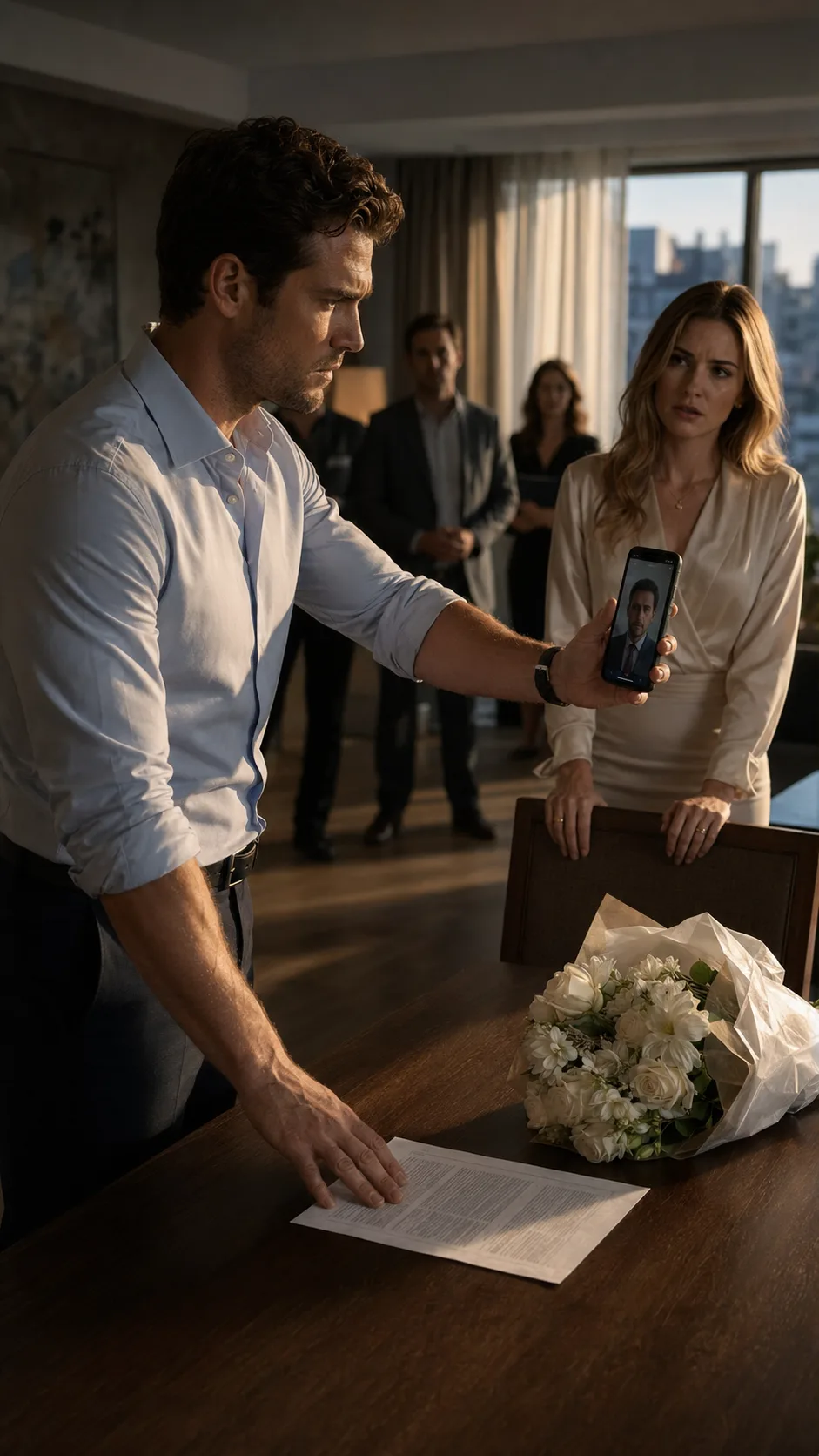
Natalie sat at the far side of the table in a cream blouse with pearl buttons, her hair pinned low, her phone face down beside her hand. Across from her sat a man in a navy suit with a real estate pin on his lapel. Two strangers sat beside him, a couple around Thomas’s age. The woman held a pen. The man had a measuring tape near his water glass.
A contract lay open on the table.
Not a brochure.
Not a listing estimate.
A contract.
The white flowers lowered in Thomas’s hand until the paper wrapper brushed his thigh.
Natalie’s eyes moved to the bouquet. Then to the folder under his arm. Then to his face.
“Thomas,” she said.
Nobody else spoke.
The agent rose halfway from his chair. “Mr. Bennett.”
Thomas did not ask how the man knew his name.
He looked at the document.
His house address sat at the top of the page. Printed cleanly. Black ink. The full legal description followed in blocks of text. The buyer couple had initials marked in several places. A yellow tab stuck out near the bottom.
His chair had been pulled out slightly.
A pen rested beside it.
Natalie reached for the page.
Thomas reached it first.
His fingers pressed the paper flat.
At the bottom of the page, under the seller line, was his signature.
A good copy.
Too good.
It had the same slant, the same clipped T, the same narrow loop in Bennett that he had hated since college. Whoever had done it had practiced.
The flowers touched the dining table.
The sound was soft.
Natalie lifted her chin. “It’s just a consultation.”
Thomas looked at the signature a second longer.
Then he looked at her.
“A consultation,” he said.
The buyer woman set the pen down.
The agent cleared his throat and closed one side of his folder. “Perhaps this would be better discussed privately.”
Thomas kept his palm on the contract.
“No,” he said.
The word settled under the chandelier.
Natalie’s fingers moved once against the edge of the table. Her ring tapped wood. Small. Sharp.
“You came home early,” she said.
“I did.”
“You should have called.”
Thomas looked at the flowers.
Then back at the contract.
“I thought I’d surprise my wife.”
The agent shifted his weight. The buyer man reached for the measuring tape, then left it where it was. A coffee cup near Natalie’s elbow had a lipstick mark on the rim. She had used the good cups. The ones from the cabinet they barely opened.
Thomas noticed that.
He noticed the blue vase was gone from the center of the table.
It sat on the windowsill, empty.
Natalie glanced at the buyers. “This isn’t what it looks like.”
Thomas picked up the top page and turned it toward her.
“My signature is on it.”
Her mouth tightened. “Preliminary paperwork can be corrected.”
“Corrected.”
“It was not final.”
“The pen was beside my chair.”
The buyer woman pushed her chair back an inch. The legs scraped. She stopped, as if even leaving would make her part of the scene.
The agent held up one hand. “Mrs. Bennett told us both owners were informed.”
Thomas did not look away from Natalie.
“She did?”
Natalie stood.
Her chair moved back too fast and hit the sideboard behind her. A silver serving tray rattled against the wood.
The agent looked down.
The buyers looked anywhere else.
Natalie placed both hands on the table, leaning forward just enough to make the pearls at her cuff catch the light. “You have been under pressure for months. The repairs. The bills. That old roof estimate you keep pretending does not exist.”
Thomas let the page fall back to the table.
“I handle the bills.”
“You handle them by delaying everything.”
“I handle them.”
“No. You hold on to this place like it is still your father sitting on that porch.”
The room went still at his father’s name.
Thomas’s hand flattened over the contract again.
Do not move.
Natalie saw it. Something in her face sharpened.
“You want honesty?” she said. “Fine. I am tired of living in an old house that smells like dust every time it rains. I am tired of pretending chipped paint is sentimental. I am tired of listening to you say next year, next month, after one more project, after one more raise.”
Thomas touched the folder under his arm, but did not pull it out.
The promotion letter stayed hidden.
Natalie’s voice carried too well in the dining room. “I deserve a real home. A luxury home. A place where I don’t have to explain to people why the guest bathroom door won’t close.”
The buyer man looked at the bathroom hallway.
Bad instinct.
Thomas saw it.
The agent closed his folder another inch.
Natalie looked at the agent. “This is a misunderstanding.”
Thomas looked at her.
“When were you planning to tell me? After you changed the locks?”
The buyer woman covered her mouth with two fingers.
Natalie’s face shifted. Not much. Enough.
“You always do this,” she said.
“What?”
“You make me the villain because you refuse to grow.”
Thomas picked up the flowers and moved them aside. A few white petals fell loose onto the table, near the forged signature.
He looked at the petals.
Then at her.
Natalie took one step around her chair. “Marcus said you would never find out if we moved fast.”
The name landed between them.
Marcus.
The agent’s head lifted.
Natalie stopped walking.
Her lips parted once. Closed. Opened again.
Thomas did not speak.
The refrigerator hummed in the kitchen. Outside, a car passed the house and its tires whispered against the road. The old clock in the hallway ticked once, then again, as if the house itself had begun counting.
Marcus Vale.
Thomas’s best friend since college.
Best man at the wedding.
Family lawyer.
The man who had brought soup after Thomas’s father’s funeral and stayed late to help sort hospital bills. The man who knew where the deed was filed, which bank held the joint account, and which accounts Thomas rarely checked because he trusted the people closest to him.
Natalie stepped closer. “Thomas.”
He took out his phone.
“Don’t,” she said.
He unlocked it.
The agent rose fully now. “I think we should leave.”
“Nobody leaves yet,” Thomas said.
The agent sat back down.
The buyer man froze with one hand on the table.
Thomas searched Marcus’s name. His thumb paused over the call button for half a breath.
Then he tapped video.
The phone rang.
Natalie came around the table. “Please don’t do this here.”
Thomas looked at her then.
“Here is where you brought them.”
The phone rang again.
Natalie’s fingers curled at her side. She looked toward the buyers, toward the agent, toward the contract, as if one of them might remove the last thirty seconds from the room.
The phone rang a third time.
Marcus answered on the fourth.
He appeared from his office, dark shelves behind him, suit jacket still on, tie loosened at the throat. A glass of water sat near his keyboard. He smiled before he saw anything.
“Tom,” Marcus said. “Everything all right?”
Thomas lifted the contract from the table.
Natalie stopped beside the chair.
Thomas turned the phone so Marcus could see the room first. Natalie. The agent. The buyers. The bouquet. The contract.
Marcus’s smile left slowly, like a light being dimmed.
“What’s going on?” he said.
Thomas turned the contract toward the camera and held it close enough for Marcus to see the signature at the bottom.
His own hand stayed steady.
The paper shook slightly anyway.
“Did you forge my signature?”
Marcus said nothing.
One second passed.
Then another.
The buyer woman lowered her hand from her mouth. The agent’s eyes moved from the contract to the phone screen. Natalie’s breath came in through her nose, too sharp for the quiet room.
Marcus blinked.
His jaw shifted.
Thomas held the page higher.
“Answer me.”
Marcus looked away from the camera.
That was not an answer in words.
It did not need to be.
Natalie gripped the chair back. Her knuckles paled against the dark wood.
“Marcus,” she said.
Marcus looked back at the screen, but not at Thomas. His eyes moved somewhere off to the side of his office. Maybe toward a door. Maybe toward another phone. Maybe toward whatever excuse he had kept ready for months and suddenly could not reach.
Thomas lowered the contract.
The bouquet rested beside his wrist, white petals open under the chandelier.
He set his phone upright against a water glass so Marcus’s face still stared into the room.
Then Thomas reached into his briefcase and removed a second folder.
Natalie took one step back.
“No,” she said.
The agent looked at the folder.
Thomas placed it on the table.
The folder was plain gray. No logo. No label. He had printed the documents three days earlier after the bank app sent a notification for a transfer he did not recognize. At first, he thought it was a mistake. Then he thought it was a subscription. Then he spent two nights at the kitchen counter after Natalie went to bed, going line by line through eight months of statements.
Small amounts first.
Then larger ones.
A transfer to a consulting account.
A payment to a property staging company.
A deposit toward a gated subdivision Thomas had never visited.
Marcus’s name did not appear on every page.
It appeared enough.
Thomas opened the folder.
The first sheet showed the joint account transfers.
The second showed the destination account.
The third showed an email header Marcus had forwarded to himself and forgotten to delete from the shared cloud archive. Thomas had found it because Natalie used the same password for everything.
Messy.
Human.
Fatal.
Thomas turned the first page toward Natalie.
“Eight months,” he said.
Natalie looked at the page and did not touch it.
The buyer man stood. “We had no idea.”
Thomas did not answer him.
The agent spoke next, slower than before. “Mr. Bennett, I was given documentation by Mrs. Bennett and Mr. Vale’s office.”
Marcus’s face moved on the phone screen. “Tom, we should discuss this privately.”
Thomas picked up the phone.
“Now you want privacy.”
Marcus swallowed. The movement was visible even through the small screen.
Natalie stepped toward Thomas. “I was going to tell you once everything was stable.”
Thomas looked down at the contract.
Then at the bank records.
Then at the flowers.
“Stable,” he said.
She pointed at the folder. Her hand shook once before she lowered it. “You don’t understand what it feels like to wait year after year while everyone else moves forward.”
The buyer woman picked up her purse.
The agent began collecting his papers with careful hands, separating his copies from Thomas’s contract as if the pages might burn him.
Thomas turned to him. “Leave your card.”
The agent stopped.
“Now.”
The agent placed a business card on the table.
The buyer couple left without looking at Natalie. Their shoes crossed the hallway. The front door opened, and for a few seconds the late-afternoon air came through the house.
Then the door shut.
Only four people remained.
Thomas.
Natalie.
Marcus on the phone.
And the house.
Natalie’s eyes moved to the phone screen. “Say something.”
Marcus did not.
Thomas almost laughed.
It came out as a breath through his nose.
“You were my lawyer,” Thomas said.
Marcus leaned closer to his camera. “I can explain the transfers.”
“No.”
“I can.”
“No.”
The second no was quieter.
It cut cleaner.
Thomas picked up the forged contract and folded it once. The paper crease ran through his false signature. He placed it inside the gray folder with the bank records.
Natalie reached for his arm.
He stepped back.
She stopped.
Her hand stayed in the air for a second, then dropped to her side.
The clock ticked again in the hallway.
Thomas looked around the dining room. The blue vase sat empty on the windowsill. The good coffee cups had gone cold. The white flowers had begun to sag against their wrapping. One petal had stuck to the edge of the contract page before he folded it, trapped there under the paper.
His father’s table had held birthdays, tax receipts, burnt toast, unpaid bills, sympathy casseroles, and the deed to the house.
Now it held proof.
Thomas ended the call.
Marcus’s face disappeared.
Natalie stared at the black phone screen. “You can’t just hang up.”
Thomas slid the phone into his pocket.
“I just did.”
She drew in a breath, held it, released it through pressed lips. Her face rearranged itself into something practiced. Smaller. Softer. The same expression she used at family dinners when she wanted someone else to look unreasonable.
“Thomas,” she said. “We can fix this.”
He picked up the gray folder.
“We?”
She glanced at the flowers. “I made a mistake.”
He looked at her hand.
No tremor now.
“A mistake is forgetting to pay the water bill.”
Her eyes sharpened.
There she was.
He had seen that look before, but never this clearly. It had appeared in pieces over the years. At open houses. At restaurant tables when friends talked about renovations. At weddings where she ran her fingers over marble counters in other people’s kitchens and came home quiet.
Natalie crossed her arms. “You’re going to ruin both of us over a house?”
Thomas looked toward the hallway, toward the framed photograph of his father on the wall. It was slightly crooked. It had been crooked for three weeks. He had meant to fix it.
He walked over and straightened it.
Natalie did not speak while he did it.
The movement took only a second.
It still felt like the first real thing he had done since opening the front door.
He returned to the dining room and picked up the flowers. The ribbon had loosened again. He did not fix it this time.
“I got promoted today,” he said.
Natalie’s eyes flicked to the folder under his arm.
A small calculation crossed her face before she could hide it.
There.
Thomas saw that too.
He set the flowers back down.
“You were going to sell my father’s house before I could tell you.”
Natalie’s mouth opened.
No words came.
The police report came later.
So did the formal complaint to the bar association. So did the bank investigation, the frozen account, the temporary restraining order on the sale attempt, the divorce filing, and the letter from Marcus’s firm stating that he had been placed on immediate leave pending review.
Those things arrived in envelopes, emails, and phone calls over the next several weeks.
The first night was quieter.
Natalie packed two suitcases and left with the cream blouse still buttoned to her throat. She took her jewelry box, her skincare bottles, three pairs of heels, and the framed wedding photo from the bedroom dresser.
She left the blue vase.
Thomas slept on the couch because the bedroom smelled like her perfume and the guest room still had boxes of his father’s books stacked against the wall. At 2:17 a.m., he woke to the sound of the house settling. The porch creaked once in the dark.
He got up and checked the front door.
Locked.
He checked the back door.
Locked.
Then he stood in the dining room with the lights off and looked at the table.
The coffee cups were still there.
So were the flowers.
He put them in the blue vase before sunrise.
Not for Natalie.
Not for peace.
Because they had already been paid for.
Weeks passed in paperwork.
Thomas learned how many signatures could be challenged, how many accounts could be traced, how many smiles in old photographs could look different after a lawyer explained intent.
Marcus called once from an unknown number.
Thomas let it ring.
Natalie sent three messages the first week, two the second, none by the fourth. Her attorney used cleaner language than she ever had. The house remained in Thomas’s name. The attempted sale collapsed. The buyers sent a brief statement through the agent saying they had believed all parties were informed.
The agent cooperated.
Marcus did not keep his license.
The bank recovered part of the money. Not all of it. Enough to repair the roof when spring came.
Thomas used the promotion raise for the rest.
He hired a contractor his father would have disliked because the man wore white sneakers on job sites, but the work was good. The porch stopped creaking. The upstairs bathroom window opened without a fight. The dining room floor still complained near the sideboard, and Thomas left it that way.
Some warnings deserved to stay.
On the first warm evening after the repairs were done, Thomas came home from work with no flowers, no folder, and no announcement waiting in his briefcase.
He opened the front door.
The house was quiet.
The blue vase sat in the center of the dining table. Empty. Clean. The photograph in the hallway stayed straight. The table had one pale mark where the bouquet paper had trapped moisture in the wood that day.
Thomas ran his thumb over it once.
Then he set his keys down beside it and opened the curtains.
The house held.
Chapter complete
You have reached the end of this chapter.
Continue reading
A few more worlds to get lost in after this chapter.




