I found my father’s coffee mug behind the toaster on the morning we started sorting his things.
Chapter 1
I found my father’s coffee mug behind the toaster on the morning we started sorting his things.
It still had a brown ring at the bottom.
My mother had washed every plate, folded every condolence card, and packed the leftover ham from the funeral into plastic containers, but she had not touched that mug. It sat where he had left it the week before his heart finally stopped, handle turned toward the chair he always used, a small crack running down one side like a hairline in old porcelain.
“Throw it out,” my sister Karen said from the pantry doorway.
I picked it up.
“Not yet.”
She made a sound through her nose, not quite a laugh. Karen had flown in from Raleigh with a black suitcase, a folder full of estate forms, and the kind of efficiency that made every room feel like a meeting. She wore her hair pinned back and kept checking her watch, though none of us had anywhere to be.
My younger
brother, Michael, was kneeling beside the lower cabinets, pulling out old extension cords and coffee cans full of screws. He held up a rusted hinge.
“Dad saved everything.”
“He called it being practical,” I said.
Karen slid a cardboard box across the kitchen table with the side of her hand.
“He called a lot of things practical.”
No one answered.
My father, Robert Carter, had lived seventy-four years in the same slow, careful manner. He drove below the speed limit. He sharpened pencils with a pocketknife. He filled out rebate forms. He spoke so little at family dinners that my children used to count his words, then giggle when they reached ten.
He had served in the National Guard before I was born, but that fact sat in our family like an old tool nobody used. It was there. It had weight. It had no story attached.
Whenever anyone asked,
he gave the same answer.
“Nothing worth telling.”
That was all.
My mother, Ellen, sat at the kitchen table while we worked around her. She wore a beige cardigan over a dark blouse, though the house was warm. Her hands rested around a cup of tea she had not drunk. Every so often, her eyes moved to the back hallway, toward my father’s small den.
Not much.
Just enough.
The den had always been his room. A narrow space with a rolltop desk, two metal filing cabinets, an Army calendar from 1998 he never took down, and a wooden chair whose left leg had been repaired with tape and stubbornness. When I was a boy, I would stand in the doorway and watch him pay bills under a green banker’s lamp. He never invited me in. He never pushed me out.
That was worse.
Karen stacked insurance papers on one
side of the table and medical bills on the other.
“We need to finish the den today,” she said. “The realtor can come next week if Mom agrees.”
My mother’s fingers tightened around the cup.
“She hasn’t agreed,” I said.
Karen did not look at me.
“She can’t keep this house by herself.”
Michael shut the cabinet door too hard.
“Can we not do this right now?”
Karen picked up my father’s coffee mug, turned it once, and placed it near the trash bag.
“It’s just stuff.”
My mother stood.
The chair scraped softly against the floor. She walked to the counter, took the mug from Karen’s hand, and set it beside the sink. Then she returned to her seat without a word.
Small thing.
Nobody touched it again.
By noon, the kitchen smelled like dust, cold coffee, and old paper. We had opened three boxes from the attic and found nothing more important than tax returns, instruction manuals, and a stack of birthday cards my father had kept without ever mentioning them. My name was on seven of them. Karen’s on nine. Michael’s on eleven.
Karen noticed.
She counted twice.
“Figures,” she said.
Michael looked up.
“What?”
“Nothing.”
But it was not nothing. In our family, nothing had always been the shape of my father.
He had gone to every school play and stood in the back. He had paid for braces and never discussed money. He had bought Karen her first car, used, with a broken radio, and let her think the dealership had given him a deal. He had driven eight hours to pick Michael up from college after a bad night Michael still refused to describe. He had sat beside my hospital bed after my appendix burst and read Popular Mechanics while I slept.
He did these things like repairs.
Quietly.
Without asking thanks.
That made it easy, over the years, to mistake silence for distance.
Karen opened the den door after lunch.
The hinges complained.
My mother looked down at her tea.
“You don’t have to go in,” I told her.
She nodded, but she did not move. So the three of us stepped into the room where my father’s life had been folded into drawers.
The den smelled like pencil shavings and machine oil. A small American flag stood in a cup beside the lamp. On the wall above the desk hung his National Guard photograph, the one we had used at the funeral. He was twenty-two in it, broad-shouldered, clean-shaven, staring past the camera as if someone had called his name from another room.
Michael opened the first filing cabinet.
“Utilities. Car insurance. Furnace receipts.”
Karen opened the second.
“House deed. Warranties. Medical.”
I lifted the rolltop on the desk. It stuck halfway, then jumped open with a wooden clatter. Inside were envelopes tied with rubber bands, a tin of paper clips, a dried-out fountain pen, and a small brass key taped under the top shelf.
I stopped.
“What is it?” Michael asked.
I peeled the tape away.
Karen turned.
“Key?”
“Looks like it.”
“For what?”
I looked around the room. The filing cabinets were open. The desk drawers had no locks. The closet door was plain. On the bottom shelf, behind a stack of National Geographic magazines, I noticed a narrow metal box the color of old smoke.
I pulled it out.
The key fit.
Karen crossed the room before I opened it.
“Careful.”
That word did not suit her mouth.
Inside the box was a bundle of letters tied with blue cotton string, a faded photograph of my father standing beside two other young men in uniform, and a folded paper with my mother’s handwriting across the front.
Daniel only.
My name.
Karen reached for it.
I moved the box back.
“It has my name on it.”
She drew her hand away.
“Fine.”
The paper was brittle at the creases. I unfolded it on the desk.
My mother’s handwriting was younger there, rounder, less cramped than it had become in grocery lists and Christmas cards.
If your father never tells you, don’t think it means there was nothing.
That was the whole note.
No explanation.
Just that.
I read it twice, then carried it to the kitchen. My mother was still at the table, her tea cold, her cardigan buttoned wrong.
I placed the note in front of her.
She looked at it.
For a long time, she did not touch it.
“Mom,” I said.
She picked it up and ran her thumb over the words.
“He made me promise,” she said.
Karen and Michael came in behind me.
“Promise what?” Karen asked.
My mother folded the paper once.
“To let him be ordinary.”
The refrigerator hummed into the silence.
Michael shifted his weight.
“Ordinary?”
My mother’s face stayed turned toward the note. “That was the word he used.”
Karen pulled out the chair across from her and sat. “Mom, what are we talking about?”
My mother looked smaller at the table than she had that morning. The cup beside her had left a pale ring on the wood.
“Your father came home different after training,” she said. “Not in a way people noticed. He still went to work. Still mowed the lawn. Still fixed Mr. Avery’s truck when it wouldn’t start. But he stopped sleeping through the night.”
Michael put his phone facedown on the table.
Training.
That was the family word. The safe one. My father had been deployed briefly during a tense overseas mission attached to a federalized Guard unit before any of us were born. He had never called it combat. He had never called it war. He had never called it anything.
Karen leaned forward.
“Why didn’t you tell us?”
My mother looked at her.
“Because I was his wife.”
Karen opened her mouth. Closed it.
A car passed outside, slow over the gravel road. The kitchen window shook lightly in its frame.
I returned to the den and went through the metal box again. The letters were mostly from my mother, written before they married. One had a lipstick mark so faint it was almost gone. Another held a pressed leaf that crumbled when I touched the edge.
The photograph with the two soldiers had names written on the back.
Bobby Carter. Frank Willis. Thomas Reed.
The third name had been underlined.
Thomas Reed.
I carried it back to the kitchen.
“Do you know them?”
My mother took the photograph. Her hand hovered over the underlined name.
“Tommy,” she said.
Michael leaned closer.
“Who was he?”
“Your father’s friend.”
Karen’s voice sharpened. “What happened to him?”
My mother placed the photo down. “Ask the records.”
That was all she would say.
The next morning, I called the North Carolina Department of Military and Veterans Affairs. Then I called the county records office. Then the National Personnel Records Center, where a woman with a tired voice explained forms, delays, verification, next of kin, archived files, service numbers, and partial records.
I filled out everything.
Karen said it was a waste of time.
Michael said nothing.
My mother gave me my father’s Social Security card, his discharge paperwork, and a small envelope with his service number written in his own blocky hand.
“Don’t lose that,” she said.
“I won’t.”
She held it an extra second before letting go.
The request went out on a Tuesday. Karen returned to Raleigh two days later, taking the estate folder and leaving behind a list of things she wanted done before the house could be sold. Michael stayed until Sunday, then drove back to Charlotte with a box of tools and my father’s old fishing tackle.
I stayed.
Not because anyone asked.
My wife brought the kids by after school. They sat at the kitchen table eating cereal from mismatched bowls while my mother folded funeral napkins into squares no one needed. My daughter asked why Grandpa never smiled in pictures.
My mother set down a napkin.
“He did.”
“Not with his mouth,” my daughter said.
My mother touched the edge of the table.
“No,” she said. “Not much.”
Weeks passed. The house developed the sound of waiting. Mail dropped through the slot each afternoon. The old furnace clicked at night. My father’s chair remained at the table, though no one sat in it.
Karen called every few days.
“Any update?”
“No.”
“Then we need to proceed.”
“Mom isn’t ready.”
“She’ll never be ready if you keep treating the house like a shrine.”
“It’s been four weeks.”
“It’s been long enough to know Dad wasn’t hiding treasure.”
There it was.
The crack in her voice was not grief. It was impatience wrapped in practicality.
“He hid something,” I said.
“Daniel.”
“One note. One locked box. One underlined name.”
“Maybe he just didn’t want us digging through his life.”
“Maybe.”
She exhaled into the phone.
“You always did this with him.”
“Did what?”
“Made him deeper than he was.”
I looked toward the den. The lamp was off, but afternoon light caught the glass over his photograph.
“He was our father.”
“He was quiet. That’s not the same as mysterious.”
I ended the call before I answered.
Not noble.
Just tired.
A week later, Michael came by with takeout and a six-pack he forgot to open. We ate at the kitchen table with my mother between us. The cardboard containers left grease spots on the paper plates.
After dinner, he followed me into the den.
“Karen says you’re obsessing.”
“Karen says many things.”
“She says Mom needs closure.”
I opened the desk drawer and took out the photograph of my father, Frank Willis, and Thomas Reed.
“Look at Dad’s hand.”
Michael frowned.
“What about it?”
In the picture, my father’s left hand gripped Thomas Reed’s sleeve. Not casually. His knuckles stood out white even in the faded print. Thomas had one arm around my father’s shoulder, laughing at something outside the frame. Frank Willis held a cigarette.
Michael turned the picture toward the lamp.
“Okay.”
“Look at the back.”
He flipped it.
His eyes stopped on the underlined name.
“Tom Reed,” he said.
“Mom called him Tommy.”
“So?”
“So she told me to ask the records.”
Michael put the photograph down. “You think Dad did something involving him.”
“I think everyone knew except us.”
“No.” Michael shook his head once. “Not everyone.”
He reached into his jacket pocket and pulled out a folded church bulletin from the funeral. My father’s photograph stared up from the front.
“I saw a man at the service,” he said. “Old guy. Gray suit. He stood near the back, by the door.”
“A lot of people came.”
“He didn’t sign the guest book.”
I waited.
Michael rubbed his thumb against the edge of the bulletin.
“He left before the hymn ended. But he saluted Dad’s casket.”
The room felt suddenly too full.
“Did you know him?”
“No.”
“Why didn’t you say anything?”
Michael looked at the floor.
“Because I thought it was weird. Then Karen started talking about listing the house, and Mom looked like she might break in half if anyone touched the flag.”
He picked up the photograph again.
“I think the man was this one.”
He pointed to Frank Willis.
The cigarette.
The grin.
The young face beside my father.
I found Frank Willis two days later through an obituary for his wife and a veterans’ group newsletter in Fayetteville. His phone number was printed beneath a notice for a reunion luncheon that had happened five years earlier.
I called.
A man answered on the sixth ring.
“Willis.”
“My name is Daniel Carter. Robert Carter was my father.”
The line changed.
Not sound.
Weight.
“Bobby’s boy,” he said.
“Yes, sir.”
No answer.
“I’m sorry to bother you.”
“You’re not.”
I sat down at the desk.
“You were at his funeral.”
“I was.”
“You didn’t come speak to us.”
“No.”
“Why?”
A long breath moved across the line.
“Because your father asked me not to.”
My hand closed around the phone.
“When?”
“Thirty years ago.”
The desk clock ticked twice.
“What happened to Thomas Reed?”
Frank Willis did not answer right away.
A truck backed up somewhere on his end, the warning beeps faint and far away.
“You requested the record,” he said.
“How do you know that?”
“Ellen called me.”
My mother.
Of course.
Frank cleared his throat.
“When it comes, read the citation first. Not the letters. Not the witness statement. The citation.”
“Why?”
“Because that is what the Army could say in public.”
“And the rest?”
His voice dropped.
“That is what your father had to live with.”
The call ended a minute later. He gave me no more.
That night, I found my mother in the den.
She stood in front of the photograph on the wall, one hand on the back of my father’s chair. She had not turned on the lamp.
“Frank Willis called you,” I said.
“Yes.”
“You knew he came to the funeral.”
“Yes.”
“Mom.”
She turned then. Her face looked older in the dim room, the lines beside her mouth cut deeper by shadow.
“Your father saved that man’s life too,” she said.
“Frank’s?”
She nodded.
“And Thomas Reed?”
Her fingers tightened on the chair.
“Tommy didn’t come home.”
The words sat between us.
Four of them.
I asked the next question because I was still a son, still trying to open a locked door with bare hands.
“Did Dad blame himself?”
My mother looked at the photograph.
“Every night.”
She walked past me and left the den.
The envelope arrived eleven days later.
It was thicker than I expected.
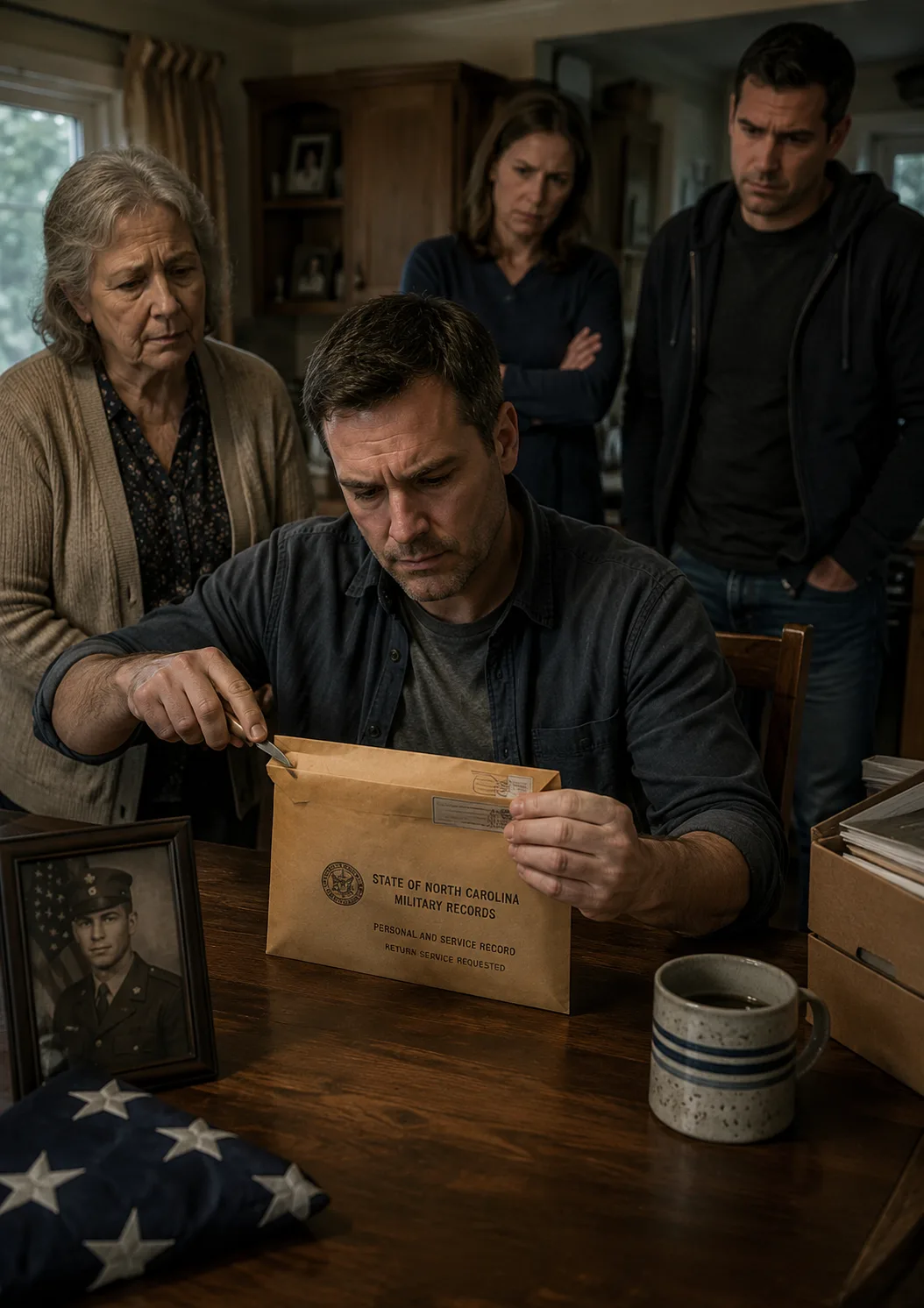
The return address was official, typed cleanly in the upper left corner. North Carolina. Military records. My father’s full name. His service number. My hands paused at the mailbox, the metal door still hanging open.
A wasp crawled along the wooden post.
I did not move until it flew away.
Inside, my mother was at the kitchen table. Karen had come back that morning with more forms. Michael arrived twenty minutes after I called him, his shirt untucked, hair still damp from a shower. Karen had already spread estate documents across the table like she could cover the past before it surfaced.
When I placed the envelope down, she looked at it, then at me.
“You called them again?”
“It came.”
She leaned back.
“Well. Open it.”
My mother’s hands folded in her lap.
Michael stood near the counter, phone in his pocket this time. A cardboard box of my father’s papers sat open beside him. The den door remained half shut behind us.
I sat in my father’s chair.
No one told me not to.
The envelope lay on the table beside his chipped mug, which my mother had moved back from the sink days earlier. The mug was empty. Clean. The crack down its side caught the light from the window.
I took the letter opener from the drawer.
Karen crossed her arms.
“Let’s see what all this has been about.”
I slid the blade under the flap.
The paper tore unevenly at the corner.
Not clean.
The sound made my mother close her eyes for half a second, then open them again. Michael stepped closer. Karen stayed where she was, but her fingers tapped once against her sleeve.
I pulled out the first stack.
Service dates.
Assignment record.
Medical form.
A copy of his discharge.
Ordinary pages, dry with official language, full of acronyms and lines that reduced years into boxes. I laid them aside one by one. Karen picked up the discharge form before I finished with it.
“See?” she said. “Standard.”
I did not answer.
Another page slid out behind it, folded twice. Heavier paper. Different texture. The edges had yellowed, though the copy had been preserved under a clear protective sheet.
At the top, in bold capital letters, were the words:
DISTINGUISHED SERVICE CROSS
My breath caught in my throat, but no sound came out.
Not yet.
I unfolded the page completely.
My father’s full name appeared beneath the heading.
Robert James Carter.
Typed.
Official.
Undeniable.
Karen stood so quickly her chair leg scraped against the floor.
Michael moved to the table and placed both hands on the back of the empty chair beside me.
My mother did not stand.
She looked at the paper, then at the mug.
I read the first line silently because I could not trust my voice with it. The citation praised extraordinary heroism during hostile action. It described a convoy ambush, wounded men trapped under fire, and a young guardsman who left cover three times to pull others from a burning vehicle.
Three times.
My father had complained if I left the porch light on too long. He had refused to replace a toaster until it sparked blue. He had eaten toast scraped black with a butter knife.
Three times.
I placed the citation flat on the table.
Karen reached toward it.
“Wait.”
My voice came out sharper than I expected. Her hand stopped above the paper. Slowly, she pulled it back.
I picked up the old photograph from the metal box. My father stood there beside Frank Willis and Thomas Reed, young and thin and unknowable.
I placed the photograph beside the citation.
Name beside face.
Past beside proof.
Michael leaned over the table, reading faster now. His lips moved without sound.
Karen shook her head.
“There must be some mistake.”
My mother’s chair creaked.
“There isn’t.”
Karen turned toward her.
“You knew?”
My mother stood then. Not quickly. She pushed both palms against the table and rose with the effort of someone standing from a pew after a long service.
“I knew there was a medal,” she said.
“A medal?” Karen’s voice cracked on the word. “Mom, this isn’t a participation ribbon.”
My mother looked at her.
“No.”
The kitchen clock ticked over the stove. A fly bumped once against the window, then again.
I looked back at the citation and began to read aloud.
“For extraordinary heroism…”
My voice held for those three words.
Barely.
The citation described the attack in language polished by command and distance. It said my father’s unit had been caught on a narrow road after an explosion disabled the lead vehicle. It said hostile fire came from both sides. It said two soldiers were pinned near the burning wreckage.
One was Frank Willis.
One was Thomas Reed.
My father, then Specialist Robert J. Carter, had moved across open ground under direct fire to drag Willis behind cover. He returned for Reed, whose leg had been trapped beneath twisted metal. The vehicle had begun to burn.
My mother sat back down.
Her hand found the coffee mug.
I kept reading.
The citation said my father ignored orders to stay back and entered the danger area a third time with a field axe from the convoy truck. It said he freed Reed’s leg enough to move him. It said additional fire forced the remaining men back.
There was one sentence near the bottom.
Specialist Carter remained with the wounded soldier until evacuation was impossible.
I stopped.
The room stopped with me.
Michael lowered his head.
Karen pressed her fingers against her mouth.
My mother stared at the mug in her hands as if it were warm.
I read the final line.
For his actions, Specialist Robert J. Carter reflected great credit upon himself, his unit, and the United States Army.
No one spoke after that.
The house made its old sounds around us. Furnace. Window. Clock. The soft shift of paper under my hand.
Karen took one step back from the table.
The motion was small, but it gave the citation more room than anything she had said.
Michael pulled out the chair beside me and sat without looking away from the document.
My mother reached into the pocket of her cardigan and took out a folded handkerchief. She did not use it. She set it on the table beside the mug.
I turned the page over.
There were more records behind it. A witness statement. A recommendation letter. A note about the medal presentation my father had declined to attend publicly. A copy of a letter sent to my mother before they married.
But Frank Willis had told me what to read first.
So I did.
The citation lay in the center of the table, no longer folded, no longer hidden in a file or locked in a box or buried beneath the phrase nothing worth telling.
I placed my palm flat beside it.
Not on it.
Beside it.
Karen looked at my hand, then at the photograph. Her shoulders lowered.
“He never said,” she said.
My mother’s answer came without force.
“He asked me not to.”
Michael looked up.
“Why?”
She turned the mug once between her hands.
“Because Tommy Reed had a mother.”
The words moved through the kitchen with no hurry.
My father had returned alive. Frank Willis had returned alive. Thomas Reed had not. And somewhere, years before we existed, a mother had received a folded flag, a letter full of careful language, and maybe the name Robert Carter written in a place she could not decide whether to bless or blame.
Karen sat down.
No one had invited her.
She reached for the old photograph, but this time she waited. I nodded, and she picked it up by the edges. Her thumb hovered near my father’s young face.
“He looked so young,” she said.
“He was twenty-two,” Mom said.
Michael’s jaw worked once.
“Did he get the medal?”
My mother nodded.
“Privately. In a room at the armory. He wore his dress uniform. I wore the blue dress your grandmother made me. There were six men there, maybe seven.”
“Where is it?” Karen asked.
Mom looked toward the den.
“He gave it away.”
“To who?”
She did not answer right away.
Then she said, “To Tommy’s mother.”
Karen set the photograph down as if it had grown heavier.
My mother folded her handkerchief into a square.
“She mailed it back a year later. Said she couldn’t keep it. Your father put it in the metal box and never opened it again.”
I stood.
The chair moved behind me.
In the den, I went to the metal box and lifted out the letters, the blue string, the photograph. At the bottom, under a sheet of tissue paper yellowed at the fold, was a small presentation case.
Black leather.
Cracked at the hinge.
I carried it back to the kitchen and placed it beside the citation. I did not open it at first. My mother watched the case. Karen watched my mother. Michael watched the floor.
I opened the lid.
The medal rested inside, dark and bright at once, its ribbon faded at the edges. It did not look like something that belonged in our kitchen beside cold coffee and estate forms. It looked too formal. Too final.
Karen pushed the estate folder away.
The papers slid against the salt shaker and stopped.
“I didn’t know,” she said.
Nobody answered.
She looked at Mom.
“I said things.”
“Yes,” Mom said.
Karen’s face changed, but no apology came yet. She reached into her purse, took out her phone, and turned it off. Not silenced. Off.
Michael stood and walked to the counter. He picked up my father’s mug and held it under the faucet, though it was already clean. Water ran over the crack and down his wrist.
“Leave it,” Mom said.
He turned off the faucet.
The mug remained in his hand.
After a while, I read the witness statement from Frank Willis. His sentences were rougher than the citation. Less polished. They described heat, smoke, shouting, and my father crawling on his stomach because standing meant dying. Frank had written that Robert Carter shoved him behind a tire, slapped him once to keep him awake, and went back for Tommy Reed before anyone could stop him.
The last paragraph had been signed with a hand that pressed hard enough to mark the page.
I owe him my life. He would not say that. I am saying it.
The room had no use for Karen’s lists after that.
One by one, she gathered the estate papers and put them back in her folder. Michael closed the cardboard box of tools. My mother carried the medal case into the den and placed it on my father’s desk beneath the green banker’s lamp.
She left the lid open.
That night, nobody left right away.
Karen slept in the guest room. Michael took the couch. I sat with my mother in the kitchen after the others had gone quiet. The overhead light was off. Only the small lamp by the stove burned, yellow against the dark window.
“Why now?” I asked.
She looked at the den doorway.
“He didn’t want it opened while he was alive.”
“But he left the key.”
“For you.”
“Why me?”
A small smile touched her mouth and disappeared before it could become anything more.
“Because you kept asking him questions after everyone else stopped.”
I looked down at my hands.
“I stopped too.”
“No,” she said. “You just learned to ask quieter.”
The clock above the stove clicked into the next hour.
“What did he dream about?” I asked.
My mother folded her hands.
“Fire,” she said. “Mostly fire.”
The next morning, Karen made breakfast for the first time in years. Eggs, toast, bacon too crisp on one side. She moved around the kitchen without giving orders. When she opened the cabinet, she stood too long in front of the mugs, then chose one that was not my father’s.
Michael came in wearing the same clothes as the night before. He picked up the citation from where I had left it inside a clear sleeve and read it again while standing beside the table.
Karen placed a plate in front of him.
“Eat.”
He took the toast and did not argue.
My mother entered last. She had brushed her hair and pinned it back. On her cardigan, near the second button, she wore a small gold pin I had never seen.
“Was that his?” I asked.
She touched it once.
“Mine. From the armory ceremony.”
Karen looked at it.
“You kept that all these years?”
Mom poured coffee into three mugs, then paused at the fourth. My father’s mug sat beside the pot.
She filled it halfway and placed it at his chair.
Nobody said a word.
Later that week, we called Frank Willis together. We put the phone on speaker in the den. Frank answered with a cough and a gruff hello.
Karen was the first to speak.
“Mr. Willis, this is Karen Carter. Robert’s daughter.”
“Yes, ma’am.”
“I owe you an apology.”
“No, you don’t.”
She looked at the medal case.
“I think I do.”
Frank let the silence sit.
“Your father didn’t want worship,” he said. “He didn’t want pity either. Most people only know how to give one or the other.”
Michael leaned forward.
“What did he want?”
Frank’s voice softened around the edges.
“To come home and cut his grass.”
That sounded like my father.
It sounded so much like him that I had to turn away from the desk.
The realtor did not come the next week.
Karen canceled the appointment herself.
My mother stayed in the house through spring. I came by every Saturday and fixed what my father had meant to fix but never did. Michael replaced the broken porch light. Karen organized the records into sleeves, not to erase them this time, but to preserve them. She labeled each folder in her neat handwriting and left empty spaces for anything else we might find.
We found more.
A Christmas card from Frank Willis. A newspaper clipping my father had cut out but never shown us. A letter from Thomas Reed’s mother, written in blue ink, thanking him for returning the medal and asking him to live long enough for both boys.
My mother read that one alone.
She returned it to the box and rested her hand over it before closing the lid.
In May, the local veterans’ hall held a small memorial service for my father. Not a public spectacle. Not a parade. Just folding chairs, coffee in paper cups, and men in jackets that no longer fit across the shoulders. Frank Willis came with a cane and a gray suit. He stood before my mother and took both her hands.
“Ellen,” he said.
“Frank.”
That was all.
He saluted my father’s photograph again, but this time he did not leave before the hymn.
Karen brought her children. Michael brought his. My daughter stood beside me and studied the framed citation near the front of the room.
“Grandpa was brave,” she said.
I looked at the photograph.
“Yes.”
“Why didn’t he tell us?”
I watched Frank Willis lower himself carefully into a chair. I watched my mother straighten the ribbon on the medal case. I watched Karen touch the edge of the program, fold it, unfold it, fold it again.
“Some stories cost too much to say out loud,” I told her.
She thought about that. Then she slipped her hand into mine.
At the end of the service, Frank walked to the front. His cane tapped once, twice, three times across the floor. He did not give a speech. He placed a folded piece of paper beside the medal case and returned to his seat.
I opened it after everyone had gone.
Bobby never thought he deserved the medal. Tommy’s mother thought he did. So did I.
The handwriting shook across the page.
I placed the note inside the metal box with the others.
That summer, my mother decided to stay in the house. Not because she could manage every repair or climb every stair without gripping the rail. Because the house had stopped being a burden to be solved and had become a place with its doors opened.
Karen still visited with folders, but now they held insurance quotes for roof work, not listing agreements. Michael came on Sundays and sat in my father’s chair only after Mom told him to stop hovering. He drank coffee from the chipped mug once, by accident, and froze when he noticed.
Mom waved him off.
“Use it.”
He did.
The crack held.
On the first anniversary of my father’s death, I drove to the cemetery alone. I brought no flowers. He would have considered flowers wasteful after the first day. Instead, I brought a small cloth and cleaned the dust from his headstone.
Robert James Carter.
Husband. Father. Soldier.
We had added the last word after finding the record. My mother approved it. Karen paid for the engraving. Michael stood beside the stonecutter while he worked, arms crossed, saying nothing until the man finished.
I sat on the grass and took the copied citation from my jacket pocket.
The original stayed at home now, framed in the den beneath the photograph of three young soldiers. The medal case sat below it. The metal box remained unlocked.
I read the citation once more, from the first line to the last.
The words still sounded too formal for him.
Great credit.
Extraordinary heroism.
United States Army.
None of it mentioned the way he saved rubber bands in a drawer, or how he cut apples with the same pocketknife he used on twine, or how he stood in the rain at my Little League games with his hands in his jacket pockets, never cheering loud enough to embarrass me.
None of it mentioned fire.
None of it mentioned silence.
I folded the copy and placed it back in my jacket.
On my way out, I passed an older woman standing at a nearby grave with a plastic bouquet in her hand. She nodded. I nodded back. The cemetery mower droned near the far fence, moving in slow straight lines.
At home, my mother was in the kitchen.
My father’s mug sat on the table, turned toward his chair.
She had made coffee.
Two cups.
I sat where I always had, across from him, across from the empty chair that was not as empty as it used to be. My mother pushed the mug toward me.
“Use that one,” she said.
I wrapped my hand around the cracked porcelain.
It was warm.
My father had spent his life telling us there was nothing worth telling. In the end, the record told us what he could not. But the paper was not the whole man. Neither was the medal. Neither was the silence.
The mug left a brown ring on the table.
This time, nobody wiped it away.
Chapter complete
You have reached the end of this chapter.
Continue reading
A few more worlds to get lost in after this chapter.




