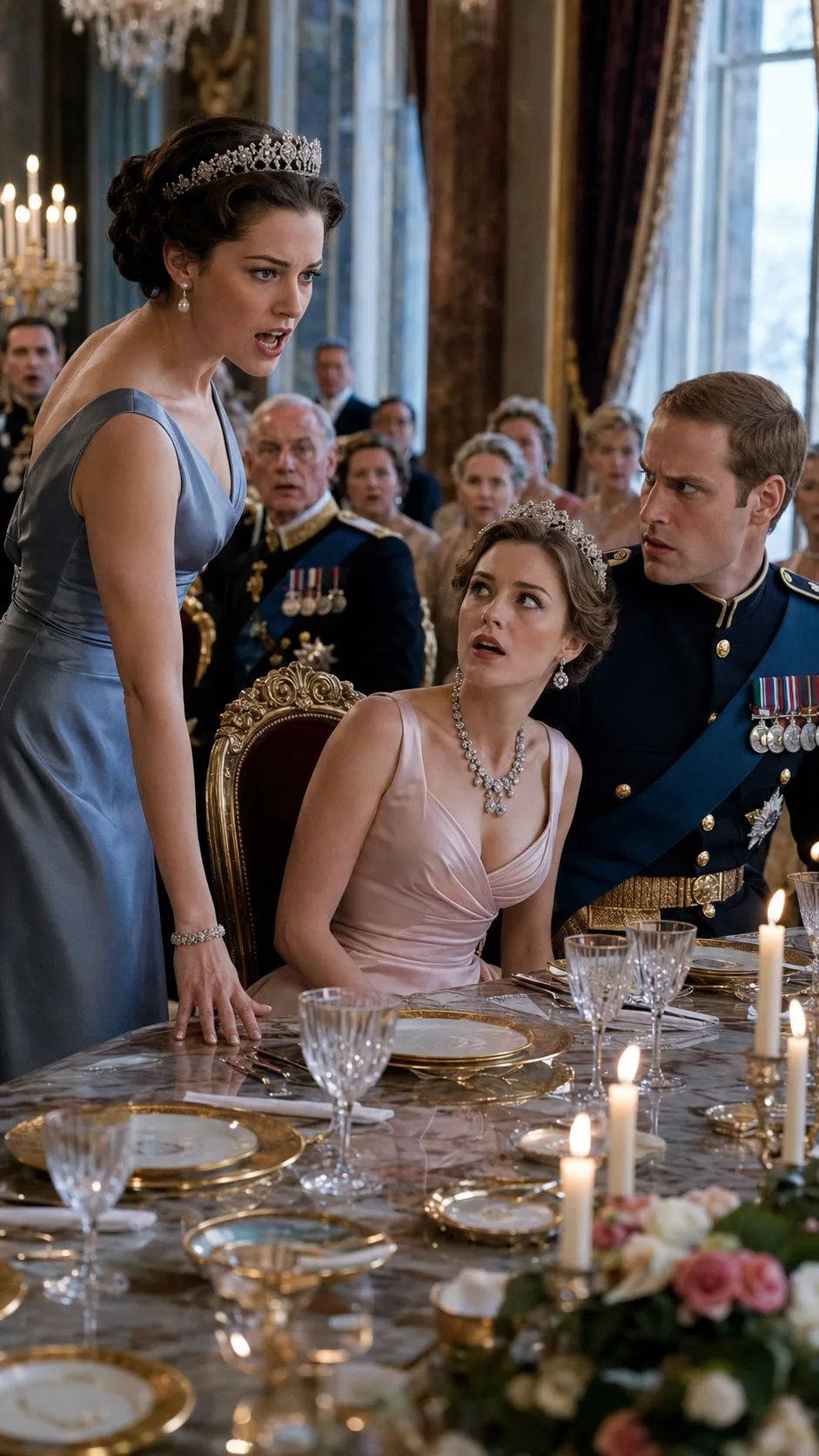
The Seat Beside the Prince Was Not a Chair — It Was the Future Crown
The royal banquet at Ravenshire Palace began with music soft enough to hide a lie.
Chapter 1
The royal banquet at Ravenshire Palace began with music soft enough to hide a lie.
Crystal glasses lined the long marble tables. White candles burned between silver plates and folded silk napkins. Every noble family in the kingdom had sent someone that night. Dukes, ambassadors, generals, royal cousins, foreign ministers.
Everyone was watching.
Princess Margaret knew that before she even entered the hall.
She stood in the east waiting room, staring at herself in the mirror.
Her silver-blue satin gown was simple compared to what her younger sister usually wore. No heavy diamonds. No dramatic neckline. No desperate sparkle. Just pearl earrings, a slim tiara, and her mother’s old sapphire pin fastened near her heart.
She looked calm.
That was what people always said about her.
Princess Margaret was calm.
Princess Margaret was cold.
Princess Margaret never cried in public.
They said it like it was a flaw.
Behind her, Lady Helena adjusted the final fold of her train.
“Your Highness,” she said softly, “Prince
William has arrived.”
Margaret nodded.
“And Princess Alice?”
Lady Helena hesitated.
“She entered the banquet hall ten minutes ago.”
Margaret closed her eyes for one second.
Of course she had.
Alice always arrived first when she wanted something that belonged to Margaret.
When they were children, Alice had taken Margaret’s favorite ivory comb before a portrait sitting. When Margaret asked for it back, Alice smiled and said, “I only borrowed it.”
When they were teenagers, Alice stepped into Margaret’s first dance with a visiting prince and laughed when people stared. “It was only a dance.”
When Margaret was appointed to the Royal Charity Council, Alice gave an interview that same morning announcing her own “special interest” in the same charity. “It’s only good publicity for the family.”
It was always only something.
Only a comb.
Only a dance.
Only a title.
Only attention.
But tonight was not a childhood game.
Tonight was the Aldenmere State Banquet.
Tonight, the treaty between Ravenshire and Northvale would be confirmed in front of seven kingdoms.
And the seat beside Prince William was not just a seat.
It was the public sign of the future royal consort.
Margaret had read the treaty herself. Every page. Every clause. Every careful sentence written by old men who thought marriage was just another border agreement.
Article Seven stated that the woman seated at Prince William’s right hand during the first state banquet after ratification would be formally recognized by both courts as his future consort.
Princess Margaret.
Not Alice.
Not anyone else.
Margaret had not asked for that life when negotiations first began. At first, Prince William of Northvale had been only a name attached to military reports, trade routes, and old alliances.
Then she met him.
He was not charming in the easy way court ladies liked.
He did not flatter. He did not fill silence with pretty words. He listened.
The first time they spoke alone, she expected a lecture about duty.
Instead, he asked, “Did anyone ask whether you wanted this treaty?”
Margaret had looked at him for too long.
“No,” she said.
His face did not change, but his voice softened. “Then I am asking now.”
That was the beginning.
Not romance.
Not yet.
Something quieter.
Respect.
In the months that followed, William sent her marked copies of treaty drafts. He asked for her corrections. He pushed back when ministers ignored her notes. He stood beside her in council meetings when men twice her age tried to speak over her.
He never made her feel like an ornament.
That was dangerous.
A woman could survive being used.
It was harder to survive being seen.
A knock sounded at the door.
Lord Chamberlain entered, carrying his black leather ceremonial book.
“Your Highness,” he said, bowing. “The hall is ready.”
Margaret turned from the mirror.
“The original seating chart,” she said. “Where is it?”
He paused.
“In the ceremonial box beside the head table. Sealed with both royal stamps.”
“Keep it close.”
His expression shifted.
He understood.
“Yes, Your Highness.”
Margaret lifted her chin.
“Then let us begin.”
The palace doors opened.
The music changed.
Every head in the banquet hall turned toward her.
Margaret walked alone down the center aisle.
The room glittered around her. Gold-framed portraits watched from the walls. The ceiling rose high above her, painted with old victories and dead kings. Snow tapped softly against the tall windows, but inside, the air felt hot and tight.
She kept her eyes forward.
At the raised head table, King Edmund sat at the center. Queen Eleanor sat beside him, covered in emeralds and silence. Prince William sat to the king’s right in his navy military uniform.
And in the seat beside William sat Princess Alice.
Margaret stopped at the foot of the platform.
For one second, nobody moved.
Alice looked beautiful. She always did. Pale pink satin. Diamonds at her throat. Golden hair falling over one shoulder. Her hand rested lightly near William’s glass, as if she had belonged there all evening.
William was not smiling.
His jaw was tense. One hand gripped the armrest of his chair. He looked ready to stand, but he was surrounded by ambassadors and ministers. Any sudden move from him could turn a family insult into an international incident.
Alice knew that.
She had chosen the exact moment when manners would protect her.
Margaret climbed the three marble steps.
Alice turned her head and smiled.
“You’re late, Margaret.”
The room went still.
Margaret looked at the chair.
“That is my seat.”
Alice gave a soft laugh.
“Seats are for those who arrive first.”
A few people looked down at their plates.
Someone at the far table coughed once and fell silent.
Margaret felt the insult move across the room before anyone spoke. It was in the lowered eyes. The stiff shoulders. The quick glances toward the king.
Queen Eleanor’s face remained smooth.
Too smooth.
Margaret understood then.
Alice had not done this alone.
Prince William spoke first.
“Princess Alice,” he said, voice low, “stand up.”
Alice looked at him with bright, wounded eyes.
“Your Highness, I’m only sitting here. It’s one chair.”
William’s expression darkened.
“It is not one chair.”
Alice turned back to Margaret.
“See? This is what I mean. You make everything so serious.”
Margaret heard that sentence like a door slamming shut.
You make everything so serious.
That had always been Alice’s weapon.
She did something cruel, then made Margaret look cruel for objecting.
Margaret glanced at her father.
King Edmund did not speak.
His silence hurt more than Alice’s smile.
Her father was not heartless. He loved both daughters. But he had always been weak where Alice was concerned. He feared tears. He feared scandal. He feared choosing.
And because he never chose, Margaret had spent her life losing pieces of herself in rooms full of witnesses.
Not tonight.
Margaret turned her head.
“Lord Chamberlain.”
The old official stepped forward immediately.
“Yes, Your Highness.”
“Bring the original seating chart.”
Alice’s smile froze.
Queen Eleanor set down her glass.
“Margaret,” she said, calm but sharp, “there is no need to embarrass your sister over a simple misunderstanding.”
Margaret did not look at her.
“I am not embarrassing her. I am confirming a royal document.”
Alice laughed, but it came out thin.
“A document? For a chair?”
Margaret finally looked directly at her.
“No. For a treaty.”
The room changed.
People who had been pretending not to listen now stared openly.
Lord Chamberlain walked to the ceremonial box at the side of the platform. Two guards stood near it. He unlocked the box, broke the outer ribbon, and lifted out a thick rolled parchment sealed with blue and silver wax.
Alice’s fingers tightened around the edge of the chair.
Prince William stood slowly.
The scrape of his chair against the marble was loud enough to cut through the entire hall.
Lord Chamberlain unrolled the document on the table.
His voice was formal, but his hands were not steady.
“Official seating arrangement for the Aldenmere State Banquet,” he read. “Head table. Seat at the right hand of His Royal Highness Prince William of Northvale: Her Royal Highness Princess Margaret of Ravenshire.”
Alice stood halfway.
“There. Fine. I’ll move. It was a mistake.”
Margaret lifted one hand.
“Read the note beneath it.”
Lord Chamberlain stopped.
For the first time that night, fear flashed across Queen Eleanor’s face.
Margaret saw it.
So did William.
The hall went silent again, but this silence felt different. The first silence had been shock. This one was fear.
Lord Chamberlain cleared his throat.
“Attached note to Article Seven of the Aldenmere Treaty,” he continued. “The seat beside Prince William during the first state banquet after ratification shall serve as the formal public recognition of the future royal consort, witnessed by both courts and allied ambassadors.”
No one breathed.
Alice’s face lost its color.
Margaret stepped closer.
“You said seats are for those who arrive first.”
Her voice was quiet.
That made it worse.
“But crowns, treaties, honor, and marriage are not for those who push their way in.”
Alice swallowed.
“You’re humiliating me.”
Margaret looked at her sister.
“No. I am asking you to return what was never yours.”
Queen Eleanor rose from her chair.
“Enough.”
William turned to her.
“No, Your Majesty,” he said. “Not enough.”
The queen looked stunned.
William faced Alice.
“You sat in a treaty seat in front of seven kingdoms. You allowed the room to believe you had the right to be there. And when Princess Margaret challenged you, you called it nothing.”
Alice’s eyes filled, but no tears fell.
“William, you know I didn’t mean—”
“Do not call me William while you are sitting in my fiancée’s place.”
The words struck the room like glass breaking.
My fiancée.
Margaret’s stomach dropped.
Not from fear.
From the force of being defended in public.
For years, she had been told to stay calm, stay quiet, stay graceful. She had been told that dignity meant swallowing pain without changing expression.
But William did not ask her to swallow this.
He stood beside her.
Alice stared at him.
“You only choose her because of the treaty.”
William’s eyes did not move from her face.
“I choose her because when this entire room waited for her to be silent, she asked for the truth to be read aloud.”
Margaret looked away for a second.
If she kept looking at him, her face might betray too much.
King Edmund finally stood.
His voice was heavy.
“Lord Chamberlain.”
“Yes, Your Majesty.”
“Record that Princess Margaret is confirmed as the future royal consort under Article Seven.”
Queen Eleanor turned sharply.
“Edmund.”
The king did not look at her.
“And record that any attempt to alter ceremonial seating tied to the treaty will be investigated by the council.”
Alice stepped back as if the floor had shifted.
“All of this over one chair?”
Margaret looked at her for a long moment.
“It was never one chair.”
Then she said the words she had held inside for years.
“It was every time you believed you could sit in my place long enough for people to forget I had been invited.”
Alice’s lips parted.
For once, no clever answer came.
Lord Chamberlain motioned to the attendants.
Nobody touched Alice. Nobody needed to.
The silence of the room moved her better than force could.
She stepped away from the chair.
Her pink gown brushed against the marble floor. Her diamonds still shone. Her face was still beautiful.
But her smile was gone.
William turned to Margaret.
He pulled the chair out for her.
He did not do it dramatically.
He did not look at the crowd.
He simply stood there, waiting for her to choose.
Margaret looked at the seat.
So much of her life had been spent being told where to stand.
Behind Alice when Alice cried.
Beside her father when he needed the image of unity.
Behind ministers when they signed papers she had helped write.
But this seat was different.
This seat had been written into law.
This seat had been challenged.
This seat had been defended.
Margaret sat down.
The entire hall rose to its feet.
Not because protocol demanded it.
Because everyone understood what had just happened.
Alice had tried to steal a place at the table.
Margaret had revealed it was never just a table.
The banquet continued, but the air never recovered.
Ambassadors spoke in low voices. Ministers avoided Queen Eleanor’s eyes. King Edmund barely touched his wine. Alice sat three seats away beside an old southern duke, her hands folded so tightly her knuckles turned white.
Margaret ate very little.
She felt calm now, but not empty.
There was a strange weight in her chest.
Not sadness.
Not victory.
Recognition.
William leaned slightly toward her.
“Did you know she would do it?”
Margaret kept her gaze forward.
“I knew she would try something.”
“And the original chart?”
“I asked Lord Chamberlain before entering.”
William looked at the parchment still lying open near the end of the table.
“You came prepared.”
“I came tired.”
He looked at her then.
Margaret turned her glass slowly between her fingers.
“I am tired of crying afterward. I am tired of explaining. I am tired of people calling cruelty a misunderstanding because Alice smiles when she does it.”
William said nothing.
That was one thing she liked about him.
He did not rush to soften the truth.
After a while, he said, “You should never have had to prove your place.”
Margaret let out a quiet breath.
“No. But tonight I did.”
His hand rested on the table near hers.
Close enough to be seen.
Not touching.
A promise without spectacle.
“I will not let them make you prove it alone again,” he said.
The words were simple.
That made them harder to dismiss.
After the final course, King Edmund ordered the council to remain in session. That had never happened during a state banquet. Not once in Margaret’s lifetime.
But tonight, tradition had already cracked.
The next morning, Ravenshire woke to rumors.
By noon, they were no longer rumors.
The Royal Council confirmed that an altered copy of the seating chart had been sent to the banquet staff. The original had never changed. The forged copy placed Alice beside Prince William and moved Margaret two seats down, where she would have looked like a guest instead of the treaty bride.
The order had come through one of Queen Eleanor’s ladies-in-waiting.
The queen denied direct involvement.
No one believed her.
Alice was stripped of all diplomatic ceremonial duties for one year. Queen Eleanor lost her seat on the Alliance Reception Committee. The minister who had approved the forged copy resigned before sunset.
Margaret read the announcement alone in the north library.
She expected relief.
Instead, she felt the ache of a battle that should never have been necessary.
The door opened behind her.
She did not turn.
“If you came to tell me I was too harsh,” Margaret said, “choose your words carefully.”
A small voice answered.
“I came to tell you I know it wasn’t just a chair.”
Margaret turned.
Alice stood in the doorway.
For once, she did not look like she had dressed for an audience. No diamonds. No bright gown. Her hair was tied back. Her eyes were red.
Margaret closed the council report.
“Do you?”
Alice looked down.
“I wanted them to look at me.”
“That is not an answer.”
Alice flinched.
Then she nodded.
“No. It isn’t.”
She stepped into the room, but only a little.
“Mother said Northvale would prefer me if the court saw me beside him first. She said you were too serious. Too cold. Too difficult for people to love.”
Margaret felt the words land.
They hurt.
Not because she believed them.
Because part of her once had.
Alice’s voice broke slightly.
“She said if I looked right in the seat, the council might reconsider.”
Margaret stared at her sister.
“And you thought that was fair?”
Alice laughed once, bitterly.
“I didn’t think about fair. I thought about winning.”
There it was.
The truth, ugly and small.
Margaret walked toward the window. Outside, snow had melted into rain. The palace gardens looked gray under the morning sky.
“You have spent your life being forgiven before you finished apologizing,” Margaret said. “That is why you think consequences are cruelty.”
Alice wiped quickly at her cheek.
“I’m sorry.”
Margaret looked back at her.
The words sounded unfamiliar in Alice’s mouth.
“You are sorry because you lost.”
Alice shook her head.
“At first, yes.”
The honesty surprised Margaret.
Alice swallowed.
“But then I saw your face when he called you his fiancée. You didn’t look proud. You looked like someone who had been waiting years for one person to say you weren’t imagining it.”
Margaret said nothing.
Alice’s voice dropped.
“I did that to you.”
The room was quiet.
Margaret wanted to say yes.
She wanted to say, You did.
She wanted to list every theft, every laugh, every moment Alice had turned her pain into entertainment for the court.
But something in Alice’s face stopped her.
Not forgiveness.
Not yet.
Recognition.
“Yes,” Margaret said. “You did.”
Alice nodded as if she deserved the blow.
“I don’t know who I am if I’m not the one people choose first.”
Margaret watched her.
For the first time in years, she saw not just a rival, but a frightened girl raised to believe attention was survival.
That did not excuse her.
But it explained the hunger.
“You can be Princess Alice,” Margaret said, “without becoming a thief.”
Alice closed her eyes.
A tear slipped down her cheek.
Margaret did not move to comfort her.
Some lessons should not be softened too quickly.
“Will you forgive me?” Alice asked.
Margaret answered honestly.
“Not today.”
Alice nodded.
“I understand.”
“But if you truly want to change,” Margaret said, “start by never calling betrayal a misunderstanding again.”
Alice looked at her.
Then she lowered her head.
“I tried to take your place.”
Margaret waited.
Alice’s voice shook.
“And I knew it was yours.”
That was the first real apology Margaret had ever received from her sister.
It did not fix everything.
But it changed the room.
Weeks passed.
The court adjusted faster than Margaret expected.
People always did.
The same nobles who had whispered behind their fans now bowed lower when she entered. Ministers who once ignored her notes began asking for her amendments. King Edmund invited her into meetings without needing Prince William to insist.
Queen Eleanor became polite in the way losing people become polite.
Alice kept her distance.
At the next spring banquet, Margaret entered the hall and saw the head table waiting.
Prince William stood beside her chair.
Alice was already seated three places away, in her correct position. Her back was straight. Her face was composed. When Margaret walked past, Alice did not smile too brightly or pretend nothing had happened.
She simply bowed her head.
Margaret returned the gesture.
Small.
Enough.
William pulled out Margaret’s chair.
This time, no one laughed.
No one whispered that she was late.
No one called it only a seat.
Margaret sat beside him while the hall rose.
William leaned toward her.
“Are you all right?”
Margaret looked down the long table.
At the candles.
At the treaty documents.
At the faces waiting for her to speak.
Then she looked at the chair beneath her hand.
For most of her life, she had believed power was something other people granted.
Her father.
The council.
The court.
The man beside her.
But that night had taught her the truth.
Power was not being offered a place.
Power was refusing to move when the place was yours.
“I am,” she said.
William smiled faintly.
“You look like you are preparing to challenge three ministers before dessert.”
“Only two,” Margaret said. “The third can wait until after the soup.”
He laughed under his breath.
It was quiet, but real.
Margaret faced the room.
The music began again.
The banquet moved forward.
And this time, when Princess Margaret sat beside Prince William, everyone understood.
The chair had never been the prize.
It was the proof.
And no one in Ravenshire would ever again mistake her silence for permission.
THE END.
-My sister took the seat beside the prince before I even entered the royal banquet.-
Chapter complete
You have reached the end of this chapter.
Continue reading
A few more worlds to get lost in after this chapter.