Daniel corrected the pastor before our mother’s casket had even reached the aisle.
Chapter 1
Daniel corrected the pastor before our mother’s casket had even reached the aisle.
“Four children,” he said.
The pastor looked down at his paper. One blink. Then he crossed out a word with the end of his pen and started the sentence again.
“Our beloved Margaret Whitaker leaves behind four children.”
Four.
Daniel stood straighter after that, as if the number itself had been nailed into place. Sarah lowered her eyes to the folded program in her lap. Michael leaned back in the pew and pressed two fingers against the bridge of his nose. I watched my mother’s casket move past the front row, the brass handles catching the church lights.
No one spoke.
The sanctuary smelled like lilies and old carpet, the same smell it had carried when my mother made us sit through Easter service in stiff shoes and warned us not to scuff the floor. She had liked things clean. Clean floors. Clean counters. Clean stories.
Our family story had
always been simple.
Margaret Whitaker had married once, buried one husband, raised four children in a white house with green shutters outside Richmond, and never asked anyone for help unless she could repay it by Sunday. She worked at the county library for thirty-two years. She made peach cobbler in a square glass dish. She kept every birthday card she ever received in a cedar chest at the foot of her bed.
She had four children.
That was the sentence.
Daniel carried it like a badge. He was forty-eight and still acted like birth order gave him legal authority over the rest of us. He spoke to the funeral director before any of us did. He chose the flowers. He picked the hymn. He told Sarah the navy dress was “more appropriate” than the black one she had brought.
Sarah changed.
Just like that.
Michael said nothing during the service,
but when the pastor mentioned our mother’s “whole family,” I saw his mouth twitch. He had been the baby, the one Mom excused longer than she excused the rest of us. He could make her laugh even when the rest of the room had learned not to try.
I was the one who stayed.
Not always. Not proudly. I had married, divorced, moved two counties away, then moved back when Mom’s knees began to fail and Daniel started saying she was “too independent for her own good.” On Tuesdays, I brought groceries. On Thursdays, I checked the pill organizer. On Sundays, I sat with her at the kitchen table while she sharpened pencils she no longer used.
She always sharpened them anyway.
Tiny yellow points.
After the burial, people came back to the house carrying casseroles wrapped in foil and sympathy cards tucked under their arms. They moved through our
rooms like careful guests in a museum. Women from church washed serving spoons without asking. Neighbors stood in the hallway telling stories that sounded rehearsed.
Daniel accepted every condolence with both hands.
“Mom would have appreciated you coming,” he said again and again.
His voice never cracked.
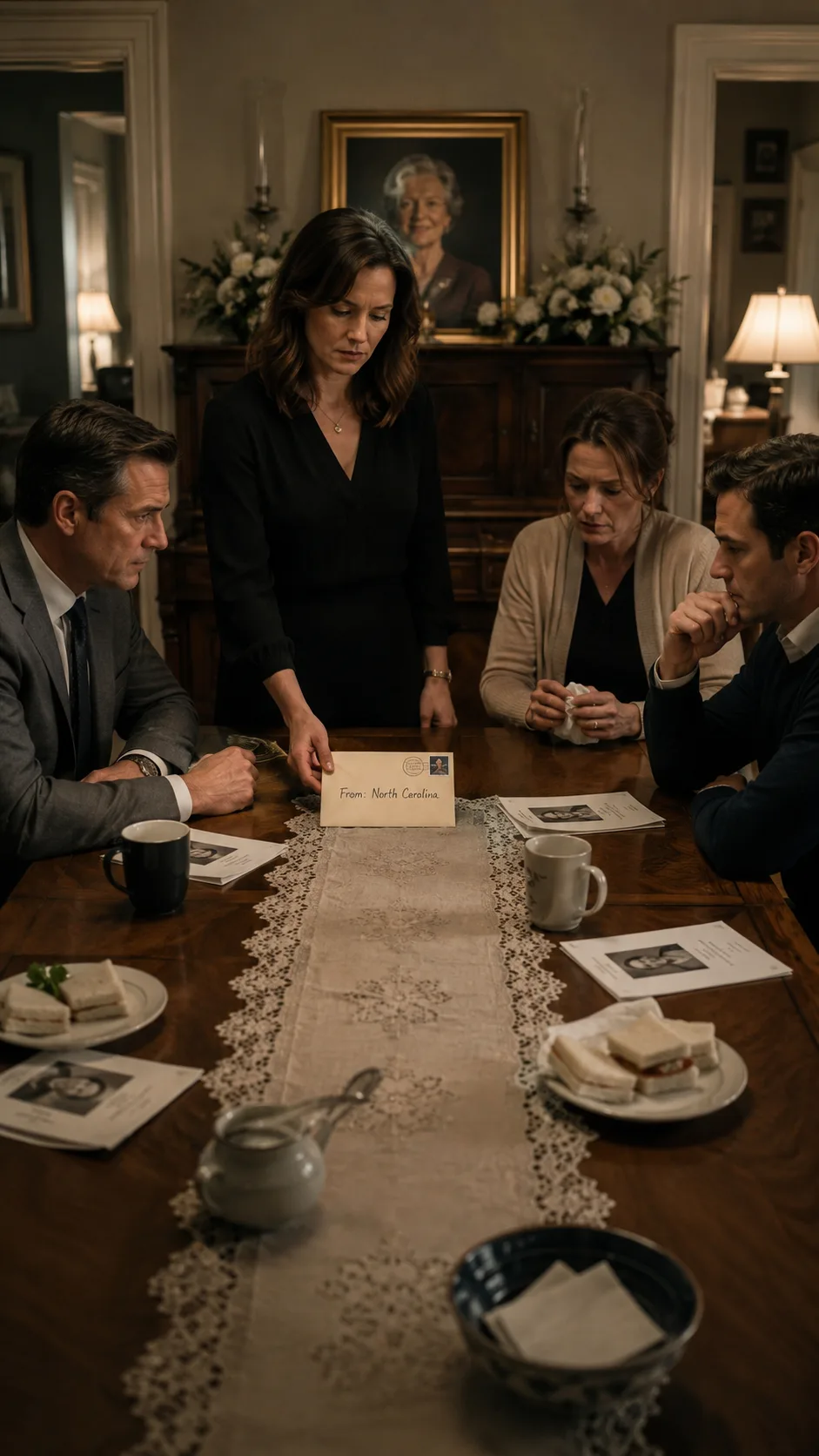
By four o’clock, the crowd had thinned. A half-empty coffee urn sat on the sideboard. Funeral programs lay scattered on the dining table between paper plates of untouched sandwiches. Someone had left a black umbrella leaning against the china cabinet even though it had not rained.
A small thing.
Wrong place.
Sarah was gathering napkins into a pile when the mail slot clattered in the front door.
We all heard it.
Michael looked toward the hall. “Mail runs late now?”
Daniel did not answer. He set down the guest book and walked out before anyone else moved.
Too fast.
I followed him into the foyer and found him standing over three envelopes on the floor. Two were bills. One was cream-colored and thick, with a North Carolina postmark stamped hard in the corner. No return name. Just a county office address printed in blue ink.
Daniel bent down.
I bent down too.
Our hands reached at the same time.
He got there first.
“It’s probably estate junk,” he said.
He slipped the envelope beneath the two bills and turned back toward the dining room.
I watched his thumb press against the seal.
Not junk.
Back at the table, Sarah had stopped gathering napkins. Michael was holding one of the funeral programs, but his eyes were on Daniel’s hand.
“What’s that?” Sarah asked.
“Nothing urgent.”
Daniel placed all three envelopes beside the guest book, then set his coffee cup on top of them.
Not subtle.
The cup left a damp ring on the electric bill. He noticed. He moved it a quarter inch to the left, careful to cover the cream envelope instead.
I sat down across from him.
“Open it.”
Daniel looked at me like I had spoken during a prayer.
“It can wait.”
“Then it can wait open.”
Michael made a low sound through his nose. Not a laugh. Not quite. Sarah touched the edge of her cardigan and pulled it closed at the throat, though the room was warm.
The refrigerator hummed in the kitchen.
Daniel picked up the guest book. “We have enough to handle today.”
“Do we?”
His eyes moved to the portrait on the cabinet behind me. Our mother smiled from the gold frame, pearl earrings on, gray hair pinned the way she wore it every Christmas Eve. White roses sat on both sides of the frame, already browning at the edges.
Daniel did not look at the envelope.
That told me where to look.
I reached across the table and slid the cup aside.
The cream paper showed.
North Carolina.
Sarah read the postmark. Her hands went still.
“Mom never liked North Carolina,” Michael said.
Daniel closed the guest book. “She didn’t know anyone there.”
He said it too quickly.
There it was.
The first crack.
I lifted the envelope, but Daniel’s hand came down over mine.
“Claire.”
Just my name.
A warning.
I looked at his fingers. The knuckles had gone pale against the cream paper. He had the same hands as our father, broad and square, made for holding tools and signing checks. He had used them all day to shake hands, receive pity, guide people through our mother’s house.
Now he used them to stop me.
Sarah stood. Her chair legs scraped the rug.
“Maybe we should wait until tomorrow,” she said.
“No,” Michael said.
One word.
Daniel turned on him. “You don’t know what this is.”
“Neither do you.”
Daniel’s mouth opened, then closed.
Too late.
I pulled my hand free and kept the envelope in front of me. I did not tear it open. Not yet. I set it flat on the lace runner my mother brought out every Thanksgiving, the one she washed by hand and dried over the back porch railing.
Daniel reached for it again.
I placed two fingers on the edge.
“Stop.”
He stopped.
For the first time that day, he did not know what to do with his hands.
The house had changed after Mom’s diagnosis, though none of us said it plainly. Labels appeared on kitchen cabinets. A rubber mat appeared in the shower. Daniel started coming by on Friday mornings, usually when I was at work, and leaving notes on the counter about “simplifying.” He cleared out her pantry without asking and threw away spices she had owned for twenty years.
Mom let him.
Or she seemed to.
The last month, she carried a small gray sweater with her from room to room even when she was not cold. She would fold it over the chair beside her, unfold it, smooth the sleeves, then fold it again. Once, when I asked if it needed washing, she pressed it to her lap.
“No,” she said.
That was all.
After the funeral guests left, I found that sweater on her bed. Folded. Waiting.
Daniel came upstairs while I was standing there.
“We should start with documents,” he said.
“Today?”
“Estate work doesn’t pause.”
He opened her closet before I answered. Hangers clicked against the rod. He moved through her clothes like he was sorting office files.
I picked up the gray sweater.
A small envelope fell from one sleeve.
Not sealed.
Inside was a photograph cut in half.
Only Mom’s side remained. Younger. Maybe in her thirties. She stood near a chain-link fence with one hand reaching toward someone no longer in the frame.
The missing half had been torn away by hand.
Rough edge.
I put it back before Daniel turned around.
He did not see.
Or he pretended not to.
Downstairs, Sarah was packing leftover food into plastic containers. Michael stood by the kitchen sink, flipping through a stack of old recipe cards. He held one up.
“Who’s L?” he asked.
Sarah looked over.
On the back of a peach cobbler card, in Mom’s rounded handwriting, was one line.
Less sugar for L.
Sarah wiped her hands on a dish towel.
“Maybe Aunt Linda?”
“We don’t have an Aunt Linda.”
Daniel came in carrying a folder from Mom’s desk. “Old recipe notes don’t matter.”
Michael placed the card on the counter. “You’re working hard today.”
Daniel ignored him.
He opened the folder and began dividing papers into piles: house, bank, medical, funeral. He did not ask for help. He never did when control was available.
I watched him slide one small receipt beneath the medical papers.
Not fast enough.
It was from a shipping store.
Certified mail forwarding.
Destination: Beaufort County, North Carolina.
Date: three weeks before Mom died.
My mouth went dry, but I did not speak. I took the receipt when Daniel went to answer a call from the funeral home. I folded it once and put it in my coat pocket.
A small choice.
It sat there all evening, pressing against my hip.
At six, Sarah’s husband picked up her children and took them home. Michael stepped onto the back porch for a cigarette he claimed he had quit. Daniel stayed in the dining room with the cream envelope still unopened on the table.
I stood in the kitchen, reading the shipping receipt under the fluorescent light.
Beaufort County.
The same county on the envelope.
The receipt had Daniel’s name on it.
Paid in cash.
When Michael came back inside, I handed it to him. He read it once, then looked through the doorway at Daniel.
“That yours?”
I nodded toward the dining room. “Found it in Mom’s papers.”
Michael folded it exactly along my crease and handed it back.
“Ask him.”
“You ask him.”
He shook his head. “He’ll lie better to me.”
Sarah returned from the hallway, holding a shoebox from the downstairs closet. “These were behind the vacuum.”
The box was old, printed with the name of a department store that had closed before any of us had children. Inside were envelopes tied with green yarn. Most were Christmas cards from church friends, old tax forms, a faded warranty for a toaster.
Then Sarah lifted a postcard.
No picture on the front. Just lines of writing in blue ink.
Dear M, I turned twelve today.
No signature.
Only one letter.
L.
Sarah read it without making a sound. Her lips moved around the words.
Michael took the postcard from her and flipped it over. Beaufort, North Carolina.
Daniel appeared in the doorway.
“What are you doing with that?”
Sarah dropped the yarn.
The envelopes spilled across the floor.
No one moved.
Daniel stepped into the kitchen and bent to gather them, but Michael put his shoe on one corner of the postcard.
“Careful,” Michael said.
Daniel looked up at him.
The old refrigerator clicked off, and the kitchen fell into a silence so complete I could hear the wall clock above the stove.
Daniel straightened.
“Mom had private correspondence.”
“With a twelve-year-old?” Michael asked.
Daniel held out his hand. “Give it to me.”
“No.”
Sarah backed into the counter. Her hip hit a spoon, and it clattered into the sink.
I took the cream envelope from the dining room and brought it into the kitchen. Daniel’s eyes followed it the whole way.
“Tell us what’s in it,” I said.
He laughed once, without sound.
“I haven’t opened it.”
“But you knew to forward mail from Beaufort County.”
His face shifted. Not much. Enough.
Sarah looked at him. “Daniel?”
He rubbed his forehead with two fingers, the way he did when he wanted a room to slow down and wait for him. It had worked when we were kids. It worked at hospital desks. It worked with bank clerks.
It did not work there.
“You don’t understand what Mom wanted protected,” he said.
Protected.
Not hidden.
Not forgotten.
Protected.
Michael picked up the postcard from under his shoe and laid it beside the envelope. “From us?”
Daniel said nothing.
That answer had weight.
Sarah sat down at the kitchen table, though we were not in the dining room anymore. She looked suddenly small in Mom’s chair, her cardigan sleeves pulled over her knuckles.
“Who is L?” she asked.
Daniel looked at the back door.
Escape route.
Closed.
I carried the envelope back to the dining room. The others followed, one by one. Sarah left the shoebox open on the kitchen counter. A few cards lay on the floor behind us, white rectangles under the stove light.
Daniel came last.
He had lost the room, but he had not accepted it.
Not yet.
I placed the envelope in the center of the dining table, exactly where the funeral programs had been stacked. The cream paper looked too clean against the dark wood. The North Carolina postmark sat in the upper corner like a bruise no one had noticed.
Daniel remained standing.
“Don’t make a spectacle out of Mom,” he said.
“There’s no one here but us.”
“That’s enough.”
Michael pulled out a chair and sat across from him. “You’ve been treating her like a court case all day.”
Daniel pointed at the envelope. “Because none of you think before you rip open things that can’t be put back.”
Sarah looked down at her lap.
I could see the torn photograph in my mind again. Mom’s younger face. Her arm reaching toward someone cut away.
“Did she ask you to hide this?” I said.
Daniel’s hand went to his tie. He loosened it, then tightened it back.
“She asked me to keep the family intact.”
Four words too many.
Michael pushed his chair back. “What family?”
Daniel’s voice dropped. “The one she raised.”
Sarah covered her mouth with her hand, then lowered it.
The one she raised.
Not the only one she had.
I picked up the envelope.
Daniel moved around the table and reached for it, but Michael stood between us. Not touching him. Just standing.
Daniel stopped.
His face turned toward our mother’s portrait on the cabinet. For half a second, he looked like a boy caught taking coins from the jar by the phone. Then he squared his shoulders again.
“Claire,” he said. “Put it down.”
I did.
Flat on the table.
Then I tore it open.
The sound cut through the room.
Small.
Sharp.
The flap peeled back unevenly, leaving a jagged white strip along the seal. I slid two fingers inside and felt thick paper, folded twice. Something glossy moved behind it.
No one breathed loudly.
The first document came out stiff from age, cream against cream, sealed with a blue county stamp at the top. A second page clung to it. Then a photograph slipped free and landed face down near Sarah’s abandoned napkin.
Sarah reached toward it.
Stopped.
Daniel’s hand rested on the back of a chair. His fingers dug into the wood.
Michael leaned over the table but did not touch anything.
I unfolded the document.
The paper resisted at the creases, as though it had spent years refusing to lie flat. The county seal appeared first. Beaufort County, North Carolina. A clerk’s signature in black ink. A filing date from thirty-nine years earlier.
Then my mother’s name.
Margaret Ellen Whitaker.
There it was.
No mistake.
I placed one palm on the lower half of the page, not ready to move it. My fingernails were still clean from the funeral, filed square because Sarah had insisted we “present ourselves properly.” Under my hand, more ink waited.
Daniel swallowed.
I heard it.
Sarah looked at him, then back at my hand.
“Move it,” Michael said.
I lifted my palm.
The next line showed the name of a child.
Lydia Mae Whitaker.
Female.
Born alive.
Mother: Margaret Ellen Whitaker.
Father: blank.
Sarah’s chair gave a small creak as she sat back.
Michael took the edge of the table with both hands.
Daniel did not move.
The words lay there without asking permission.
Lydia Mae Whitaker.
Our mother’s last name.
Our mother’s child.
I read the lines again, slower the second time. Not because they were hard to understand. Because the room had been built around a different sentence, and this one did not fit.
Four children.
The paper said five.
Sarah reached for the photograph and turned it over.
A young girl stood beside our mother near a chain-link fence. Maybe eleven. Maybe twelve. Thin legs. Dark hair cut at the chin. One hand held the strap of a backpack. My mother stood beside her in a blue dress I recognized from old family albums, the one she wore to Daniel’s high school graduation.
Only the photograph had been taken somewhere else.
Different fence.
Different child.
Mom’s hand rested on the girl’s shoulder.
Not hovering.
Resting.
Sarah placed the photograph beside the document with the care of someone setting down a glass already cracked.
Daniel sat.
Not by choice. His knees bent before the rest of him agreed. The chair caught him with a dull wooden sound.
Michael looked at him. “You knew.”
Daniel’s mouth worked once.
No answer.
The second page slid from under the first when I moved my hand. It was a letter from the county office, addressed to Margaret Whitaker’s estate. A copy of adoption-related records had been requested by a Lydia Mae Hartwell of Washington, North Carolina. The office had been instructed, years earlier, to notify next of kin upon Margaret’s death.
Next of kin.
That phrase sat colder than the rest.
Attached to the letter was a handwritten note in blue ink.
Mom’s handwriting.
If this reaches them, let Claire open it.
My name.
Not Daniel’s.
His eyes dropped to the note. His hand left the chair and moved toward it, but I picked it up before he could touch it.
The shift was quiet.
No raised voice.
No slammed door.
Just my hand holding the note while his hand closed around empty air.
Sarah noticed first. She looked from Daniel’s empty hand to mine. Michael stepped back from between us because he no longer needed to block anything.
The room no longer belonged to Daniel.
It belonged to the paper.
I placed the birth record in the center of the table and smoothed it once with my palm. The lace runner bunched beneath it. I flattened that too. The envelope sat open above it, mouth torn wide, North Carolina stamp facing up.
Daniel stared at the document.
“You should have left it alone,” he said.
His voice had no place to go.
Sarah picked up the photograph again. Her thumb hovered over the girl’s face but did not touch it.
“Who is she?” she asked.
Daniel’s jaw flexed. “Someone Mom gave up.”
The sentence scraped the table.
Michael turned toward him. “That’s not an answer.”
Daniel looked at me. “You think you can handle the truth because you found a paper?”
I held up Mom’s note.
Let Claire open it.
His eyes fixed on the words.
For once, he had no correction.
I opened the folded note with both hands. The paper was thin, torn from the small stationery pad Mom kept in her bedside drawer. Blue flowers along the top. Faint lavender smell. Her handwriting wandered more than it used to, but every letter still tried to sit neatly on the line.
My children,
I have asked too much of silence.
That was the first line.
Sarah covered her mouth again, but this time she kept reading.
I stopped after those words because the room needed to catch up with the paper. Michael reached for one of the untouched coffee cups, then set it back without drinking. Daniel stared at the chandelier above the table.
I continued.
Before your father and before this house, I had a daughter. Her name is Lydia Mae. I was young. I had no money. I let another family raise her because everyone told me love without shelter was selfish. I believed them.
The paper shook once in my hand.
I pressed it down against the table.
I sent birthday cards when I could. I kept photographs when I was allowed. I told myself I had four children because that was the only way I could keep standing in front of you.
Sarah made a sound that did not become a word.
Michael reached across the table and took the photograph. He studied the girl’s face like he was searching for a family resemblance that had been waiting there all along.
There was one.
The mouth.
Mom’s mouth.
I kept reading.
Daniel found some of the letters years ago. He thought he was protecting the family. I let him think that because I was tired and ashamed and old enough to know cowardice can wear Sunday clothes.
Daniel stood.
The chair nearly tipped.
“Stop.”
I did not.
I want Claire to contact Lydia if Lydia still wants contact. I do not ask forgiveness. I ask only that the truth not be buried with me.
The last line was dated six months before she died.
Six months.
Daniel had spent six months preparing to keep the grave closed.
I set the note beside the birth record. Three papers now. One photograph. One torn envelope.
Proof arranged on the table where we used to eat birthday cake.
Sarah stood and walked to the cabinet beneath Mom’s portrait. She took the framed picture down and brought it to the table. No announcement. No explanation. She placed it beside the photograph of Lydia and our mother at the fence.
Two Margarets looked back at us.
One public.
One hidden.
Michael rubbed his hands over his face, then lowered them. “How many times did she call?”
Daniel did not answer.
Michael turned fully toward him. “How many?”
Daniel picked up his coffee cup. Empty. He set it down again.
“Every Mother’s Day,” he said.
Sarah closed her eyes for one second. Then she opened them and reached for the back of a chair.
Daniel continued, because silence had finally stopped helping him.
“Sometimes Christmas.”
“And you knew?” Michael asked.
“I knew enough.”
“You knew a sister was alive.”
Daniel looked at the birth record but not the photograph. “Half sister.”
The word landed badly.
Sarah flinched as if something had snapped near her ear.
I put one finger on Lydia’s name.
“Daughter,” I said.
Daniel’s face tightened.
No correction.
The refrigerator hummed through the doorway. Somewhere in the hall, the grandfather clock ticked with the offbeat click it had developed years ago. The umbrella still leaned against the china cabinet, forgotten by whoever had brought it.
The dining room had not moved.
Everything in it had.
Sarah sat again, but not in the same chair. She moved beside me. Michael stayed standing behind Lydia’s photograph. Daniel remained across the table, farther away than the width of the room could explain.
I gathered the papers into a neat stack, then stopped.
No.
I spread them out again.
Birth record.
County letter.
Mom’s note.
Photograph.
Each piece had room.
Daniel watched my hands. “You don’t know what calling her will do.”
I looked at the county letter. Lydia Mae Hartwell. Washington, North Carolina. A phone number listed under the return request.
“She already called first,” I said.
Sarah touched the edge of the letter. “She asked for records.”
“She asked for a mother,” Michael said.
No one corrected him.
Daniel walked to the window and looked out at the dark front yard. His reflection showed in the glass above the dining table candles, face cut into pieces by the window muntins.
“She’ll want things,” he said.
Michael laughed once. Dry. Small. “There it is.”
Daniel turned. “You think this is simple?”
“No,” Michael said. “I think you are.”
Sarah picked up Mom’s note and read the first line again without sound.
I have asked too much of silence.
The sentence looked different the second time. Not softer. Sharper.
Daniel left before eight.
He took no food, no documents, no flowers. At the front door, he paused beside the umbrella, then stepped around it. His coat brushed the wall where Mom used to hang the children’s school pictures in mismatched frames.
He did not say goodbye.
The door closed.
Not hard.
Final enough.
Sarah and Michael stayed. We did not talk for a long time. Sarah washed cups that had already been washed by church women. Michael collected funeral programs from the table and stacked them beside the guest book. I put Lydia’s photograph in a clean envelope because I could not stand the idea of it touching coffee stains.
Mom’s portrait remained on the table.
Not on the cabinet.
At nine-thirty, Sarah found the other half of the torn photograph in the gray sweater.
It had been tucked into the hem, stitched badly with blue thread.
She brought it to me in the kitchen, holding it between two fingers. The torn edge matched the picture from the envelope. On this half, Lydia stood closer to the camera, smiling with two missing front teeth. My mother’s hand still rested on her shoulder from the other side.
Together, they made one photograph.
Almost.
A white tear line ran between them.
I placed both halves under a heavy cookbook to flatten overnight. Mom’s peach cobbler recipe card lay on the counter beside it, the one with the note on the back.
Less sugar for L.
The next morning, I called the number on the county letter.
My finger hovered over the last digit for longer than it needed to.
Then I pressed it.
A woman answered on the fourth ring.
“This is Lydia.”
Her voice was lower than I expected. Careful. Not old, not young. A voice that had waited long enough to stop waiting out loud.
I stood beside Mom’s kitchen sink, looking at the backyard where the bird feeder hung empty.
“My name is Claire Whitaker,” I said.
The line stayed open.
No breath.
No click.
I continued. “Margaret was my mother.”
A chair moved on Lydia’s end of the phone. Wood against floor. Then nothing.
“She was mine too,” Lydia said.
Four words.
The house went still around them.
I held the phone with both hands.
“We found the envelope.”
Lydia did not speak at first. Somewhere behind her, a dog barked once. A door closed. Life continued in a house I had never seen.
“I didn’t know if she told you,” Lydia said.
“She didn’t.”
A pause.
“Did Daniel open it?”
“No.”
Another pause, shorter this time.
“Good.”
So she knew him too.
Not as a brother.
As a locked door.
We spoke for eleven minutes. I know because the microwave clock changed from 9:42 to 9:53 while I stood there. Lydia did not ask about money. She did not ask about the house. She asked if Margaret had still worn pearls. She asked if she kept a blue glass bird on the kitchen windowsill. She asked if she still made peach cobbler too sweet.
I looked at the recipe card.
Less sugar for L.
“Yes,” I said.
That was not fully true.
It was true enough to begin.
Two weeks later, Lydia came to Virginia.
Sarah arrived early with flowers, then moved them from table to counter to sideboard because she could not decide where they belonged. Michael brought store-bought pie and removed the label before anyone saw. Daniel did not come.
He sent a text.
This is a mistake.
I deleted it.
Not because he was gone from us. He was not. He remained in every gap, every withheld letter, every year Lydia spent with a mother who existed only in pieces. But he no longer got to decide the shape of the table.
Lydia knocked at three.
Not the doorbell.
Three careful knocks.
I opened the door and saw our mother’s mouth first.
Then the eyes.
Then the way she held her purse with both hands in front of her, as if she might be asked to leave before crossing the threshold.
She was fifty-six, with dark hair threaded with gray and a navy coat buttoned to the throat. A small silver cross hung at her collarbone. She looked at me, then past me into the hall.
The umbrella was gone.
I had moved it that morning.
“Claire?” she said.
I nodded.
Sarah appeared behind me with one hand pressed against her skirt. Michael stood in the dining room doorway, holding the pie plate like an offering that had become too heavy.
Lydia stepped inside.
No one hugged first.
The house did not know how.
I led her to the dining room. Mom’s portrait was back on the cabinet, but not alone. Beside it sat the repaired photograph, both halves pressed into one frame, the tear line still visible down the middle.
Lydia saw it and stopped.
Her hand rose to the silver cross.
I did not say anything.
Sarah pulled out a chair.
Michael set the pie down.
Lydia walked to the cabinet and touched the bottom edge of the frame, not the glass.
“She kept it,” she said.
One sentence.
Enough.
We sat around the dining table, not in our old places. Lydia took Daniel’s chair. No one mentioned it. Sarah poured coffee. Michael cut pie unevenly. I placed Mom’s peach cobbler recipe card in front of Lydia, back side up.
Less sugar for L.
Lydia ran one finger under the line, careful not to smear ink that had dried decades ago.
“She always forgot,” Lydia said.
Then she smiled.
Small.
Real.
The lace runner lay flat down the center of the table. The envelope from North Carolina was stored in a clear sleeve now, along with the birth record, the county letter, and Mom’s note. Not hidden. Not displayed like a trophy. Kept.
Daniel called once that evening. I let it ring.
Later, Sarah answered his second call from the porch. Her voice stayed low, but I heard one sentence through the screen door.
“You don’t get to reduce her anymore.”
The next week, Daniel asked for copies of the documents. I sent them. All of them. No note.
He did not respond.
Months later, Lydia came back for Thanksgiving. She brought a sweet potato casserole and a box of old cards Margaret had sent over the years, each signed with only an M. We read them after dinner. Some had pressed flowers inside. One had a lock of baby hair tied with thread. One contained a photograph of our house taken from the sidewalk, mailed but never delivered, returned for insufficient postage.
Mom had tried.
Not enough.
Still tried.
The cedar chest at the foot of her bed holds different things now. Birthday cards. Funeral programs. The North Carolina envelope. The repaired photograph. The gray sweater with the bad blue stitches left in the hem.
I keep the sharpened pencils too.
Tiny yellow points.
On the first Mother’s Day after Lydia came, we set five plates at the table.
Daniel’s chair stayed empty.
Lydia arrived with peach cobbler.
Less sugar.
No one corrected the recipe.
Chapter complete
You have reached the end of this chapter.
Continue reading
A few more worlds to get lost in after this chapter.




