The Runaway Bride Chose the Man Her Father Tried to Erase From Her Life Forever Before Three Hundred Guests Watched
The groom was twenty-seven minutes late, and everyone in the cathedral knew it.
Chapter 1
The groom was twenty-seven minutes late, and everyone in the cathedral knew it.
No one said the truth out loud at first. That would have been vulgar, and the people sitting in the first twelve rows of St. Bartholomew’s Cathedral had built entire lives around never being vulgar in public. They adjusted diamond bracelets. They checked their phones beneath folded programs. They whispered behind gloved fingers and turned their pity into posture.
But Evelyn Whitmore could feel every second.
She stood beneath an arch of white lilies in a silk wedding gown that weighed more than it should have. The bodice pressed against her ribs until breathing felt like a negotiation. Her bouquet of white peonies trembled lightly against her waist, though she had stopped trying to pretend her hands were steady.
Three hundred guests watched her wait for a man who was not coming.
Sebastian Vale, heir to a shipping fortune, polished enough to look kind in photographs and empty enough to
let other people make his decisions for him, had vanished somewhere between the Plaza Hotel and the cathedral steps. The official explanation had shifted three times in the last ten minutes. Traffic. A car issue. A family emergency.
Then her phone began to vibrate inside the hidden pocket sewn into the side of her dress.
One buzz.
Then another.
Then another.
By the eighth message, Evelyn stopped counting.
She did not look down. She did not move. She stood at the altar with her chin lifted and let the entire room misunderstand her silence.
Behind her, the organist kept her hands suspended above the keys, afraid to begin and more afraid to stop. The priest had already coughed twice. Somewhere near the third row, a child asked too loudly why the bride looked sad, and his mother silenced him with a hand over his mouth.
Evelyn’s father sat in the
front pew like a carved statue.
Conrad Whitmore had always known how to occupy space. He did not sit so much as claim a chair. Even after two heart attacks and the silver-headed cane he carried as if it were a royal scepter, he still radiated ownership. Of the cathedral. Of the guests. Of the companies attached to every name in the room.
Of Evelyn.
She could feel his stare at the back of her neck. It was the same stare he had used when she was nine and cried at a piano recital. The same stare from when she was seventeen and refused to wear the dress he chose for a gala. The same stare from the summer she was nineteen, when she had whispered one forbidden name across a breakfast table and watched his face turn cold.
Julian.
She had not allowed herself to think his name all
morning.
Not while the makeup artist painted calm onto her face. Not while the stylist pinned her hair into a soft, expensive shape that made her look like a woman who had chosen her own life. Not while her mother entered the bridal suite, kissed the air beside her cheek, and said, “You look exactly as you should.”
Exactly as you should.
That had always been the Whitmore family prayer.
Evelyn should marry well. Evelyn should smile gently. Evelyn should understand that love was what people talked about when they could not afford alliances.
So she stood in front of three hundred people and tried to become the woman they had spent years shaping.
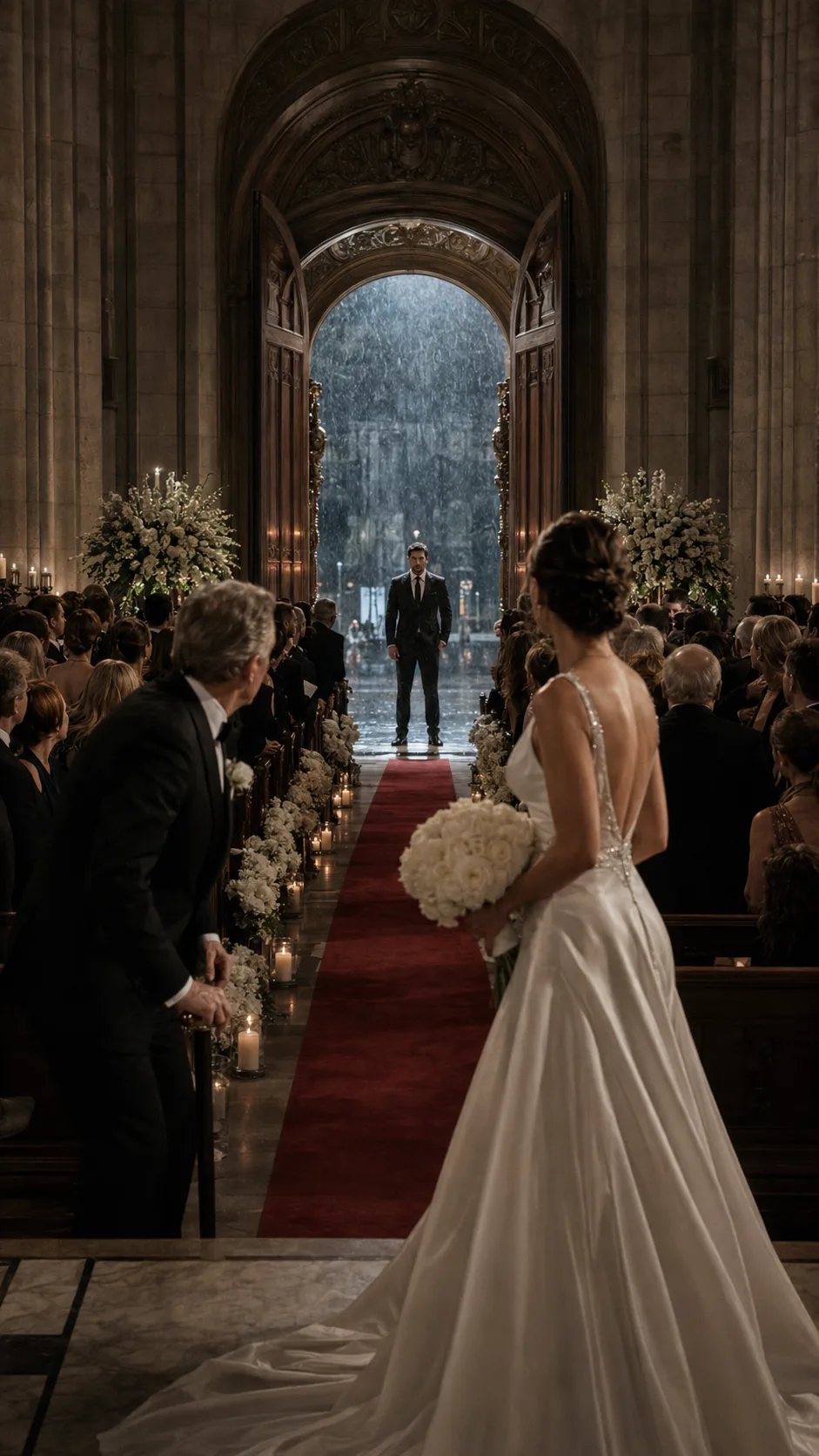
Then the doors opened.
No.
They did not open.
They struck the stone walls with such force that the entire cathedral flinched.
The sound cracked through the nave like thunder trapped under a roof. The organist startled and hit a broken note that had no place in any hymn. A row of guests turned at once, then another, then the whole cathedral shifted like a tide.
Cold air rushed in.
Rain came with it, silver and hard, blurring the city beyond the open doors.
And in the center of that storm stood the man her father had buried seven years ago.
Julian Cross did not hurry.
That was the first thing Evelyn noticed, because memory had betrayed him in every other way. In her mind, he was still nineteen, lean from summer work, sun-browned from fixing fences and hauling crates near her family’s Southampton estate, hair falling across his forehead whenever he laughed. She remembered him smelling like cedar soap and saltwater. She remembered his hands, rough where hers had been soft, and the way he had looked at her as if she were not an heiress or a Whitmore or a piece on her father’s board, but simply a girl standing barefoot near a pool at midnight.
The man at the doors was not a boy.
He wore a black suit cut with dangerous precision. Rain darkened the shoulders. His hair was shorter now, his jaw sharper, his face more controlled. He looked like someone who had learned to walk into rooms that once would have thrown him out.
People began whispering before he had taken three steps.
“Who is that?”
“Is that Julian Cross?”
“Cross Holdings?”
“Oh my God.”
Evelyn could not breathe.
His eyes found her immediately.
Not the flowers. Not the guests. Not the empty place where Sebastian should have stood.
Her.
Seven years vanished with one look.
Julian stepped onto the red carpet and began walking toward the altar. Each footstep echoed against the marble. Slow. Certain. Unapologetic.
Evelyn’s bouquet tightened in her hands.
Her father rose.
For one brief, terrible second, Conrad Whitmore forgot the room. He surged upward from the front pew, one hand closing around the head of his cane, his mouth opening as if to issue an order that the universe itself was expected to obey.
“Stop him,” he said.
No one moved.
Security stood near the side entrance. Two men in black suits, both loyal to the Whitmore payroll, both accustomed to stopping photographers and drunk cousins and inconvenient reporters. They looked toward Conrad, then toward Julian, and neither stepped into the aisle.
Julian did not even slow.
When he reached the first row, he turned his head and looked at Conrad.
It was not a dramatic look. There was no rage in it, no performance, no raised voice.
That made it worse.
It was the look of a man who had once been powerless in front of a monster and had spent seven years becoming something the monster could not touch.
Conrad’s grip whitened on the cane.
Then, slowly, impossibly, he sat back down.
A murmur spread through the cathedral.
Evelyn watched it happen and felt something inside her life tear open.
Julian stopped one step below the altar.
Close enough that she could see rain caught along his collar. Close enough that the air around him reached her, cold and familiar. Close enough that she could see the thin white scar across the base of his thumb.
She remembered that scar.
A broken latch. A pool gate. Summer rain. Her hands shaking as she wrapped a towel around his bleeding hand while he laughed softly and told her it was nothing.
“Evelyn,” he said.
Her name in his mouth nearly ruined her.
She had imagined hearing it again so many times that the real sound felt impossible.
“What are you doing here?” she whispered.
His eyes moved over her face with a tenderness so carefully controlled it looked almost like pain.
“We’re leaving.”
Gasps snapped through the pews.
Her father slammed his cane once against the stone floor.
“Evelyn,” Conrad said, his voice hard enough to draw blood, “do not embarrass yourself.”
Julian’s gaze did not leave hers.
“He was never coming,” Julian said quietly.
The words were not loud, but they carried.
Evelyn’s throat tightened.
“I know.”
His expression changed then. Only a fraction. A crack in steel.
“You knew?”
She swallowed. “Not soon enough.”
A faint sound moved through him, something almost like sorrow, but he buried it before it could become visible.
Then he held out his hand.
“Come with me.”
Every person in the cathedral seemed to stop breathing.
Evelyn looked down at his open palm. The scar. The calluses. The steady certainty of him.
Seven years earlier, he had held out that same hand beneath a storm-dark sky behind her father’s guest house.
Come with me, Ev.
She had been nineteen, barefoot in the wet grass, her heart racing so hard she could taste metal. He had been shaking then, though he tried to hide it. He had told her he had to leave. He had told her he would come back. He had promised he would find a way.
The next morning, he was gone.
There had been a note in her jewelry box.
I’ll come back.
Three words.
No explanation. No address. No phone call.
No Julian.
And for seven years, everyone around her had treated that absence like proof.
He forgot you.
He used you.
He saw what our world costs and ran.
Her father had been the cruelest because he never sounded cruel. He had only sounded certain.
“A man like that does not love a girl like you,” Conrad had told her. “He wanted the fantasy of you. Not the burden.”
Now that same man sat ten feet away, watching the fantasy he had arranged collapse.
Evelyn’s fingers loosened.
The bouquet slipped from her hands.
White peonies struck the marble and scattered petals across the red carpet like pieces of a life she had not chosen.
Conrad stood again.
“Evelyn.”
This time, his voice cracked.
That crack was what decided her.
She placed her hand in Julian’s.
His fingers closed around hers, warm and firm, and the cathedral vanished down to one point of contact.
He did not pull.
He waited.
That was the difference.
Her father had always pulled. Her mother had always guided. Sebastian had always agreed with whoever held the most power.
Julian waited for her to step.
So she did.
A sound rose behind them as they turned together. Shock. Outrage. Delight. The kind of noise people make when they know they are witnessing disaster and history at the same time.
Evelyn walked down the aisle beside the man her family had tried to erase.
She did not look at the guests.
She did not look at her father.
But at the cathedral doors, just before the rain swallowed them, she looked once over her shoulder.
Conrad Whitmore was standing alone beside the front pew, his cane hanging uselessly from one hand, his face pale with the first true fear she had ever seen on him.
Not fear of scandal.
Fear of losing control.
Then Julian led her outside.
The rain hit her veil first, then her shoulders, then the silk dress that had cost more than some people’s homes. A black SUV waited at the curb with its engine running. The driver opened the door without staring.
Evelyn stopped under the cathedral awning.
Julian stopped too.
He released her hand immediately.
That hurt more than she expected.
“You can still go back,” he said.
She looked at him through the rain.
“Is that what you came here to tell me?”
“No.”
“Then don’t pretend this is simple.”
His jaw tightened. “It never was.”
“You vanished.”
“I know.”
“You left me with three words, Julian. Three. I built seven years of pain around those words.”
His eyes darkened, but he did not defend himself.
Not yet.
“I’ll tell you everything,” he said. “But not here. Not while they can still reach you.”
She almost laughed. “They have always been able to reach me.”
“I know.”
The way he said it made her pause.
Not sympathy. Not guesswork.
Knowledge.
The driver held the door open. Rain ran in clean lines down the car windows. Behind them, the cathedral remained lit and waiting, as if the life she had escaped might still call her back if she hesitated long enough.
Evelyn lifted the front of her ruined dress and got into the car.
Julian slid in after her, leaving careful space between them.
The door shut.
The cathedral disappeared behind sheets of rain.
For several minutes, neither of them spoke.
Manhattan blurred past in wet streaks of gray and gold. Evelyn stared at her reflection in the dark glass: a bride with damp hair, white silk clinging to her knees, lipstick still perfect because expensive things were built to survive humiliation.
Julian sat across from her, not beside her.
His hands rested loosely on his knees, but she saw the tension in them. The restraint. The effort.
“Where are we going?” she asked.
“The Plaza.”
Her head turned. “Of course we are.”
A faint, humorless curve touched his mouth. “I booked the suite six months ago.”
Her chest tightened.
“Six months?”
“Yes.”
“You knew the wedding date for six months?”
“Closer to seven.”
She stared at him.
“You planned this.”
“I planned for the possibility.”
“That is not better.”
“No,” he said. “It isn’t.”
The honesty disarmed her more than any excuse would have.
At the Plaza, no one asked why a drenched bride entered through the private service entrance with a man who moved like he owned every camera in the building. Maybe he did. The elevator rose in silence to the forty-second floor.
When the suite door closed behind them, the quiet was enormous.
Floor-to-ceiling windows framed Central Park under a bruised sky. A low table held white orchids. Someone had lit a candle before their arrival, something dark and expensive, smoke and fig and black tea.
Evelyn laughed once, softly and without humor.
“You thought through the candle.”
Julian removed his wet suit jacket. “I thought through everything except what you would say to me once we were alone.”
“Good.”
He looked at her.
She stood in the center of the suite, still in the dress Sebastian’s mother had praised, still wearing the veil her own mother had adjusted with tearless pride. The silence between them thickened.
“How long?” she asked.
Julian placed his jacket over the back of a chair. “How long what?”
“How long have you known where I was?”
He did not answer quickly.
That was answer enough.
Evelyn’s stomach turned.
“Julian.”
“Since the morning after your twentieth birthday.”
The room tilted slightly.
She walked to the window and pressed her palm against the cold glass.
“You watched me for seven years?”
“I made sure you were alive. Safe. Not alone in ways you couldn’t survive.”
“That sounds prettier than surveillance.”
“It was surveillance.”
She turned.
He did not flinch from the word.
“I never interfered with your life.”
“You interfered with my wedding.”
“Yes.”
“Why?”
“Because that wasn’t your life.”
Anger rose fast enough to steady her.
“You don’t get to decide that.”
“No,” he said. “You do.”
“And if I decide I hate you?”
“Then I’ll leave.”
The answer came too easily, and that made her angrier.
“Don’t do that,” she snapped.
“Do what?”
“Stand there and act noble after walking into my wedding like a man claiming property.”
Something dangerous flickered in his face.
“You were never property to me.”
“But you said it, didn’t you? In front of everyone. Like I was yours.”
His eyes held hers.
“You were always mine because I was always yours. That is not the same thing.”
Her anger faltered.
She hated him a little for that.
“I waited,” she said. “Do you understand that? I waited longer than any sane person would admit. I kept thinking there would be a letter. A call. A message through someone. Anything.”
His face changed.
It was brief, but she saw it.
Letters.
The word had landed somewhere deep.
“What?” she said.
“Nothing.”
“No. Don’t you dare. Not after today.”
Julian looked away first.
It shocked her.
“I wrote,” he said.
The room went silent.
Evelyn felt her heartbeat move into her throat.
“What did you just say?”
“I wrote to you.”
“When?”
“At first, every week. Then when nothing came back, every month. For years.”
The cold glass behind her seemed to reach through the dress into her spine.
“No.”
“Evelyn—”
“No. Don’t lie to me about that.”
“I’m not lying.”
“If you wrote me, I would have known.”
His expression broke then, not fully, but enough.
“I hoped that too.”
She walked past him toward the bathroom because if she stayed in front of him one more second, something in her might collapse. She shut the door, locked it, and stood with both hands on the marble sink.
The woman in the mirror looked unreal.
A runaway bride. A stolen heiress. A girl who had spent seven years grieving a man who might not have abandoned her at all.
She undid the veil with shaking fingers.
By the time she came out, wearing a hotel robe two sizes too large, Julian had retreated to the far side of the suite. The wedding dress lay over a chair like a shed skin. Someone had sent up tea, fruit, toast, untouched.
He stood by the window with his back to her.
“I’ll take the second bedroom,” he said.
She almost told him to leave.
Instead, she said, “Tomorrow you tell me everything.”
He nodded once.
“Tomorrow.”
But Evelyn did not sleep.
Neither did he.
By morning, the story had become public property.
A society bride abandoned at the altar. A billionaire investor storming the cathedral. The Whitmore heiress leaving hand in hand with the man nobody had realized she knew.
Photos appeared before noon. Grainy, long-lens images from outside the cathedral. Evelyn’s white dress disappearing into rain. Julian’s hand at her back, not touching, just near enough to shield. Conrad Whitmore standing beneath the arch like a defeated king.
Her phone died under the weight of messages.
Her mother called eighteen times.
Her cousin Margo texted once.
Tell me where you are when you can breathe.
Evelyn stared at that message for a long time before answering.
I’m safe.
Margo replied almost instantly.
With him?
Evelyn looked across the breakfast table.
Julian sat opposite her in a white shirt, sleeves rolled to his forearms, his laptop closed though she knew he had been working before she entered. He had not shaved. It made him look younger and more tired.
Yes, Evelyn typed.
Three dots appeared. Disappeared. Appeared again.
Good. I hated Sebastian.
Evelyn laughed before she could stop herself.
Julian looked up.
“What?”
“Nothing.”
His gaze softened, just slightly.
She put the phone face down.
“Tell me about Sebastian.”
The softness disappeared.
Julian leaned back. “His company was failing.”
“I know.”
“No. You knew what your father told you.”
She said nothing.
“Vale Maritime was carrying debt it couldn’t hide anymore. Your father wanted the merger because it would give Sebastian legitimacy and give Whitmore access to shipping infrastructure without taking on public risk.”
“You sound like a board report.”
“That’s the language men like your father use to disguise selling their children.”
Her hands went still around the teacup.
Julian’s mouth tightened.
“I’m sorry.”
“No,” she said quietly. “Don’t be.”
He studied her for a moment, then continued.
“I bought Sebastian’s debt through three separate entities. When he realized who controlled it, he came to me.”
“When?”
“Three weeks ago.”
“What did you offer him?”
“Freedom from ruin.”
“In exchange for leaving me.”
“In exchange for admitting he already wanted to.”
The words struck harder because they fit too cleanly into things she had refused to name.
Sebastian had never looked at her like he loved her. He had looked relieved when she agreed with him. Grateful when she made him look better in rooms. Gentle sometimes, yes. Kind in the way weak people could be kind when kindness cost nothing.
But love?
No.
Evelyn stood and crossed to the window.
“You paid my fiancé to abandon me at the altar.”
“I paid him to stop pretending he had the courage to marry you.”
“Do you hear yourself?”
“Yes.”
“And you still think you were right?”
Julian rose but stayed on his side of the table.
“No. I think I was out of time.”
“Out of time for what?”
“For letting your father finish what he started.”
The sentence opened something dark.
Evelyn turned slowly.
“What did he start?”
Julian’s face closed.
“There are parts of this you don’t need today.”
“Don’t treat me like I’m made of glass.”
“I’m treating you like someone who has been lied to all her life and deserves one full breath before the next truth.”
She hated the gentleness in that answer.
She hated that he was right.
So she stayed.
Not because she forgave him. She did not. Not because she trusted him. Trust was not a door she could open just because he had kicked down another. She stayed because photographers had camped outside the Plaza. Because her father’s lawyers had already called the front desk. Because going back to the Whitmore townhouse felt less like returning home and more like walking into a locked room.
That evening, Julian moved her to his Tribeca apartment through a service elevator and a loading entrance.
His home was not what she expected.
She had imagined glass, chrome, cold perfection. Instead, the apartment filled a converted warehouse with old brick walls, black steel beams, and windows tall enough to hold the city. It was expensive, yes, painfully so, but there were books on tables, worn leather chairs, a chipped mug near the sink, and a framed black-and-white photograph of a woman laughing beside a river.
Julian noticed her looking.
“My mother,” he said.
The word entered the room carefully.
Evelyn turned back to the photo.
“She looks kind.”
“She is.”
“Is?”
“Yes.”
Something in his voice warned her not to ask more.
So she didn’t.
The first night, she slept in a guest room two floors above his.
She counted the stairs.
In the morning, she found a note on the kitchen island.
Coffee is in the left cabinet. Use the black card if you need anything. I won’t come upstairs unless you ask.
J.
The black card sat beside the note. No name. No bank logo. Just numbers embossed like a secret.
She did not use it.
On the third day, Margo arrived with two suitcases, a bottle of red wine, and the expression of a woman who had spent seventy-two hours deciding whether to commit a felony on Evelyn’s behalf.
She hugged Evelyn first.
Then she slapped Julian across the face.
Evelyn gasped.
Julian absorbed it without moving.
“That,” Margo said, pointing at him, “was for the cathedral.”
Julian nodded. “Fair.”
“And this—” Margo slapped him again, harder. “That is for making me find out from Page Six.”
Julian blinked once.
“Also fair.”
Evelyn covered her mouth, unsure if she was horrified or about to laugh.
Margo turned to her. “You look terrible.”
“Thank you.”
“You’re welcome. I brought clothes that don’t look like they belong to a tragic ghost.”
That night, after Margo fell asleep on the sofa with a wineglass on the floor beside her, Evelyn found Julian on the terrace.
The city below moved in red and white streams. Wind lifted the loose hair at her neck.
“You let her hit you,” Evelyn said.
“I deserved worse.”
“Probably.”
He gave a small nod, accepting the sentence like a verdict.
She leaned on the railing beside him, leaving a foot of space between them.
“Did you really write?”
His shoulders shifted.
“Yes.”
“Where did you send them?”
“At first, the Southampton house. Then your father’s office, because I thought maybe staff would sort them differently. Then the townhouse. Then your grandmother’s house in Connecticut.”
She looked at him sharply.
“My grandmother?”
“I guessed he wouldn’t watch her as closely.”
“Did she answer?”
“No.”
Evelyn stared out at the city.
Norah Whitmore had always been the only person in the family who made Evelyn feel like she could exhale. Her father’s mother had a clapboard house in Connecticut, a garden that ignored fashion, and a habit of telling truths at inconvenient times. Evelyn had spent summers there as a child, eating toast with too much butter and learning that silence did not always mean punishment.
“Maybe she never got them,” Evelyn said.
“Maybe.”
But his voice said he had stopped believing in maybe years ago.
Over the next week, Julian took her nowhere romantic.
That was what made it dangerous.
He brought her to a private dinner with investors because she said she was tired of hiding. He introduced her simply as Evelyn, no surname, no explanation. He warned her which man at the table confused cruelty with intelligence and which woman would pretend not to know her story while knowing every detail.
At a charity reception on the seventy-fifth floor of a Midtown tower, a woman in red silk asked Evelyn, with a smile sharpened to a blade, whether it was difficult adjusting to “sudden changes in life direction.”
Before Evelyn could answer, Julian appeared with two glasses of sparkling water.
“Not as difficult as adjusting to irrelevance, I imagine,” he said pleasantly.
The woman’s smile died.
Evelyn waited until they were alone near the windows to whisper, “That was unnecessary.”
“She deserved worse.”
“She asked a question.”
“She smelled blood.”
Evelyn looked at him then, really looked, and understood something: Julian had built an empire not because he liked power, but because he had once been surrounded by people who used it without mercy.
Power, to him, was not decoration.
It was armor.
That should have frightened her.
Instead, it made her sad.
On the ninth night, they drove out to Long Island.
Julian said he needed to sign papers on a house in Sag Harbor. Evelyn heard herself say, “I’ll come,” before she had decided to.
The drive east was quiet. Rain threatened but did not fall. The highway lights slid over Julian’s face in brief bands.
“Is it the old place?” she asked.
“No.”
She turned toward the window. “Good.”
“I sold it.”
Her head snapped back.
“The Southampton estate?”
“The section I bought, yes.”
“You bought my father’s old estate?”
“Not all of it. Just the guest house, the pool, the south garden, and the land attached.”
“Why?”
His hands tightened slightly on the wheel.
“Because I wanted to be the one who decided what happened to the place that broke us.”
The answer was too much, so she let the road take the silence.
The Sag Harbor house was low, modern, built into a dark slope above the water. Cedar, glass, stone. No white columns. No manicured cruelty. No hedges heavy with memory.
Inside, Julian cooked pasta with lemon and garlic while Evelyn sat at the kitchen island and watched him move without the Manhattan version of himself. No jacket. No boardroom voice. His hair fell forward when he bent over the stove.
He laughed once when she asked if billionaires were allowed to cook their own food.
“They can,” he said. “But only if no one from Forbes is watching.”
She laughed too.
The sound startled them both.
Later, rain came hard off the water.
Evelyn woke just after midnight with the strange certainty that the house was breathing. She left the guest room and walked downstairs barefoot. The porch doors opened easily. Cold air rushed in, but she kept going.
Rain hit her skin like needles.
She stood at the railing in a thin nightdress and Julian’s oversized cardigan she had found on a chair, though she had no memory of putting it on. The water beyond the house churned black under the storm.
She cried before she knew she was crying.
Not loudly. Not beautifully. Just quietly, like grief had found an unlocked door.
The porch light came on.
“Evelyn.”
She did not turn.
His footsteps stopped behind her.
“You’re freezing.”
“I don’t care.”
“I know.”
The kindness in his voice hurt.
He came closer, not touching, then draped his coat around her shoulders. It was warm from him.
“Come inside.”
“No.”
“All right.”
She wiped rain from her mouth. “That’s it? You’re not going to command me?”
“No.”
“Pay someone to carry me inside?”
A low breath. Almost a laugh. Almost pain.
“No.”
She turned then.
He stood in the rain with his shirt darkening across the shoulders, hair wet, eyes fixed on her as though the storm mattered less than one wrong word.
“Why did you come back?” she asked. “Not the money answer. Not the revenge answer. The real one.”
His throat moved.
“For seven years,” he said, “I walked into rooms I used to dream about. Boardrooms. Hotels. Towers with my name on legal documents and men twice my age waiting for me to speak. And every time, before I said a word, I looked for you.”
The rain beat harder on the porch roof.
“I built a life large enough that no one like your father could throw me out of it. Then one morning I woke up in a penthouse I hated, looked at a city I owned pieces of, and realized none of it had been a life. It had been a road.”
“To me?”
“To the chance of you.”
Her breath broke.
“That’s a dangerous thing to say.”
“I know.”
“You don’t know if I can forgive you.”
“I know that too.”
She stepped closer, rain running down her face.
“What if I don’t?”
“Then I’ll still be grateful I got you out of that cathedral.”
The answer destroyed the last clean edge of her anger.
She moved into him.
He caught her carefully, as though even now he did not trust himself to take what she had not freely given. His arms closed around her only after hers closed around him. When she lifted her face, he waited for the smallest nod.
Then he kissed her.
It was not the kind of kiss that solved anything. It did not erase seven years. It did not forgive secrets. It did not turn pain into romance.
But it was real.
Rain, salt, breath, trembling hands, and a grief so old it had become part of the body.
When he drew back, he rested his forehead against hers.
“I never left,” he whispered. “Not where it counted.”
Evelyn closed her eyes.
She wanted to believe him.
She almost did.
Then Sebastian found her.
It happened three days later in a small café behind a flower shop on Bleecker Street. Evelyn had gone alone because she needed to remember where her own edges were. Julian’s presence had become too easy to feel, like heat from a fire. Comforting, dangerous, impossible to ignore.
She was stirring untouched coffee when the chair across from her scraped back.
“Five minutes,” Sebastian said.
She looked up.
He was thinner. Unshaven. Wearing the same navy blazer from their engagement party, though now it sat wrong on him, loose in the shoulders. He looked less like a villain than a man who had finally run out of polish.
Evelyn’s hand closed around her cup.
“You have four.”
He sat.
“I’m not here to ask you back.”
“That would be embarrassing for both of us.”
A humorless smile flickered and died.
“I deserved that.”
“You deserved worse.”
“I know.”
The simplicity of it unsettled her.
Sebastian looked down at his hands. “Julian paid me.”
“I know.”
“He told you?”
“Yes.”
“Did he tell you why he disappeared?”
Evelyn went still.
The café sounds sharpened. Steam. Cups. A spoon against ceramic.
“What do you mean?”
Sebastian looked older than he had two weeks ago.
“Your father didn’t just send him away.”
Evelyn’s pulse slowed in terror.
“What did he do?”
Sebastian swallowed.
“That summer. After your father found out about the two of you. He had Julian dragged behind the equipment shed by two of his security men.”
“No.”
“They beat him badly enough that he couldn’t stand at first.”
“No.”
Sebastian pressed on, cruel only because the truth was crueler if stretched out.
“Your father watched. Then he told Julian that if he came near you again, or called you, or wrote to you where you could actually receive it, the same men would visit his mother.”
Evelyn’s hand slipped from the cup.
Coffee spilled across the table.
Sebastian reached for napkins. She did not move.
“His mother?”
“She was a nurse in Riverhead. Your father had something on the clinic. Licensing, lease, debt—I don’t know all of it. Enough to make the threat real.”
The room narrowed.
Julian, nineteen, bleeding somewhere behind her father’s estate.
Julian, leaving three words because anything more could hurt his mother.
Julian, writing letters anyway.
Julian, standing in a hotel suite while she accused him of abandoning her.
“Why are you telling me this?” she whispered.
Sebastian looked at her then, and for the first time since she had known him, he looked honest.
“Because I was weak,” he said. “I let your father buy my future and Julian buy my escape. I can live with being weak. I can’t live with being one more man who lets you misunderstand the cage you were in.”
Evelyn could barely hear him.
“He knows you don’t know,” Sebastian said. “He chose that. He thought you would rather hate him than pity him.”
He stood.
“You should ask your grandmother about the letters.”
Her eyes lifted sharply.
“What?”
Sebastian hesitated.
“I don’t know everything. But your father once said old women were useful because guilt made them obedient.” His mouth twisted. “I think he meant Norah.”
Then he left.
Evelyn sat in the café until the spilled coffee went cold.
When she returned to Julian’s apartment, he was in the kitchen.
He knew immediately.
The glass in his hand touched the counter with a soft click.
“Who told you?”
Not denial.
Not surprise.
Just resignation.
That hurt almost as much as the truth.
“Sebastian.”
Julian closed his eyes briefly.
“Evelyn—”
“Your mother.”
His face went still.
“You let me say those things to you.”
“I let you be angry.”
“You let me be wrong.”
“I didn’t want that night living between us.”
“It was already there,” she said, voice breaking. “You just left me standing on the wrong side of it.”
He stepped toward her, then stopped himself.
“I was nineteen.”
“I know.”
“I had nothing.”
“I know.”
“If he touched my mother because of me—”
“I know!”
The shout echoed through the apartment.
Julian flinched.
Not from fear.
From hearing her pain and having no defense against it.
Evelyn covered her mouth, breathing hard.
“You should have told me.”
“Yes.”
“Why didn’t you?”
His voice went rough. “Because every time I imagined telling you, I saw your face doing exactly this.”
She shook her head.
“You don’t get to protect me by deciding what truth I can survive.”
“No,” he said. “I don’t.”
There it was again.
No excuse.
No fight.
She wanted to be furious, but grief kept getting in the way.
“I have to go.”
His face tightened.
“Where?”
“To someone who may have answers.”
“Your grandmother.”
She stared at him.
“You knew?”
“I guessed.”
“And you never went?”
“I did.”
The room stopped.
“When?”
“Four years ago. She wouldn’t see me.”
Evelyn turned and walked out before the tears could reach her face.
Julian did not follow.
He knew better.
Norah Whitmore lived in a pale blue house off a back road in Connecticut where the GPS failed twice and the trees grew close enough to scrape the sides of the car. Evelyn drove herself. She had not driven in months. At first her hands shook on the wheel; then the road steadied her.
Her grandmother was waiting on the porch.
Eighty-one years old, wrapped in a thick oatmeal cardigan, white hair pinned carelessly, both hands around a chipped mug Evelyn remembered from childhood.
Norah did not ask why she was there.
She opened her arms.
Evelyn reached her and fell apart.
Not elegantly. Not like a society bride. Like a daughter who had finally found the one door in the family that might open from the inside.
Norah held her without speaking.
Later, on the couch beneath a wool blanket, Evelyn told her everything.
The cathedral. Julian. Sebastian. The beating. The threat. The letters.
At the word letters, Norah closed her eyes.
Evelyn’s heart cracked.
“You knew.”
Norah stood slowly.
“I hoped I would die before this day,” she said.
She left the room and returned with an old shoebox.
Its corners had softened with age. The lid sat crooked, held in place by a faded ribbon.
Norah placed it on the coffee table.
“Your father told me to burn them.”
Evelyn stared at the box.
“He told me Julian had become dangerous. Obsessed. That giving them to you would pull you back into something that would ruin you.”
Her voice trembled.
“I told him I burned them.”
“But you didn’t.”
“No.”
“Why didn’t you give them to me?”
Norah sat down as if her bones had become too heavy.
“Because I was a coward in a quieter way than your father. He called every time I nearly did. Told me you were healing. Told me you were happy. Told me you were engaged. I let myself believe that silence might be kinder than reopening a wound.”
Tears filled her eyes but did not fall.
“I was wrong.”
Evelyn reached for the box.
Inside were letters.
Dozens.
No.
More than dozens.
Some thick. Some only a folded page. All addressed to her in handwriting her body recognized before her mind did. Careful, slanted, the J shaped the way it had been when he was a boy writing notes on napkins in the pool house kitchen.
The first was postmarked September, seven years ago.
Her hands shook as she opened it.
Ev,
I don’t know if this will reach you. I don’t know if I’m allowed to hope it will. I am in Boston. I found work unloading trucks in the morning and washing dishes at night. My mother is safe. That is the only thing I can let matter right now, because if I let myself think about you for more than a minute, I can’t breathe.
He did not explain everything in the first letter. Not the beating. Not the threat. He wrote like someone trying to keep a candle lit in a storm without letting the flame be seen.
The second letter told her about a room above a bakery where he slept beside a radiator that screamed all night.
The fifth described a tree outside a library he thought she would like because it refused to grow straight.
The twelfth said he had saved enough money to buy his mother a better winter coat.
The twenty-third said he had met a man who taught him how distressed debt worked and that rich men were less invincible once you learned where they borrowed money.
The fortieth said he had stood outside a charity gala where he knew she was inside, but he left before seeing her because he was still not strong enough to protect either of them.
Evelyn read until daylight faded.
Norah turned on a lamp.
Evelyn kept reading.
Four years in, the letters changed. Less desperation. More restraint. More power hiding between the lines.
I bought my first building today. It is ugly. You would hate the lobby. I bought it anyway because the man selling it used to call me “kid” when I carried boxes through his office. He called me Mr. Cross this morning. I thought that would feel better than it did.
Another:
Your father appeared across a room from me tonight. He knew exactly who I was. For the first time, he looked away first. I should have felt triumphant. Instead, I went home and wrote to you.
The last letter was dated four years ago.
Ev,
I went to your grandmother’s house today. She would not open the door. I saw the curtain move, so I know she was there. I don’t blame her. Everyone who loves you has been taught to fear what happens when they choose wrong around your father.
I am going to stop sending these for a while. Not because I have stopped loving you. I don’t know how to do that. I am stopping because I can feel myself turning love into proof, and you were never something I needed to prove.
But if there is ever a door between us again, I will come to it.
I promised you I would come back.
I am still keeping that promise.
J.
Evelyn pressed the page against her chest and bent over it.
A knock sounded at the door.
Two soft knocks.
Norah rose.
Evelyn already knew.
Julian stood on the porch in the rain, holding a plain envelope at his side. His coat was soaked. His hair had gone almost black. He looked nothing like the man who entered the cathedral.
He looked like the boy at the edge of the property line, waiting to find out whether the world would take her from him again.
“Margo told me,” he said. “I’m sorry.”
Evelyn stepped outside in her socks.
The cold porch boards pressed through the wool.
“I read them.”
His eyes closed.
“All?”
“All.”
The envelope in his hand lowered.
“I brought one more.”
She looked at it.
“Why?”
“Because I wrote it last night and decided not to send it. Old habit.”
The smallest laugh escaped her, broken and wet.
“Julian.”
He looked at her as if his name from her mouth was something he had no right to ask for and no strength to refuse.
“You should have told me,” she said.
“Yes.”
“I’m still angry.”
“You should be.”
“I’m angry at you. At him. At her. At everyone. At myself.”
“Not yourself.”
The words came sharp.
For the first time, she heard command in him, but not the kind her father used.
This was defense.
“Never yourself,” Julian said.
The rain fell harder around them.
Evelyn crossed the porch.
She did not fall into his arms.
She walked into them.
There was a difference.
He understood it. She felt him understand in the careful way he held her, his arms closing only after hers had settled around him. He bowed his head against her hair and exhaled like he had been holding the breath for seven years.
“I came back,” he whispered.
“I know.”
“I tried before.”
“I know.”
“I’m sorry it took me so long.”
She held him tighter.
Five months later, the chapel had only twelve rows.
No cathedral. No society pages. No white lilies chosen by a wedding planner. No groom selected for mergers. No father waiting in the front pew to approve the shape of her life.
The chapel sat on a low rise near Sag Harbor, half a mile from the cedar-and-glass house where rain no longer felt like punishment. Through bare winter branches, the water showed in a thin gray line.
Forty people came.
Margo, who cried before the music started and threatened to deny it under oath.
Norah, wearing a cream wool coat she had altered three times because she did not trust tailors.
Helen Cross, Julian’s mother, warm-eyed and quick to laugh, holding Evelyn’s hands for so long when they first met that Evelyn almost cried into her diner coffee.
A handful of friends who had not needed the Whitmore name to love her.
Two men from Boston who called Julian “kid” once during the rehearsal dinner and then looked terrified when they realized what they had done.
Conrad Whitmore was not invited.
Evelyn had written him one letter.
She told him she loved him, because the truth did not become less true just because it hurt. She told him she would not see him until his love stopped arriving as control. She told him that silence was not weakness and distance was not cruelty.
Then she mailed it.
On the morning of her wedding, Evelyn dressed alone at first.
Her gown was cream silk, simple, with long sleeves and no train to trap her. She had chosen it herself in a small atelier on Greene Street, without her mother, without a stylist, without anyone telling her what photographed well.
Her hair fell loose over her shoulders.
Behind her ear, Norah pinned a tiny sprig of jasmine grown all winter in a clay pot on her porch.
“There,” Norah said. “Something that survived.”
Evelyn touched the flower gently.
Margo leaned in from the doorway.
“He’s crying already.”
“Margo.”
“What? I thought you’d want useful information.”
Evelyn laughed, and the laugh turned into a breath that almost became a sob.
Norah took her hand.
“You walk when you’re ready.”
There was no one to give Evelyn away.
She had decided that months earlier.
No one had owned her.
No one would transfer her.
So when the low strings began, she walked alone.
The chapel floor was uneven beneath her shoes. She felt every step. She liked that. The old cathedral had made her feel like she was floating toward a life planned by others. This small chapel made her feel the earth beneath her.
Julian stood at the front in a dark suit with no tie.
One button of his white shirt was open. His hands were at his sides, one curled into a fist as if he were physically restraining himself from reaching for her too soon.
Margo had not lied.
His eyes were wet.
When Evelyn reached him, he lifted one hand and touched her cheek with his palm. Only for a second. Reverent. Disbelieving.
The officiant spoke gently and briefly.
When it was time for vows, Julian did not unfold paper.
He held both her hands.
“I wrote you one hundred letters,” he said, voice unsteady, “and for years I thought the tragedy was that you never received them. I know now the tragedy was that I let silence teach you the wrong thing about love.”
Evelyn’s fingers tightened around his.
“I loved you when I had nothing,” he continued. “I loved you when I thought having everything would make me whole, and it didn’t. I loved you in every room where I looked for you and in every year when I thought finding you again might destroy us both. I cannot promise I will never be afraid. I cannot promise I will never make the wrong choice trying to protect you. But I promise I will never again confuse silence with safety. I will tell you the truth. I will choose you in the open. And I will spend the rest of my life coming home to wherever you are.”
Evelyn had written vows.
Beautiful ones. Careful ones. Words revised at midnight and memorized by the window.
They vanished.
All she had left was the truth.
“I waited for you,” she said. “Even when I hated myself for it. Even when I thought you had left. Some part of me stayed in that summer because that was the last place I remembered being fully alive.”
Julian’s face broke.
She smiled through tears.
“I don’t want to live in that summer anymore. I don’t want to love a memory. I want this. The hard truth. The mornings after fights. The rooms we build together. The doors we open ourselves.”
Her voice dropped.
“Don’t ever leave me in silence again.”
“Never.”
“And don’t ever let me become someone people hand from one man to another.”
His answer came rough.
“Never.”
She breathed in.
“I’m yours because I choose you. And you’re mine only the same way.”
Julian laughed softly, a sound wet with tears.
“Yes.”
The officiant finished the ceremony.
Julian kissed her in front of forty people who had already known the ending before either of them said it aloud.
Outside, wind moved across the water and carried the faint scent of jasmine from Norah’s clay pot by the chapel door.
Evelyn stood on the steps with Julian’s hand in hers and looked at the gray horizon.
Seven years had not disappeared. They would never disappear. They were inside the letters, inside scars, inside the caution with which Julian still reached for her when she grew too quiet. They were inside Evelyn’s refusal to let anyone else name her happiness.
But they were not a prison anymore.
Some promises do not die when powerful men bury them.
Some love does not end when letters are hidden.
Some women lose the wedding they were told to want and find, beneath the ruins of it, the life that had been waiting all along.
Evelyn Whitmore had walked into one cathedral as someone’s daughter, someone’s bride, someone’s future arrangement.
She walked out holding the hand of the man they failed to erase.
And when she married him five months later, she did not feel rescued.
She felt returned to herself.
THE END.
Chapter complete
You have reached the end of this chapter.
Continue reading
A few more worlds to get lost in after this chapter.