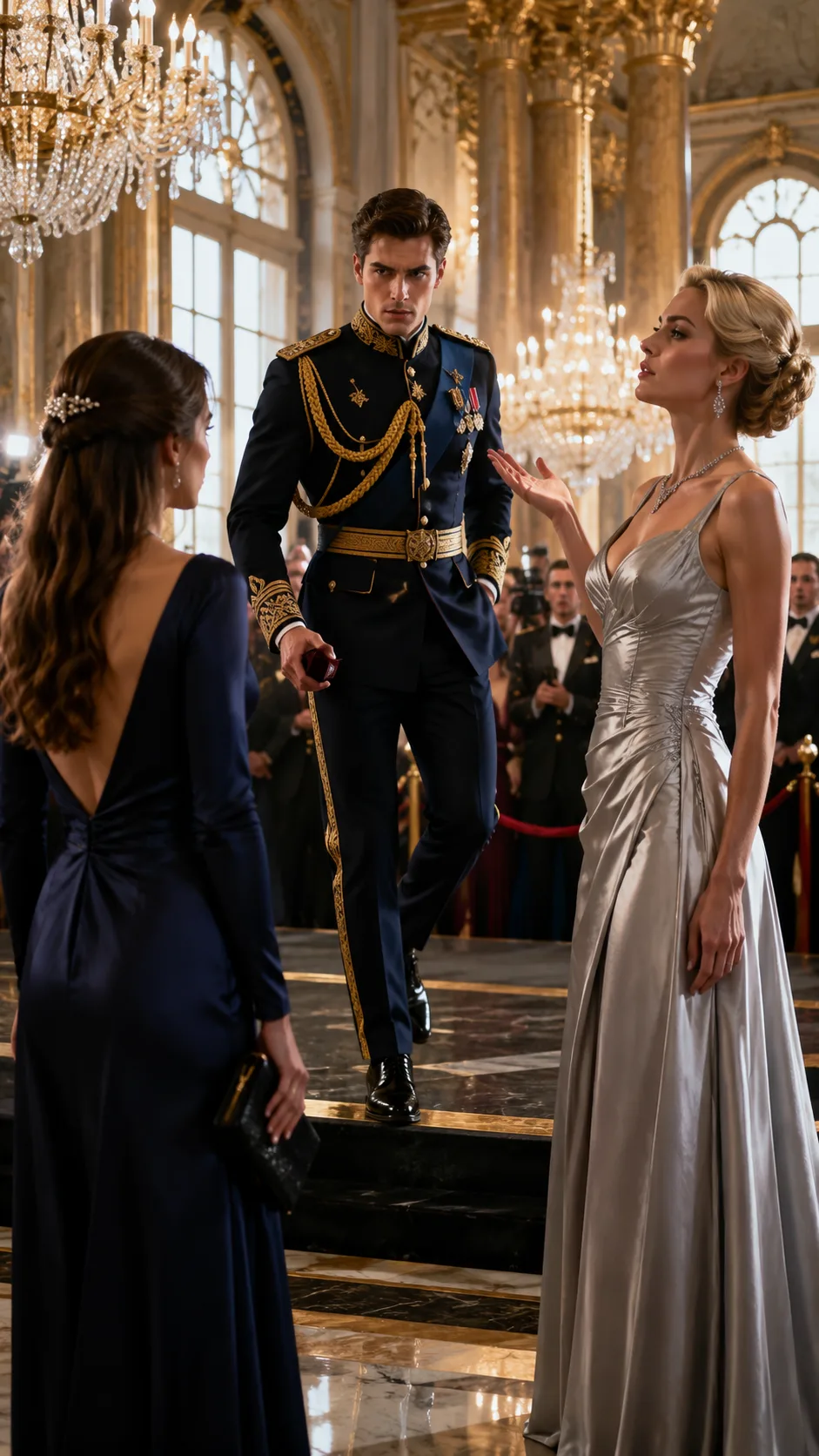
The Royal Family Chose a Perfect Princess for Him, But He Proposed to the Woman They Humiliated Publicly Before Everyone
Grace Bennett learned very early that palaces had two kinds of doors.
Chapter 1
The Royal Family Chose a Perfect Princess for Him, But He Proposed to the Woman They Humiliated Publicly Before Everyone
Grace Bennett learned very early that palaces had two kinds of doors.
The first kind opened wide for people with titles.
The second kind opened quietly for people who were expected to disappear after entering.
She always used the second kind.
At twenty-four, Grace had spent nearly three years walking through the service corridors of Valenbrook Palace with a leather folder pressed to her chest, translating letters, treaties, interviews, and private diplomatic notes for people who rarely remembered her name. She spoke five languages fluently, understood royal etiquette better than most nobles, and could calm an angry ambassador with one sentence whispered in the correct accent.
But in the palace records, she was simply listed as: Contract Interpreter — External Staff.
Not noble.
Not wealthy.
Not useful beyond her voice.
And certainly not the kind of woman a prince was supposed to notice.
Prince Adrian of Valenbrook noticed her anyway.
The first time he noticed her, she was standing behind a silk
curtain during a reception for the French delegation. The palace had assigned her to interpret for an elderly count who kept changing languages mid-sentence because he enjoyed making young officials nervous.
Grace never became nervous.
She stood straight in a dark green dress that had been approved by the palace because it was “modest enough not to draw attention.” Her brown hair was pinned neatly at the nape of her neck. A pearl clip, fake but polished, held back the loose strands near her temple.
Adrian had been expected to make polite conversation, smile for the cameras, and survive the evening without saying anything that could become a headline by morning.
Instead, he found himself watching Grace.
She translated every insult from the count into diplomacy.
When the count said, “Your kingdom has survived longer than expected for a country so small,” Grace calmly translated, “His Excellency admires Valenbrook’s resilience
and historic strength.”
When the count said, “Your parliament looks like a family dinner after too much wine,” Grace translated, “He notes the passion of your democratic debate.”
Adrian almost laughed.
Grace did not look at him. She never looked directly at royalty unless spoken to first.
That was the first rule of survival in a palace: never appear to want anything.
After the reception, Adrian found her alone in the corridor, organizing her notes.
“You saved me from starting a diplomatic incident,” he said.
Grace turned so quickly one of the papers slipped from her folder.
“Your Highness.”
He bent to pick it up before she could.
She looked startled, almost offended that a prince had lowered himself to the floor for her.
“You do not need to do that,” she said.
“I know,” Adrian replied. “That is why I did it.”
She stared at him for half a
second too long, then lowered her eyes.
“That is a dangerous habit in a palace, Your Highness.”
“What is?”
“Doing things you do not need to do.”
He smiled then, but she did not smile back. Not fully. Only the corner of her mouth softened, as if she had once trusted smiles and had learned better.
From that night on, Adrian began looking for her in every room.
He found her beside ambassadors, behind curtains, near podiums, at the edges of press briefings, always close enough to be useful and far enough to be ignored.
Grace Bennett was not invisible.
The palace had simply trained everyone not to see her.
Adrian began seeing too much.
He saw the way senior advisors handed her urgent documents without thanks. He saw how ministers interrupted her mid-sentence, then repeated her exact words as if they had thought of them. He saw how noblewomen glanced at her dresses, calculated their price, and dismissed her before she even spoke.
He also saw how she carried herself.
Not like someone ashamed.
Like someone refusing to let shame touch her.
Over time, their conversations became longer.
At first, it was nothing more than a question after a meeting.
“Did the German minister mean what he said?”
“No, Your Highness. He meant the opposite.”
“Then why did he say it?”
“Because powerful men enjoy hiding fear behind long sentences.”
Then it became tea in the archive room when storms delayed a reception.
Then it became books passed between them through a retired librarian who pretended not to notice.
Then, one winter evening, it became silence.
Adrian had found Grace on the western balcony after a charity dinner. Snow was falling over the palace gardens. Inside, violin music floated through golden halls. Outside, Grace stood with her arms wrapped around herself, looking at the city lights beyond the iron gates.
“You should be inside,” Adrian said.
“So should you.”
“I am avoiding three dukes and a woman who asked me whether I believe love is useful for monarchy.”
Grace glanced at him. “What did you say?”
“I said monarchy has survived many useless things.”
This time, she laughed.
It was brief, surprised, and real.
Adrian felt it like a crack of light under a locked door.
But Grace’s laughter faded when she noticed how he was looking at her.
“Your Highness,” she said carefully, “you should not stand out here with me.”
“Why?”
“Because someone will decide it means something.”
“What if it does?”
The snow seemed to still between them.
Grace looked away first.
“Then someone will decide I planned it.”
Her voice was calm, but Adrian heard the bruise beneath it.
That was the thing about Grace. She never begged. She never complained. She never made herself the center of pain. She simply stated the truth as if pain was a weather pattern she had learned to walk through.
Adrian stepped closer.
“I do not care what they decide.”
“That is because decisions fall softer on princes.”
He had no answer to that.
She turned toward him fully then, her face pale beneath the balcony lights.
“You can walk away from rumors with a statement from the palace press office,” she said. “I would walk away without a career, without references, and with every newspaper calling me a social climber before breakfast.”
“I would protect you.”
Her expression changed.
Not softened.
Hardened.
“Do not say that unless you know what it costs.”
Adrian did know.
Or at least, he thought he did.
He was wrong.
Three months later, the royal family announced his engagement negotiations.
Not to Grace.
To Princess Cassandra of Merovia.
Cassandra was everything the palace wanted.
Twenty-six years old. Blonde. Elegant. Educated at the finest schools in Europe. Daughter of a powerful royal house. Loved by fashion magazines. Followed by millions online. Her charities photographed well. Her scandals disappeared quickly. Her smile looked flawless from every angle.
The newspapers called her “the future face of Valenbrook.”
Queen Helena called her “a blessing.”
King Philip called her “politically necessary.”
Adrian called her nothing.
The announcement was not yet official, but the palace machine had already begun moving. Invitations were drafted. Designers were contacted. Journalists received whispers. Commentators praised the union before the couple had even stood in the same room.
Grace translated the first diplomatic letter regarding the arrangement.
She did it with steady hands.
Adrian watched from the end of the council table as she read the Merovian proposal in French, then repeated it in English without a single tremor.
“The House of Merovia believes this alliance will strengthen regional stability, cultural continuity, and economic cooperation,” Grace said.
Her voice was clear.
Her face was unreadable.
After the meeting, Adrian followed her into the corridor.
“Grace.”
She stopped but did not turn.
“Do not,” she said.
“You have not even let me speak.”
“I heard enough in the council chamber.”
“I did not agree.”
“You did not refuse.”
“That is not the same thing.”
She turned then, and for the first time since he had known her, Grace looked angry.
“No,” she said quietly. “It is worse.”
He reached for her hand, but she stepped back.
A footman passed at the end of the corridor. Grace instantly lowered her voice.
“You told me you did not care what they decided.”
“I don’t.”
“Then decide.”
The words struck him harder than any accusation.
Grace’s eyes shone, but she did not cry.
“I have spent my whole life watching powerful people postpone courage and call it duty,” she said. “Please do not ask me to admire you for doing the same.”
Then she walked away through the second kind of door.
The quiet one.
The one built for people expected to disappear.
Adrian did not sleep that night.
By morning, he had made his decision.
But royal decisions were never private. They had to pass through rooms full of people who believed love was a threat because it could not be scheduled, controlled, or inherited.
When Adrian told his parents he would not marry Cassandra, the king stared at him as if he had spoken treason.
“You will marry her,” King Philip said.
“No.”
Queen Helena’s face tightened. “Adrian, this is not a university romance. This is a kingdom.”
“And I am not a horse being traded between families.”
“You are the crown prince,” the king snapped. “You were born into responsibility.”
“I know exactly what I was born into,” Adrian said. “I was born into rooms where cruelty is disguised as tradition.”
The queen inhaled sharply.
“Careful.”
“No,” Adrian said. “I have been careful my entire life. I have been careful in interviews, careful in mourning, careful in war memorials, careful while shaking hands with men who funded our enemies ten years ago. I have been careful enough.”
King Philip stood.
“You are speaking of that interpreter.”
Adrian went still.
The room changed.
It was no longer a discussion of policy.
It was a hunt.
Queen Helena looked away, and that was how Adrian knew she had already known.
The king’s voice lowered.
“She is not suitable.”
“For what?”
“For you.”
“Because she lacks a title?”
“Because she lacks protection,” the king said coldly. “And if you drag that girl into this, the world will tear her apart.”
Adrian hated that the king was not entirely wrong.
That was how royal families survived: they wrapped selfishness in accurate warnings.
“I will not marry Cassandra,” Adrian said.
“Then you will destroy the stability your grandfather built.”
“No. I will destroy the illusion that my life belongs to a committee.”
The king came around the desk, his expression carved from years of command.
“You think this is love? It is rebellion wearing perfume. You are infatuated with the first woman who did not bow emotionally when you entered a room.”
Adrian’s jaw tightened.
“You know nothing about her.”
“I know enough. She is common. She is ambitious. And whether she intended it or not, she has made you foolish.”
Adrian stepped closer.
“She has made me honest.”
The meeting ended with no blessing.
By sunset, Grace was removed from diplomatic translation duty.
No announcement. No explanation.
Her palace access card stopped working at the north entrance. Her schedule disappeared from the staff system. Her supervisor, a nervous man who would not meet her eyes, told her there had been “internal adjustments.”
Grace listened silently.
Then she asked, “Was my work unsatisfactory?”
“No,” he said too quickly. “Of course not.”
“Then say the real reason.”
He swallowed.
“I cannot.”
Grace nodded, as if she had expected nothing else.
She packed her desk in thirteen minutes.
A dictionary with worn corners. Three notebooks. A silver pen Adrian had once lent her and forgotten to take back. A pair of spare heels. A small photo of her mother outside their old apartment in Lyon.
She did not cry in the office.
She did not cry in the corridor.
She did not cry when two guards escorted her through the side exit like a thief.
But when she reached the street outside the palace walls, she finally stopped.
Behind her, Valenbrook Palace glowed in the winter dusk, every window golden, every balcony polished, every flag moving gently in the cold wind.
A beautiful machine.
Built to crush quietly.
Grace took one breath.
Then another.
Then she walked away.
Adrian found out an hour later.
By midnight, he was at her apartment.
Grace lived on the third floor of an old building above a bakery, in a neighborhood where the streets smelled of rain, coffee, and warm bread. She opened the door wearing a gray sweater, her hair loose over one shoulder, her face pale with exhaustion.
For a moment, neither of them spoke.
Then she said, “You should not be here.”
“I know.”
“You keep doing things you do not need to do.”
“No,” he said. “This one I needed.”
Her eyes flickered.
“I lost my position today.”
“I know. I’m sorry.”
“Did you know before it happened?”
“No.”
She studied his face, searching for the lie.
She did not find one.
Adrian stepped inside only when she moved aside. Her apartment was small, warm, and crowded with books. A kettle steamed on the counter. Rain tapped against the window.
“I told them I would not marry Cassandra,” he said.
Grace closed the door.
“And they punished me first.”
His face tightened with shame.
“Yes.”
Grace laughed once, without humor.
“That is how palaces apologize. They wound the person with the least armor.”
“I will fix it.”
“No.” She turned on him. “You will not fix me like a public relations problem.”
“That is not what I meant.”
“Then what did you mean?”
He reached into his coat pocket and took out a small velvet ring box.
Grace went completely still.
Adrian did not open it.
Not yet.
“I meant,” he said, “that I am done letting them decide where you are allowed to stand.”
Grace stared at the box as if it were dangerous.
“Put that away.”
“Grace—”
“Put it away, Adrian.”
It was the first time she had used his name without his title.
He obeyed.
The box disappeared back into his pocket.
Her eyes were bright now.
“You cannot give me a ring in secret after they take away my work in public.”
“I was not going to ask you in secret.”
She froze.
“No.”
“Yes.”
“No,” she repeated. “Absolutely not.”
He stepped closer, but carefully, as if approaching a wounded animal that had learned every hand could become a trap.
“They will announce the engagement gala next week,” he said. “They will expect me to stand beside Cassandra. Smile. Accept the arrangement. Let the world believe it is done.”
Grace shook her head. “Do not use me as a weapon against your family.”
“I’m not.”
“Then what are you doing?”
“Choosing you where everyone can see.”
The room was silent except for the rain.
Grace’s voice dropped.
“And after that? When they call me a manipulator? When they dig through my childhood? When they photograph my building? When they say I trapped you because women like me are never allowed to be loved without a strategy?”
Adrian’s answer came quietly.
“Then I will stand beside you for every word.”
Grace looked at him for a long time.
Then she said the truth neither of them wanted to touch.
“You may lose the crown.”
Adrian nodded.
“I know.”
“You may lose your family.”
“I know.”
“You may regret me.”
His expression changed.
That wounded him.
Not because she doubted his love, but because the world had taught her to expect abandonment as the final chapter of every miracle.
He moved closer.
“I might regret many things,” he said. “But never the person who made me brave enough to be myself.”
Grace looked away before tears could fall.
“I need time.”
“You have it.”
“And if I tell you not to do this?”
He looked at her, and for the first time, the prince seemed less like a prince than a man standing at the edge of his entire life.
“Then I will not propose,” he said. “But I will still refuse Cassandra.”
Grace closed her eyes.
That was when she believed him.
Not because he offered her a crown.
But because he was willing to lose one without using her as the reason.
The royal engagement gala took place six days later.
The palace called it a “winter diplomatic celebration,” but everyone knew what it was. A soft launch. A staged romance. A royal fairytale prepared for cameras.
The ballroom had been transformed into a theater of wealth. Crystal chandeliers poured light over marble floors. White roses climbed gold pillars. A string orchestra played beneath the balcony. Reporters stood behind velvet ropes, their lenses hungry.
Princess Cassandra arrived in silver satin and diamonds.
She looked like someone created by a monarchy to prove monarchy still deserved to exist.
Her blonde hair fell in perfect waves over one shoulder. Her smile was soft for the cameras and sharp when they turned away. She touched the queen’s hand with graceful familiarity and kissed King Philip on both cheeks.
The newspapers would adore her by morning.
Adrian arrived in a dark navy royal military uniform with gold embroidery at the cuffs. He looked composed, but his eyes were cold.
In his left pocket, the velvet ring box felt heavier than a crown.
He had not seen Grace since the night in her apartment.
He had sent one message that morning.
Come only if you choose to. Leave anytime you need to. I will understand.
She had not replied.
At eight-thirty, the king gave the signal.
The orchestra softened. The press leaned forward. Cassandra stepped onto the central platform beside Adrian, her diamond earrings flashing beneath the lights.
Queen Helena watched from the front row, face unreadable.
King Philip stood near the podium, satisfied.
Then the ballroom doors opened.
Not the grand doors reserved for royals.
The side doors.
The second kind.
Grace Bennett entered quietly.
For one second, Adrian forgot how to breathe.
She wore a midnight blue satin gown, simple but elegant, with long sleeves and a clean neckline. Her hair was pinned back with the same pearl clip he remembered. No crown. No diamonds. No borrowed nobility.
Just Grace.
The room noticed her slowly, then all at once.
Whispers moved like smoke.
Cassandra saw her and smiled.
Not with surprise.
With pleasure.
She had been waiting for this.
Grace walked only a few steps into the ballroom before a palace aide tried to stop her.
But Adrian stepped down from the platform.
The movement was small.
The message was not.
Every camera turned.
Cassandra’s smile tightened.
“Adrian,” she said softly, warning hidden beneath silk.
He did not look at her.
He looked at Grace.
But before he could reach her, Cassandra descended from the platform and crossed the marble floor with perfect grace. She stopped between them, close enough for the cameras to catch all three faces.
“What a touching surprise,” Cassandra said.
Grace remained still.
“I was invited,” she said.
It was true.
Adrian had placed her name on the guest list himself.
Cassandra tilted her head.
“Were you?”
The words were light.
The cruelty was not.
Around them, nobles pretended not to listen while listening with their entire bodies.
Cassandra’s eyes traveled over Grace’s dress.
“How brave,” she said. “Wearing satin in a room where everyone knows the difference between elegance and imitation.”
A few people laughed softly.
Grace’s face did not change, but Adrian saw her fingers tighten around her small clutch.
He moved forward.
Cassandra turned slightly, making sure the cameras had her best angle.
“No, Your Highness,” she said sweetly. “Let her stay. I admire confidence. Even when it comes from confusion.”
Adrian’s voice was low.
“Enough.”
But Cassandra had already chosen her stage.
She looked directly at Grace now.
“You translated at court, didn’t you? That must have been exciting. Standing near history. Hearing important people speak. Perhaps after a while, proximity begins to feel like belonging.”
Grace lifted her chin.
“I never confused the two.”
“Really?” Cassandra smiled. “Then why are you here?”
The ballroom went quiet.
Grace could have said Adrian invited her.
She could have said she had every right to stand in any room that opened its doors.
She could have defended herself.
But she knew the trap.
If she answered emotionally, she would be dramatic.
If she answered calmly, she would be arrogant.
If she stayed silent, they would call it guilt.
So Grace said nothing.
Cassandra leaned closer.
“That is what I thought.”
Adrian stepped beside Grace.
The room shifted again.
Cassandra noticed, and something ugly flashed behind her perfect eyes.
She raised her voice just enough for the reporters.
“I do not blame her,” she said. “Women like Miss Bennett are taught to reach above themselves. It must be difficult to accept that admiration is not destiny.”
Grace’s breath caught.
Adrian’s hand curled into a fist at his side.
Cassandra looked at him now, her smile brightening with public innocence.
“Surely the crown prince understands the difference between affection and suitability.”
King Philip’s face hardened near the podium.
Queen Helena closed her eyes briefly.
Adrian’s voice cut through the room.
“I understand it better than anyone here.”
Cassandra’s smile faltered.
“Then perhaps you should explain it to her.”
She turned back to Grace, and this time she no longer pretended kindness.
“She has no royal blood.”
The sentence landed like glass breaking.
Not because it was clever.
Because it was exactly what everyone had been too polite to say.
The ballroom froze.
Reporters leaned in.
Grace went very still.
For a heartbeat, Adrian saw the service corridors, the side doors, the quiet dismissals, the stolen credit, the job taken from her without explanation. He saw every invisible wound the palace had given her and called tradition.
And then he was done.
He stepped forward until he stood between Grace and Cassandra.
His voice was calm.
Clear.
Deadly.
“Good,” Adrian said. “Then she’s the only one here who didn’t inherit cruelty.”
A gasp traveled through the room.
Cassandra’s face emptied.
King Philip moved toward them. “Adrian.”
But Adrian had already reached into his pocket.
The velvet ring box appeared in his hand.
Every camera flashed.
Grace stared at him, eyes wide.
He turned toward her, and the entire palace seemed to hold its breath.
Not because a prince was about to propose.
But because he was about to disobey history in front of the people who had spent their lives worshiping it.
Adrian lowered himself to one knee on the marble floor.
A prince kneeling before a woman they had tried to remove through the side door.
Grace covered her mouth with one trembling hand.
Adrian opened the ring box.
Inside was not one of the crown jewels.
It was a simple ring with a deep blue sapphire, surrounded by small white stones. Beautiful, but personal. Human.
“My family chose a princess for me,” he said, his voice carrying through the silent ballroom. “They chose bloodline, alliance, image, and obedience.”
He looked up at Grace.
“But I choose the woman who told me the truth when everyone else sold me duty and called it love.”
Grace’s eyes filled.
Cassandra stood behind him, pale with humiliation.
The king’s face darkened.
The queen did not move.
Adrian continued.
“I choose the woman who never needed a crown to have dignity. The woman who translated the words of kings but never let power change her own. The woman this palace tried to make invisible because she stood too honestly in its light.”
A reporter whispered, “Are we live?”
Someone answered, “Yes.”
Adrian heard it and did not stop.
“Grace Bennett,” he said, “I cannot promise they will be kind. I cannot promise the world will understand. I cannot promise that choosing me will make your life easier.”
His voice softened.
“But I promise you will never again stand alone in a room where I have breath left to stand beside you.”
Grace was crying now, but quietly.
Not broken.
Released.
Adrian held up the ring.
“Will you marry me?”
The silence stretched.
Every person in the ballroom waited for Grace to become the fairytale they could understand. To cry beautifully. To accept immediately. To let the prince rescue her and make the story easy.
Grace looked at the ring.
Then at Adrian.
Then at the king.
Then at Cassandra.
Finally, she looked at the room that had measured her blood and found her unworthy.
She stepped closer to Adrian.
But she did not take the ring yet.
Instead, she said, “Stand up.”
A murmur passed through the guests.
Adrian blinked.
Grace’s voice trembled, but it did not weaken.
“Please,” she said. “Stand up.”
Adrian rose.
Grace faced him eye to eye.
“If I say yes,” she said, “it will not be because you saved me from them.”
“I know.”
“And it will not be because a ring makes me worthy.”
“I know.”
“And I will not spend the rest of my life being grateful for a place I had to be humiliated to enter.”
Adrian’s eyes shone.
“No,” he said. “You will not.”
Grace looked at him for one long moment.
Then she smiled through tears.
“Then yes.”
The ballroom erupted.
Not in applause at first.
In shock.
Then, from somewhere near the back, a single clap sounded.
It came from an old palace translator who had trained Grace during her first month and once told her, “In rooms like this, survive first. Be brilliant later.”
Then another clap joined.
Then another.
Soon the staff along the walls were applauding.
Footmen. Interpreters. junior aides. Musicians. Security guards. People who knew what it meant to enter through the second kind of door.
The nobles followed later.
Some out of sincerity.
Most out of fear of being filmed not clapping.
Adrian slid the ring onto Grace’s finger.
Cassandra turned away, her face burning beneath the diamonds.
King Philip stepped forward, but Queen Helena touched his arm.
“Do not,” she said.
He looked at her, furious.
The queen’s eyes remained on Grace.
For the first time that evening, Helena looked less like a monarch and more like a woman remembering something she had buried.
“Do not make the crown smaller than it already looks,” she said.
The king stopped.
The cameras captured everything.
By morning, the proposal had been viewed by millions.
The headlines were chaos.
PRINCE ADRIAN DEFIES ROYAL FAMILY.
ORDINARY INTERPRETER ACCEPTS ROYAL PROPOSAL.
PRINCESS CASSANDRA HUMILIATED AT VALENBROOK GALA.
DID THE CROWN PRINCE JUST END AN ALLIANCE?
But one clip spread faster than all the others.
Cassandra’s voice: “She has no royal blood.”
Adrian’s reply: “Good. Then she’s the only one here who didn’t inherit cruelty.”
People replayed it in offices, cafés, classrooms, trains, apartments, and palace kitchens.
Some called it romantic.
Some called it reckless.
Some called Grace a social climber, exactly as she had predicted.
But something unexpected happened too.
Former palace staff began speaking.
Anonymous at first.
Then openly.
They described the way non-noble workers were treated. The quiet humiliations. The unpaid overtime hidden beneath prestige. The impossible rules. The way brilliance was borrowed from ordinary people and presented through royal mouths.
Grace did not give interviews.
Not for one week.
Not while reporters camped outside her old apartment.
Not while commentators debated whether she had “earned” the ring.
Not while Princess Cassandra returned to Merovia under the official explanation of “private family matters.”
Adrian stayed beside her.
Not in front of her.
Beside her.
When the palace press office drafted a statement calling their relationship “unexpected but deeply cherished,” Grace crossed out the word unexpected.
“It makes me sound like an accident,” she said.
Adrian handed her the pen.
“Then write it yourself.”
So she did.
The statement released two days later was only three sentences.
Prince Adrian and Grace Bennett are engaged. Their relationship began with mutual respect, honesty, and private friendship long before public speculation. They ask that Grace’s former colleagues and private family be treated with dignity.
It was the first royal statement in Valenbrook history drafted by the future bride herself.
Three weeks later, King Philip summoned Grace to the private council chamber.
Adrian offered to come with her.
Grace said no.
The king received her standing behind his desk, beneath a portrait of his grandfather. He looked older than he had at the gala, or perhaps Grace was simply no longer looking at him from a distance.
“Miss Bennett,” he said.
“Your Majesty.”
“I owe you an apology.”
Grace waited.
The king seemed uncomfortable with the shape of the words.
“What happened at the gala should not have happened.”
“No,” Grace said. “It should not have been allowed to happen for years before the gala.”
His eyes narrowed slightly.
“You speak boldly.”
“I speak five languages, Your Majesty. Boldly is only one of them.”
For half a second, something like amusement crossed his face.
Then it disappeared.
“You understand the pressure my son has placed upon the monarchy.”
“I understand the pressure the monarchy placed upon your son.”
The king looked at her for a long time.
“You do not fear me.”
Grace thought about that.
Then she answered honestly.
“I did. For years. Then your palace took my position, my reputation, and my privacy in less than a week. After that, fear became inefficient.”
The king lowered himself into his chair.
“You will not be easy to control.”
“No.”
“And you consider that a virtue?”
“I consider it a requirement for marrying your son.”
Silence filled the chamber.
Then King Philip did something Grace did not expect.
He sighed.
Not as a king.
As a tired father.
“He has changed since meeting you.”
Grace’s voice softened, but only slightly.
“No, Your Majesty. He has become more himself.”
The king looked toward the window, where the palace gardens lay silver beneath winter frost.
“My wife said something similar.”
“Then perhaps you should listen to her more often.”
The king turned back sharply.
Grace held his gaze.
Then, very slowly, King Philip smiled.
It was small.
Reluctant.
But real.
“You are either very brave,” he said, “or completely impossible.”
Grace thought of side doors, service corridors, borrowed dignity, and the moment Adrian had stood between her and cruelty.
“Both,” she said.
The wedding was not held that spring.
Grace refused.
The palace wanted speed. A public celebration to stabilize the scandal. A controlled ceremony. A polished transformation from controversy into fairytale.
Grace said no.
“I will not become decoration for the institution that tried to erase me,” she told Adrian.
So instead, she returned to work.
Not as a contract interpreter.
As the newly appointed Director of Language and Cultural Affairs for the Valenbrook Royal Foundation.
The title was Adrian’s idea.
The authority was Grace’s demand.
Under her leadership, the palace revised staff contracts, created anti-harassment protections, raised salaries for translators and diplomatic aides, and ended the practice of removing workers from event records to keep photographs “clean.”
The changes were not glamorous.
They did not trend as easily as a proposal.
But inside the palace, people noticed.
The second kind of doors still existed.
But they no longer closed as quietly.
Six months after the gala, Grace stood again in the grand ballroom.
This time, she was not near the edge.
She stood beside Adrian at the center of the room during a reception for international scholars. She wore an ivory satin gown and pearl earrings. The sapphire ring rested on her finger, catching soft daylight from the tall windows.
A young interpreter approached her nervously before the speeches began.
“I just wanted to say,” the girl whispered, “I saw the video.”
Grace smiled gently.
“I think everyone saw the video.”
The girl laughed, then lowered her voice.
“My mother cried when you told him to stand up.”
Grace looked across the ballroom at Adrian, who was speaking with two ministers and clearly wishing he were not.
“She understood why,” Grace said.
The young interpreter nodded.
“You did not let them turn you into a rescue story.”
Grace looked back at her.
“No,” she said. “Because I was never waiting to be rescued.”
Across the room, Adrian noticed Grace watching him.
He excused himself from the ministers and came to her side.
“Everything all right?” he asked.
Grace took his hand.
“Yes.”
The orchestra began to play. Sunlight moved across the marble floor. Beyond the windows, the city of Valenbrook glittered beneath a clear sky.
The palace was still old.
Still proud.
Still full of portraits of people who believed blood was destiny.
But in the center of its grandest ballroom stood a woman with no royal blood, wearing a ring chosen not by a council, not by an alliance, not by inheritance, but by a man who had finally learned that love without courage was only another form of obedience.
Adrian leaned closer.
“Do you ever miss being invisible?”
Grace looked at the chandeliers, the cameras, the nobles pretending they had always admired her, and the staff who no longer had to lower their eyes when she passed.
Then she looked at him.
“No,” she said. “But I remember it.”
His thumb brushed gently over her hand.
“So do I.”
Grace smiled.
“Good.”
“Good?”
“Yes,” she said, lifting her chin as the ballroom doors opened for the evening guests. “Because the people who remember the side doors are the only ones who know how heavy the front doors really are.”
And this time, when the doors opened, Grace Bennett did not step aside.
She stood exactly where she belonged.
THE END.
Chapter complete
You have reached the end of this chapter.
Continue reading
A few more worlds to get lost in after this chapter.