Isabella was pinning a white orchid to her husband’s lapel when Alexander took her wrist and turned it away from the staircase.
Chapter 1
Isabella was pinning a white orchid to her husband’s lapel when Alexander took her wrist and turned it away from the staircase.
“Not there,” he said.
His voice was calm. His thumb rested on her pulse for one second too long. Then he smiled for the photographer.
Flash.
The wedding guests gathered in the east hall below the crystal chandelier, all champagne and silk and careful laughter. Outside the tall windows, the sea struck the cliffs hard enough to send salt mist against the glass. Inside, the mansion looked warm. Gold-framed portraits. Polished floors. White roses spilling from silver urns.
Too perfect.
Isabella had married him that morning in the chapel behind the estate, with twelve witnesses and a string quartet that played too softly. Alexander had held her hand through every vow. He had lowered his head when the minister mentioned loyalty. He had looked like a man who knew how to suffer beautifully.
That was what everyone said about him.
“He lost Vivian so young.”
“He never recovered.”
“He deserves
tenderness.”
Isabella had heard those sentences all afternoon. They followed her from the receiving line to the dining room, from the terrace to the library, always spoken with that lowered voice people used near illness or money.
Alexander did not correct them.
He kept Vivian’s portrait above the fireplace in the blue room. A woman in a pearl-colored dress, dark hair pinned back, one hand resting on the arm of a velvet chair. Her smile was not a smile. It looked more like she had been told to stay still.
At dinner, Alexander raised his glass.
“To second chances,” he said.
The guests drank. Isabella drank too, though the champagne had gone flat.
A servant named Marta stood near the doorway with a tray of untouched canapés. She was older than the other staff, with silver hair pulled into a tight knot and eyes that moved too quickly. When Isabella
turned toward the west staircase, Marta’s hand shifted against the tray.
One spoon slid.
No one else noticed.
Isabella did.
After the guests left, Alexander walked her through the mansion as though giving a tour of a museum he owned. The east wing was for family. The south wing was for guests. The library was his father’s favorite room. The music room had been Vivian’s.
“The piano?” Isabella asked.
“Untouched for years,” he said.
He shut the music room door before she could step inside.
The west staircase stood at the end of the corridor, narrow and dark, with a velvet rope hooked across it.
“And upstairs?” she asked.
Alexander looked at the rope, not at her.
“Storage. Old furniture. Nothing worth seeing.”
He placed one hand on the small of her back and guided her away.
That night, after she changed out of her wedding dress, Isabella found a
white orchid lying on the floor outside the west staircase.
Its stem had been snapped clean.
By the third morning, Isabella knew the mansion had two schedules.
One schedule belonged to the living.
Breakfast at eight. Staff meetings at nine. Alexander in the glass office by ten, speaking to lawyers in Zurich, London, and Singapore. Lunch placed on a silver tray even when no one asked for it. Dinner at seven, always at the long table, always with two candles lit at Alexander’s end and one at hers.
The other schedule moved above her head.
At 12:07 every night, a floorboard creaked above the west corridor. At 12:12, water ran through pipes that should have belonged to empty rooms. At 12:20, three piano notes slipped through the ceiling.
Never a song.
Just three notes.
Then silence.
The first time she heard them, Isabella sat up in bed.
Alexander did not move.
The second time, she touched his shoulder.
“Do you hear that?”
He opened his eyes too quickly.
“Hear what?”
“The piano.”
He turned his face toward the ceiling. Waited. The room gave them only rain and old wood.
“Wind,” he said.
“No. It was music.”
His hand found hers under the blanket. He held it flat against the mattress.
“This house makes sounds.”
His grip stayed gentle.
Still a grip.
The next morning, the music room was locked.
Isabella tried the brass handle twice. Marta appeared at the far end of the hall before the metal stopped moving.
“Mrs. Vale,” she said.
Isabella let go.
Marta crossed the hall with a stack of folded linen. One sheet hung lower than the others, almost touching the floor.
“Does someone play at night?” Isabella asked.
Marta’s eyes flicked toward the ceiling.
“No one plays.”
“That is not what I asked.”
The older woman tightened her hold on the linen.
A door closed somewhere above them.
Marta walked away without another word.
That afternoon, Alexander hosted three trustees from the Vale Foundation in the library. Isabella was not invited, but the doors had been left open two inches. She passed once with a book. Then again with nothing in her hands.
A man with a red face and a navy tie said, “The remaining shares still require final clearance.”
Alexander’s answer came low.
“My wife will not be a problem.”
Isabella stopped beside a marble bust of Alexander’s grandfather. The bust had a chipped ear.
One of the trustees cleared his throat.
“You mean your late wife?”
A pause.
Alexander’s glass touched the table.
“I mean my wife.”
The room went quiet for three seconds.
Then papers shifted.
Isabella stepped back before anyone saw her.
That evening, Alexander gave her a diamond bracelet at dinner. It sat in a black velvet case between the soup bowls.
“For patience,” he said.
“With what?”
“With old houses. Old habits.”
He fastened it around her wrist himself. The clasp clicked shut. The bracelet was beautiful, heavy, and slightly too tight.
The housekeeper served roasted fish. Marta poured wine. The grandfather clock in the hall ticked loud enough to fill every pause.
“You should come to the foundation dinner next week,” Alexander said. “People want to meet you properly.”
“I thought I already met everyone.”
“Not everyone who matters.”
His knife touched porcelain.
A sharp sound.
Isabella placed her left hand under the table and turned the bracelet around her wrist until the clasp pinched her skin.
“Will Vivian’s family be there?”
Alexander looked up.
“No.”
“You never talk about them.”
“They preferred grief from a distance.”
Marta’s wine bottle trembled over Alexander’s glass. A single red drop struck the white tablecloth.
Alexander watched it spread.
“Marta,” he said.
The housekeeper set the bottle down and wiped the stain with a folded napkin. Her hands worked fast. Too fast.
“Leave it,” Isabella said.
Marta stopped.
Alexander’s eyes stayed on the stain.
“Continue,” he said.
Marta wiped until the red faded into a pale shadow.
After dinner, Isabella went to the blue room and stood before Vivian’s portrait. The woman’s painted hand rested near her lap, one finger bare except for a thin gold ring. Not a wedding ring. Smaller. Plain. Almost hidden in the brushwork.
Isabella leaned closer.
The frame had dust along the top edge, but the lower right corner was clean, as if someone touched it often.
She lifted her hand.
A voice came from behind her.
“You look for things.”
Alexander stood in the doorway, jacket removed, tie loosened. The warm light from the hall sharpened the lines of his face.
“I look at things,” Isabella said.
He walked into the room and stopped beside her.
“Vivian hated that portrait.”
“Why keep it?”
“Because people expect grief to have furniture.”
He smiled.
Not enough.
Isabella looked back at the painting. The gold ring caught a brushstroke of light.
That was the first crack.
The mini twist came two days later inside a drawer that should have held stationery.
Alexander had left for London before sunrise. His driver had carried two leather cases to the car. Marta had watched from the entryway, one hand pressed to her apron pocket.
The mansion loosened after he left.
Doors stayed open. Staff voices rose above whispers. Someone laughed in the kitchen and stopped too quickly when Isabella entered.
She spent the morning in the library, pretending to read.
At noon, she pulled the lower drawer of Alexander’s father’s desk.
Locked.
She tried the smaller key from her jewelry case. Nothing. A letter opener. Nothing. Then she noticed a tiny brass notch beneath the lip of the drawer, hidden under carved leaves.
She pressed it.
The drawer released.
Inside sat old ledgers, a stack of estate maps, and a folded cream envelope with no seal.
On the front, in narrow handwriting, was one name.
Vivian.
Isabella opened it.
There was no letter. Only a key wrapped in tissue paper and a torn strip of legal stationery. On it, in Vivian’s handwriting, were four words:
If she comes next.
Isabella read them twice.
Then she read them once more without breathing.
Not if someone comes.
If she comes next.
The words had been written before Isabella entered this house. Before the wedding. Before Alexander stood at the altar and promised tenderness.
A floorboard creaked above her.
She closed the drawer and kept the key.
That night, the three piano notes came again at 12:20.
This time, Isabella was already dressed.
She wore a robe over her nightgown and tied her hair back with shaking fingers that she refused to look at. The brass key sat in her palm, warm now from being held too long.
The west corridor had no lamps lit except the wall sconces near the stairs. Their bulbs hummed faintly. Somewhere below, the kitchen refrigerator clicked on.
A stupid sound.
A real sound.
It made the whole thing worse.
Isabella stepped over the velvet rope.
The staircase smelled of dust, lavender polish, and something medicinal.
Halfway up, she heard movement behind the wall. Not rats. Not old pipes.
A chair leg scraping wood.
She reached the landing.
The door at the top was painted the same dark green as the walls, its brass lock polished brighter than the handle. Someone used it. Someone cared for it.
The key fit.
One turn.
One click.
The door opened.
The bedroom breathed warm air into the hall.
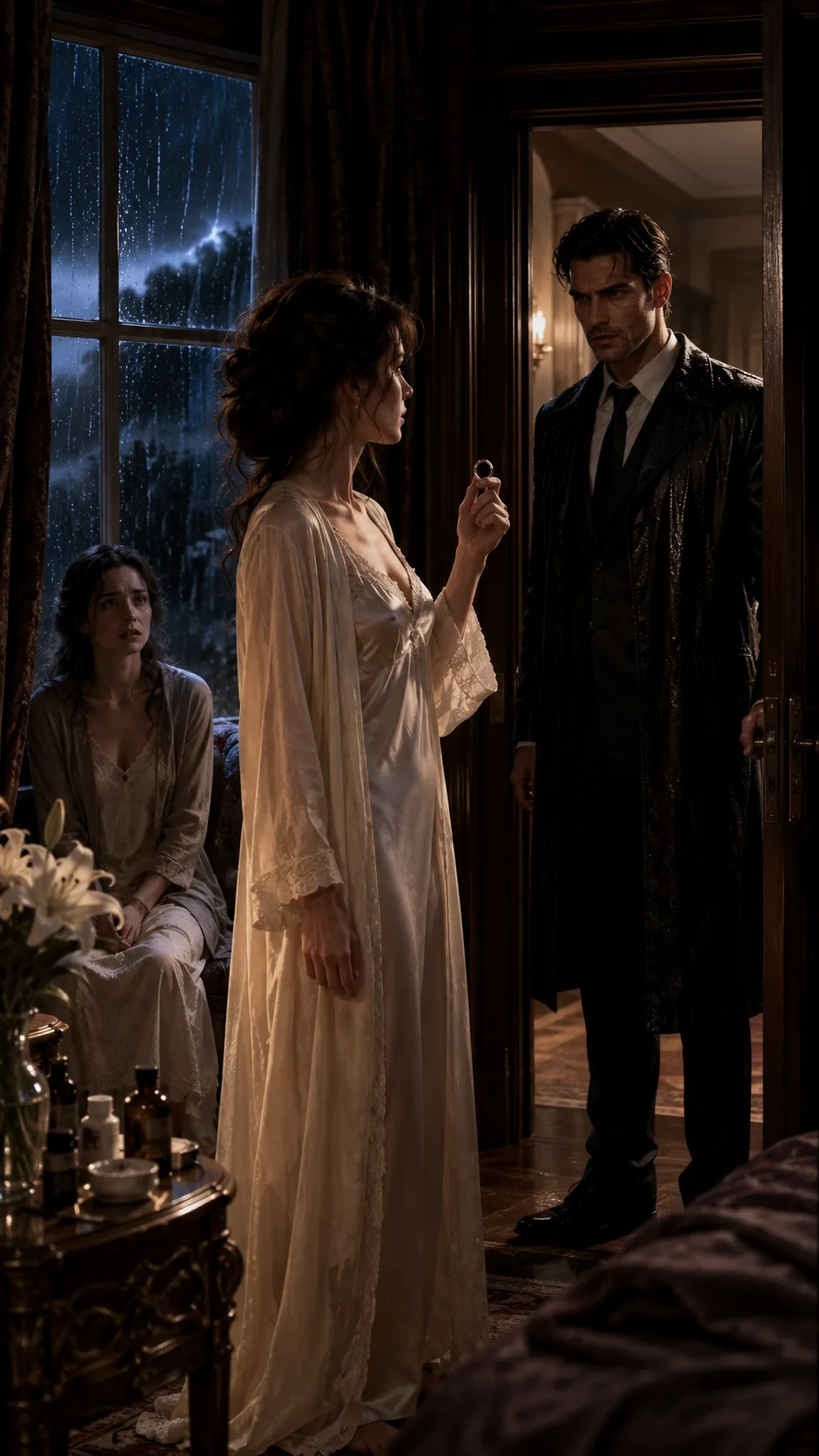
Isabella stood with one hand on the door and stared at the room Alexander had called storage. A fire burned low in a marble fireplace. Fresh lilies filled a crystal vase on the bedside table. Medicine bottles stood in a straight row beside a silver spoon, a half-full glass of water, and a folded napkin with a pale brown tea stain near one corner.
A grand piano sat near the rain-streaked window.
Its lid was open.
On the chair beside it lay a shawl, not old, not forgotten. Used. Folded badly by tired hands.
Then the woman by the window turned.
“So you are the new wife.”
The voice was dry from disuse. Not weak. Dry.
Isabella’s fingers slipped from the door.
The woman rose halfway, one hand gripping the arm of the chair. Her hair was dark with strands of gray near the temples. Her cheekbones cut sharp under thin skin. She wore a cream nightdress under a cardigan too large for her shoulders.
But the face was the portrait.
The same brow. The same mouth. The same eyes that looked as if they had learned not to expect rescue.
“Vivian,” Isabella said.
The woman looked toward the open door.
“Close it.”
Isabella did not move.
Vivian’s gaze sharpened.
“Close it.”
Isabella stepped back and pushed the door until the latch almost caught, then stopped before it clicked.
“Alexander said you died.”
Vivian gave a small sound with no humor in it.
“He needed me dead.”
Rain struck the windows. The fire snapped. Somewhere in the room, a clock ticked unevenly, one beat late every few seconds.
Isabella looked at the medicine bottles. The flowers. The piano. The locked door.
“How long?”
Vivian’s fingers tightened on the chair.
“Long enough for people to stop asking.”
Isabella crossed the room slowly, passing a vanity covered with silver brushes and unopened perfume. A blue ceramic dish on the dresser held hairpins, two pearl earrings, and a tiny screwdriver.
Vivian saw her notice it.
“I used to take things apart,” Vivian said. “Before he started taking things from me.”
Isabella stopped three feet away.
The woman looked smaller up close. Not fragile like glass. Fragile like wire bent too many times.
“Why are you here?” Isabella asked.
Vivian’s eyes moved to Isabella’s bracelet.
“Because I would not sign.”
The bracelet felt tighter.
“Sign what?”
“My shares. My voting rights. My father’s trust. The last pieces he could not buy with charm.”
Isabella’s mouth opened, then closed.
No words.
Vivian looked past her again.
“You should not have come alone.”
A sound rose from the hallway.
Footsteps.
Measured. Familiar. Too calm.
Isabella turned.
The door opened before she reached it.
Alexander stood there in his dark suit and rain-damp overcoat, one hand still on the brass handle. Water shone on his shoulders. His hair was wet from the storm, but his breathing was even.
He looked at Vivian first.
Then Isabella.
Then the key in Isabella’s hand.
“I hoped you wouldn’t be as curious as she was.”
The sentence landed without force. That made it worse.
Isabella’s back touched the edge of the vanity.
Alexander stepped inside and closed the door behind him.
Not hard.
Carefully.
“You came home early,” Isabella said.
“I live here.”
Vivian remained by the window. Her hands had vanished into the folds of her cardigan.
Alexander glanced at her.
“Sit down.”
Vivian did not sit.
The corner of his mouth tightened.
“You should not be standing.”
“You should not have married her.”
His eyes moved back to Isabella.
“There are things in a family that outsiders misunderstand.”
Isabella lifted the key.
“Is that what this is?”
Alexander took another step. The room changed around him. The doorway belonged to him. The hall belonged to him. The staff downstairs, the lawyers, the trustees, the bank accounts, the names on the doors.
All of it stood behind him.
Isabella stood barefoot on a rug beside a woman declared dead.
The fire shifted.
Light ran along the glass bottles.
Alexander looked at Isabella’s wrist.
“That bracelet is too tight,” he said. “You should have told me.”
She did not answer.
He held out his hand.
“Give me the key.”
Vivian moved.
Fast enough that Isabella almost missed it.
She reached from behind and caught Isabella’s left wrist. Her fingers were cold, thin, and exact. She pressed something into Isabella’s palm, then folded Isabella’s fingers over it.
A small gold ring.
Plain.
Heavy.
Alexander saw it.
His hand stopped in the air.
For the first time since entering the room, his body forgot what it was performing.
Vivian’s fingers dug once into Isabella’s skin.
“Years,” she said.
Alexander’s gaze lifted from the ring to Vivian.
“You kept it.”
Vivian’s chin lifted a fraction.
“You confessed to a ghost.”
The room held still.
Isabella looked down at the ring. Inside the band, almost invisible beneath a ridge of gold, was a small black dot.
A recording device.
The same ring from the portrait.
The one painted on Vivian’s hand.
Isabella closed her fingers around it.
Alexander took one step toward her.
“Give it to me.”
No charm now.
No widower’s sorrow. No polished grief. No warm voice for donors and trustees.
Just the man under it.
Isabella stepped sideways, placing herself between Vivian and Alexander. Her heel struck the leg of the piano bench. It scraped against the floor with a thin, ugly sound.
Alexander’s eyes flicked to the door.
Then to the window.
Then back to the ring.
He was measuring the room.
Vivian said, “He told the doctors I was unstable.”
Alexander did not look at her.
“Be quiet.”
“He told the board I had left the country.”
“Enough.”
“He told everyone I died because a dead wife is easier than one who says no.”
Alexander’s face did not change much. Only his jaw worked once. His right hand lowered, then curled.
Isabella raised the ring.
Small. Gold. Almost nothing.
Alexander looked at it as if it had teeth.
“What is on it?” Isabella asked.
Vivian’s eyes stayed on Alexander.
“His voice.”
Alexander’s hand went into his coat pocket.
Isabella saw the phone.
She moved first.
She stepped back, lifted the ring higher, and turned toward the small writing desk beside the fireplace. A house phone sat there beneath a brass lamp. Old-fashioned. Cream-colored. The kind Alexander kept because it looked elegant.
She picked up the receiver.
Alexander stopped.
The ring stayed in her other hand.
“Put it down,” he said.
Isabella held the receiver against her ear. There was a dial tone.
A living sound.
Vivian gripped the back of the chair.
Alexander looked from the phone to the ring. One second. Two.
His shoulders dropped by less than an inch.
Enough.
Isabella faced him fully.
“You didn’t lose your first wife. You locked her away. And now you’ve created a second witness.”
The words did not echo.
They sat in the room.
Alexander’s hand remained in his coat pocket, but he did not take the phone out. Vivian exhaled once through her nose. Downstairs, somewhere far below, a door opened and closed.
The mansion had heard something.
Alexander looked at Isabella as though seeing the wrong woman in her body.
Then the house phone clicked.
A voice came through the receiver.
“Emergency services. What is your location?”
Isabella kept her eyes on Alexander.
“The Vale estate,” she said. “Third floor. Locked west wing.”
Alexander moved.
Vivian lifted the piano bench with both hands and shoved it into his path. It struck his shin and tipped sideways. The sound cracked through the room, hard and wooden.
Alexander stumbled half a step.
Only half.
But it was enough for Isabella to reach the door.
She opened it.
Marta stood in the hallway with two other staff members behind her. One held a laundry basket. One held nothing at all. Their faces had gone pale in the yellow wall light.
Marta looked past Isabella.
She saw Vivian.
The laundry basket hit the floor.
White sheets spilled across the landing.
No one picked them up.
The west staircase filled with voices that did not rise above a murmur.
Marta wrapped a blanket around Vivian’s shoulders. The younger maid brought water and dropped the glass cap twice before it stayed on the bottle. One of the footmen stood at the top of the stairs, blocking Alexander without touching him.
That mattered.
No one touched him.
No one needed to.
Alexander sat in a chair near the bedroom door with his hands visible on his knees. His coat dripped rainwater onto the carpet. A small dark pool spread beneath the hem.
Isabella stood by the writing desk, still holding the receiver, still holding the ring. Her thumb rested against the black dot inside the band.
The emergency operator kept asking questions.
Isabella answered the ones she could.
Name. Address. Number of people. Immediate danger.
Vivian did not speak again until sirens began below the cliff road.
Then she asked for shoes.
Not a coat. Not documents. Not jewelry.
Shoes.
Marta knelt in front of the wardrobe and opened the lower drawer. Inside were four pairs lined up neatly, all unworn, all too clean. Vivian looked at them for a long time before choosing the plain brown flats.
Alexander watched.
His mouth opened once.
Marta turned her head.
He closed it.
The police arrived with wet shoulders and practical shoes. The first officer paused when she saw Vivian, then looked at the portrait visible through the open door of the blue room below.
The same face.
No one said the obvious thing.
Isabella placed the ring inside a clear evidence bag on the desk. The officer sealed it. Vivian watched the plastic close around the gold.
Alexander stood when they asked him to.
The footman stepped aside.
This time, the mansion did not move for him.
As they led him down the west staircase, one of the white sheets from the fallen basket caught under his shoe.
He dragged it three steps before it came loose.
Three months later, the west staircase had no velvet rope.
Isabella had it removed on a Tuesday morning while rain pressed silver lines down the windows. The worker asked if she wanted the brass hooks taken out too.
“Yes,” she said.
The holes stayed in the wall.
Small. Dark. Honest.
Vivian moved into the east wing after the hospital released her, though she refused Alexander’s bedroom and refused the blue room with the portrait. She chose a smaller room facing the garden, where the morning light came in without touching the sea.
The doctors called her recovery complicated.
Vivian called it Tuesday.
She sat by the window most days with legal folders stacked beside her tea. Her hands shook when she signed the first affidavit. They did not shake on the third.
The recordings on the ring did what Vivian had kept them to do.
They opened sealed questions. They brought trustees into rooms where they could no longer pretend grief had paperwork. They turned private whispers into testimony. They made Alexander’s polished silence look worse than any confession he had tried to hide.
The board froze his control within a week.
The prosecutors followed.
By winter, Alexander Vale’s name remained on the iron gates, but not on the decisions inside them.
He was not allowed near the estate. Not near Vivian. Not near Isabella.
His lawyers released one statement about personal tragedy and misunderstanding. No one read it twice.
Isabella stayed long enough to give statements, sign her own petition, and remove her name from Alexander’s accounts. She kept no jewelry from the marriage except the diamond bracelet, which she did not wear. It sat in a sealed envelope with photographs, contracts, and copies of police reports.
Evidence had its own drawer now.
On the last morning before she left the mansion, Isabella walked through the hall with a small suitcase. Marta waited by the front door, hands folded over a fresh apron. The younger staff stood farther back, pretending not to watch.
Vivian came down the west staircase alone.
Slowly.
One hand on the rail. Brown flats on her feet.
She carried the white orchid from the entry table. The stem was whole this time.
At the bottom step, she handed it to Isabella.
“For your next house,” Vivian said.
Isabella took it.
No one hugged. Not there. Not under the chandelier where Alexander had toasted second chances and smiled for cameras.
Outside, the car waited with its engine running. The sea was gray beyond the cliffs. The old mansion stood behind Isabella with every window uncovered.
She looked once toward the third floor.
The curtains were open.
Vivian stood at the window.
Not hidden.
Isabella got into the car with the orchid across her lap.
The gates opened.
Chapter complete
You have reached the end of this chapter.
Continue reading
A few more worlds to get lost in after this chapter.




