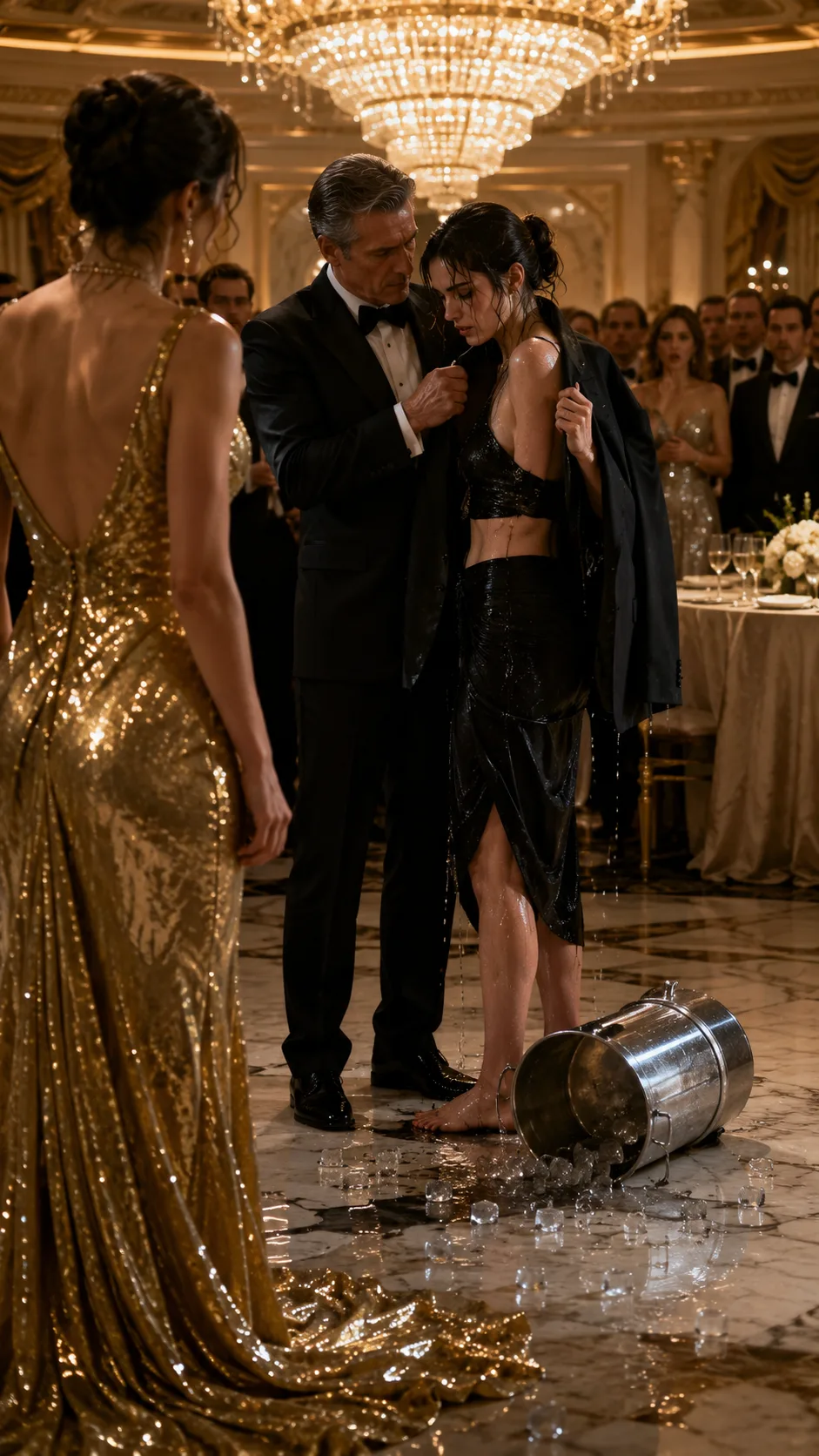
Sarah Vale stood behind the service table of the most expensive charity gala in the city, holding a silver tray she was not supposed to be holding.
Chapter 1
Sarah Vale stood behind the service table of the most expensive charity gala in the city, holding a silver tray she was not supposed to be holding.
The ballroom looked like something built for people who had never checked the price of anything in their lives. Gold chandeliers hung from a painted ceiling. White roses climbed around marble pillars. A string quartet played near the staircase while guests in black tuxedos and jeweled gowns lifted champagne glasses under warm lights.
Every few seconds, a camera flashed.
Every flash seemed to belong to Evelyn Hart.
She stood near the center of the room in a gold couture gown, smiling as if the entire evening had been arranged around the curve of her hand. Her dark hair was pinned in a perfect twist. Diamonds wrapped her throat. A gold ribbon was pinned to her chest beside the charity’s emblem.
The foundation was celebrating another year of “life-saving generosity.”
Those were the words printed on every program card.
Sarah had not read them from the card.
She had read them
from across the room, where the letters shone on a banner behind the donor stage.
Life-saving generosity.
Her fingers tightened around the tray.
A waiter brushed past her shoulder and whispered, “You’re not supposed to stand there.”
Sarah stepped back immediately. “Sorry.”
The waiter barely looked at her. “Agency staff stay near the kitchen until called.”
“I’m not with the agency.”
He glanced down at her black dress, her simple shoes, the tray in her hands, and the plain pin clipped to her collar. The pin was temporary. Someone had pressed it into her hand at the entrance when she arrived and said, “Staff check-in is down the hall.”
She had tried to explain.
No one listened.
In rooms like that, black dresses meant one thing. Wealthy guests wore gold, silk, diamonds, and confidence. Everyone else carried trays.
The waiter gave her the kind of tired look people give when
they do not want a problem. “Then why are you holding drinks?”
Sarah looked at the tray.
Because someone had shoved it into her hands when she walked in.
Because nobody believed she had been invited.
Because Richard Hart’s assistant had promised her name would be on the guest list, and then vanished into a line of donors.
Because Sarah had spent ten minutes standing near the entrance while two receptionists checked the list three times and still looked at her like she had wandered in from the wrong street.
She simply said, “I’m waiting for Mr. Hart.”
The waiter’s expression changed, but not with respect.
With warning.
“Don’t say that too loudly.”
Then he walked away.
Sarah lowered the tray to the edge of the table. She should have left then. She knew that later. The second the receptionist gave her that staff pin, she should have turned around
and gone back to her small apartment, taken off the borrowed dress, and forgotten the whole thing.
But Richard had asked her to come.
Not by email. Not through a secretary.
He had called her himself.
“Miss Vale,” he had said, voice quiet and careful, “I know you may not want to attend, but there are things that should be said publicly. You deserve to be in the room when they are.”
Sarah had almost laughed.
Deserve.
That word had been missing from her life for so long it sounded like a foreign language.
Her mother used to say it differently.
“Don’t wait for people to decide you deserve kindness, Sarah. Some people only understand proof.”
Her mother had died six months ago with a stack of unpaid bills beside her bed and an eviction notice folded inside a kitchen drawer.
Sarah had found that notice three days after the funeral.
The company name printed at the bottom of the page was Hartwell Medical Holdings.
Evelyn Hart’s family company.
Sarah had stared at that name until the paper blurred.
Now she stood beneath Evelyn’s chandeliers, holding a tray of champagne for people who called themselves generous.
Across the ballroom, Richard Hart stood beside the donor table, speaking with two older men in tuxedos. He was tall, silver-haired, and composed in a way that made people lean toward him when he spoke. He did not look like the kind of man who lost control in public.
But Sarah had heard his voice on the phone.
She had heard the crack in it when he said, “My wife never knew your name.”
Sarah had not answered.
What could she say to that?
Evelyn Hart was alive because Sarah had signed a medical form at twenty-three, alone, afraid, and still willing.
The donation had been anonymous.
That was what Sarah wanted at the time.
No press. No charity dinner. No photograph of a poor girl praised by rich strangers for doing something they would forget by dessert.
She had done it because a woman was dying, and because Sarah’s mother had raised her to believe that saving a life mattered even when the life belonged to someone who would never know yours.
Then her mother got sick.
Then insurance denied coverage.
Then paperwork disappeared.
Then every appeal came back stamped and cold.
Then Sarah discovered the same family who benefited from her sacrifice had profited from the system that abandoned her mother.
Richard had found out too late.
That was what he said.
Too late to help Margaret Vale.
Not too late to speak.
Sarah looked down at her hands.
A faint line of water from a sweating champagne flute slid across the tray and touched her thumb.
She wiped it away.
“Excuse me.”
The voice came from behind her.
Sarah turned.
Evelyn Hart stood three feet away.
Up close, she was even more beautiful than the photographs. Perfect makeup. Perfect posture. Perfect smile. She had the kind of face that had never needed to ask twice.
Her eyes moved from Sarah’s shoes to the tray, then to the staff pin on her collar.
“You’re blocking the rose display,” Evelyn said.
Sarah stepped aside. “Sorry.”
Evelyn did not move on.
Instead, she looked Sarah over with slow precision, as if checking a table setting.
“Which agency sent you?”
Sarah’s fingers rested against the tray. “I’m not with an agency.”
Evelyn’s smile stayed in place, but something behind it sharpened. “Then why are you dressed like staff?”
A few women nearby turned their heads.
Sarah felt it immediately. The shift. The silent invitation.
Some people hear cruelty and walk away.
Some people hear it and gather close.
“I was invited,” Sarah said.
Evelyn gave a small laugh.
It was not loud.
It did not need to be.
“Invited,” she repeated.
The women near the champagne table exchanged looks. One of them smiled into her glass.
Sarah kept her shoulders square.
She had faced worse rooms than this. Hospital billing offices. Landlord meetings. Funeral homes with clipboards. Places where people looked at her grief and asked for payment before sympathy.
But this room was different.
This room was warm, golden, perfumed.
And somehow colder than all of them.
Evelyn leaned closer. “By whom?”
Sarah glanced across the ballroom toward Richard.
It was a mistake.
Evelyn followed the glance.
Her smile vanished by half.
“Don’t look at my husband.”
The words were soft enough that only the nearest guests heard them. But the women behind Evelyn became very still.
Sarah lowered the tray onto the table.
Carefully.
No spill.
No trembling glass.
“I’m not here to cause trouble,” Sarah said.
“That’s what people say after they’ve already caused it.”
Evelyn stepped closer. The gold hem of her gown brushed the marble floor like a warning.
Sarah saw Richard still speaking to donors across the room. His back was turned. A man beside him was laughing at something. Richard nodded politely.
He had not seen her.
Evelyn looked at the temporary staff pin again. “If you’re not agency, then you lied at check-in.”
“I tried to explain.”
“To whom?”
“The front desk.”
“And they gave you a staff badge?”
Sarah did not answer.
Evelyn’s smile returned, but now it had teeth.
“That must have been humiliating.”
One of the women behind her let out a tiny breath of laughter.
Sarah looked at the floor.
The marble reflected everything: chandeliers, shoes, gold fabric, the black line of her dress. In the reflection, Sarah almost looked like a shadow standing inside someone else’s celebration.
Evelyn touched the stem of a champagne glass on the table, turning it slowly between her fingers.
“You know, my husband is kind,” she said. “Sometimes too kind. People misunderstand that.”
Sarah looked up.
Evelyn’s eyes were fixed on her now.
“They mistake courtesy for invitation,” Evelyn continued. “They mistake a polite conversation for importance. They mistake being near power for belonging to it.”
Sarah’s hand moved toward her side before she could stop it.
Just once.
A small movement.
Her fingers brushed the place beneath her ribs where the scar rested under the fabric.
Evelyn noticed.
Of course she noticed.
People like Evelyn noticed weakness the way sharks noticed blood in water.
“What’s wrong?” Evelyn asked. “Did I touch something?”
Sarah’s jaw tightened. “No.”
“Good.”
Evelyn turned suddenly toward a passing waiter. “You.”
The waiter stopped.
“Find whoever manages staff tonight,” Evelyn said. “Tell them one of their girls is making guests uncomfortable.”
The waiter looked at Sarah.
Then at Evelyn.
“Yes, Mrs. Hart.”
Sarah took one step forward. “Please don’t do that.”
Evelyn’s eyebrows lifted.
The guests around them had stopped pretending now. Conversations thinned. A man at the nearest cocktail table shifted to get a better view.
Sarah could feel the room watching her become entertainment.
“Please?” Evelyn repeated. “So now you can speak.”
“I don’t work here.”
“Then stop standing near the service table.”
Sarah looked toward Richard again.
This time, Evelyn moved with her gaze.
Her voice dropped.
“I told you not to look at him.”
Sarah inhaled once.
“I didn’t come for your husband.”
“No,” Evelyn said. “You came for money.”
The sentence landed harder because Evelyn sounded so certain.
Sarah stared at her.
Evelyn looked around at the growing audience and gave a small shrug, as if she had been forced into an unpleasant but necessary duty.
“It happens all the time,” she said. “Someone hears about a charity event, finds a dress, walks in pretending to be connected to someone important.”
Sarah’s face remained still.
Inside her chest, something old and tired pressed against her ribs.
She thought of her mother at the kitchen table, sorting bills into piles. Rent. Medicine. Food. Heat.
She thought of the phone call from insurance.
Denied.
She thought of the hospital social worker who would not meet her eyes.
She thought of Hartwell Medical Holdings printed neatly on paper that ruined everything.
Evelyn’s voice cut through the memory.
“I don’t know what story you prepared,” she said, “but you chose the wrong room.”
Sarah said, “You don’t know anything about me.”
The ballroom heard that.
A few heads turned across the room. Richard finally looked over.
Evelyn saw him turn.
Her face changed.
It was fast, but Sarah caught it. Not fear. Not yet. Something closer to possession.
Evelyn did not want Richard looking at Sarah.
Not with concern.
Not with recognition.
Not in front of everyone.
So she reached for the silver ice bucket beside the champagne stand.
At first, Sarah thought Evelyn was going to move it aside.
Then the ice shifted.
A hard metal sound.
Guests nearest them froze.
Nobody stepped forward.
The waiter who had gone to call the staff manager had stopped near the pillar. The women behind Evelyn watched without blinking. Even the string quartet seemed to fade under the sound of ice knocking against silver.
Evelyn lifted the bucket.
Sarah stood still.
She could have moved.
She could have stepped back.
She could have shouted.
But some part of her refused to give Evelyn the satisfaction of seeing her run.
Evelyn’s smile returned in full.
“You came here dressed like a servant,” she said. “So let me help you remember your place.”
Across the room, Richard began walking.
Too late.
The bucket tipped.
Ice water crashed over Sarah’s shoulders.
The shock of cold stole her breath. Water ran down her hair, across her neck, into the front of her black dress. Ice struck the marble and scattered around her shoes. The silver bucket slipped from Evelyn’s hand and hit the floor with a ringing clang that silenced the ballroom completely.
Sarah staggered half a step.
Then stopped.
Water dripped from her sleeves.
From her chin.
From the hem of her dress.
Her hands hung at her sides, fingers slightly curled. She did not wipe her face. She did not cover herself. She did not bend to pick up the ice.
The guests stared.
Some with mouths open.
Some with glasses frozen halfway to their lips.
A photographer near the staircase lowered his camera.
Evelyn stood before Sarah in a gown of liquid gold, untouched except for a few dark splashes near the hem.
“She ruined my evening,” Evelyn said.
No one answered.
Then Richard reached them.
He did not look at his wife first.
He removed his tuxedo jacket and placed it over Sarah’s shoulders.
The gesture was quiet.
So quiet the entire room seemed to lean toward it.
Sarah gripped the edges of the jacket with both hands. It was warm from Richard’s body, heavy and expensive, smelling faintly of cedar and rain.
“I’m sorry,” he said.
Only Sarah heard it.
She looked at him then.
For the first time that night, someone in the room looked at her as if she were not a mistake to be corrected.
Evelyn’s face tightened. “Richard, don’t be ridiculous.”
Richard did not turn.
Sarah tried to pull the jacket closed, but the wet fabric of her dress clung to her side. As she moved, the jacket shifted.
The chandelier light fell across her ribs.
There, just beneath the line of the dress, a pale surgical scar curved across her skin.
Richard saw it.
His hand stopped.
The room was already quiet.
Now it became something else.
Sarah pulled the jacket tighter, but it was too late.
Richard’s eyes stayed on the scar.
Not with curiosity.
With recognition.
Evelyn’s gaze followed his.
For the first time that night, her confidence faltered. Her fingers twitched near her gold gown. Her eyes moved from the scar to Richard’s face, then back again.
“Richard,” she said, lower now. “Come away.”
He finally turned to her.
“Say her name.”
Evelyn blinked. “What?”
Richard took one step forward.
Sarah stood behind him, soaked and silent, wrapped in his tuxedo jacket while ice melted around her bare ankles.
“Say her name,” Richard repeated.
Evelyn looked around.
Too many people were watching now.
Board members. Donors. Reporters. Friends. Women who had copied her smile all evening. Men who had paid thousands for tables near the stage.
She gave a small laugh, but it broke before it became anything useful.
“This is absurd,” she said.
Richard’s voice stayed calm. “Her name is Sarah Vale.”
The name moved through the room like a dropped match.
Sarah Vale.
Some guests looked confused.
Others leaned toward one another, already searching memory, connection, gossip.
Evelyn’s lips parted.
Richard turned slightly, making sure the room could hear him.
“The agency didn’t send her,” he said. “I invited her.”
A murmur spread near the donor tables.
Evelyn stepped closer to him. “Richard, stop.”
He looked at her.
For a second, Sarah saw the marriage between them stripped of gold and cameras. Not love. Not partnership. Something polished for public viewing until the surface finally cracked.
Richard reached into the inside pocket of his tuxedo vest and removed a folded document.
Evelyn’s face changed.
This time, everyone saw it.
“What is that?” she asked.
Richard did not answer her.
He unfolded the paper slowly.
Sarah recognized the logo before she saw the words.
Hartwell Medical Holdings.
Her throat tightened.
Richard held the document at his side, not yet showing it fully.
“For five years,” he said, “my wife has stood on stages like this one and allowed this city to praise her survival.”
Evelyn whispered, “Don’t.”
Richard continued.
“She spoke about miracles. About gratitude. About second chances.”
He turned toward Sarah.
“But she never knew the name of the woman who gave her that chance.”
The ballroom went still again.
This time, stillness had weight.
Evelyn’s hand rose slightly, as if she might reach for the paper, then fell back against her gown.
Sarah looked down.
She had not wanted this.
Not exactly.
She had wanted her mother to live.
She had wanted an apology before the funeral.
She had wanted one person from Hartwell Medical Holdings to answer a phone call without transferring her to another department.
She had wanted not to stand dripping beneath chandeliers while strangers learned the most private part of her body had once saved a woman who despised her.
But Richard kept speaking.
“Sarah Vale was the anonymous donor who saved Evelyn’s life.”
The gasp came from several places at once.
A champagne glass touched the edge of a table too hard. Someone cursed under his breath. One of Evelyn’s friends took a step back from her without realizing it.
Evelyn stared at Sarah.
Not with gratitude.
With accusation.
As if Sarah had done something vulgar by surviving the humiliation long enough to be named.
“That isn’t possible,” Evelyn said.
Richard turned the paper outward. “It is.”
Evelyn’s voice sharpened. “Those records were sealed.”
“They were,” Richard said. “Until I requested the internal review.”
Her face drained.
Sarah looked at him.
Internal review.
Richard had not told her everything on the phone.
He had said there were things to say publicly.
He had not said there were things to prove.
Richard lifted another sheet.
“This,” he said, “is the denial notice sent to Margaret Vale. Sarah’s mother.”
Sarah stopped breathing for one second.
Her mother’s name in that room sounded wrong.
Too small.
Too sacred.
Too late.
Richard’s grip tightened on the paper.
“Her coverage was terminated after Hartwell Medical Holdings acquired the clinic network handling her treatment.”
Evelyn shook her head. “That had nothing to do with me.”
Richard looked at her.
“Your signature is on the authorization.”
The room broke open in whispers.
Evelyn stepped back.
The gold train of her gown dragged through the puddle left by the ice bucket.
“No,” she said. “That was administrative. I sign hundreds of things.”
“You signed this one two weeks after your transplant.”
Evelyn’s mouth closed.
Sarah felt the floor beneath her feet more than she saw it. Cold marble. Melting ice. The heavy jacket around her shoulders. Her mother’s name hanging under chandelier light.
Richard lowered the document.
“You stood here tonight raising money for patients,” he said. “And the woman your company abandoned was the mother of the person who saved your life.”
No one came to Evelyn’s side.
Not one person.
A minute earlier, the room had belonged to her.
Now even her closest friends looked at her as if distance could protect them.
Evelyn turned to Sarah.
For a second, Sarah thought she might apologize.
A real apology.
A quiet one.
Something human.
Instead, Evelyn said, “Why didn’t you ask for money?”
The question was so ugly that even the whispers stopped.
Sarah looked at her.
Evelyn’s voice rose. “If this is what you wanted, why didn’t you just ask? Why come here like this? Why make a scene?”
Sarah stood very still.
Then she removed one hand from the jacket and wiped water from her cheek with the back of her fingers.
Not tears.
Water.
“I did ask,” Sarah said.
Her voice was hoarse, but steady.
Evelyn stared.
Sarah looked toward the document in Richard’s hand.
“My mother asked. I asked. We called every office your company gave us. We filed every appeal. We sent every form twice.”
The ballroom listened.
Sarah took one step forward. Ice shifted beneath her shoe.
“Your people told us to wait.”
Her voice did not rise.
That made it worse.
“My mother waited until she couldn’t sit up by herself.”
Richard closed his eyes briefly.
Sarah looked at Evelyn again.
“And when she died, your company sent one last letter saying her case was closed.”
Nobody moved.
The string quartet had stopped playing completely.
Evelyn’s face hardened, because some people choose pride even at the edge of ruin.
“You expect everyone here to believe you?” she asked.
Sarah gave the smallest shake of her head.
“No.”
She looked at the guests, the donors, the cameras, the people who had watched her get soaked and did nothing.
“I stopped expecting rooms like this to believe people like me a long time ago.”
Then she turned back to Evelyn.
“But I didn’t come here to beg.”
Richard looked at her.
Sarah reached into the small pocket hidden in the side seam of her dress. The movement was careful because her hands were cold. She pulled out a folded photograph protected inside a thin plastic sleeve.
The photograph was old.
Sarah and her mother sat on a hospital bench, shoulder to shoulder. Margaret Vale wore a faded blue cardigan. Sarah was younger, thinner, smiling like she did not yet know how expensive survival could become.
Sarah placed the photo on the nearest table.
The guests closest to it leaned in.
“My mother kept this in her Bible,” Sarah said. “She said if I ever regretted what I gave, I should look at it and remember I was raised to save a life, not measure whether the person deserved it.”
Evelyn looked at the photograph.
Something flickered across her face and vanished.
Richard picked up the photo with care.
Sarah stepped away from him.
The jacket slipped slightly from one shoulder, but she caught it before it fell.
“I didn’t want your money,” Sarah said. “I wanted you to know her name.”
Evelyn swallowed.
Sarah looked at her, and this time the whole room seemed to disappear behind the gold and glass.
“Margaret Vale.”
The name sat between them.
Evelyn said nothing.
Richard turned toward the foundation board seated near the stage.
“Effective immediately,” he said, “I am resigning as chair of this foundation unless every account connected to Hartwell Medical Holdings is opened to an independent investigation.”
A board member stood halfway. “Richard, this is not the place—”
“It is exactly the place.”
His voice finally sharpened.
“This room has raised millions under my wife’s face and my family’s name. If that name buried people while praising itself for saving them, then every person here deserves to hear it under the same chandeliers where they applauded us.”
The board member sat down.
Evelyn looked around, searching for rescue.
No one moved.
The first camera flash came from near the staircase.
Then another.
Then another.
This time, Evelyn was not posing.
Sarah looked toward the exit.
She wanted air.
Not victory. Not applause. Not revenge wrapped in headlines.
Just air.
Richard saw her movement.
“Sarah,” he said.
She stopped but did not turn.
“I know it can’t undo what happened,” he said. “But I will make sure your mother’s case is reopened publicly. And I will make sure her name is attached to every correction we make.”
Sarah looked at him then.
He meant it.
Maybe.
But meaning it now did not erase the months when no one listened.
“I don’t need you to make her important,” Sarah said. “She already was.”
Richard bowed his head.
Sarah walked toward the exit.
Guests parted for her.
Not out of kindness.
Out of discomfort.
The same people who had watched her be humiliated now lowered their eyes as she passed. Diamonds glittered. Cufflinks caught the light. Perfume hung in the air. Nobody reached for her.
At the ballroom doors, Sarah paused.
Behind her, Evelyn stood alone in the center of the gold gala, her gown trailing through the puddle she had created, her face caught in the cold burst of cameras.
The banner above the stage still read:
Life-saving generosity.
Sarah looked at it once.
Then she walked out.
Outside, the night air touched her wet skin, cool and clean. The city hummed below the hotel steps. Cars passed. A doorman opened his mouth as if to ask whether she needed help, then seemed to think better of it.
Sarah sat on the bottom step and removed the staff pin from her collar.
For a moment, she held it in her palm.
Then she placed it on the stone beside her.
The tuxedo jacket was still around her shoulders.
A minute later, Richard came through the doors.
He did not come too close.
Sarah appreciated that.
He stood a few steps behind her and said, “The reporters are asking for you.”
Sarah almost smiled.
Almost.
“Of course they are.”
“You don’t have to speak to them.”
“I know.”
He looked at the staff pin on the stone.
“I’m sorry they gave you that.”
Sarah looked at the street.
“They saw what they expected to see.”
Richard was quiet.
Then he said, “So did I, for too long.”
Sarah did not answer.
The doors behind them opened again. Noise spilled out from the ballroom, broken and frantic now. Voices. Footsteps. Someone calling Evelyn’s name. Someone else calling Richard’s.
The perfect gala had finally become honest.
Sarah stood.
The tuxedo jacket slipped from her shoulders. She caught it and held it out to Richard.
He shook his head. “Keep it.”
Sarah looked at the jacket, then at him.
“No.”
She placed it over his arm.
“I didn’t come here to leave with something expensive.”
Richard accepted it.
Sarah stepped down from the hotel entrance.
“Miss Vale,” he said.
She turned.
“I will call tomorrow.”
Sarah looked at him for a long moment.
Then she said, “Call the families who are still waiting first.”
Richard’s face changed.
Not dramatically.
Just enough.
Sarah walked down the steps and into the city night alone.
Behind her, under all that gold, Evelyn Hart’s name was still being spoken.
But for the first time, so was Margaret Vale’s.
And Sarah did not need to hear it to know the room would never sound the same again.
Chapter complete
You have reached the end of this chapter.
Continue reading
A few more worlds to get lost in after this chapter.




