I was halfway up the ladder cleaning leaves out of my father's gutter when my mother opened the front door and called my name.
Chapter 1
I was halfway up the ladder cleaning leaves out of my father's gutter when my mother opened the front door and called my name.
Not loudly.
Just enough.
The kind of voice that makes you climb down without asking why.
I found her standing in the hallway holding a small wooden box against her chest.
The box wasn't anything special. Dark oak. Scratches on the corners. One brass latch.
I'd seen it my entire life.
It sat on the top shelf of my father's closet for as long as I could remember.
Nobody touched it.
Nobody talked about it.
My mother looked at it for a moment before holding it out to me.
"I think this was your father's."
I took it.
The wood felt heavier than it should have.
Three weeks earlier, we had buried my father in a small cemetery outside Tulsa, Oklahoma. Friends came. Family came. Veterans came.
The service was simple.
Exactly how he would have wanted it.
My father hated attention.
If you asked him about his years in
the National Guard, he'd shrug and change the subject.
If someone thanked him for his service, he'd nod once and move on.
He never owned a military display case.
Never wore medals.
Never told stories.
Growing up, I honestly believed he'd spent most of his military career filling out paperwork somewhere.
That was Dad.
Quiet.
Predictable.
Ordinary.
At least that's what I thought.
The wooden box sat between my mother and me on the dining room table.
Afternoon sunlight spilled across the surface.
For a while neither of us opened it.
My mother traced her finger along the edge.
"He never let anyone look inside."
"Not even you?"
She shook her head.
"No."
That surprised me.
My parents had been married for nearly sixty years.
There weren't many secrets left between them.
Finally I released the latch.
The lid creaked open.
Inside were photographs.
Military patches.
Old letters.
A rusted
lighter.
A faded pocketknife.
The kind of keepsakes people save when they can't bring themselves to throw things away.
Nothing remarkable.
Until I reached the bottom.
There, folded neatly beneath everything else, was a sealed envelope.
Yellow with age.
No stamp.
No address.
Just one word written across the front in my father's handwriting.
Private.
I stared at it.
Something about it felt different.
My mother noticed too.
"Open it."
I turned the envelope over.
The seal was still intact.
Whatever was inside had remained untouched for decades.
I slipped a finger beneath the flap and carefully opened it.
A folded letter slid into my hand.
The paper crackled softly.
I unfolded it.
The room became very quiet.
At first, I didn't understand what I was reading.
The letter wasn't addressed to family.
It wasn't addressed to a friend.
It appeared to be written to a military officer.
The first
paragraph described an accident.
The second described injuries.
The third described a rescue operation.
I read slower.
Then slower still.
My mother stopped pretending to organize photographs.
By the time I reached the final page, both of us were staring at the paper.
There was a sentence near the bottom that made me read it twice.
Then three times.
Then a fourth.
"I do not believe recognition is necessary. The men survived. That is enough."
I looked up.
"What does that mean?"
My mother shook her head.
She looked as confused as I felt.
The letter described my father repeatedly entering a dangerous situation to pull other soldiers to safety.
Several names were mentioned.
Dates.
Locations.
Details.
Too many details for it to be fiction.
Yet there was no explanation.
No ending.
No indication the letter had ever been sent.
Only silence.
The envelope sat on the table between us.
For the first time in my life, I realized there might have been an entire part of my father's life I knew nothing about.
That realization stayed with me all night.
The next morning I called my uncle Frank.
If anyone knew something, it would be him.
Frank had served in the National Guard too.
Not with my father.
But during the same period.
When I mentioned the letter, the line went silent.
Not completely.
I could hear breathing.
Then a chair moving.
Then nothing.
"You found that?"
My grip tightened on the phone.
"You knew about it."
Another pause.
"I knew the letter existed."
That wasn't an answer.
"What's it about?"
Frank exhaled slowly.
"Your father never wanted people talking about it."
"What happened?"
"I promised him."
The call ended ten minutes later without me learning anything useful.
But one thing became clear.
My father had hidden something.
And other people knew about it.
That bothered me more than I expected.
For days I couldn't stop thinking about the letter.
Every time I read it, more questions appeared.
Why write it?
Why never send it?
Why hide it?
Why make people promise not to discuss it?
Eventually curiosity won.
I started making phone calls.
Veterans organizations.
National Guard archives.
Military records offices.
Most conversations led nowhere.
Until one Thursday afternoon.
A woman at a veterans records office asked for my father's full name.
I gave it to her.
Keyboard clicks filled the silence.
Then more clicking.
Then suddenly nothing.
"Sir?"
"Yes."
"Are you aware your father received a Purple Heart?"
The question hit me so hard I thought I'd misunderstood her.
"A Purple Heart?"
"Yes."
I stared through the kitchen window.
The backyard looked exactly the same.
The bird feeder.
The fence.
The maple tree.
Yet everything felt different.
"No," I finally said.
"I wasn't aware."
More typing.
Then:
"Records indicate he was awarded a Purple Heart following an emergency rescue incident."
The rescue incident.
The letter.
The hidden box.
My heart hammered.
For several seconds I couldn't think.
The woman continued speaking.
I barely heard her.
All I could focus on was one impossible fact.
My father had received one of the most respected military honors in America.
And he had never told anyone.
Not me.
Not my brother.
Not his grandchildren.
Nobody.
That evening I sat alone in my father's old recliner and stared at the letter again.
The same paper.
The same words.
Yet now it felt completely different.
I wasn't looking at a mystery anymore.
I was looking at evidence.
A clue.
Proof that the man I thought I knew wasn't the complete story.
Three days later a packet arrived in the mail.
Copies of archived military records.
Witness statements.
Recommendations.
Official correspondence.
I spread everything across the dining room table.
The rescue described in the letter had actually happened.
Every detail matched.
Except for one thing.
The official accounts described the event as far more dangerous than my father had written.
Several soldiers became trapped after a vehicle accident.
Fuel ignited.
Chaos followed.
My father entered the area once.
Then twice.
Then again.
Each time bringing another man out.
The reports repeatedly used the same word.
Voluntarily.
Nobody ordered him to return.
He chose to.
One witness statement stopped me cold.
"If Carter had not gone back, I would not be alive today."
I read the sentence several times.
Then leaned back.
Growing up, my father had taught me how to fish.
How to repair a lawnmower.
How to change brake pads.
Now strangers were telling me he'd risked his life to save people.
The image didn't fit.
Yet it did.
In a strange way.
Because helping people had always been who he was.
Just on a smaller scale.
Or so I'd believed.
Then I discovered something even stranger.
Among the witness statements appeared one name repeatedly.
Robert Jennings.
The same man mentioned several times in the unsent letter.
Unlike everyone else, Robert was still alive.
Ninety years old.
Living in Missouri.
It took two weeks to track him down.
When I finally reached him by phone, his voice sounded thin but sharp.
The moment I mentioned my father's name, he laughed softly.
Not because anything was funny.
Because he couldn't believe someone was finally asking.
"Took long enough."
"You knew my father?"
"Knew him?"
Another laugh.
"Your father saved my life."
The room disappeared around me.
For over an hour Robert told stories.
Stories I'd never heard.
Stories nobody in my family had ever heard.
My father pulling vehicles from floodwater.
Volunteering for difficult assignments.
Helping younger soldiers.
Giving away credit.
Avoiding praise.
Always avoiding praise.
Then Robert told me about the rescue.
The real rescue.
According to him, the official reports actually left things out.
Not because they were inaccurate.
Because nobody could explain why my father kept going back.
The first rescue made sense.
The second too.
The third didn't.
By then he was already injured.
Others were telling him to stop.
He ignored them.
One final soldier remained trapped.
Everyone believed it was over.
Except my father.
"He went back anyway," Robert said.
I closed my eyes.
"He shouldn't have."
"But he did."
The old man fell silent.
When he spoke again, his voice was quieter.
"I've spent fifty years trying to understand why."
"Did he ever explain it?"
"No."
The answer somehow felt exactly right.
Before hanging up, Robert said something I never forgot.
"Your father wasn't humble because he thought he was ordinary."
I waited.
"He was humble because he believed everyone else would've done the same thing."
After the call ended, I sat alone for a long time.
A clock ticked somewhere behind me.
The air conditioner hummed.
Outside, children rode bicycles past the house.
Life continued.
Yet every assumption I had about my father was unraveling.
A week later, another discovery changed everything again.
While sorting through old notebooks, my mother found one of Dad's journals.
Most pages were ordinary.
Appointments.
Reminders.
Shopping lists.
Nothing dramatic.
Then near the back we found four lines written in his neat handwriting.
Recognition belongs to the families who waited.
The men who survived earned their future.
I was simply present.
That was all.
No explanation.
No speech.
No attempt to sound noble.
Just four simple lines.
My mother closed the notebook.
Neither of us spoke.
Because suddenly we understood why the letter had never been sent.
My father hadn't hidden the story because it hurt.
He hadn't hidden it because he was ashamed.
He had hidden it because he genuinely believed it wasn't important.
The realization somehow felt bigger than the medal itself.
Word spread gradually.
Veterans organizations became interested.
Former Guardsmen began contacting our family.
Stories surfaced.
Photographs appeared.
People I'd never met shared memories of my father.
The more I learned, the more one thing became clear.
Dozens of people remembered him.
Yet almost none remembered him talking about himself.
A veterans memorial event had already been scheduled for the following month.
Originally it was meant to be small.
A simple gathering.
Now attendance doubled.
Then tripled.
Robert Jennings promised he would come.
So did several other veterans.
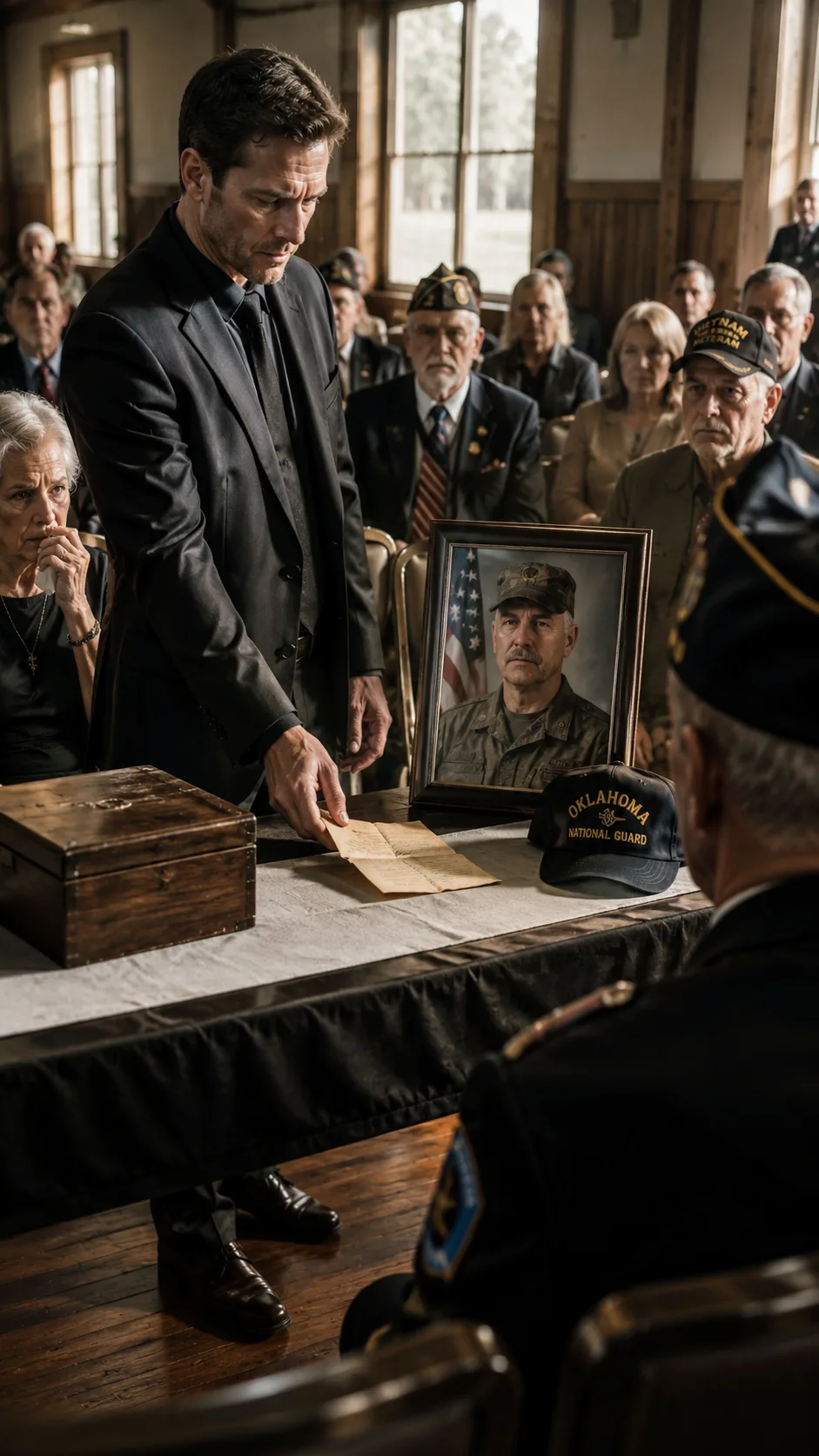
By the day of the memorial, the hall was packed.
Rows of chairs filled the room.
American flags stood near the stage.
Photographs lined display tables.
My father's framed portrait sat beside the wooden keepsake box.
The same box that started everything.
People talked quietly before the ceremony.
Old friends shook hands.
Families shared stories.
Veterans exchanged memories.
Then Robert arrived.
Ninety years old.
Leaning on a cane.
Walking slowly.
The moment he saw my father's photograph, he stopped.
Nobody interrupted him.
He stood there for several seconds.
Then raised his hand and saluted.
The entire room went silent.
The ceremony began shortly afterward.
Several speakers shared stories.
Most were simple.
Funny.
Personal.
Human.
A fishing trip.
A practical joke.
A community fundraiser.
Then it became my turn.
I walked to the front carrying the unsent letter.
The room watched.
The wooden keepsake box rested on the table beside me.
I opened it.
Removed the letter.
Placed it carefully in front of everyone.
A few people leaned forward.
Something changed in the room.
They could feel it.
Even if they didn't know why.
I unfolded the paper.
The sound echoed in the silence.
"My father spent most of his life avoiding attention."
Several people smiled.
That part was true.
"He rarely talked about his service."
Heads nodded.
Also true.
Then I lifted the letter.
"And that's why none of us knew what he did."
The room became still.
I explained how the letter had been found.
How records had been uncovered.
How witnesses had been contacted.
Every sentence tightened the atmosphere.
Then I reached the truth.
The truth hidden for decades.
"The Department of Veterans Affairs confirmed something my father never told anyone."
Nobody moved.
"My father received the Purple Heart."
Silence.
Complete silence.
People turned toward the photograph.
Then back toward me.
I continued.
I described the rescue.
The trapped soldiers.
The injuries.
The repeated returns.
The men who survived.
The witnesses.
The medal.
Everything.
Across the room, Robert lowered his head.
My mother gripped the arm of her chair.
Several veterans stared at the floor.
The room no longer belonged to assumptions.
It belonged to the truth.
Then I read the final line from the letter.
The sentence my father never intended anyone else to hear.
"I do not believe recognition is necessary. The men survived. That is enough."
Nobody spoke.
For several long seconds.
Then Robert stood.
Slowly.
Painfully.
Using his cane.
Every eye followed him.
He walked to the front.
Stopped beside the photograph.
And saluted.
"My life is only here because of that man."
That was all he said.
Then he sat down.
A second veteran stood.
And saluted.
Then another.
And another.
Within moments nearly every veteran in the room was standing.
No announcement.
No instructions.
No ceremony.
Just respect.
My mother covered her mouth with both hands.
The window light caught the tears gathering beneath her eyes.
For sixty years she had shared a life with a man who never mentioned any of this.
Now an entire room stood because of him.
After the ceremony, people remained for hours.
Sharing stories.
Looking at photographs.
Reading copies of records.
The hall felt different.
Lighter somehow.
Not because a mystery had been solved.
Because a hidden chapter had finally been returned to its rightful place.
Months later, a local veterans center created a display honoring my father.
The Purple Heart sat inside a glass case.
Beside it rested a copy of the unsent letter.
Visitors often spent more time reading the letter than looking at the medal.
I understood why.
The medal showed what he did.
The letter showed who he was.
Robert Jennings passed away the following year.
Before he died, he mailed me a photograph.
Two young soldiers.
Covered in dirt.
Laughing at something outside the frame.
One of them was my father.
I placed the photograph inside the wooden box.
Beside the original letter.
Where it belonged.
My mother still lives in the same house.
The chipped coffee mug still sits in the cabinet.
Nobody throws it away.
Every Saturday I mow my lawn.
Sometimes I think about how many extraordinary people spend their lives being mistaken for ordinary ones.
Not because they're hiding.
Because they never thought their stories mattered.
The last time I opened the wooden box, I read the letter again.
Not the military records.
Not the witness statements.
Just the final sentence.
Then I closed the lid.
And put it back exactly where he left it.
Some stories don't need recognition.
Only remembering.
Chapter complete
You have reached the end of this chapter.
Continue reading
A few more worlds to get lost in after this chapter.




