THE PROMISE HE NEVER MEANT TO KEEP.
Chapter 1
THE PROMISE HE NEVER MEANT TO KEEP.
THE MIRACLE THAT MADE IT IMPOSSIBLE TO BREAK
Maya Collins learned to fold paper bags before she learned how to read every word printed on them.
The bags came from different places. A deli two blocks east. A grocery store with green letters. The bakery with the blue awning where she slept when the owner locked the door and the street went mostly quiet. Some bags smelled like sugar. Some smelled like onions. Some were empty except for crumbs, and Maya still folded them carefully because an empty bag could keep her knees from touching the freezing pavement.
She was seven.
At least, that was what she told people.
She had no birthday written anywhere she could find. No school card. No clinic bracelet. No grown-up who said, “This was the day you came into the world.” She only had a name, a silver locket that would not open, and
a memory of a woman’s voice singing low near her ear whenever she was too cold to sleep.
Most mornings, Maya woke before the city became loud.
She would sit up beneath the bakery awning, pull her coat around her knees, and wait for the first delivery truck to hiss against the curb. The driver never looked at her directly, but sometimes he left a hot roll wrapped in napkin paper on the step after carrying flour inside. Maya never chased him. Never called after him. She waited until he was gone, then picked up the roll with both hands.
“Thank you,” she always said.
Even when no one answered.
The bakery owner was a woman named Mrs. Bell, though Maya had only learned that from the painted sign on the window. Bell’s Pastries. Warm Bread. Coffee. Cakes. Mrs. Bell had gray hair pinned behind her ears and a limp
that made one shoe scrape slightly across the floor.
She never invited Maya inside.
She never told Maya to leave either.
That winter, Detroit looked hard enough to bruise. Snow turned gray within hours. Wind moved through alleys and under doors. The sky stayed the color of old metal. People walked faster, faces tucked behind scarves, shoulders lifted as if the cold were a punishment they could outrun.
Maya did not try to outrun it.
She had learned that running made hunger worse.
So she walked carefully. She kept near crowds, but never inside them. She watched hands. Pockets. Shoes. Dogs. Doors. She knew which stores had workers who shouted and which churches left boxes near the side entrance. She knew the bus stop with the heated bench, though she never sat there for long because someone always asked where her mother was.
That question was the worst one.
Not
because Maya could not answer.
Because she could.
She remembered her mother in pieces.
A cough behind a closed bathroom door. A red sweater with one missing button. Fingers rubbing warmth into Maya’s hands. A silver locket placed over her head. A paper folded so small it disappeared inside the metal.
“If you ever meet him,” her mother had said once, voice thinner than usual, “don’t be afraid.”
“Meet who?”
Her mother had touched Maya’s cheek.
Then the memory always broke there.
Maya did not know how many months had passed since the shelter lady stopped finding her. She did not know why the apartment door had been locked when she went back one afternoon and a man with a clipboard told her no one lived there anymore. She did not know why adults could disappear from a child’s life but still remain everywhere inside it.
She only knew how to survive the next hour.
That was enough.
Most nights, before she slept, she folded her hands beneath the awning, lifted her face toward the dark, and said, “Thank You, God. I know You’re watching over me.”
Her voice was small.
The city did not soften.
But she said it anyway.
Twenty miles away, Jonathan Whitaker’s house glowed behind iron gates.
It had been designed by someone who believed grief could be kept out with stone. Tall windows. Wide rooms. Marble floors pale enough to reflect candlelight. A staircase that curved upward beneath a chandelier made of hundreds of pieces of cut crystal. Every table shone. Every rug had been chosen by a designer. Every room had a purpose except the ones no one entered anymore.
Jonathan had bought the house when Sophia and Isabella were two.
His wife, Meredith, had still been alive then. She had stood in the foyer with both girls balanced on her hips, laughing because they kept grabbing the crystals on her earrings. Sophia had a pink ribbon. Isabella had a blue one. Jonathan had watched them under the chandelier and thought, with the arrogance of a man who had not yet been humbled, that he had finally built a life no tragedy could touch.
Six years later, the chandelier still hung there.
Meredith was gone.
The girls were in wheelchairs.
Jonathan kept the house warm enough that staff complained privately. He kept doctors’ numbers written in a leather notebook beside his bed. He kept duplicate medical files in three locked cabinets, though he could recite most of the reports without looking.
Sophia and Isabella had started losing strength at three.
At first, it was small. A stumble on the nursery carpet. Isabella crying because her legs felt “fuzzy.” Sophia refusing to climb stairs she had climbed the day before. Meredith had worried first. Jonathan had called it a phase.
He hated that memory.
He hated the exact sound of his own voice saying, “Kids grow strangely. Let’s not panic.”
The panic came anyway.
It came through appointments, scans, blood work, genetic panels, specialists, private consultations, and rooms where doctors looked at him like they were trying to decide which word would hurt least. Meredith lived long enough to hear three different possible diagnoses and no certain solution.
Cancer took her in eight months.
The girls’ condition took longer.
That made it crueler.
By eight, Sophia and Isabella were bright, sharp, beautiful children who knew how to read adults better than adults knew how to speak around them. They could tell when a doctor had bad news before he opened his file. They could tell when Jonathan had been crying by the way he adjusted his cufflinks too many times before entering their room.
They never said so.
That morning, a specialist from Boston stood in the blue sitting room and used careful sentences.
Sophia sat by the window, watching snow caught in the hedges.
Isabella had a book open in her lap but had not turned the page.
Jonathan stood near the fireplace with both hands in his pockets.
“We continue therapy,” the doctor said. “We maintain mobility where possible. We support circulation. We manage pain. We protect quality of life.”
Jonathan looked at him.
“Will they walk again?”
The doctor removed his glasses.
Sophia looked down.
Isabella shut her book.
The doctor did not answer fast enough.
That was the answer.
After the specialist left, Jonathan remained in the foyer while his assistant tried to review the rest of the day’s schedule. Board call at noon. Investor dinner at six. Charity committee request. Legal documents from Zurich. Jonathan heard none of it.
He took his coat from the closet himself.
His driver stepped forward.
“I’ll drive,” Jonathan said.
The driver held the keys for half a second too long.
Jonathan took them.
He drove without direction. Past private lanes and neat mailboxes. Past country clubs under snow. Past gas stations and office buildings. Past the clean roads into streets where the snow had turned black along the curb.
By the time he parked downtown, his hands ached from gripping the wheel.
He sat there with the engine off.
Across the street, beneath a blue bakery awning, a child sat with her knees drawn up inside a coat too big for her body.
People passed.
She did not ask them for anything.
That was what made him open the door.
The cold hit his face at once. He crossed between two parked cars, stepped onto the curb, and stopped in front of her.
She looked up.
Her eyes were dark. Not wide. Not pleading. Steady in a way no child’s eyes should be steady.
“What’s your name?” he asked.
“Maya.”
“Where are your parents?”
She glanced toward the bakery window.
Jonathan wished he had not asked.
“Do you have somewhere to go?”
Maya shook her head once.
Not dramatically. Not for pity. Just the truth.
A paper bag sat beside her. Inside was half a muffin wrapped in wax paper. Her hand rested on it like someone might take it away.
Jonathan looked at that hand. Small fingers. Red knuckles. Dirt beneath the nails.
Something in him bent too far.
“My daughters can’t walk,” he said.
Maya tilted her head slightly.
“I’ve taken them everywhere. To everyone. I’ve paid for every doctor. Every treatment.” His voice came out rougher than he intended. “Nothing works.”
Maya waited.
Jonathan laughed once, but there was no humor in it.
“If you can help my twin daughters walk again,” he said, “I’ll adopt you.”
The sentence landed between them, ugly and impossible.
He knew it as soon as it left his mouth.
A bargain with a hungry child.
A promise built to break.
He opened his mouth to take it back.
Maya spoke first.
“Do they want to walk?”
Jonathan stared at her.
“What?”
“Your daughters,” Maya said. “Do they want to walk?”
His throat tightened.
“More than anything.”
Maya stood.
She was smaller than he expected. The coat nearly swallowed her shoulders. Her pink dress had a tear near the hem. One shoe was tied with a different colored lace.
“Then take me to them,” she said.
Jonathan should have called social services. He should have brought her to a shelter, a hospital, a police station. He should have done any number of responsible things.
Instead, he opened the passenger door.
Maya climbed in carefully and placed the paper bag on her lap.
She did not touch anything.
During the drive, Jonathan glanced at her several times. She watched the city change outside the window. Brick buildings became glass. Glass became trees. Trees became gates. She held the muffin bag with both hands.
“Are you hungry?” he asked.
“Yes.”
“We have food at the house.”
She nodded.
Then, after a few seconds, she tore the muffin in half and offered him one piece.
Jonathan looked at it.
“No, thank you.”
Maya placed the piece back in the bag.
“You can have it later,” she said.
He did not answer.
The gates opened before the car reached them. The guard stared. Staff had been alerted by the driveway camera, and by the time Jonathan entered the foyer with Maya beside him, three people were waiting badly disguised as people who had not been waiting.
Mrs. Alvarez, the housekeeper, took one look at Maya’s coat and pressed her lips together.
“Sir?”
“Where are the girls?”
“In the sitting room.”
Jonathan looked down at Maya.
“You don’t have to do anything,” he said.
She looked up at him.
“You brought me.”
That settled it for her.
They entered the sitting room.
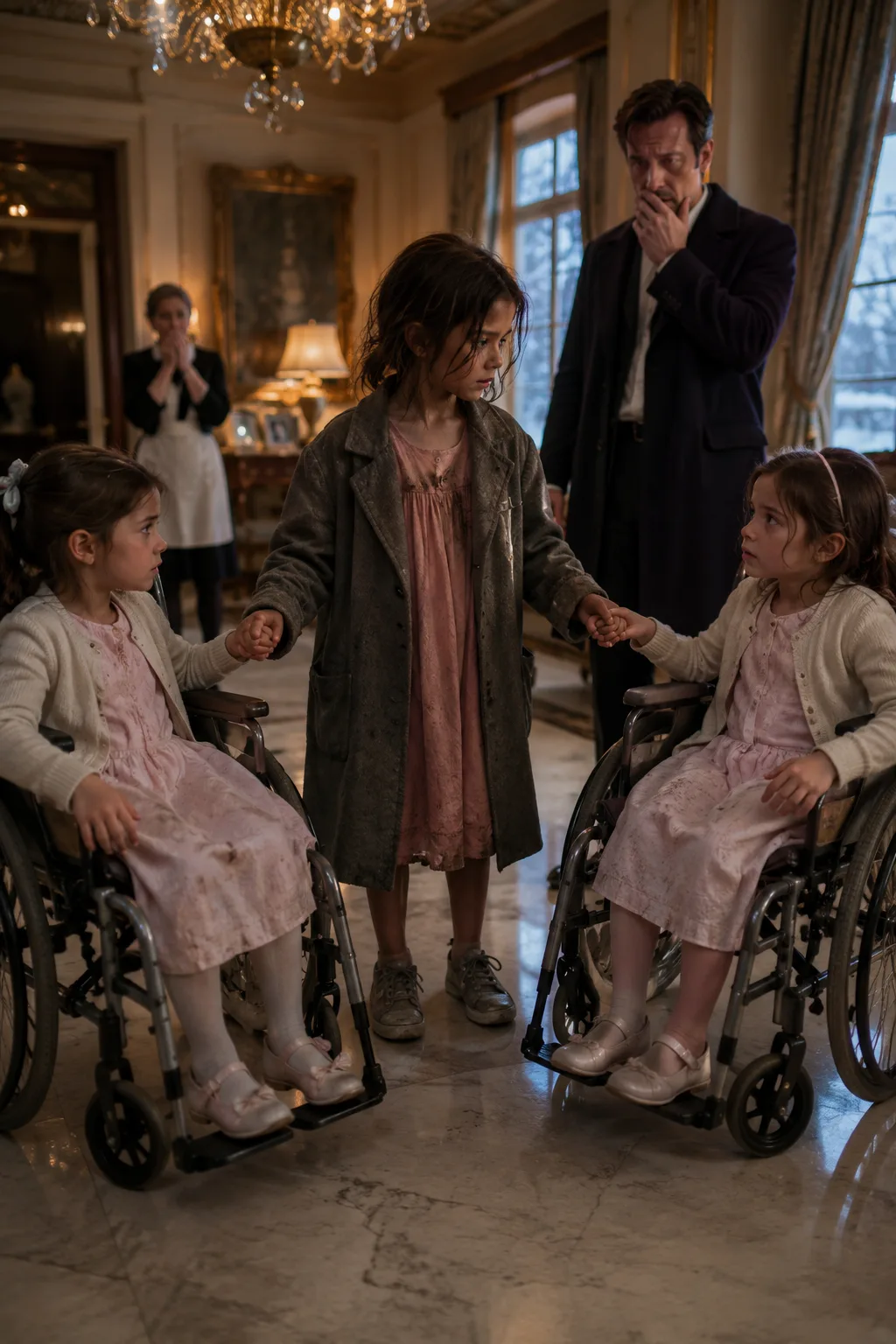
Sophia and Isabella sat near the windows where pale winter light touched the floor. Sophia wore a blue dress and white cardigan. Isabella wore pale pink. Their wheelchairs were angled toward a low table where someone had arranged colored pencils, though neither girl was drawing.
Sophia saw Maya first.
“Who is she?”
Jonathan had no good answer.
“This is Maya.”
Isabella looked from Maya’s coat to her shoes.
“Is she lost?”
“No,” Maya said.
Sophia studied her.
“Are you a doctor?”
“No.”
Sophia’s face changed. Only a little. Enough.
Maya stepped closer.
“That’s good,” she said. “Doctors always look worried.”
For a second, no one reacted.
Then Sophia laughed.
It was small and sudden. A cracked little sound from a door no one had opened in weeks.
Isabella looked at her sister and smiled despite herself.
Jonathan turned his face away.
Mrs. Alvarez stood near the doorway with one hand pressed to her apron.
Maya stopped in front of the wheelchairs.
“Can I sit?”
Sophia nodded toward the rug.
Maya sat cross-legged on it, coat pooling around her.
“Do you live here?” Isabella asked.
“No.”
“Where do you live?”
Maya looked at the window.
“Different places.”
Sophia’s fingers touched the wheel of her chair.
“That sounds cold.”
“It is.”
Isabella looked down at her lap.
“My legs are cold all the time,” she said.
Jonathan closed his eyes for one second.
Maya leaned forward.
“Do they hurt?”
“Sometimes.”
“Do they listen?”
The twins looked at each other.
“What does that mean?” Sophia asked.
Maya shrugged.
“Sometimes when I’m cold, my hands don’t listen right away. I have to tell them twice.”
Sophia looked at her hands.
“My legs don’t listen.”
“Maybe they forgot.”
Isabella’s brow tightened.
“Forgot what?”
“How.”
The room went quiet.
Jonathan stepped forward.
“Maya—”
She looked back at him, not offended, not frightened.
Then she turned again to the twins.
“Can I hold your hands?”
Sophia hesitated.
Isabella did not.
She reached first.
Sophia followed because twins often understand bravery as a door that one opens and the other enters.
Maya took their hands.
Her fingers were rough and cold. The twins’ hands were warm and soft. For a moment, the difference between their worlds sat there openly, held between three children.
Maya closed her eyes.
Jonathan stood behind them, one hand on the chair nearest him.
“Dear God,” Maya said, “they’ve waited a long time. Their dad looks tired. If You want to help… You can do it now.”
No one moved.
The fire shifted in the hearth.
Somewhere beyond the room, a clock ticked.
Jonathan felt shame first. Hot and immediate. Shame for bringing her. Shame for letting the girls hear another false hope. Shame for making a promise to a child on a sidewalk because he had run out of things to offer heaven.
Then Isabella made a sound.
A small, sharp inhale.
Jonathan’s eyes opened.
Her fingers tightened around Maya’s hand.
Sophia’s wheelchair footrest rattled.
“Bella?” Sophia said.
Isabella stared at her knees.
Maya opened her eyes.
“It’s okay.”
Jonathan took one step forward.
“Maya, stop.”
But Maya was already standing.
She kept both girls’ hands in hers and stepped backward once.
Just once.
Her worn shoes slid slightly on the polished marble beyond the edge of the rug.
“Come with me,” she said. “Just one step.”
Jonathan lifted his hand.
“Girls—”
Sophia pressed her palms against the arms of her chair.
Her body shook before she rose. Her shoulders came forward. Her knees trembled beneath the blue dress. Her lips parted, but no sound came out at first.
Then she stood.
Jonathan stopped breathing.
Isabella made a broken little noise and gripped Maya harder. Her legs jerked once, failed, caught again. Maya did not pull. She held on like a railing made of faith and bone.
Isabella stood too.
Mrs. Alvarez cried out and covered her mouth with both hands.
Jonathan dropped to his knees.
Not because he decided to.
Because his body gave way before his mind could reject what it saw.
Sophia took one step.
It was ugly. Uneven. More fall than walk.
It was a step.
Isabella followed with both arms stretched between Maya and empty air, knees shaking so badly her shoes scraped the floor.
Jonathan held out his arms but did not touch them. He was afraid contact would break whatever thin thread had entered the room.
Sophia reached him first.
She fell against his chest.
Isabella landed half a second later.
Jonathan caught both of them and made a sound no one in that house had ever heard from him. Not words. Not even a cry with shape. Something pulled from a place money had never reached.
Maya stood alone in front of the empty wheelchairs.
Her coat had slipped off one shoulder.
She watched the father and daughters folded together on the marble floor, and her face was calm in a way that made Mrs. Alvarez look at her twice.
Doctors came that evening.
Then more doctors the next morning.
The house filled with voices again. Measurements. Tests. Reflex checks. Scans ordered urgently. Blood drawn. Specialist calls made across three time zones. Sophia and Isabella were examined until both girls grew cranky and demanded pancakes.
“They stood,” Jonathan said to the first neurologist.
“Yes, but we need to establish—”
“They walked.”
“We need to understand whether this is a temporary functional—”
“They walked to me.”
The doctor closed his folder.
“I saw the video from the security feed.”
Jonathan looked toward the corner of the room where the small black camera sat above the molding.
He had forgotten it existed.
The doctor looked older than he had that morning.
“I don’t have an explanation.”
“Good,” Jonathan said.
The video never went public.
Jonathan locked it away.
The staff spoke in whispers for three days. Then whispers became stories. Stories became something the outside world caught and fed on. The billionaire’s daughters. Sudden recovery. A mysterious child. Miracle in Bloomfield Hills.
Jonathan hired a child advocate before the end of the week.
Maya was given a room across from the twins. The bed was too large, and the first night she slept on the rug beside it because the mattress made her feel like she might sink and disappear. Mrs. Alvarez found her there at six in the morning, curled around the paper bag she had brought from the bakery.
The next day, Mrs. Alvarez bought her pajamas with clouds on them.
Maya thanked her three times.
Sophia and Isabella began therapy again, but now the room sounded different. There were grunts. Complaints. Laughter. Arguments over who had taken more steps. Isabella accused Sophia of cheating by leaning too much on the parallel bars. Sophia accused Isabella of smiling at Dr. Keller to get extra rest breaks.
Maya watched from a bench with her knees tucked beneath her.
“You can try too,” Isabella said one afternoon.
“My legs work.”
“Then use them,” Sophia said. “Race us.”
“You’re very bossy for someone holding a railing.”
Sophia narrowed her eyes.
Jonathan, standing near the doorway, laughed before he could stop himself.
All three girls turned to look at him.
He had not heard that sound from himself in so long that it startled him too.
The legal work should have been simple.
It was not.
Maya had almost no records. A few shelter intake notes from months earlier. One partial school registration that had never been completed. A clinic visit under the name Maya Collins, age unknown, mother listed as Elena Collins. No father. No current address. No known relatives.
Jonathan read the file at his desk while Maya sat on the rug nearby, drawing crooked houses with chimney smoke.
“Do you remember your mother’s full name?” he asked.
“Elena.”
“Anything else?”
“Collins.”
He looked at the file again.
“Did she ever talk about your father?”
Maya’s pencil stopped.
Jonathan regretted the question.
“She said he was busy.”
The word struck him oddly.
Busy.
Such a small word. Such a convenient grave for responsibility.
Maya reached beneath the collar of her new sweater and pulled out the silver locket.
“She gave me this.”
Jonathan had seen it before, but only from a distance. The locket was tarnished, oval-shaped, and dented along one side. It hung from a string instead of a chain.
“May I see it?”
Maya hesitated, then lifted it over her head and placed it in his palm.
“It doesn’t open.”
Jonathan turned it carefully.
The seam was nearly sealed with age and grime.
“I know someone who can fix this.”
“Will it break?”
“I’ll make sure it doesn’t.”
She studied him for a long moment.
“Promise?”
The word sat between them.
Different this time.
Jonathan closed his fingers around the locket.
“Yes,” he said. “I promise.”
The jeweler came to the house because Jonathan did not want the locket leaving Maya’s sight. He brought small tools, magnifying lenses, and a cloth the color of cream. Maya stood beside Jonathan the entire time, one hand gripping the edge of his sleeve.
The locket opened with a tiny click.
Inside was folded paper.
So thin it looked like dried skin.
The jeweler stepped back without being asked.
Jonathan used tweezers to lift the paper free. He unfolded it slowly on the desk, smoothing each crease with the side of his finger.
The handwriting was faded.
But readable.
For Jonathan Whitaker—if you ever find her.
The room shifted without moving.
Maya looked up at him.
Jonathan could not blink.
He read the next line.
You may not remember me the way I remember you. We were young before your money, before your name became something people used to open doors. I tried to reach you when I learned I was pregnant. Your office turned me away. Maybe they never told you. Maybe you chose not to know.
His hand began to shake.
Her name is Maya.
She has your eyes.
I am sick now. I have no family left. I am leaving this with her because if there is one kind thing in you that still belongs to the boy I knew, maybe one day you will see her and know.
At the bottom, the signature waited like a person standing at the end of a hallway.
Elena Collins.
Jonathan sat back.
The office went silent except for the small hum of the heating vent.
Maya still held his sleeve.
“Do you know her?” she asked.
Jonathan looked at the child beside him.
The eyes.
He had noticed them. Some part of him had noticed before the note, before proof, before his mind was willing to open the locked room where Elena Collins had been kept.
A summer came back in fragments.
Elena laughing across a diner booth at two in the morning. Elena wearing his sweatshirt on a fire escape. Elena telling him he worked too much even before he had anything worth working for. Elena standing outside his first office with rain in her hair.
Then the other memories came.
Calls he did not return because investors were in town. Messages filtered by assistants. A letter he placed in a drawer because he was engaged by then, because Meredith’s family was powerful, because the life opening before him required certain doors to close.
He had told himself Elena would be fine.
People always told themselves that when they did not want to look.
“Maya,” he said.
His voice failed.
She let go of his sleeve.
“You’re sad.”
Jonathan lowered himself from the chair to his knees in front of her.
Not as a rich man. Not as a rescuer. Not as the father of miracle twins.
As the man who had stepped around her before the city ever did.
“I knew your mother,” he said.
Maya waited.
“I loved her once.”
The word came out broken but true.
“Was she nice?”
Jonathan covered his mouth with one hand. He nodded.
“She was better than nice.”
Maya looked at the paper.
“She said you were busy.”
He shut his eyes.
“I was.”
A terrible answer.
The only honest one.
“Did you know about me?”
He opened his eyes.
“No.”
Maya watched him with the same steady gaze she had given him under the bakery awning.
“I didn’t know,” he said. “But I should have tried harder to know.”
There it was.
No defense. No assistant to blame. No office policy. No old ambition dressed up as circumstance.
Only a child.
Only the truth.
Maya lifted one hand and touched his cheek.
Her fingers were warmer now than they had been that first day.
“You know now,” she said.
Jonathan bowed his head.
The adoption papers were stopped before filing.
New attorneys came. Different paperwork replaced the old. Paternity testing confirmed what the locket already had. Guardianship. Birth records. Medical care. Inheritance structures. Public statements carefully worded and privately meaningless compared to what happened inside the house.
Jonathan asked Maya if she wanted to change her last name.
She looked down at the locket resting in her palm.
“No.”
He nodded.
“Collins is my mother’s name,” she said.
“Yes.”
“I want to keep it.”
“Then you keep it.”
Sophia objected.
“But you’re our sister.”
Maya sat on the edge of Sophia’s bed, swinging her feet in cloud pajamas.
“I can be your sister with my own name.”
Isabella considered this from her wheelchair, though she had begun using it less inside the house.
“That’s allowed?”
Maya shrugged.
“I think families have a lot of rules people make up.”
Sophia looked at Jonathan.
“Can we make up better ones?”
Jonathan leaned against the doorway.
“Yes.”
So they did.
They made a rule that breakfast could happen in the kitchen instead of the formal dining room. They made a rule that wheelchairs were not sad objects and could be decorated with ribbons if the owner wished. They made a rule that Maya did not have to answer reporters’ questions. They made a rule that no one said “miracle girl” inside the house because Maya hated it.
“I didn’t do it,” she said one evening, pushing peas around her plate.
Sophia looked offended.
“You held our hands.”
“Yes.”
“And said the prayer.”
“Yes.”
“And stepped back.”
Maya looked at her.
“God did the hard part.”
Isabella nodded solemnly.
“That seems fair.”
The newspapers did what newspapers do.
They made clean stories out of messy lives.
A billionaire kept his promise. A homeless girl saved his daughters. A family found hope. The twins walked again. The child was welcomed into wealth.
No headline mentioned Elena Collins.
Jonathan made sure of that.
Not because he wanted to hide her.
Because Elena had already been erased by enough people.
He kept her photograph in his study after an investigator found one in old housing records. Maya stood beside him when he placed it on the shelf. The picture was grainy. Elena was younger than Jonathan remembered, smiling with her head tilted, one hand lifted as if blocking sunlight.
Maya stared at it for a long time.
“My hair is like hers.”
“Yes.”
“My mouth too?”
“Yes.”
“Do I have your eyes?”
Jonathan looked at her.
“Yes.”
Maya nodded, as if confirming something she had carried without proof.
Then she placed the silver locket beside the frame.
Spring arrived slowly.
Detroit thawed in patches. Snow withdrew from corners. The hedges around the Whitaker house turned green at the tips. The girls moved from parallel bars to braces, from braces to short careful walks, from short careful walks to supervised chaos across the garden path.
Jonathan canceled more meetings than he attended.
No one at the company knew what to do with that at first.
His assistant called one afternoon while he sat on a bench watching Sophia argue with Isabella over whose turn it was to use the blue chalk.
“The Singapore call starts in twelve minutes.”
Jonathan looked at Maya, who was drawing three uneven stick figures holding hands.
“Move it.”
“To when?”
He watched Isabella stand without reaching for the chair.
“Tomorrow.”
“There’s a board concern that—”
“Tomorrow.”
He hung up.
Maya looked over.
“Are you busy?”
The old word.
He put the phone face down on the bench.
“Not right now.”
She seemed satisfied and returned to her chalk.
By late April, the garden smelled of cut grass and damp soil. Mrs. Alvarez brought lemonade outside even though it was still too cool for it. Sophia insisted she could run. Isabella said running required both feet leaving the ground at some point, and Sophia was mostly stomping quickly. Maya listened to the debate with the patience of someone judging a court case.
Jonathan stood near the stone path.
“Ready?” Isabella called.
“No running near the steps,” he said.
“We know.”
“You say that like people who do not know.”
Sophia rolled her eyes.
Maya cupped her hands around her mouth.
“On three!”
The three girls lined up badly. Sophia leaned forward too far. Isabella adjusted her cardigan. Maya stood barefoot in the grass because she said shoes made the earth harder to hear.
“One!”
Jonathan folded his arms.
“Two!”
Mrs. Alvarez appeared at the back door, drying her hands on a towel.
“Three!”
They ran.
Not gracefully.
Not evenly.
Sophia stumbled after six steps and kept going. Isabella laughed so hard she slowed herself down. Maya darted ahead, then stopped and turned back as if victory meant nothing unless everyone arrived.
Jonathan watched them cross the lawn.
For a second, the breeze lifted Maya’s hair away from her face.
He saw Elena there.
Not in a way that punished him.
In a way that allowed him to keep walking.
Maya waved both arms.
“Come on!”
Jonathan shook his head.
“I’m not racing.”
Sophia pointed at him.
“You’re scared.”
Isabella nodded.
“Very scared.”
Maya grinned.
Jonathan looked at the marble house behind him, the iron gates beyond the trees, the life he had built like a fortress, and the small girl who had entered it with dirty shoes and a paper bag.
Then he stepped off the path.
Mrs. Alvarez laughed from the doorway.
Jonathan ran badly. His shoes slipped in the grass. His coat opened. Sophia shrieked that he was cheating. Isabella tried to block him with one arm. Maya laughed so loudly that a bird shot out of the hedge.
He reached them breathless.
Sophia grabbed one hand.
Isabella grabbed the other.
Maya stood in front of him, eyes bright, locket shining against her sweater.
“You came,” she said.
Jonathan looked at the three daughters around him.
This time, he did not make a promise.
He stayed. THE END.
Chapter complete
You have reached the end of this chapter.
Continue reading
A few more worlds to get lost in after this chapter.




