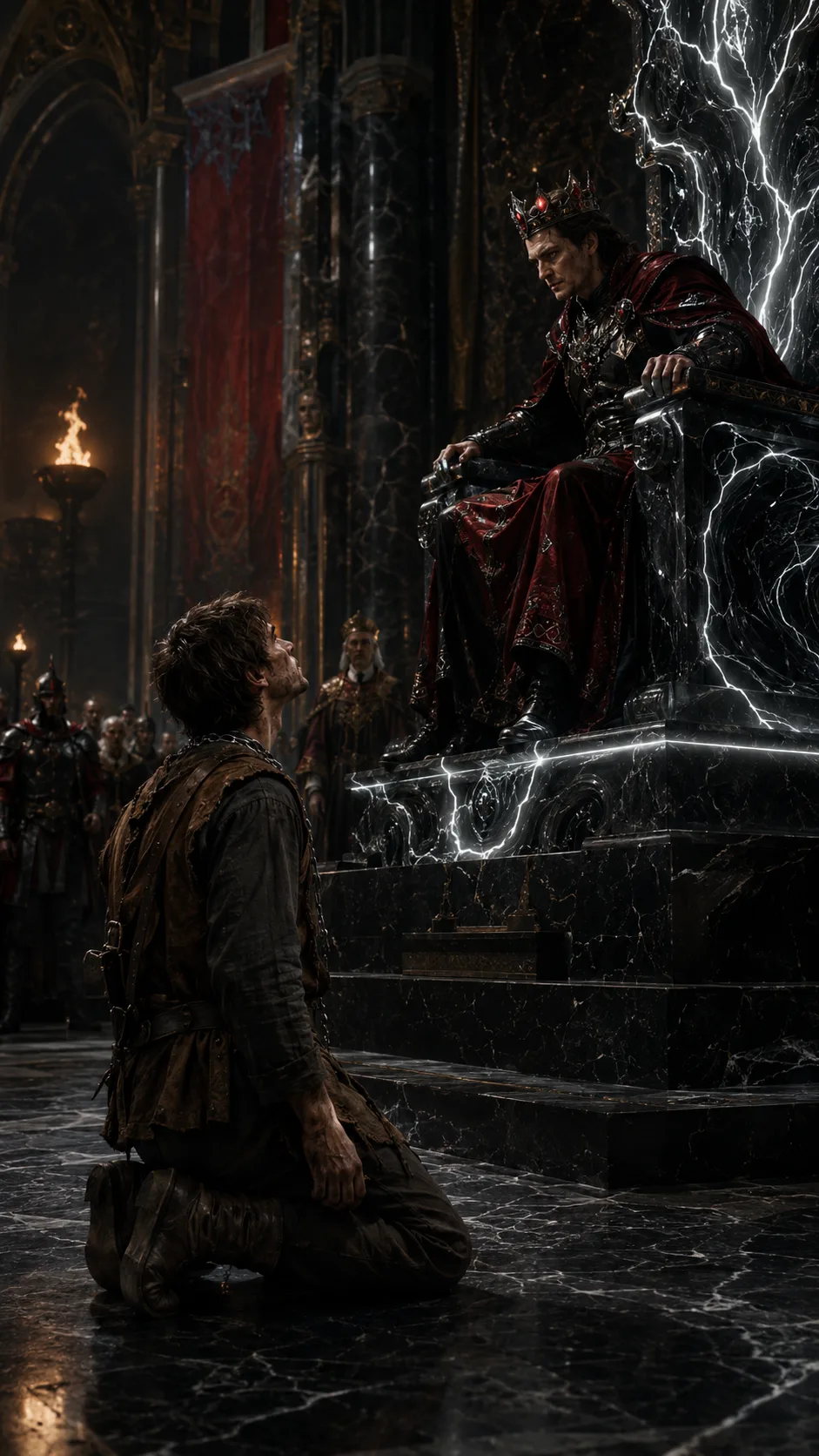
Dain kept his thumb pressed against the ring beneath his shirt while the palace guards dragged him over the black marble floor.
Chapter 1
Dain kept his thumb pressed against the ring beneath his shirt while the palace guards dragged him over the black marble floor.
The ring was warm.
It should not have been. The morning had been cold enough to turn the smithy windows white, and the palace corridors held no heat except the thin smell of torch smoke and old incense. But the ring under his collar had warmed the moment they crossed the first iron gate. By the time they reached the Hall of Oaths, it felt like a coal that refused to die.
“Keep walking,” one guard said.
Dain stumbled once. Not from fear. From the chain.
The sacred truth-chain around his neck was heavier than it looked. Silver links lay against his skin, cold at first, then tightening in tiny pulses whenever he breathed too hard. He had seen such chains only from a distance, on festival days when priests walked through the market and every merchant suddenly remembered fair weights.
Now it belonged to him.
A prisoner.
A traitor.
A blacksmith’s apprentice with soot still under one fingernail.
The Hall of Oaths opened ahead of him like the inside of a mountain. Black pillars rose into shadow. Red banners hung from the upper galleries, each one stitched with Cassian’s crowned lion. Brass braziers burned along the walls, throwing light across hundreds of faces that had been trained not to look surprised.
Nobles filled the lower hall in rows of velvet and armor. Captains stood near the pillars. Priests waited beside the dais. Above all of them sat the Divine Throne.
Dain had heard stories about it since he was small.
The throne had been carved from celestial stone, the old women said, from a black star that fell before Valdris had kings. Silver veins ran through it like lightning trapped in rock. No cushion softened it. No fur covered it. Kings were meant to sit on it and remember
that the crown was borrowed.
King Cassian did not look like a man borrowing anything.
He sat high above the hall in a dark red cloak, the cloth spilling over the steps like old blood under torchlight. Black ceremonial armor covered his chest. Rubies burned in his crown. His right hand rested on the arm of the throne, fingers relaxed, rings catching the light.
Beside him stood Prince Rovan.
The prince did not sit. He did not need to. He wore a fitted black tunic, a short red cape, and a smile thin enough to cut cloth. Dain had seen that expression on men who bet on dogs in alleys.
The guards shoved Dain to his knees.
The marble struck bone.
He did not make a sound.
Somewhere behind him, someone laughed once and then stopped. Dain stared at the lower step of the dais. It had a crack near
the edge, old and pale, filled with dust no servant had cleaned.
That was the first thing he noticed.
Not the king.
Not the court.
The dust.
The High Priest came forward with a silver rod in one hand. He was tall, spare, wrapped in white and gray robes so layered that he seemed less like a man than a funeral folded upright. His eyes paused on Dain’s face, then dropped to the chain around his throat.
“Name,” the priest said.
“Dain of Westforge.”
A clerk near the side table scratched the answer onto parchment.
“Trade.”
“Apprentice smith.”
A second scratch of the quill.
The priest’s mouth tightened. “Crime.”
Dain looked up then.
King Cassian watched him from the throne as if a fly had landed on a royal plate.
The guard behind Dain answered before he could. “He forged the forbidden crest of Prince Alaric onto a sword hilt.”
The hall changed.
Not loudly. No one cried out. No one stepped away. But fans stopped moving. Gloved hands stilled. A captain near the left pillar turned his head half an inch.
Alaric.
The name was not spoken in halls anymore. Not in daylight. Not where servants could hear. Dain had heard it from his mother in a room with the shutters closed and her hand over the candle flame.
Prince Alaric did not betray the kingdom, she had said.
He had been seven then, sitting cross-legged on the floor while she polished the ring with ash and oil.
Then why does everyone say he did?
Her hand had closed around the ring.
Because kings have scribes.
Now that same ring burned under his shirt.
King Cassian leaned forward.
“You wear dead symbols on living steel,” he said. His voice carried without effort. “Do you know what happens to boys who worship traitors?”
Dain lifted his chin enough to meet the king’s eyes.
“My mother said Prince Alaric was no traitor.”
The hall froze around the sentence.
Prince Rovan gave a small laugh. He took one step down from beside the throne and looked Dain over as if measuring him for a grave.
“Then your mother was a liar.”
Dain’s jaw locked.
His mother had died with her hair spread across a straw mattress and one hand closed around his wrist so hard it left marks for three days. She had given him the ring without ceremony. No speech. No long blessing. Just the ring, a folded strip of cloth, and one sentence.
Never sell it. Never show it. Never let a crowned man take it.
Dain had followed two of those rules.
The king raised one hand, and the prince stepped back.
“This is the Day of Oaths,” Cassian said. “Let it begin with justice. The boy will confess before the god beneath this throne, and the court will witness mercy where mercy is deserved.”
Mercy.
A noblewoman in blue lowered her eyes.
The High Priest moved behind Dain and adjusted the chain around his neck. The links tightened until Dain had to swallow against them. The priest touched the silver rod to the chain.
“Speak only truth before the Divine Throne,” he said. “Falsehood burns. Evasion binds. Confession frees.”
Dain nearly laughed at the last part.
He did not.
The priest stepped aside.
Cassian remained seated.
“Did you forge the rebel crest?”
“Yes.”
The chain warmed. Silver light ran through every link, clean and bright.
Truth.
A murmur moved through the hall. The clerk wrote quickly.
Cassian nodded, almost gently.
“Did you know the symbol belonged to my brother, the traitor prince?”
“I knew it was Prince Alaric’s crest.”
Again the chain glowed.
Truth.
Prince Rovan smiled wider.
Cassian lifted his hand as if the answer had pleased him. “Did you intend to insult the crown?”
Dain looked at the black marble floor. The pale crack on the step looked like a vein under skin.
“No.”
The chain glowed again.
Truth.
This time the murmur did not move. It caught.
Cassian’s fingers tightened on the armrest.
Not enough for the court to speak of later. Enough for Dain to see.
Rovan’s smile thinned.
The king’s eyes sharpened. “A boy may commit treason without understanding its shape.”
Dain did not answer.
Rovan descended another step. “Ask him if he has accomplices.”
The High Priest did not look at the prince. He looked at the king.
Cassian gave a tiny nod.
The priest raised the silver rod again. “Do you know any living supporter of Prince Alaric?”
“No.”
Light passed through the chain.
Truth.
A guard coughed into his fist.
Rovan’s hand drifted toward the hilt at his belt. “Ask it clearly.”
The priest’s nostrils moved once. “Have you ever carried messages for rebels?”
“No.”
Truth.
“Have you ever sworn loyalty to Alaric’s blood?”
“No.”
Truth.
The clerk stopped writing.
Dain felt the chain settle against his collarbone. It no longer felt like a noose. It felt like a thing waiting.
Cassian’s face had not changed. That was the worst part. Men in Westforge shouted when the metal went wrong. They cursed cracked blades, snapped tongs, warped hinges. The king did not shout. He only sat straighter and let the hall remember who owned its doors.
“Enough,” Cassian said.
The High Priest lowered the rod.
Rovan turned toward his father. “The crest is still treason.”
“And treason is still punished,” Cassian said.
Dain looked at the throne then.
He had avoided it since being shoved to his knees. Not from reverence. From the ring. The closer his gaze came to that black celestial stone, the hotter the ring became under his shirt.
The throne’s silver veins pulsed once.
Then again.
No one else seemed to notice at first. A small thing. A flash beneath Cassian’s left hand. Then a line of silver light trembled through the armrest and vanished.
Dain stared.
Cassian spoke over him. “The boy will be marked and sent to the southern quarries. Let every house here remember what dead loyalties cost.”
Rovan’s smile returned.
The priest stepped toward Dain with the silver rod.
The throne pulsed again.
Longer this time.
Dain’s throat moved against the chain. The question came before he could decide whether to keep it inside.
“Why does the throne shake when you lie?”
The priest stopped.
The hall did not breathe.
Cassian rose halfway from the throne. “What did you say?”
Dain looked from the glowing vein under the king’s hand to Cassian’s face.
“The stone moved when you called him traitor.”
The word hung between them.
Trait...or.
Rovan drew his sword halfway. Steel hissed against the scabbard.
“Silence him,” the prince said.
No guard stepped forward.
The throne moved.
Not much. Not enough for a servant sweeping tomorrow to swear anything had happened. But the black stone beneath Cassian shifted with the low grind of a sealed door loosening underground. Silver light ran down the back of the throne in branching veins.
Cassian’s fingers clamped around the armrest.
“Priest,” he said. “End this.”
The High Priest did not move. His eyes were on the throne.
The silver light spread.
The braziers guttered as if wind had entered the hall, but no doors had opened. Dust fell from the upper arches. A crack drew itself down the center of the Divine Throne, slow and clean, from the crown-shaped crest at the top to the base between Cassian’s boots.
Dain’s ring burned.
He pressed one palm against his chest.
A voice rose from beneath the floor.
It was not loud at first. It came through the soles of every shoe, through the marble under Dain’s knees, through the bronze cups on the nobles’ tables until they rang faintly in place.
“He hears because my blood hears.”
The High Priest fell to both knees.
Someone screamed in the back of the hall.
Cassian tried to stand.
The throne caught him.
Black stone curled over his wrists like living roots, locking him to the armrests. He pulled once. The stone did not give. He pulled harder. His crown slid crooked, one ruby flashing at the side of his brow.
“Release me,” Cassian said.
The command struck the hall and died there.
The voice beneath the throne rose again.
“Fourteen years, Cassian. Fourteen years of false oaths upon my chest.”
The old banners stirred though the air remained still.
Rovan stepped down from the dais, sword fully drawn now. The blade shook at the tip. He saw it and lowered the point, but not fast enough.
Cassian looked at the priests. “This is sorcery.”
The High Priest kept his forehead near the floor.
The voice filled the hall.
“You swore your brother fled. He did not.”
A nobleman near the front put one hand to the back of the chair beside him.
“You swore his child died. He did not.”
The clerk dropped his quill.
“You swore the crown came to you by law.”
The throne cracked wider beneath Cassian.
“It came by blood spilled in darkness.”
Dain could not move.
His palm pressed against the ring under his shirt. Heat pushed through the cloth. The chain around his throat trembled. The links began to glow again, but not with the clean, obedient light of truth. This light was sharper. Older. It spread from the chain to his collar, then down his chest where the ring burned like a second heartbeat.
The High Priest lifted his head.
His eyes found the glow.
Dain looked down. The chain snapped.
One link fell first.
Then another.
The rest split open and slid from his neck onto the black marble floor. The sound was small. Too small for what it did to the room.
The High Priest stood in pieces, one movement at a time. His gaze stayed fixed on Dain’s chest.
“Show it,” he said.
Dain’s fingers tightened around the ring beneath his shirt.
Cassian went still.
Not calm.
Still.
Rovan took one step toward Dain. “Do not touch him.”
The High Priest ignored him.
“Boy,” the priest said, and his voice had no temple music left in it. “Show it.”
Dain pulled the ring from under his collar.
The cord caught briefly on the torn edge of his tunic. He freed it with two fingers. The ring swung in front of him, silver darkened by years of oil, ash, and skin. At its center was the crest his mother had traced with her thumb a hundred times: a hawk with wings half-spread, holding a broken crown in its claws.
The High Priest’s hand rose.
He did not touch it.
“That is Prince Alaric’s seal.”
The hall erupted, but no one moved enough to break the spell. Nobles spoke over one another. A captain turned toward another captain. The woman with the fan covered her mouth. In the rear gallery, a servant dropped a tray, and three cups rolled down the steps one after another.
Dain heard none of it clearly.
He looked at the ring.
“My mother said it belonged to my father.”
The voice beneath the throne answered.
“It did.”
That single sentence struck harder than thunder.
Rovan moved first. He lunged down the last step toward Dain, sword angled low.
The guards near the aisle blocked him.
Not with blades raised. Not yet.
They simply stepped into his path.
Rovan stared at them. “Move.”
The nearest guard did not look at him.
Cassian twisted against the stone. His wrists scraped under the black bindings. “Kill him.”
No one did.
The king’s voice sharpened. “Kill him!”
A dozen sword hands shifted.
Then stopped.
A soldier near the pillar lowered his blade until the tip touched the floor. Another followed. The scrape of steel on marble spread through the hall, one weapon after another, until the room sounded like rain made of metal.
Dain stood slowly.
His knees did not want to obey. His left leg had gone numb from kneeling. He nearly stumbled on the fallen chain, caught himself, and lifted the ring from the cord.
It felt heavier now.
His mother had told him never to show it.
She had not told him what to do if a god did.
Dain slid the ring onto his finger.
The violent silver light under the throne changed. It steadied. The crack down the Divine Throne stopped widening. The black stone holding Cassian did not release.
The High Priest stepped back from Dain and lowered his head.
Not fully.
Enough.
The voice beneath the throne spoke one more time.
“Son of Alaric. Stand before the throne.”
Dain looked up at Cassian.
The king sat trapped on the seat he had stolen, red cloak twisted under one leg, crown tilted, jaw hard enough to break teeth. His eyes held the same hatred Rovan had carried down the steps, but there was something beneath it now, something that had not been there when Dain was dragged in.
Space.
The court made it for him.
Nobles stepped aside. Guards shifted their spears. The priest moved away from the center aisle. Even Rovan stood with two soldiers between him and Dain, his sword hanging uselessly at his side.
Dain walked toward the throne.
Every step showed him another detail he had missed when they dragged him in: wax spilled near the priest’s table, a loose buckle on one guard’s boot, the clerk’s ink drying in a dark spot on his sleeve. The hall had seemed too large to belong to men.
Now it was full of them.
Small.
Breakable.
Silent.
He stopped three steps below Cassian.
The ring on his finger glowed against the grime on his hand.
Cassian looked down at it, then at Dain’s face.
“You are a smith’s stray,” he said.
Dain lifted his right hand. The ring flashed once. The throne answered with a pulse of silver beneath Cassian’s wrists.
“You made me confess,” Dain said.
Cassian’s mouth opened.
No sound came.
Dain took one more step.
The silver light brightened under the king, clean and cold, showing every carved line in the black throne, every crack, every place where Cassian’s fingers had dug into stone.
“Now the throne has confessed you.”
No one spoke after that.
The sentence did not echo. The hall swallowed it whole.
The High Priest turned toward Cassian, and whatever loyalty had held his spine straight for fourteen years left his shoulders. He walked to the clerk’s table, picked up the unfinished oath parchment, and tore it down the center.
The sound was dry.
Final.
Rovan tried to push past the guards.
One captain caught his wrist.
The prince looked at the hand on him as if it belonged to a corpse. “You forget who I am.”
The captain released him, then removed his own sword belt and placed it on the floor between them.
“I remember,” he said.
More belts followed.
Not all. Not at once. But enough.
Cassian watched each one fall.
The throne did not loosen.
The Buried God said nothing more. He did not need to. His silence settled over the hall with more weight than any decree Cassian had ever spoken from that seat.
Dain stood on the steps until his legs stopped shaking.
A small noise pulled his attention down.
The broken truth-chain lay near his boot, open and harmless. One link was bent almost flat, as if struck by a hammer. He picked it up. The silver had cooled.
His thumb rubbed the edge of it once.
The High Priest approached him with both hands visible.
“My lord,” the priest said.
Dain looked at him.
The priest stopped.
Dain had heard men call Cassian that word all morning. He had heard it in the street, in the market, from guards who threw elbows into ribs to make people bow faster. On the priest’s tongue, aimed at him, it sounded like clothing stolen from a dead man.
“Do not call me that,” Dain said.
The priest lowered his head again. “What shall be done with him?”
Him.
No name.
Only the man bound to the throne.
Cassian gave a short laugh. It broke halfway.
“You think this ends because stone grumbles under a chair?” he said. “Armies answer to banners. Coin answers to vaults. Border lords answer to power. You have a ring and a dead man’s name.”
Dain looked at the nobles.
Some stared at the floor. Some at the ring. Some at Cassian, as if seeing the shape of him for the first time without gold around it.
“Where is Alaric?” Dain asked.
Cassian’s laugh stopped.
The question did more than the god’s voice had done. It put a man back inside the myth. A brother. A prince. A father.
The High Priest’s hands folded into his sleeves. “There were records sealed after the border rebellion.”
“Bring them.”
Cassian leaned forward as far as the stone allowed. “Those records belong to the crown.”
Dain looked at the cracked throne.
“They still do.”
The first sealed door opened before sundown.
It took six men to lift the iron bar from the archive beneath the eastern chapel. Two of those men had served Cassian for ten years. Neither looked at him when they passed through the Hall of Oaths to fetch the keys.
Dain did not sit on the Divine Throne.
No one asked him to.
A wooden chair was brought from the priest’s chamber instead, plain and too low for the dais. He sat beside the lower step while clerks carried boxes out of the archive and laid them on long tables. His old boots left dust on the polished floor. No one mentioned it.
The records smelled of damp leather.
Names appeared.
Dates.
Payments.
A hunting party that never reached the forest.
A physician summoned to the western tower and dismissed before dawn.
A child listed twice: once as dead, once as transferred under guard to a village three days from Westforge.
Dain read that line until the letters blurred.
He put the parchment down.
His mother had never told him everything. She had only shown him how to bank a forge fire, how to hide bread in winter, how to hold his tongue when soldiers asked whose son he was.
By nightfall, Cassian had been removed from the throne.
The stone released his wrists only when the High Priest placed both hands on the cracked armrests and spoke an oath not to free him, not to hide him, not to spill his blood without judgment. The throne accepted that. The silver veins dimmed.
Cassian stood with raw circles around both wrists.
He did not look at Dain while they led him away.
Rovan fought.
Three guards disarmed him. One received a cut across the cheek, shallow but bright. The prince was taken to the west tower under watch, still calling names, still promising ruin to every man who touched him.
His voice faded behind stone doors.
The hall remained.
Someone swept the broken cups from the rear steps. Someone replaced the fallen brazier. The fan of the noblewoman in blue lay abandoned under a bench, its painted ribs cracked.
Dain found it near dawn.
He picked it up and set it on the table beside the torn oath parchment.
The High Priest came to stand near him. He had changed out of his ceremonial robes into plain gray wool. Without the silver layers, he looked older.
“We found where Prince Alaric died,” he said.
Dain did not turn.
The priest placed a small bundle on the table. A strip of dark cloth. A signet impression. A lock of hair wrapped in waxed linen.
Dain touched none of it.
“Did he know?” he asked.
The priest was quiet for a while.
“That you lived?”
Dain nodded.
“No record says he did.”
The answer sat between them without comfort.
At sunrise, the bells of Valdris rang without Cassian’s order.
Not the victory peal. Not the coronation song. The old temple bell in the eastern tower sounded first, a single deep note. Then the western wall answered. Then the market bell. Then the harbor bells, small and uneven, as if the city itself were testing a language it had not used in years.
People came to the palace gates.
Not cheering. Not yet.
They stood behind the ironwork with bread in their hands, tools at their belts, children on their shoulders. Dain saw soot on faces from the forge district. He saw fish scales on sleeves from the lower harbor. He saw soldiers who had removed Cassian’s lion from their cloaks and had not yet replaced it with anything.
The High Priest asked him to appear on the balcony.
Dain said no.
An hour later, he went to the gates instead.
No crown. No cloak. No speech written by clerks.
He wore the same torn clothes he had been dragged in with, except the chain was gone and the ring stayed on his finger. A guard offered him a clean coat. Dain took it, looked at the gold stitching, and handed it back.
The gates opened halfway.
The crowd did not rush.
Dain stepped out until only one line of iron stood between him and the city.
For a moment, no one spoke.
Then an old woman near the front lifted her hand. Her fingers were blackened with charcoal. A smith’s hand. She looked at the ring, then at his face.
“You have her eyes,” she said.
Dain did not know who she meant.
His mother, maybe.
Alaric, maybe.
Someone the kingdom had buried before he had a name.
He placed his palm against the iron gate.
The woman placed hers on the other side.
That was enough.
Cassian’s judgment lasted seven days.
The god beneath the throne did not speak again, but no oath given in that hall failed to leave a mark. Men who had sold testimony found their tongues stiffening when they lied. Lords who had signed false border reports watched ink boil off the parchment. One by one, they chose smaller truths before the throne chose larger ones for them.
Cassian gave none.
He sat in a plain chair before the cracked dais with his wrists bandaged and his crown on the table beside him. Without it, his hair showed gray at the temples. He looked less like a monster than Dain wanted him to.
That made it harder.
The records named him.
The witnesses named him.
The throne did not need to.
Cassian was stripped of title and sent north to the oath monastery at Blackmere, where kings had once gone to die without swords or songs. Rovan was disinherited and kept under guard until the border houses agreed to take him as a hostage against rebellion. He left Valdris in a closed carriage with no banners on the horses.
Dain watched neither departure.
He went to Westforge.
The smithy had been sealed after his arrest, the door marked with red wax. He broke the seal with a chisel and went inside. Ash still lay in the hearth. Half-finished work waited on the bench: a hinge, two nails, a plain knife with no crest at all.
His master’s stool had been knocked over during the search.
Dain set it upright.
He opened the shutter. Light entered in a thin bar and struck the old anvil.
For three days, he stayed there while the court argued succession, bloodline, regency, coronation, law. Messengers came and went. Priests arrived. Captains waited in the street. Dain answered some. He sent most away.
On the fourth morning, he lit the forge.
The fire caught slowly.
He held the bent link from the sacred chain in the tongs until it glowed orange, then laid it on the anvil. The hammer felt right in his hand. Not royal. Not divine. Just weight, handle, balance.
One strike.
Then another.
The silver flattened under his work.
By noon, it had become a plain band.
No crest.
No oath marks.
No king’s name.
He carried it back to the palace in his pocket.
The Divine Throne remained cracked. No mason had touched it. Silver veins still ran through the black stone, calmer now, like water under winter ice. Dain stood before it while the court waited behind him.
They had brought a crown.
He did not look at it first.
He took the plain silver band from his pocket and placed it on the lower step of the throne, beside the pale crack where dust had gathered on the day they dragged him in.
Then he turned to the hall.
“I will not sit until every oath spoken here can bind me first.”
No one clapped.
Good.
Dain climbed the steps and stopped before the Divine Throne.
The black stone gave no welcome.
It gave no comfort.
He sat anyway.
The ring on his finger cooled.
Below him, the broken chain was gone. The dust remained.
He left it there.
Chapter complete
You have reached the end of this chapter.
Continue reading
A few more worlds to get lost in after this chapter.