The chain bit into Kael’s wrist before the gate even opened.
Chapter 1
The chain bit into Kael’s wrist before the gate even opened.
A guard behind him shoved the iron bar across his back, hard enough to make his knees touch the stone. The men above the tunnel laughed. Their voices rolled down through the dark passage with the smell of hot sand, torch oil, and old sweat.
“Stand,” one guard said.
Kael stood.
The iron around his wrists was not made for ceremony. It had no polish, no royal crest, no velvet lining where metal touched skin. It was prison iron, black with age, heavy enough that every step pulled his shoulders forward. A short length of chain connected his hands. Two longer lengths dragged from the cuffs and scraped the stone behind him.
The gate ahead was still closed.
Beyond it, the arena roared.
The sound came through the iron bars in waves, a thousand voices feeding on one another until it became something with teeth. Kael could not see them
yet, but he knew how they would look. Nobles in shaded seats. Merchants leaning over railings. Soldiers with their arms crossed. Children lifted onto shoulders to see the prisoner die.
The kingdom loved a clean ending.
A condemned man.
An undefeated champion.
A king watching from gold.
One gate opened with a groan that moved through the floor.
Sunlight struck Kael’s face.
For half a breath, he saw nothing but white heat. Then the world sharpened around him.
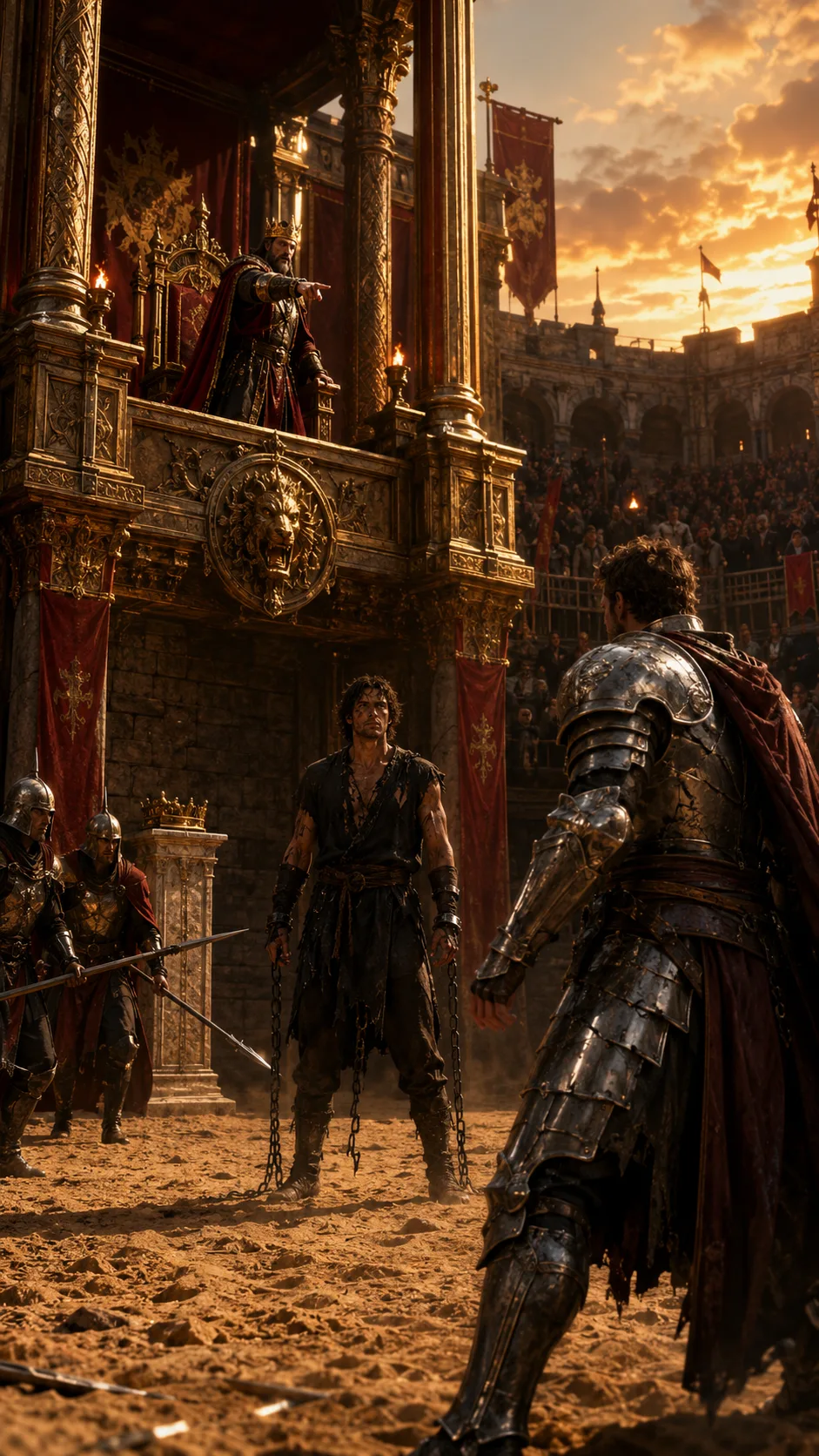
The Royal Arena of Caleon rose in circles of stone, banners, and bodies. Red cloth hung from high arches, each banner stitched with the golden lion of Aldric’s house. Torches burned even in daylight, fixed to black iron brackets along the lower walls. The sand below was raked smooth except for old stains the workers had not fully buried.
At the far side of the arena, above a carved balcony, King Aldric
sat on a throne made to look older than it was.
Gold claws wrapped the arms. A lion’s head snarled beneath his feet. Behind him, ministers and noble families filled the shadowed gallery, all dressed in colors too rich for dust.
The king wore black and gold.
He had dressed for judgment.
At the center of the arena, on a low stone pedestal, sat the Champion’s Crown.
Kael’s eyes stopped there.
Not because it was beautiful, though it was. The crown was made of beaten gold and dark iron, its points shaped like old flames. It had belonged to Caleon’s champions for two hundred years, passed only after trial by combat before the king himself. No commoner had worn it. No prisoner had stood close enough to cast a shadow over it.
A guard jabbed Kael forward.
“Walk.”
Kael walked.
Sand swallowed the sound of his bare feet. The chains
did not stay quiet. They dragged behind him, loud enough for the closest rows to hear. The first laugh came from somewhere to his left. Then another. Soon the sound spread in little pieces until the lower tiers smiled down at him like he had already fallen.
Lord Varos waited near the pedestal.
The champion’s armor was silver, dented in places but polished so well the sun flashed from every plate. A red cloak fell from his shoulders. His sword was already in his hand, point lowered, patient. He was taller than most men and built with the calm weight of someone who had never needed to prove strength by wasting it.
Forty-three trials.
Forty-three victories.
Kael had heard the guards recite them that morning while they tightened his cuffs. Varos had broken war captains, foreign challengers, rebels, and one prince from the northern coast who had lasted less than a minute.
A herald stepped into the sand between them.
He carried a scroll and did not look at Kael.
“By order of His Majesty, King Aldric of Caleon, the condemned man shall face Lord Varos, Champion of the Royal Arena, in lawful trial before crown and kingdom.”
The crowd cheered at the word condemned.
Kael glanced up at the king.
Aldric did not move. He watched from the balcony with one gloved hand resting on the golden armrest. His face held no anger. No curiosity. Only the stillness of a man inspecting a stain that would soon be cleaned.
The herald lifted his voice.
“If the prisoner falls, sentence is fulfilled.”
He stopped there.
No one laughed louder than the nobles this time.
A thin smile touched Aldric’s mouth.
The herald stepped away quickly, as if Kael carried sickness.
Varos tilted his head.
“You have a name?” he asked.
Kael had not expected the champion to speak to him.
The crowd softened to a murmur, irritated by the delay.
Kael flexed his hands inside the cuffs. The iron had rubbed the skin raw during the walk from the lower cells. He could feel the pulse under it.
“Kael.”
Varos looked at the chains, then at the guards along the wall.
“They gave you no blade.”
“They gave me chains.”
The champion’s gaze returned to Kael’s face.
“That was not my order.”
Kael said nothing.
A fly circled the edge of the pedestal, settled on the stone, then lifted again.
The herald raised a white cloth.
The arena pulled in a single breath.
The cloth dropped.
Varos moved with the speed of a falling shadow.
His first strike came from the right. Kael stepped back, but the chain between his wrists shortened the movement. Steel passed close enough to cut the air against his cheek. The crowd roared.
The second strike came lower.
Kael turned his wrists together and let the chain catch the blade near the guard. Metal screamed. The force jarred up his arms, but the sword stopped short of his ribs.
For a moment, Varos’s eyes narrowed.
Kael twisted.
The chain slid along the sword and wrapped once around Varos’s wrist.
The champion pulled back.
Kael went with him.
Not away.
In.
His shoulder drove into the center of the silver breastplate. Varos shifted his weight and stayed standing, but the impact broke his rhythm. His sword arm dipped half an inch.
Small.
The first row saw it.
The cheering broke unevenly.
Kael released the chain before Varos could trap it. He ducked under the returning blade and let the second length of chain drag across the sand near the champion’s boots.
Varos recovered fast.
Too fast.
The pommel struck Kael’s shoulder. Pain flashed down his arm. He staggered. The chain pulled his wrists wrong, and the nearest guards laughed.
Varos did not.
“Stay down,” the champion said.
Kael spat sand from his mouth and got his feet under him.
“No.”
The next exchange lasted longer.
Varos attacked with control, not cruelty. That made him more dangerous. Every strike tested distance, chain length, breath, balance. He learned the shape of Kael’s limitations and cut into them. Kael gave ground because he had no choice. The arena saw the champion regain command and began to cheer again.
King Aldric leaned back in his throne.
Kael saw it.
He saw the king’s fingers relax on the armrest. He saw one noble woman lift her cup. He saw a boy in the second tier point at his chains and grin.
Something in Kael’s chest went flat.
Not cold.
Not hot.
Flat.
The world narrowed.
Varos stepped in for a finishing cut.
Kael let the chain between his wrists go slack.
The sword came down.
Kael dropped to one knee and swung both hands upward. The loose chain snapped tight around the blade. Instead of pulling against it, he threw his weight sideways.
The move should not have worked.
It only worked because Varos had expected fear.
The champion’s sword turned in his grip. Kael rolled under his arm, dragged the chain across the back of Varos’s knee, and pulled.
Armor crashed into sand.
The sound cut the crowd in half.
Varos hit hard. His sword flew from his hand and landed near the pedestal. Kael moved before the guards could shout. He placed one foot on the blade and pulled the chain tight across the champion’s throat—not enough to kill, enough to end the fight.
Varos froze under him.
The arena did not breathe.
Kael’s hands shook from strain. His shoulder burned. Sand clung to the sweat on his face. The chains trembled between his wrists.
Varos looked up at him from the ground.
There was no plea in his eyes.
Only measure.
Kael loosened the chain and stepped back.
The champion did not move at first. Then he rolled to one side, pushed himself up on one hand, and stopped on one knee.
A guard shouted from the wall.
A noble dropped a cup.
King Aldric stood.
The movement of the king rising did more than the fight had. It bent the entire arena toward him. Nobles stood after him. Ministers leaned forward. The guards near the gate tightened their hands around their spears.
Aldric looked at Varos, then at Kael, then at the sword lying under Kael’s foot.
His voice carried over every stone.
“Seize him before the crowd kneels.”
Two guards entered the sand.
They came from Kael’s left, spears lowered, red cloaks dragging behind them. They did not look at Varos. Their eyes stayed fixed on the prisoner.
Kael did not step away from the sword.
He did not raise his hands.
He only stood there with broken chains hanging from his wrists, the links dark against the sun.
The guards kept coming.
Then Varos lifted one hand.
The first guard stopped.
Varos pushed himself upright slowly. His armor scraped. One knee almost gave beneath him, but he planted his boot and turned just enough to stand between Kael and the spears.
“He won,” Varos said.
The arena heard it.
The king heard it.
Varos took one breath.
“Touch him and you shame me.”
A murmur moved through the lower seats. Not loud. Not brave. But it moved.
Aldric’s jaw hardened.
“You forget who gave you that crown.”
Varos glanced at the pedestal.
The Champion’s Crown still sat there, gold catching torchlight, untouched.
“I remember,” Varos said.
The king’s hand closed on the armrest.
“That crown answers to my blood.”
Kael looked from the crown to the king.
The words landed in the sand between them.
Blood.
The old answer to every locked gate in Caleon. Blood decided who ate at tables and who served beside them. Blood decided which names entered records and which names were scraped off stone. Blood turned theft into inheritance and obedience into honor.
Kael had been born without a recorded father.
That was enough for prison iron.
That was enough for laughter.
He lifted one broken chain at chest height.
The links caught the sunset.
“Then let the crown answer.”
The arena went so quiet the torch nearest the pedestal could be heard spitting.
Nothing happened.
For one breath.
Then another.
Aldric’s mouth curved.
Somewhere above, a noble exhaled a laugh.
Varos did not look away from the pedestal.
The crown trembled.
A tiny movement.
So small Kael thought the heat had bent the air.
Then the crown shifted again.
The gold points tapped the stone.
Tap.
Tap.
The sound moved through the silence like a nail tapped into wood.
The smile left Aldric’s face.
The crown slid.
One inch.
Then another.
The nearest guard took a step back before he knew he had done it.
The crown tipped from the low stone pedestal and fell into the sand.
It did not bounce.
It struck with a dull, heavy sound and rolled once, then twice, carving a small line through the dust until it stopped at Kael’s bare feet.
No one cheered.
No one shouted.
Kael stared down at it.
Up close, the crown looked less perfect. There were scratches along the lower rim. A dark stain beneath one point. Old repairs where iron had been fused back into gold. It was not a jewel from a song. It was a thing that had survived hands, bloodlines, and lies.
Kael did not pick it up.
He bent only enough to touch the nearest point with two fingers.
The iron cuff around his wrist brushed the gold.
A sound came from the crowd.
Not a cheer.
A question with no words.
Varos turned toward Kael fully. He looked at the crown. Then he looked at the broken chain. His face changed in pieces. First the jaw loosened. Then the eyes lowered. Then his sword hand opened and closed once, empty.
He understood something before the rest of them did.
The champion lowered himself to one knee.
Not the half-kneel of a wounded man.
A full kneel.
His fist pressed into the sand.
His head bowed before Kael.
“The arena has chosen him.”
The words did not echo.
They did not need to.
The guards lowered their spears.
One at a time.
Aldric’s hand froze on the armrest.
For all his robes and gold, for all the carved lions under his balcony, he looked suddenly far away from the sand. Too high to reach the truth before it reached him.
“That is not—”
His voice stopped.
The unfinished line stayed above the arena like smoke.
Kael looked up.
The entire kingdom was watching the king fail to finish a sentence.
That did more damage than shouting ever could.
A minister behind Aldric stepped back from the throne. The movement was small, almost polite. Then another noble shifted away. A captain near the royal stairs lowered his chin and stared at the crown in the sand.
Aldric noticed.
His eyes moved left, then right.
No one came forward.
“Varos,” he said.
The champion did not rise.
Aldric’s voice sharpened.
“Stand.”
Varos kept his fist in the sand.
“No.”
The word was quiet.
It reached every row.
Kael still had not touched the crown beyond that first contact. He did not know what would happen if he lifted it. He did not know what old law had woken under the stone. He did not know why the crown had answered chains.
But he knew the king was afraid of it.
That was enough.
Aldric turned to the guards on the lower wall.
“Remove him.”
No one moved.
The first guard who had entered the sand looked at Kael’s wrists. Then at the crown. Then at Varos kneeling before him. He swallowed once and stepped back.
A second guard did the same.
The crowd changed after that.
Not all at once. A crowd never becomes brave in one breath. It begins with the person who stops pretending not to see. A merchant in the lower tier stood. A soldier two rows above him removed his helmet. An old woman near the eastern arch pressed both hands to the railing and bowed her head.
Then a section of the arena lowered.
Not fully.
Not neatly.
But enough.
King Aldric watched the first kneeling row with his face carved into stillness.
Kael heard the chains before he understood why.
His own.
They were shaking.
He looked down and saw his hands were steady. The chains were not moving because of him.
The cuffs around his wrists split at the hinges.
One cuff dropped into the sand.
Then the other.
The sound was small compared to the crown, smaller than armor, smaller than the gate.
It cut deeper.
Kael stood with bare wrists in the middle of the Royal Arena.
No sentence.
No shackles.
No blade.
A crown at his feet.
Varos lifted his head.
“Take it,” he said.
Kael looked at him.
The champion’s face was pale under dust, but his eyes were clear.
“If you leave it there, Aldric will take the arena back before sunset.”
Aldric heard him.
“Traitor.”
Varos did not turn.
Kael crouched and picked up the crown.
It was heavier than he expected. Warm from the sun on one side. Cold where the sand had touched it. He held it with both hands, chains lying broken around his feet.
The arena watched him.
A crown was not a life. It did not return years spent below ground. It did not give back names removed from records, or mothers who died without answers, or men who vanished because a king had needed silence.
Still, it had fallen.
Before everyone.
Kael raised the crown.
Not high.
Just enough that the crowd could see it was no longer on the pedestal.
Aldric took one step back from the balcony rail.
Behind him, the throne looked too large.
A royal clerk rushed to the king’s side with a leather book held to his chest. His face had gone pale enough to show the red veins near his nose. He opened the book with shaking fingers, stopped at a marked page, and looked at Aldric.
The king did not look at him.
“Majesty,” the clerk said.
Aldric’s hand snapped out and struck the book away.
Pages scattered across the balcony.
The crowd saw that too.
One page slid over the carved rail and drifted down into the arena.
It landed near Kael’s feet, beside the broken cuff.
Varos reached for it, but Kael moved first.
The page was old. Older than Aldric’s reign. The ink had browned at the edges, but the royal seal remained clear at the bottom. Not Aldric’s lion. An older mark. A crown over an open gate.
Kael could read only part of it. The lower prison schools had not cared for beautiful handwriting.
Varos read over his shoulder.
His voice lowered.
“Trial by crown.”
Kael kept his eyes on the page.
Varos continued.
“If a condemned man defeats the seated champion and the crown leaves its pedestal unbidden, the arena recognizes blood hidden by record, exile, or unlawful decree.”
A cold line moved through the sand.
Not through Kael.
Through everyone else.
Aldric gripped the balcony rail.
“Enough.”
The clerk bent to gather the fallen pages, but his hands failed him twice.
Varos stood slowly.
“Hidden by record,” he said.
Aldric’s face turned red under the crown.
Kael looked up at him.
For the first time, the king looked back as if Kael were a person.
Not a stain.
Not a sentence.
A problem.
The page shook slightly in Kael’s hand.
“What record?” Kael asked.
No one answered.
The old woman in the eastern tier bowed fully now. The soldier without a helmet followed. More knees touched stone.
Aldric lifted one hand, but the gesture no longer commanded the arena. It searched for something to grip.
“Take him below,” he said.
His voice was quieter.
A captain at the royal stairs did not move.
Aldric turned on him.
“I gave an order.”
The captain looked down into the sand, then at the crown in Kael’s hands.
“No, Majesty,” he said. “You gave a denial.”
The words were not loud.
The balcony heard them.
The first noble left.
A woman in a green court dress stood from her seat behind Aldric and walked toward the stairs without asking permission. Then a minister. Then two younger lords who had laughed when Kael entered.
Aldric watched them go.
The crown on his own head seemed heavier by the second.
Kael did not know how long he stood there. Time had a strange shape in the arena after that. Guards withdrew from the sand. The herald who had called him condemned stood near the gate with the scroll crushed in his fist. Varos picked up his fallen sword and handed it hilt-first to Kael.
Kael did not take it.
“I have carried enough iron today.”
Varos lowered the sword.
A corner of his mouth moved. Not quite a smile.
The royal physician came to the arena edge and hesitated, unsure whether he was allowed to treat a prisoner, a champion, or something the old law had not named yet.
Kael looked at his wrists.
The skin beneath the cuffs was swollen, raw, marked deep where iron had pressed for years. The air against it felt strange. Too gentle.
Varos followed his gaze.
“I can have those dressed.”
“Later.”
Kael turned toward the gate he had entered through.
The tunnel beyond it was dark.
Same stones.
Same shadow.
But the guards there had moved aside.
Aldric remained on the balcony, alone now except for the clerk and one trembling page boy. His hand still rested on the rail. He had not sat back down.
Kael held the Champion’s Crown against his side and walked toward the gate.
No chain followed him.
The sound missing from his steps made the arena listen harder.
At the threshold, he stopped and looked back once.
Varos stood in the sand, sword lowered.
The pedestal was empty.
The king was still above them.
Kael turned away from the balcony.
That was his first choice as a free man.
The lower corridors smelled the same as before. Damp stone. Rusted hinges. Burned oil. But the men waiting there did not shove him. They stepped back. One bowed his head. Another stared at the crown and forgot to breathe.
Kael passed the cell row where he had slept for three years.
Prisoners pressed close to the bars.
No one called his name at first. Most of them had never known it. In the lower cells, names were dangerous things. They could be taken, twisted, used to count you.
Then a voice came from the last cell on the left.
“Kael.”
He stopped.
An old prisoner sat near the bars, wrapped in a grey blanket even though the passage was warm. His beard had grown thin. One eye was clouded.
He had once given Kael half a piece of stale bread and told him not to thank him where guards could hear.
Kael stepped closer.
The old man looked at the crown.
Then at Kael’s wrists.
“Your mother said the arena would remember,” the old man said.
Kael’s fingers tightened around the crown.
“My mother died before I could remember her voice.”
The old man nodded once.
“She knew.”
A guard behind Kael shifted. Varos had followed at a distance and now stood at the corridor mouth, watching.
Kael crouched to the old man’s level.
“What was her name?”
The old man reached through the bars with two fingers. Not to touch the crown. To touch the broken mark on Kael’s wrist.
“Seren.”
The name entered Kael like a key into a lock that had waited too long.
Seren.
The old man closed his eyes.
“She was not a servant. She was not a thief. She was the last daughter of the old gate line. Aldric erased her from the registry before you were born.”
Kael looked down at the crown.
Hidden by record.
The words on the old page had found a face.
Behind him, Varos spoke for the first time since leaving the arena.
“I guarded the registry room in my first year.”
Kael turned.
Varos looked at the stones near his feet.
“There was a fire. We were told rebels had burned the west archive.”
“Did they?”
Varos did not answer quickly.
“No.”
The corridor settled around them.
Kael rose.
The crown felt different now. Not lighter. Not heavier. Closer.
“What happens to Aldric?”
Varos looked toward the stairs that led back to the royal galleries.
“If the old law is read before the council, he will be made to answer for the erased record.”
“And if the council refuses?”
Varos looked at the prisoners behind the bars, the guards standing still, the crown under Kael’s arm.
“They already watched the crown fall.”
Kael understood.
A kingdom could ignore a rumor.
It could bury a woman.
It could chain a boy and call him nothing.
But it could not make an entire arena unsee what it had seen.
By dusk, the page from the old law had been copied by three clerks and carried to the council chamber. By night, the lower city had heard that the Champion’s Crown had left its pedestal for a prisoner. By morning, Aldric’s own guard refused to seal the arena records.
No battle followed.
Not that day.
No armies marched through the city. No gate burned. No noble house admitted guilt with clean language.
Power did not fall like a tower.
It loosened like a knot.
King Aldric was not dragged through the streets. He was too skilled at keeping men near him who feared disgrace more than death. But he was removed from the arena balcony before the next sunset. The council called it a temporary withdrawal from public judgment. The lower city called it hiding.
Varos surrendered the champion’s quarters and asked to stand guard at the old archive doors.
Kael did not wear the crown that first week.
He kept it on a plain wooden table in a small chamber overlooking the arena floor. The table rocked if touched on the left corner. No one replaced it, because Kael never asked.
Every morning, he went to the lower cells.
Every morning, another door opened.
Not all prisoners were innocent. Kael knew that. The old law did not wash every hand clean. But records were read. Names were spoken. Sentences were checked against signatures that had hidden too long in sealed books.
On the seventh morning, Kael stood before the arena gate where he had entered in chains.
The sand had been raked smooth again.
Workers had removed the broken armor. The pedestal remained empty. Someone had left the black iron cuffs there, cleaned and placed side by side beneath the stone.
Varos stood behind him.
“You should decide where the crown goes,” the former champion said.
Kael looked at the pedestal.
Then at the cuffs.
The arena seats were empty now. Without a crowd, the place looked less hungry.
“Leave the pedestal empty.”
Varos studied him.
“And the crown?”
Kael lifted it from the wooden table later that day and carried it down to the lower gate, where prisoners used to enter without names. He fixed it above the arch, not on a throne, not behind a king, but over the passage every condemned person would walk through before trial.
A clerk asked if that was proper.
Kael looked at the old law page laid flat beside the registry.
“No.”
The clerk blinked.
Kael wiped dust from the crown’s lower rim with his thumb.
“It is necessary.”
That evening, the old prisoner from the last cell was brought into the courtyard to feel the sun on his face. He asked to see the crown. Kael helped him stand close enough to touch the arch beneath it.
The old man did not cry.
He only pressed his palm to the stone and said Seren’s name once.
Kael said it after him.
The arena carried it upward.
Weeks later, when the council finally read Aldric’s decree of erasure aloud, the former king stood without his crown in a chamber full of witnesses. He denied the first charge. He argued the second. By the third, his voice had become careful and thin.
When Seren’s name was entered back into the registry, Kael was not in the chamber.
He was in the arena tunnel, removing the last rusted chain from the wall.
It took three strikes.
The chain fell at his feet.
He left it there until morning.
Then he walked out through the gate with empty hands.
Chapter complete
You have reached the end of this chapter.
Continue reading
A few more worlds to get lost in after this chapter.