Camila Reyes learned very early that silence could be mistaken for weakness.
Chapter 1
Camila Reyes learned very early that silence could be mistaken for weakness.
She had learned it in airport lines, when officers spoke over her head as if she were luggage. She had learned it in government buildings, when men in suits asked questions they did not want answered. She had learned it in courtrooms, where the shape of a person’s life could be reduced to one folder, one stamped form, one signature from a man who never had to remember her name.
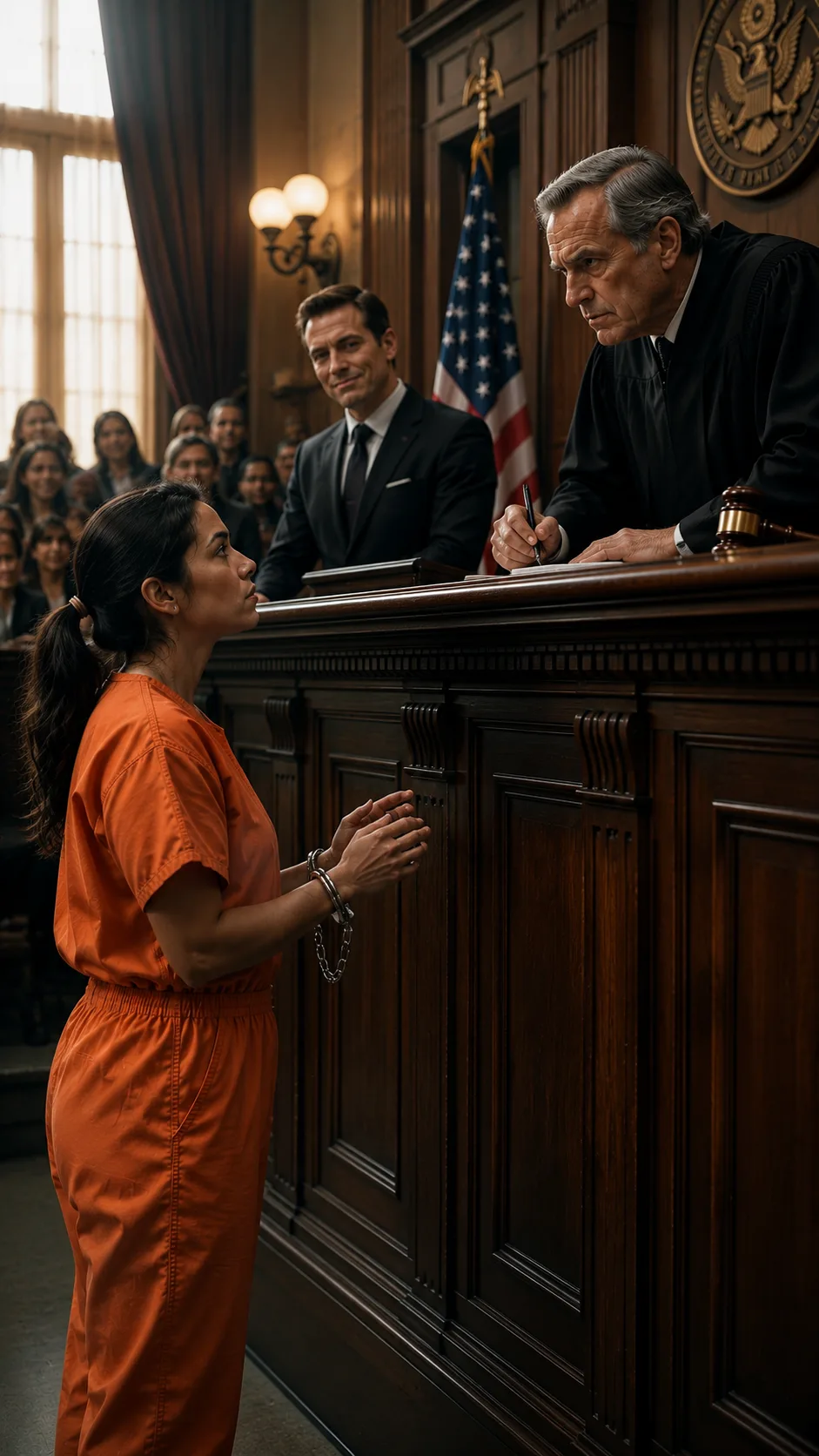
But that morning, as two federal officers led her into Courtroom 7B, Camila did not lower her head.
The courtroom was grand in the coldest possible way. Tall windows poured soft daylight across dark wooden benches. A large seal hung behind the judge’s chair, polished enough to catch the light. The walls smelled of old paper, varnished wood, and power that had been sitting in the same place for too long.
Camila wore an orange prison jumpsuit.
The sleeves were
too short. The collar scratched her neck. Steel handcuffs circled her wrists, connected by a short chain that clicked every time she moved her fingers.
People turned when she entered.
Some stared openly. Some looked away with practiced politeness. A reporter near the aisle lifted her pen. A young court clerk paused over her keyboard. At the prosecution table, Assistant U.S. Attorney Martin Vale adjusted his tie and gave her one brief glance.
Then he smiled.
Not wide.
Just enough.
Camila saw it.
She kept walking.
“Defendant to the front,” one officer said.
The interpreter, a thin man in a gray suit, stood near the defense table. He gave Camila a quick look and then checked the papers in his hand.
“You understand English?” he asked quietly.
Camila looked at him. “Yes.”
He seemed surprised by her accent. Or maybe by the lack of one.
“I’ll interpret if needed,” he
said.
“That won’t be necessary.”
He blinked.
Before he could answer, the side door opened.
“All rise.”
The courtroom stood.
Judge Malcolm Bennett entered slowly, wearing a black robe that moved around him like shadowed cloth. He was in his mid-fifties, silver-haired, handsome in a severe way, with a face made for portraits in courthouse hallways. He did not look rushed. Men like him never rushed. They let rooms arrange themselves around their presence.
He sat.
Everyone sat.
Camila remained standing before the bench, hands cuffed in front of her.
Judge Bennett opened the file.
“Case number 7B-419. United States versus Camila Reyes.”
His voice was smooth. Controlled. Almost bored.
Camila watched his eyes move across the page.
“Ms. Reyes,” he said, “you are currently detained pending investigation into unauthorized possession of restricted government materials, obstruction, and suspected involvement in the transfer of classified documents.”
Martin Vale rose at once.
“Your Honor, the government maintains that the defendant is a flight risk and a serious risk to national security. She has no stable address, no verified employment, and no legal standing that would justify release.”
Camila’s assigned lawyer, a tired public defender named Nora Klein, stood beside her.
“Your Honor, my client has repeatedly stated that she did not steal anything. She says she was employed as a translator on a contract basis and that she came into possession of the documents through official channels.”
Judge Bennett glanced at Camila.
“A translator.”
One word.
The courtroom felt the weight he placed on it.
Vale gave a quiet laugh. “Your Honor, the defendant has made several claims about her linguistic background. Some of them are… difficult to verify.”
Judge Bennett looked down again.
“According to this statement, Ms. Reyes claims fluency in Spanish, English, Portuguese, French, Russian, Arabic, Mandarin, Farsi, Pashto, and several diplomatic dialect systems used in restricted communications.”
A ripple moved through the gallery.
Someone whispered, “Seriously?”
Someone else laughed under their breath.
Camila did not move.
Nora leaned closer. “Don’t react.”
Camila had no intention of reacting.
Judge Bennett tapped his pen once against the file.
“Ms. Reyes,” he said, “this court is not a stage. Claims of extraordinary skill do not replace evidence.”
“I understand,” Camila said.
The sound of her voice shifted the room for half a second. Not because it was loud. It wasn’t. But because it was steady.
Judge Bennett lifted his eyes.
“You understand?”
“Yes, Your Honor.”
“Then perhaps you understand why this court will not delay proceedings because a defendant suddenly announces that she possesses rare knowledge useful to the federal government.”
“I did not announce it suddenly.”
Vale turned slightly. “Your Honor, the government has found no official record of Ms. Reyes being authorized for any classified translation work.”
Camila looked at him.
Vale’s smile returned.
“No official record,” he repeated, as if that settled everything.
Camila’s hands rested in front of her. The cuffs were cold against her skin.
Nora opened a folder.
“Your Honor, there are irregularities in the government’s own documents. My client insists the transfer logs were altered after her detention. We are requesting time to subpoena the original chain-of-custody files.”
Judge Bennett leaned back.
“Denied.”
Nora froze. “Your Honor—”
“The defendant has already consumed enough court resources with unsupported statements.”
Camila looked at the judge’s right hand.
His pen was black and silver. Expensive. The kind of object a man used when he liked people to notice what his signature meant.
Judge Bennett turned a page.
“Ms. Reyes, you are asking this court to believe that a contract translator with no official clearance somehow had access to classified diplomatic material, recognized internal inconsistencies, and can now assist in identifying corruption inside a federal chain of custody.”
“Yes,” Camila said.
The gallery reacted again.
This time the laughter was clearer.
Nora closed her eyes for one second.
Vale lowered his head as if hiding amusement.
Judge Bennett’s mouth tightened into something almost like a smile.
“Ms. Reyes, this court runs on law, not fairy tales.”
A few people laughed openly now.
The sound moved behind Camila like a soft wave.
She heard every part of it.
The reporter’s pen scratching.
The prosecutor shifting his weight.
The interpreter breathing through his nose.
The bailiff near the door adjusting his belt.
The old wooden clock ticking above the gallery.
Judge Bennett lowered his pen toward the detention order.
“The defendant will remain in custody pending further review. Her claims are unsupported, theatrical, and irrelevant to the present proceeding.”
Nora stepped forward. “Your Honor, please. At least allow us to enter the sealed translation memo into preliminary review.”
Judge Bennett did not look up.
“There is no sealed memo before this court.”
Camila’s eyes moved to the corner of his bench.
There it was.
A red folder.
Thin. Plain. Unmarked except for a small white label with no public case number.
Judge Bennett noticed her looking.
His pen stopped for less than a second.
Then continued.
Camila understood then.
Not suspected.
Understood.
The folder had reached him.
He had seen it.
And he had decided to bury it.
The first time Camila saw that red folder had been eight months earlier in a windowless office beneath a federal annex in Arlington. She had been hired under a temporary translation contract, one of those contracts that kept people invisible until someone needed their skill and disposable when someone needed distance.
She had been given audio fragments. Diplomatic phrases. Banking references. Names hidden inside coded trade language.
Most translators would have heard old jargon.
Camila heard laundering routes.
She heard dates.
She heard judicial initials.
One set of initials appeared again and again.
M.B.
At first, she told herself it could be anyone.
Then she found the phrase that changed everything.
A phrase from a restricted diplomatic shorthand used decades earlier in covert asset transfers. Almost no one used it anymore. Almost no one remembered it.
But Camila did.
Her mother had once translated for embassy backchannels in Bogotá. Her father had disappeared after refusing to falsify a shipment record. Camila had grown up with languages the way other children grew up with lullabies. Warnings hidden in grammar. Names hidden inside pauses.
She reported what she found.
Three days later, her badge stopped working.
Five days later, her apartment was searched.
One week later, she was arrested.
And now the man whose initials lived inside those coded documents was sitting above her, preparing to sign away her voice.
Judge Bennett pressed the paper flat with his left hand.
Camila’s fingers moved.
The handcuffs gave one quiet metallic sound.
Clink.
The judge’s eyes flicked up.
Camila raised her bound hands just slightly.
Not pleading.
Not pointing.
Just enough for the chain to catch the daylight.
Then she spoke.
Not in English.
Not in Spanish.
The words were soft, precise, and old.
The interpreter’s face changed first.
He looked at Camila as if the floor had shifted beneath him.
Vale turned. “What did she say?”
The interpreter did not answer.
Camila continued.
Every syllable was measured. Clean. Controlled.
Judge Bennett’s pen froze above the detention order.
Only the pen stopped at first.
Then his hand.
Then his face.
The gallery’s laughter thinned into silence.
Vale looked between the judge and Camila.
“Your Honor?”
Judge Bennett did not respond.
Camila spoke again, still in the forbidden diplomatic register.
The language did not sound dramatic. That was what made it worse. It sounded official. Practical. Like a door opening in a government building where nobody was supposed to be.
Judge Bennett’s jaw tightened.
Nora slowly turned toward Camila.
“What are you saying?” she whispered.
Camila did not look away from the bench.
She switched languages.
This time the words carried clipped consonants and formal cadence. Another system. Another layer. She named a date. A bank corridor. A transfer reference. Then a phrase that had appeared inside the red folder.
Judge Bennett’s fingers tightened around the pen.
Vale’s smile disappeared.
The judge finally spoke.
“Stop.”
The word was quiet.
Everyone heard it.
Camila stopped.
For one breath.
Then she said one more line.
The judge stood so suddenly his chair scraped against the floor.
“Clear the courtroom.”
The gallery erupted into murmurs.
Nora stepped forward. “Your Honor, on what grounds?”
“Clear the courtroom now.”
The bailiff looked uncertain.
Reporters began reaching for phones. The clerk’s hands hovered over her keyboard. Vale moved closer to the bench.
“Your Honor,” he said under his breath, “we should proceed carefully.”
Judge Bennett turned on him.
“Do not instruct me in my courtroom.”
Camila watched Vale’s face.
There it was.
Fear, hidden under procedure.
The bailiff approached the gallery. “Everyone out.”
People stood reluctantly. The reporter near the aisle tried to keep writing as she moved. A man in the back whispered, “What language was that?”
The interpreter stepped away from Camila as if distance could protect him.
Nora gripped the edge of the defense table.
“Camila,” she said quietly, “what did you just do?”
Camila looked at the red folder.
“I translated.”
The courtroom doors closed one by one.
Heavy.
Final.
Only a handful remained: Judge Bennett, Vale, Nora, Camila, the clerk, two officers, the interpreter, and the bailiff.
Judge Bennett sat back down, but he no longer looked elevated. He looked trapped behind the bench.
“You will not speak another word in that dialect,” he said.
Camila’s cuffed hands rested in front of her.
“Then enter the red folder into record.”
Vale stepped forward. “The defendant does not dictate procedure.”
Camila looked at him. “No. Evidence does.”
Judge Bennett’s eyes sharpened.
“You have no idea what you are touching.”
Camila’s expression did not change.
“I know exactly what I’m touching.”
Vale’s voice dropped. “Ms. Reyes, you are making things worse for yourself.”
“For myself?” Camila asked.
It was the first time her voice carried anything close to warmth.
Not kindness.
Recognition.
She turned slightly toward Vale.
“You changed the transfer log at 2:14 a.m. on March 6. You removed three initials from the custody note and replaced them with mine.”
Vale’s face went still.
Nora inhaled sharply.
Judge Bennett slammed his palm on the bench.
“That is enough.”
Camila looked back at him.
“No,” she said. “It is not.”
The two officers near her shifted.
Judge Bennett pointed at the clerk. “Strike that from the record.”
The clerk did not move.
“Strike it.”
Her fingers trembled above the keyboard.
Nora stepped in. “Your Honor, the defendant has just made a direct allegation of evidence tampering. I am requesting immediate preservation of all court audio, all filings, and the sealed folder presently visible on your bench.”
Judge Bennett’s face hardened.
“That folder is not part of this proceeding.”
“Then why is it on your bench?” Nora asked.
Silence.
The question sat there longer than anyone wanted.
Vale adjusted his cuff.
Judge Bennett reached for the red folder.
Camila spoke again in the forbidden language.
Only four words.
The judge’s hand stopped inches from the folder.
His face lost color.
The interpreter whispered something in Spanish under his breath, almost a prayer.
Nora turned to him. “You understood that?”
He shook his head.
“No,” he said. “But he did.”
Judge Bennett slowly withdrew his hand.
Camila took one step forward.
The chain between her wrists swung once.
The bailiff moved, but Bennett lifted his hand.
Too fast.
Too afraid.
Everyone saw it.
Camila lowered her gaze to the detention order.
The black pen still hovered near the judge’s fingers. A dark ink mark had spread across the paper where the nib had rested too long.
“You assumed,” Camila said, now in English, “that because I wore orange, I had no power.”
No one moved.
She lifted her cuffed hands and pointed, not at the judge, but at the red folder.
“You assumed silence meant ignorance.”
Judge Bennett’s lips parted.
Nothing came out.
Camila continued.
“You assumed a missing badge meant I had never been in the room.”
Nora looked from Camila to the folder.
Vale took half a step back.
Camila’s voice stayed even.
“But I was in the room when that code was written. I translated the first version. I know what was removed. I know who ordered the correction. I know why my name was placed on the transfer log after the fact.”
Judge Bennett stared at her.
The courtroom clock ticked once.
Twice.
Camila said the final phrase in the forbidden language.
This time, Judge Bennett whispered back.
He seemed to forget there were other people in the room.
The response left his mouth before he could stop it.
The interpreter did not understand the words.
Vale did.
His head snapped toward the judge.
Nora saw it.
Camila saw it too.
That was the mistake.
Judge Bennett had just answered in a language he had claimed was irrelevant, to a phrase he should never have known, about a file he had insisted was not before the court.
Nora moved immediately.
“Let the record reflect,” she said, voice shaking but clear, “that Judge Bennett responded to the defendant’s classified linguistic prompt.”
Judge Bennett’s eyes widened.
“Counselor—”
“And let the record reflect,” Nora continued, louder now, “that the government’s own prosecutor recognized the exchange.”
Vale said, “I did not—”
The clerk’s keyboard began to move.
Fast.
Judge Bennett turned toward her. “Stop typing.”
The clerk did not stop.
The bailiff looked at the judge, then at Camila, then at the red folder.
For the first time, he did not move on command.
Camila stood very still.
Orange uniform.
Steel cuffs.
Cheap shoes.
But the room no longer looked at her the same way.
Judge Bennett reached for the gavel.
Nora stepped closer to the bench.
“Your Honor, I am requesting your immediate recusal and the preservation of that folder.”
“You are out of order.”
“No,” Nora said. “I think you are.”
The words landed like a crack through glass.
Vale turned toward the exit.
Camila saw it.
“He’s leaving,” she said.
The bailiff blocked the door before Vale reached it.
Vale stopped.
His face changed completely now. The confidence was gone. The polish had cracked. Underneath it was a man calculating distance, witnesses, exposure.
Judge Bennett stood.
“This proceeding is suspended.”
“No,” Nora said. “This proceeding is evidence.”
The clerk kept typing.
The reporter outside must have sensed something, because muffled voices rose beyond the closed doors. Someone knocked once.
Then again.
Judge Bennett looked at Camila.
For the first time that morning, he did not look annoyed.
He looked old.
“What do you want?” he asked.
Camila’s answer came without hesitation.
“The original chain-of-custody file. My contract record restored. The detention order withdrawn. And every person named in that folder placed under independent review.”
Vale laughed once.
It sounded broken.
“You think you can walk out of here?”
Camila turned to him.
“No,” she said. “I think you can’t.”
The silence after that was deeper than any order the judge had given.
Nora looked at Camila, then at the officers.
“My client should be uncuffed.”
Judge Bennett said nothing.
The officers hesitated.
Then one of them looked at the bailiff.
The bailiff looked at the judge.
Judge Bennett’s hand lowered from the gavel.
No command came.
The officer stepped behind Camila and unlocked the cuffs.
The sound was small.
Click.
But everyone in the room felt it.
Camila brought her wrists apart slowly. Red marks circled her skin where the metal had pressed.
She did not rub them.
She did not smile.
The courtroom doors opened.
Reporters leaned in. The gallery beyond them had not left the hallway. Phones were raised. Cameras waited. The public had been removed from the room, but not from the story.
Nora picked up the detention order.
Unsigned.
She held it for Judge Bennett to see.
“Your Honor?”
He stared at the paper.
Then at the red folder.
Then at Camila.
His mouth tightened.
“Motion for temporary release is granted pending emergency review.”
Vale turned sharply. “Your Honor—”
Judge Bennett looked at him.
“Sit down.”
Vale sat.
Camila looked toward the open doors.
The same people who had laughed now stood silent in the hallway.
The reporter near the aisle was still holding her pen, but she was no longer writing. She was staring at Camila as if trying to understand how someone could enter a room in chains and leave with the room behind her.
Camila walked past the prosecution table.
Vale did not look at her.
At the doorway, she stopped.
Judge Bennett remained behind the bench, smaller beneath the seal than he had been when he entered.
Camila turned back once.
Not to him.
To the clerk.
“Make sure the transcript keeps the language tags,” she said.
The clerk nodded.
Camila stepped into the hallway.
The crowd parted.
No one laughed.
Behind her, inside Courtroom 7B, the red folder was finally placed on the record.
Chapter complete
You have reached the end of this chapter.
Continue reading
A few more worlds to get lost in after this chapter.




