The Princess Who Was Challenged Before the Council Won Without Raising Her Voice Once
The morning of the royal selection should have smelled like polished wood, fresh roses, and expensive perfume.
Chapter 1
The Princess Who Was Challenged Before the Council Won Without Raising Her Voice Once
The morning of the royal selection should have smelled like polished wood, fresh roses, and expensive perfume.
Instead, it smelled like a trap.
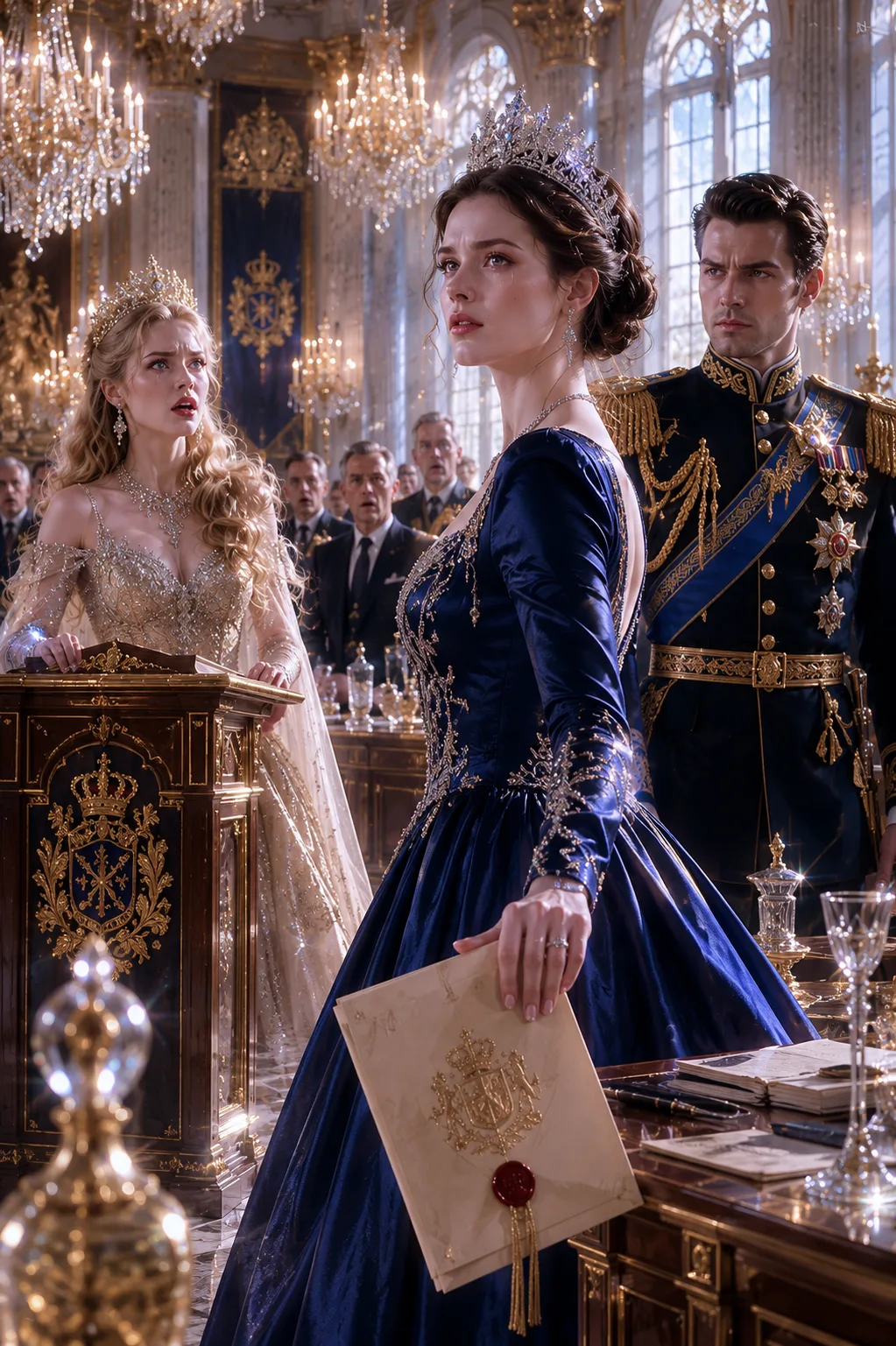
Princess Amelia knew it the moment she stepped into the Council Hall and saw two podiums instead of one.
The hall was built for ceremony, not mercy. White marble columns rose toward a painted ceiling where old kings stared down from gold-framed murals. Sunlight poured through the tall palace windows, soft and clean, making every cruel face look almost holy. Ministers sat in curved rows. Foreign ambassadors whispered behind silver nameplates. Reporters waited behind velvet ropes with their cameras lifted like weapons.
At the center of the room stood Isabella.
Her half-sister wore a pale gold satin gown, diamond earrings, and the relaxed smile of someone who had already been told the ending. Her hair had been pinned into perfect waves. Her lips were painted a careful red. Every inch of her looked prepared for a crown.
Amelia looked prepared for work.
Her navy
dress was elegant, but simple. Her pearl earrings were small. Her hair was pulled back neatly, not decorated with diamonds or gold. She carried no notes in her hands because she had not been told there would be a contest.
Queen Helena had made sure of that.
The queen sat on the raised platform beside the empty royal chair that had once belonged to Amelia’s father. Helena’s back was straight. Her face was calm. But her eyes were cold enough to cut glass.
“Princess Amelia,” Helena said, her voice carrying across the hall. “You are late.”
Amelia glanced at the clock on the west wall.
She was not late.
Everyone could see she was not late.
But no one said anything.
That was how Helena ruled. She never needed to shout. She only had to say the lie in public, and everyone else would become responsible for pretending it was
true.
Amelia walked forward anyway.
“My apologies, Your Majesty,” she said.
Isabella’s smile widened.
There it was. The first cut.
The public apology. The lowered head. The little performance Helena loved so much.
Amelia had grown used to it, the way some people grew used to winter. Since her father’s death, she had been pushed further and further away from the throne that should have protected her. Helena had not locked her in a tower. That would have been too obvious. She had done something cleaner.
She had turned Amelia into the palace’s most useful invisible person.
Amelia wrote the policy briefings Isabella pretended to understand. She reviewed the food relief plans Helena took credit for. She negotiated with trade ministers under the title of “junior adviser” while Isabella smiled for cameras beside flower arrangements.
The world saw Isabella as the shining princess.
The palace knew Amelia as the woman
who fixed everything before sunrise.
And today, the Royal Council would choose the official representative for the Northern Alliance Summit.
The person chosen would speak for the kingdom before five nations.
The person chosen would stand beside Prince Alexander of Valoria.
The person chosen would look like the future.
Helena had spent six months preparing Isabella for that photograph.
Amelia had spent six years preparing the kingdom for survival.
“Ladies and gentlemen,” the Lord Chancellor announced, rising from his seat. “Today, the council will hear from both royal candidates before making its recommendation.”
A murmur moved through the room.
Both royal candidates.
Amelia kept her face still.
That phrase was new.
Isabella turned slightly, just enough for Amelia to see the pleasure in her eyes.
“You didn’t know?” Isabella whispered.
Amelia did not answer.
“Mother thought it would be fair,” Isabella continued, soft enough that the microphones would not catch it. “A proper duel between princesses.”
Then she smiled brighter and turned toward the cameras.
Not with swords, Amelia thought.
With humiliation.
The chancellor cleared his throat. “Her Majesty has proposed a diplomatic examination. Questions on budget, alliance structure, border security, grain distribution, and civilian crisis response. Each princess will answer without assistance.”
A few ministers shifted in their seats.
One of them, Minister Rowe, looked down at his papers with sudden discomfort. Amelia had written three of the crisis proposals on that desk.
He knew.
They all knew.
But knowing and speaking were different things in Helena’s court.
Isabella stepped to the left podium. Amelia took the right.
Across the hall, Prince Alexander stood among the visiting Valorian delegation.
He wore a dark navy military uniform with gold embroidery at the cuffs. He was tall, controlled, and unreadable. Most people called him cold. Amelia had learned he was not cold. He was careful.
During the past year, he had attended several closed strategy meetings. Isabella had smiled at him. Helena had flattered him. Amelia had handed him documents and corrected border figures under her breath before Isabella could repeat them wrong.
Alexander had noticed.
That made Helena dangerous.
It made Isabella desperate.
The chancellor lifted the first card.
“Princess Isabella, you may begin. The kingdom faces a projected winter grain shortage of fourteen percent in the northern provinces. What is your immediate recommendation?”
Isabella folded her hands on the podium.
Her answer came smoothly.
“The palace will show strength by increasing ceremonial aid deliveries and reassuring the people that the crown remains generous in times of hardship.”
Cameras clicked.
She sounded elegant.
She sounded rehearsed.
She also said nothing.
The chancellor turned to Amelia. “Princess Amelia?”
Amelia felt Helena’s eyes on her.
A warning.
Do not embarrass her.
Do not rise too high.
Do not forget who controls the palace doors.
Amelia placed both hands on the podium.
“The shortage is not fourteen percent everywhere,” she said. “It is twenty-one percent in the mountain districts, nine percent along the eastern river, and almost zero in the capital reserve. If we send ceremonial aid first, food goes where cameras are, not where hunger is.”
The hall went quiet.
Amelia continued.
“Immediate response: release twelve percent of the capital reserve, suspend export quotas for thirty days, redirect rail access to the three northern storage depots, and remove the private toll fees at the border roads until spring.”
Minister Rowe looked up.
The ambassador from Norwick stopped whispering.
Amelia kept her voice even.
“No mother should have to stand in a palace-approved line for bread while grain sits behind a locked gate.”
The room changed.
It was small, but she felt it.
The air moved toward her.
Isabella’s smile tightened.
Helena’s fingers curled once around the arm of her chair.
The chancellor read the second card.
“The Northern Alliance has requested increased naval patrols in exchange for reduced tariffs on medical supplies. Princess Isabella?”
Isabella looked pleased again. This was one of the topics Helena’s tutors had drilled into her.
“The crown supports strong defense and fair trade,” Isabella said. “We will protect our waters while maintaining dignity in all negotiations.”
A safe answer.
A beautiful empty box.
“Princess Amelia?”
Amelia did not look at Isabella.
“We should accept reduced tariffs on medical supplies, but not in exchange for open-ended naval patrols. The fleet is already overextended after the southern storms. We offer seasonal patrol support for six months, tied to shared fuel costs and a written emergency clause. If the alliance wants permanent patrols, they must provide port access and repair credits.”
She paused.
“And dignity is not a policy. Terms are.”
Someone in the second row made a small sound before covering it with a cough.
Prince Alexander’s mouth did not smile.
But his eyes changed.
Isabella leaned toward her microphone before the chancellor could speak.
“How practical,” she said lightly. “You always were good with paperwork, Amelia.”
A few reporters laughed.
Not loudly.
Just enough.
The old kind of laugh. The palace laugh. The laugh people used when they wanted to be seen agreeing with power.
Amelia felt it hit her chest.
My stomach dropped.
Not because Isabella had insulted her. That was normal.
Because for one second, Amelia was fourteen again, standing outside her father’s study with a stack of maps in her arms, listening to Helena tell him, “The child is too serious. Let Isabella be the face of the family.”
Her father had said, “Amelia will be more than a face.”
Then he died three months later.
And Helena made sure Amelia became hands, labor, silence.
Amelia lifted her eyes.
“Paperwork feeds people when signatures matter,” she said.
The laughter stopped.
Isabella blinked.
It was the first real crack.
Helena leaned forward. “Princess Amelia,” she said, smooth and dangerous, “this is not a staff meeting.”
Amelia turned her head toward the queen.
“No, Your Majesty,” she said. “That is why the answers should matter more.”
The room went silent.
Not polite silent.
Dangerous silent.
Helena’s face did not move, but Amelia knew the look. She had seen servants dismissed for less. She had seen advisers reassigned to cold border offices for less. She had seen people disappear from palace influence for less.
The chancellor swallowed.
“Next question,” he said quickly. “Civil unrest has grown in the east after flood compensation delays. What message should the crown send to restore trust?”
Isabella’s confidence returned with a sharp little breath.
“The crown must remind citizens that unity is strongest during hardship,” she said. “We should visit the region, embrace the affected families, and promise that the palace hears them.”
This time, the cameras liked it.
A royal visit. A soft photograph. Isabella in a blue coat holding a child’s hand.
It was exactly the kind of answer the papers would print.
Then the chancellor looked at Amelia.
She thought of Eastmere.
The flooded streets. The school gym filled with cots. The old man who had shown her the cracked wall of his home and said, “They told us the funds were approved.”
They had been approved.
Helena’s office had delayed them because Isabella’s birthday gala needed renovation money transferred first.
Amelia had found the ledger at 2:13 in the morning.
She had kept the copy.
“Do not send a message first,” Amelia said.
Isabella laughed softly. “So your plan is silence?”
“My plan is payment,” Amelia said.
A low murmur rolled through the hall.
Amelia looked at the council, not the cameras.
“Eastmere does not need another speech. They need the compensation already approved under Emergency Relief Order Seven. The crown should release the funds within forty-eight hours, publish the payment schedule, dismiss the private contractor who inflated repair costs, and send engineers before photographers.”
Minister Rowe went pale.
Helena’s gaze sharpened.
Isabella’s hand tightened around the edge of the podium.
Amelia knew she had stepped onto forbidden ground.
Good.
She was tired of living there quietly.
The chancellor lowered the card in his hand.
“Princess Amelia,” he said carefully, “are you suggesting the funds were delayed after approval?”
Amelia inhaled.
This was the door.
Once opened, it would not close.
Before she could answer, Helena spoke.
“The council is not here to entertain administrative accusations.”
Alexander finally moved.
It was only one step.
But every camera caught it.
“With respect, Your Majesty,” he said, his voice calm, “the question concerns civilian trust. Delayed relief funds seem relevant.”
Helena looked at him.
For the first time that morning, she looked displeased in a way she could not hide.
Isabella turned quickly toward Alexander.
“Prince Alexander, I’m sure Amelia is only trying to sound impressive. She spends so much time in offices that she forgets how politics works in public.”
The insult was sharper now.
Less polished.
More afraid.
Amelia saw it.
So did Alexander.
“So explain it,” Alexander said.
Isabella froze.
The room shifted again.
Alexander’s eyes stayed on her. “If politics works differently in public, Princess Isabella, explain the Eastmere compensation process.”
Isabella’s lips parted.
No answer came.
A camera clicked.
Then another.
Helena stood.
“The prince is a guest,” she said. “He will not interrogate a royal daughter in her own palace.”
Amelia almost laughed.
Royal daughter.
Helena only used that phrase for Isabella.
Never for her.
The chancellor tried to regain control. “We will proceed to the final question.”
He lifted the last card with two hands.
“The representative chosen today will attend the Northern Alliance Summit and may be asked to negotiate directly with Valoria regarding the shared border treaty. What is the most important principle the crown should defend?”
Isabella looked relieved.
This was the grand question.
The one where facts mattered less than performance.
She straightened her shoulders and looked directly into the cameras.
“The crown must defend honor,” she said. “We must show that our bloodline is strong, our traditions are sacred, and our voice cannot be ignored.”
It was perfect for a headline.
It was useless for a treaty.
But Isabella was not finished.
She turned to Amelia with a smile that looked like a blade.
“And of course, some people believe numbers and servant files are enough to lead. But a kingdom is not led by the woman behind the desk. It is led by the woman born for the balcony.”
There it was.
The real duel.
Not policy.
Status.
Not leadership.
Blood.
The reporters leaned forward.
Helena’s expression softened with satisfaction.
Amelia felt hundreds of eyes on her.
Every old humiliation returned at once.
The time Isabella took Amelia’s place beside their father’s portrait.
The time Helena introduced Amelia as “support staff” to a visiting duke.
The time Amelia drafted a famine response while Isabella gave a speech about compassion from a script Amelia had written.
The time a child in Eastmere asked her, “Are you the princess who actually came?” and Amelia could not answer because the palace had forbidden her to use her title during relief visits.
Her throat tightened.
For one dangerous second, she wanted to break.
Isabella saw it and smiled like she had already won.
Then Amelia looked at the council.
Not at the cameras.
Not at Helena.
Not even at Alexander.
“The most important principle is responsibility,” Amelia said.
Her voice was quiet.
The microphones caught every word.
“A border treaty is not a painting of old kings. It is roads, farms, ports, schools, soldiers, mothers, winter fuel, and the price of medicine. If we defend honor but lose children to hunger, we have defended nothing.”
No one moved.
Amelia continued.
“A crown is not proof that you are better than other people. It is proof that more people can be hurt by your mistakes.”
Isabella’s face changed.
Just a flicker.
A flash of panic under the makeup.
Amelia turned to her.
“And if the council wants a louder voice, choose my sister. She has been trained for applause.”
A gasp moved across the chamber.
Amelia did not stop.
“But if the council wants someone who knows the budget, the treaty, the rail routes, the hospital shortages, and the names of the towns still waiting for flood relief, then I am ready.”
Helena’s mouth tightened.
“Enough,” the queen said.
But Amelia had spent years obeying that word.
This time, it did not reach her.
“I have been ready,” Amelia said.
The sentence landed harder than a shout.
The room went still.
Then Minister Rowe stood.
For a second, nobody understood what he was doing.
He was not a brave man. He had survived three reigns by bending before the wind. But his face looked different now. Tired. Ashamed.
He began to clap.
One sound.
Then another.
Across the aisle, the Norwick ambassador stood too.
Then the health minister.
Then two council members from the eastern provinces.
Then half the hall.
The applause grew until it filled the marble chamber and shook the silence loose from the walls.
Amelia stood frozen behind the podium.
She had imagined many punishments.
She had not imagined this.
Isabella looked around as if the room had betrayed her personally.
Helena remained seated now, because standing would make her fury too visible. Her face had gone cold and flat.
Alexander walked forward.
He did not rush. He did not perform. He crossed the hall with the steady confidence of a man who knew history had just changed direction.
He stopped between the two podiums.
The applause faded.
Every microphone turned toward him.
Isabella’s eyes brightened with sudden hope, as if she still believed he might save the performance.
“Your Highness,” she said quickly, “surely Valoria values tradition.”
Alexander looked at her.
“We do.”
Her smile returned.
Then he turned to Amelia.
“But tradition without competence is just decoration.”
Isabella’s smile died.
Alexander faced the council.
“A crown does not need a louder voice,” he said. “It needs the right mind.”
The room went silent again.
This time, it belonged to Amelia.
Helena rose slowly.
“That is a charming sentiment,” she said, “but this council serves this kingdom, not Valoria.”
Alexander did not flinch.
“Then let this kingdom choose honestly.”
Helena looked at the chancellor. “The vote will be private.”
“Public,” Amelia said.
The word left her mouth before fear could catch it.
Helena turned.
“What did you say?”
Amelia stepped away from the podium.
Her hands were cold, but her voice was steady.
“If the questions were public, the vote should be public too.”
Isabella let out a bitter laugh. “You are enjoying this.”
“No,” Amelia said. “I am ending it.”
Another silence.
A better one.
The chancellor looked at Helena, then at the council, then at the cameras.
He was calculating survival.
For once, survival pointed toward the truth.
“All council members in favor of Princess Isabella as royal representative,” he said, “please stand.”
Helena stood immediately.
Three ministers followed.
Only three.
The cameras caught the number before anyone could soften it.
Isabella stared at the room.
Her lips parted, but she said nothing.
“All council members in favor of Princess Amelia,” the chancellor said.
Chairs scraped across marble.
One after another.
The sound was small at first, then overwhelming.
Minister Rowe stood. The health minister stood. The eastern delegates stood. The trade council stood. The northern ambassador stood though he had no vote, a deliberate gesture that made reporters gasp.
Amelia could not breathe for a moment.
Not because she was weak.
Because the world had finally stopped pretending she was invisible.
Helena stepped down from the platform.
Her gown whispered against the marble like a warning.
She came close enough that only Amelia, Isabella, Alexander, and the nearest microphones could hear her.
“You think applause is power?” Helena said.
Amelia met her eyes.
“No,” she said. “But exposure is.”
Helena went still.
Amelia reached into the slim folder on the podium and pulled out a sealed copy of the Eastmere relief ledger.
The room sharpened.
Every camera shifted.
Isabella whispered, “What is that?”
Amelia did not look at her.
“This is the payment approval for Eastmere,” she said. “Signed six weeks ago. Delayed by the royal household office.”
Helena’s face lost a shade of color.
Amelia held up the second page.
“And this is the transfer request made three days later for ballroom renovations under Princess Isabella’s birthday celebration budget.”
The gasp this time was not polite.
It was public.
It was ugly.
It was real.
Helena’s voice dropped. “Put that down.”
Amelia’s fingers tightened on the paper.
For years, those three words would have worked.
Put that down.
Step back.
Apologize.
Stay useful.
Stay quiet.
She looked at the woman who had taken her grief, her labor, her title, and tried to make a cage out of duty.
“No,” Amelia said.
The word was not loud.
It did not need to be.
Alexander stepped beside her, not in front of her.
That mattered.
He did not rescue her from the room.
He made sure the room could not swallow her.
The chancellor reached for the ledger with shaking hands. “This will be entered into council review.”
“Public review,” Alexander said.
Helena looked at him with open hatred now.
“You forget your place, Prince Alexander.”
“No,” he said. “I remember it very well. I am the man expected to sign a treaty with your kingdom. I would prefer to sign it with the person who understands it.”
Isabella backed away from her podium.
For the first time in Amelia’s life, her sister looked small.
Not poor. Not humbled. Just small in the way a person becomes when the room stops feeding their illusion.
“You planned this,” Isabella hissed.
Amelia turned to her.
“No,” she said. “You challenged me.”
Isabella’s eyes filled with angry tears.
“You think you’re better than me because you memorized a few reports?”
“I didn’t memorize them,” Amelia said. “I wrote them.”
The line cut through the hall.
A camera flash burst white.
Isabella flinched.
That was the moment everything changed.
Not when the council applauded.
Not when Alexander spoke.
Not even when the ledger was revealed.
It changed when Isabella understood that the throne she had been promised was built on work she had mocked.
The council voted before noon.
Princess Amelia was named royal representative to the Northern Alliance Summit by an overwhelming majority.
The Eastmere ledger was transferred to an independent inquiry. The ballroom renovation funds were frozen before sunset. Minister Rowe resigned two days later, but not before testifying that Amelia had repeatedly warned the household office about the delays.
Helena did not fall in one dramatic scene.
People like Helena rarely did.
They lost power the way they built it: document by document, whisper by whisper, door by door.
But the palace doors changed.
Servants who had lowered their eyes around Amelia began to bow properly again. Advisers sent documents to her office without Helena’s approval. Foreign ambassadors requested direct meetings.
Isabella disappeared from public view for three weeks.
When she returned, she was quieter.
Not kind.
Just careful.
Amelia did not celebrate her humiliation.
She knew too well what humiliation did to a person.
But she also did not apologize for surviving it.
On the morning of the Northern Alliance Summit, Amelia stood in the same Council Hall, now cleared of reporters. The two podiums had been removed. Only one table remained at the center, covered with maps, treaty drafts, and black pens arranged in a perfect line.
Alexander entered just after sunrise.
Soft natural daylight touched the gold on his uniform.
“You are early,” Amelia said.
“So are you.”
“I had revisions.”
“You always do.”
There was a small silence.
Not dangerous this time.
Almost peaceful.
Alexander looked at the treaty draft in front of her. “The port access clause?”
“Changed,” she said. “Valoria gets seasonal repair credits. We keep emergency authority over civilian roads.”
He read the paragraph.
A slow smile touched his face.
“Difficult,” he said.
“Fair,” she corrected.
“Fair can be difficult.”
“It should be.”
He looked at her then, not as an adviser, not as a forgotten daughter, not as the woman behind the desk.
As the person in the room who knew what she was doing.
“My father used to say power reveals what people were already willing to do,” Amelia said quietly.
Alexander’s expression softened. “And what has it revealed about you?”
Amelia looked toward the empty royal chair.
For years, she had thought the chair was the thing that mattered. The symbol. The height. The official place where everyone could finally see her.
Now she understood something colder and stronger.
A chair could be stolen.
A title could be buried.
A balcony could be handed to someone else.
But competence left fingerprints everywhere.
In ledgers.
In treaties.
In rail schedules.
In children fed before winter.
In rooms that went silent when the truth finally stood up.
“It revealed,” Amelia said, “that I do not need to be louder than them.”
Alexander closed the treaty folder.
“No,” he said. “You never did.”
Outside the windows, the palace bells began to ring for the summit.
This time, Amelia did not stand behind anyone.
She walked first.
THE END.
Chapter complete
You have reached the end of this chapter.
Continue reading
A few more worlds to get lost in after this chapter.