The Princess Who Stole My Prince Lost the Kingdom He Needed Before She Could Wear My Crown Tonight In Public
Princess Catherine learned about betrayal in a room full of flowers.
Chapter 1
The Princess Who Stole My Prince Lost the Kingdom He Needed Before She Could Wear My Crown Tonight In Public
Princess Catherine learned about betrayal in a room full of flowers.
Not in a battlefield.
Not in a prison tower.
Not in some dark corridor where enemies whispered behind closed doors.
She learned it in the Royal Rose Gallery, beneath a ceiling painted with angels, while her younger sister Beatrice stood beside Prince Charles with one hand resting on his arm like she had already owned him for years.
Catherine stopped at the doorway.
No one noticed her at first.
The musicians were still playing softly. The chandeliers glowed above hundreds of white roses. Servants moved between gold tables with silver trays. Noble families spoke in soft voices, pretending not to stare.
But everyone was staring.
Because Prince Charles, the man Catherine was meant to marry, was holding Beatrice’s hand.
Catherine’s stomach dropped.
Beatrice looked beautiful that evening. Too beautiful. She wore a pale gold gown that caught every beam of candlelight. Her diamonds were new. Her smile was sharp. She
had always known how to look innocent while doing something cruel.
Charles saw Catherine next.
His face changed.
Only for a second.
Then he straightened his shoulders.
That hurt more than if he had looked guilty.
Beatrice turned slowly, following his gaze. When she saw Catherine, her smile widened.
“Catherine,” she said, sweetly. “You came.”
The room went silent.
Catherine walked forward. Every step sounded louder than the music.
Charles released Beatrice’s hand, but too late.
Catherine saw the mark on Beatrice’s finger. A royal engagement ring. The sapphire ring that had belonged to Charles’s grandmother. The ring Catherine had seen locked inside the royal vault three months earlier, when the court jeweler had measured her hand.
Her throat tightened.
But she did not cry.
Not there.
Not for them.
“What is this?” Catherine asked.
Charles opened his mouth.
Beatrice answered first.
“Love,” she said.
A few women gasped. Someone
dropped a glass. It shattered softly against marble.
Catherine looked at Charles. “Is that your answer too?”
Charles swallowed. He was handsome in the way portraits were handsome: perfect jaw, perfect posture, perfect uniform, perfect emptiness behind the eyes.
“Catherine,” he said, “this became complicated.”
“No,” Catherine said. “Complicated is a treaty. Complicated is a border dispute. This is simple.”
Beatrice tilted her head. “Don’t make a scene.”
Catherine almost laughed.
Her sister had taken her fiancé in front of half the kingdom, and now wanted manners.
Charles stepped closer. “I never meant to hurt you.”
“That sentence has never stopped anyone from hurting someone,” Catherine said.
Beatrice’s smile flickered.
For years, people had called Catherine cold. The steady princess. The quiet heir. The one who never raised her voice. Beatrice had always hated that.
Beatrice was the glittering one. The laughing one. The favorite of gossip columns. She knew
how to fill a room with noise.
Catherine knew how to end one with silence.
Queen Eleanor entered moments later.
The entire gallery bowed.
Catherine did not.
The queen saw the ring first. Then Beatrice’s hand. Then Charles’s face. Then Catherine standing alone beneath the archway.
“My daughters,” the queen said carefully, “we will discuss this privately.”
Beatrice stepped forward before anyone could stop her.
“There’s nothing shameful to hide, Mother,” she said. “Charles and I are in love.”
Catherine looked at her mother.
For one fragile second, she hoped the queen would defend her.
Instead, Queen Eleanor closed her eyes.
That was when Catherine understood.
The palace already knew.
Maybe not the whole court.
But the queen knew.
Charles’s father knew.
The ministers knew.
They had not come to warn Catherine. They had come to manage her.
Charles exhaled. “Catherine, the alliance with Valemont still stands. Beatrice is also royal blood. The marriage can continue through her.”
There it was.
The truth.
Not love.
Not destiny.
Convenience.
Catherine had been raised to marry Charles because the Treaty of Valemont required a union between the House of Arden and the House of Valemont. She had been trained for it since she was twelve. She learned his language. His laws. His court customs. She spent years preparing to stand beside him.
And now, because he wanted her sister, they thought they could simply move the crown from one woman’s head to another.
Beatrice lifted her chin.
“You were never warm enough for him,” she said softly.
A few nobles looked away.
Catherine stared at her sister.
Beatrice stepped closer, lowering her voice just enough to make it cruel.
“He smiled with me. He laughed with me. He breathed when he was with me. With you, he was always standing at attention.”
Charles said nothing.
That silence told Catherine everything.
For the first time that night, her hands trembled. She folded them in front of her gown before anyone could see.
“Then I release you,” Catherine said.
Charles blinked. “What?”
“I release you from our betrothal.”
Beatrice’s eyes brightened.
Charles looked relieved.
That relief nearly broke her.
Catherine turned to the queen. “Announce it properly. I will not be whispered out of my own life.”
Then she walked out of the Rose Gallery without looking back.
No one followed her.
Not her mother.
Not Charles.
Not even the servants who used to lower their eyes with pity when Catherine passed.
She made it to the east corridor before her legs almost gave out.
A hand caught her elbow.
Lord Adrian Ashford, the royal legal adviser, stood beside her. He was in his early fifties, calm, silver-haired, and always dressed as if he expected history to walk through the door.
“Your Highness,” he said.
Catherine pulled her arm back. “Did you know?”
His silence was answer enough.
She breathed once. Slowly.
“Everyone knew.”
“Not everyone,” he said.
“Enough.”
“Yes.”
Catherine looked toward the closed gallery doors. Behind them, the music had started again. Softer this time. Careful.
“They are already celebrating,” she said.
Lord Ashford’s eyes narrowed. “They are assuming the treaty transfers cleanly.”
“Does it?”
He hesitated.
That hesitation was the first honest gift Catherine received that night.
“What?” she asked.
Lord Ashford lowered his voice. “There is an old clause.”
Catherine turned fully toward him.
“What clause?”
“In the original Coronation Settlement. It was written after Princess Helena’s scandal seventy years ago. It concerns the consort of a direct heir.”
Catherine’s pulse changed.
Lord Ashford glanced around the corridor. “If a royal consort betrays the crown heir before formal dissolution of betrothal, and the betrayal creates political instability, that consort is stripped of all political privileges attached to the union.”
Catherine stared at him.
“What does that mean in plain words?”
“It means,” he said, “Prince Charles may marry your sister. But if the council recognizes his conduct as betrayal against the Crown Princess, he cannot hold military command. He cannot vote in the Royal Council. He cannot serve as Prince Consort. He cannot inherit treaty authority through marriage. He becomes ceremonial.”
Catherine’s lips parted.
For the first time all night, she felt the floor beneath her feet again.
Lord Ashford continued. “The clause can only be invoked by the wronged crown heir.”
“Me.”
“Yes.”
“And the queen?”
“She may try to avoid it.”
“Because it would humiliate Beatrice.”
“No,” Lord Ashford said. “Because it would expose that the palace tried to cover it.”
Catherine looked down the corridor.
The roses. The music. The gold gowns. The whispers.
Her sister thought she had won a prince.
But Charles had not been valuable because he was handsome. He had been valuable because of what came with him: command of the eastern regiments, voting power in both courts, influence over Valemont’s treasury, and the right to stand beside Arden’s future queen.
Without that, he was just a man who betrayed her.
Catherine wiped one tear before it could fall.
“Bring me the settlement,” she said.
Lord Ashford bowed.
Three days later, the palace announced that Princess Beatrice would marry Prince Charles in Catherine’s place.
The announcement was wrapped in polished words.
“A union born from affection.”
“A joyful continuation of the alliance.”
“A modern royal understanding.”
The newspapers called Beatrice brave.
They called Charles romantic.
They called Catherine dignified, which was what people called women when they wanted them to disappear quietly.
Catherine did disappear.
For twelve days.
She did not attend breakfast. She did not answer reporters. She did not walk in the gardens. She did not respond when Beatrice sent a white box containing the old engagement dress with a handwritten note.
You won’t need this anymore.
Catherine read the note once.
Then she placed it in a drawer with the legal copy of the Coronation Settlement.
Beatrice expected tears.
Catherine prepared paperwork.
On the thirteenth day, Queen Eleanor came to Catherine’s private library.
Catherine was standing at the window, watching rain gather on the palace glass.
“You missed the council reception,” the queen said.
“I was not invited.”
“You were expected.”
“That is not the same thing.”
The queen closed the door. She looked tired. Older than she had two weeks before.
“Catherine, your sister made a mistake in how she handled this.”
Catherine turned. “In how she handled it?”
“Do not twist my words.”
“I am trying to understand them.”
The queen’s jaw tightened. “Beatrice is impulsive. Charles is weak. But the kingdom needs stability.”
“There it is,” Catherine said.
“What?”
“The word everyone uses when they want me to swallow humiliation.”
The queen took a step forward. “You are the heir. You have duties beyond your feelings.”
Catherine’s face did not move. “I know. I was raised by you.”
That landed.
The queen looked away.
Catherine walked to the desk and picked up the white note Beatrice had sent.
“She mailed me the dress,” Catherine said. “Did she tell you that?”
The queen said nothing.
“She wanted me to open a box and see the gown I was supposed to wear beside him. She wanted me to know she had taken even that.”
“Catherine…”
“No. You will listen now.”
The queen froze.
Catherine had never spoken to her like that.
“I did everything right,” Catherine said. “I studied. I obeyed. I smiled when I wanted to scream. I stood beside Charles through every dull ceremony, every border visit, every cold dinner with his father. I let this family turn my life into a treaty. And when he betrayed me with my own sister, you asked me to be stable.”
The queen’s eyes glistened.
Catherine did not soften.
“Tell Beatrice she may enjoy her victory dinner.”
“What does that mean?”
“It means I will attend.”
The queen looked relieved too quickly.
Catherine noticed.
“And Mother,” Catherine added, “tell her to wear the biggest crown she can find.”
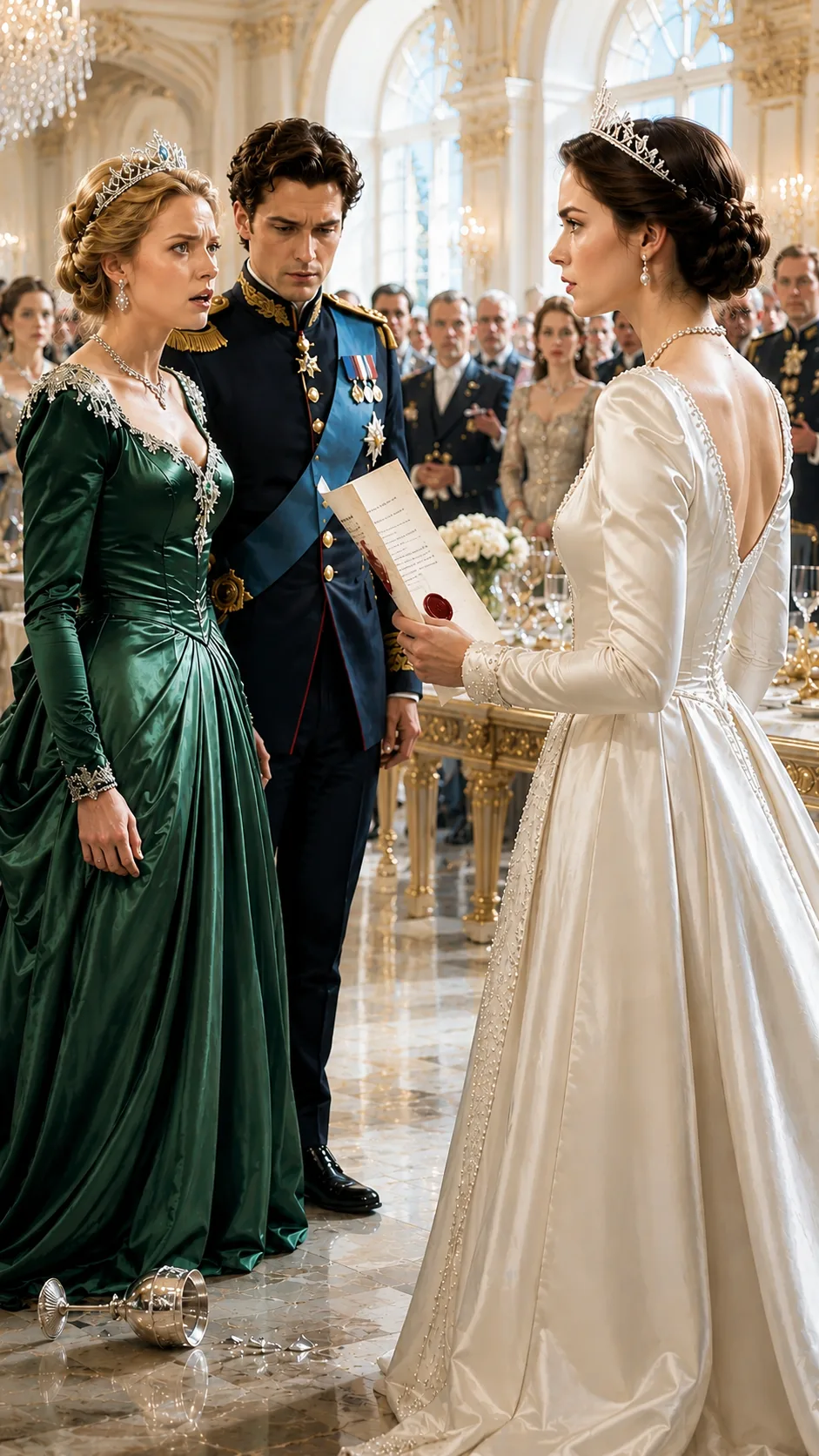
The victory dinner took place in the Palace Dining Hall.
It was not called a victory dinner, of course.
It was called a blessing ceremony.
But everyone knew.
Beatrice entered wearing emerald silk, a diamond tiara, and the smile of someone who had rehearsed forgiveness she did not mean.
Charles walked beside her in a navy royal uniform.
Catherine watched from the far end of the hall.
He looked nervous.
Good.
Beatrice noticed Catherine and came straight toward her.
“Sister,” she said, arms open.
Catherine did not move.
Beatrice let her arms drop, still smiling for the watching nobles.
“I’m glad you came,” she said. “I was afraid you would hide forever.”
“I was busy.”
“With what?”
Catherine looked at her. “Reading.”
Beatrice laughed lightly. “You always did prefer books to people.”
“And you always preferred people who belonged to someone else.”
The nearby conversations died instantly.
Beatrice’s smile hardened.
Charles touched her arm. “Beatrice.”
But she pulled away.
“No,” Beatrice said. “Let her speak. She needs to feel powerful for a moment.”
Catherine said nothing.
That irritated Beatrice more.
“You know,” Beatrice continued, voice lower, “I used to envy you. Everyone said Catherine was born for the throne. Catherine was steady. Catherine was wise. Catherine was the future.”
Her eyes flashed.
“But look at you now. Standing alone while I walk in with the man you were promised.”
Charles looked down.
Catherine saw it.
So did half the room.
Beatrice turned to the nobles and lifted her glass.
“To new beginnings,” she said.
The hall echoed the toast.
Catherine lifted her glass too, but did not drink.
Queen Eleanor stood at the head table.
The blessing ceremony began.
The Archbishop spoke about unity. Charles’s father spoke about alliance. The ministers spoke about continuity.
Then Beatrice stepped forward.
“I know some of you were surprised,” she said, glancing at Catherine. “But love does not always follow old arrangements. Sometimes, the heart chooses where the crown hesitates.”
A few nobles clapped.
Beatrice glowed.
Charles smiled weakly beside her.
Then Beatrice made her mistake.
She reached for Charles’s hand and said, “Together, we will serve both kingdoms with the authority granted to us by this union.”
Lord Ashford looked at Catherine.
Catherine set down her glass.
The sound was small.
But it carried.
She rose.
Every head turned.
Beatrice’s expression shifted. “Catherine, this is not the time.”
Catherine walked forward.
Slowly.
Not angry.
Not shaking.
That was what frightened them.
“This is exactly the time,” Catherine said.
Queen Eleanor stood. “Catherine.”
Catherine did not look at her mother.
She looked at Charles.
“Did you believe no law could reach you because I was quiet?”
Charles went pale.
Beatrice laughed once. “What is this?”
Catherine held out her hand.
Lord Ashford stepped from the side of the hall and placed a sealed parchment into her palm.
The room went silent.
Charles knew before Beatrice did.
Catherine saw it in his face.
His arrogance fell first.
Then his color.
Then his breath.
Beatrice looked between them. “Charles?”
He did not answer.
Catherine broke the seal.
“The Coronation Settlement of Arden,” she said, clear enough for every noble to hear. “Article Seven. The Loyalty Clause.”
Queen Eleanor closed her eyes.
Beatrice’s smile vanished.
Catherine read the clause without raising her voice.
A royal consort or betrothed consort who betrays the direct heir before lawful dissolution, and whose actions endanger the stability of succession, shall forfeit all political privileges, military command, council vote, treaty authority, and consort power attached to the heir’s crown.
No one moved.
Not even the servants.
Catherine lowered the parchment.
“Prince Charles betrayed me before our betrothal was lawfully dissolved. He did so with Princess Beatrice, in full knowledge of the succession alliance. I invoke Article Seven.”
Beatrice whispered, “No.”
Lord Ashford stepped forward. “The invocation is valid.”
Charles turned to him. “Ashford—”
“The council witnesses are present,” Lord Ashford said. “The queen is present. The treaty envoys are present. The record is complete.”
Beatrice grabbed Charles’s arm. “Tell them it doesn’t matter.”
Charles stared at the floor.
Catherine almost pitied him.
Almost.
“Tell them,” Beatrice demanded.
Charles lifted his head, but no words came.
Because now he understood.
Beatrice had won him.
But the man she won had just lost everything that made him a prize.
His command.
His vote.
His treaty power.
His future place beside the throne.
Catherine turned to her sister.
Beatrice’s eyes were wide now. Not sad. Furious.
“You can’t do this to me,” she said.
Catherine’s voice stayed calm.
“I didn’t.”
Beatrice stepped closer. “You were supposed to lose quietly.”
Catherine looked at Charles, then back at her sister.
“That was your first mistake.”
The hall was so silent that Catherine could hear Beatrice breathing.
Charles reached for Beatrice’s hand.
She pulled away.
That was the second moment everyone understood.
Beatrice had not wanted Charles only for love.
She had wanted the kingdom that came with him.
Catherine saw it.
Charles saw it too.
His face changed in a way Catherine had never seen before.
Not heartbreak.
Recognition.
Beatrice looked around the hall, searching for someone to save her. Her mother. The ministers. The archbishop. The envoys.
No one moved.
Power had a scent. Everyone in that hall knew when it had left a body.
It had left Charles.
And with him, it had left Beatrice.
Catherine stepped close enough that only the front rows could hear clearly, but the room was so quiet, everyone heard anyway.
“Congratulations,” she said. “You won what I no longer wanted.”
Beatrice flinched as if struck.
Catherine turned to the council.
“Record the forfeiture.”
Lord Ashford bowed. “It will be entered before midnight.”
Charles whispered, “Catherine…”
She looked at him one final time.
There was a time when that voice could have ruined her.
Not anymore.
“You taught me something,” Catherine said. “A crown is heavy. But betrayal is heavier. I choose the crown.”
Then she walked past him.
This time, people moved out of her way.
Not with pity.
With respect.
Two months later, Charles and Beatrice married in the small chapel instead of the Grand Cathedral.
There were no foreign generals at the door. No treaty banners. No military salute.
Charles wore a simple black tuxedo, not the commander’s uniform.
Beatrice wore diamonds, but the newspapers noticed what she did not wear.
No consort mantle.
No council sash.
No emerald crown of Valemont.
Catherine attended as Crown Princess.
She wore white satin and pearl earrings. Her expression was calm. The cameras loved her for it. The nobles feared her for it.
After the ceremony, Beatrice approached her in the chapel garden.
“You took everything from me,” Beatrice said.
Catherine looked at her younger sister.
For a moment, she saw the little girl Beatrice used to be. The child who cried when Catherine got praised. The girl who broke Catherine’s dolls and claimed they had fallen. The sister who never wanted a thing until Catherine had it first.
“No,” Catherine said. “I left you exactly what you chose.”
Beatrice’s eyes burned.
Charles stood several feet behind her, alone among the rose bushes, speaking to no one.
He looked smaller without power.
Beatrice glanced back at him.
For the first time, Catherine saw doubt on her sister’s face.
That was punishment enough.
Catherine walked away before Beatrice could speak again.
The next spring, Catherine was crowned Queen of Arden.
The crown was heavier than she expected.
When the archbishop placed it on her head, the entire cathedral knelt.
Her mother knelt.
Lord Ashford knelt.
The council knelt.
And in the third row, dressed in pale gray, Beatrice knelt too.
Charles knelt beside her, no longer a prince consort, no longer a commander, no longer a man with a kingdom attached to his name.
Just Charles.
Catherine looked across the cathedral.
For years, she had feared losing him.
Now she understood the truth.
She had not lost Charles.
She had been freed from him.
The trumpets sounded.
The doors opened.
Soft daylight spilled across the marble floor.
Catherine rose as queen.
And the kingdom rose with her.
THE END.
-Princess Beatrice walked into the palace like she had already won.-
Chapter complete
You have reached the end of this chapter.
Continue reading
A few more worlds to get lost in after this chapter.