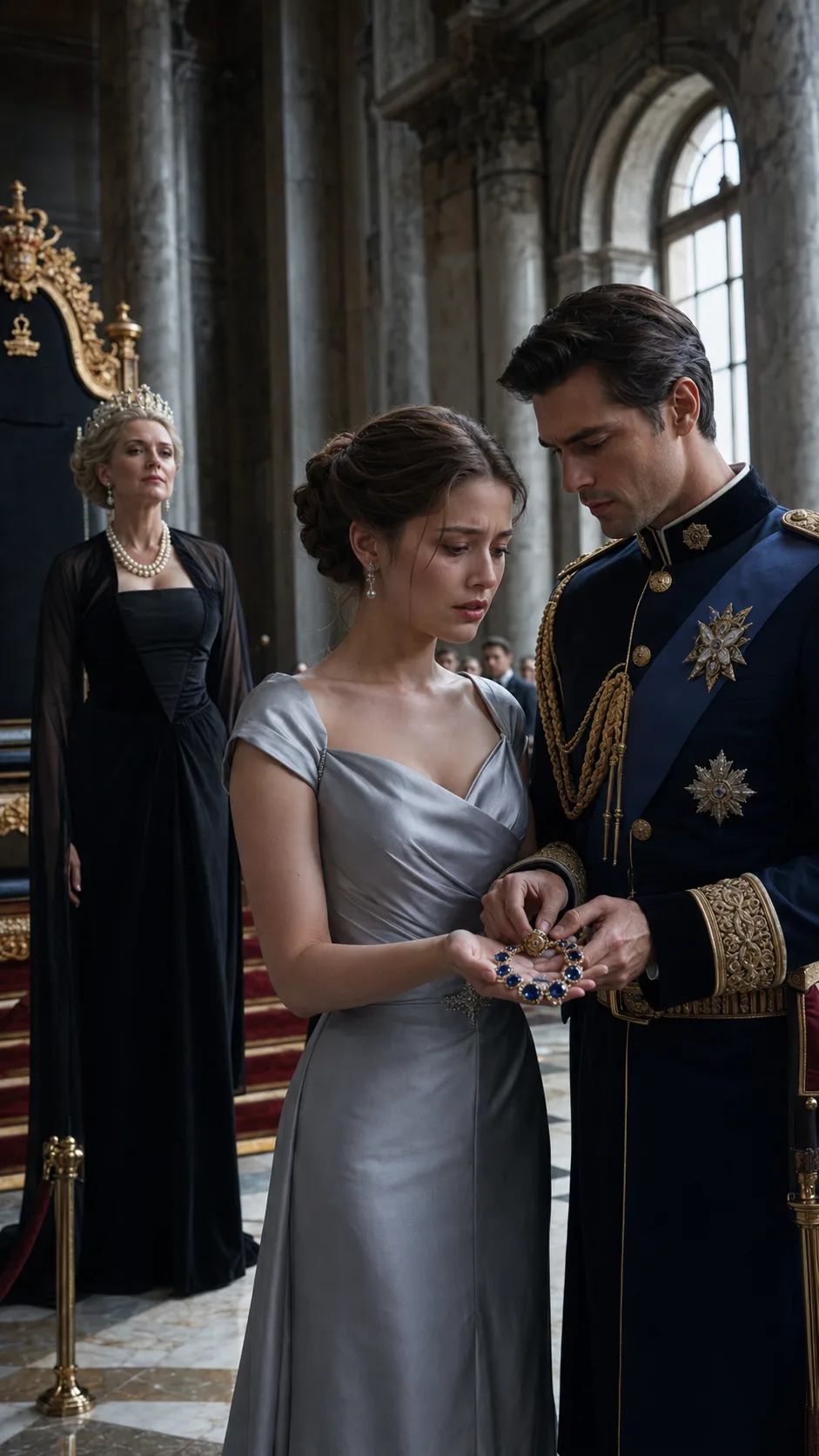
The Princess Who Forgot Her Crown Was Found Serving Coffee to the Prince Who Never Stopped Searching for Her Again
The first thing Prince Adrian noticed was not her face.
Chapter 1
The first thing Prince Adrian noticed was not her face.
It was the way she held a cracked white coffee cup.
Carefully.
Almost ceremonially.
As if porcelain mattered. As if small things could still be honored, even in a noisy café on a rainy Paris afternoon, even when the world outside smelled of wet pavement, taxi smoke, and autumn leaves crushed beneath expensive shoes.
Adrian had entered the café only because his driver had taken the wrong street.
He was supposed to be at the Embassy of Valmere in twenty minutes, seated beneath crystal chandeliers, smiling politely at ministers who spoke in careful lies about trade, borders, and royal stability. He was supposed to be discussing grain routes, energy agreements, and the recent unrest in the kingdom of Bellarine.
Instead, he stood just inside the doorway of a narrow café near Rue Saint-Honoré, rain dripping from the edge of his black coat, staring at a young waitress behind the counter.
She was laughing at something an old man had said.
Not loudly.
Not carelessly.
It was a quiet laugh, almost surprised, as if joy had found her by accident.
Her brown hair was tied back with a ribbon. A few loose strands framed her face. She wore a plain cream blouse, a long dark skirt, and an apron dusted with flour near the pocket. There was a tiny burn mark on her wrist, the kind someone got from touching a hot tray too quickly. Her shoes were simple. Her hands were work-worn. Nothing about her belonged to a palace.
And yet Adrian’s heart stopped so violently he forgot how to breathe.
Because three years ago, Princess Clara of Bellarine had disappeared after her carriage went off the cliff road above Lake Veyra.
Three years ago, the royal family had closed the silver gates and announced that the princess was presumed
dead.
Three years ago, Adrian had stood in a cathedral full of candles and refused to bow his head when the bishop said her name among the lost.
And now she was standing ten steps away from him, pouring coffee into a blue cup.
Alive.
“Your Highness?” his aide whispered behind him. “We should go.”
Adrian did not move.
The waitress turned, carrying the cup toward a corner table. She passed near him, close enough that he saw the small faded scar near her left temple.
The same scar.
His fingers tightened around the handle of his umbrella.
“Clara,” he said.
The cup slipped slightly in her hand, but she caught it before it fell.
She looked at him.
Politely.
Carefully.
Like one stranger looking at another.
“I’m sorry, monsieur,” she said in soft French-accented English. “Do I know you?”
The question broke something inside him.
Not loudly.
Not dramatically.
It broke like ice cracking beneath a quiet lake.
Adrian took one step forward. His aide moved behind him, alarmed, but Adrian lifted a hand without looking back.
The waitress’s eyes narrowed, not with fear, but caution. She was used to men staring. Used to tourists thinking they recognized someone. Used to strangers creating stories around her face.
“My name is Adrian,” he said.
She gave a small, professional smile. “That is a nice name.”
“You don’t remember me?”
Her smile faded.
For the first time, uncertainty crossed her face.
“I remember the names of regular customers,” she said gently. “You are not one.”
“I was not your customer.”
“Then what were you?”
He looked at her as rain tapped against the windows, as the old man in the corner slowly lowered his newspaper, as the café owner paused beside the pastry case.
Adrian’s voice dropped.
“I was the man who was supposed to marry you.”
The café went silent.
The waitress stared at him.
Then she laughed once, softly, but there was no amusement in it.
“Monsieur, that is a terrible joke.”
“It isn’t.”
“My name is Elise.”
“No,” Adrian whispered. “Your name is Clara.”
The cup in her hand trembled.
“Elise,” the café owner called from behind the counter, his voice protective. “Is this man bothering you?”
She did not answer immediately.
Her eyes stayed on Adrian’s face, searching for something she could not name.
“I don’t know him,” she said at last.
The owner stepped forward. He was a broad-shouldered man with gray in his beard and flour on his sleeves. “Then the gentleman should leave.”
Adrian could have commanded the room with a word. He could have identified himself, summoned guards, called the embassy, turned the street outside into a wall of black cars and royal security.
But Clara—Elise—was watching him like a frightened animal deciding whether the open door was a trap.
So he did the only thing he could.
He removed his royal signet ring.
He placed it on the counter between them.
The gold caught the café light.
The crest of Valmere shone against the worn wood: a lion beneath three stars.
The owner’s face changed.
Several customers leaned closer.
Elise stared at the ring, then back at Adrian.
“You are…” Her voice became smaller. “You are really a prince?”
“Yes.”
Her eyes hardened at once.
“Then you should know better than to walk into a café and tell a waitress she is a dead princess.”
The words were sharp, but her hand had gone pale around the cup.
Adrian swallowed.
“I know how impossible it sounds.”
“No. You don’t.” She set the cup down with careful control. “Because impossible is easy for people like you. You can say impossible things, and everyone has to listen.”
“That is not why I came.”
“Then why did you?”
Because I saw you in every crowd for three years.
Because every time someone with brown hair crossed a ballroom, I stopped breathing.
Because they told me you were gone, and I built my life around refusing to believe it.
Because I loved you before the world buried you.
But he said none of that.
Instead, he said, “You have a scar near your left temple.”
Her expression changed.
“And?”
“You got it when you were twelve, riding a gray pony named Maribel through the east orchard. You fell because you refused to let go of the reins.”
Her lips parted.
The owner looked at her.
“Elise?”
She shook her head faintly, as if trying to remove a sound from her mind.
“I don’t know a pony named Maribel.”
“You hated candied violets but ate them when Queen Isolde watched because you did not want to hurt her feelings.”
Her breathing grew uneven.
“You are making guesses.”
“You played the piano badly on purpose whenever ministers visited because you said serious men deserved wrong notes.”
“Stop.”
“You wore a sapphire necklace at the winter ball the night before I left for Valmere.”
“Stop.”
“And when I asked if you were afraid of marrying a man chosen by treaty, you said—”
“Stop!”
The entire café froze.
Elise pressed one hand to her temple.
For one second, Adrian saw it.
Not recognition.
Pain.
A flash of something moving beneath locked doors.
Then she stepped back.
“I don’t remember you,” she whispered. “I don’t remember any of that.”
Adrian’s voice softened.
“I know.”
“How?”
“Because if you remembered, you would never have let them call you dead.”
Her eyes filled suddenly, not with tears exactly, but with panic.
“I was found by the river,” she said, as if reciting a truth she had repeated many times. “I had no papers. No family. No memory. Monsieur Bernard gave me work. A doctor said I might remember one day, or never. That is all I know.”
Adrian looked at the café owner.
Bernard nodded slowly, grimly.
“She arrived almost three years ago,” he said. “Half-starved, feverish, with blood in her hair. She did not know her own name. The police found nothing. No one came for her.”
“I did,” Adrian said.
The words came out rougher than he intended.
Elise looked at him again.
This time, her anger was thinner.
Beneath it, fear showed clearly.
“What do you want from me?”
Adrian wanted to reach for her hand.
He did not.
“I want to take you to a safe doctor. I want to show you evidence. And if you still do not believe me after that, I will walk away.”
Her expression flickered.
“You would walk away?”
“No,” he said honestly. “But I would stop asking you to come with me.”
For a long moment, she said nothing.
Outside, a siren wailed somewhere beyond the rain.
Then the old man in the corner folded his newspaper.
“Girl,” he said in French, “dead princesses do not usually get found twice.”
Bernard glared at him.
But Elise almost smiled.
Almost.
Then she looked down at Adrian’s signet ring.
“What was my full name?” she asked.
“Clara Amelie Rose Laurent of Bellarine.”
The color left her face.
Adrian noticed.
“What is it?”
She touched the small chain around her neck. It held no jewel, only a plain brass key.
“When I dream,” she whispered, “someone calls me Amelie.”
By evening, Paris knew.
Not officially.
Not through newspapers.
But through whispers.
A waitress from a small café had been escorted into a private medical clinic by Prince Adrian of Valmere. Royal security had arrived. Embassy cars had blocked the street. A woman who looked exactly like the dead Princess Clara had been seen behind tinted glass.
By midnight, the palace of Bellarine knew too.
And inside its marble walls, Queen Marcelline stopped smiling.
She had become queen by patience.
Not by blood.
Not by love.
By patience.
She had married King Roland of Bellarine six years after his first wife died. At the time, Clara was nine years old, solemn, observant, and already beloved by the people. Marcelline entered the palace wearing white silk and a grieving expression, promising to be gentle with the motherless princess.
For years, she performed kindness perfectly.
She kissed Clara’s forehead in public. She held her hand at funerals. She smiled while reporters praised her devotion. But privately, Marcelline understood what everyone else refused to say aloud.
As long as Clara lived, Marcelline would never truly rule Bellarine.
King Roland’s health had been fragile. The council trusted Clara. The people adored her. The old royal guard would have followed the girl into fire if she asked softly enough.
Marcelline had no child of her own.
No heir.
No blood claim.
Only influence.
Then came the accident.
A carriage found broken below the cliff road. A driver dead. A torn royal cloak in the lake. A bloodstained glove caught among the rocks.
No body.
That had been the problem.
There had been no body.
But grief made people easy to guide.
Marcelline guided them.
She wept in black silk. She commissioned statues. She ordered mourning bells. She told the nation that the princess had returned to God and that Bellarine must move forward.
King Roland died eleven months later, weak with sorrow.
Marcelline was named Queen Regent until the council settled the succession.
Then the council never settled it.
Three years passed.
And now, at one in the morning, her private secretary stood trembling beside her bedroom door.
“Your Majesty,” he said, “Prince Adrian is requesting permission to enter Bellarine airspace tomorrow morning.”
Marcelline sat before her mirror, removing emerald earrings one by one.
“With whom?”
The secretary hesitated.
“With a young woman.”
The emerald in Marcelline’s fingers clicked softly against the vanity.
“Name?”
“He has not provided one.”
She looked at her reflection.
For a moment, the face in the mirror was not the graceful queen the country knew. It was colder. Older. Bare of performance.
“Then he will not enter.”
“He has already contacted the High Council.”
Marcelline turned.
Her secretary went pale.
“He what?”
“He claims the matter concerns the House of Laurent.”
“Prince Adrian has no authority over my house.”
“No, Your Majesty. But the Treaty of Veyra gives Valmere the right to request verification of a royal betrothal claim if succession legitimacy affects the alliance.”
The room became very still.
Marcelline stood.
Her silk dressing gown whispered across the floor.
“Prepare a statement,” she said. “Say that Bellarine welcomes Prince Adrian but warns against cruel impersonations exploiting national grief.”
“Yes, Your Majesty.”
“And send for Lord Pascal.”
The secretary blinked.
“The former royal archivist?”
“Now.”
“But he left service two years ago.”
Marcelline smiled without warmth.
“Then he has had two years to forget what should never be remembered.”
The next morning, Clara returned to Bellarine in a gray dress borrowed from the embassy.
She hated the dress.
Not because it was ugly. It was beautiful in a quiet way, with pearl buttons at the wrists and a high collar that made her stand straighter than she intended.
She hated it because everyone looked at her differently once she wore it.
In Paris, she had been Elise.
Elise carried trays. Elise remembered which customer liked extra foam. Elise slept in a small room above the café and kept a notebook beside her bed to write down dreams before they vanished.
Elise was nobody important.
Nobody expected anything from Elise.
But in the embassy suite that morning, a woman from protocol had fastened Clara’s hair back with silver pins and stepped away with tears in her eyes.
“Your Highness,” the woman had whispered.
Clara had nearly been sick.
Now she sat in a royal car beside Prince Adrian, watching the countryside of Bellarine roll past the window.
Green hills.
White villages.
Silver rivers.
A strange ache opened in her chest with every mile.
Not memory.
Something deeper.
Recognition without pictures.
The body remembering what the mind refused to return.
Adrian sat across from her, giving her space. He had changed into a dark formal suit. His face was calm, but she noticed his hands.
They were clenched.
“You don’t have to do anything today,” he said.
She laughed softly.
“I am in a royal car being taken to a palace where a queen plans to call me a liar.”
“I won’t let her hurt you.”
“You keep saying things like that.”
“Because I mean them.”
“That is what makes it dangerous.”
He looked at her.
She turned to the window.
The palace appeared at the top of a hill just as sunlight broke through clouds.
Clara stopped breathing.
It was enormous, pale stone and blue roofs, rising above gardens arranged like green embroidery. Fountains flashed in the morning light. Guards stood at the gates. Beyond them, hundreds of people had gathered.
Not cheering.
Watching.
Waiting.
Some held flowers. Some held photographs of Princess Clara printed from old newspapers. Some made the sign of blessing when the car passed.
A little girl on her father’s shoulders pointed.
“Maman,” she cried, “it’s the princess!”
Clara flinched.
Adrian saw.
“The palace released the statement before we landed,” he said quietly. “The press followed.”
“What statement?”
His jaw tightened.
“That a woman falsely claiming to be Princess Clara is being brought for examination.”
Clara stared at him.
“So they already decided what I am.”
“No,” Adrian said. “She decided what she needs you to be.”
At the palace steps, Queen Marcelline waited in a black dress with a pearl collar.
She was stunning.
That was Clara’s first thought.
Not kind. Not warm.
Stunning.
The queen stood perfectly beneath the palace arch, surrounded by council members, guards, and cameras. Her silver-blonde hair was swept into a smooth crownlike twist. Her expression carried sorrow so elegant it looked rehearsed by candlelight.
When Clara stepped out of the car, the crowd beyond the gates gasped.
Marcelline’s eyes moved over her face.
One second.
That was all.
But in that second, Clara saw fear.
Then the queen came forward with open arms.
“My poor child,” Marcelline said, loud enough for cameras. “Whoever has placed you in this cruel position has done you a terrible wrong.”
Clara froze.
The queen embraced her.
To everyone watching, it looked tender.
But Marcelline’s lips brushed Clara’s ear.
“You should have stayed dead,” she whispered.
Clara’s blood turned cold.
Then Marcelline stepped back, eyes shining with public tears.
“Prince Adrian,” she said, turning gracefully. “Bellarine welcomes you, though I must say I am devastated that you would encourage such a painful spectacle.”
Adrian bowed only slightly.
“Truth is not spectacle, Your Majesty.”
“No,” Marcelline said. “But grief can be manipulated by ambitious men.”
The cameras clicked.
Clara felt the palace doors behind the queen like the mouth of something enormous.
A minister stepped forward. “The High Council has assembled in the Hall of Witness. Identity proceedings will begin immediately.”
Marcelline’s smile did not move.
“Of course.”
Inside, the palace smelled of wax, roses, and old stone.
Clara walked through corridors lined with portraits.
Faces watched her from gold frames.
Kings. Queens. Children in lace. Soldiers with medals. Women wearing jewels shaped like stars.
Then she saw one portrait and stopped.
A girl of sixteen stood beside a white horse, one gloved hand resting on its neck. She wore a riding coat of deep green. Her brown hair was loose in the painted wind. At her throat was a sapphire necklace shaped like a blooming flower.
Clara’s fingers rose to her own bare neck.
The world tilted.
A sound came back.
Hooves striking wet earth.
A girl laughing.
Someone shouting, “Clara, slow down!”
Then pain exploded behind her eyes.
She stumbled.
Adrian caught her before she fell.
The hallway erupted in murmurs.
Marcelline turned.
“How theatrical,” she said.
Adrian’s eyes flashed. “She needs air.”
“She needs a doctor, not an audience.”
“I agree.”
“Then perhaps we should allow the palace physician to examine her privately.”
“No,” Clara said.
Her voice surprised even herself.
Everyone looked at her.
She stood straighter.
“No private rooms.”
Marcelline’s eyes narrowed almost imperceptibly.
Clara did not know where the courage came from. Maybe from Elise, who had learned to survive without answers. Maybe from Clara, buried somewhere beneath broken memory. Maybe from the way Marcelline’s whisper still burned in her ear.
“If I am a fraud,” Clara said, “let everyone see it. If I am not, let everyone see that too.”
For the first time, Adrian smiled.
Not happily.
Proudly.
The Hall of Witness had been built for coronations, trials, and royal oaths.
Its ceiling rose three stories high, painted with angels carrying banners of Bellarine’s ancient houses. Sunlight poured through tall windows and struck the polished floor in long white rectangles. At the far end stood the throne—not occupied, but present, carved from pale oak and set beneath the royal crest.
The council sat in a half circle.
The press stood behind a velvet rope.
Queen Marcelline took her place near the throne, not on it. She was careful about symbols. Always careful.
Clara stood in the center of the hall beside Adrian.
A physician examined her scar. A historian compared her face to childhood portraits. A handwriting expert asked her to sign the name Clara Laurent, then frowned when her hand moved naturally through the letters before she understood what she had written.
Each small test unsettled the room.
Each answer weakened Marcelline’s smile.
But none proved enough.
Amnesia could be faked.
Scars could be copied.
A face could resemble another face.
Then Lord Pascal arrived.
He was thin, stooped, and nearly seventy, with white hair and trembling hands. He carried a black leather case.
Marcelline watched him enter.
Something passed between them.
Not fear.
A warning.
Lord Pascal bowed to the council.
“I was summoned to authenticate archival records,” he said.
His voice shook.
“Do you know this woman?” asked the senior councilor.
Pascal looked at Clara.
His eyes filled at once.
For a second, his mouth worked without sound.
Then he lowered his gaze.
“I cannot say.”
Adrian’s face hardened.
Marcelline’s shoulders relaxed.
Clara understood immediately.
He knew.
And he was afraid.
The senior councilor sighed. “Then we have no conclusive—”
“There is one more test,” Adrian said.
The hall turned toward him.
Marcelline’s head snapped slightly.
“No,” she said.
The word came too quickly.
Adrian looked at her. “I haven’t named it.”
“You are a guest in Bellarine. You do not command our proceedings.”
“I command nothing. I request the use of the Royal Seal Necklace.”
The hall changed.
Whispers moved like wind through silk.
Clara touched her throat again.
Necklace.
Sapphire flower.
The portrait.
The flash of memory.
Marcelline’s expression became cold.
“The Royal Seal Necklace is ceremonial,” she said. “It has not been used in decades.”
“Because it only responds to direct blood of the Laurent line,” Adrian replied.
A councilor leaned forward. “That is an old tradition, not legal evidence.”
“It is both,” Adrian said. “The seal mechanism was designed by Bellarine’s royal jeweler in the nineteenth century. It opens the succession vault using fingerprint pressure and bloodline-coded crestwork.”
One reporter whispered, “Bloodline-coded?”
Adrian continued, “Princess Clara wore it publicly until the night before her disappearance. After the accident, it was stored in the royal vault.”
Marcelline laughed softly.
A beautiful laugh.
A poisonous one.
“Prince Adrian, surely you are not suggesting that a necklace can identify a princess.”
“No,” he said. “I am suggesting that the vault records can.”
Marcelline looked at the council.
“This is absurd.”
Clara watched her.
The queen’s control was thinning.
Not breaking.
Thinning.
Like ice under pressure.
The senior councilor conferred with two others, then nodded toward a guard.
“Bring the necklace.”
Marcelline turned sharply. “I object.”
“Your objection is noted.”
“I am Regent Queen.”
“And this is a succession inquiry.”
The words struck the hall harder than a shout.
Marcelline went still.
For the first time since Clara had entered the palace, the queen looked almost human.
Almost afraid.
They waited twenty minutes.
No one spoke much.
Adrian stood beside Clara, close but not touching. She was grateful. If he touched her, she thought she might lean into him, and if she leaned into him, she might fall apart.
The black leather case arrived in the hands of two guards.
Behind them came an elderly woman in a dark blue uniform.
The royal jeweler.
She bowed, then placed the case on a table in the center of the hall.
The locks opened with three separate keys.
Inside, on faded ivory velvet, lay the necklace.
A sapphire pendant shaped like a flower.
Around it, delicate silver vines held tiny diamonds. At the back of the pendant was a golden crest no larger than a coin: the royal seal of Bellarine.
Clara stared at it.
The room disappeared.
For one instant, she was not in the Hall of Witness.
She was younger, standing before a mirror while a woman with gentle hands fastened the necklace around her throat.
“Never wear it as decoration,” the woman said.
“Then why must I wear it?”
“Because one day, my darling, people may forget what blood means. This will not.”
Clara inhaled sharply.
Tears spilled before she could stop them.
Adrian turned.
“What did you see?”
“My mother,” Clara whispered.
Marcelline’s face hardened.
The jeweler lifted the necklace with gloved hands.
“The seal is dormant,” she explained to the council. “When held by a direct Laurent descendant with matching imprint pressure, the crest releases. If the person is not recognized, nothing happens.”
“And if it recognizes her?” Adrian asked.
The jeweler looked at Clara with trembling hope.
“The royal seal will open.”
Marcelline stepped forward.
“This proves nothing. Any mechanism can be altered. Any girl can pretend to be a princess.”
The words rang across the hall.
Cold.
Clear.
Cruel.
Every camera turned.
Clara looked at the queen.
For a moment, all fear left her.
She saw Marcelline’s beauty. Her jewels. Her power. Her careful grief. Her borrowed throne.
And beneath it, she saw the woman who had whispered, You should have stayed dead.
Adrian took the necklace from the jeweler.
He turned to Clara.
His voice was quiet, but the hall heard every word.
“Give me your hand.”
Clara lifted it.
Her fingers trembled.
Marcelline’s smile returned, thin and sharp.
Adrian placed the necklace across Clara’s palm.
Then he turned toward the queen.
“Then why does the royal seal open only for her?”
He pressed Clara’s thumb gently against the crest.
At first, nothing happened.
The hall held its breath.
Marcelline’s eyes brightened with victory.
Then the sapphire began to glow.
Not like fire.
Like dawn trapped inside blue glass.
A soft click sounded.
The golden crest opened.
Inside the pendant, a tiny royal emblem unfolded—three silver lilies around a crown.
The old jeweler began to cry.
Lord Pascal covered his mouth.
The senior councilor stood so quickly his chair scraped against the floor.
The crowd outside the hall heard the shouting before they knew why.
“Princess Clara,” someone whispered.
Then another voice.
“Princess Clara.”
Then the whole hall seemed to breathe her name.
Marcelline did not move.
Her face had gone white.
Clara stared at the open seal in her palm.
Something inside her cracked.
Not memory returning all at once.
Not a miracle.
A door.
A door opening in a dark room.
Images flooded through.
A lake road at night.
Rain.
A carriage wheel jerking.
The driver shouting.
A hand grabbing her wrist—not saving her, pulling her.
Marcelline’s voice.
“Make sure she never reaches the border.”
Clara gasped.
Adrian caught her as she swayed.
“What is it?”
She looked at the queen.
The hall blurred around her.
“You were there,” Clara whispered.
Marcelline’s expression emptied.
“No.”
“You were there the night of the accident.”
The whispers stopped.
Marcelline smiled again, but now it looked painted onto stone.
“My dear, trauma creates fantasies.”
“You were in the second carriage.”
“That is enough.”
“You told someone not to let me reach the border.”
Adrian turned slowly toward Marcelline.
“What border?”
Clara’s breathing quickened.
More images came.
A sealed letter.
A treaty carriage.
Her father’s hand shaking as he gave her a sapphire necklace.
Adrian younger, standing beneath winter lanterns.
A private chapel.
A promise.
Not just a betrothal.
A secret marriage contract.
She looked at Adrian, stunned.
“We were already married.”
The hall erupted.
Adrian froze.
Marcelline shouted, “Lies!”
Clara pressed one hand to her temple.
“My father signed it. Yours signed it. The public ceremony was supposed to happen after the spring council, but the legal bond was already sealed because my father feared…” She looked at Marcelline. “He feared you.”
Adrian’s face had lost all color.
His aide rushed forward, whispering urgently, but Adrian ignored him.
“Clara,” he said, voice barely steady, “are you certain?”
“No.” Tears ran down her face. “I remember pieces. A chapel. White candles. You were wearing a dark blue uniform. I laughed because you looked terrified.”
Adrian’s eyes filled.
“I was terrified.”
The hall went silent again.
He reached inside his coat and withdrew a folded paper, worn at the edges from years of being carried.
“I thought I was honoring the dead,” he said.
He opened it.
A copy of a private royal marriage accord, signed by King Roland of Bellarine and King Matthias of Valmere.
And at the bottom, two young signatures.
Adrian Valen.
Clara Laurent.
The senior councilor took the document with shaking hands.
Marcelline stepped back.
“No,” she said.
Adrian did not look away from Clara.
“I remembered,” he said. “But after your disappearance, the council buried the contract to avoid a succession war. They said if you were dead, the bond was meaningless.”
Clara wiped her cheek.
“You never told me.”
“You didn’t know who I was yesterday.”
Despite everything, a broken laugh escaped her.
Then Lord Pascal made a sound.
It was small.
Ashamed.
Everyone turned.
The old archivist lowered himself to one knee.
“Forgive me,” he said.
Marcelline’s eyes flashed. “Pascal.”
He flinched but continued.
“Forgive me, Your Highness. I was ordered to destroy the original accord after the accident. I did not. King Roland had entrusted it to me before he died. He said if the princess ever returned, I was to open the succession vault.”
Clara stared at him.
“Why didn’t you?”
Pascal’s voice broke.
“Because the queen knew. She threatened my grandchildren.”
Marcelline’s control shattered.
“You pathetic old fool.”
The words echoed.
No performance now.
No sorrow.
Only rage.
Cameras captured everything.
The senior councilor stepped forward. “Queen Marcelline, you will remain where you are.”
Marcelline laughed.
It was not beautiful anymore.
“You think a glowing trinket makes her fit to rule? She served coffee yesterday.”
Clara looked down at her apronless dress, then back at the queen.
“Yes,” she said softly. “I did.”
The room quieted.
“I served coffee. I cleaned tables. I counted coins. I burned my wrist on hot trays and apologized to customers who never looked at my face. I slept above a café and woke from dreams of a palace that felt like a lie. And somehow, that life taught me more about this country than your throne ever taught you.”
Marcelline’s mouth tightened.
Clara stepped forward.
“I don’t remember everything. I may not remember everything for a long time. But I remember enough.”
She lifted the open necklace.
“I remember my mother telling me this seal was not decoration. I remember my father fearing betrayal. I remember Prince Adrian in a chapel full of candles. And I remember your voice on the road the night I disappeared.”
Marcelline’s eyes flicked toward the side door.
Adrian saw it.
So did the guards.
“Seal the hall,” he ordered.
Bellarine guards hesitated.
The senior councilor raised his hand.
“Seal it.”
The doors closed.
Marcelline stood alone beneath the painted angels.
For years, she had ruled rooms by making everyone else uncertain. Now certainty surrounded her like a cage.
The jeweler, still crying, reached into the black case.
“There is more,” she said.
Marcelline spun toward her.
“No.”
The jeweler removed the velvet lining from the case, revealing a hidden compartment.
Inside was a small silver key and a folded note.
“My predecessor told me this was to be revealed only if the seal opened after Princess Clara’s presumed death,” she said. “It bears King Roland’s private mark.”
The senior councilor opened the note.
His face changed as he read.
Then he looked at Marcelline.
“The late king ordered an investigation into suspected interference with Princess Clara’s carriage route. He names Queen Marcelline as a person of concern.”
Marcelline’s voice dropped to a hiss.
“He was ill.”
“He also ordered that if Princess Clara returned alive, the regency would terminate immediately.”
The hall exploded.
Outside, through the tall windows, the crowd began to roar without knowing the words yet.
Marcelline stared at Clara with pure hatred.
“You don’t even know how to be royal.”
Clara looked at her for a long moment.
Then she smiled sadly.
“No,” she said. “But I know how to be honest.”
That was when Lord Pascal finally opened his black leather case.
He removed a second document.
“The original marriage accord,” he said. “And the succession declaration.”
Adrian stepped beside Clara.
Pascal handed both documents to the council.
The senior councilor read aloud, voice shaking but clear.
“Upon the confirmed return of Princess Clara Amelie Rose Laurent, rightful heir of Bellarine, all regency powers shall cease. Her lawful alliance with Prince Adrian Valen of Valmere shall stand recognized, unless rejected freely by the princess herself.”
Clara blinked.
“Rejected?”
Adrian turned to her immediately.
“You owe me nothing.”
The hall watched.
The country watched.
The queen watched with a fury that could no longer harm her.
Clara looked at Adrian and saw not a stranger now, not fully. She saw fragments: his hand offering hers a cup of winter wine, his nervous smile in a chapel, his voice telling her he would wait until she chose him freely, even if treaties had already chosen.
But she also saw yesterday.
A café.
A cracked white cup.
A prince who had placed his ring on a counter and promised to stop asking if she said no.
Her voice softened.
“I don’t know how to be your wife.”
Adrian’s eyes glistened.
“Then don’t be. Not today. Be alive. That is enough.”
Something in the hall changed.
Even the council seemed to understand that the most powerful thing said that day was not about crowns.
It was about choice.
Clara turned to the senior councilor.
“I accept my name,” she said. “I accept the truth of my birth. I accept investigation into the crime committed against me. But I will not be rushed into a throne, a marriage, or a life I cannot yet remember.”
The councilor bowed.
“As you command, Your Highness.”
The words struck Clara like a bell.
Your Highness.
This time, she did not flinch.
Marcelline did.
Guards approached the queen.
She stepped backward.
“No one will believe this,” she snapped. “They loved my grief. They trusted my hand. She is a broken girl with café manners and half a memory.”
The old jeweler lifted her chin.
“Then it is fortunate, Your Majesty, that the cameras were recording.”
For the first time, Marcelline looked toward the press.
Every lens faced her.
Every word had been captured.
Her whisper at the palace steps had not.
But her rage had.
Her insult had.
Her panic had.
Her objection to the necklace had.
And soon, with Pascal’s documents and the king’s note, the rest would follow.
The guards took her arms.
She did not scream.
That would have been too honest.
Instead, Queen Marcelline lifted her chin and walked from the Hall of Witness as if arrest were another form of procession.
But at the doorway, she turned once.
Her eyes found Clara.
“You will never survive this palace,” she said.
Clara looked at the necklace in her palm.
Then at Adrian.
Then beyond the windows, where the people of Bellarine were shouting a name she was still learning how to carry.
“Yes,” Clara said. “I will.”
By sunset, the palace gates opened.
No coronation happened that day.
No wedding.
No grand speech about destiny.
Clara refused all of it.
Instead, she walked down the palace steps in the gray embassy dress with the sapphire necklace resting at her throat. Adrian walked beside her, not touching her, not guiding her, only staying close enough that if she reached for him, he would be there.
The crowd fell silent when she appeared.
Thousands of faces watched her.
Some wept.
Some knelt.
Some simply stared, as if afraid she might vanish again if they blinked.
Clara looked at them and felt terror rise in her chest.
Elise would have gone back inside.
Elise knew coffee orders, rent, rain, and the price of bread.
Princess Clara belonged to these people’s prayers, grief, flags, and history.
She did not know how to be that woman yet.
Then she saw a little girl near the front holding a wilted flower.
The same girl from the gate.
Clara walked down the steps.
The guards moved quickly, but she lifted a hand to stop them.
The crowd parted just enough.
The little girl held out the flower.
“I knew you weren’t dead,” she whispered.
Clara knelt.
Her eyes filled again.
“What is your name?”
“Amelie.”
Clara laughed through her tears.
“So is mine.”
The crowd heard.
A wave of emotion moved through them—not wild, not violent, but deep. People pressed hands to their mouths. Men bowed their heads. Women cried openly.
Clara took the wilted flower.
Then she stood and faced the country that had buried her.
“My name is Clara Amelie Rose Laurent,” she said.
Her voice shook.
But it carried.
“I do not remember everything. I cannot promise you I am the same princess you lost.”
A murmur moved through the crowd.
She continued.
“But I know what it means to be lost. I know what it means to wake up with no name, no family, and no proof that you belong anywhere. So if I return to this palace, it will not be to sit above you. It will be to remember, with you, what this kingdom is supposed to be.”
Adrian watched her, his face full of something he did not try to hide.
Hope.
Not possession.
Not triumph.
Hope.
Clara turned slightly toward him.
“And Prince Adrian,” she said, loud enough for all to hear, “found me when I did not even know I was missing. For that, Bellarine owes him gratitude.”
Adrian bowed his head.
“But my life will not be decided by treaties written while I was afraid, unconscious, or gone.”
The crowd stilled.
Adrian looked up.
Clara met his eyes.
“If I stand beside him one day, it will be because I choose to.”
Adrian smiled.
Small.
Devastated.
Proud.
“Good,” he said softly.
The microphones caught it.
By morning, the clip was everywhere.
Not the queen’s arrest, though that spread too.
Not the glowing necklace, though people replayed it endlessly.
The moment the world remembered was smaller.
A lost princess standing on palace steps with a wilted flower in her hand, telling two kingdoms that even a crown did not have the right to choose her heart.
Three weeks later, Clara returned to Paris.
The council hated the idea.
The palace staff panicked.
The newspapers called it strange, humble, dangerous, brilliant, disrespectful, and healing, depending on who paid them.
But Clara went anyway.
She entered Café Bernard just after opening.
The bell above the door rang.
Bernard came out from the kitchen, took one look at the sapphire necklace under her coat, and burst into tears.
Clara hugged him.
Not like a princess thanking a loyal subject.
Like a lost girl holding the man who had given her soup, work, and a name when the world had given her nothing.
“You look too thin,” Bernard said gruffly.
“I was a princess for three weeks. It was exhausting.”
He wiped his eyes. “Do princesses still wash cups?”
“This one does.”
Adrian arrived ten minutes later.
No guards inside.
No cameras.
Just a prince in a dark coat, standing awkwardly near the same counter where he had once placed his signet ring.
Clara looked at him.
“Coffee?”
“Please.”
“How do you take it?”
He paused.
“You used to know.”
She smiled faintly.
“I don’t today.”
“Black,” he said. “No sugar.”
She poured it carefully into a cracked white cup.
The same cup.
Then she set it before him.
Their fingers almost touched.
This time, she did not pull away.
“I remembered something last night,” she said.
Adrian went still.
“What?”
“A piano.”
His face softened.
“Oh no.”
“I was playing badly.”
“Very badly.”
“And you were laughing.”
“I was trying not to.”
“You failed.”
“I usually did with you.”
She looked down, smiling.
Then the smile faded into something quieter.
“I am afraid,” she said.
Adrian did not answer too quickly.
“Of what?”
“That the more I remember, the less I will be Elise.”
He nodded.
“That might happen.”
Her eyes lifted.
He continued, “But maybe Elise is not someone you lose. Maybe she is the part of Clara who survived when everything else was taken.”
Clara looked around the café.
At the old tables.
At Bernard pretending not to watch.
At the rain beginning again outside.
At the prince who had found her and still refused to claim her.
Then she removed the brass key from around her neck.
The key to her room above the café.
She placed it beside Adrian’s coffee.
“I want to keep this,” she said. “Even when I go back.”
“Then keep it.”
“I want the café protected. Bernard too.”
“Done.”
“And I want you to stop looking at me like I might disappear.”
His jaw tightened.
“I’m trying.”
“I know.”
She reached across the counter and placed her hand over his.
It was not a royal gesture.
Not a treaty.
Not a promise before witnesses.
Just warmth.
Human and trembling.
“I disappeared once,” Clara said. “But I came back.”
Adrian turned his hand beneath hers, slowly, giving her time to refuse.
She didn’t.
Outside, Paris moved on in rain and traffic.
Inside the café, a princess who had forgotten her crown and a prince who had never forgotten her sat across from each other with one cracked cup between them.
And for the first time in three years, neither of them felt haunted by the empty space where Clara had been.
Because she was not fully healed.
Not fully restored.
Not fully royal.
But she was alive.
She had a name.
She had a choice.
And when the palace bells of Bellarine rang the next Sunday to mark the formal end of Marcelline’s regency, Clara did not stand on a balcony in diamonds.
She stood in the café doorway, wearing her sapphire necklace under a simple coat, holding the brass key in one hand and Adrian’s hand in the other.
The bells reached Paris only through a phone screen.
Tiny.
Delayed.
Imperfect.
But Clara heard them anyway.
This time, they did not sound like mourning.
They sounded like a door opening.
THE END.
Chapter complete
You have reached the end of this chapter.
Continue reading
A few more worlds to get lost in after this chapter.