Elara was counting the cracks in the chapel floor when she first noticed the king had stopped calling her daughter.
Chapter 1
Elara was counting the cracks in the chapel floor when she first noticed the king had stopped calling her daughter.
The chapel was empty except for the two of them and the smell of old incense trapped in stone. Rain tapped against the stained glass above the altar, turning the painted saints into broken strips of red and blue. A silver candle snuffer lay on the step near her boot. Someone had dropped wax across the floor and left it there, a pale crooked line between Elara and her father.
King Alaric stood beneath the statue of Saint Orwyn with his hands folded behind his back.
Not a father’s hands.
A ruler’s hands.
“You should not have opened the northern correspondence,” he said.
Elara held the folded treaty against her ribs. The paper had been sealed with black wax when she found it. Dravenmoor wax. The kind Valtherion called cursed in public and useful in private.
“It had your seal,” she said.
“It was in my chamber.”
“It named Dorian
heir.”
The king did not answer.
That was enough.
Elara looked at him for a long moment, then at the treaty again. Her brother’s name sat near the bottom, written in a careful diplomatic hand. Prince Dorian of Valtherion shall assume succession upon the removal of Princess Elara from the royal line.
Removal.
A clean word.
A court word.
It could mean marriage. Exile. Disinheritance. Death, if the right men stood close enough while it was spoken.
Elara folded the treaty once, then twice.
“You promised them the northern mines,” she said.
The king’s jaw tightened.
She knew those mines. She had ridden there every winter since she was fifteen, not for ceremony, but because her mother used to say a ruler should know where the kingdom bled silver from the earth. Miners knew her by name. Their children had given her rough little stone charms carved with wolves and
birds.
The treaty gave the mines to Dravenmoor for twenty years.
In exchange, Dravenmoor would keep its army north of the river.
And Dorian would inherit.
Elara looked up.
“Was I too expensive to keep?”
The king’s face did not change, but his left hand flexed behind his back.
There it was.
The first answer.
“You were too beloved,” he said.
No thunder followed. No holy statue cracked. The chapel stayed exactly as it was, narrow and cold, as if daughters were traded in it every evening.
Elara placed the treaty on the altar.
“I will present this before the council at dawn.”
“You will do no such thing.”
“I am Crown Princess of Valtherion.”
“For now.”
Two words.
Stone.
The side door opened behind her.
Elara turned.
Dorian stood there in a dark cloak, rainwater beading on the shoulders. He looked less like a prince than he did at
court. No silver breastplate. No ceremonial gloves. Just a man who had come where he was not supposed to be and arrived without surprise.
Three guards stood behind him.
None wore the palace crest.
Elara’s fingers moved toward the small dagger at her belt.
Dorian noticed.
“Please don’t,” he said.
It sounded almost tired.
That was what stayed with her later. Not his betrayal. Not the guards. Not the treaty.
His boredom.
As if her life had become a task he wished would finish quickly.
The king stepped down from the altar. His boots touched the wax line on the floor and crushed it flat.
“I gave you every chance to be obedient,” he said.
Elara looked at him, then at Dorian.
Her brother would not meet her eyes.
“You told Mother I went riding tomorrow,” she said.
Dorian rubbed the cuticle of his thumb with one finger.
“Near the cliffs,” he said.
The guards moved.
Elara reached for the dagger, but one guard caught her wrist. Another seized the back of her cloak. Her shoulder struck the chapel pew hard enough to send pain through her arm.
She did not cry out.
Not for them.
The treaty slid off the altar and fell open on the floor.
Dorian looked down at it.
Then he placed one polished boot on the page.
“Burn it,” the king said.
Elara fought once. Hard. Enough to make one guard grunt and stumble against the pew.
Then steel touched her throat.
She stopped.
One breath.
Dorian came closer. His hair was damp from the rain, curled at the edges the way it had when they were children running through the orchard after lessons. Elara remembered him at nine years old, hiding behind her skirts when the old fencing master shouted too loudly. She remembered stealing honey cakes for him from the kitchen. She remembered promising him that when she became queen, no one would laugh at him for being second-born.
He had been listening.
All those years.
He had heard second-born as insult.
“I never asked to be your shadow,” he said.
Elara looked at him.
“You could have stepped out of it.”
His mouth tightened.
The guard dragged her toward the side passage.
The king walked ahead.
Dorian followed.
They took her beneath the chapel, down stairs that had not been used in years. Dust lay thick along the walls. Old names had been carved into the stone by soldiers during some forgotten siege. The air changed as they descended, warm incense giving way to damp rock and rot.
Elara counted turns.
Left.
Down.
Right.
Twenty-three steps.
Another left.
A narrow tunnel opened into the old burial chamber of Valtherion’s first kings.
She had been there once as a child. Her mother had brought her with a candle and told her not to be afraid of bones.
“Fear the living,” Queen Maerwyn had said.
Elara had laughed then.
Not now.
At the center of the chamber stood an ancient stone tomb. Its lid had already been moved aside.
Prepared.
The word entered her mind and stayed there.
The king faced her.
For the first time that night, his expression almost bent.
Almost.
“You should have married where I told you,” he said. “Smiled when I told you. Waited until I died and inherited what was left.”
“What was left?” Elara asked.
“The kingdom.”
“No,” she said. “Your debt.”
His hand moved before she saw it.
The slap cracked across the chamber.
Dorian flinched.
Elara tasted blood.
The king removed the royal signet ring from his finger. Heavy gold. Valtherion’s lion cut into black stone. The ring every ruler wore when signing decrees, treaties, death warrants, and marriage contracts.
He held it up between them.
“This will be found with you if the tomb is ever opened,” he said. “One day, when no one living remembers the shape of your face, they will say grief drove me mad enough to bury my ring with my daughter.”
Elara looked at the ring.
Then at him.
“You think grief can be performed with jewelry?”
He put the ring inside the tomb.
Dorian looked away.
The guards lifted her.
She kicked one in the knee. His grip slipped. She twisted. Her shoulder struck the tomb edge. Stone tore skin beneath her sleeve.
A second guard hit her across the mouth.
Dorian said, “Enough.”
Too late.
They forced her into the tomb.
The inside smelled of dust and dead kings.
Elara pushed herself up on one elbow. The chamber torch burned above her father’s shoulder. It made his crown look black at the edges.
“Father,” she said.
He paused.
Not from love.
From habit.
Elara reached toward him, not begging, not yet. Her fingers closed around the signet ring hidden near her hip. Cold metal pressed into her palm.
He did not see.
Dorian did.
His eyes dropped to her hand.
For one small second, brother and sister looked at each other across the mouth of the tomb.
He said nothing.
The lid scraped back into place.
Darkness took the chamber in pieces.
First the king’s robe.
Then Dorian’s face.
Then the torchlight.
Stone met stone above her.
The sound ended with a dull final thud.
Elara did not scream at first.
She listened.
Bootsteps.
A murmur of voices.
The scrape of something heavy moved against the outer seam.
More stone.
More weight.
Then silence.
Her fist closed around the ring until the lion cut into her skin.
The first hour, she called for Dorian.
The second, she called for her mother.
After that, she saved her breath.
The tomb had not been built for the living. There was only a finger-width crack near the upper seam where old mortar had fallen away. Enough air came through to keep her alive. Not enough to make life kind.
She tore a strip from her sleeve and wrapped her bleeding palm. She pressed her ear to the stone and listened for water. Nothing. She searched the tomb by touch and found old carvings beneath her fingers. Names. Prayers. A rusted pin left from some burial cloth.
The dead had small uses.
By the second day, her throat had become stone.
By the third, she stopped counting hours and counted breaths instead.
A sound came on what might have been the fourth night.
Tap.
Tap.
Tap.
Not above.
Beside.
Elara opened her eyes in the dark.
Another tap.
Then a scrape.
She pushed herself toward the side of the tomb, her knees weak, one hand braced against the old bones beneath the burial cloth.
“Who is there?” she tried to say.
Only air came out.
The scraping continued.
A sliver of gray appeared near the lower corner.
Then a hand.
Small. Dirt-covered. Human.
A stone shifted. Then another.
A girl’s voice said, “Princess?”
Elara pressed her forehead to the crack.
“Here.”
The word was almost nothing.
The girl outside began to cry, but quietly, like servants did.
“Mara?” Elara said.
“Yes.”
Mara had been a kitchen maid once, twelve years old when Elara found her being beaten for dropping a roast during a banquet. Elara had dismissed the steward and moved the girl to the linen rooms. Mara was sixteen now. Thin, clever, always listening.
The palace had forgotten kindness quickly.
Mara had not.
It took until dawn to open enough space.
Mara had brought two others. An old mason who owed Elara’s mother a favor. A chapel boy with shaking hands. They did not lift the tomb lid. That would have made too much noise. They broke the side seam stone by stone, wrapped the tools in cloth, and stopped every time footsteps passed above.
When Elara crawled out, she could not stand.
Mara caught her.
The signet ring was still in Elara’s fist.
Her first drink of water hurt worse than thirst.
The mason wanted to take her to the eastern farms. Mara wanted to hide her in the laundry wagons. The chapel boy kept looking toward the stairs as if the king would appear from the dark and take back the breath he had missed.
Elara sat against the wall with the cup in both hands.
“No,” she said.
Her voice scraped.
They stared at her.
She looked at the ring.
“North.”
Mara shook her head. “The cliffs?”
“Beyond them.”
“Dravenmoor will kill you.”
Elara closed her hand around the lion.
“They might listen first.”
The journey north was not a flight. Flight had speed. Flight had fear in the open.
This was survival by inches.
Mara cut Elara’s hair with sewing shears and stained the ends with ash. The mason wrapped her in a pilgrim’s cloak. The chapel boy stole a mule from the royal stables and cried when Elara thanked him.
They left through the old drainage gate before sunrise.
Behind them, Valtherion began to mourn.
Bells rang by noon.
Seven days, the king ordered.
Seven days for the lost princess.
Elara heard the bells from a shepherd’s hut two valleys away. She lay beneath a wool blanket, fever moving through her bones, while Mara changed the bandage on her shoulder. The sound floated over the hills, soft and golden.
Mara paused.
Elara opened her eyes.
“Let them ring,” she said.
The fever took her again.
Dravenmoor did not look like the stories.
There were no skull gates. No rivers of blood. No wolf-headed men waiting in the snow.
There were black pines. Stone watchtowers. Wind sharp enough to cut breath in half. Villages built close to the ground, with smoke rising from turf roofs and children staring at strangers through frost-fogged windows.
King Rovan of Dravenmoor received her in a hall smaller than Valtherion’s winter dining room.
He was not young. His beard had gone iron-gray. A scar pulled at one side of his mouth. His crown, the black iron wolf crown, sat on the table beside a bowl of stew.
A practical man.
A dangerous one.
He looked at Elara, then at Mara, then at the ring Elara placed between them.
“Your father sent me a treaty,” he said.
“I know.”
“He promised me mines.”
“He lied to both of us.”
Rovan picked up the ring.
His thumb moved over the Valtherion lion.
“You came here with one maid, a stolen mule, and a ring taken from your own grave.”
Elara sat straight despite the pain in her shoulder.
“I came with proof.”
Rovan smiled without warmth.
“You came with a war.”
“Perhaps.”
“Do you want an army?”
“No.”
That surprised him.
Good.
Elara reached for the cup of water beside her and drank before she answered. Her hands still shook sometimes. She hated that. She let them see it anyway.
“I want time,” she said. “I want records. I want every copy of the treaty your envoys kept. I want the names of every man my father paid, threatened, or promised. And when I return, I want your banners outside my gate, not your soldiers inside my hall.”
Rovan leaned back.
“Why not inside?”
“Because if your army takes Valtherion, they will call me a puppet.”
“They will call you worse no matter what you do.”
Elara looked at him.
“Then let them be accurate.”
For the first time, the old wolf king laughed.
Not kindly.
Not cruelly.
With interest.
She stayed in Dravenmoor through winter.
The court watched her at first as if she were a blade left on a dining table. No one knew whether to pick her up or move away.
Elara learned their language by listening at councils and correcting herself in private until her tongue hurt. She studied their military maps. She read copies of the treaty under candlelight until she could recite every clause. She trained with their captains at dawn because her body had forgotten strength and she refused to let memory be the last place she had it.
Mara stayed.
Of course she did.
“You could have gone home,” Elara said once.
Mara was mending a torn glove near the fire. Snow pressed against the window.
“To what?” Mara said.
“A life.”
Mara looked at her over the needle.
“I chose one.”
That was all.
Three months after Elara arrived, King Rovan became ill.
Five months after, he could no longer climb the council steps without stopping.
The Dravenmoor lords began to circle. Nephews. Cousins. Generals with old claims and newer ambitions. They looked at Elara with the same expression Valtherion had used when she spoke too clearly in council.
Useful.
Temporary.
Rovan noticed.
He summoned her one morning before the ice broke on the northern river.
His chamber smelled of pine smoke and bitter herbs. The black iron crown rested beside him on the bed.
“You know why I kept you alive,” he said.
“Yes.”
“Say it.”
“You wanted a blade pointed at Valtherion.”
“And what did I get?”
Elara stood at the foot of his bed.
“A ruler who knows where to point herself.”
Rovan’s scar shifted with his smile.
He coughed into a cloth. When he lowered it, there was blood.
Small amount.
Enough.
“You have no Dravenmoor blood,” he said.
“No.”
“My lords will hate you.”
“Yes.”
“Your own kingdom buried you.”
“Yes.”
He studied her.
“Good. You already understand inheritance.”
The next day, before twelve witnesses and three furious nephews, King Rovan named Princess Elara of Valtherion his legal heir by conquest bond, treaty breach, and crown adoption. Dravenmoor law allowed strange things if written in old enough ink.
The black iron crown became hers three weeks later.
She did not sleep the night before she returned south.
Mara found her in the armory, standing before rows of black shields marked with the silver wolf.
“You do not have to go yourself,” Mara said.
Elara ran one finger along the edge of a foreign sword.
“Yes,” she said. “I do.”
“He may try again.”
“He will.”
Mara came closer.
Elara looked at the black iron crown on the table between them. It was heavier than Valtherion’s crown. Less beautiful. More honest. No jewels tried to soften it. No gold pretended kindness.
“Will you kill him?” Mara asked.
Elara did not answer at once.
A coal shifted in the brazier.
“No,” she said. “I will let him sit in the room while everyone learns what he is.”
Mara nodded.
“That may be worse.”
Elara picked up the crown.
“It should be.”
They reached Valtherion on the night of Dorian’s coronation.
Not by accident.
Elara had chosen the hour herself.
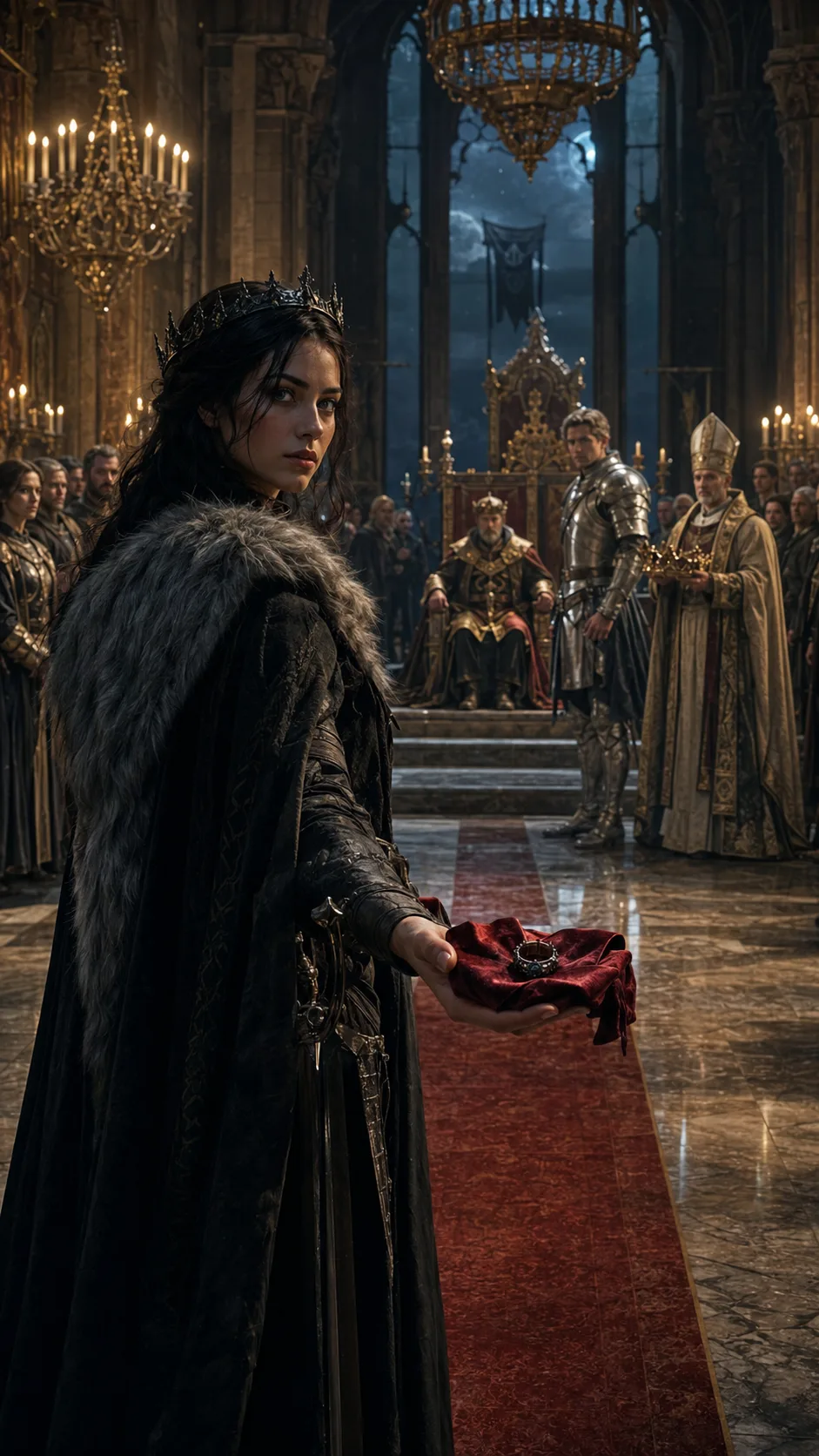
Every noble house would be present. Every oath would be public. Every lie would need to stand upright beneath the chandeliers and wait for her to touch it.
The Dravenmoor army halted outside the palace walls, exactly where she ordered. Not one soldier crossed the gate. Not yet.
Inside, the coronation began.
Elara waited beyond the great doors of the royal hall with Mara at her side and twelve Dravenmoor guards behind her. She could hear the Archbishop’s voice through the wood.
“By blood, by law, and by divine right…”
Mara looked at her.
Elara closed her fingers around the bundle of red silk beneath her cloak.
The ring was inside.
Her father’s ring.
Her proof.
Her grave.
She nodded once.
The doors opened.
The sound of iron hinges cut across the hall.
At first, irritation.
Then silence.
Elara stepped forward.
The hall had not changed. That struck her harder than she expected. The same chandeliers. The same marble. The same red carpet stitched with gold thread. The same saints painted above the vaulted ceiling, watching rulers lie in better clothing than thieves.
The nobles stood in rows.
She knew nearly every face.
Lord Merrow, who had taught her falconry and then signed Dorian’s succession petition.
Lady Celene, who had kissed Elara’s cheek at her twentieth birthday and sent no letter after the funeral.
The Archbishop, who had spoken over her empty coffin.
The queen mother, pale behind her veil.
Dorian beneath the crown.
And her father on the throne.
His hands tightened when he saw her.
That pleased her more than it should have.
Elara walked down the center aisle.
No hurry.
No need.
The black iron crown sat heavy on her head. Candlelight caught on its points and made a dark halo against the hall’s gold. Her boots left faint dust on the carpet with every step.
Someone dropped a prayer bead.
It bounced once.
Dorian spoke first.
“This is some trick.”
A poor opening.
Elara stopped beneath the chandeliers.
“A trick?” she said. “Like sealing your sister beneath the chapel and calling it grief?”
The court did not erupt. Not yet. Courts did not know how to react until power showed them which direction to face.
Her father stood halfway from the throne.
“Guards.”
No one moved.
The palace guards at the walls kept their eyes forward. Some had been paid. Some had been persuaded. Some had served Elara’s mother and waited years for a command worth obeying.
Outside the windows, Dravenmoor horns sounded.
Low.
Deep.
The nobles turned.
Black banners rose beyond the courtyard, each marked with the silver wolf. Soldiers stood in formation beneath the moonlight, silent and still. They did not storm the palace. They did not need to.
Presence could be a blade.
Dorian took one step back.
“You married him?”
Elara did not look at him.
“No. King Rovan died three weeks ago.”
The Archbishop’s mouth opened.
Elara let the next words land cleanly.
“And before he died, he named me his heir.”
The hall found its voice in pieces.
A murmur here.
A gasp there.
A chair leg scraped marble.
Dorian looked from her crown to the windows, then to their father.
The king’s face had hardened now. Not calm. Stone forced into the shape of calm.
“You have no claim here anymore,” he said.
Elara finally looked at him fully.
He had aged in six months. The crown sat lower on his brow. A purple vein pulsed near his temple. His right hand moved toward his signet finger and stopped.
He knew.
Elara reached beneath her cloak.
The old king’s eyes followed her hand.
There.
Let the court see that too.
She drew out the blood-red silk bundle and held it in her palm. The hall quieted again, not from obedience this time, but hunger. Nobles loved secrets most when they belonged to someone else.
Elara unfolded the silk once.
A corner fell loose.
She unfolded it again.
Gold flashed.
The royal signet ring of Valtherion lay in her palm, its black lion stone marked with scratches from the tomb.
No one breathed loudly.
The king’s hand clenched around air.
Elara lifted the ring.
“You buried me with this,” she said. “Did you forget?”
The words crossed the hall and struck the throne.
Her father did not sit. He lowered himself by inches, as if the chair had moved away from him.
“I placed it in your tomb myself,” Elara said. “Your hand shook when you did it. Not enough for mercy. Just enough for me to remember.”
Dorian’s face had gone pale beneath the candlelight.
“That proves nothing,” he said.
Elara turned her head toward him.
He looked younger suddenly. Not innocent. Never that. Just smaller without the ceremony around him.
“No?” she said.
Mara stepped forward from the side aisle and placed a leather case into Elara’s free hand.
The king’s eyes snapped to the case.
Elara did not open it.
Not yet.
“You should know something about stone, brother,” she said. “It keeps sound badly. But it keeps marks very well.”
Mara opened the case for her.
Inside lay a rubbing of the tomb wall: fresh scratches, dates, the Valtherion chapel mason’s seal, and the broken side seam marked where Elara had been cut out before dawn.
Elara placed the rubbing on the marble floor where the Archbishop could see it.
Then she placed the treaty beside it.
Dravenmoor wax.
Valtherion seal.
Dorian’s name.
The Archbishop stepped away from him.
Only one step.
That was all it took.
Nobles understood movement faster than words.
Lord Merrow bowed first. Not deeply. Not bravely. Just enough to save himself.
Lady Celene followed.
Then the northern houses.
Then the lesser lords.
Heads lowered down the hall like a field of wheat under hard wind.
Not to Dorian.
Not to the old king.
To Elara.
Dorian looked at the crown still waiting in the Archbishop’s hands. It hung there useless, bright and empty.
“What do you want?” he asked.
Elara looked at the golden crown.
Then at the throne.
Then at the father who had mistaken silence for death.
“I came to finish the coronation,” she said.
No one stopped her.
The Archbishop did not lift Dorian’s crown. His fingers loosened around it, and one of the smaller jewels clicked against his ring.
Elara walked past her brother.
He did not reach for her.
He knew better now.
She climbed the first step to the throne. Her father remained seated, one hand fixed to the armrest, the other curled against his robe where the signet had once lived.
For six months, the court had spoken of her as a tragedy.
For six months, they had placed flowers beneath a portrait they were too frightened to uncover.
For six months, they had let a king turn murder into mourning.
Elara stopped one step below the throne and held out her hand.
The signet ring rested in her palm.
“Stand,” she said.
The old king looked at her.
At the crown.
At the nobles.
At the windows full of black banners.
At last, his fingers slipped from the armrest.
He stood.
Not like a ruler.
Like a man obeying the sentence he had written for himself.
The queen mother covered her mouth. Dorian stared at the floor. The Archbishop bowed his head so low that the white edge of his mitre caught the candlelight.
Elara stepped onto the dais.
She did not take off the black iron crown.
Not yet.
She placed the signet ring on her own finger.
It fit loosely.
Her father saw that.
Good.
She sat on the throne of Valtherion with Dravenmoor’s crown still on her head, the lion ring on her hand, and both kingdoms waiting outside the same door.
No cheering came.
No music.
No blessing.
Only the soft sound of nobles lowering themselves to their knees one by one.
Mara stood below the dais, hands folded, eyes dry.
Elara looked across the hall she had once called home.
The red carpet still held dust from her boots.
She let it stay.
By dawn, Prince Dorian had been taken to the eastern tower under guard.
Not a dungeon. Not yet. Elara refused to decide his fate while the sound of his voice still lived too near the chapel in her mind.
Her father was moved to the old king’s apartments with three guards at the door and no signet, no seal, no private messengers.
The Archbishop begged for a private audience before sunrise.
Elara denied it.
Private rooms had done enough damage.
She received the council in the throne hall with the doors open and the Dravenmoor banners still visible through the windows.
Some nobles came quickly.
Those were the frightened ones.
Some came late.
Those were the stupid ones.
Lord Merrow offered loyalty before breakfast. Lady Celene offered tears. The southern barons offered soldiers they had not offered when Elara was declared dead.
She accepted none of it with warmth.
She recorded names.
That was enough.
Mara brought her a cup of black tea near midday. It had gone bitter from sitting too long.
Elara drank it anyway.
“You have not slept,” Mara said.
“No.”
“You should.”
“Yes.”
Neither moved.
Across the hall, servants pulled down the black silk from Elara’s portrait. Dust slid from the fabric in a soft gray sheet. The painted princess beneath looked too young. Too clean. Pearls in her hair. No scar at the lip. No black crown. No grave under her skin.
Elara watched the servants carry the silk away.
“Burn it?” Mara asked.
Elara shook her head.
“No. Cut it into mourning bands for the chapel doors.”
“For whom?”
Elara looked toward the western corridor, the one that led to the chapel stairs.
“For the girl they buried.”
Mara nodded.
That evening, Elara went down to the tomb.
Alone.
The passage smelled the same. Damp stone. Dust. Old bones. A place built to hold endings.
The broken seam in the tomb had been covered with a board when Mara and the mason pulled her out. No one had repaired it. No one had dared.
Elara stood beside the stone and touched the edge with two fingers.
Her nail caught in one of the scratches she had left from inside.
Small marks.
Wild marks.
Proof that a hand had refused to become history.
She stayed there until the candle shortened.
Then she removed the black iron crown and set it on the tomb lid.
For one breath, she was only Elara.
No Valtherion.
No Dravenmoor.
No crown at all.
The silence did not soften.
It simply made room.
When she returned upstairs, dawn was beginning behind the eastern glass. The palace servants were already awake. Someone in the kitchen had burned bread. Somewhere outside, a horse stamped against the stones.
The kingdom had not healed.
The dead had not been paid.
The throne had not become clean because she sat on it.
But the doors were open now.
Elara walked into the hall with the black crown beneath one arm and the lion ring on her finger.
The first light touched the marble.
Dust still marked the carpet where she had entered.
No one swept it away.
Chapter complete
You have reached the end of this chapter.
Continue reading
A few more worlds to get lost in after this chapter.




