Alexander was different.
He did not arrive with a marching army. He did not bring musicians, giant banners, or a hundred nobles dressed in silver. He came with twelve Eldorian knights, one wooden box containing the forgotten treaty, and a plain silver ring carved with the symbol of a falcon.
He was tall, quiet, and serious, with calm gray eyes that made people wonder how much pain he had learned to hide.
Five years earlier, Alexander had fought on Valoria’s northern border when rebels burned three villages. He had not been the heir then, only the second prince sent as a military representative. But the people of Valoria remembered him. They remembered the prince who opened Eldoria’s grain stores for refugee children. They remembered him riding through rain without waiting for servants to hold a canopy over him. They remembered him standing beside the coffins of Valorian soldiers as if they had been his own.
Amelia remembered him too.
She had been twenty-one when she met him in a field hospital near the northern road. The air had smelled of medicine, smoke, and wet wool. Alexander had not asked her if she was frightened. He had handed her a list of orphaned children and said, “They need names, not pity.”
That sentence made her look at him longer than court manners allowed.
Then the war ended.
Alexander returned to Eldoria.
Amelia returned to being a princess inside a glass cage.
Now, years later, both treaties were placed on the council table.
And Valoria began to split in silence.
The first council meeting took place inside the white chamber, where portraits of dead kings watched from the walls. Amelia sat at the head of the long table. Her father, King Edmund, sat to her right. Her stepmother, Queen Helena, sat to her left.
Helena wore a deep wine-colored gown and emeralds at her throat. Her smile was soft, but her eyes were never warm.
Adrian stood before the council with the Dravenmoor treaty in his hand.
Alexander stood three steps away with the Eldorian treaty inside the wooden box.
No one looked at Amelia first.
That was what made her stomach drop.
Chancellor Marlow read the first treaty in a flat, formal voice.
“According to the seventh clause of the Dravenmoor agreement, Princess Amelia, lawful heir of Valoria, was promised in marriage to Prince Adrian upon reaching royal maturity.”
Adrian lifted his chin slightly.
Helena smiled.
Then Marlow opened the second treaty.
“According to the twelfth clause of the Eldorian relief agreement, if the crown princess of Valoria remains unmarried before her twenty-seventh birthday, Eldoria may request fulfillment of the alternative royal marriage alliance.”
The room went silent.
Adrian laughed softly.
“A forgotten piece of paper does not outrank a military debt.”
Alexander did not look at him. He looked at King Edmund.
“A king’s promise does not expire because it becomes inconvenient.”
Amelia placed one hand on the edge of the table.
“And in either of those treaties,” she asked, “is there one line asking for my consent?”
For the first time in the meeting, everyone turned to her.
Slowly.
As if the chair she occupied had suddenly begun to speak.
Helena released a gentle sigh, the kind women like her used to make another woman sound childish in a room full of men.
“Amelia, you know this is larger than personal emotion.”
“I asked a legal question,” Amelia said. “Not an emotional one.”
King Edmund closed his eyes.
He had aged badly since Amelia’s mother died. Decisions that had once been sharp as blades now came from him late, as if he were asking permission from a ghost before he spoke.
“No,” he said at last. “There is no such line.”
Adrian looked at Amelia.
His smile faded.
“You were born to serve Valoria.”
Amelia looked back at him.
“I was born in Valoria. That is not the same thing.”
The room changed.
Alexander lowered his eyes, almost hiding the briefest flicker of approval.
Adrian did not hide anything. His jaw tightened.
Helena placed both hands neatly on the table.
“We cannot allow this issue to divide the kingdom. The council requires a clear solution.”
A duke from the southern provinces spoke immediately.
“Ancient law provides one. When two royal marriage treaties conflict, the claimants may settle the matter through a duel of honor. The victor earns the right to marry.”
Amelia heard those words, and for a moment, the room seemed to move far away from her.
The victor earns the right to marry.
Not the man she chose.
Not the man she trusted.
Not the man who saw her as a human being.
The victor.
As if she were disputed land.
A toll bridge.
A key to a treasury.
Adrian turned to Alexander.
“Then let the law decide.”
Alexander was silent.
Amelia looked at him.
She wanted him to refuse.
She wanted just one person in that room to understand the insanity before she had to say it herself.
But Alexander only asked, “If I refuse, what happens to Eldoria’s claim?”
Chancellor Marlow answered, “Eldoria will be considered to have surrendered its treaty right. Dravenmoor will win by default.”
Adrian smiled.
“Convenient.”
Alexander looked down at the wooden box.
And Amelia understood.
Even the better man had been trapped inside a system built by dead men.
She stood.
The legs of her chair scraped against the stone floor, making several lords flinch.
“I do not agree.”
Helena frowned.
“You do not have the authority to veto ancient law.”
“Then ancient law does not have the authority to veto my body.”
This time, the silence did not simply fall.
It hit the table like shattered glass.
King Edmund opened his eyes. For one moment, Amelia saw the father she had known as a child, the man who had carried her through the apple garden, the man who had promised never to let anyone decide her life for her.
Then he looked at the lords.
He looked at Helena.
He looked at the treaties.
And he said, tiredly, “The council will summon a public judgment. Until then, both princes will remain in the palace.”
Adrian bowed like a man already accepting victory.
Alexander bowed with restraint.
Amelia bowed to no one.
News spread faster than fire through dry straw.
Outside the palace, crowds gathered in the cold. Supporters of Adrian carried the blue-black banners of Dravenmoor and shouted that Valoria needed an army. Supporters of Alexander wore silver ribbons and said Valoria needed honor. Taverns argued until midnight. Churches prayed for peace. Newspapers printed enormous headlines about “the princess between two swords.”
Not one newspaper asked what Amelia wanted.
The night before the public judgment, Amelia stood alone in the western library, the place where her mother used to read diplomatic letters. Rain tapped softly against the tall windows. She wore an ivory satin gown, no crown, her blonde hair pinned low, pearl earrings brushing her neck whenever she moved.
Alexander found her there.
He did not enter immediately. He knocked once on the doorframe.
“Princess.”
Amelia did not turn around.
“Did you come to tell me you will fight for my honor?”
“No.”
She turned.
Alexander stood under the dim wall lamp, his navy royal uniform slightly damp at the shoulders from the rain. He looked more tired than he had in the council chamber.
“I came to apologize,” he said.
That caught her off guard.
“For what?”
“For not refusing the duel the moment they suggested it.”
Amelia watched him for a long moment.
“Why didn’t you?”
Alexander stepped into the library but stopped several paces from her. Close enough to speak quietly. Far enough not to force her backward.
“If I refuse, Adrian wins by default. If I agree, I become another man using a sword to decide your life.”
“So what do you choose?”
“I do not know yet.”
The honesty hurt more than a polished answer would have.
Adrian would never say that. Adrian spoke as if certainty itself were a form of power.
Alexander stood before her with an helplessness he did not try to decorate.
Amelia said quietly, “Everyone keeps asking what you will do. No one asks me.”
“I am asking now.”
“No.” She shook her head. “You are asking after the whole kingdom has already placed me between two swords.”
Alexander accepted the words like a cut.
He did not defend himself.
“You are right.”
Amelia felt her throat tighten, not because she was weak, but because it had been so long since anyone inside the palace admitted she was right without asking for something in return.
“I do not want to be a prize,” she said.
“I know.”
“No, you don’t.” Her voice sharpened. “You know it is wrong. But you do not know what it feels like to stand there while men who watched me grow up debate which one of you has the more legal claim to own me. You do not know what it feels like when my father says nothing because he fears war. When my stepmother calls my silence wisdom. When two kingdoms use my name to measure the loyalty of men.”
Alexander lowered his eyes.
“I do not know.”
Amelia looked at the rain moving down the glass.
“Thank you for not pretending.”
Silence stretched between them.
Then Alexander removed the silver ring from his hand and placed it on the table.
“Tomorrow, if the duel happens, I will not kill Adrian.”
“That is not what frightens me most.”
“I know.” He looked up. “What frightens you is that no matter who wins, the law still wins over you.”
She did not answer.
Because for the first time, someone had said the exact sentence she had been afraid to speak aloud.
Alexander continued, slowly.
“If I step into that arena, I will do it only to prevent Adrian from winning by default. But if you ask me to lower my sword, I will lower it.”
Amelia stared at him.
“Even if that costs Eldoria its treaty claim?”
“Yes.”
“Even if the council calls you a coward?”
A faint, sad smile crossed his face.
“I have been called worse by men with less courage.”
The library door opened.
Adrian stood there.
He had heard enough.
The air froze.
Adrian looked at the ring on the table. Then at Alexander.
“How touching. The noble prince asks permission to lose.”
Alexander did not move toward him.
“This conversation does not belong to you.”
Adrian laughed coldly.
“Everything involving my future wife belongs to me.”
Amelia felt the blood in her body go cold.
“My future wife,” Adrian said again, this time looking directly at her. “Unless you intend to break the kingdom over a feeling.”
Amelia stepped forward.
“I am not yours.”
“Not yet.” Adrian’s reply came instantly. “But after tomorrow, no one in this palace will be able to pretend otherwise.”
Alexander’s hand tightened.
Adrian noticed and enjoyed it.
“Careful, Eldoria,” Adrian said. “She may enjoy your softness tonight, but kingdoms are not held by soft men.”
Alexander’s voice dropped.
“Nor are women.”
Adrian stepped forward.
Amelia moved between them before either man could touch a sword.
“Enough.”
Adrian looked at her as if she had embarrassed him in front of servants.
“Step aside.”
“No.”
One word.
The room shifted.
Adrian stared at her for a long time.
Then he smiled.
“Tomorrow, Amelia. In front of everyone.”
He left, taking the smell of rain and anger with him.
Alexander looked at Amelia.
“You should not have to do that.”
Amelia picked up the silver ring and placed it back into his hand.
“Tomorrow,” she said, “do not listen to the law before you listen to me.”
The next morning, the ancient arena of Valoria was packed with people.
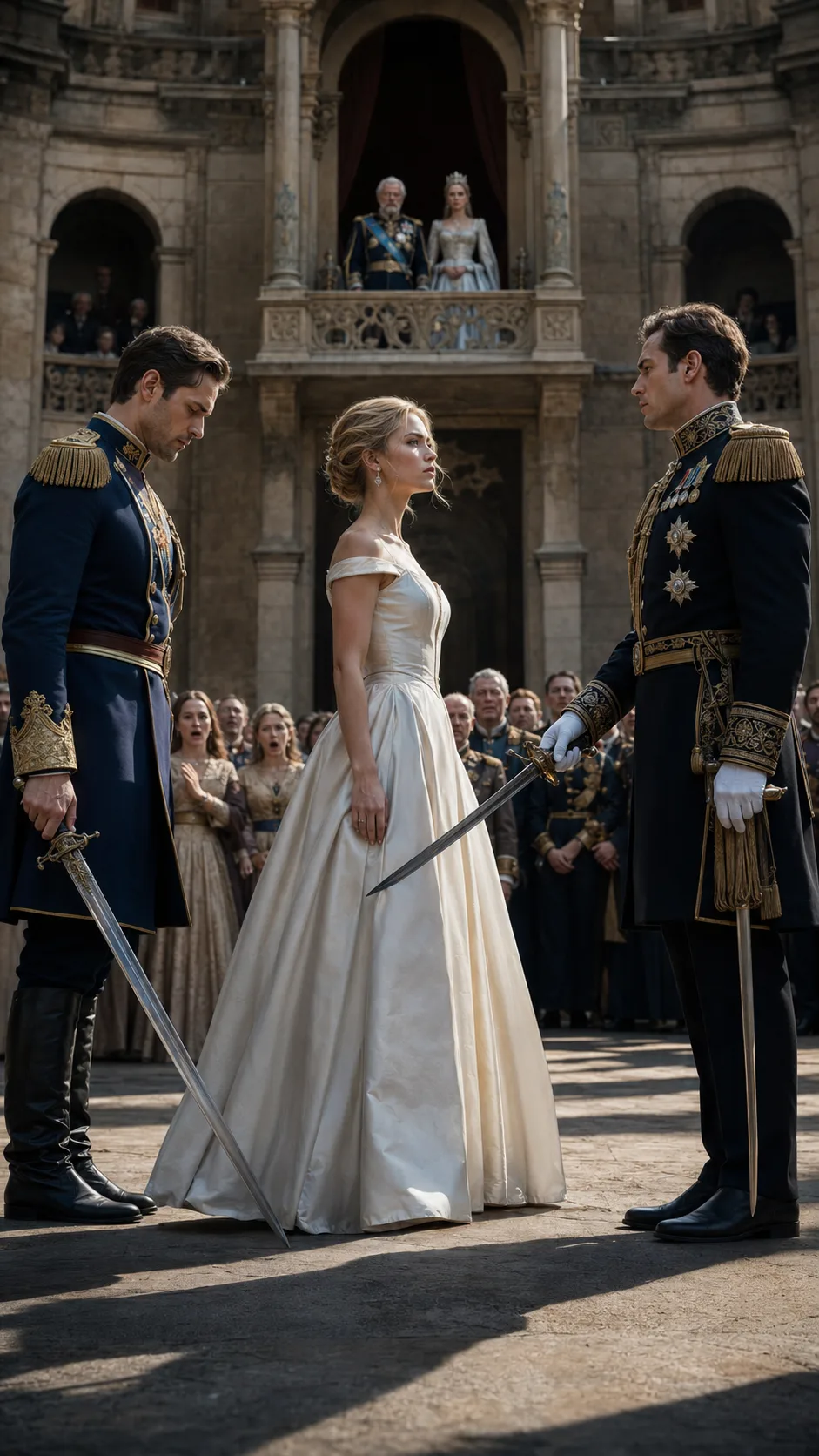
It stood between the palace and the cathedral, a ring of white stone built during the reign of the first king. Above it, the royal balcony was draped with the flags of Valoria, Dravenmoor, and Eldoria. Below, crowds pressed behind the line of guards. The sky was gray but bright, filling the arena with soft natural daylight that made every blade look colder.
Amelia entered to the sound of thousands whispering.
She wore a pearl-white satin gown, simple enough to insult every jewel in the palace. Her hair was pinned neatly. Small pearl earrings glowed at her ears. She wore no crown.
Helena had tried to force her to wear the crown of succession to “remind the people she was a national symbol.”
Amelia refused.
She did not want a symbol to enter the arena.
She wanted a person.
Adrian already stood on the eastern side. His Dravenmoor uniform was dark blue and black, his sword at his hip, his handsome face calm and shameless. He raised one hand to the crowd. A group of nobles shouted his name.
Alexander stood on the western side. He wore Eldorian navy, with no heavy decorations except the silver ring on his hand. He did not wave.
He looked at Amelia.
In that moment, she knew he remembered.
Do not listen to the law before you listen to me.
Chancellor Marlow walked into the center of the arena with the official decree in his hands. His voice carried across the stone.
“According to the ancient law of Valoria, when two royal marriage treaties hold equal claim, the matter may be settled by a duel of honor between the two claimants.”
The crowd quieted.
“The victor will be recognized as the lawful fiancé of Princess Amelia.”
The word lawful struck her like a slap.
King Edmund sat on the balcony, his hands gripping the armrests, his face pale. Helena sat beside him, beautiful and cold, her mouth set in a thin line. She had supported Adrian from the beginning, not for Amelia’s sake, but because Dravenmoor would strengthen her own influence at court.
Marlow raised one hand.
“Princes, draw your swords.”
Steel slid from scabbards.
A sharp sound.
Clear.
Irreversible.
Adrian drew quickly, his blade catching the gray light.
Alexander drew more slowly.
Amelia looked at the two swords.
Then she looked at the crowd.
Thousands of people were waiting to see who would win her.
No.
Not win for her.
Win her.
Marlow lowered his hand.
“Begin—”
“Stop.”
Amelia’s voice rang out before his hand finished falling.
No one breathed.
She stepped away from the honored place at the edge of the arena.
A guard lifted one hand to stop her, but she looked at him once.
He stepped back.
“Amelia,” Helena called from the balcony, her voice smiling and sharp at the same time. “This is not the moment.”
Amelia did not look at her.
She walked into the stone circle.
Between the two swords.
The crowd stirred.
Adrian’s expression hardened.
“Get out of the ring.”
Alexander lowered the point of his sword slightly.
“Princess—”
Amelia raised her hand, stopping him.
She stood between them, her white gown touching the stone, two bright blades on either side of her. Wind pulled a few strands of hair loose from her pinned style, but her face remained calm enough to make the entire arena look closer.
Adrian clenched his jaw.
“You are humiliating the court.”
Amelia turned to him.
“No. The court humiliated itself when it called me a prize.”
A murmur moved through the crowd.
Chancellor Marlow went pale.
“Princess, please leave the arena. The law has already—”
“The law has spoken enough.” Amelia looked at him. “Now I will.”
King Edmund rose from the balcony.
“Amelia…”
She looked up at her father. Pain flickered in her eyes, but it did not weaken her.
“You let them read two treaties in front of me as if I were the final clause to be signed. I waited for you to remember that I was your daughter before I was Valoria’s property.”
King Edmund froze.
That sentence made the arena so silent that the wind moving through the flags could be heard.
Helena stood.
“The princess is emotional. Remove her.”
No guard moved.
Because Amelia had turned back to the two princes.
Adrian took one step forward, sword still in his hand.
“Enough.”
Alexander also moved half a step, but he did not raise his sword.
Amelia looked at both of them.
Then she spoke in a voice clear enough for the first rows to hear.
“If you fight for me without asking me, neither of you deserves me.”
The sentence cut through the arena like lightning without thunder.
Alexander looked at her.
Not like she was a princess.
Like she was a person offering him one last chance to become the man he claimed to be.
He lowered his sword.
No hesitation.
The blade touched the stone with a small metallic sound that somehow carried across the entire arena.
Then Alexander went down on one knee.
Not before the law.
Not to ask for marriage.
He knelt to show that he would not stand above her choice.
The crowd stopped breathing.
Amelia turned to Adrian.
He still held his sword.
Not only held it.
He gripped it harder.
His handsome face lost its polished control. Beneath the noble mask, there was only the raw anger of a man being refused in public.
“Pick it up,” Adrian said to Alexander.
Alexander did not move.
Adrian looked at Amelia.
“You think this makes you free?”
“No,” Amelia said. “I think your hand just told the kingdom why I was never safe with you.”
Adrian looked around.
For the first time, he realized the crowd was no longer shouting his name.
They were looking at the sword in his hand.
They were looking at the princess standing before it.
They were understanding.
Adrian understood at the same time they did.
His voice dropped.
“Do not make me look like a villain.”
Amelia looked straight at him.
“Then stop holding a weapon at the woman you claim to love.”
The entire arena went dead silent.
Adrian did not lower the sword.
One second.
Two seconds.
Three seconds.
Those three seconds lasted longer than any speech ever delivered in the palace of Valoria.
Then the whispering began.
No one needed Amelia to say more.
No one needed Alexander to win.
Adrian had judged himself in front of the whole kingdom.
King Edmund stared down from the balcony, his face white as if he had just woken from a years-long sleep. He saw his daughter standing between two men. One had lowered his sword. The other still refused to let go.
Slowly, the king descended from the balcony.
Helena grabbed his sleeve.
“Your Majesty, don’t. If you interfere, Dravenmoor will consider it an insult.”
Edmund looked at her.
For the first time in years, his voice was not tired.
“No. I have insulted my daughter enough.”
He walked into the arena.
The guards moved aside.
When Adrian saw the king approaching, he lowered the sword slightly.
But it was too late.
Too visible.
Edmund stood beside Amelia.
Not in front of her. Not shielding her like something fragile. Beside her, like a father finally remembering where he should have stood.
“Chancellor Marlow,” he said. “Record this.”
Marlow opened the royal ledger with shaking hands.
“The duel of honor is canceled. No treaty of Valoria shall turn the heir of the throne into a prize for combat. From this day forward, any marriage clause without the direct consent of the person promised shall be void.”
Noise exploded through the arena like a wave breaking against stone.
Helena shouted from the balcony.
“You cannot do this!”
Edmund did not look at her.
“I am the king. And worse, I am her father. I should have done it long ago.”
Amelia looked at him.
She did not cry.
But her eyes turned red.
Adrian stepped forward.
“Dravenmoor will not accept this insult.”
Alexander rose to his feet. His sword still lay on the stone.
Before anyone else could speak, Amelia turned to Adrian.
“Dravenmoor may take back its treaty,” she said. “And you may take back the sword you chose to keep.”
Adrian stared at her as if searching for one final sentence strong enough to reclaim the arena, the crowd, the court, everything.
But there was nothing left to say.
Because his power had always depended on people believing he had the right.
Amelia had taken that belief out of his hands.
He slid the sword back into its scabbard with a stiff motion.
The sound did not feel like honor.
It felt like defeat.
After that day, Valoria did not collapse the way the council had warned it would.
Dravenmoor sent three letters of outrage in one week. The fourth letter requested trade negotiations over grain and mountain passage rights. Without Amelia as a bargaining piece, they still needed Valoria’s silver, Valoria’s ports, and Valoria’s roads.
That truth embarrassed half the council.
Amelia made sure it embarrassed them publicly.
Queen Helena tried to recover control. She told the court that Amelia’s actions had been dangerous, reckless, emotional.
But the people had seen the arena.
They had seen one prince kneel.
They had seen the other refuse to lower a weapon.
No speech from Helena could erase that image.
Two months later, King Edmund stripped Helena of her authority over marriage negotiations and removed three council members who had supported the duel. Chancellor Marlow kept his position only because he stood before the court and admitted, in writing, that ancient law had been used to justify a moral failure.
Amelia read the confession twice.
Then she filed it in the royal archive beside the two treaties.
She did not destroy them.
She wanted future rulers to see what obedience had almost cost.
Adrian returned to Dravenmoor before winter fully settled over the mountains. He left with his medals, his guards, and a pride so wounded it looked almost human.
He did not say goodbye to Amelia.
She was glad.
Alexander remained in Valoria as Eldoria’s diplomatic representative. Not as her fiancé. Not as a claimant. Not as a man waiting for reward.
For the first month, he did not ask her for anything.
He attended trade meetings. He visited the northern villages he had helped years before. He sent Eldorian engineers to repair a bridge washed out by rain. He stood beside Amelia in council chambers, but never spoke over her.
That was how trust began.
Not with grand declarations.
With space.
With patience.
With the strange, rare dignity of a man who did not mistake access for entitlement.
One evening in early spring, Amelia found him in the palace garden where the apple trees were beginning to bloom. He was standing near the fountain, reading a report with a crease between his brows.
“You look like you are preparing to argue with a bridge,” she said.
Alexander looked up, startled, then smiled.
“The bridge has made several unreasonable demands.”
Amelia laughed before she could stop herself.
It surprised both of them.
For a moment, they were not heirs, representatives, symbols, or pieces of history.
They were simply a woman and a man standing under apple blossoms after surviving a winter of politics.
Alexander closed the report.
“May I ask you something?”
Amelia tilted her head.
“You may ask.”
He seemed to notice the difference.
Not I must ask.
Not I have the right to ask.
May I.
“Would you walk with me?”
Amelia looked at the garden path, then at him.
“No treaty?”
“No treaty.”
“No council approval?”
“Absolutely not.”
“No sword?”
He held up both empty hands.
“No sword.”
She smiled.
“Then yes.”
They walked slowly through the garden. The palace windows glowed behind them. Somewhere inside, courtiers were probably whispering. Somewhere beyond the gates, newspapers were probably inventing new versions of old truths.
Amelia did not care.
For once, no one was deciding the meaning of her steps except her.
Months passed.
Valoria changed.
Not quickly. Kingdoms never did. Old power did not disappear simply because one princess spoke the truth in an arena. But it cracked. And once cracked, it could no longer pretend to be eternal.
Amelia began reforming royal marriage law. She expanded the council to include widows, merchants, scholars, and village representatives. The nobles called it chaos. The people called it overdue.
At her twenty-seventh birthday ceremony, the entire court expected a formal announcement about her future.
Helena, now seated three rows behind the royal family with far fewer jewels, watched with a frozen smile.
Adrian did not attend.
Alexander stood among the foreign representatives, not beside the throne.
Amelia noticed that.
She respected it.
King Edmund placed the crown of succession on a velvet cushion before her. His hands trembled slightly.
“My daughter,” he said, voice carrying through the hall, “when your mother died, I thought protecting the kingdom meant keeping peace at any cost. I forgot that a kingdom which sacrifices its own children does not deserve peace.”
The room went silent.
Amelia looked at him.
Edmund continued, “You reminded me that the crown does not own you. One day, you will wear it. Until then, may you never again have to stand between two swords to prove you are human.”
Amelia stepped forward.
This time, she accepted the crown.
Not because the court demanded it.
Because she chose to.
As the hall applauded, her eyes moved to Alexander.
He did not clap first. He waited until the people began. Then he joined them quietly, his expression steady, proud, and a little sad.
Amelia understood why.
He still would not claim any part of that moment.
That was why she wanted him there.
After the ceremony, she found him on the balcony overlooking the city. Lanterns floated below like fallen stars. The air smelled of spring rain and candle smoke.
“You stood very far from the throne today,” she said.
Alexander turned.
“It was your day.”
“You were part of it.”
“I was a witness.”
Amelia stood beside him.
“Is that all you want to be?”
He looked at her carefully.
“No.”
The honesty settled between them.
This time, it did not hurt.
“But I will not ask while the court is watching,” he said. “And I will not ask because a treaty once gave me permission. If I ever ask, it will be because you have given me reason to believe the question is welcome.”
Amelia looked out at the city.
For years, men had spoken of marrying her as if the question had already been answered by ink, blood, law, strategy, or war.
Alexander was the first man who treated the question itself as something sacred.
So she turned back to him.
“Then ask me tomorrow,” she said.
His breath caught.
“Tomorrow?”
“Yes.”
“Why tomorrow?”
“Because tonight everyone is watching.”
A slow smile touched his face.
“And tomorrow?”
“Tomorrow I will meet you in the apple garden,” Amelia said. “No council. No treaties. No swords.”
Alexander bowed his head.
“Then tomorrow.”
The next morning, the apple garden was full of pale blossoms and soft daylight.
Amelia arrived without a crown.
Alexander arrived without guards.
He did not kneel immediately. He did not reach for her hand. He stood before her and looked at her as if the answer mattered more than his pride.
“Amelia,” he said, “would you allow me to court you?”
She smiled.
Not because the question was grand.
Because it was small enough to be honest.
“Yes,” she said. “You may.”
One year later, when Alexander asked her to marry him, he did it in the same garden.
No council watched.
No soldiers stood nearby.
No priest held a treaty.
He asked with one ring, one shaking breath, and one simple sentence.
“Will you choose me?”
Amelia looked at the man who had once lowered his sword before the entire kingdom.
Then she gave him her answer.
“Yes,” she said. “Because you asked.”
Their wedding took place at the beginning of summer.
The doors of the cathedral were opened to the city. No one was forced to bow. No foreign army marched outside. No council member dared speak of debt, duty, or treaty claims.
When Amelia walked down the aisle, she wore her mother’s pearls and a satin gown the color of morning light. King Edmund walked beside her, not to give her away, but to accompany her.
At the altar, Alexander waited in navy blue, tall and still, his eyes shining with emotion he did not try to hide.
Before the vows began, Amelia turned to the gathered court.
“The last time this kingdom watched me stand between two men,” she said, “it was to decide who had the right to claim me.”
The hall went silent.
Alexander lowered his eyes, not in shame, but in memory.
Amelia took his hand.
“Today, you are not witnessing a claim. You are witnessing a choice.”
No one spoke.
Then the people rose.
Not for the treaty.
Not for the crown.
For her.
Years later, when children in Valoria learned about the day of the royal duel, their teachers did not describe it as the day Prince Alexander defeated Prince Adrian.
Because he had not.
They did not describe it as the day King Edmund changed the law.
Because that had only happened after the truth was already visible.
They called it the day Princess Amelia stopped two swords.
The day she walked into the arena and made a kingdom understand that love without consent was not love.
Protection without respect was still control.
And a woman was not made free because the better man won her.
She was free when no man was allowed to win her at all.
THE END.