The Princess Stayed Silent While Her Sister Lied About the Prince’s Baby Until the Royal Doctor Destroyed Everything
Princess Catherine knew the marriage was over before Prince Charles admitted anything.
Chapter 1
The Princess Stayed Silent While Her Sister Lied About the Prince’s Baby Until the Royal Doctor Destroyed Everything
Princess Catherine knew the marriage was over before Prince Charles admitted anything.
She knew it from the way he stopped looking at her across the breakfast table.
She knew it from the way he suddenly had meetings after midnight.
She knew it from the perfume left on the collar of his royal navy uniform—sweet, expensive, and painfully familiar.
Beatrice’s perfume.
Her younger sister.
The same sister who used to run barefoot through the eastern gardens behind Catherine, begging her to slow down. The same sister Catherine had shielded from gossip, from their father’s temper, from every sharp corner of palace life.
And now that same sister had taken Catherine’s husband.
The worst part was not the affair.
The worst part was how careless they had become.
A hand on Charles’s sleeve in public.
A whispered joke during a charity dinner.
A glance held two seconds too long beneath the chandeliers.
Everyone in the palace saw it.
No one said a word.
Because
royal families did not collapse loudly.
They rotted behind polished doors.
Catherine signed the divorce petition on a rainy Tuesday morning inside her private sitting room. Her hand did not shake. Her face did not break. The solicitor across from her looked more nervous than she did.
“Your Royal Highness,” he said softly, “once this is filed, there will be no easy way back.”
Catherine looked down at Charles’s name printed beside hers.
Prince Charles Edmund of Arvendale.
Her husband.
Her mistake.
“There was no way back the moment he brought my sister into our marriage,” Catherine said.
The solicitor lowered his eyes.
Outside, rain tapped against the palace windows like tiny fingers asking to be let in.
Catherine removed her wedding ring and placed it beside the papers.
It looked smaller than she remembered.
That afternoon, Charles came to her apartments without knocking.
He still wore his ceremonial uniform,
the dark blue jacket fitted perfectly to his tall, broad frame, gold buttons shining across his chest. At thirty-three, Charles still looked like the prince every newspaper wanted him to be—handsome, disciplined, born for portraits and balcony waves.
But Catherine had seen the truth beneath the uniform.
A weak man could still stand straight.
“You filed,” he said.
Catherine stood near the fireplace, dressed in a pale ivory satin gown, pearl earrings at her ears, her blonde hair pinned neatly at the nape of her neck. She looked calm enough to terrify him.
“Yes.”
Charles closed the door behind him. “You should have spoken to me first.”
That almost made her laugh.
Almost.
“I spoke to you for months,” she said. “You lied for months.”
His jaw tightened. “This will embarrass the Crown.”
“No,” Catherine said. “You embarrassed the Crown.”
Charles stepped closer. “Beatrice is young. She made a mistake.”
Catherine’s stomach turned.
Beatrice was twenty-five. Old enough to know what betrayal meant.
“And you?” Catherine asked. “Were you young too?”
He looked away.
That was the only answer she needed.
Then he said the sentence that ended the last soft thing left inside her.
“You don’t understand what she means to me.”
The room went silent.
Catherine stared at him.
For a moment she could still see the man who had once held her hand on a balcony and promised he would never let the palace make her lonely.
Then that image disappeared.
“Get out,” she said.
Charles looked stunned. “Catherine—”
“Get out before I forget I was raised to be graceful.”
He left.
Two days later, Princess Beatrice called a press conference.
Not the palace.
Not the council.
Not Catherine.
The press.
It was scheduled for eleven in the morning in the Grand Blue Hall, the most photographed room in the palace. The same room where Catherine and Charles had announced their engagement four years earlier.
The message reached Catherine through her private secretary.
“Princess Beatrice has requested full media access,” the secretary said, standing stiffly near the doorway.
Catherine looked up from the divorce documents. “For what reason?”
The secretary swallowed. “She has not stated it publicly.”
But Catherine already knew.
Beatrice never chose a stage unless she had rehearsed the wound.
By ten forty-five, the hall was full.
Reporters lined the velvet ropes. Cameras pointed toward the raised platform beneath the enormous royal crest. Palace staff whispered behind columns. Senior nobles arrived pretending they had simply been passing by.
Charles stood near the side entrance, pale and tense.
Beatrice stood at the center of the platform.
She looked beautiful.
That was the cruel part.
She wore a soft pink silk dress that made her appear innocent, fragile, almost saintly beneath the daylight pouring through the tall arched windows. Her brown hair fell in glossy waves around her shoulders. Her face was lightly powdered. Her eyes were bright.
Too bright.
Catherine watched from the back of the hall.
No crown.
No dramatic entrance.
Just a white satin dress, pearl earrings, and a face so still that even the guards seemed afraid to breathe near her.
Beatrice touched the microphone.
The room quieted.
“I know many of you have heard rumors,” Beatrice began, her voice soft and trembling in all the right places. “Rumors about my relationship with Prince Charles.”
The cameras clicked.
Charles lowered his head.
Catherine did not blink.
Beatrice placed one hand lightly over her stomach.
A murmur moved through the room like a match catching silk.
“My sister wants to divorce him,” Beatrice continued. “But before she asks the kingdom to judge us, she should know the truth.”
Catherine felt the air change.
Beatrice lifted her chin.
“I am carrying Prince Charles’s child.”
The hall exploded.
Reporters shouted over one another.
Charles froze.
A noblewoman gasped loudly enough for everyone to hear.
Catherine felt every camera trying to find her face.
She gave them nothing.
No tears.
No flinch.
No hand over her mouth.
Nothing.
Beatrice turned slightly toward Catherine, and for one second the trembling mask slipped.
Her eyes were not afraid.
They were victorious.
Then she said, “I never wanted to hurt my sister. But a child changes everything. The honorable thing now is for Catherine to step aside and allow Charles to build a legitimate royal household with the mother of his heir.”
There it was.
Not love.
Not shame.
Power.
Beatrice did not want Charles.
She wanted Catherine’s place.
The title.
The apartments.
The chair beside Charles at state dinners.
The balcony.
The photographs.
The future.
Catherine heard her own heartbeat.
Charles finally moved. He stepped toward Beatrice, but he did not look happy. He looked trapped.
Good.
Catherine turned and left the hall without saying a word.
That silence became the headline.
PRINCESS CATHERINE WALKS OUT AFTER SISTER’S BABY CLAIM.
By evening, the palace was burning without fire.
Every television channel repeated Beatrice’s announcement.
Royal commentators argued over succession rules.
Foreign newspapers called it “the scandal of the decade.”
Some people pitied Catherine.
Some called her cold.
Some said she should be gracious and let the child have a father.
The word child was everywhere.
And that was why Beatrice had chosen the lie.
No one looked closely at a woman claiming motherhood.
Not at first.
That night, Charles came again.
This time Catherine allowed him in.
He looked worse than before. His hair was slightly messy, his uniform jacket unbuttoned at the throat. The perfect prince had begun to crack.
“Did you know?” Catherine asked.
He stared at her. “Know what?”
“That she would announce it.”
“No.”
Catherine believed him.
Not because he was honest.
Because he looked too frightened to have planned anything.
“She told me this morning,” he said. “I thought she was going to speak privately to the council.”
“And when she said it in front of the whole kingdom?”
He said nothing.
Catherine walked to the window. Below, reporters stood beyond the palace gates under umbrellas, waiting for the next piece of her humiliation.
“Is it true?” she asked.
Charles looked at the floor.
“I don’t know.”
That hurt more than yes.
Because it meant there had been enough betrayal for him to wonder.
Catherine closed her eyes for one second.
Only one.
Then she opened them again.
“Leave.”
“Catherine, please—”
“You do not get to ask for comfort from the wife you betrayed.”
He stepped back like she had slapped him.
Maybe she had.
With the truth.
The next morning, the Royal Council called an emergency session.
Catherine was invited.
Beatrice was invited.
Charles was ordered to attend.
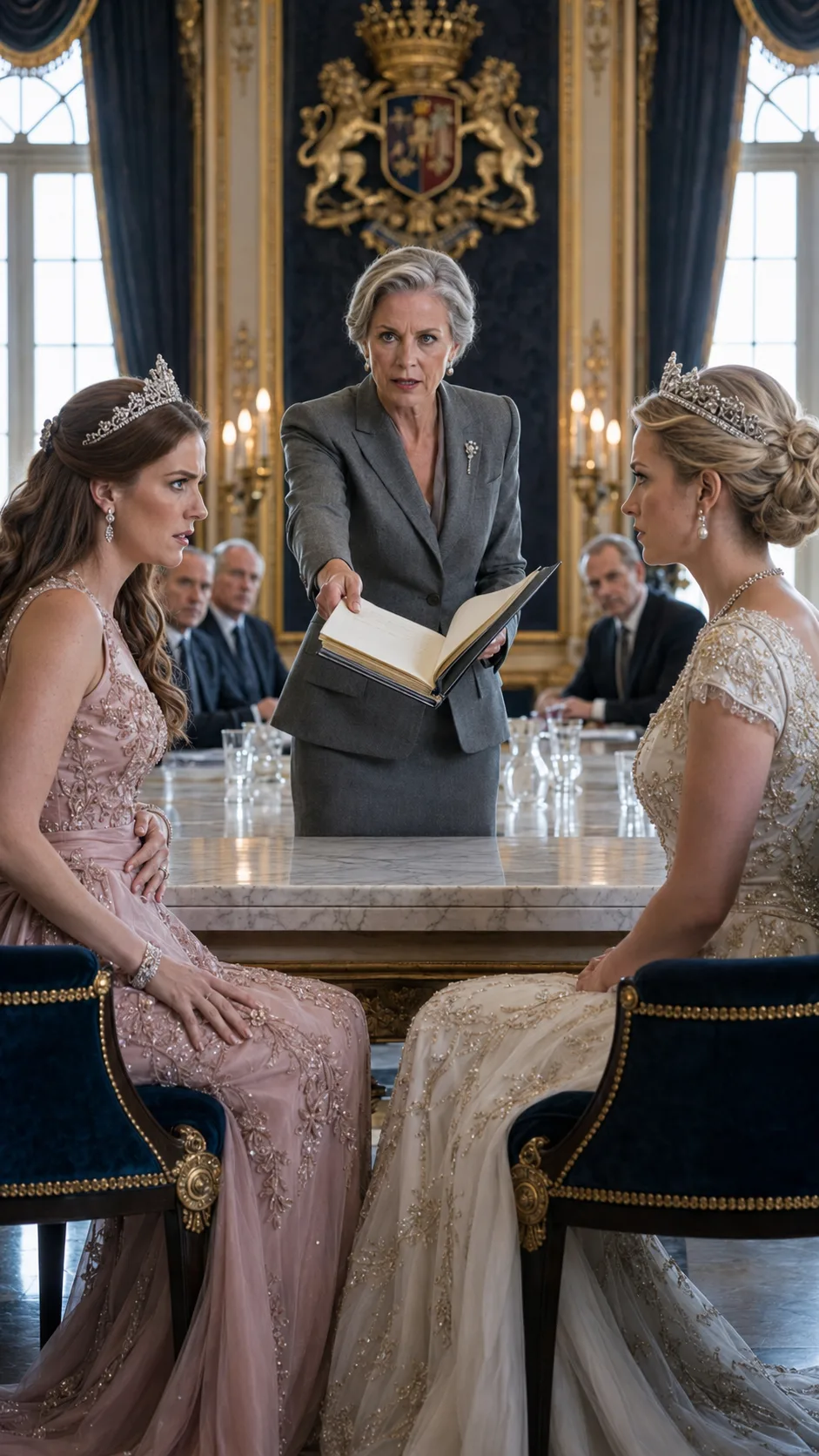
The council chamber was colder than usual, though sunlight fell across the long marble table. Portraits of dead kings watched from the walls, all painted in stiff poses, as if dignity could be preserved by oil and gold frames.
At the head of the table sat King Edmund, Charles’s father, his face carved from exhaustion and anger.
Queen Helena sat beside him, elegant and silent.
Catherine entered first.
Every council member stood.
She did not smile.
Charles entered next.
Fewer people stood.
Beatrice arrived last.
She moved slowly, one hand still resting lightly against her stomach, face pale, lashes lowered. She had mastered the performance overnight.
The grieving sister.
The frightened mother.
The woman wronged by circumstance.
Catherine almost admired the discipline.
Almost.
King Edmund spoke first.
“Princess Beatrice, your public announcement has placed the monarchy in crisis.”
Beatrice lowered her eyes. “Your Majesty, I had no choice. My sister was preparing to erase my child.”
Catherine turned her head slowly.
The room went still.
“Erase?” Catherine repeated.
Beatrice’s lips trembled. “You wanted Charles removed from your life. From the palace. From everything.”
“I wanted a divorce,” Catherine said. “Not a disappearance.”
Beatrice looked at the council. “You see? She can say that now, but we all know what happens when a princess loses her place. She destroys what she cannot control.”
Catherine’s hands remained folded on the table.
Inside, something sharp moved through her chest.
Beatrice had not only taken her husband.
She was trying to rewrite Catherine into the villain.
Charles finally spoke. “Enough, Beatrice.”
She looked at him, wounded. “Don’t defend her now.”
“I am not defending anyone,” Charles said. “I am asking you to stop.”
Her eyes hardened for half a second.
Catherine saw it.
So did Queen Helena.
The queen’s gaze moved from Beatrice’s hand to her face, then to Catherine.
It was small.
But Catherine understood.
The queen suspected.
King Edmund leaned forward. “There will be a private medical verification by the royal physician.”
Beatrice froze.
Only for a breath.
But the room caught it.
Catherine felt the first shift.
Beatrice recovered quickly. “Of course.”
“Today,” the king said.
Her smile thinned. “Your Majesty, I am overwhelmed. Perhaps tomorrow—”
“Today.”
The word landed like a gavel.
Beatrice looked at Charles.
For the first time, she seemed afraid.
Charles did not move to help her.
Catherine looked down at her folded hands.
That was the moment everything changed.
The royal physician, Dr. Margaret Ellison, was not a woman easily intimidated.
She had served three generations of the royal family and had once told a duke to stop pretending his gout was a war injury. She arrived at the council chamber forty minutes later in a gray suit, silver hair pinned back, medical folder tucked under one arm.
Beatrice was escorted to the private clinic wing.
Catherine waited in the council chamber.
Charles paced.
King Edmund said nothing.
Queen Helena watched everyone.
Time stretched.
Thirty minutes.
Forty.
An hour.
When Beatrice returned, she looked pale.
Not delicate pale.
Cornered pale.
Dr. Ellison returned behind her, carrying a sealed medical folder.
Beatrice sat down carefully.
Too carefully.
Catherine noticed.
The royal doctor stood at the head of the table.
“Your Majesty,” Dr. Ellison said, “I have completed the preliminary examination and reviewed the document Princess Beatrice’s office submitted this morning.”
Beatrice’s head snapped up. “That was private.”
Dr. Ellison looked at her. “You made the matter public.”
The room went silent.
Catherine felt her pulse in her throat.
Dr. Ellison opened the folder.
“The document submitted as proof of pregnancy did not originate from the Royal Medical Clinic.”
Beatrice went completely still.
Charles stopped pacing.
King Edmund’s expression darkened.
Dr. Ellison continued, voice flat and merciless. “The clinic stamp is false. The signature is not mine. The bloodwork reference number belongs to a routine allergy screening from eight months ago.”
A gasp moved through the council chamber.
Beatrice stood so fast her chair scraped the marble floor.
“This is a misunderstanding.”
Dr. Ellison looked at her. “No, Your Highness. It is a forged medical document.”
Catherine did not speak.
She just looked at her sister.
Beatrice’s eyes filled with tears, but now they came too late.
“Catherine,” Beatrice said.
Not Your Highness.
Not sister.
Catherine.
The name sounded like a hand reaching from a burning room.
Catherine did not take it.
Beatrice turned to Charles. “Say something.”
Charles stared at her like he was seeing her for the first time.
“You told me there was a child,” he said.
Beatrice’s mouth opened.
No words came.
King Edmund stood.
Every person in the room straightened.
“This council will recess for ten minutes,” he said. “Princess Beatrice will remain under palace supervision. Prince Charles will remain seated.”
His voice dropped colder.
“And Princess Catherine will stay.”
Beatrice looked at Catherine with pure panic.
Catherine finally spoke.
“You wanted my place so badly,” she said quietly, “you forgot the palace keeps records.”
Beatrice flinched.
The guards moved toward her.
There was no dragging.
No screaming.
Just one princess escorted from a room she thought she had conquered.
The door closed behind her.
The sound was soft.
Final.
Charles lowered himself into a chair.
He looked ruined.
Catherine thought she would feel satisfaction.
She did not.
She felt tired.
Tired of being graceful while others were cruel.
Tired of silence being mistaken for weakness.
Tired of loving people who learned her kindness and used it as a map.
King Edmund remained standing.
Queen Helena placed one hand on the table, her ruby ring catching the daylight.
“The public scandal cannot be undone,” the queen said.
Charles looked up slowly.
His mother did not soften.
“You betrayed your wife with her sister,” Queen Helena said. “You allowed the affair to become visible. You failed to protect the dignity of this house. And now, because of your conduct, a forged pregnancy claim reached the national press.”
Charles swallowed. “Mother—”
“No.”
The queen’s voice cut through him.
Catherine had never heard Queen Helena speak that way.
Not loudly.
Worse.
Disappointed.
King Edmund looked at the council secretary. “Prepare the decree.”
Charles stood. “What decree?”
No one answered at first.
Then Catherine understood.
Her breath caught.
King Edmund turned toward his son. “Prince Charles Edmund of Arvendale is hereby removed from consideration for the title of prince consort in any future royal alliance. His ceremonial duties will be suspended pending full review.”
Charles stared at him.
“You can’t do that.”
“I can,” the king said. “And I should have done it before your wife had to bleed in public for your failures.”
Catherine looked away.
That sentence hit harder than she expected.
Because for the first time, someone in that family had named it correctly.
Her pain.
His failure.
Not her embarrassment.
Not her coldness.
His failure.
Charles turned to Catherine.
“Say something.”
It was almost funny.
After every lie, every silence, every public humiliation, he still believed her voice existed to save him.
Catherine stood.
The room watched.
She looked at the man she had once loved.
“You wanted my silence when it protected you,” she said. “Do not ask for my voice now that it would cost me my freedom.”
Charles’s face changed.
The last hope left it.
Catherine turned to King Edmund.
“I will proceed with the divorce.”
King Edmund nodded once.
“You have the Crown’s protection.”
It was not an apology.
But it was something.
The divorce moved faster after that.
Not because the palace became kinder.
Because fear is efficient.
Beatrice’s forged document was never released in full, but the official statement was enough.
Princess Beatrice’s medical claim had been found invalid.
Prince Charles’s duties were suspended.
Princess Catherine had requested legal separation.
The public understood the rest.
For three days, Beatrice remained in the west wing under palace supervision. No cameras. No interviews. No silk dresses in front of microphones.
On the fourth day, Catherine went to see her.
Not because she owed her.
Because she needed to leave nothing unsaid.
Beatrice’s room overlooked the rose gardens. The same gardens where they had played as children.
She sat near the window in a simple blue dress, hair loose, face bare. Without makeup and performance, she looked younger.
Almost like the sister Catherine remembered.
Almost.
“You came to enjoy this?” Beatrice asked.
Catherine closed the door behind her. “No.”
“Then why?”
Catherine walked to the center of the room. “Because I want you to hear this from me, not from lawyers.”
Beatrice laughed bitterly. “What else can you take from me?”
Catherine stared at her.
“You still think something was taken from you?”
Beatrice’s eyes flashed. “You had everything. Father trusted you. The council respected you. Charles married you. The whole kingdom looked at you like you were born better.”
Catherine felt something inside her settle.
There it was.
The truth beneath the affair.
Not love.
Comparison.
“You think being watched is being loved,” Catherine said.
Beatrice’s face tightened.
“You think being chosen by a weak man means you won.”
“Don’t call him weak.”
“He let you destroy yourself to avoid facing what he did.”
Beatrice looked away.
Catherine stepped closer, voice lower.
“I protected you your whole life because I thought you were fragile. But you were not fragile, Beatrice. You were hungry.”
Beatrice’s eyes filled.
This time Catherine did not know whether the tears were real.
It no longer mattered.
“I loved him,” Beatrice whispered.
Catherine shook her head. “No. You loved that he made you feel like you had beaten me.”
The sentence landed between them.
Beatrice covered her mouth.
Catherine turned toward the door.
“Catherine.”
She stopped.
Beatrice’s voice broke. “Are you going to forgive me?”
Catherine did not turn around.
“One day, maybe I will stop hurting,” she said. “Do not confuse that with forgiveness.”
Then she left.
Spring arrived late that year.
The palace tried to return to normal, as palaces always do. Flowers were replanted. Scandal faded into documentaries and whispered dinner stories. Charles was sent abroad on a diplomatic charity mission with no cameras. Beatrice was removed from public duties and placed under financial oversight.
Catherine moved into the north residence near the cliffs.
It was smaller than the palace but brighter.
Every morning, sunlight came through the windows without touching anything that belonged to Charles.
She kept no portraits from the marriage.
No gifts.
No letters.
Only one thing remained: the pearl earrings her mother had given her before the wedding.
“You may wear them as a bride,” her mother had said, “but remember, Catherine, pearls are made by pressure. So are queens.”
Catherine did not become queen.
She became something better.
Free.
Six months after the scandal, the Royal Foundation held its annual charity gala at the National Gallery.
Catherine attended alone.
The cameras shouted her name as she stepped from the car in a midnight blue satin gown, diamond pins in her hair, pearls at her ears. She looked calm.
But not the old calm.
Not the calm of a woman swallowing pain to preserve a family’s image.
This calm had edges.
Inside, donors gathered beneath glass ceilings and golden light. Conversations paused when she entered.
Not with pity.
With respect.
King Edmund approached her near the staircase.
He looked older than he had in winter.
“Your Highness,” he said.
Catherine inclined her head. “Your Majesty.”
There was a brief silence.
Then he said, “The kingdom owes you an apology.”
Catherine looked across the room at the cameras, the ministers, the nobles pretending not to listen.
“No,” she said. “The kingdom watched. Your family owes me one.”
The king accepted it.
“Yes,” he said. “We do.”
It was the closest he had come to bowing.
Across the room, Charles stood near a column.
He looked thinner. Less certain. Still handsome, but the shine had gone from him.
For a second, their eyes met.
He began to move toward her.
Catherine turned away before he could take a step.
That was not cruelty.
That was closure.
A journalist near the rope line called out, “Princess Catherine, do you have any comment on your new role as patron of the Royal Women’s Legal Fund?”
Catherine paused.
The room quieted.
She turned toward the microphones.
For months, the world had replayed her silence.
Now they waited for her voice.
Catherine looked directly into the cameras.
“I learned that dignity is not staying silent while people lie about you,” she said. “Sometimes dignity is letting the truth arrive with witnesses.”
The room went still.
Then applause began.
Soft at first.
Then louder.
Catherine did not smile like she had won.
She smiled like she had survived.
And somewhere in the palace archives, in a sealed file beneath the royal doctor’s signature, the forged report remained as proof of one thing.
A lie can enter a room loudly.
But the truth only needs one clear voice to end it.
THE END.
-My sister announced she was carrying my husband’s child in front of the entire kingdom.-
Chapter complete
You have reached the end of this chapter.
Continue reading
A few more worlds to get lost in after this chapter.