The girl arrived at the palace with mud on her feet and a torn piece of blue silk in her hand.
Chapter 1
The girl arrived at the palace with mud on her feet and a torn piece of blue silk in her hand.
At the outer gate, the guards laughed before they searched her.
She stood still while rough hands checked the folds of her brown cloak, the frayed hem of her faded dress, the small cloth pouch tied at her waist. She had nothing worth stealing. No coins. No weapon. No letter sealed in wax. Only the strip of blue silk, folded twice and held so tightly in her fingers that the cloth had left red marks across her palm.
“What is this?” one guard asked.
The girl did not answer.
He tried to pull it free.
Her hand closed around it like a fist.
The other guard stepped closer, his armor clinking in the cold morning air. Behind them, the palace rose above the city like a mountain of white stone and gold roofs, every window catching the pale daylight. People at the market below could see the royal banners from
miles away. To them, the palace looked like heaven.
To the girl, it looked like the last door left in the world.
“I need to see the king,” she said.
Both guards laughed harder.
One of them was older, with a gray beard and a scar beneath his left eye. He looked her up and down, from her tangled dark hair to the worn strips of leather tied around her feet.
“Beggars do not request kings.”
“I am not here to beg.”
“That is what all beggars say.”
The younger guard reached for her shoulder.
She pulled back.
Not far. Just enough.
His face changed. A palace guard could shove a farmer, kick away a street child, strike a servant for breathing too loudly near a noble, and no one would ask questions. But this girl, dressed in rags, had refused to be touched.
That was enough.
They dragged her
through the gate.
She did not scream.
She did not plead.
She only held the silk tighter.
The palace corridors were warmer than the streets. Sunlight fell through tall arched windows onto polished marble floors. Servants carrying silver trays stopped to stare. A pair of noblewomen passing beneath a carved archway lifted their skirts as if poverty could stain fabric from six feet away.
The girl kept walking because the guards forced her forward.
Every step echoed.
At the end of the corridor stood the great doors of the throne room, carved with lions, roses, and the royal crescent.
The girl looked at the crescent.
Her fingers tightened around the blue silk.
The older guard noticed.
“What are you staring at?”
She lowered her eyes.
“Nothing.”
He pushed the doors open.
Inside, the royal court was already in session.
The throne room was grand enough to make men forget their
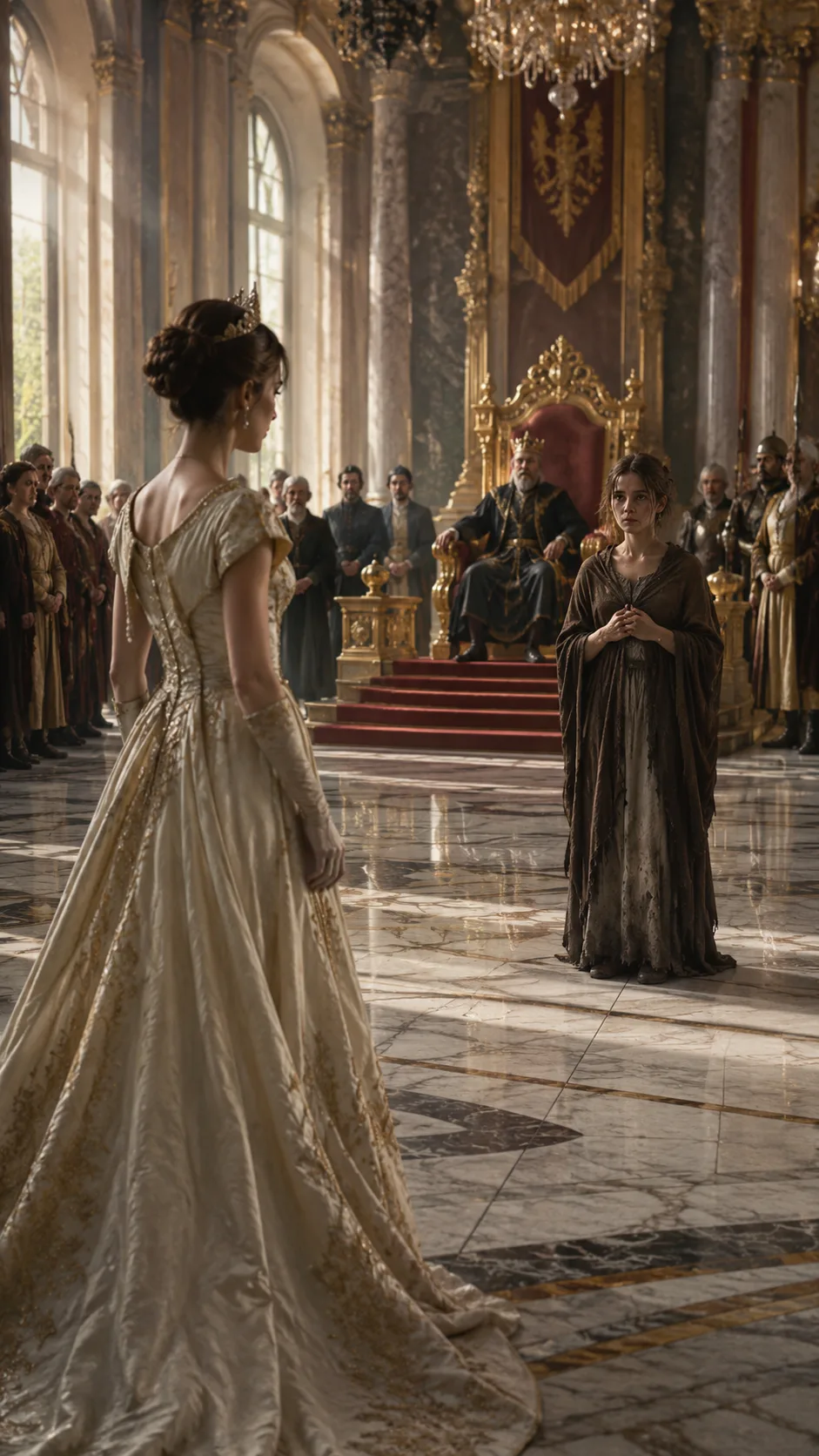
own names. Tall stone columns rose to a painted ceiling where gold stars shimmered in the daylight. Red velvet banners hung between the windows. Crystal chandeliers caught the sun and scattered it across the marble floor like broken diamonds.
At the far end of the hall, King Aldric sat on a golden throne.
He was fifty-five, though grief had placed older shadows around his eyes. His beard was trimmed with silver. His dark robe was embroidered with gold thread. The crown on his head was heavy, but it was not the weight that had bent his shoulders over the years.
It was the empty nursery in the east wing.
It was the tiny cradle that had been locked away for twenty years.
It was the child no one spoke of unless they wanted the king to leave the room.
Beside the lower steps of the throne stood Princess Celestia.
She was not Aldric’s daughter by blood.
Everyone knew that, though no one said it in front of her.
She was the daughter of the late queen’s younger sister, taken into the palace after the royal infant vanished and raised under the king’s protection. For years, the court had called her the king’s heir. She wore the title like a jewel and the palace like it had been built for her alone.
Celestia was beautiful in the way expensive things were beautiful. Her ivory gown was stitched with gold vines. Pearls hung from her ears. A jeweled tiara rested in her dark hair, catching every eye in the room.
She turned when the guards entered with the girl.
The court went quiet.
The girl stood at the center of the marble floor.
Her cloak hung loosely from her shoulders. Her hair was wind-tangled. Dust marked the hem of her dress. She looked small beneath the chandeliers, but she did not bow until the guards shoved her forward.
Her knees bent.
Her head lowered.
But she did not drop to the floor.
A murmur moved through the nobles.
Celestia noticed first.
She always noticed disrespect.
“What is this?” she asked.
The older guard bowed. “Your Highness, she was found near the royal fountain. She refused to leave.”
Celestia’s gaze moved to the girl’s hands.
“What is she holding?”
The guard reached for the blue silk.
The girl pulled it close to her chest.
A few nobles smiled.
King Aldric leaned back on the throne, tired and distant. He had spent the morning listening to petitions about taxes, grain, borders, and marriages. His mind had drifted toward the locked east wing more than once.
Then the girl lifted her head.
For half a second, his eyes narrowed.
Something about her face seemed familiar.
Not exact.
Not clear.
A line of the jaw. The shape of the brow. The way she stood, even in rags, as if her spine had never learned how to bend for cruelty.
Celestia stepped down one stair.
Her slippers made no sound on the marble.
“What is your name?”
The girl looked at the king before she answered.
“My name is Elara.”
The court whispered again.
“Elara,” Celestia repeated, tasting the name with open dislike. “And why have you come into a royal court dressed like that?”
Elara looked down at the silk in her hand.
“I was told this palace would know where I came from.”
A servant near the wall stiffened.
It was almost nothing.
But King Aldric saw it.
So did Celestia.
The princess turned her head slightly toward the servant. He lowered his gaze at once, but not quickly enough.
Celestia smiled.
Not warmly.
“You were told?” she said. “By whom?”
Elara’s fingers moved over the edge of the cloth.
“The woman who raised me.”
“And where is this woman?”
Elara did not answer right away.
The silence made the nobles lean closer.
“She died three days ago.”
No one in the court moved.
Elara continued, her voice quieter. “Before she died, she gave me this. She said it was wrapped around me when I was brought to her. She said there was a mark on it. She said if I ever had nowhere else to go, I should bring it to the palace.”
Celestia’s smile faded.
The king’s hand shifted on the armrest.
“Bring it here,” Aldric said.
The court turned toward him.
It was the first time he had spoken since the girl entered.
Elara took one step forward.
Celestia moved into her path.
“No.”
The word rang across the room.
Aldric looked at her.
Celestia kept her eyes on Elara.
“This is absurd. Father, you cannot allow every street girl with a dirty scrap of cloth to interrupt court business.”
The word Father was deliberate.
Sharp at the edges.
Aldric’s face did not change, but something in his hand tightened.
Elara looked from Celestia to the king.
“I only want to know the truth.”
Celestia turned on her.
“The truth?” She gave a short laugh. “The truth is that you were found sneaking around the palace fountain. The truth is that you refused the guards. The truth is that you stand in a royal hall with mud on your feet and expect a king to care about your little story.”
Elara lowered her eyes.
She did not move.
The princess stepped closer.
“You should be on your knees.”
Elara’s thumb rubbed once over the blue silk.
“I already bowed.”
“Not low enough.”
A few nobles exchanged pleased looks. They enjoyed cruelty when it wore perfume and gold.
King Aldric watched Celestia. His expression remained calm, but the old chamberlain beside the throne knew him too well. The king’s silence had changed. It was no longer tired.
It was listening.
Celestia turned toward the court and lifted one graceful hand.
“Look at her,” she said. “Look at what happens when pity is mistaken for permission. She touches palace stone once and thinks she has royal blood. She hears a dying woman’s tale and thinks she can walk into this hall and demand answers.”
Elara’s face stayed still.
Only her fingers betrayed her, tightening again around the silk.
Celestia stepped so close that the gold embroidery of her gown almost brushed Elara’s cloak.
“What did that woman tell you?” she asked.
Elara looked at her.
“She told me I was not born in the village.”
A whisper passed through the room.
“She told me I was carried there at night by a man with blood on his sleeve.”
Another whisper. Louder now.
“She told me he left before dawn. He gave her silver, this cloth, and one instruction.”
King Aldric rose half an inch from the throne.
Celestia snapped, “Enough.”
Elara looked past her.
The king’s voice came low. “What instruction?”
Celestia spun toward him. “Father—”
“What instruction?” he repeated.
Elara swallowed.
“She said he told her never to let anyone see the mark unless I was in danger.”
The chamberlain’s face went white.
The king stood fully.
But Celestia moved first.
She struck Elara across the face.
The sound cracked through the throne room.
A crystal goblet trembled on a nearby table. One noblewoman covered her mouth. A guard looked down at the floor.
Elara stumbled back half a step.
She did not fall.
The blue silk slipped from her fingers and landed on the marble between them.
Her cloak slid from one shoulder.
For one breath, no one understood why the king had gone completely still.
Then they saw it.
A small crescent-shaped birthmark near Elara’s collarbone.
Pale against her skin.
Perfectly curved.
Exactly where the royal physician had once written it down in the sealed birth record of the missing princess.
The chamberlain dropped to one knee.
Not slowly.
Not politely.
He collapsed as if the strength had left his legs.
Celestia turned toward him, confused.
“What are you doing?”
The old man did not look at her.
His eyes were on Elara.
King Aldric descended the first step of the throne.
His face had lost all color.
Elara reached for her cloak, trying to pull it back over her shoulder, but her hand stopped when she saw the king staring.
He took another step.
Then another.
The entire court bent under the silence.
Celestia’s lips parted.
“No,” she said.
No one answered her.
Aldric stopped three feet from Elara.
He looked at the mark, then at the blue silk on the floor.
His voice came out rough.
“Where did you get that mark?”
Elara’s hand remained frozen near her collar.
“I was born with it.”
The king looked at the chamberlain.
The old man’s head bowed lower.
“My king,” the chamberlain whispered. “The physician’s record. The missing infant had the same mark.”
Celestia stepped backward.
“That means nothing.”
Aldric did not look at her.
“Elara,” he said, as if the name hurt him. “Who raised you?”
“A woman named Mira.”
The king closed his eyes.
The name struck him harder than the slap had struck Elara.
Mira.
The young laundry maid who had vanished from the palace two nights after the princess disappeared. The court had searched for her, accused her, cursed her name. For twenty years, she had been remembered as either a thief or a traitor.
But if she had raised the child…
If she had hidden her…
If she had kept her alive…
Aldric opened his eyes.
“Bring me the silk.”
No one moved.
Then the chamberlain crawled forward on one knee and picked up the cloth with shaking hands. He unfolded it.
The blue silk was old, faded, and stained by time, but the embroidery remained.
A silver crescent.
And beneath it, so small it had almost disappeared into the torn seam, a single thread of gold forming the first letter of the queen’s private mark.
A.
For Amara.
The late queen.
King Aldric took the silk.
His fingers trembled.
Celestia saw it.
Her face hardened.
“You are going to believe this?” she demanded. “A beggar shows a mark and a rag, and suddenly the court is supposed to kneel?”
Aldric turned to her at last.
The room seemed to shrink around that look.
“You struck her.”
Celestia lifted her chin. “She insulted the crown.”
“No,” he said. “She came seeking it.”
The princess’s eyes flashed.
“I am your daughter.”
Aldric’s silence answered before his mouth did.
Celestia’s face changed.
For the first time in her life, the court watched her lose something she could not buy back with beauty, rank, or rage.
The king looked toward the captain of the guard.
“Send for the royal physician’s archive. Bring the sealed birth record. Bring the midwife if she still lives. Bring anyone who served in the east wing the night my daughter disappeared.”
The captain bowed and hurried out.
Celestia stepped forward. “You cannot do this in front of everyone.”
Aldric’s voice remained calm.
“You chose the audience.”
The words landed across the hall.
Celestia looked at the nobles, searching for support.
They gave her none.
Their eyes had already shifted toward Elara.
Not kindly. Not lovingly. But with fear.
Fear was the first form of respect they understood.
Elara stood with one hand still holding her cloak in place, the other pressed lightly against the cheek Celestia had struck. She looked at the king as if she did not know whether to run or kneel.
Aldric saw that.
Slowly, he removed the heavy royal cloak from his own shoulders.
Gasps moved through the court as he stepped forward and placed it around Elara.
The robe was too large. It swallowed her thin frame, the gold embroidery falling past her hands. She looked smaller in it, not grander.
But she no longer looked like someone the court was allowed to touch.
Celestia’s voice shook. “Father.”
Aldric did not turn.
“Do not call me that until I know how far your ambition has gone.”
The princess went still.
The guards at the sides of the room straightened.
Aldric looked down at Elara. His expression changed then, not into certainty, not yet, but into something older and more fragile than power.
“Did Mira ever tell you why she kept you hidden?”
Elara looked at the blue silk in his hands.
“She said the palace was not safe for me.”
The chamberlain covered his face.
Aldric’s jaw tightened.
Behind him, Celestia moved.
Just one step.
But the king heard it.
“Do not leave,” he said.
Celestia froze.
The doors opened before she could answer.
The captain returned with two servants carrying a sealed iron box from the royal archive. Behind them walked an elderly woman with a bent back and white hair pinned beneath a plain gray veil. Two guards supported her by the arms.
The old woman lifted her head when she saw Elara.
Her mouth opened.
No sound came at first.
Then she whispered, “Princess Amara.”
The court erupted.
Not loudly at first. A dozen whispers. Then a hundred. Nobles turned to one another. Servants stared. Guards shifted their weight. The name had not been spoken in that room for twenty years.
Elara stepped back.
“I am not—”
The old woman sank to her knees.
“I held you the night you were born.”
Aldric went still beside her.
The woman pointed a trembling hand toward Elara’s collarbone.
“The crescent mark. The queen kissed it and said the moon had chosen her child.”
Elara’s eyes moved to the king.
Aldric looked as though something inside him had broken open and found breath again.
The chamberlain unlocked the iron box.
Inside lay a yellowed birth record, sealed with the royal crest, and a small painted miniature of the infant princess. On the record, written in the royal physician’s hand, were the words:
Female child. Dark hair. Crescent birthmark below the right collarbone.
Aldric read the line once.
Then again.
The paper shook in his hand.
Celestia took another step backward.
The captain of the guard turned toward her.
This time, she noticed.
“What are you doing?” she said.
No one answered.
The elderly midwife kept her eyes on Elara. “There was a fire in the east wing that night. We were told the child died. But I saw a man leaving through the laundry passage with a bundle under his cloak. I tried to speak. By morning, I was dismissed and sent away.”
Aldric’s voice became dangerously quiet.
“Who dismissed you?”
The old woman looked at Celestia.
Not directly at first.
Then fully.
“Her mother.”
The room fell silent again.
Celestia’s face drained.
“My mother is dead,” she said.
“Yes,” the midwife answered. “And she took many secrets with her.”
Aldric turned to Celestia.
For years, he had protected her. Fed her. Educated her. Given her gowns, tutors, horses, jewels, and a place at his side because she had been the child left in the palace after his own was gone.
Now he saw not a daughter, but the shadow of a crime dressed in ivory and gold.
“Did you know?” he asked.
Celestia’s mouth opened.
For once, no perfect answer came.
That was enough.
Aldric looked at the captain.
“Take Princess Celestia to the west chamber. She is not to leave. No visitors. No letters. No servants except those I appoint.”
Celestia’s voice broke into fury. “You cannot imprison me over a beggar!”
The king stepped toward her.
“She has a name.”
Celestia looked at Elara with hatred sharp enough to cut glass.
“She is nothing.”
Aldric’s eyes hardened.
“She is my daughter.”
The words struck the throne room like a bell.
Elara stopped breathing.
The court dropped to its knees.
One by one, nobles lowered themselves to the marble. Guards bowed their heads. Servants folded to the floor. Even those who had smiled when Celestia mocked her now pressed their palms to the stone.
Elara stood alone, wrapped in the king’s robe, staring at a room that had spat on her moments before and now bowed at her feet.
She did not smile.
She did not lift her chin.
She looked down at the torn blue silk in Aldric’s hands, then at the woman who had identified her, then at the princess being held by two guards near the steps.
Celestia fought once.
The guards tightened their grip.
Her tiara slipped crooked in her hair.
For the first time, she looked less like royalty and more like someone terrified of being seen without it.
Aldric turned back to Elara.
He did not reach for her at first.
He seemed to understand that blood did not erase twenty years of hunger, fear, and unanswered questions. A crown could claim her in a sentence. A father could not.
So he lowered himself.
The king of the realm knelt on the marble before the girl everyone had called a beggar.
The court watched without breathing.
Aldric bowed his head.
“I failed you before I knew your name,” he said. “I cannot undo the years. But if you allow me, I will spend every day I have left answering for them.”
Elara looked at him for a long time.
The mark near her collarbone was hidden again beneath the robe, but everyone in the room seemed to see it anyway.
At last, she bent and picked up the blue silk from his hand.
Her voice was quiet.
“The woman who raised me said I should not hate the palace until I knew the truth.”
Aldric looked up.
Elara folded the cloth once.
Then again.
“I want the truth first.”
The king nodded.
“You shall have it.”
She looked toward Celestia.
“And justice.”
Aldric rose.
The grief in his face remained, but something stronger stood beside it now.
“You shall have that too.”
Three days later, the palace bells rang for the first time in twenty years without mourning.
The royal physician’s archive confirmed the record. The midwife’s testimony uncovered the plot. Celestia’s mother had arranged the disappearance of the infant princess after the queen’s death, hoping her own daughter would one day inherit the throne. Mira, the laundry maid accused of betrayal, had discovered the child was alive and fled with her into the countryside, hiding her not for ransom, but survival.
Mira had died poor.
But she had kept a princess alive.
King Aldric ordered her name cleared in every town square in the kingdom. A stone was placed for her in the royal garden, beneath the fountain where Elara had been found.
Celestia was stripped of succession rights.
She was not executed. Elara asked for that.
Not out of mercy that sounded pretty in songs, but because she wanted Celestia to live long enough to watch the truth become history.
Months later, when Elara stood again in the throne room, she wore no tiara.
Not yet.
Her gown was simple blue silk, the same color as the torn cloth that had brought her home. The crescent mark near her collarbone remained visible above the neckline, not hidden, not displayed like a trophy, just present.
The court bowed when she entered.
This time, she did not look surprised.
King Aldric stood beside the throne and offered his hand.
Elara looked at it.
Then at the marble floor where she had once been struck.
Then at the nobles who had laughed.
She took one step forward.
Not as a beggar.
Not as a lost child.
As the daughter of a queen, the keeper of a dead woman’s promise, and the living proof that a crown stolen in silence could still be answered in front of everyone.
When she placed her hand in the king’s, the bells began again.
And this time, no one in the palace dared pretend they did not hear.
Chapter complete
You have reached the end of this chapter.
Continue reading
A few more worlds to get lost in after this chapter.




