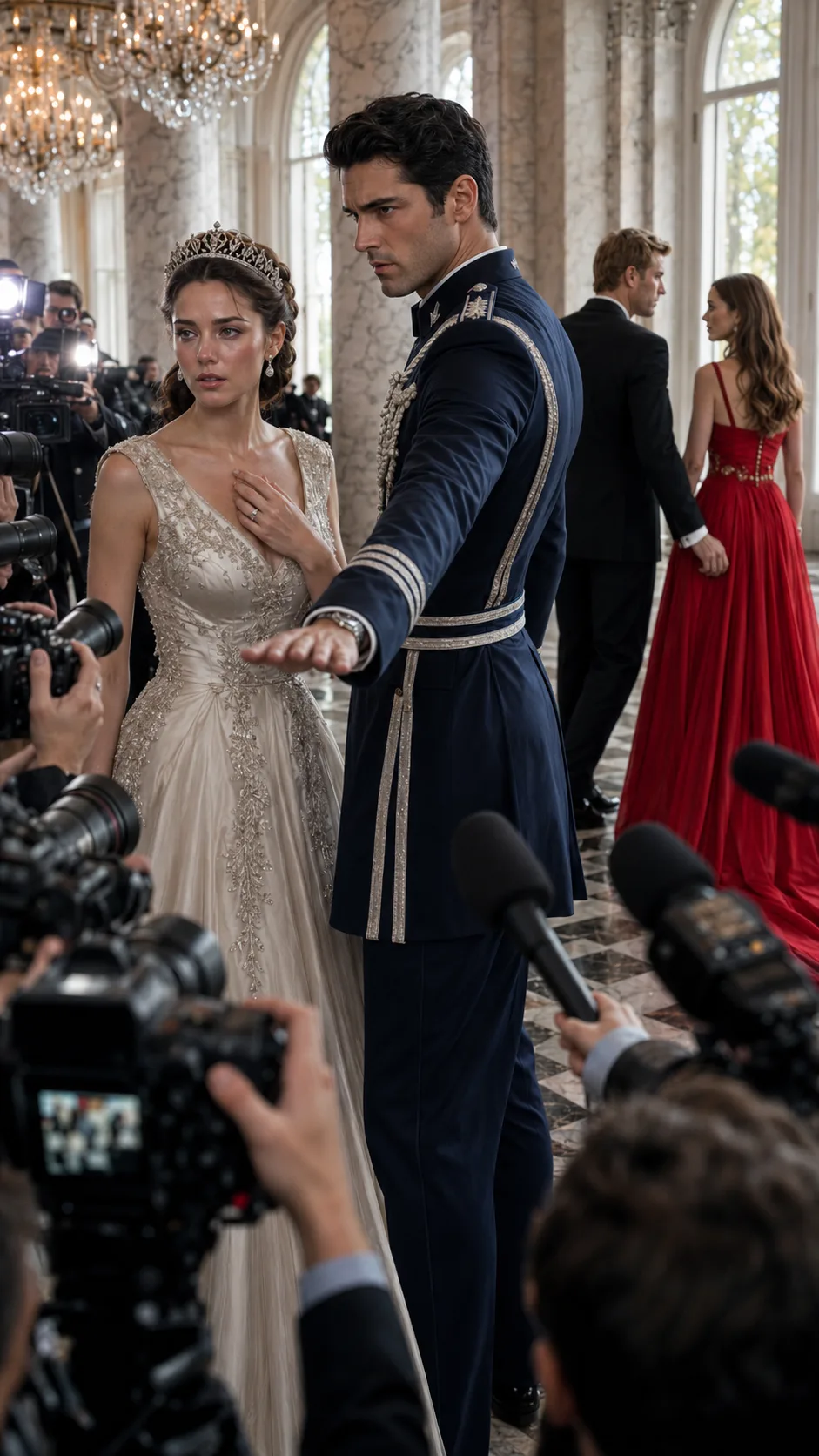
The Princess Let the Public Choose Wrong Until One Prince Finally Stood Where Her Fiancé Never Did Before Millions Watched
Princess Catherine had learned early that a crown could turn silence into duty.
Chapter 1
The Princess Let the Public Choose Wrong Until One Prince Finally Stood Where Her Fiancé Never Did Before Millions Watched
Princess Catherine had learned early that a crown could turn silence into duty.
When she was twelve, her grandmother told her that a princess never reacted in public.
When she was seventeen, her royal tutors told her that a princess never corrected a prince in front of the court.
When she was twenty-five, the Royal Council told her that a princess never refused a marriage that kept two kingdoms from war.
By twenty-six, Catherine had become very good at standing still while other people decided what her life should look like.
She stood still when the engagement announcement was made.
She stood still when Prince Charles smiled beside her on the balcony and raised her hand for the cameras.
She stood still when newspapers called them “the perfect royal couple.”
She stood still when strangers online posted edited portraits of her and Charles with golden crowns above their heads.
She stood still when the palace released a campaign video showing Charles visiting hospitals,
greeting children, laughing beside soldiers, and placing one careful hand on Catherine’s back as if he had always protected her.
The public loved him immediately.
Prince Charles was handsome in the exact way the royal press knew how to sell. Tall, polished, confident, with dark blond hair, expensive suits, and a smile that seemed made for balcony appearances. He knew how to turn his face toward the best light. He knew when to lower his voice. He knew when to pretend that every question surprised him, even when his advisers had prepared every answer the night before.
The people called him charming.
The newspapers called him modern.
The Royal Council called him necessary.
Catherine called him her fiancé because that was the only word she was allowed to use.
Their marriage was meant to unite two powerful kingdoms: Westhaven, Catherine’s homeland, and Asterley, Charles’s kingdom. The official story was simple.
Two young royals had fallen in love after years of friendship. Two crowns would become one alliance. Two nations would step into a brighter future together.
It was a beautiful story.
It was also a lie.
Catherine and Charles had known each other for only eight months before the engagement. Most of those eight months had been spent in controlled meetings, photographed dinners, and public events where every laugh had a camera nearby.
In private, Charles rarely asked Catherine anything.
He did not ask what kind of music she liked.
He did not ask why she always paused before entering a hospital ward.
He did not ask why she touched the silver locket at her throat whenever reporters mentioned her late mother.
He knew her titles, her schedule, her approval rating, and the estimated political value of their wedding.
He did not know her.
But the public did not see
that.
They saw the prince the palace wanted them to see.
And when another prince entered the story, they hated him before he even spoke.
Prince William of Northmere arrived in Westhaven three months before the wedding, officially as a diplomatic guest. Northmere was smaller than Asterley, colder, less glamorous, and often ignored by the royal press. But its army had protected Westhaven’s northern border during the famine wars. Its ports had carried food into villages when the sea routes collapsed. Its king had died defending a treaty that most larger kingdoms had abandoned.
William came as the new royal envoy.
The tabloids decided he came for Catherine.
They called him “the prince who arrived too late.”
They called him “a threat to peace.”
They called him “the man trying to break a royal engagement.”
None of that was true.
At least, not at first.
William never stood too close to Catherine in public. He never looked at her for too long when the cameras were near. He never gave interviews about her. He never answered questions about the engagement.
But Catherine noticed things.
She noticed that when Charles interrupted her during council briefings, William looked down at the table, jaw tight, as if forcing himself not to speak.
She noticed that when reporters shouted personal questions at her, William’s expression changed—not dramatically, not enough for the newspapers to frame, but enough for her to see it.
She noticed that when a young girl at a school visit asked Catherine if princesses ever got scared, William was the only adult in the room who did not laugh softly.
Catherine had answered, “Of course they do.”
The girl had asked, “Then what do they do?”
Before Catherine could respond, Charles had leaned down with his practiced smile and said, “They remember they are princesses.”
The room applauded.
William did not.
Later that day, as Catherine stepped into the hallway outside the classroom, William walked beside her for exactly six seconds.
“That little girl deserved a better answer,” he said quietly.
Catherine looked at him.
It was the first honest sentence anyone had spoken to her that week.
“What would you have said?” she asked.
William kept his eyes forward. “That courage does not mean being unafraid. It means being afraid and still refusing to abandon what matters.”
Catherine said nothing.
But that night, she wrote the sentence down.
The palace noticed their short conversations before the public did.
Queen Helena, Catherine’s stepmother and the strongest voice in the Royal Council, summoned Catherine two days later.
Helena’s private office overlooked the western gardens. Everything inside it was pale, expensive, and cold. White marble fireplace. Silver-framed portraits. Cream curtains. A glass desk with nothing on it except a gold pen and a file containing Catherine’s wedding schedule.
Helena sat behind the desk without offering tea.
“You are being watched,” she said.
Catherine remained standing. “I am always being watched.”
“Do not be clever.”
“I was being accurate.”
Helena’s eyes narrowed. She was a beautiful woman in her early fifties, elegant and controlled, with the kind of smile that made servants lower their voices. She had married Catherine’s father five years before his death and had spent every year since learning how to sound like a mother while acting like a ruler.
“The people love Charles,” Helena said. “They believe in this marriage.”
“The people believe what the palace shows them.”
“And that is why the palace must show them the right thing.”
Catherine understood the warning.
Helena opened the file and turned it toward her. Inside were printed screenshots from social media. One showed Catherine and William standing beside each other at a hospital opening. Another showed William helping Catherine guide a lost child back to his nurse. A third showed them laughing at something no one else seemed to hear.
The caption beneath one image read: She looks happier with him.
Helena tapped the page.
“This ends now.”
“There is nothing to end.”
“Do you think the public cares about truth?” Helena asked. “They care about the story they can understand. Charles is your fiancé. William is an outsider. If you allow this to continue, you will make yourself look disloyal.”
Catherine’s hand tightened around her locket.
“I have done everything the council asked of me.”
“No,” Helena said softly. “You have obeyed. That is not the same as helping.”
The words landed harder than Catherine expected.
Helena stood and walked around the desk.
“Your father trusted me to protect this crown,” she said. “Charles brings Asterley’s navy, its trade routes, its money, and its political support. William brings sympathy and a tragic biography. Do not confuse pity with power.”
Catherine lifted her chin.
“And do not confuse power with respect.”
For one second, Helena’s expression changed.
Then she smiled.
“There she is,” Helena said. “The girl your mother raised. Proud. Difficult. Always mistaking emotion for principle.”
Catherine went still.
Helena knew exactly where to cut.
“Your mother would have understood duty,” Helena continued.
“My mother understood people.”
“Your mother is not here.”
The room went silent.
Catherine’s stomach dropped, but her face did not move. She had trained too long for that.
Helena stepped closer.
“You will stand beside Charles at the Children’s Foundation Gala next week. You will smile. You will thank the public for supporting the wedding. And you will stay away from Prince William unless protocol demands otherwise.”
Catherine looked at the file, then at Helena.
“What if protocol demands that I speak?”
“Then speak carefully.”
Catherine left the office with her pulse pounding beneath her pearl earrings.
Outside the door, William was standing at the far end of the corridor.
He was not eavesdropping. He was speaking with one of the palace security officers. But when Catherine stepped out, his gaze found her face with unsettling speed.
He saw too much.
That was the problem.
Charles saw what benefited him.
Helena saw what threatened her.
The public saw what the palace edited for them.
William saw Catherine.
And Catherine did not know what to do with that.
The Children’s Foundation Gala was supposed to be the final public event before the wedding celebrations began.
It was held in the Grand Hall of Westhaven Palace, a vast glass-roofed charity space restored by Catherine’s mother years earlier. The hall had white marble columns, tall windows, chandeliers shaped like falling stars, and a raised platform where donors gave speeches beneath the royal crest.
Catherine had chosen the foundation herself.
Long before the engagement, long before Charles, long before the palace turned her life into a political campaign, Catherine had worked with children from border villages affected by war and poverty. She knew their names. She remembered which children liked drawing, which ones hated hospitals, which ones were afraid of loud applause.
The gala was not just another event to her.
It mattered.
That morning, Catherine arrived early.
She wore a pale ivory satin gown with a high neckline, pearl earrings, and her mother’s locket tucked beneath the fabric. Her hair was pinned neatly at the back of her head. Her makeup was soft. Her smile was ready.
Charles arrived forty minutes late.
He entered through the side doors surrounded by aides, cameras, and Princess Beatrice.
Beatrice was not technically part of the engagement arrangements, but she had become impossible to ignore. She was Charles’s childhood friend, a distant royal cousin from another court, and the woman every tabloid called “the princess who knows him best.”
She was glamorous, sharp, and always close enough to Charles to be photographed.
That night, Beatrice wore a red silk gown that made half the room turn when she entered. She laughed at something Charles whispered. Charles placed his hand at the small of her back as they walked.
Catherine saw it.
So did William.
He stood near the donor reception line in a navy royal uniform, speaking with an elderly ambassador. His eyes moved from Charles’s hand to Catherine’s face.
Catherine looked away first.
The gala began beautifully.
Catherine greeted children by name. She knelt to speak with a little boy who had drawn a picture of the palace garden. She thanked nurses, teachers, and volunteers. She delivered a speech about rebuilding childhoods instead of simply repairing buildings.
For five minutes, the room listened.
Then Charles took the stage.
He smiled like he had already won.
“My future wife has always cared deeply about causes like this,” he said.
Causes like this.
Catherine felt the words tighten around her chest.
He continued, “And I am proud to stand beside her as we bring compassion, stability, and unity to both our kingdoms.”
The applause was immediate.
The cameras loved him.
Catherine stood beside him and smiled because that was what a princess did.
Then the live interview segment began.
A royal broadcast host stepped onto the platform, polished and excited, with cameras positioned across the hall. The gala was being streamed nationwide. Millions were watching from homes, cafes, hospitals, and city squares.
The host asked Catherine about the foundation’s new children’s wing.
Catherine leaned toward the microphone.
Before she could answer, Charles spoke.
“The wing represents what Catherine and I hope to build together,” he said. “A future where our nations are united by care.”
Catherine’s smile stayed in place.
The host turned to her again. “Your Highness, you’ve been personally involved in the border education program for years. What inspired that work?”
This time Catherine opened her mouth faster.
“My mother began—”
A bright laugh cut across the edge of the platform.
Beatrice had leaned close to Charles and whispered something. Charles laughed, not softly, not discreetly, but visibly enough that several cameras shifted toward him.
The host paused.
Catherine stopped speaking.
Charles did not seem to notice.
Beatrice touched his sleeve, tilting her head toward a private donor near the west exit.
Charles glanced at Catherine for less than a second.
“I’ll be right back,” he murmured.
Then he stepped away.
On live broadcast.
In front of the children’s foundation.
In the middle of Catherine’s answer about her mother.
He walked off the platform with Beatrice.
For a heartbeat, nobody moved.
Then every reporter in the hall understood what had just happened.
The cameras turned.
The whispers started.
Catherine stood alone beneath the royal crest, one hand resting near the microphone, the other pressed lightly against her gown as if the fabric could hold her steady.
The host tried to recover.
“Your Highness, perhaps we can return to—”
A reporter shouted from the press line.
“Princess Catherine, how do you feel watching Prince Charles leave with Princess Beatrice during your own charity event?”
Another voice followed.
“Is the engagement still stable?”
“Has Princess Beatrice caused tension between you?”
“Were you aware they would appear together tonight?”
“Does Prince Charles still support your foundation?”
“Are you embarrassed, Your Highness?”
The word embarrassed struck harder than the rest.
Catherine’s throat tightened.
She looked toward the west exit.
Charles had not stopped.
Beatrice looked back once.
She smiled.
That was the moment something inside Catherine went cold.
Not broken.
Cold.
The reporters moved closer. Security hesitated because the cameras were live and nobody wanted to create a scene. The children near the front row stared up at Catherine with wide eyes. The host kept saying, “Please, one question at a time,” but no one listened.
The room was turning on her.
Not because she had done anything wrong.
Because she had been left standing alone.
Then William moved.
He crossed the marble floor with no permission from the protocol officers. His boots hit the ground with clean, sharp sound. He did not rush. He did not look dramatic. He simply walked forward as if the space between Catherine and the reporters had always belonged to him.
A palace aide tried to touch his arm.
William did not stop.
Catherine heard his footsteps before she saw him.
Then he stepped onto the platform and placed himself between her and the cameras.
Not beside her.
In front of her.
The hall went silent so quickly it felt like the air had been cut.
William faced the press line.
His voice was calm, but it carried through every microphone in the room.
“Ask her about the children she came here to help,” he said, “not the man who forgot to stand beside her.”
No one spoke.
Catherine stared at the back of his navy uniform.
The sentence reached every camera.
Every phone.
Every living room.
Every person who had spent months calling him an intruder.
William turned slightly, just enough to look at Catherine.
His voice lowered, but the nearest microphone still caught it.
“Are you all right?”
Catherine could have said yes.
That was the safe answer.
The trained answer.
The royal answer.
But something about the way he asked it made lying feel unbearable.
“No,” she said quietly. “But I will be.”
William nodded once, then turned back to the press.
“The princess was answering a question about her mother’s work,” he said. “You may continue from there.”
The host blinked like someone had handed her the script after the building caught fire.
“Yes,” she said quickly. “Princess Catherine, you were speaking about Queen Margaret.”
Catherine looked past William.
The children were still watching.
A little girl in the front row held a paper flower Catherine had given her earlier.
Catherine stepped forward.
William moved aside, but he stayed close enough that the reporters did not surge again.
Catherine placed both hands on the podium.
“My mother believed charity should never be used as decoration,” she said.
The room went still.
“She taught me that children do not need royal pity. They need schools that remain open. Doctors who return. Homes that do not disappear when the cameras leave.”
Her voice strengthened.
“The new wing is not a symbol of my engagement. It is not a backdrop for politics. It belongs to the children who survived more than any child should be asked to survive.”
The silence changed.
It was no longer awkward.
It was listening.
Catherine continued.
“And tonight, I ask every person watching to remember why we came here.”
She looked toward the press line.
“Not for gossip.”
Then toward the children.
“For them.”
The applause did not begin immediately.
It began with one nurse.
Then a teacher.
Then the front rows.
Then the entire hall rose to its feet.
The cameras captured Catherine standing at the podium, pale but steady, with William behind her and slightly to the side—not claiming her, not touching her, not smiling for himself.
Just standing where Charles had not.
Within minutes, the clip was everywhere.
At first, the palace communications team tried to cut the broadcast segment from official channels.
They were too late.
Someone had screen-recorded Charles walking away.
Someone else had captured Beatrice’s smile.
Dozens had filmed the reporters circling Catherine.
And every angle caught William’s sentence.
“Ask her about the children she came here to help, not the man who forgot to stand beside her.”
By midnight, the country had split in two.
By sunrise, it had chosen a side.
The old hashtag had been simple.
#ChooseCharles
It had been used for months by royal fan accounts, palace-friendly journalists, and citizens who believed the engagement represented peace.
But after the gala, another hashtag began appearing beneath every clip.
#LetCatherineChoose
At first it was small.
Then it was everywhere.
A nurse posted: “I was in that hall. Prince William did what every decent person should have done.”
A teacher wrote: “Princess Catherine remembered every child’s name. Charles didn’t even remember to stay.”
A war widow from the northern border posted a photograph of William’s father delivering food crates during the famine wars.
“Northmere stood with us before,” she wrote. “Maybe we should have remembered.”
The public had chosen the wrong prince first.
Now they knew it.
Inside the palace, panic spread faster than support.
Queen Helena called an emergency council meeting before breakfast.
Charles arrived with red eyes and an angry jaw. Beatrice was not invited, but everyone knew she was waiting in the east sitting room.
Catherine arrived last.
She wore a simple navy dress, pearl earrings, and no engagement ring.
The absence was louder than any accusation.
Charles saw it immediately.
“Put it back on,” he said.
The council chamber went silent.
Catherine looked at him. “Good morning to you too.”
“This is not a joke.”
“No,” she said. “It stopped being a joke when you left me alone on a live broadcast.”
Charles stepped toward her.
“I was speaking to a donor.”
“You were walking away with Beatrice.”
“It was a misunderstanding.”
Catherine almost laughed.
Not because it was funny.
Because it was pathetic.
“A misunderstanding requires confusion,” she said. “Millions of people understood exactly what they saw.”
Helena struck the table with her palm.
“Enough.”
Everyone turned.
Helena’s face was calm, but her eyes were sharp.
“This marriage will proceed,” she said. “The alliance cannot be endangered because of one poorly handled public moment.”
Catherine looked at the council members.
Some avoided her eyes.
Some looked worried.
One elderly minister looked ashamed.
Charles pointed toward the window, where distant chants could already be heard beyond the palace gates.
“They are humiliating me,” he said.
Catherine stared at him.
That was what he cared about.
Not the foundation.
Not the children.
Not leaving her alone.
His humiliation.
“You humiliated yourself,” she said.
His face darkened.
“You would not even have this public sympathy without him.”
Everyone knew who he meant.
William.
Helena leaned back slowly.
“Prince William will return to Northmere by the end of the week,” she said. “His diplomatic work is complete.”
Catherine’s pulse jumped.
She kept her face still.
“No,” she said.
Helena turned to her. “Excuse me?”
“He came under treaty invitation. His schedule is approved for another month.”
“Plans change.”
“Not because Charles is jealous.”
Charles snapped, “Jealous?”
Catherine faced him fully.
“Yes.”
The word cracked through the room.
Charles took one step closer.
“I am your fiancé.”
“You are a man who left me standing alone while reporters asked if I was embarrassed.”
“I apologized.”
“No,” Catherine said. “Your aide apologized.”
Charles flushed.
The elderly minister finally spoke.
“Your Highness, perhaps the people’s reaction should be considered—”
Helena cut him off. “The people react to emotion. We govern through structure.”
“And what structure protects me?” Catherine asked.
No one answered.
She looked around the chamber.
“What law protects a princess from being used as a treaty seal? What protocol gives her the right to refuse public disrespect? What council rule says her dignity matters as much as a naval agreement?”
Silence.
Catherine nodded once.
“That is what I thought.”
Helena stood.
“You are emotional.”
“My entire life has been negotiated by people who call every objection emotion.”
“You are risking your country.”
“No,” Catherine said. “I am refusing to confuse my country with Charles’s pride.”
Charles laughed bitterly.
“You think William wants you for love? He wants influence. He wants to weaken Asterley. He wants to be the noble prince in your little tragedy.”
Catherine’s eyes hardened.
“William did not ask me for anything.”
“That makes him more dangerous.”
“No,” Catherine said. “It makes him different from you.”
Charles looked as if she had slapped him.
Helena’s voice dropped.
“You will regret this.”
Catherine touched the place where her ring used to be.
“I already regret enough.”
That afternoon, the palace released an official statement.
It said Princess Catherine and Prince Charles remained committed to their engagement.
It said the gala incident had been exaggerated by hostile media.
It said Prince William’s actions were appreciated but unnecessary.
The statement lasted twelve minutes before Catherine destroyed it.
She did not ask permission.
She walked into the same broadcast room where her engagement had been announced and requested a live camera.
The palace press secretary nearly fainted.
Helena arrived two minutes too late.
By then, the red light was already on.
Catherine stood alone in front of the royal crest.
No Charles.
No William.
No council.
Just the princess the public had finally started listening to.
“My country deserves honesty,” she said.
The broadcast cut across every major channel.
People stopped in train stations.
Hospital waiting rooms went quiet.
Phones lifted in cafes.
Catherine kept her hands folded in front of her.
“For months, you were told that my engagement to Prince Charles was a love story. It was not. It was a political arrangement made for reasons the council believed were necessary.”
A wave of noise moved through the palace corridor outside.
Catherine continued.
“I accepted that duty because I believed peace required sacrifice. But duty does not require humiliation. Peace does not require silence. And a crown should never ask a woman to disappear inside a marriage she did not choose.”
Her voice trembled once.
Only once.
“I am grateful to the people who supported me last night. But I do not ask you to choose a prince for me. I ask you to respect that I must choose my own future.”
She paused.
Then she said the sentence that ended the engagement before any legal document could.
“I will not marry Prince Charles.”
The palace erupted.
Somewhere outside, the crowd began to roar.
Catherine did not smile.
She removed the engagement ring from the small velvet pouch in her hand and placed it on the table before her.
“The alliance between Westhaven and Asterley should be negotiated by leaders, not hidden inside a wedding gown.”
Then she looked straight into the camera.
“To the children at the foundation, I am sorry your night became something else. I promise it will not be remembered that way. It will be remembered as the night this country chose truth over performance.”
The broadcast ended.
For several seconds, no one in the room moved.
Then Helena entered.
Her face was white with fury.
“You have no idea what you have done.”
Catherine turned.
“Yes,” she said. “I do.”
Charles appeared behind Helena.
He looked less angry now.
More stunned.
As if he had truly believed she would never do it.
“You ended us on television,” he said.
Catherine looked at him for a long moment.
“No, Charles. You ended us when you forgot I was a person. The television only caught up.”
He had no answer.
Outside, the chants grew louder.
Not Choose William.
Not Punish Charles.
Not Crown Catherine.
Only one phrase, rising from thousands of voices beyond the palace gates.
“Let Catherine choose.”
William left Westhaven Palace three days later.
At least, he tried to.
Catherine found him in the north courtyard before dawn, standing beside a black royal car with his travel coat folded over one arm. The sky was pale gray. The palace windows reflected the first thin line of morning.
“You were going to leave without saying goodbye,” she said.
William turned.
He looked tired.
Not weak.
Just tired in the way good men became tired when they had spent too long trying not to want something impossible.
“I thought it would make things easier,” he said.
“For whom?”
He looked down.
Catherine stepped closer.
“William.”
He met her eyes.
There were no cameras in the courtyard. No reporters. No council members. No hashtags. No palace lights arranged to flatter them.
Just two people in the cold morning.
“I did not end my engagement because of you,” Catherine said.
“I know.”
“But you helped me remember I had the right to end it.”
His expression changed, barely.
“I only stood where anyone should have stood.”
“But you did stand.”
The words hung between them.
William looked toward the palace gates.
“The public will turn this into another story. They already have.”
“Then let them be wrong again,” Catherine said.
He looked back at her.
She smiled slightly.
“Until I am ready to tell the truth.”
William’s voice softened.
“And what is the truth?”
Catherine took one step closer.
“The truth is that I do not need another man to rescue me from the first one.”
William nodded.
“Good.”
“But I would like to know the man who asked if I was all right when the whole country was watching.”
For the first time since she had met him, William smiled without restraint.
It was small.
It was real.
And it belonged only to that quiet courtyard.
“I would like that too,” he said.
A year later, the Children’s Foundation opened its new wing.
Catherine attended as patron, not as a bride.
The alliance with Asterley had survived, but it had changed. The treaty was renegotiated through parliament, trade ministers, and public review. Charles returned to his kingdom with his reputation damaged, though not destroyed. Beatrice married a duke six months later and never again stood close enough to a taken prince to be mistaken for innocent.
Queen Helena remained in the palace, but her power weakened. The council no longer spoke of Catherine as if she were a document waiting to be signed.
And William?
He returned to Westhaven often.
Not as an intruder.
Not as a savior.
Not as a prince stealing a bride.
He came as the man who waited until Catherine could choose without being cornered by duty.
When they finally appeared together on the balcony two years after the gala, Catherine wore a blue satin gown and her mother’s locket. William stood beside her, close but not possessive.
A reporter shouted from below, “Princess Catherine, did the public choose correctly this time?”
Catherine looked at William.
Then at the crowd.
Then at the cameras that had once trapped her.
“No,” she said clearly.
The crowd fell quiet.
Catherine smiled.
“The public does not choose my life.”
William lowered his head slightly, not in embarrassment, but in respect.
Catherine reached for his hand because she wanted to.
“Neither does a council. Neither does a treaty. Neither does a prince.”
The crowd waited.
Catherine lifted their joined hands.
“I do.”
For a moment, nobody moved.
Then the cheering began.
Not because a prince had won.
Because a princess had finally been heard.
THE END.
Chapter complete
You have reached the end of this chapter.
Continue reading
A few more worlds to get lost in after this chapter.