The Princess He Tried to Erase
Preston Whitmore checked his reflection in the side of a champagne bucket before he stepped onto the stage.
Chapter 1
Preston Whitmore checked his reflection in the side of a champagne bucket before he stepped onto the stage.
He did not look at me.
Not once.
I sat two tables away from the platform in the Hawthorne Imperial Hotel, wearing a pale blue dress I had repaired myself three nights earlier beneath the yellow light above our kitchen sink. A seam near the waist had split when I bent to pick up one of Preston’s speech drafts from the floor. I had sewn it back together with thread that did not quite match.
Preston had noticed.
“You’re wearing that?” he had asked before we left our apartment.
I had looked down at the dress. “It’s formal enough.”
“It looks homemade.”
I wanted to tell him that most of his life had been homemade before people with titles began clapping for him. His campaign introductions. His donor letters. His late-night talking points. The speech he was about to deliver in front of senators and billionaires.
All of it had
passed through my hands.
Instead, I fastened the small silver locket at my throat and said nothing.
The locket was old, oval, and rubbed dull at the edges. On the front was an engraving so worn that most people thought it was a damaged flower. I had worn it since I was old enough to know what “mine” meant. The orphanage director once told me it was found around my neck when I was left outside a church in Pennsylvania as a baby.
“Probably costume jewelry,” she had said.
But I had kept it.
Some children had birth certificates.
I had a locket.
That night, beneath a thousand crystal lights, Preston stood before New York’s most powerful people and lifted his glass like a man accepting a crown.
The ballroom had been arranged around him. White flowers on every table. Gold-backed chairs. Cameras near the back wall. A blue banner
behind the stage congratulating him on his appointment as Senior Director of Global Partnerships for the New York Governor’s Office. The title sounded heavier than the man wearing it.
People applauded before he even spoke.
Preston smiled.
He was good at being admired.
He thanked the governor. He thanked Conrad Ashcroft, the billionaire developer whose daughter sat near the front in a silk champagne gown. He thanked the committees, the donors, the “international partners,” the people who had “believed in vision.”
Then his eyes found me.
“My wife is here tonight,” he said.
My fingers closed around the stem of my water glass.
For one foolish second, I thought he might remember.
The small apartment we had rented when he was still calling himself a consultant. The nights I ate toast so he could take donors to lunch. The mornings I ironed his only white shirt while he practiced sounding
confident in the bathroom mirror. The quiet years before ambition taught him to be ashamed of every witness who had seen him hungry.
The room turned toward me.
I sat straighter.
Preston looked directly at me and smiled with no warmth.
“Claire stood beside me when I had nothing,” he said. “And for that, I will always be grateful.”
A few women made soft approving sounds.
Then Preston lowered his glass slightly.
“But gratitude is not the same as destiny.”
The sentence landed before I understood it.
The smile stayed on his face.
“Public life demands more than loyalty. It demands heritage, refinement, education, and a partner who understands the burden of legacy.”
Someone near my table shifted in his chair.
Preston continued.
“I cannot pretend anymore that a woman found outside a church, without a birth certificate, without family, without a name anyone can verify, is prepared to stand beside me in the future I have been called to build.”
The room changed.
Not loudly.
A fork touched porcelain. A whisper stopped halfway through someone’s mouth. The cameras did not move, but I could feel them finding my face.
Preston lifted his glass higher.
“So tonight, with honesty and respect, I am announcing that Claire and I have decided to separate.”
We had decided nothing.
My hand went numb around the glass.
Lydia Ashcroft, seated beside her father near the front, lowered her eyes as if she were embarrassed for me. But her mouth gave her away. One corner rose before she pressed it flat.
Preston turned toward her for half a second.
That was enough.
The applause came slowly, then gathered strength. Not because people approved. Because powerful rooms fear silence more than cruelty. The governor clapped first. Conrad Ashcroft followed. Others joined until the room became a polished machine, helping Preston turn my humiliation into a celebration.
I did not cry.
The hurt came too fast for tears.
It hardened instead.
Preston lifted his glass toward me.
“To new beginnings.”
The ballroom doors opened.
They did not open like hotel doors.
They opened like gates.
Two men in dark suits stepped inside first, scanning every corner of the room. Behind them came uniformed guards in midnight blue and silver, their jackets marked with a crowned white stag holding a rose in its mouth.
The applause died in uneven pieces.
Someone whispered, “The Ardenian Embassy.”
Preston turned sharply.
A tall older man entered the ballroom.
He wore black formal military dress, a blue sash across his chest, and the kind of stillness that made everyone else look temporary. His silver hair was combed back. His face was lined, not with age alone, but with discipline and long grief.
Preston nearly dropped his glass.
“Your Majesty,” he said, rushing down the stage steps. “King Alistair. This is an extraordinary honor.”
The king walked past him.
Not around him.
Past him.
Preston stopped as though he had collided with a wall.
King Alistair’s eyes moved across the room. Table by table. Face by face. He was not looking at the banner or the governor or Conrad Ashcroft.
Then his gaze landed on my throat.
The locket.
His face changed.
It did not soften. It broke.
“No,” he said.
The word was small.
The room heard it anyway.
King Alistair took one step toward me.
Preston moved quickly beside him, trying to reenter the moment. “Your Majesty, allow me to introduce my—”
“Silence.”
The word cut through the ballroom.
Preston stopped.
King Alistair looked only at me.
“Where did you get that?”
I stood slowly. The chair legs scraped against marble. Every face turned with me.
“This?” My fingers touched the locket.
His hand lifted a fraction, then lowered. “Yes.”
“I’ve always had it.”
The king’s eyes closed.
Behind him, a woman in a silver-gray gown stepped forward. She was elegant, older, with dark hair threaded in white. She looked at the locket, then at my face, then back at the locket. Her hand went to her mouth.
“Alistair,” she said.
He opened his eyes.
“Always?” he asked.
“I was found outside a church in Pennsylvania,” I said. “As a baby. This was around my neck.”
The woman made a sound that was almost a sob.
Preston let out a thin laugh.
“Your Majesty, this is obviously emotional, but Claire has always been sensitive about her background. I would hate for anyone to exploit a coincidence.”
King Alistair turned his head.
Preston stopped smiling.
“I told you to be silent.”
The cameras moved closer.
The king faced me again.
“My daughter was taken from us thirty years ago,” he said. “Princess Amara Elise of Ardenia. She was eighteen months old. She vanished during a diplomatic visit to Washington after a security breach at the royal residence. The world was told there had been no survivors close enough to identify the kidnappers. We were told many things.”
My breath shortened.
The woman in gray came closer. Her face had gone pale.
“She wore a locket,” the king said. “Made by her mother. There were only two.”
The woman’s voice trembled. “One stayed with me. One stayed with my child.”
I looked down at the tarnished silver.
The ballroom seemed too bright.
Preston stepped closer to me. “Claire, sit down.”
I did not move.
King Alistair extended a hand, palm open.
“May I?”
No one had asked my permission that night.
Not Preston before making me a public sacrifice.
Not the cameras.
Not the room.
But this king did.
I nodded.
He touched the locket with two fingers. His hands were steady until they reached the rose engraving. He pressed a point I had rubbed with my thumb a thousand times.
The locket clicked.
For thirty years, I had believed it was sealed shut.
It opened in front of everyone.
Inside lay a tiny crest: a crowned white stag holding a rose. Beneath it, almost too small to read, were three initials.
A.E.M.
The woman in gray covered her mouth with both hands.
King Alistair’s face crumpled.
“Amara,” he said.
The name passed through the room like a bell struck underwater.
Preston’s face drained of color.
Lydia Ashcroft stood up too fast, knocking her napkin to the floor.
I stared at the open locket.
Not Claire Whitmore.
Not the orphan girl with no documents.
Not the woman Preston had just discarded because she lacked a past.
Amara.
The king took a step toward me, then stopped himself.
The restraint undid me more than touch would have.
The woman in gray came forward instead, slowly.
“I am Queen Marielle,” she said. “And if there is any mercy left in this world, you are my daughter.”
I reached behind my ear without knowing why.
Queen Marielle watched the motion.
“You have a small crescent scar there,” she said. “Left side. Behind the ear. You fell from a nursery cushion at five months. I blamed myself until I had no more blame left to give.”
My fingers found the scar.
Small.
Curved.
Real.
The room exhaled.
Preston moved toward me again, voice lower now, careful for the cameras.
“Claire, whatever this means, we face it together.”
A laugh escaped me.
It was not loud.
It was clean.
Together.
The word lay between us like a broken plate.
“You announced our separation three minutes ago,” I said.
His jaw tightened. “That was mishandled.”
“In front of television cameras?”
“We were both emotional.”
“I was sitting down.”
Someone near the back made a sound they tried to hide.
King Alistair looked at Preston.
“You called her nameless.”
Preston swallowed. “My words have been misunderstood.”
“They were spoken clearly.”
“I only meant that public service requires—”
“You meant she was beneath you.”
Preston had no answer.
The king’s voice lowered. “And now you wonder whether she may be useful again.”
Conrad Ashcroft shifted near the stage.
It was the first movement from him since the locket opened.
The king noticed.
So did one of his guards.
Queen Marielle held out her hand to me. She still did not touch me.
“You do not have to decide anything tonight,” she said. “But you should not remain here without protection.”
Preston stepped in. “She is my wife.”
I took off my wedding ring.
The band stuck for a second at the knuckle. My skin had grown used to it. I pulled once more, and it came free.
I set it on the table beside my untouched champagne.
“No,” I said. “I was.”
Preston stared at the ring.
For a moment, the entire ballroom looked at the small circle of gold as if it were more dangerous than the royal guards.
Then I turned to the king and queen.
“I’ll go with you.”
King Alistair bowed his head.
It was not deep.
It did not need to be.
The guards formed a path.
People who had clapped for Preston’s cruelty now moved aside to let me pass. Their eyes followed my repaired dress, my open locket, the ring I had left behind. Some looked ashamed. Most looked afraid of being seen too clearly.
At the doors, Preston called after me.
“Claire.”
I stopped.
He stood beneath the stage lights, smaller than he had been ten minutes before.
“You can’t leave like this,” he said.
I turned.
“You’re right.”
Hope crossed his face.
“I should have left sooner.”
Then I walked out.
Outside, Manhattan was a storm of cameras, sirens, and shouted questions. Royal cars waited at the curb. King Alistair let me enter first. Queen Marielle sat beside me. She kept her hands folded tightly in her lap, as if she were afraid any sudden movement might frighten me away.
For several minutes, the car moved through the city without a word.
Then the king spoke.
“I am sorry.”
I looked at him. “For what?”
“For finding you there.”
I glanced down at the locket open in my palm.
“You didn’t know I would be at the gala?”
“No.” His face changed. “We came for Preston Whitmore.”
The name felt wrong in his mouth.
“Why?”
The king looked through the tinted window at passing city lights.
“His new appointment gave him access to conversations involving Ardenian development interests. We received information that someone connected to his office was attempting to broker access to mineral and infrastructure contracts through private channels.”
“Preston?”
“Possibly. Or someone using him.”
Queen Marielle’s voice was quieter. “Then we saw the locket.”
The Ardenian Consulate stood behind iron gates on the Upper East Side. Inside, everything was stone, silver, blue carpet, and silence. Doctors came. Advisers came. A jeweler examined the locket beneath a magnifying glass and nearly dropped it when he saw the hidden crest.
They took a cheek swab.
Fingerprints.
Photographs.
Statements.
King Alistair stayed nearby but never crowded me. Queen Marielle left only once. When she returned, her eyes were red, and her makeup had been repaired with a care that made the grief worse.
At dawn, they brought me to a room with blue walls and a view of a small garden. A silk nightgown lay across the bed.
I ignored it.
I sat in my repaired dress until morning.
When I woke, my face was on every screen.
DISCARDED WIFE MAY BE LOST PRINCESS.
KING INTERRUPTS NEW YORK GALA.
WHITMORE HUMILIATION BACKFIRES.
The clips played again and again: Preston’s speech, the king opening the locket, my ring on the table.
The world had given me a new name before I had learned how to hold it.
The Orphan Princess.
I turned the television off.
A knock came.
Magnus, the king’s adviser, entered with coffee and a folder.
“His Majesty asks whether you will join him in the library.”
The library smelled of leather and rain.
King Alistair stood before a portrait of Queen Marielle when she was younger. In daylight, the resemblance was no longer a suggestion. It was a mirror with history behind it.
Dr. Soren held a paper with both hands.
“The preliminary genetic markers show a strong paternal match,” she said. “A full royal laboratory confirmation will follow, but based on these results—”
The king finished.
“You are our daughter.”
The room went still.
Thirty years of emptiness did not fill at once.
It trembled.
King Alistair stepped toward me, then stopped again.
That restraint broke the last of what I had been holding.
I crossed the room.
He opened his arms.
When he held me, he did not smell like a palace. He smelled like wool, coffee, and rain. His hand shook against the back of my dress.
“My little star,” he said in a language I did not know.
Some part of me answered anyway.
Queen Marielle touched my hair once, then withdrew, waiting. I turned and reached for her. She came to me with a sound she tried not to make.
For a few minutes, there were no cameras, no titles, no Preston.
Only three people holding the shape of a stolen life.
Then Magnus spoke.
“Your Majesty.”
The king released me slowly.
Magnus placed a photograph on the table. It showed Preston leaving the hotel through a side entrance after the gala. Lydia was not beside him. Instead, he stood with an older woman in a gray coat and dark glasses.
King Alistair went pale.
“Who is she?” I asked.
No one answered.
Dr. Soren leaned closer to the photograph. “That cannot be.”
Magnus placed a second image beside it. An old photograph. Queen Marielle sitting in a nursery chair, a baby in her arms, a young nurse standing behind her.
The young nurse had the same cheekbones as the woman in the surveillance image.
King Alistair gripped the back of a chair.
“Celeste Varga,” he said. “Your royal nurse.”
I frowned. “You said my nurse died.”
His eyes lifted to mine.
“That is what we were told.”
Magnus opened the folder.
“After leaving the hotel, Whitmore made three encrypted calls. One to Conrad Ashcroft’s private office. One to an Ardenian number still being traced. One to a Zurich bank connected to accounts opened the year Princess Amara disappeared.”
The room seemed to narrow.
“Preston knew,” I said.
No one corrected me.
Memory rearranged itself with cruel precision.
Preston asking to see my locket when we first met.
Preston insisting I never sell it, never repair it, never let anyone take a close photograph.
Preston becoming irritated every time I searched old adoption records.
Preston telling me, “Some doors only lead to pain.”
Preston choosing Global Partnerships.
Ardenia.
My husband had not stumbled into my secret.
He had slept beside it.
A guard entered with a small black box tied in silver ribbon.
“It was delivered for Mrs. Whitmore.”
The king’s voice sharpened. “Do not touch it.”
“It has been scanned.”
Magnus opened it with gloves.
Inside lay a brittle blue hair ribbon.
And a note in Preston’s handwriting.
Ask your father what really happened to your mother.
Queen Marielle went rigid.
King Alistair’s face drained.
I looked between them.
“What does that mean?”
The king did not answer quickly enough.
That was the answer.
By afternoon, Mara Voss was found.
Not Celeste Varga. Mara Voss. The woman who had worked as a night nurse at the Ardenian residence three decades ago, then died on paper. She had been working under another name at the Hawthorne Imperial for years.
When royal guards brought her into the consulate, she looked smaller than the weight she carried.
She did not deny anything.
“I helped take the child,” she said.
Queen Marielle sat down.
King Alistair did not move.
Mara looked at me.
“I was ordered to open the nursery passage. I was told the child would be held until a trade agreement was signed. I was young. My brother owed money to dangerous men. They told me if I refused, he would be killed.”
“Who ordered it?” the king asked.
Mara’s eyes dropped.
“Conrad Ashcroft was involved.”
Magnus’s jaw tightened.
“He was a consultant attached to the delegation then,” Mara said. “He learned what Ardenia’s mineral contracts could become if the crown was destabilized. But he was not alone.”
“Who else?” I asked.
Mara’s hands twisted together.
“There was a royal signature behind it. I never saw the person. Only the symbol.”
She described it.
A black swan.
King Alistair turned to the window.
Queen Marielle closed her eyes.
“What is that?” I asked.
The king answered without turning.
“My sister’s mark.”
“Your sister?”
“Princess Seraphine,” Queen Marielle said. “She died twenty-eight years ago.”
Mara looked at the floor.
“No, Your Majesty. She didn’t.”
That night, we drove to Saint Bartholomew’s Church in Pennsylvania.
The church stood in a quiet town beneath a thin moon. Its stone walls were dark with age, its red doors faded, its bell tower leaning slightly as if tired.
Mara led us inside.
The priest trembled so badly that his keys struck each other like small bells.
“I saw the news,” he said. “I thought it was impossible.”
“So did I,” I said.
The church smelled of wax and old wood.
A statue of Saint Agnes stood near the left transept.
Mara touched the wall behind it.
“I put it here before I ran.”
A guard brought tools.
Stone scraped. Mortar cracked. The sound filled the church like bone shifting.
A block came loose.
Behind it sat a rusted tin box.
King Alistair opened it himself.
Inside were photographs, a hospital bracelet, a ledger wrapped in oilcloth, and a folded letter sealed with black wax.
The ledger contained names.
Conrad Ashcroft.
Two embassy officials.
Three private security contractors.
A federal liaison.
And near the bottom of one page, in different handwriting, one name I knew.
Eleanor Whitmore.
Preston’s mother.
My mouth went dry.
“He told me she died when he was young,” I said.
Magnus studied the name. “Payments continued through E.W. for years.”
Queen Marielle opened the sealed letter.
Her hand tightened.
She passed it to King Alistair.
He read it once.
Then again.
His face went gray.
I took the letter from him.
If the child lives, she must remain hidden. Ashcroft is reckless, but the royal family cannot be allowed to recover her. Too much depends on the throne remaining wounded. Payment will continue through E.W.
Beneath it was the black swan.
The church doors slammed open.
A woman stood in the entrance, framed by headlights.
She wore a black coat and dark veil. White hair pinned beneath it. Age had touched her face, but not her posture. She stood like a person who expected rooms to obey.
King Alistair breathed one word.
“Seraphine.”
The woman smiled.
“Hello, brother.”
Queen Marielle moved in front of me.
Seraphine’s eyes found my face.
“So,” she said. “The little princess survived.”
The guards raised their weapons.
Seraphine did not flinch.
“You took my daughter,” King Alistair said.
“I preserved the kingdom.”
“You let us mourn a living child.”
“I let you remain king.”
The words fell cold onto the church floor.
Seraphine looked at me with interest, not affection. “I wondered when the locket would ruin everything. Sentimental objects are dangerous.”
“Why?” I asked.
Her eyes moved over my dress, my face, my locket.
“Because you were never supposed to come back as a symbol people could love. If you returned at all, you needed to look unworthy. Small. Damaged. Easy to dismiss.”
My throat tightened.
“Preston,” I said.
Seraphine smiled.
“I did not choose him for brilliance.”
Outside, a sound cracked through the night.
Glass shattered inward.
The church went dark.
Guards shouted.
Queen Marielle pulled me down behind a pew. King Alistair’s voice carried through the chaos.
“My daughter first!”
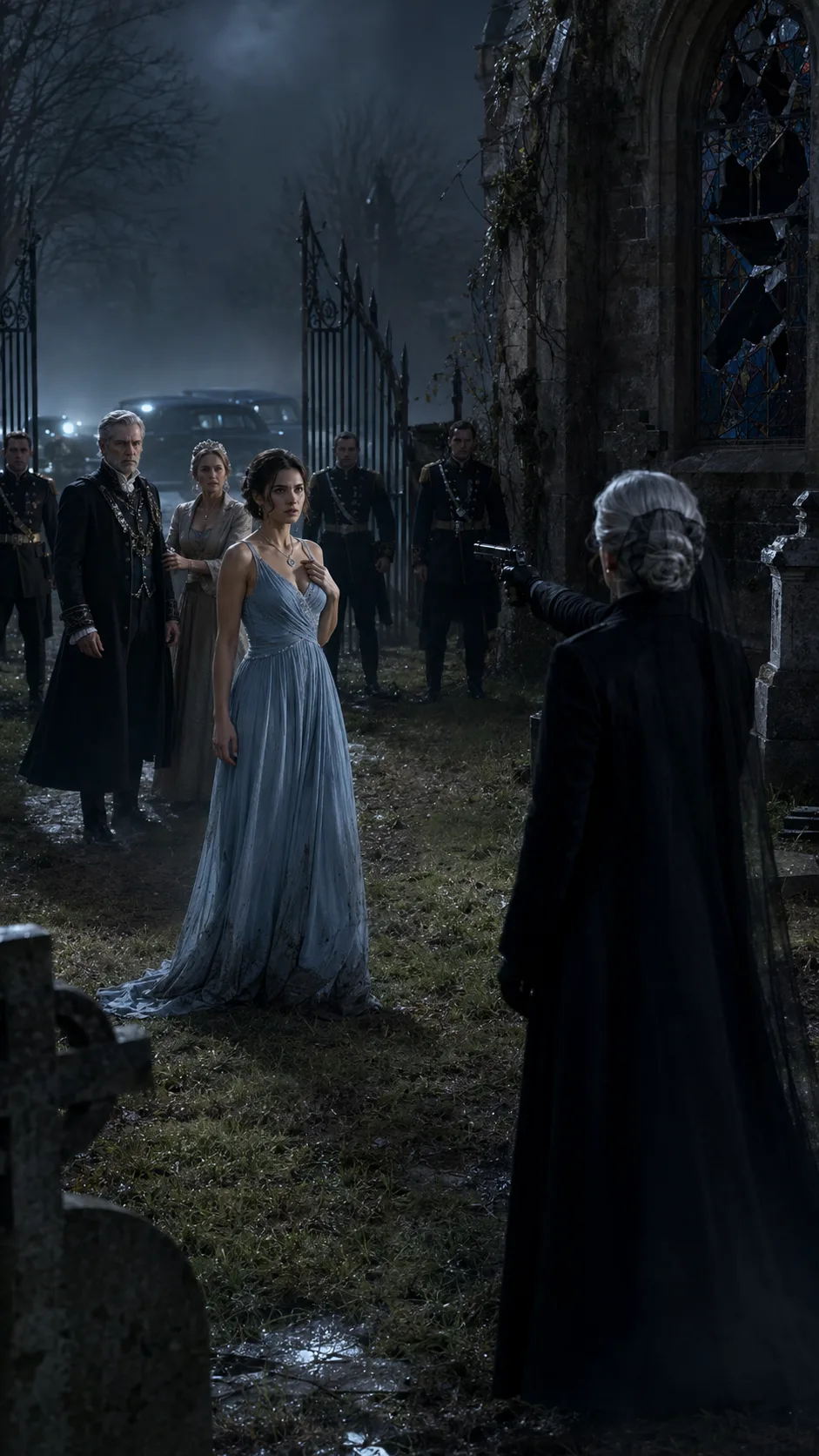
A side door opened near the altar. A guard led us through a narrow passage that smelled of damp stone. We emerged into the church cemetery, where fog lay low over wet grass and old graves.
A black car waited beyond the iron fence.
Then headlights appeared on the road.
Three vehicles blocked the exit.
Preston Whitmore stepped into the light.
His tuxedo was loose at the collar. His hair had fallen out of place. Without chandeliers and applause, he looked unfinished.
“Claire,” he called.
Queen Marielle gripped my arm.
Preston smiled as if he still knew how to own a room.
“There she is,” he said. “My wife.”
“I was your wife,” I answered.
His smile thinned.
“You’re confused. These people don’t know you.”
“You knew how to use me.”
“I gave you a life.”
“You gave me bills, loneliness, and apologies you never meant.”
His eyes hardened.
King Alistair stepped beside me, but I moved forward before he could stop me.
Preston looked relieved, mistaking motion for surrender.
“You think they’ll keep you?” he said. “Royal families don’t want damaged goods. They will dress you, parade you, then hide you where no one has to hear how you grew up.”
The words were chosen well.
He had lived close enough to my wounds to aim at them.
Behind me, Queen Marielle spoke.
“Amara.”
I turned.
She stood beside the king, pale but steady.
“Whatever the blood says, whatever the courts say, whatever history has stolen—you are not disposable.”
The fear inside me loosened its grip.
Preston saw it.
His face changed.
“You stupid girl,” he said. “Do you know what you are ruining?”
“Your future?” I asked.
He said nothing.
Fog shifted near a mausoleum.
Seraphine stepped out with a pistol in her gloved hand.
“Enough theatre.”
Every guard froze.
The pistol was aimed at King Alistair.
Preston stepped back, suddenly less certain of the monsters he had trusted.
Seraphine looked at me.
“You should have stayed nameless. It suited you.”
For thirty years, she had lived inside the blank spaces of my life. The abandoned church steps. The foster homes. The records that ended before they began. Preston’s cruelty. My own habit of making myself smaller to be kept.
She had built a life for me like a room without windows.
And now she stood with a gun, still expecting me to lower my head.
I touched the locket.
Then I looked at Preston, half-hidden beside the fence, his shoes sinking into cemetery mud.
I looked back at her.
“You had thirty years,” I said. “Thirty years to destroy me. And the best you could do was Preston?”
A guard made a sound he swallowed too late.
Preston flinched as if the bullet had gone into him instead.
Seraphine’s expression cracked.
“You think this is funny?”
“No,” I said. “I think it’s over.”
Mara Voss stepped forward from behind King Alistair.
“Seraphine.”
The old nurse’s hand trembled, but the phone she held did not lower.
“You always underestimated servants.”
Seraphine turned.
Mara raised the phone.
On the screen, a red recording light glowed.
“Every word,” Mara said. “From the church to now. The confession. The threats. All of it.”
The fog seemed to stop moving.
Preston lunged.
A royal guard caught him before he reached Mara and drove him down into the wet grass beside a gravestone. Preston’s hand clawed at mud. His mouth opened, but no sound came that mattered.
Seraphine fired.
King Alistair shoved Queen Marielle aside and stumbled back.
For one second, no one moved.
Then I saw his hand go to his shoulder.
“Father!”
The word tore out of me before I could choose it.
The guards surged forward.
Seraphine tried to run, but Queen Marielle moved first. She snatched a fallen iron lantern from the ground and struck Seraphine’s wrist. The pistol dropped into the grass.
Royal guards seized her.
Seraphine screamed, not from pain, but from disbelief.
“You cannot do this to me. I am royal blood.”
Queen Marielle stood over her, breathing hard.
“So is she.”
I dropped to my knees beside King Alistair.
His face had gone gray. He pressed one hand to his shoulder, but his eyes were on me.
“You called me Father,” he said.
I pressed my hands over the wound as a guard shouted for medical support.
“Don’t make me regret it.”
His mouth curved, faint but certain.
“Never.”
Three weeks later, Preston sat in a federal courtroom wearing a suit that no longer looked expensive.
Without applause, he had no shape.
The governor revoked his appointment within hours. Conrad Ashcroft was arrested before sunrise. Lydia Ashcroft gave a statement before her father’s lawyers could reach her. She testified that Preston had promised to marry her after he “cleared away” his wife and secured international access through her father’s money.
Preston’s attorney tried to paint him as a man manipulated by older, richer forces.
Then Mara’s recording played.
Then the ledger was entered into evidence.
Then a message from Preston’s phone appeared on a courtroom screen.
Once Claire signs, she disappears. No family. No fight. Perfect.
Queen Marielle’s hand closed around mine.
Preston stared at the table.
He did not look at me.
After the hearing, he asked to speak with me.
My attorney said no.
I said yes.
We met in a narrow room with a guard by the door. Preston’s wrists were cuffed. His hair fell over his forehead, no longer sculpted into control.
For a moment, I saw the man who once ate noodles from a saucepan with me and promised blue shutters on a house we never bought.
I did not know if that man had died.
I did not know if he had ever existed.
“Claire,” he said.
I waited.
“Amara,” he corrected, bitterness scraping the word.
“That name is not yours to use like that.”
His jaw worked.
“I loved you once.”
“No,” I said. “You loved being loved by me.”
His eyes sharpened.
“You think they are better? Crowns? Courts? Bloodlines? At least I was honest about wanting power.”
“You were honest only when cruelty helped you.”
He leaned forward.
“I can still help you. I know the donors. The networks. The people who will try to use you. You need someone who understands public life.”
Even then, he was trying to become necessary.
I stood.
“I needed someone who would sit beside me when no one knew my name. You had that chance.”
His face changed.
Not with remorse.
With defeat.
At the door, he said, “What will you do now? Pretend you weren’t raised unwanted?”
I looked back.
“I will be all of it.”
The final DNA confirmation arrived the next morning.
Maternal and paternal match.
99.9998 percent probability.
Princess Amara Elise Marielle of Ardenia.
Claire Whitmore.
The baby left in the rain.
The woman in the blue dress.
All of them.
The official announcement took place outside the Ardenian Consulate two days later. Cameras filled the street. The Ardenian flag moved above us in the hard white light.
King Alistair stood with his arm in a sling.
Queen Marielle stood beside him, holding herself together with both hands.
“Thirty years ago,” the king said, “our daughter was stolen from us. Today she returns not as property of a crown, not as a symbol for others to polish, but as a woman who survived a life no child should have been given.”
He turned to me.
“Princess Amara Elise.”
I stepped forward.
The microphones waited.
For one second, I saw the ballroom again.
Preston’s glass.
Lydia’s smile.
The applause that had abandoned me.
Then I touched the locket at my throat.
“My name is Amara,” I said. “My name is Claire. I was raised without answers, but not without strength. No child becomes worthless because someone refuses to claim them. No woman becomes nameless because a man finds it convenient to say so.”
The cameras flashed.
Queen Marielle reached for my hand.
This time, I took it first.
Ardenia received me beneath a sky so clear it seemed unreal.
Mountains rose beyond the capital. White stone buildings climbed toward the palace. Stag banners snapped from windows. Crowds filled the streets with roses, flags, photographs, and handmade signs.
WELCOME HOME, AMARA.
Home was the hardest word.
At the palace gates, Queen Marielle touched my hand.
“You do not have to wave.”
“I know.”
But I did.
The crowd answered like thunder.
Inside the palace, servants lined the grand hall. Some cried. Some bowed. An old man near the staircase touched his heart.
“Your cradle stood under my watch,” he said.
Queen Marielle led me through corridors hung with portraits of severe ancestors who looked as if they had never forgiven anyone for being alive.
At the end of the east wing, she stopped before ivory doors.
King Alistair stood beside her.
“This room has remained closed,” he said.
Queen Marielle’s voice was careful. “Not abandoned. Closed.”
The doors opened.
The nursery had not been left to dust.
Cream curtains moved in the breeze. A white crib stood near the window. Books lined a small shelf. A painted rose garden covered one wall. A silver music box sat on a table.
Queen Marielle wound it.
A soft melody filled the room.
I knew it.
Not in memory.
Lower than memory.
In the part of the body that keeps what the mind cannot.
Inside the crib lay a blue blanket embroidered with three letters.
A.E.M.
My fingers touched the edge.
Queen Marielle stood behind me.
“I missed your first words,” she said. “Your first steps. Your fevers. Your favorite stories. I do not know how to be your mother now without grieving the mother I was not allowed to be.”
I turned.
“I don’t know how to be a daughter.”
King Alistair spoke from the doorway.
“Then we learn.”
Six months passed.
Seraphine’s trial shook Ardenia until even the old families stopped pretending they had known nothing. She stood before the royal court in black silk and called herself a guardian of tradition. The people called her by other names.
Conrad Ashcroft died before sentencing, alone in a private medical wing paid for by money that no longer protected him.
Preston received twelve years for conspiracy, fraud, obstruction, and attempting to profit from crimes tied to my identity. His final public statement blamed ambition, politics, the media, Lydia, Conrad, and me.
No one printed it in full.
Mara Voss came to Ardenia.
There were people who wanted her imprisoned.
I understood them.
There were nights when I wanted it too.
Then I remembered the locket around my neck when I was found. The church steps. The fact that she had run with a feverish royal baby in her arms while men behind her wanted a cleaner ending.
“She made one unforgivable mistake,” I told the court. “Then she spent thirty years making sure I lived long enough for the truth.”
Mara was not forgiven by decree.
Forgiveness does not work like law.
But she was allowed to serve.
At my request, she became caretaker of the children’s wing at the Amara Foundation, a program for abandoned and displaced children across Europe and America.
On opening day, she stood beside me, smaller than I remembered from the cemetery.
“You should hate me,” she said.
“I did,” I answered.
Her eyes lowered.
“Before I knew your name,” I added.
Through the glass, children painted paper crowns at a long table. One boy had blue paint on both cheeks and no idea it was there.
Mara watched them.
“What now?” she asked.
“Now we build something better than silence.”
One year after the gala, I returned to New York.
Not for Preston.
Not for the cameras.
For the room.
The Hawthorne Imperial Hotel had changed management after the scandal. The ballroom had been renovated. The chandeliers cleaned. The stage rebuilt.
I rented it for a charity auction benefiting foster youth.
The same room.
The same lights.
A different guest list.
Former foster children sat beside diplomats. Social workers beside royals. Teachers beside ministers. No one asked who belonged.
Near the end of the evening, I stepped onto the stage in a deep blue gown designed by a young woman who had aged out of foster care and started her own label.
Queen Marielle sat in the front row.
King Alistair sat beside her, smiling with the careful pride of a man still learning not to fear happiness.
I touched the locket at my throat.
It had been repaired, but not polished smooth. I had asked them to leave the dents.
“Last year,” I said, “a man stood in this room and called me a woman without a name.”
A ripple moved through the audience.
“He was wrong. Not because I turned out to be royal.”
I looked at the tables where children from the foundation sat with straight backs and glittering shoes, trying to behave in a room too large for them.
“He was wrong because no person is nameless simply because others refuse to recognize them.”
The applause rose.
This time, it did not feel like a weapon.
A little girl from the foundation walked onto the stage carrying a small velvet box. She was seven, with solemn eyes and a crooked silver bow in her hair.
“This is for you,” she said.
Inside was a bracelet engraved with words the children had chosen.
FOUND IS NOT THE OPPOSITE OF LOST. LOVED IS.
For a moment, I could not speak.
Then the ballroom doors opened.
Every head turned.
A royal messenger entered with a sealed document.
King Alistair rose.
“What is it?”
The messenger bowed.
“Your Majesty, the Council has voted.”
The room went silent.
The messenger turned to me.
“By unanimous decree, the succession law has been amended. Blood alone no longer determines readiness. Service, public trust, and demonstrated courage may now be considered by Parliament and Crown together.”
Queen Marielle’s hand went to her mouth.
The messenger continued.
“Princess Amara Elise has been named Crown Heir of Ardenia.”
The room broke open.
Gasps.
Cries.
Applause that shook the chandeliers.
I stared at my parents.
Queen Marielle was crying.
King Alistair stepped onto the stage with a small velvet case in his hand. He opened it, revealing a silver circlet shaped like roses and antlers.
“For thirty years,” he said, “your mother and I waited to give you a crown.”
He turned the circlet in his hands.
“But watching you this year, we understood something. You did not need a crown to become worthy of one.”
He did not place it on my head.
He placed it in my hands.
“The crown is not a reward,” he said. “It is a question. Do you accept the burden of being seen, not as the child we lost, but as the woman you became?”
The crystal lights blurred.
I thought of the orphanage beds. The church steps. Preston’s champagne glass. The ring on the table. The cemetery fog. The nursery music. The children with paint on their hands.
Every version of myself stood with me.
I lifted the circlet.
Then I placed it on my own head.
“Yes,” I said.
The room erupted.
Beneath the thousand crystal lights that had once witnessed my humiliation, I became the future Preston Whitmore had tried to keep me out of.
Not his.
Not Seraphine’s.
Mine.
The locket rested against my throat.
This time, it was open. THE END.
Chapter complete
You have reached the end of this chapter.
Continue reading
A few more worlds to get lost in after this chapter.




