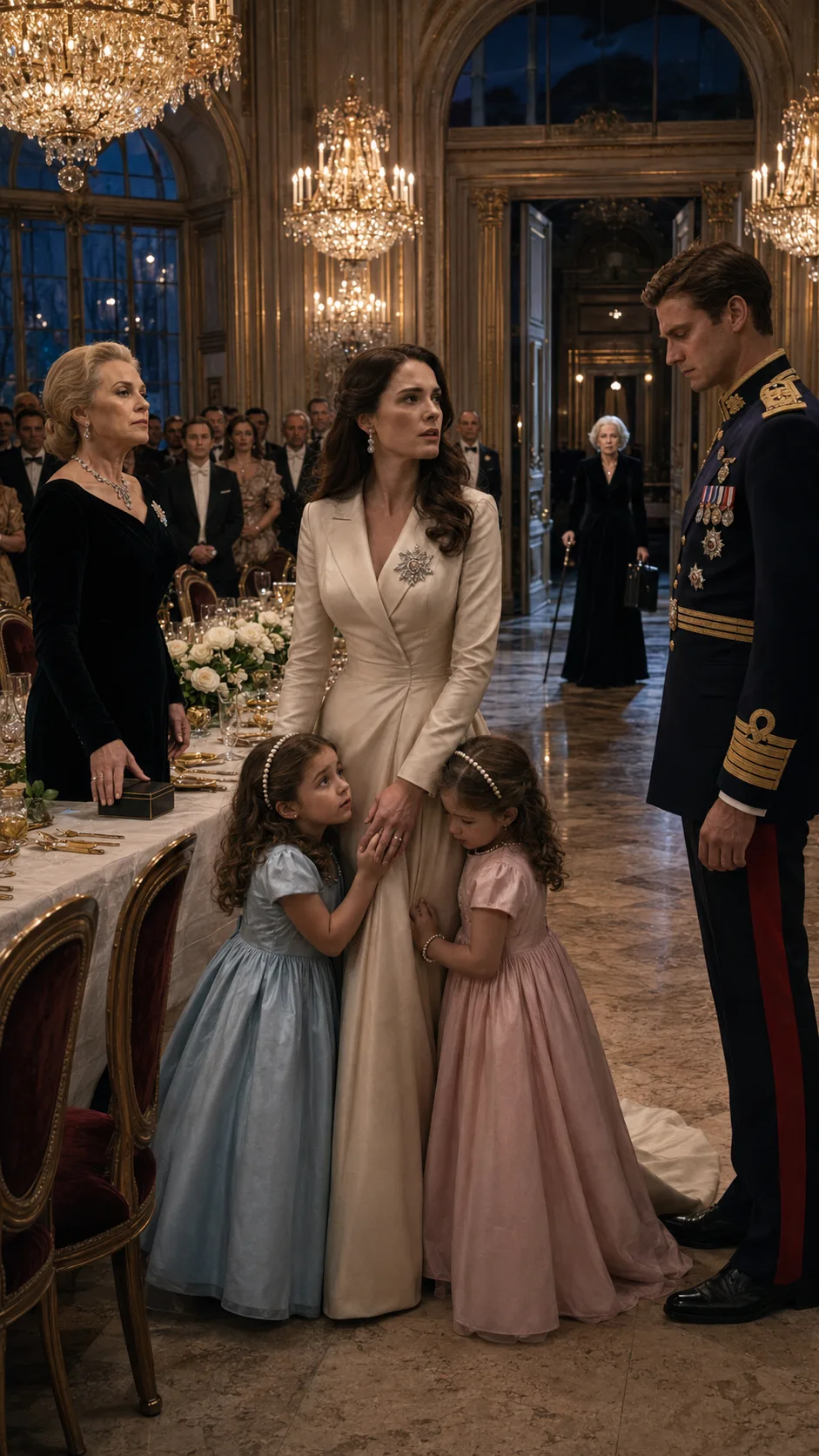
By noon, every newspaper in Europe had the same headline.
THE PRINCESS WHO LEFT WITH THE MONEY.
But Eleanor did not read them.
She sat in the back of the Whitmore carriage with Clara asleep against her shoulder and Elise curled across her lap. Both girls were exhausted from crying, from leaving their nursery, from watching adults treat their existence like a national mistake.
Eleanor watched the palace disappear behind the winter trees.
She expected to feel free.
Instead, she felt hollow.
Beatrice sat across from her, hands folded over the silver handle of her cane.
“You are allowed to grieve him,” her mother said.
Eleanor looked away. “I am not grieving him.”
“Yes, you are.”
“He stood there.”
“I know.”
“He heard them call our daughters less than sons.”
“I know.”
“And he still chose the crown.”
Beatrice’s voice softened. “Then grieve the man you thought he was. Leave
began resigning from committees. The grain relief program paused. The hospital wing stopped construction. Every decision Queen Margot had hidden behind velvet and ceremony began crawling into daylight.
Lady Serena’s family withdrew from the proposed match first.
They did it politely, of course. Aristocrats always knew how to abandon a sinking ship while smiling.
Then the Royal Council requested a private session with Crown Prince Adrian.
For the first time in his life, Adrian entered the council chamber without his mother.
The oldest councilor, Lord Ames, placed a copy of the old succession charter before him.
Adrian frowned. “What is this?”
“The law your grandfather signed,” Lord Ames said. “The one allowing the first royal child, regardless of gender, to stand in succession if approved by council.”
Adrian stared at the page.
“My mother said that law was never ratified.”
“It was ratified twenty-nine years ago.”
Adrian went still.
Lord Ames continued. “Princess Clara has a legal path to succession.”
Adrian’s throat tightened. “She is six.”
“So were several kings when history placed crowns above their heads,” the councilor replied. “The issue is not her age. The issue is whether this palace can survive the damage done to her mother.”
Adrian left that chamber with his world rearranged.
That evening, he found Queen Margot in the portrait gallery, standing beneath the painting of her late husband. She looked smaller than usual, though she would have hated anyone saying it.
“You lied about the law,” Adrian said.
She did not turn.
“I delayed a dangerous idea.”
“You lied about Eleanor.”
“I protected you.”
“You taught me to be ashamed of my own children.”
Queen Margot turned then, and for the first time Adrian saw something like fear in her eyes.
“I taught you to survive,” she said. “A king with daughters is vulnerable.”
“No,” Adrian said. “A man who needs his children to be sons is vulnerable.”
Her hand lifted as if to slap him, but she stopped herself.
Adrian almost laughed. Not because anything was funny, but because even now, even after everything, she was still trying to rule the room with a raised hand.
“I am going to see Eleanor,” he said.
Queen Margot’s face hardened. “If you go to her, you go as a beggar.”
Adrian looked toward the window, where the sea wind shook the palace banners.
“Then I should dress honestly.”
Two nights later, Eleanor stood in the Whitmore library reading by the fire when the butler announced him.
Crown Prince Adrian Valmont entered without medals, without sash, without the polished armor of ceremony. He wore a simple dark coat. His hair was wet from rain. His face looked tired in a way royalty was never supposed to look.
Eleanor closed her book.
“No guards?” she asked.
“No.”
“No mother?”
“No.”
“No speech written by the council?”
He swallowed. “No.”
She waited.
Adrian looked toward the doorway, where Clara and Elise peeked from behind the frame in their nightgowns. His face broke.
He lowered himself to one knee.
Not to Eleanor.
To them.
“I failed you,” he said.
Clara gripped the doorframe.
Elise hid half her face against her sister’s sleeve.
Adrian’s voice shook. “I let people make you feel like being girls made you less royal, less wanted, less mine. That was not your fault. It was mine.”
Clara’s eyes filled. “Are you saying that because Grandmama is rich?”
The question landed harder than any accusation from Eleanor could have.
Adrian closed his eyes.
“No,” he said. “I am saying it because I heard your voice in that hall after everyone else stopped speaking. And I realized you had been asking me to be your father long before yesterday.”
Eleanor looked away because the sight hurt.
Not enough to forgive him.
But enough to remember why she had loved him.
Beatrice entered from the far end of the library, leaning on her cane.
“Pretty words,” she said. “What do they cost you?”
Adrian stood.
“My claim,” he said.
Eleanor turned sharply.
Beatrice’s expression did not change, but her fingers tightened on her cane.
Adrian reached into his coat and removed a handwritten letter. Not a legal decree. Not a royal order. Just a letter, folded once, sealed with blue wax.
“I have asked the council to begin formal review of Clara’s place in the succession. If she is ever considered, it will be because of her ability, not because I use her to repair what I ruined.”
Eleanor stared at him. “And you?”
“I will step back from public duties until the council decides whether I am fit to serve.”
Beatrice’s eyes narrowed. “Your mother allowed this?”
Adrian gave a sad smile. “My mother no longer commands every room she enters.”
For a long moment, no one spoke.
Then Elise walked forward on bare feet.
She stood in front of Adrian and held out a wooden block from the palace model she had been building.
“This was supposed to be your tower,” she said.
Adrian took it like it was made of glass.
“May I still have one?”
Elise looked at Clara.
Clara looked at Eleanor.
Eleanor felt the entire room waiting for her to make forgiveness simple.
She would not.
“You may visit them,” she said to Adrian. “You may earn time. You may answer their questions honestly. But you do not get to walk back into our lives because regret finally found you.”
Adrian nodded, tears in his eyes. “I understand.”
Queen Margot never apologized.
Not truly.
Months later, when the council summoned the royal family to the Hall of Crowns, she arrived in black silk and diamonds, her chin lifted high. She expected discussion. Debate. Perhaps resistance.
Instead, she found the hall full.
Nobles, ministers, citizens, teachers, soldiers, hospital nurses, and palace staff stood beneath the banners of Valoria. At the center of the hall stood Eleanor in a white gown, Beatrice beside her, and Clara holding Elise’s hand.
Lord Ames stepped forward and announced that Princess Clara Valmont, granddaughter of Duchess Beatrice Whitmore and firstborn child of Crown Prince Adrian, would begin official preparation as a future candidate for the crown under the equal succession charter.
The hall applauded.
Not politely.
Loudly.
Queen Margot’s face drained of color.
Clara looked up at her mother. Eleanor squeezed her hand.
Then the little girl walked forward.
She was still small. Her crown was still slightly too big. Her voice still trembled when she spoke before a room full of adults.
But she did not hide.
She stopped in front of Queen Margot.
“You once said Valoria did not need two little girls,” Clara said.
Queen Margot’s lips parted, but no sound came.
Clara lifted her chin.
“My sister and I heard you.”
The entire hall went silent.
Then Clara turned, looked at the crowd, and said, “I hope one day this kingdom makes every child feel wanted before they are useful.”
Eleanor pressed a hand to her mouth as tears filled her eyes.
Beatrice bowed her head.
Adrian, standing at the edge of the hall, cried openly and did not try to hide it.
And Queen Margot, who had spent a lifetime believing crowns belonged only to sons, stood beneath the weight of a kingdom applauding a daughter.
Years later, portraits would show that moment in gold and white.
Princess Clara, small but unbowed.
Princess Elise beside her, smiling.
Princess Eleanor behind them, no longer a discarded wife, no longer a woman waiting to be defended.
And beneath the painting, carved into the marble wall of the Hall of Crowns, were the words Clara had spoken on the day Valoria changed forever:
A kingdom does not become strong by choosing sons over daughters. It becomes strong when no child has to earn the right to be loved.
THE END.