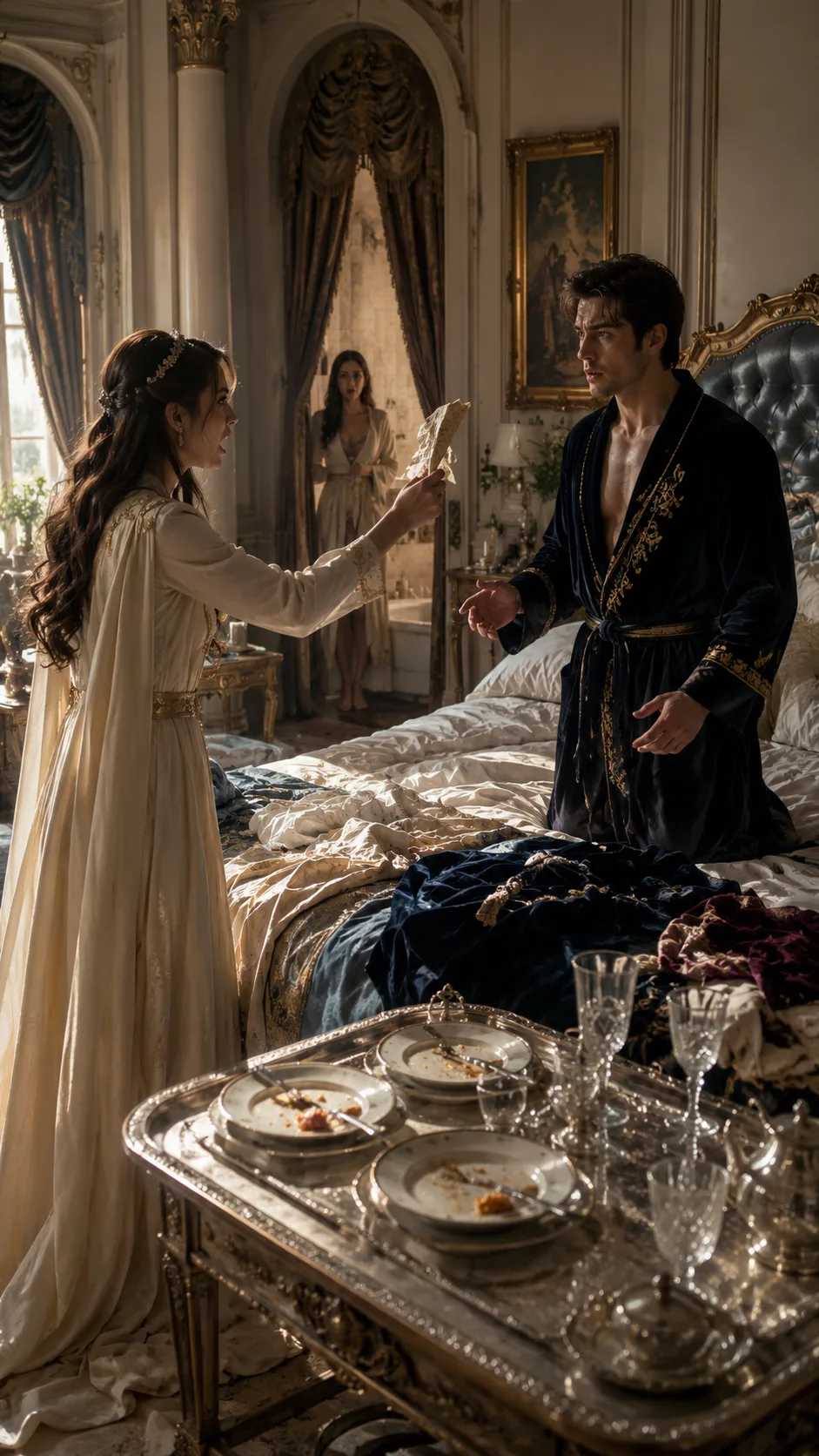
The Princess Found Three Plates in the Duke’s Bedchamber — Then the Kingdom Learned What He Had Sold
Princess Elara Veyne had been raised to understand the many sounds of danger.
Chapter 1
Princess Elara Veyne had been raised to understand the many sounds of danger.
Her father taught her that armies announced themselves with drums. Her mother taught her that poison often arrived in a cup carried by smiling hands. Her old swordmaster taught her that a man who breathed too calmly before a duel was usually the first to strike.
But no one ever taught her the sound of betrayal.
It was not loud.
It was the soft clink of crystal inside a locked royal chamber. It was the murmur of a woman’s laughter where no woman should have been. It was the rustle of a parchment receipt stamped with the royal treasury seal, lying shamelessly beside three half-finished plates.
Three plates.
That was the first thing Elara saw when she stepped into her husband’s private bedchamber at the Summer Palace.
Not the rumpled blue silk sheets. Not the abandoned wine cups. Not the dark velvet robe thrown over the carved chair. Not even
the strange perfume lingering in the warm air.
Three plates.
Three sets of silver cutlery.
Three crystal goblets with red wine still staining the rims.
Her husband, Duke Adrian Blackthorne, had told the entire capital he was traveling to the Summer Palace for an emergency war council. The northern border, he said, had become unstable. The Marovan kingdom was moving soldiers near the river. The king’s generals needed him. The treasury needed him. The crown needed him.
Elara had asked to come.
Adrian had laughed.
Not warmly. Not kindly. Not like a husband amused by the woman he loved.
He had laughed as if she were a child reaching for a crown too heavy for her head.
“My dear princess,” he said while fastening his black riding cloak, “war councils are not poetry readings. You would only sit there looking pretty and waiting for someone to explain the maps.”
The
words had landed softly enough that no servant dared react. But Elara felt them like a slap.
For six years, she had been Duke Adrian’s perfect wife. She stood at his side during banquets. She smiled while ministers praised his intelligence. She lowered her eyes when he corrected her in public. The court called her gentle. Adrian called her delicate. Her father, King Thaddeus, called her patient.
No one called her dangerous.
That was their first mistake.
Elara had not planned to follow Adrian. She had wanted to trust him. Trust, after all, was supposed to be the foundation of marriage.
But trust became a cage when the person holding the key began lying.
In the weeks before his departure, Adrian had changed. His letters arrived sealed twice, as if he feared someone might read them. His private guards moved crates through the eastern gate after midnight. He dismissed servants
who had served their household for years. And once, when Elara entered his study too quietly, she saw him shove a black-waxed letter beneath a ledger and smile with the face of a man caught near a grave.
Then, on the morning he left, he forgot a small parchment on his desk.
Elara found it beneath a folded map.
It was not a summons to war council.
It was a palace steward’s note confirming that no council had been scheduled at the Summer Palace at all.
For two hours, Elara sat in her private chamber with that note in her lap. She could have sent a guard. She could have sent a spy. She could have brought it to her father.
Instead, she changed into a plain ivory travel gown, wrapped a pale cloak over her shoulders, and ordered one carriage prepared without royal banners.
By sunset, she was crossing the desert road.
The Summer Palace rose from the red hills like a mirage carved from gold and white stone. Tall arches caught the last light. Palm trees bent in the hot wind. Servants in pale linen moved through shaded courtyards carrying trays of fruit and wine.
The palace steward nearly dropped his ink bowl when he saw her.
“Your Highness,” he stammered. “We were not told—”
“No,” Elara said. “You were not.”
His face went colorless.
“Where is my husband?”
The steward opened his mouth, closed it, then looked toward the western tower.
Elara did not wait for him to answer.
She climbed the marble stairs alone.
Each step made her heartbeat louder. Not faster. Louder. As if her own body wanted to warn her before the world split open.
At the western tower, two of Adrian’s guards stood outside his chamber door.
They straightened when they saw her.
“Princess Elara,” one said, too quickly. “His Grace is resting. He left orders not to be—”
“Move.”
The word surprised even her. It had no tremble in it.
The guards exchanged a glance. One reached for the door as if to block it.
Elara lifted her chin.
“I am his wife,” she said. “And I am your princess.”
They moved.
The chamber door was not locked.
That detail, later, would stay with her longer than it should have. Adrian had not locked the door because he had never believed she would dare open it.
Inside, the room was warm from the desert sun. Golden curtains breathed softly beside tall arched windows. The grand bed stood at the center of the chamber, its carved posts wrapped in blue silk. A silver banquet tray sat near the foot of the bed.
Three plates.
Elara stopped.
There are moments when a person’s mind refuses to name what the eyes have already understood.
She stepped closer.
Pheasant bones. Fig skins. Honeyed bread crumbs. Three knives. Three goblets. A dark smear of lipstick on one rim.
Beside the tray lay a folded receipt.
Elara picked it up.
The parchment was stamped with the royal treasury seal.
Private diplomatic supper — charged to border negotiation expense.
Her fingers tightened until the parchment crackled.
Then she heard laughter from behind the bathing chamber curtain.
A woman’s voice.
Smooth. Amused. Familiar in the way court voices often sounded familiar, all silk and knives.
“Same arrangement next moon?” the woman asked.
Adrian answered before Elara could breathe.
“Of course. The treasury never questions anything marked diplomatic.”
A second woman laughed softly. “And your princess?”
There was a pause.
Then Adrian laughed too.
“Elara?” he said. “Please. She sees flowers, gowns, and charity petitions. She does not see ledgers.”
The room tilted.
For one terrible second, Elara forgot how to stand.
She could have burst through the curtain then. She could have screamed his name. She could have thrown the receipt at him and demanded he look at what he had made of her.
Instead, she moved.
Silently.
Years of court training had taught her how to cross marble without sound. Years of being overlooked had taught her how to disappear in plain sight.
She slipped behind a carved wardrobe near the bed, leaving only a narrow gap between polished wood and wall.
Adrian emerged first.
He wore a dark robe embroidered with gold thread, open at the throat, his damp hair pushed back carelessly. He looked beautiful in the way statues looked beautiful—cold, expensive, empty.
Behind him came two women.
One was dressed in a pale silk robe, her dark hair pinned loosely at her neck. The other wore a traveling cloak and carried a black leather case. Neither looked ashamed. That was what struck Elara most. They moved through Adrian’s chamber as though they had walked there many times before.
Adrian opened a small chest on the table and removed a purse of coins.
The woman with the case took it.
“You are certain the southern gate schedule is accurate?” she asked.
Elara’s blood went cold.
Adrian reached for a roll of parchment sealed with black wax.
“The guard changes at dawn every fifth day. The old aqueduct passage is still unsealed. Your prince will find the eastern wall less heroic than our court poets claim.”
The woman smiled.
Elara stopped feeling like a betrayed wife.
She became something else.
A daughter of the crown.
A witness.
A threat.
The southern gate schedule was not a lover’s secret. It was not a private humiliation. It was military intelligence. If Marovan agents carried it across the border, the capital could fall before winter.
The second woman glanced toward the door. “You trust your household too much.”
Adrian’s smile sharpened.
“I trust everyone to remain exactly what they are. Guards obey. Servants fear dismissal. My king believes me indispensable.” He lifted his wine cup. “And my wife is too grateful for luxury to ask how it is paid for.”
Elara’s hand rose to her mouth, not to stifle a sob, but to hold back a sound that might have become a scream.
Grateful.
That was what he thought her silence had been.
Not discipline. Not patience. Not love.
Gratitude.
Adrian poured wine into three cups and continued, voice lazy with arrogance.
“Three years,” he said. “Three years of diplomatic dinners, private courier fees, border inspections that never happened. Do you know how much gold a kingdom loses when no one bothers to read the second page of a ledger?”
The woman with the case clicked it shut. “How much?”
Adrian grinned.
“Enough to buy loyalty from men who once called themselves honorable.”
Elara looked down at the receipt in her hand.
Three plates.
Three years.
Three betrayals.
Her marriage. Her father. Her kingdom.
When the women left through the servant passage, Adrian remained by the bed, humming under his breath as if he had just completed a harmless game. He did not know his wife stood ten steps away in the shadow of his wardrobe, holding the first thread of his ruin.
Elara waited until he returned to the bathing chamber.
Then she slipped out.
She took the receipt.
She took the empty black wax seal he had dropped beside the tray.
And from the table, hidden beneath a napkin, she took a second parchment—an invoice for “diplomatic companionship and confidential courier assistance,” paid again by the royal war treasury.
She walked out of the chamber before her heart could break loudly.
For the next twenty-one days, Princess Elara became the woman Adrian believed he had married.
Soft. Quiet. Decorative.
At court, she smiled when he kissed her hand. She asked him how the council had gone. She listened as he described imaginary generals debating imaginary maps. When he mocked her interest in the treasury, she lowered her eyes as if embarrassed.
Every night, when Adrian slept, Elara searched.
His arrogance had made him careless.
In his study, behind a false panel carved with the Blackthorne family crest, she found ledgers written in his own hand. Payments marked as diplomatic expenses. Names of guards bribed to ignore sealed crates. Dates of meetings at the Summer Palace. Coded references to Marovan agents.
Beneath the floorboards, she found copied maps of the eastern wall.
Inside a locked dispatch box, she found letters signed by Prince Casimir of Marovan.
The last letter was short.
When the southern gate opens, your payment will double. When the king falls, your wife’s claim may prove useful.
Elara read that sentence four times.
Your wife’s claim.
Adrian had not only stolen gold and sold military secrets.
He had planned to use her bloodline when the kingdom collapsed.
That night, Elara did not cry.
Something inside her had moved beyond tears.
At dawn, she summoned three people through separate secret corridors: Lord Halven, the High Chancellor; Captain Ser Rowen of the Royal Guard; and Magistrate Ilyra, the oldest judge in the capital and the only woman who had ever beaten Adrian in public debate.
Elara placed the ledgers on the table.
No one spoke for a long while.
Finally, the chancellor whispered, “Princess… do you understand what this means?”
Elara looked at the black-waxed letters.
“It means my husband is a traitor.”
Captain Rowen’s jaw tightened. “Your father must be told.”
“He will be,” Elara said. “But not yet.”
The magistrate studied her carefully. “Why?”
“Because if we arrest Adrian quietly, half his allies will vanish before sunset. I want every coward who sold loyalty with him to reveal themselves.”
Lord Halven looked at her then not as a princess, not as a wounded wife, but as someone standing near a blade and realizing it had been sharpened in silence.
“What do you intend to do?”
Elara folded the first receipt and placed it into her sleeve.
“I intend to let him walk into court believing he has won.”
Three days later, Duke Adrian Blackthorne announced another journey to the Summer Palace.
This time, he would not reach it.
The throne hall filled that morning with nobles, ministers, military commanders, and foreign envoys. Sunlight poured through stained glass windows, painting the marble floor in red and gold. King Thaddeus sat on the high throne, silver-haired and stern, unaware that his daughter had spent the past hour placing his kingdom’s survival into motion.
Adrian entered in black velvet with a golden collar at his throat.
He looked magnificent.
That was always his talent.
He could dress treason like nobility and make arrogance look like command.
Elara stood near the throne in a silver gown. Her mother’s crown rested in her dark hair. Her face was calm.
Too calm.
Adrian noticed.
He approached her with a smile meant for the court.
“My princess,” he murmured. “You look pale. Did you sleep badly?”
Elara looked at him.
For one heartbeat, she remembered the man she had loved. The man who had once kissed her fingertips in a garden after rain. The man who had promised to protect her from court wolves.
Then she remembered three plates.
She stepped forward.
The court quieted.
From her sleeve, she drew the crumpled treasury receipt.
Adrian’s smile flickered.
Elara raised the parchment high enough for the nearest ministers to see the royal seal.
“Three plates, Adrian,” she said.
A murmur spread through the hall.
Adrian’s eyes sharpened. “Elara.”
“Three cups,” she continued. “Three years of stolen gold.”
His face drained.
The king leaned forward on his throne.
Elara’s voice rose, no longer private, no longer soft.
“You told this court you went to the Summer Palace for war councils. You told my father the treasury funded diplomatic negotiations. You told me I was too foolish to understand ledgers.”
Adrian took one step toward her. “You are confused.”
“No,” she said. “I was quiet.”
The difference struck the room like thunder.
Lord Halven stepped from the side chamber carrying Adrian’s ledgers. Magistrate Ilyra followed with black-waxed letters. Captain Rowen entered with six royal guards.
Adrian saw them.
For the first time since Elara had known him, he looked truly afraid.
“This is a mistake,” he said, but his voice had lost its music.
Elara turned to the court.
“Duke Adrian Blackthorne used the royal war treasury to pay foreign agents. He sold the southern gate schedule to Marovan. He bribed crown guards. He prepared our capital for invasion.” She looked back at him. “And he thought I would never look beyond the first page.”
Adrian lunged—not violently, not foolishly, but desperately, reaching for her wrist as if one touch could pull the old obedient Elara back into existence.
The guards seized him before his fingers reached her sleeve.
The court erupted.
The king stood.
His face was not angry at first. It was worse. It was broken.
“Adrian,” he said quietly, “tell me my daughter lies.”
Adrian’s mouth opened.
No words came.
That silence convicted him more cleanly than any confession.
Elara stepped close enough that only he could hear her final words.
“You were right about one thing,” she whispered. “I did smile while you lied.”
His eyes burned with hatred.
She smiled then, small and cold.
“But I was gathering proof.”
By sunset, Adrian’s title had been stripped. His lands were seized. His private guards were arrested. The Marovan agents were captured at the eastern road with the southern gate plans hidden inside a hollow prayer scroll.
The court expected Princess Elara to retreat after that. To mourn. To disappear into some quiet wing of the palace and let men discuss what her courage had uncovered.
She did not.
The next morning, she entered the war council chamber and took the empty seat beside her father.
No one told her she did not belong there.
No one laughed.
Weeks later, when the first snow touched the palace roofs, the people began calling her the Silver Witness.
Not because she had been betrayed.
But because she had watched.
Because she had waited.
Because she had understood something powerful men often forgot.
Silence is not surrender.
Sometimes, silence is the sound of evidence being gathered.
And Princess Elara Veyne, once dismissed as delicate, saved her kingdom with a receipt, three plates, and the patience of a woman no traitor should have underestimated.
THE END.
Chapter complete
You have reached the end of this chapter.
Continue reading
A few more worlds to get lost in after this chapter.