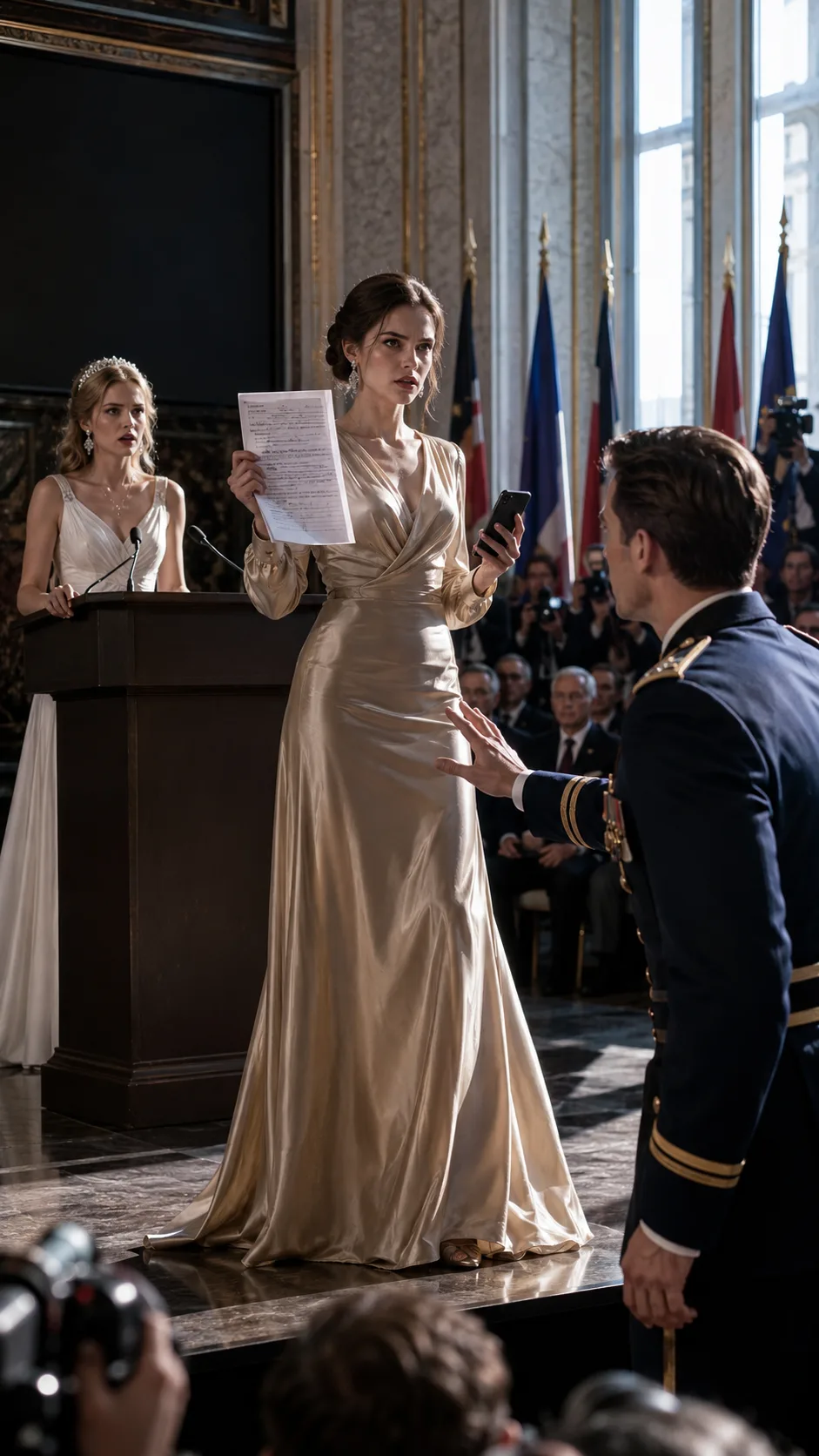
The Princess Exposed Her Stolen Speech After The Prince Gave Her Voice To His Mistress Before The World Watched Silently
Princess Amelia had rewritten the same speech seventeen times.
Chapter 1
The Princess Exposed Her Stolen Speech After The Prince Gave Her Voice To His Mistress Before The World Watched Silently
Princess Amelia had rewritten the same speech seventeen times.
Not because she was unsure.
Because every sentence mattered.
The International Crown Reform Conference was not a ball, not a ribbon-cutting, not another polished event where royals smiled beside crystal chandeliers and called silence tradition. It was the first time Amelia would speak before the leaders of twelve kingdoms, three constitutional councils, and every major press network in Europe.
Her father, King Edward, had once told her, “A crown survives only when it listens before it commands.”
He died before he could say those words to the world.
So Amelia put them in the speech.
She wrote about tax transparency. About ending private royal immunity. About opening palace archives that had been sealed for generations. About letting citizens question the monarchy without being treated like enemies of the crown.
It was dangerous.
It was necessary.
And it was hers.
At midnight, inside her private study, Amelia sat barefoot beneath a
brass lamp while the palace slept around her. Her champagne satin gown for the next day hung on the wardrobe door. Her pearl earrings lay beside the final printed draft. Her laptop screen glowed with the title:
Reform Is Not The Death Of The Crown. It Is The Proof That The Crown Still Lives.
Amelia touched the page gently.
Then the door opened.
Prince Adrian stepped inside without knocking.
He was still in his navy royal uniform, medals bright against his chest, dark hair perfectly combed, handsome in the way people trusted too quickly. To the public, he was her devoted husband. The prince consort who smiled beside her during charity galas, placed a hand at her waist during state portraits, and lowered his voice when speaking about “our shared vision.”
To Amelia, lately, he had become a locked room.
“You’re still working?” he asked.
“I’m done.”
He walked behind
her chair and looked over her shoulder. “This is the final draft?”
“Yes.”
“It’s bold.”
“That is the point.”
His smile did not reach his eyes. “The council will hate it.”
“The council hates anything they didn’t control.”
Adrian laughed softly, but there was no warmth in it. He reached for the printed draft. Amelia placed her hand over the paper.
He looked at her fingers.
“Amelia.”
“It isn’t public yet.”
“I’m your husband.”
“That used to mean something.”
The room went quiet.
Adrian’s expression shifted for less than a second. Annoyance. Then charm covered it again.
“You’re nervous,” he said. “I understand. Tomorrow is important.”
“No,” Amelia said. “I’m focused. There’s a difference.”
He leaned down and kissed the top of her head. The gesture looked tender. It felt performed.
“Get some sleep,” he said. “The world will be watching.”
Amelia waited until the door closed before she exhaled.
My stomach dropped, though I did not know why yet.
At 7:15 the next morning, the palace moved like a machine.
Staff crossed marble halls with folders and headsets. Security officers checked badges. International delegates arrived beneath gray winter light. Reporters crowded behind velvet ropes outside the conference wing, their cameras pointed at the glass doors.
Amelia stood before a tall mirror while her lady-in-waiting, Clara, fastened the clasp of her pearl necklace.
“You look calm,” Clara said.
“I’m not.”
“That’s usually when you’re most dangerous.”
Amelia almost smiled.
She wore a pale gold satin gown with long sleeves, simple but regal. Her hair was pinned in a low chignon. On her wrist was the thin diamond bracelet her father had given her the day she turned eighteen.
For courage, he had said.
At 8:02, Amelia reached for her folder.
It was gone.
She turned slowly.
“Clara.”
“Yes, Your Highness?”
“My speech.”
Clara froze. “It was on the desk.”
“It isn’t now.”
They searched the study, the dressing room, the sitting room, the table beside the balcony doors. Nothing.
Amelia opened her laptop. The final file was still there, but the system showed a new access record.
2:14 a.m.
Royal Administrative Account: A. Vale-Adrian.
Her husband.
Amelia stared at the screen until Clara whispered, “Princess?”
“Print another copy,” Amelia said.
Clara moved quickly.
Amelia did not cry. She did not call Adrian. She did not ask why.
Because somewhere in her bones, she already knew.
At 9:30, the International Crown Reform Conference began.
The main hall of the palace had been transformed into a stage of glass, flags, and power. Delegates sat in curved rows. Reporters lined both sides. Behind the podium, a massive dark screen waited to display the official speaker’s name.
Amelia entered with Adrian at her side.
Applause rose.
He offered his arm.
She took it.
From far away, they probably looked perfect.
Then Amelia saw Isabella.
Her half-sister stood near the front row in a white silk dress, diamond pins in her loose golden hair, smiling like she had already won. Isabella was not scheduled to speak. She was a guest, a decorative royal figure the palace occasionally used when it needed youth, beauty, and harmless charm.
Harmless.
Amelia looked at Adrian.
He was clapping.
Not for Amelia.
For Isabella.
The master of ceremonies stepped to the microphone.
“Ladies and gentlemen, honored delegates, members of the press. Due to a final adjustment in the royal schedule, today’s opening address will be delivered by Princess Isabella Vale.”
For one second, Amelia heard nothing.
Not the applause.
Not the cameras.
Not Clara’s sharp inhale behind her.
Only the sound of her own pulse.
Isabella walked onto the stage.
She did not look at Amelia.
That was how Amelia knew this was not a mistake.
The screen behind Isabella lit up with her name. The press raised their cameras. Adrian straightened beside Amelia and began to clap with the rest of the hall.
Amelia’s hand tightened around her folder.
Isabella placed both hands on the podium, lowered her chin with practiced humility, and began.
“Reform is not the death of the crown. It is the proof that the crown still lives.”
Amelia stopped breathing.
Every word was hers.
Not similar.
Not inspired.
Hers.
The opening line. The pause. The structure. The rhythm she had spent nights sharpening until it cut cleanly.
Isabella continued.
“A monarchy that fears its people has already lost them. A monarchy that listens may yet deserve them.”
A murmur moved through the hall.
Delegates leaned forward.
Reporters typed fast.
Adrian clapped softly beside Amelia, his face shining with pride.
For Isabella.
Amelia watched her sister read the speech with perfect confidence. Isabella lifted her voice in the exact places Amelia had marked with blue ink. She softened the line about public accountability the way Amelia had practiced. She even paused before mentioning King Edward.
“My late father once believed the crown must listen before it commands.”
Amelia’s throat tightened.
No.
That line was not political.
That line was personal.
Isabella had taken more than a speech. She had taken a daughter’s last inheritance from her father and worn it like borrowed jewelry.
Amelia turned her head.
Adrian met her eyes.
For the first time all morning, his smile slipped.
Only a little.
Then he leaned closer and whispered, “Don’t make a scene.”
That was the moment everything changed.
Because until then, Amelia had been hurt.
Now she was awake.
She sat through the rest of the speech without moving. Isabella’s voice rang through the hall, smooth and false. Each stolen sentence landed like a slap, but Amelia forced herself to memorize the room.
The council members nodding.
The journalists applauding.
The prime ministers exchanging impressed looks.
The public seeing Isabella as the brave young royal who had finally dared to speak about reform.
And Adrian, applauding like a man who thought his wife was trapped by dignity.
When Isabella finished, the hall erupted.
A standing ovation.
Cameras flashed so brightly the stage looked like lightning.
Isabella placed a hand over her heart. She lowered her head. Her eyes glistened on command.
Amelia almost admired the acting.
Almost.
Adrian stood.
He clapped louder than anyone.
Isabella looked down at him, and for one careless second, her smile changed.
It became intimate.
Triumphant.
Amelia saw it.
So did Clara.
The master of ceremonies returned to the podium.
“We will now move into questions from the international press.”
Isabella stepped aside, still glowing.
A journalist from London raised his hand.
“Princess Isabella, your address was unusually direct. Can you tell us when you began developing these reforms?”
Isabella smiled.
“Reform has always been close to my heart.”
Amelia looked at Adrian again.
He gave a tiny shake of his head.
A warning.
She won’t dare expose us.
The words had not been spoken yet, but Amelia could feel them in the air.
Then another journalist asked, “Was Princess Amelia involved in the drafting process?”
The hall shifted.
Isabella’s smile held.
“Of course,” she said lightly. “My sister and I discuss the future of the crown often.”
It was a beautiful lie.
The kind people wanted to believe because it came wrapped in silk.
Amelia stood.
Not fast.
Not dramatically.
She simply rose from her chair.
The applause died in pieces.
Adrian reached for her wrist.
She pulled away.
“Amelia,” he whispered.
She did not look at him.
She walked down the center aisle toward the stage. Every camera turned. Every delegate watched. Isabella’s smile froze.
The master of ceremonies stepped aside before Amelia reached the podium. He did not need to be told.
Amelia stood beside her sister.
Up close, Isabella smelled like roses and panic.
Amelia adjusted the microphone.
Her voice came out calm.
“Before the next question, I need to correct the record.”
A ripple moved through the hall.
Isabella laughed softly. “Amelia, this is not the time.”
Amelia turned to her. “It became the time when you read my dead father’s words and called them yours.”
Silence hit the room hard.
Someone gasped.
Adrian stepped toward the stage. “Amelia, stop.”
She looked at him then.
“Why?”
His jaw tightened.
Amelia opened the folder in her hand.
Inside was the original printed draft. Every page marked in blue ink. Notes in the margins. Timing marks. Crossed-out lines. A coffee stain on page four from the night before. At the top was her title.
Reform Is Not The Death Of The Crown. It Is The Proof That The Crown Still Lives.
She lifted it so the front rows could see.
“This is the original draft of the speech Princess Isabella just delivered,” Amelia said. “Written by me. Edited by me. Saved on the palace system under my account across seventeen versions.”
Isabella’s face went pale.
“Don’t be ridiculous,” she said. “We both worked on it.”
Amelia turned one page.
“Then perhaps you can explain why my handwritten note on page six says, ‘Pause here. Father would have hated this line but known it was true.’”
Isabella’s mouth opened.
No sound came out.
The room went silent.
Amelia looked at the journalists.
“The system access log shows my husband opened the file at 2:14 this morning using his administrative account.”
Adrian had reached the bottom of the stage.
“Enough,” he said.
Amelia’s eyes stayed on the room.
“No. Not yet.”
She took out her phone.
Isabella whispered, “Amelia, please.”
It was the first honest thing she had said all day.
Amelia tapped the screen and sent the file to the conference display system. The dark screen behind the podium changed. Not to the speech. Not to the draft.
To a message thread.
No one needed to read it aloud, but Amelia did anyway.
Her voice did not shake.
“Adrian to Isabella, 2:19 a.m.: ‘Use this. She won’t dare expose us.’”
The hall exploded.
Reporters stood.
Delegates turned to one another.
The council table erupted into whispers.
Isabella grabbed the edge of the podium as if the floor had tilted beneath her.
Adrian looked at the screen, then at Amelia, and for the first time since she had married him, he looked afraid.
Not sorry.
Afraid.
That difference mattered.
He climbed onto the stage. “This is a private matter.”
Amelia faced him fully.
“You made it public when you gave my voice to your mistress.”
The word landed like a dropped glass.
Mistress.
A camera flash burst.
Isabella flinched.
Adrian’s face darkened. “You don’t know what you’re saying.”
“I know exactly what I’m saying.”
“You will damage the crown.”
“No,” Amelia said. “I’m removing the rot before it reaches the throne.”
The council chair, Lord Bennett, stood from the front row. He was a thin man with silver hair and a voice that rarely rose above politeness.
“Princess Amelia,” he said carefully, “are you formally accusing Prince Adrian and Princess Isabella of intellectual theft and misconduct before an international royal conference?”
Amelia looked at her husband.
Then her sister.
Then the audience.
“I am formally presenting evidence that my speech was stolen, my work was misrepresented, and the royal schedule was altered without my consent. As for the affair, I believe their panic has already testified.”
Isabella’s eyes filled with tears.
Not regret.
Performance.
“Amelia,” she whispered into the microphone by accident. “You’re humiliating me.”
Amelia leaned closer.
“No. I’m returning what you tried to hand me.”
The hall went so quiet that the cameras sounded loud.
Adrian reached for the printed draft.
Amelia stepped back.
“Do not touch what you already stole.”
Clara appeared at the side of the stage with two palace security officers and the royal archivist, an older woman named Margaret Wells who had served Amelia’s father for twenty-six years.
Margaret held a sealed blue folder.
“Your Highness,” Margaret said, “the archives office has verified the authorship timeline. Princess Amelia’s drafts began three weeks ago. Princess Isabella’s speaker profile was uploaded this morning at 7:42.”
Lord Bennett’s expression hardened.
“By whose authorization?”
Margaret looked at Adrian.
“The prince consort’s office.”
Adrian said nothing.
That silence finished him.
The council chair turned to palace security. “Remove unauthorized conference materials from the system. Escort Princess Isabella from the stage pending review.”
Isabella’s face collapsed.
“No,” she said. “Adrian, say something.”
Adrian did not move.
She stared at him.
That was the cruelest part. He had risked Amelia’s reputation for Isabella, but not his own future.
Isabella finally understood.
She had not been chosen.
She had been used.
Security approached. Isabella pulled away from them and turned on Amelia.
“You think this makes you powerful?” she hissed. “Everyone will say you destroyed your own family.”
Amelia looked at her sister with a sadness that hurt more than anger.
“No,” she said. “They’ll say I stopped letting my family destroy me in public.”
Isabella was escorted offstage.
The cameras followed her until Lord Bennett ordered them back.
Adrian remained.
For a moment, he and Amelia stood before the world as husband and wife in name only.
He lowered his voice. “You could have warned me.”
Amelia almost laughed.
“You sent my speech to your lover and told her I wouldn’t dare expose you.”
His lips pressed into a thin line.
“I thought you understood duty.”
“I did,” Amelia said. “That’s why I chose the crown over your lie.”
He looked toward the council, then at the press, calculating what could still be saved.
There was nothing.
Not the speech.
Not the affair.
Not the image of a loyal prince.
Not the marriage.
Amelia turned back to the microphone.
“My father believed reform was not weakness,” she said. “Today, this palace proved why reform is necessary. Power without accountability becomes theft. Loyalty without truth becomes a cage. And dignity does not require silence.”
No one clapped at first.
They were too stunned.
Then Margaret Wells began.
One clap.
Then Clara.
Then a delegate from Norway.
Then the entire hall rose.
Not for Isabella.
Not for Adrian.
For Amelia.
Adrian stood beside her, surrounded by applause that no longer belonged to him.
Three hours later, the palace released an official statement.
Princess Isabella had been suspended from all royal duties pending investigation. Prince Adrian’s administrative access had been revoked. The council opened a formal inquiry into the unauthorized schedule change, misuse of royal communication systems, and potential breach of public trust.
By sunset, the message was everywhere.
Use this. She won’t dare expose us.
The public repeated it like a verdict.
Amelia did not watch the coverage from her bedroom. She watched from her father’s old office, where the windows faced the city and the winter sky turned silver over the rooftops.
Clara brought tea and set it quietly on the desk.
“You were magnificent,” she said.
“I was angry.”
“Sometimes that is how magnificent begins.”
Amelia looked down at the printed draft. The same pages. The same blue ink. But now the paper felt different.
Not stolen.
Returned.
There was a knock.
Lord Bennett entered with Margaret Wells and two senior council members.
“Your Highness,” he said, “the council has reviewed emergency procedure. Given the prince consort’s conduct, we recommend temporary separation of his office from all royal decision-making. We also recommend that tomorrow’s reform session proceed under your leadership.”
Amelia nodded.
“Good.”
Margaret smiled faintly. “And the speech?”
Amelia looked at the title.
“The speech has already been heard.”
Lord Bennett frowned. “Stolen, yes. But perhaps tomorrow—”
“No,” Amelia said. “Tomorrow I will write a new one.”
Clara blinked. “Tonight?”
Amelia picked up a pen.
“Yes.”
Because Isabella had stolen her words.
Adrian had stolen her trust.
But neither of them had touched the thing that mattered most.
Her voice.
At 11:48 that night, Adrian came to the office.
He no longer wore his uniform jacket. His shirt sleeves were rolled up. He looked less like a prince and more like a man who had discovered consequences were heavier than medals.
Amelia did not invite him in.
He entered anyway.
“I loved you once,” he said.
She kept writing.
“That is a strange way to begin an apology.”
“I’m trying.”
“No,” she said. “You’re losing.”
He flinched.
For a moment, the charm was gone. Beneath it stood the man she had married, smaller than she remembered.
“I didn’t think it would go that far,” he said.
“You never thought I would go that far.”
He looked at the papers on her desk.
“Another speech?”
“Yes.”
“About me?”
“No,” Amelia said. “You are not important enough to build reform around.”
His face tightened with pain, and she hated that a part of her still recognized it.
He stepped closer.
“Amelia, if you file for separation now, the scandal will double.”
“The scandal already doubled when you made my sister your secret.”
“Do you want revenge?”
She finally looked up.
“No. Revenge would mean I still organize my life around you. I want freedom.”
He swallowed.
“And us?”
“There is no us. There is a crown. There is a country. There is a woman you mistook for a quiet wife. And there is the door.”
Adrian stared at her for a long time.
Then he left.
This time, Amelia did not feel her stomach drop.
She felt the room open.
The next morning, the conference hall was even more crowded than before.
No one wanted to miss the second speech.
Amelia walked to the podium alone.
No Adrian beside her.
No Isabella waiting in stolen white silk.
No husband’s hand pretending to guide her.
Just Amelia.
The screen behind her remained dark. She had ordered it that way. No dramatic display. No message thread. No evidence.
Today, she needed only her voice.
She looked at the delegates, the cameras, the council, the citizens watching from beyond the palace walls.
Then she began.
“Yesterday, my words were taken from me. Today, I will not speak about theft. I will speak about what theft revealed.”
The room leaned in.
“Tradition is not sacred when it protects cowards. Marriage is not honorable when it is used as a curtain. Family is not loyal when it asks the honest person to stay quiet so the guilty can stay comfortable.”
A camera clicked.
Amelia continued.
“The crown does not become weaker when it admits wrongdoing. It becomes weaker when it hides behind gold doors and calls fear dignity.”
Lord Bennett lowered his eyes.
Margaret Wells smiled.
Clara stood near the side wall, crying quietly.
Amelia placed both hands on the podium.
“My father said the crown must listen before it commands. I say the crown must answer before it asks to be trusted.”
This time, the applause did not surprise her.
It rose slowly, deeply, like a verdict reached after years of silence.
Amelia stood in the center of it, not smiling for the cameras, not performing grace for people who had mistaken restraint for weakness.
By noon, the council approved the first emergency reform measure: all royal administrative access would be logged, reviewed, and subject to public audit.
By evening, the palace announced that Princess Amelia would lead the reform commission.
By the end of the week, Adrian moved out of the east wing.
Isabella’s portraits were removed from the conference gallery.
And Amelia’s stolen speech was placed in the royal archive under its true author.
Not because it had changed policy.
Because it had changed the palace.
Months later, when reporters asked Amelia whether she regretted exposing her husband and sister before the world, she gave the same answer every time.
“No.”
Then, once, a young journalist asked why.
Amelia paused.
Behind her, the palace windows reflected the city. Beyond the gates, people moved freely under a bright winter sky.
She thought of the midnight draft.
The missing folder.
The applause that had once belonged to the wrong woman.
The message that was supposed to silence her.
Use this. She won’t dare expose us.
Amelia looked into the camera.
“Because they were right about one thing,” she said. “I was afraid.”
The journalist waited.
Amelia smiled, small and cold.
“Then I dared anyway.”
THE END.
Chapter complete
You have reached the end of this chapter.
Continue reading
A few more worlds to get lost in after this chapter.