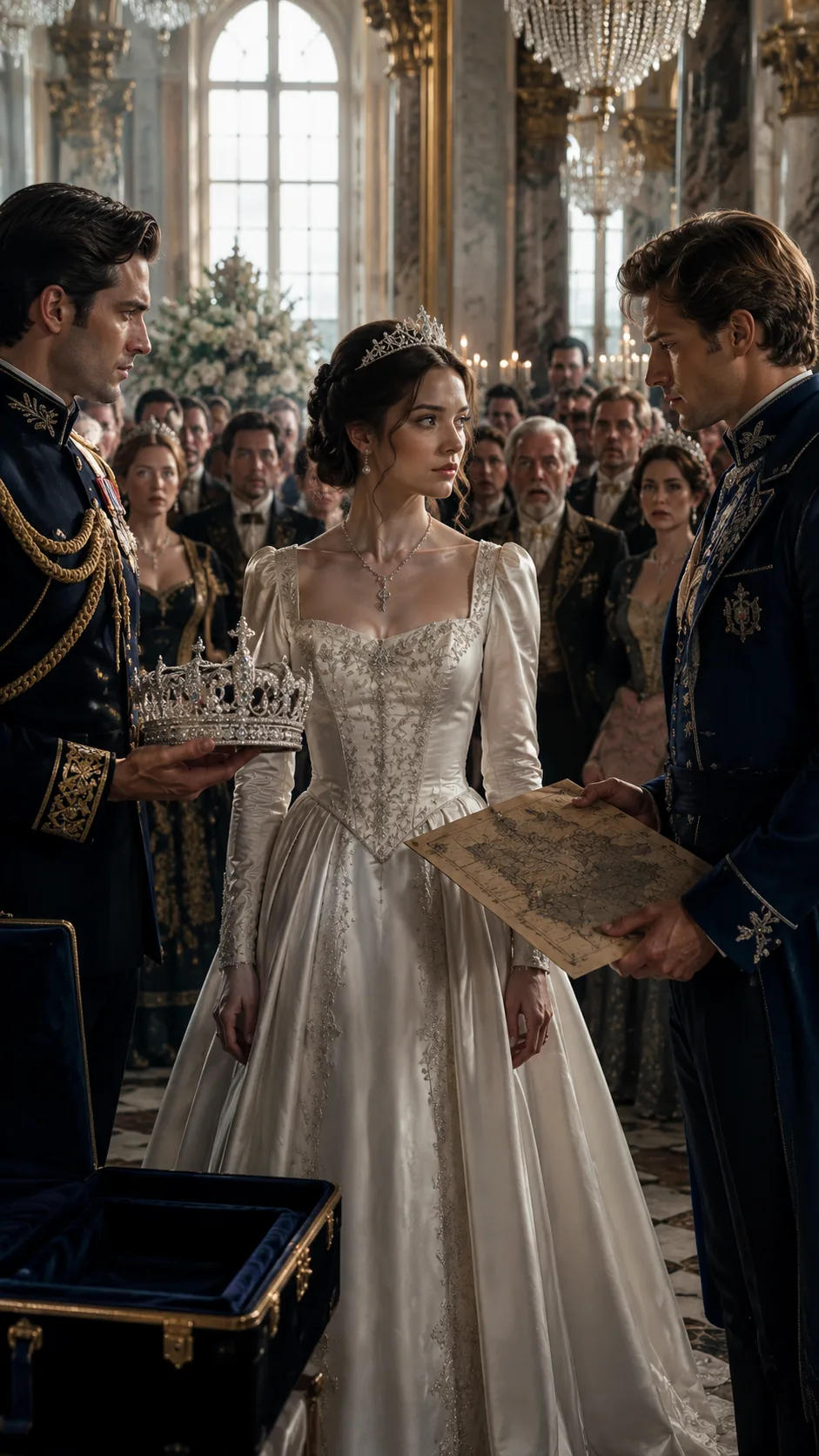
The Princess Chose The Prince Who Brought Her A Map Instead Of A Crown Before The Whole Kingdom
The royal engagement hall of Valoria had never looked more beautiful, or more dangerous.
Chapter 1
The Princess Chose The Prince Who Brought Her A Map Instead Of A Crown Before The Whole Kingdom
The royal engagement hall of Valoria had never looked more beautiful, or more dangerous.
Thousands of white roses climbed the marble pillars. Crystal chandeliers burned above the nobles like frozen stars. Banners from every province hung from the balcony rails, each one marked with the silver lion of Valoria.
At the center of the hall stood Princess Amelia.
She wore a white satin gown, pearl earrings, and a small ceremonial tiara that had belonged to her late mother. Her face was calm. Too calm. The kind of calm people mistook for obedience.
On her left stood Prince Adrian of Dravemont.
He was tall, handsome, and dressed in a dark navy royal uniform with gold cords across his chest. His kingdom controlled the largest army on the northern border. His ships guarded the trade routes. His generals could make small kings kneel with one letter.
On her right stood Prince Alexander of Eldoria.
He wore no medals today. No jeweled sword. No gold crown. Only
a deep blue ceremonial coat and a silver clasp shaped like a hawk. He was the prince Valoria’s people whispered about in markets and prayed for in temples, because three years ago, when war burned through the eastern villages, Alexander had sent soldiers, food, and physicians before Valoria’s own council agreed there was a crisis.
But the council did not care about gratitude.
They cared about armies.
And that was why Queen Helena, Amelia’s stepmother, had already chosen Adrian.
The ceremony was supposed to be simple.
Two princes would present their gifts. Amelia would accept one. The royal scribes would record the engagement. The bells would ring. Valoria would pretend the princess had freely chosen.
Amelia knew better.
That morning, Helena had come to her chamber before sunrise.
She had not knocked.
She entered in a gown of black velvet, her blonde hair pinned like a crown, her smile sharp
enough to cut silk.
“You will choose Adrian,” Helena said.
Amelia looked at her through the mirror. “Then why hold a ceremony?”
“Because kingdoms enjoy watching cages being decorated.”
Amelia did not answer.
Helena moved behind her and touched the pearl earrings Amelia wore.
“Your mother wore those when she married your father,” Helena said softly. “She understood duty.”
“My mother understood mercy,” Amelia replied.
Helena’s fingers tightened on Amelia’s shoulder.
“Mercy does not stop armies,” she whispered. “Adrian does. You will smile. You will accept his crown. You will thank him. And you will not embarrass this family.”
Amelia turned then.
For one second, Helena saw the girl she had spent years trying to make silent.
Not broken.
Not afraid.
Just waiting.
“If I refuse?” Amelia asked.
Helena smiled again.
“Then I will tell the council you are unstable. Emotional. Influenced by a foreign prince. They will remove your
voice before you ever inherit your father’s throne.”
My stomach dropped.
Not because Amelia believed Helena could destroy her.
But because she knew Helena had already begun.
For months, the council had treated Amelia like a symbol instead of a ruler. They praised her grace, then ignored her opinions. They asked her to sit beside maps, but not read them. They asked her to bless military alliances, but not question them.
And Isabella had laughed through all of it.
Isabella was Helena’s daughter from her first marriage, raised in the palace after Helena became queen. She had no royal blood from Valoria. No claim to the throne. But she carried herself like the crown had simply not reached her head yet.
At breakfast, Isabella had leaned across the table and said, “You should be grateful, Amelia. Adrian is more than most princesses deserve.”
Amelia had lifted her teacup. “Then why do you look disappointed that he is choosing me?”
The table went silent.
Isabella’s smile twitched.
Helena set down her knife.
King Roland, Amelia’s father, said nothing.
That hurt most of all.
The king had once been a strong man. A loved man. A man who held Amelia’s hand after her mother died and promised no one would ever make her feel unwanted inside her own home.
But grief and illness had changed him. Helena had stepped into every silence he left behind. She managed his letters. She reviewed his councils. She decided which advisers could speak to him and which servants were removed.
By the time Amelia understood what was happening, her father’s throne room had become Helena’s stage.
And today was supposed to be the final act.
The hall doors opened.
The herald struck his staff against the marble floor.
“His Royal Highness, Prince Adrian of Dravemont.”
The nobles turned.
Adrian walked forward like he had already won.
Behind him, four servants carried a velvet case the size of a cradle. The case was black, lined with gold, and guarded by two Dravemont officers.
Adrian did not look at the people.
He looked at Amelia.
Not with love.
With certainty.
He stopped before her and bowed just low enough to be polite.
“Princess Amelia,” he said, his voice smooth and public. “For the future queen of Valoria, I bring a gift worthy of her station.”
The servants opened the case.
Gasps moved through the hall.
Inside rested a diamond crown.
It was enormous. Cold. Blinding. Each stone caught the chandelier light and threw it back across the walls. It looked less like jewelry and more like a weapon designed to sparkle.
Isabella inhaled dramatically.
Helena smiled.
Several councilmen nodded with satisfaction.
Adrian lifted the crown himself and held it toward Amelia.
“With this crown,” he said, “Dravemont offers Valoria protection, power, and a place beside the strongest army in the continent.”
The room murmured approval.
Amelia stared at the crown.
It was beautiful.
It was also heavy.
She could already feel what it meant. A marriage signed by fear. A kingdom traded for soldiers. A lifetime standing beside a man who thought gifts were proof of ownership.
Adrian stepped closer.
Quietly, so only she could hear, he said, “Take it. This hall is full of people who need to see you make the right choice.”
Amelia looked up at him.
“The right choice for whom?”
His smile did not move.
“For everyone who matters.”
That was when the second herald struck the floor.
“His Royal Highness, Prince Alexander of Eldoria.”
The hall shifted.
Not loudly. Not openly. But Amelia felt it.
The servants near the doors straightened. The soldiers at the back lowered their eyes in respect. A woman from the eastern provinces pressed one hand over her heart.
Alexander entered without a parade.
He carried something wrapped in dark leather beneath one arm.
No servants walked behind him. No guards cleared his path. He crossed the marble floor with the steadiness of a man who had faced battle and did not need applause to remember who he was.
When he reached Amelia, he bowed lower than Adrian had.
Not to the council.
Not to Helena.
To her.
“Princess Amelia,” he said. “I did not bring diamonds.”
A few nobles whispered.
Isabella’s mouth curved.
Alexander untied the leather cord and opened what he carried.
It was a map.
Old parchment. Hand-drawn borders. Ink marks. Red thread. Small silver pins.
The nobles leaned forward, confused.
Alexander turned the map so Amelia could see it.
“This is eastern Valoria,” he said.
Amelia’s breath caught.
She recognized the river villages. The mountain passes. The burned trade road near Marenfield. The valley where refugees had waited three winters ago while the council debated whether sending help would anger Dravemont.
Alexander touched one small mark on the map.
“This is where my men found two hundred Valorian children hiding in a chapel cellar.”
The hall went still.
He moved his finger.
“This is where we rebuilt the bridge after your grain wagons were trapped.”
Another mark.
“This is where Lady Maren’s family was rescued when the northern raiders crossed the frost road.”
A woman in the gallery began to cry quietly.
Alexander looked at Amelia.
“I brought this because I wanted you to know something before you choose. I did not save those lands to ask for your hand. I helped because they were yours. Because their suffering mattered before any treaty did.”
The room went silent.
Adrian’s jaw tightened.
Helena’s smile faded by one inch.
Isabella let out a soft laugh.
It was not loud, but it was sharp enough to turn heads.
“How touching,” Isabella said, stepping forward from beside Helena. “A rescue map. How humble. How poetic.”
Amelia did not look at her.
Isabella continued anyway.
“But a princess should choose the richer crown.”
A few courtiers laughed carefully.
Not because it was funny.
Because Helena was watching.
Isabella walked closer, her silk gown whispering against the floor. She looked at Alexander’s map like it was a kitchen rag.
“Sentiment does not protect a kingdom,” she said. “A crown does. Soldiers do. Wealth does. Diamonds do.”
Then she turned to Amelia, smiling sweetly.
“Surely even you understand that.”
Amelia finally looked at her.
The entire hall seemed to hold its breath.
For years, Isabella had known exactly how to wound her in public. Never too much. Never enough to be called cruelty. Just enough to make Amelia look cold if she answered.
But today something was different.
Today Amelia was not alone in a corridor.
She was standing before every noble, every minister, every province banner, every servant who had ever lowered their eyes while Helena took more power than any queen consort should have been allowed to touch.
Adrian lifted the diamond crown higher.
“Princess,” he said, louder now. “The kingdom waits.”
Helena’s voice followed like silk over steel.
“Choose wisely, Amelia.”
King Roland sat on the throne above them, pale and silent.
Amelia looked at him.
For one terrible second, she wanted him to stand.
To say her name.
To remember he was her father before he was Helena’s husband.
But he only gripped the armrest.
His eyes were wet.
His mouth stayed closed.
That was the moment everything changed.
Amelia stepped away from Adrian’s crown.
A ripple moved through the hall.
Adrian blinked once.
Helena’s face hardened.
Isabella’s smile vanished.
Amelia walked toward Alexander’s map. She did not take it immediately. She looked down at the rivers, the roads, the burned villages, the small silver pins marking lives saved.
Then she looked at the diamond crown.
Cold.
Perfect.
Empty.
Adrian spoke through his teeth. “Do not turn this ceremony into a childish rebellion.”
Amelia raised her eyes.
“This ceremony became childish the moment everyone pretended my future was a prize to be displayed.”
A gasp moved through the nobles.
Helena rose from her seat.
“Amelia.”
But Amelia did not stop.
She turned to Isabella.
“You said a princess should choose the richer crown.”
Isabella lifted her chin. “Yes.”
Amelia’s voice was calm.
“Then I choose the man who knows a crown is not jewelry.”
The hall exploded into silence.
Not noise.
Silence.
The kind that hits harder than shouting.
Alexander looked stunned. Not triumphant. Not proud. Stunned, as if Amelia had handed him something sacred and he understood the weight of it.
Adrian’s face went pale with rage.
“You would insult Dravemont before the whole court?” he asked.
“No,” Amelia said. “I would tell Dravemont the truth before it becomes my prison.”
Helena descended from the royal platform.
Her black gown swept behind her like smoke.
“You foolish girl,” she said softly. “You think romance can govern a kingdom?”
Amelia faced her stepmother.
“No. I think fear has governed it long enough.”
The council erupted.
Lord Varrick, Helena’s closest adviser, slammed his hand onto the table.
“This is unacceptable. The princess has been manipulated.”
Alexander’s expression hardened.
“I have not spoken to Princess Amelia alone in six months.”
“Convenient,” Varrick snapped.
Adrian pointed toward the map.
“This man used charity to purchase loyalty.”
Alexander stepped forward.
“No. I used soldiers to stop Valorian children from freezing while your army waited at the border and called it strategy.”
The hall stirred.
Adrian’s officers stiffened.
Helena raised one hand.
“Enough.”
Her voice cut through the room.
She turned to the king.
“Your Majesty, this display proves what I warned you about. Amelia is emotional. Publicly unstable. Unfit to make a political decision of this scale.”
There it was.
The trap.
Not hidden anymore.
Amelia felt the words land exactly where Helena wanted them to land. Among old men who feared strong daughters. Among generals who preferred quiet queens. Among nobles who thought a woman’s anger was evidence and a man’s rage was leadership.
King Roland closed his eyes.
Helena looked back at Amelia with quiet victory.
But Amelia had learned from living with Helena.
Never enter a room without knowing where the knives are.
She turned to the royal scribe.
“Bring the eastern ledger.”
Helena froze.
Lord Varrick’s face changed.
The scribe hesitated.
Amelia’s voice sharpened.
“I am still Crown Princess of Valoria. Bring it.”
A young scribe hurried away.
Adrian frowned. “What is this?”
“The part of the ceremony my stepmother hoped we would never reach,” Amelia said.
Helena whispered, “Careful.”
Amelia heard her.
So did everyone else.
The scribe returned carrying a thick blue ledger sealed with silver wax.
Amelia took it and opened to a marked page.
“My mother created the Eastern Relief Fund before she died,” Amelia said. “It was meant to rebuild the provinces Alexander helped defend.”
Helena’s face went still.
Amelia turned a page.
“For three years, the council told me the fund was delayed because the treasury was strained.”
She looked at Lord Varrick.
“That was a lie.”
The room shifted.
Amelia held up the ledger.
“Money was released. Twice. Then redirected through private accounts controlled by Lord Varrick’s office and approved by Queen Helena.”
A servant dropped a tray somewhere near the back of the hall.
The crash rang like a bell.
Helena’s eyes flashed.
“You do not understand those documents.”
“I understood them well enough to make copies.”
My stomach dropped.
Lord Varrick stood so fast his chair hit the floor.
“That ledger is restricted.”
“Yes,” Amelia said. “Restricted from the people whose homes were never rebuilt.”
She turned toward the gallery.
“Lady Maren, is your village bridge still broken?”
A woman in gray rose with trembling hands.
“Yes, Your Highness.”
“Did the crown tell your province the relief funds had not arrived?”
“Yes.”
Amelia looked at the council.
“They arrived.”
The hall erupted.
Helena stepped toward her. “This is not the place.”
Amelia looked her dead in the eye.
“This is exactly the place. You wanted witnesses for my obedience. Now you have witnesses for your theft.”
The word theft hit the hall like a blade.
King Roland finally stood.
His movement was slow, painful, but every person in the room saw it.
“Helena,” he said.
For the first time all day, Helena looked afraid.
Only for a second.
Then she recovered.
“My love,” she said, turning to him. “She is twisting numbers she does not understand. Alexander’s arrival has clearly affected her judgment.”
Adrian seized the moment.
“Valoria needs stability. If Amelia cannot provide it, Dravemont will not risk alliance under uncertain leadership.”
Amelia laughed once.
It was quiet.
Sharp.
Adrian looked offended.
“You think that frightens me?” she asked.
“It should.”
“No,” she said. “It frightens men who believe protection means control.”
Alexander looked at her then, and something unreadable crossed his face.
Respect.
Not desire.
Not possession.
Respect.
Amelia closed the ledger.
Then she walked to the center of the hall, between the diamond crown and the map.
“I was told today to choose wisely,” she said. “So I will.”
Helena shook her head slowly.
“Amelia, stop.”
“No.”
One word.
The hall went silent again.
Amelia turned first to Adrian.
“You brought me a crown so large no one would notice the cage beneath it.”
Adrian’s hand tightened around the diamond frame.
“You will regret this.”
“Perhaps,” Amelia said. “But I will regret it as myself.”
Then she turned to Alexander.
“You brought me a map of suffering you did not cause and help you were not required to give.”
Alexander bowed his head.
“I brought the truth of what I knew.”
“And you asked for nothing in return.”
He looked at her carefully.
“I am asking now only that your choice be yours.”
Amelia took the white rose from the silver tray beside the altar.
The rose was the ancient symbol of royal consent. Once given, it became part of the public record. No council vote could erase it without accusing the crown princess of incapacity.
Helena realized it too late.
“Guards,” she snapped.
No one moved.
Because King Roland had lifted his hand.
The king’s voice was weak, but clear.
“No one touches my daughter.”
Helena turned to him, shocked.
For the first time in years, the room remembered who wore the crown.
Amelia’s throat tightened, but she did not cry.
Not yet.
She walked to Alexander and placed the white rose over his open palm.
“I choose the man who understands a crown is not jewelry,” she said. “It is responsibility.”
Alexander closed his fingers around the rose as if it might break.
Then he knelt.
The entire hall gasped.
A prince of Eldoria knelt before the crown princess of Valoria, not to claim her, not to display her, but to honor the choice she had just made.
“I accept only if you remain free to command your own throne,” he said.
The people in the gallery began to applaud.
One clap.
Then another.
Then dozens.
Then the whole upper hall shook with it.
The council did not clap.
Helena did not move.
Adrian threw the diamond crown back into the velvet case so hard the jewels struck the lining.
“This alliance is over,” he said.
Amelia faced him.
“No. This negotiation is over. There is a difference.”
Adrian stepped closer, his voice low.
“You think Eldoria can protect you from what Dravemont will do?”
Alexander rose.
He did not reach for his sword.
He did not need to.
“Choose your next words carefully,” Alexander said. “You are speaking inside her kingdom.”
Adrian’s nostrils flared.
But he said nothing.
Because outside the windows, the sound of the people had begun.
At first, Amelia thought it was thunder.
Then the doors opened.
A palace guard rushed in and bowed.
“Your Majesty,” he said to the king, “the eastern delegates have gathered outside the palace gates. They are asking for Princess Amelia.”
Helena looked toward the windows.
The crowd beyond the courtyard was growing. Farmers. Merchants. soldiers from old campaigns. Women with children on their hips. Men carrying province banners.
They had come because rumors travel faster than royal commands.
They had come because Alexander’s map had reminded them who remembered their suffering.
They had come because Amelia had finally said aloud what many of them already knew.
The palace had been afraid of Helena for too long.
King Roland descended the steps from the throne. Each step seemed to cost him strength, but he came to stand beside Amelia.
He looked older than she remembered.
Smaller.
But his hand, when it took hers, was still warm.
“I failed you,” he said quietly.
The words nearly broke her.
Helena’s face twisted.
“Roland, do not humiliate yourself.”
The king turned.
“No, Helena. I humiliated myself when I let you speak for me until my own daughter had to fight for permission to be heard.”
The hall went completely still.
Lord Varrick tried to move toward the side door.
Alexander’s guard caught the motion and stepped into his path.
Amelia opened the ledger again and handed it to the captain of the palace guard.
“Seal Lord Varrick’s office,” she said. “Secure all treasury records. No document leaves this palace.”
The captain looked to the king.
King Roland nodded.
“By order of the crown.”
Helena took one step back.
“You would arrest your own queen?”
Amelia looked at her stepmother.
“No. I would investigate a woman who used a crown to steal from the people she was supposed to protect.”
Isabella, who had been silent for the first time in her life, suddenly spoke.
“Mother?”
Helena did not look at her.
That was the answer Isabella had never wanted.
In that moment, Isabella understood something Amelia had known for years.
Helena loved power first.
Everyone else second.
Adrian turned sharply and walked toward the doors. His officers followed.
Before leaving, he looked back at Amelia.
“You chose a map over a crown.”
Amelia stood beside Alexander, the white rose between them, the stolen ledger in the captain’s hands, and the people calling her name beyond the walls.
“No,” she said. “I chose the man who knew the map mattered because people lived on it.”
Adrian left.
The doors closed behind him.
The diamond crown remained in its velvet case, glittering uselessly under the chandeliers.
No one touched it.
By sunset, Lord Varrick’s office was sealed.
By midnight, three treasury clerks had confessed.
By morning, the first wagons of silver were sent east under Amelia’s personal seal.
Helena was removed from the royal council pending investigation. She was not dragged out. Amelia would not give her the drama of martyrdom. She was escorted from the hall by guards who no longer lowered their eyes when she passed.
Isabella stayed in the palace for three days.
On the fourth morning, she came to Amelia’s private garden.
For once, she wore no jewels.
“I thought you would ruin me too,” Isabella said.
Amelia was reading reports from the eastern provinces. She did not look up immediately.
“You helped her mock me,” she said.
“I know.”
“You enjoyed it.”
Isabella swallowed.
“Yes.”
Amelia closed the report.
“Then live with the memory of who you were when you thought cruelty was safety.”
Isabella’s eyes filled.
“Is that all?”
“No,” Amelia said. “You will leave Valoria for one year. Study governance in Marenfield. Help rebuild the bridge your mother stole from.”
Isabella stared. “You are sending me to the east?”
“I am giving you the chance to become someone useful.”
“And if I refuse?”
Amelia’s face remained calm.
“Then you remain exactly what Helena raised you to be.”
Isabella had no answer.
She left the next morning.
A week later, the formal engagement between Amelia and Alexander was announced.
But Amelia refused a grand celebration.
Instead, she rode east.
Alexander came with her, not in front, not behind, but beside her.
They visited the chapel cellar where children had once hidden from raiders. They walked across the half-built bridge at Marenfield. They stood in a field where burned houses were being raised again stone by stone.
An old woman approached Amelia there and bowed.
Amelia reached for her hands before she could finish.
“No,” Amelia said. “Do not bow for receiving what was already owed to you.”
The old woman cried anyway.
That night, beside a small fire near the river, Alexander handed Amelia the same map he had brought to the ceremony.
Only now, there were new marks.
Rebuilding sites.
Supply routes.
Schools planned.
Bridges funded.
Amelia traced one line with her finger.
“You could have brought diamonds,” she said.
Alexander smiled faintly.
“I thought Adrian had enough diamonds for both of us.”
She laughed.
It surprised her.
The sound felt unfamiliar.
Free.
Then Alexander grew serious.
“I need you to know something.”
Amelia looked at him.
“I meant what I said in the hall,” he continued. “If one day you decide this engagement does not serve you or Valoria, you may end it. I will not call your freedom betrayal.”
Amelia studied him in the firelight.
All her life, men had offered protection with chains hidden inside. Councils offered guidance that sounded like obedience. Helena offered family that felt like war.
But Alexander did not reach for her hand.
He waited.
That mattered more than any vow.
Amelia placed the map between them.
“My whole life, people told me a crown was something placed on my head,” she said. “Something I had to carry because I was born to it.”
She looked toward the dark river, where the moon moved across the water like silver thread.
“But today I understood something.”
“What?”
“A crown is not what makes people kneel,” she said. “It is what reminds you never to make them crawl.”
Alexander was quiet for a long moment.
Then he bowed his head.
Not as a prince to a future bride.
As one ruler to another.
Months later, when Amelia was officially crowned Queen of Valoria, the diamond crown from Dravemont was not used.
It had been locked away in the treasury as evidence of a treaty that almost became a cage.
Instead, Amelia wore her mother’s simple silver crown.
No enormous jewels.
No foreign army’s symbol.
Just silver, pearls, and the crest of Valoria.
Alexander stood at the foot of the throne steps, not beside her as an owner, not behind her as a shadow, but below her as a witness.
When the archbishop asked if she accepted the crown, Amelia looked out at the hall.
She saw eastern villagers seated beside nobles.
She saw clerks who had testified against corruption.
She saw Isabella standing near the back, thinner, quieter, changed by a year of work among people she had once mocked.
She saw her father watching with tears in his eyes.
And she saw the map.
Framed now, not as decoration, but as a warning.
It hung behind the throne.
A reminder that kingdoms were not borders on parchment.
They were people.
Amelia lifted her chin.
“I accept,” she said.
The bells rang.
Outside, Valoria cheered.
And for the first time in many years, the sound did not feel like performance.
It felt like truth.
THE END.
Chapter complete
You have reached the end of this chapter.
Continue reading
A few more worlds to get lost in after this chapter.