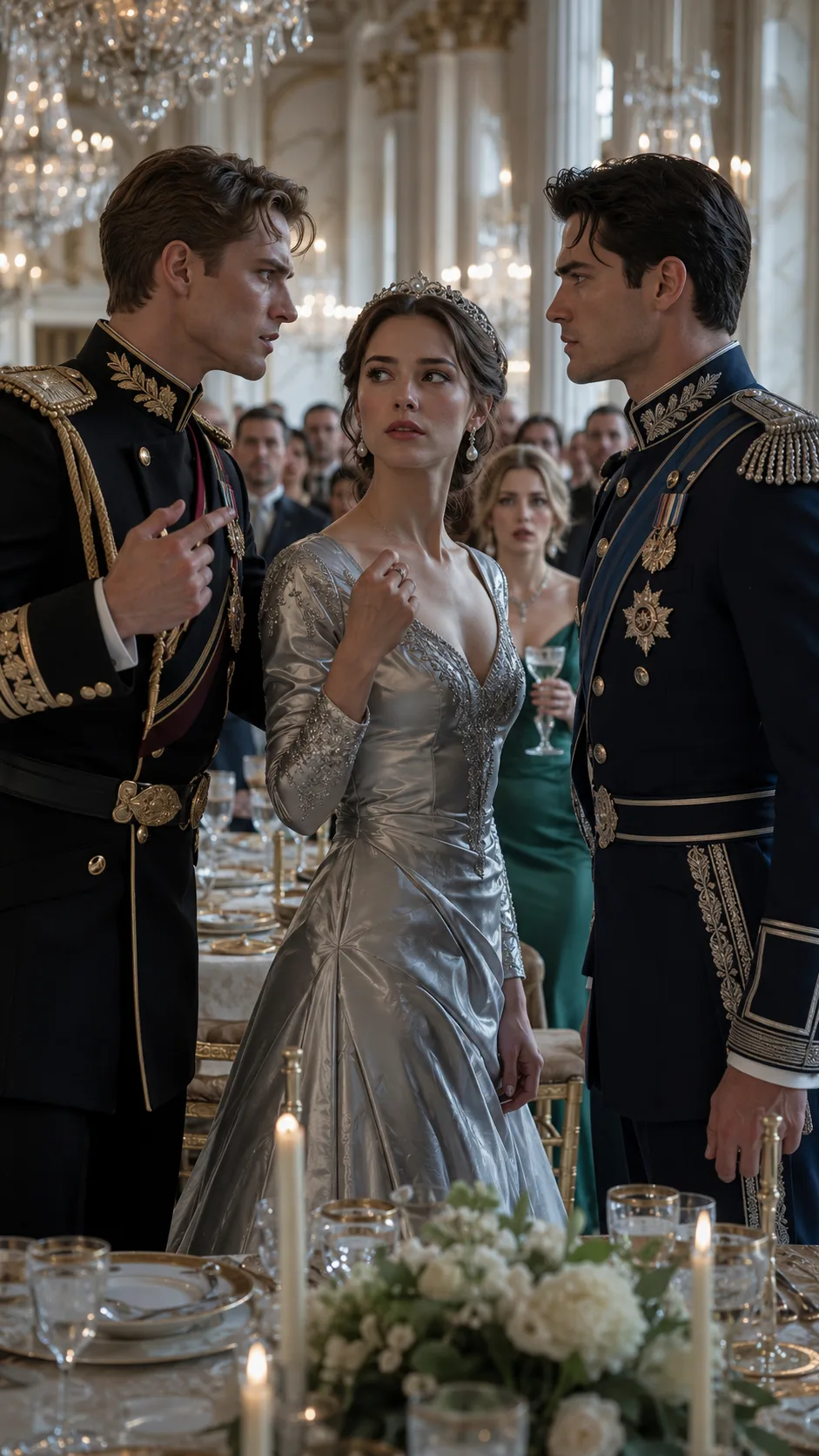
The Prince Who Betrayed His Wife Learned Too Late That Another Prince Had Already Chosen To Protect Her
The first time Prince Adrian called Princess Amelia “my wife” in public, he was not defending her.
Chapter 1
The Prince Who Betrayed His Wife Learned Too Late That Another Prince Had Already Chosen To Protect Her
The first time Prince Adrian called Princess Amelia “my wife” in public, he was not defending her.
He was warning another man not to touch what he believed belonged to him.
That was the part the entire palace remembered.
Not the chandeliers.
Not the golden plates.
Not the foreign banners hanging from the marble balcony.
Not even the orchestra, which stopped so suddenly that the final violin note seemed to hang in the air like a blade.
What people remembered was Adrian’s voice cutting across the royal banquet hall.
“She is my wife.”
And then Prince Alexander of Eldoria turned his head, calm as winter, and answered,
“Then why does she look safer standing beside me?”
The room went silent.
Not polite silent.
Not ceremonial silent.
The kind of silence that comes after a door locks and everyone inside realizes there is no way out.
Amelia stood between them in a pale silver satin gown, her pearl earrings trembling slightly against her neck. Her hands were still
folded in front of her, as every princess of Valoria had been trained to do since childhood. Chin raised. Shoulders still. Face composed.
But inside, something cracked.
Not because Adrian had humiliated her again.
She was used to that.
Not because Isabella was watching from the far end of the banquet table, smiling behind a crystal glass like she had already won.
Amelia was used to that too.
What she was not used to was someone saying the truth out loud.
For three years, her marriage to Adrian had been described as necessary.
A necessary alliance.
A necessary sacrifice.
A necessary symbol of unity between two powerful houses.
Her stepmother, Queen Helena, had said it the night before the wedding.
“A wise princess does not ask whether a marriage is happy. She asks whether it keeps the kingdom stable.”
Amelia had been twenty-four then. Old enough to understand politics, young
enough to still believe loyalty could create affection if given enough time.
She had stood beneath the cathedral dome beside Adrian, a handsome prince with dark blond hair, a navy royal uniform, and a smile perfect enough to satisfy every painter in Valoria.
He had looked at her during the vows, not with love, but with satisfaction.
At the time, she mistook that for pride.
Later, she learned it was possession.
Adrian did not want a wife.
He wanted a crown beside him.
He wanted Amelia’s bloodline, Amelia’s title, Amelia’s public approval, Amelia’s quiet obedience.
And Isabella, Amelia’s half-sister, wanted everything Amelia had never asked for.
Isabella had grown up in the palace too, but never as heir. She was Helena’s daughter from her first marriage, beautiful in a sharp, hungry way, with golden hair always arranged like a weapon and blue eyes trained to look wounded whenever it helped
her.
She called Amelia “sister” in public.
In private, she called her “the lucky one.”
The affair began six months after the wedding.
Amelia did not discover it all at once.
Betrayal rarely arrives as a thunderclap.
It comes as a perfume on a sleeve.
A door closed too quickly.
A laugh that stops when you enter a room.
A servant refusing to meet your eyes.
Then one night, Amelia returned early from a charity inspection and saw Isabella leaving Adrian’s private study at midnight, wearing one of his military coats over her shoulders.
Isabella froze for half a second.
Adrian did not.
He only looked annoyed.
“You should have sent word you were returning.”
My stomach dropped, Amelia remembered thinking.
Not because he was guilty.
Because he wasn’t ashamed.
After that, the palace became a theater of small cruelties.
At breakfast, Isabella began sitting closer to Adrian.
At council receptions, Adrian praised Isabella’s “natural charm” while Amelia’s diplomatic work went unmentioned.
At one winter ball, Isabella wore a sapphire necklace Amelia had received as a wedding gift. When Amelia quietly asked for it back, Isabella blinked innocently and said, “Adrian said it looked wasted in a locked drawer.”
Adrian did not deny it.
He smiled like he had already won.
And Amelia, trained since birth never to fracture the image of the crown in public, swallowed the insult.
Again.
Until the night Eldoria arrived.
Prince Alexander came to Valoria not for romance, not for scandal, not for war.
He came to renew an old defense pact between Valoria and Eldoria, a pact signed by their grandfathers when northern raiders still crossed the mountains.
Eldoria was smaller than Valoria, but richer in discipline and respected for one thing above all: it never broke its word.
Alexander arrived with no unnecessary ceremony.
No jeweled carriage.
No gold-covered guards.
Just twelve riders in navy-and-silver uniforms, a sealed treaty case, and a black horse that stopped at the palace steps as if it understood court politics better than most nobles.
Amelia watched from the upper balcony as he dismounted.
He was thirty, tall, broad-shouldered, with dark brown hair, calm gray eyes, and a face that looked carved by restraint rather than vanity. He wore a formal Eldorian military coat with silver buttons and no crown.
That was the first thing she noticed.
He did not need one to look royal.
Adrian noticed too.
“He looks like a soldier pretending to be a prince,” Adrian muttered beside her.
Amelia kept her eyes on the courtyard.
“Perhaps that is better than a prince pretending to be a husband.”
The words came out softer than she intended, but not soft enough.
Adrian turned.
For a moment, the pleasant mask slipped.
“What did you say?”
Amelia looked at him.
The old Amelia would have apologized.
The old Amelia would have lowered her gaze.
The old Amelia would have protected the marriage even when the marriage no longer protected her.
But that woman had been dying slowly for three years.
“I said the Eldorian delegation is here,” she replied. “We should greet them.”
Adrian’s jaw tightened.
Behind him, Isabella laughed lightly from the doorway.
“Careful, Amelia. Foreign princes are trained to flatter lonely wives.”
Amelia turned toward her half-sister.
Isabella wore emerald satin, Adrian’s favorite color.
Amelia noticed.
Everyone noticed.
No one said anything.
“That sounds like advice from experience,” Amelia said.
Isabella’s smile froze.
Adrian stepped closer. “Enough.”
But Amelia had already walked past him.
Downstairs, in the receiving hall, Alexander bowed first to King Edmund, Amelia’s father, then to Queen Helena, then to Adrian.
Last, he turned to Amelia.
He bowed lower.
Not exaggerated.
Not theatrical.
Respectful.
“Your Royal Highness,” he said.
Amelia extended her hand because protocol required it.
Alexander took it briefly and bowed again.
His eyes met hers for only a second, but something in his expression changed.
Not pity.
Pity would have offended her.
Recognition.
As if he had walked into a beautiful room and noticed the only person inside who could not breathe.
“Prince Alexander,” Amelia said. “Valoria welcomes you.”
“Eldoria remembers who kept the northern border supplied during the famine,” he replied. “My country has not forgotten your letters.”
Adrian’s head shifted slightly.
“My letters?” Amelia asked.
Alexander straightened. “The grain corridor proposal. Three winters ago. Your signature was on every order.”
The room went quiet.
Not dramatically.
Just enough.
Because everyone knew the northern relief campaign had been celebrated as Adrian’s first great diplomatic achievement after the marriage.
Amelia had written the proposal.
Adrian had delivered the speech.
The history books had printed his name.
Adrian smiled, but his eyes were cold.
“My wife assists where she can.”
Alexander looked at him.
“Yes,” he said. “Some assistance is large enough to look like leadership.”
That was the first strike.
Small.
Elegant.
Public enough to sting, polite enough that Adrian could not punish it without looking weak.
Amelia lowered her eyes to hide the surprise on her face.
She had forgotten what it felt like to be seen accurately.
The days before the banquet stretched like wire.
Alexander attended council meetings.
Amelia expected him to speak over her, as visiting princes often did, but he listened. When she explained Valoria’s port tariffs, he asked questions. When Adrian interrupted, Alexander returned the conversation to her.
“Princess Amelia was explaining the clause,” he said once, calmly.
Adrian laughed. “She has been buried in documents since childhood. Let us not punish our guests with her details.”
Alexander did not laugh.
“In Eldoria, details are where men hide theft.”
Several councilors coughed into their hands.
Queen Helena’s face hardened.
Amelia sat very still.
Later that afternoon, Helena summoned her to the west drawing room.
The room smelled of roses and old power.
Helena stood near the window, dressed in deep burgundy silk, her diamonds catching the pale daylight. Isabella sat beside her, pretending to read a letter she was not reading.
Adrian stood by the fireplace.
That was how Amelia knew it was not a conversation.
It was a trial.
Helena spoke first.
“You embarrassed your husband today.”
Amelia looked at her stepmother. “I answered questions about trade law.”
“You allowed a foreign prince to elevate you over your husband.”
“No,” Amelia said. “Adrian did that himself when he failed to know the treaty he claimed to lead.”
Isabella set down the letter.
“Listen to her. One compliment from Eldoria and suddenly she remembers she has a spine.”
Amelia turned to her.
“I never forgot. I simply stopped wasting it on people who mistake silence for weakness.”
Adrian moved from the fireplace.
His voice was low.
“You are enjoying this.”
Amelia met his stare.
“I am surviving it.”
Something flickered across his face. Annoyance. Not guilt.
Never guilt.
Helena stepped closer. “You will attend tonight’s banquet. You will smile beside your husband. You will not encourage Prince Alexander’s attention. And you will not damage the alliance by creating gossip.”
Amelia almost laughed.
The entire palace knew Adrian visited Isabella’s rooms after midnight.
Servants changed sheets.
Guards moved posts.
Ladies-in-waiting whispered, then stopped when Amelia entered.
But somehow Amelia was the danger to reputation.
“Gossip?” Amelia asked. “Or truth?”
Helena’s eyes sharpened.
“A princess who exposes private matters destroys herself first.”
Amelia looked at Adrian.
“Did you hear that? Your mother-in-law still believes shame belongs to the person betrayed.”
Isabella stood.
“That is enough.”
“No,” Amelia said. “That is exactly the problem. It has never been enough. Not the lies. Not the necklace. Not the closed doors. Not the way you sit beside my husband at public dinners as if my chair is only waiting for you to grow bold enough to take it.”
Isabella’s face went pale, then furious.
Adrian stepped forward. “You are speaking nonsense.”
Amelia smiled faintly.
It frightened him more than anger would have.
“Then tonight should be easy for you.”
At sunset, the palace transformed.
The royal banquet hall of Valoria was built to intimidate foreign rulers. White marble columns rose three stories high. Gold-framed portraits of dead kings watched from the walls. Crystal chandeliers poured light over a table long enough to make even powerful men feel temporary.
Servants moved like shadows.
Reporters were not allowed inside, but court painters, diplomatic witnesses, and noble families filled the upper gallery. Nothing said at that table would remain private.
Amelia entered on Adrian’s arm because protocol demanded it.
His grip was firm enough to hurt.
To anyone watching, they looked perfect.
The prince consort in black formal uniform, decorated with medals he had not earned.
The crown princess in silver satin, her pearl earrings glowing softly, her face calm.
Isabella entered behind them in emerald.
Of course.
Alexander was already standing near the center of the hall, speaking with King Edmund. When Amelia entered, his eyes moved briefly to Adrian’s hand on her arm.
Not long enough to insult.
Long enough to notice.
Adrian noticed him noticing.
His fingers tightened.
Amelia did not flinch.
That was her first victory of the night.
Dinner began with ceremony.
Toasts.
Music.
Formal praise.
King Edmund, aging and tired from illness, raised his glass to Eldoria.
“May the old pact stand stronger than the mountains between us.”
Alexander stood.
“Eldoria honors Valoria’s friendship. And we honor those who worked quietly to preserve it.”
His gaze did not move to Amelia.
He was careful.
That made it worse for Adrian.
Because restraint can be more threatening than desire.
The first insult came with the second course.
A council lord asked Amelia about the refugee trade route near the northern pass.
Amelia began to answer.
Adrian cut in.
“My wife concerns herself with charitable appearances. The hard border matters remain with the military council.”
The room shifted.
Amelia set down her fork.
Before she could speak, Alexander said, “Strange. The report Eldoria received had Princess Amelia’s seal on the risk assessment.”
Adrian smiled tightly. “She signs what is placed before her.”
Alexander’s expression did not change.
“Then someone in Valoria places unusually intelligent work before her.”
A few nobles looked down to hide their reactions.
Isabella leaned toward Adrian and whispered something.
Amelia did not hear it.
She saw Adrian’s mouth curve.
Then he lifted his glass.
“To my wife,” he said loudly. “Whose greatest talent is making others believe she suffers more than she does.”
The banquet hall froze.
It was not the loudest insult Adrian had ever made.
But it was the most public.
Amelia felt the heat of every gaze.
Her father’s hand tightened around his glass.
Helena looked satisfied.
Isabella looked delighted.
Adrian turned toward Amelia with a smile that dared her to react.
For years, he had counted on one thing: Amelia would never embarrass the crown.
Not even to save herself.
Amelia picked up her glass.
Her hand was steady.
She looked at Adrian.
“I was taught not to speak of private pain at public tables.”
Adrian’s smile widened.
“Good.”
Then Amelia continued.
“But I was also taught that a man who mocks pain he caused should not be trusted with a kingdom’s mercy.”
The room went dead quiet.
Adrian’s smile disappeared.
Isabella’s eyes widened.
Helena whispered, “Amelia.”
But the name came too late.
Adrian stood so suddenly his chair scraped against the marble floor.
The sound cut through the hall.
“Careful,” he said.
One word.
Soft.
Ugly.
A warning disguised as advice.
Alexander stood too.
Not quickly.
Not dramatically.
Just enough to make the entire room understand that Amelia was no longer standing alone.
Adrian turned on him.
“This is a family matter.”
Alexander said, “No. This is a royal table, before allies, after a public insult.”
Adrian laughed, but there was no humor in it.
“You forget your place, foreign prince.”
Alexander’s eyes stayed calm.
“I know exactly where I stand.”
Isabella rose halfway from her chair.
“Beside another man’s wife, apparently.”
A few guests gasped.
There it was.
The accusation they had been trying to place on Amelia all week.
Not Adrian’s affair.
Not Isabella’s stolen seat.
Not Helena’s cover-ups.
Amelia’s dignity was the scandal.
Alexander looked at Isabella once.
Only once.
“Princess Isabella, if standing beside someone while they are humiliated is a crime in Valoria, then your court has legalized cruelty.”
Isabella sat back as if slapped by words.
Adrian moved around the table.
“Do not speak to her.”
Amelia stood.
“Do not defend her to the man defending your wife.”
Adrian stopped.
For the first time that night, the mask broke completely.
There he was.
Not the charming prince consort.
Not the loyal husband.
Not the decorated leader.
Just a man whose possession had spoken without permission.
“You are my wife,” he said.
The words struck the hall like a door slamming.
Amelia could feel the old training rise in her body.
Lower your eyes.
Soften your voice.
Protect the crown.
Do not make men look small in public.
Then Alexander stepped beside her.
He did not touch her.
He did not reach for her hand.
He did not claim what Adrian claimed.
He simply stood close enough that the space around Amelia changed.
And Adrian saw it.
“She is my wife,” Adrian said again, louder.
Alexander turned his head slowly.
“Then why does she look safer standing beside me?”
The room went silent.
That was the moment everything changed.
Because everyone looked at Amelia.
Not at Adrian.
Not at Alexander.
At Amelia.
And what they saw was worse than any confession.
She looked calm beside Alexander.
Not romantic.
Not guilty.
Safe.
For three years, she had stood beside her husband like someone bracing for impact.
Now, beside a foreign prince who had known her for less than a week, her shoulders had lowered by half an inch.
Her breathing had steadied.
Her eyes were no longer asking permission to exist.
The truth was visible.
And once visible, it could not be buried again.
Adrian saw it too.
His face turned cold.
“You have rehearsed this,” he said.
Amelia almost smiled.
“No, Adrian. You have performed cruelty so often that anyone honest could answer it without practice.”
Helena rose.
“This banquet is over.”
King Edmund’s voice came from the head of the table.
“No.”
Everyone turned.
The king had rarely interrupted Helena in recent years. Illness had made him quieter. Grief had made him dependent on peace.
But now he stood, slow and pale, with one hand on the table.
“This banquet is not over,” he said. “It has finally begun telling the truth.”
Helena’s face drained.
“Edmund—”
He lifted his hand.
“Sit down.”
The queen obeyed.
Not because she wanted to.
Because the gallery was watching.
King Edmund looked at Adrian.
“I have tolerated much for stability.”
Adrian’s jaw tightened. “Your Majesty, with respect—”
“With respect?” Edmund repeated. “You humiliate my daughter in my hall, before my allies, after betraying the vows you made beneath our cathedral dome, and you speak to me of respect?”
Isabella whispered, “This is a misunderstanding.”
Amelia turned to her.
“No. A misunderstanding is when someone hears wrong. This palace heard everything correctly for three years and chose comfort.”
A servant near the wall began to cry silently.
That tiny sound nearly broke Amelia.
Because it meant the servants knew too.
They had always known.
Adrian looked around and realized the room was slipping from him.
So he did what men like him do when charm fails.
He reached for power.
“I am still prince consort,” he said. “My marriage gives me authority in this court.”
Amelia picked up a sealed folder from beneath her chair.
Adrian stared at it.
For the first time, uncertainty crossed his face.
“What is that?”
Amelia held the folder against her chest.
“The document I hoped I would never need.”
Helena stood again. “Amelia, stop.”
But Amelia had already broken the first rule.
After that, the rest were only paper.
She placed the folder on the table.
The sound was small.
Everyone heard it.
“Before this banquet,” she said, “I submitted a private petition to the royal legal council. It contains witness statements, financial records, guard logs, and household schedules proving that Prince Adrian used royal resources to conceal his affair with Isabella.”
Isabella went white.
Adrian stepped forward. “You wouldn’t dare.”
Amelia looked at him.
“There it is,” she said softly. “Not ‘I didn’t.’ Not ‘I’m sorry.’ Just ‘you wouldn’t dare.’”
Alexander’s expression tightened, but he remained silent.
This was Amelia’s moment.
Not his.
Amelia opened the folder.
“Page one: the west corridor guard rotation changed fifteen times on nights Isabella entered your private wing. Page three: palace funds used to send three servants away after they refused to alter household records. Page seven: the sapphire necklace gifted to me by the Duchess of Maren, transferred to Isabella’s chambers by your written order.”
Isabella gripped the edge of the table.
“That necklace was nothing.”
Amelia looked at her.
“No. It was everything. Not because of its price. Because you wore it to see how much of my life you could put on your body before I screamed.”
No one moved.
Amelia turned a page.
“And page twelve: Queen Helena’s instruction to the household press office to deny any rumors by implying I was emotionally unstable.”
Helena’s face hardened into something dangerous.
“Do not forget who raised you.”
Amelia’s voice did not shake.
“My mother raised me. You trained me to be quiet.”
King Edmund closed his eyes.
The pain on his face was visible.
For years, he had failed to see what was happening inside his own palace.
Now the truth stood on the table like a body no one could pretend was sleeping.
Adrian pointed at Alexander.
“This is his doing.”
Amelia laughed once.
It was not a happy sound.
“No. That is why you cannot understand this. You think a woman only speaks when another man teaches her how.”
Alexander finally spoke.
“Princess Amelia needed no instruction from me.”
Adrian snapped, “Stay out of this.”
Alexander’s voice lowered.
“I tried.”
The room tightened.
“But you mistook her silence for permission. You mistook her loyalty for fear. And tonight, you mistook my restraint for weakness.”
Adrian moved closer until they stood only a few feet apart.
Two princes.
One husband by law.
One defender by choice.
“Do you want a duel?” Adrian asked.
Amelia’s heart clenched.
There it was.
The old trick.
Turn a woman’s pain into a man’s contest.
Make swords louder than truth.
But Alexander did not take the bait.
“No,” he said. “I want witnesses.”
The answer stunned the room more than a challenge would have.
Alexander looked toward the gallery, then the council, then King Edmund.
“Let the record show that the Crown Princess of Valoria presented evidence at a formal diplomatic banquet after being publicly insulted by her husband. Let the record show she was not hysterical, not coerced, not seduced, and not confused. Let the record show she spoke clearly.”
Amelia felt her throat tighten.
Not because he saved her.
Because he refused to replace her.
He did not fight over her.
He cleared the room enough for her voice to stand.
King Edmund looked at the royal scribe.
“Record it.”
The scribe, trembling, dipped his pen.
Helena whispered, “This will destroy us.”
Amelia turned.
“No. It will destroy what was already rotten.”
Adrian’s face twisted.
“You think this makes you free?”
Amelia looked at him for a long moment.
Three years of dinners.
Three years of locked doors.
Three years of watching another woman wear pieces of her life.
Three years of being told that dignity was dangerous because it made guilty people uncomfortable.
Then she removed her wedding ring.
Gasps rose from the table.
Adrian stared as if she had drawn a blade.
Amelia placed the ring beside the folder.
“No,” she said. “This does.”
The sound of the ring touching marble was almost nothing.
Yet it ended a marriage.
Isabella began to cry.
This time, no one moved to comfort her.
Adrian looked at King Edmund. “You cannot allow this.”
The king’s face had aged ten years in ten minutes.
But his voice was steady.
“I allowed too much already.”
He turned to the captain of the royal guard.
“Prince Adrian is to be escorted to the east residence until the council reviews the evidence. Princess Isabella will remain under palace supervision. Queen Helena will surrender all press office authority immediately.”
Helena gripped the back of her chair.
“You cannot strip me before foreign guests.”
King Edmund’s eyes flashed.
“You stripped my daughter of peace before servants. Consider this mercy.”
The guards moved.
Adrian did not resist at first.
He looked at Amelia, waiting for the old reflex.
Waiting for her to soften.
Waiting for her to save him from the consequences he had never believed would arrive.
Amelia did not move.
So Adrian turned cruel one last time.
“You will regret this when Eldoria leaves,” he said. “Foreign princes enjoy rescuing unhappy women until the cost becomes inconvenient.”
The words were meant to poison the one clean thing in the room.
Amelia looked at Alexander.
He did not speak first.
He did not promise.
He did not step forward like a hero in a cheap song.
He waited.
That made the choice hers.
Amelia turned back to Adrian.
“I do not need Prince Alexander to stay for me to know I deserved better than you.”
Alexander’s eyes softened almost imperceptibly.
Adrian had no answer.
The guards escorted him out.
The banquet hall remained silent until the doors closed behind him.
Then the room inhaled.
Not loudly.
Not in celebration.
In shock.
In grief.
In release.
Amelia stood alone beside the table, ring gone, folder open, every hidden wound finally given a name.
King Edmund came toward her.
For a moment, Amelia was eight years old again, waiting for her father to notice she had been crying in corridors no princess was supposed to cry in.
He stopped in front of her.
His voice broke.
“I failed you.”
The room should not have heard it.
But it did.
Amelia swallowed.
“Yes,” she said.
The honesty hurt more than forgiveness would have.
King Edmund nodded.
A king could command armies.
A father could still arrive too late.
“I will not fail you now,” he said.
Amelia wanted to believe him.
Maybe someday she would.
But that night, belief was too heavy.
She turned toward the hall.
“The banquet is over.”
No one argued.
As guests rose, whispers spread like wind through dry leaves. Nobles who had spent years bowing to Adrian suddenly avoided looking at the door he had exited through. Ladies who once complimented Isabella’s gowns now stepped away from her path. Councilors who had told Amelia to be patient began rehearsing expressions of concern.
The court changed quickly when power changed direction.
But Amelia no longer mistook movement for loyalty.
Alexander remained near the table until the hall emptied.
Only then did he approach.
Slowly.
Carefully.
As if she were not fragile, but surrounded by broken glass.
“Princess Amelia,” he said.
She looked at him.
“Do not apologize for my husband.”
“I would not insult you that way.”
A tired smile touched her mouth and disappeared.
“Then what were you going to say?”
Alexander glanced at the folder, then the ring, then back at her.
“That you should keep a second copy somewhere outside this palace.”
For the first time that night, Amelia almost laughed.
“I have three.”
His expression changed.
Admiration, quiet and real.
“Good.”
They stood in the ruined banquet hall beneath thousands of crystals that had witnessed the collapse of a lie.
Amelia said, “You did not challenge him.”
“No.”
“Why?”
Alexander’s answer came without hesitation.
“Because he wanted the room to watch two men fight for control of your story. I wanted the room to hear you tell it.”
The words settled into her like warmth after a long winter.
Not love.
Not yet.
Something safer.
Respect.
She looked toward the closed doors.
“He will try to return.”
“Yes.”
“Helena will try to twist the court.”
“Yes.”
“Isabella will cry until someone calls her the victim.”
“Probably.”
Amelia looked back at him.
“You say that very calmly.”
“I am from Eldoria. We prepare for winter before admiring snow.”
This time, Amelia did laugh.
Small.
Exhausted.
Real.
Alexander’s mouth curved slightly.
Then he bowed.
Not as a lover.
Not as a rescuer.
As an ally.
“Eldoria will honor the pact with Valoria,” he said. “And I will testify to what I witnessed tonight, if your council requests it.”
Amelia studied him.
“You risk offending Adrian’s supporters.”
“I have offended better men for worse reasons.”
She looked down at the ring on the table.
For three years, that gold circle had felt heavier than any crown.
Now it looked strangely small.
“I thought removing it would feel like victory,” she said.
“What does it feel like?”
She answered honestly.
“Like grief.”
Alexander nodded.
“Freedom often does, at first.”
The next morning, the palace woke to a scandal it could not smother.
By dawn, every noble house in Valoria knew Prince Adrian had been removed from the banquet by royal guard.
By breakfast, the council had received Amelia’s evidence.
By noon, three servants who had disappeared into “retirement” were brought back under royal protection.
By evening, the press office issued its first statement in years not written by Helena.
It did not call Amelia emotional.
It did not call the matter private.
It did not call betrayal a misunderstanding.
It announced a formal inquiry into abuse of royal funds, manipulation of palace records, and misconduct by the prince consort.
Adrian’s supporters tried to rally.
They said Amelia had embarrassed the crown.
The people answered faster.
For years, they had seen their princess at hospitals, schools, border towns, and winter shelters. They had seen Adrian at parades. They knew the difference between service and performance.
Outside the palace gates, women began leaving white roses.
Not for romance.
For witness.
By the third day, the steps were covered.
Isabella refused to leave her rooms until she realized no one was begging her to appear.
Helena tried to summon old allies and found many suddenly ill, traveling, or unreachable.
Adrian sent three letters to Amelia.
She returned all unopened.
On the fourth day, the council convened in the private royal courtroom.
There were no chandeliers there.
No music.
No banquet table.
Only dark wood, winter daylight, and the sound of paper being placed where lies used to sit.
Amelia testified for two hours.
She did not cry.
That disappointed some people.
They had wanted tears because tears were easier to dismiss than facts.
Alexander testified after her.
He described only what he saw and heard.
Nothing more.
Nothing embellished.
That made his words harder to attack.
When asked whether he had inappropriate feelings toward the crown princess, he looked directly at the councilor who asked.
“My feelings are not evidence. Prince Adrian’s conduct is.”
The courtroom went silent again.
Amelia looked down to hide the expression on her face.
By the end of the week, Adrian was stripped of all advisory authority pending annulment review. Isabella was removed from public royal duties. Helena was forced to surrender her position over household appointments and press communications.
It was not a clean victory.
Clean victories belong in songs.
Real ones leave bruises.
There were nights Amelia woke shaking with anger she had never allowed herself to feel. Mornings when she reached for a ring no longer there and hated herself for remembering its weight. Afternoons when court ladies spoke gently to her now, and she wanted to ask where their gentleness had been when Isabella wore her necklace.
Freedom did not erase what happened.
It only stopped the wound from being reopened by the same hand.
On the tenth day, Amelia returned to the banquet hall alone.
The servants had cleaned everything.
The long table was gone.
The flowers had been replaced.
The marble shone as if nothing had happened.
That almost angered her more than the scandal.
Places recover faster than people.
She walked to the spot where she had placed her ring.
The marble held no mark.
Behind her, footsteps stopped at the entrance.
She did not turn.
“Prince Alexander,” she said.
“You knew it was me?”
“Everyone else walks into this room like they are afraid of ghosts.”
“And you?”
Amelia looked around.
“I am one of them.”
Alexander came to stand several feet away.
He respected distance like it was a language.
“The council has accepted Eldoria’s renewed pact,” he said.
“I heard.”
“I leave tomorrow.”
There it was.
The sentence Adrian had tried to weaponize.
Foreign princes leave.
Amelia waited for pain.
It came, but not the kind she expected.
Not abandonment.
Something quieter.
The sadness of meeting someone at the exact moment you are learning to belong to yourself.
“I know,” she said.
Alexander nodded.
“I wanted to say goodbye without an audience.”
Amelia turned.
He wore his navy Eldorian coat again, travel-ready, no crown, no unnecessary decoration.
The man who had stood beside her when the room turned cruel was leaving with the same restraint with which he had arrived.
That steadiness almost broke her.
“Thank you,” she said.
His expression softened.
“For what?”
“For not making me your victory.”
Alexander looked at her for a long moment.
“You were never mine to win.”
The words struck deep because they were the opposite of everything Adrian had believed.
Amelia looked toward the windows, where pale winter daylight filled the hall.
“Everyone thinks that night began because you challenged him.”
“No,” Alexander said. “It began because you stopped protecting him from the truth.”
She turned back.
“Will Eldoria remember that version?”
“Eldoria already does.”
For the first time in years, Amelia felt something open in her chest that was not fear.
Maybe not happiness.
Not yet.
But space.
Enough space to breathe.
Alexander bowed.
This time, Amelia stopped him.
“Friends do not need to bow every time.”
He straightened.
“Are we friends?”
Amelia considered the word.
Friend felt too small for someone who had witnessed the worst night of her marriage and still looked at her without pity.
But anything larger felt too soon.
“We are allies,” she said.
Alexander smiled slightly.
“That is stronger than friendship in my country.”
“Then do not ruin it by becoming dramatic.”
“I will try.”
He turned to go.
At the doorway, Amelia spoke again.
“Alexander.”
He looked back.
“When you return to Eldoria, tell them Valoria’s crown is not broken.”
His eyes held hers.
“What should I tell them it is?”
Amelia stood in the center of the hall where she had once been humiliated, where she had once removed a ring, where the entire court had once watched her become impossible to silence.
“Tell them,” she said, “it is awake.”
Alexander bowed his head once.
Not to a wounded woman.
To a sovereign.
Then he left.
Months later, the annulment was granted.
Adrian lost the title of prince consort and was sent to a remote estate under guard while investigations continued. Isabella married no prince, inherited no crown, and found court sympathy far harder to steal than jewelry. Helena remained in the palace, but without command, without loyal staff, without the power to turn whispers into weapons.
King Edmund began appearing beside Amelia at council sessions, not to speak for her, but to listen.
The first time he waited for her opinion before giving his own, every old lord in the room noticed.
So did Amelia.
Trust did not return quickly.
But it returned honestly or not at all.
The white roses outside the gate dried with time, but the people kept bringing new ones every week. Amelia ordered them gathered and replanted in the east garden, where any citizen could walk during public hours.
No statue was built.
No song was commissioned.
Amelia did not want to turn pain into decoration.
Instead, she created a law.
No royal spouse could hold authority through marriage alone. No household office could dismiss staff without review. No press statement about a royal woman’s emotional state could be issued without her written consent.
The court called it revolutionary.
Amelia called it overdue.
A year after the banquet, Eldoria returned for the spring summit.
This time, Alexander arrived with a larger delegation, three treaty ministers, and the same black horse.
Amelia watched from the palace steps, not from a balcony.
When he dismounted, he bowed.
She did not offer her hand immediately.
Instead, she smiled.
“You are late, Prince Alexander.”
His eyes brightened.
“Eldorian roads are honest but slow.”
“Valorian courts are dishonest but improving.”
He laughed softly.
Behind Amelia, the new council waited.
No Adrian.
No Isabella at her shoulder.
No Helena controlling the doorway.
Just Amelia, crown princess of Valoria, standing in daylight she no longer had to borrow.
Alexander stepped closer.
Not too close.
Never too close.
“I heard about your new law,” he said.
“Only one?”
“I heard about all seven. Eldoria is impressed.”
“And you?”
“I was not surprised.”
Amelia tilted her head.
“No?”
“No. The woman I saw in the banquet hall was not beginning. She was arriving.”
For once, Amelia did not look away from praise.
She let herself receive it.
Not as rescue.
Not as romance.
As truth.
The palace doors opened behind her.
The summit awaited.
Politics awaited.
Work awaited.
The future, difficult and imperfect, awaited.
Amelia turned toward the entrance, then paused.
“Alexander?”
“Yes?”
She looked at him beside her, then at the court watching from within.
A year ago, standing beside him had made the room see she was safer than she had been with her husband.
Now, she did not need anyone beside her to prove safety.
But she could still choose who walked with her.
That was the difference.
“Come,” she said. “Valoria has work to do.”
Alexander smiled.
“Then let us not keep it waiting.”
Together, they entered the palace.
Not as scandal.
Not as savior and saved.
Not as a prince claiming a princess.
But as two sovereign hearts who understood that the strongest protection is not possession.
It is respect.
And in the hall where Adrian once shouted, “She is my wife,” the court now watched Amelia walk forward with no ring, no fear, and no need to be claimed by anyone.
That was the moment Valoria finally understood.
A crown does not become stronger when a woman is silenced beside it.
It becomes stronger when she speaks.
THE END.
Chapter complete
You have reached the end of this chapter.
Continue reading
A few more worlds to get lost in after this chapter.