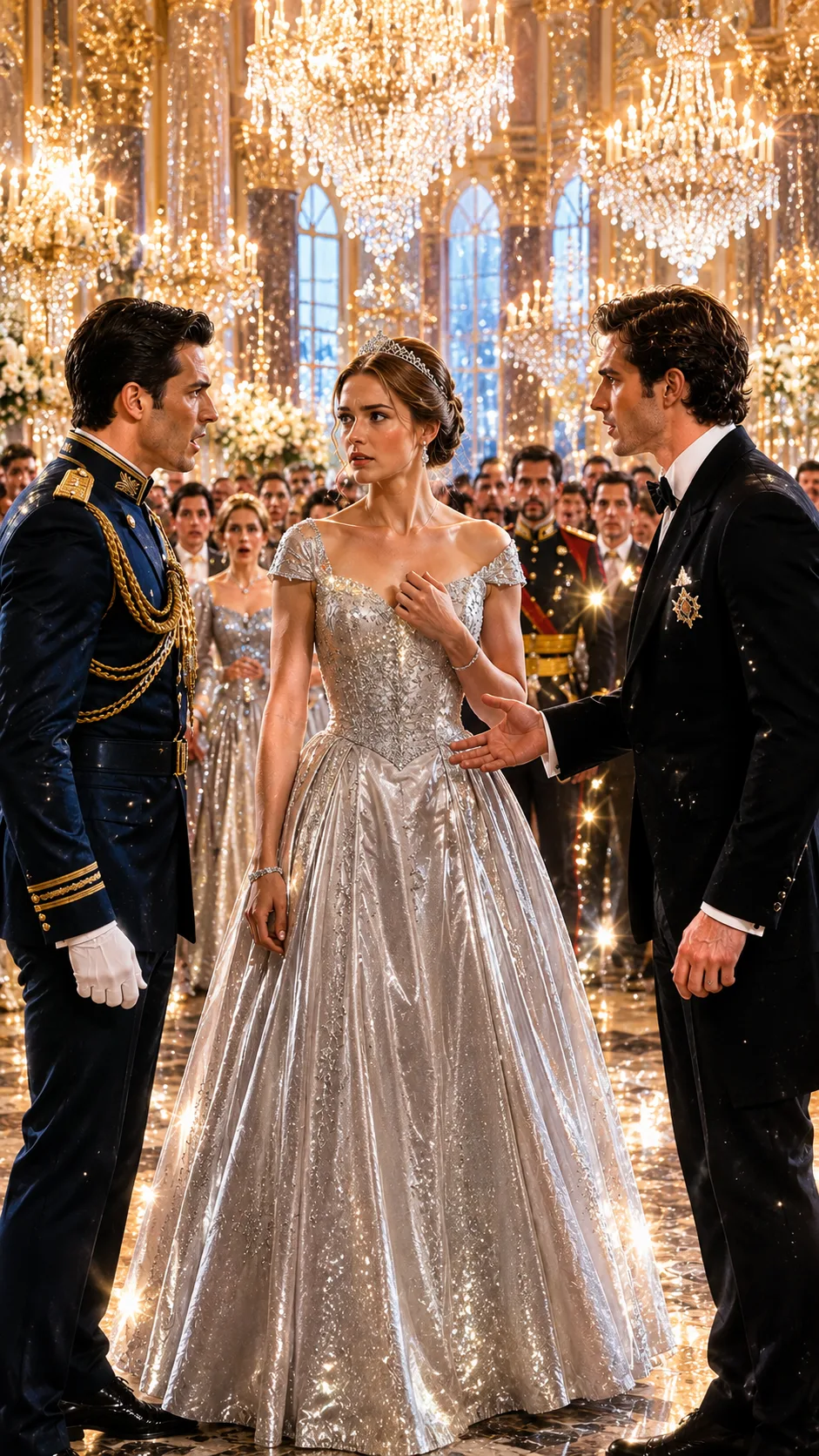
The Prince Who Asked for One Dance Exposed the Brother Who Only Wanted the Crown
Princess Victoria had been trained to smile through humiliation.
Chapter 1
The Prince Who Asked for One Dance Exposed the Brother Who Only Wanted the Crown
Princess Victoria had been trained to smile through humiliation.
She had smiled when foreign ambassadors studied her like a treaty written in silk.
She had smiled when the royal council discussed her engagement as if she were a bridge, a port, a fleet of ships, or a border agreement.
She had smiled when Prince Edward arrived three months earlier, kissed her hand in front of the cameras, and whispered without warmth, “Let us make this simple.”
Simple.
That was what he called her life.
Edward was the crown prince of Valebrook, the perfect heir with perfect posture, perfect answers, and a face so calm it made people mistake control for dignity. The newspapers loved him. The council trusted him. Her father, King Arthur, believed him useful.
Victoria had tried to believe there was something human beneath the polished surface.
At first, she told herself Edward was only guarded. Men raised around thrones often learned to hide their hearts before
anyone could use them. She understood that better than most. Her own childhood had been full of rooms where silence mattered more than truth.
But Edward did not hide his heart.
He simply did not bring it.
He remembered the treaty dates, the troop numbers, the trade routes, the jewels expected at the wedding, the order of the royal procession.
He did not remember that Victoria hated being spoken over.
He did not remember that her mother had died in the west chapel, not the east one.
He did not remember the name of her charity, although she had spent seven years building it.
When she told him once that the Royal Children’s Fund had nearly lost half its budget, Edward had glanced at a stack of military reports and said, “Charity is good for public sentiment. We will keep enough of it visible.”
Visible.
Not alive.
Not protected.
Visible.
That was the moment Victoria began to understand the shape of the cage being built around her.
The engagement would be announced at the Royal Winter Ball.
Every noble family in the alliance would attend. Reporters would be allowed into the outer gallery. The first dance would seal the promise between Eldoria and Valebrook. The council called it tradition. Victoria called it theater.
On the evening of the ball, the palace looked like a dream built by people who had never had to wake up.
Crystal chandeliers poured gold over the marble floor. Tall arched windows reflected hundreds of candles. White roses climbed the pillars in perfect spirals. Musicians waited beneath a balcony carved with angels, their instruments glowing under the light.
Victoria stood before the mirror in her private dressing room, wearing a silver satin gown that fell from her shoulders like moonlight. Pearl earrings brushed her neck. Her
dark blonde hair was pinned low, elegant and controlled.
Her lady-in-waiting, Clara, fastened the final clasp and stepped back.
“You look like a queen,” Clara said softly.
Victoria looked at her own reflection.
“No,” she said. “I look like an agreement.”
Clara’s face tightened.
Before she could answer, there was a knock at the door.
Not the sharp, official knock of Edward’s guards.
A quieter one.
Clara opened it.
Prince James stood outside.
Edward’s younger brother.
He was not supposed to be there.
James wore a black royal tuxedo instead of a military uniform, though the small gold crest of Valebrook rested at his lapel. He was tall, broad-shouldered, with dark hair slightly less controlled than court fashion preferred. His face had the same royal structure as Edward’s, but his eyes were different.
Edward looked at people as if measuring their usefulness.
James looked as if he was trying to understand what they were not saying.
Victoria had met him only four times.
The first time, he had arrived late to a council luncheon because he had stopped in the palace garden to help a servant carry a fallen crate of winter oranges.
Edward had laughed afterward and called it childish.
Victoria had remembered it.
The second time, James had quietly corrected a duke who referred to her charity as “the princess’s little nursery project.”
“She built schools in three border towns,” James had said calmly. “You should learn the name before you insult it.”
The duke had gone red.
Edward had looked irritated.
Victoria had said nothing, but something inside her had gone still.
The third time, during a rehearsal for the engagement announcement, an old countess had made a joke about Victoria learning to obey Valebrook customs after marriage.
James had looked at Edward, waiting.
Edward had smiled politely.
James had not.
The fourth time was now.
Clara stepped aside.
Victoria turned from the mirror.
“Prince James,” she said. “Is something wrong?”
He looked at her gown, then at her face, and his expression changed. Not dramatically. Not in a way anyone else would notice.
But Victoria saw it.
He looked angry.
Not at her.
For her.
“I heard what the council decided,” James said.
“They decide many things.”
“They changed the order of the public oath.”
Victoria’s stomach dropped.
She had not been told.
“What order?”
James hesitated. That was answer enough.
Victoria’s voice became careful. “Tell me.”
James stepped into the room. Clara closed the door behind him.
“The original wording said both kingdoms would protect your foundation after the marriage,” James said. “Edward asked to remove that clause.”
The room went quiet.
The candles seemed to burn smaller.
Victoria stared at him.
“He asked?”
James nodded once.
“He said the foundation created unnecessary financial obligations.”
Victoria felt the words land like a hand across her face.
Not because she was surprised.
Because she had hoped she was wrong.
The Royal Children’s Fund was not decoration. It was not a ribbon to be tied around her public image. It paid for doctors in mountain villages. It kept orphan houses open through winter. It funded scholarships for girls whose names would never appear in a royal newspaper.
Her mother had started it.
Victoria had saved it after her death.
And Edward had cut it from the oath like trimming a loose thread.
“Why are you telling me?” she asked.
James looked directly at her.
“Because someone should have told you before you walked into that ballroom.”
There it was again.
That unbearable decency.
Victoria looked away first.
For a moment, she hated him for it. Not because he was wrong, but because he made Edward’s coldness impossible to excuse.
“Your brother is my chosen fiancé,” she said.
“Chosen by whom?”
The question was quiet.
It still struck harder than a shout.
Victoria met his eyes.
James immediately lowered his gaze, as if he regretted stepping too close to the truth.
“I apologize,” he said. “That was not my place.”
“No,” Victoria said. “It was exactly the right question.”
A horn sounded from below.
The ball was beginning.
Clara’s hands moved nervously at her sides.
James stepped back.
“I only came to warn you,” he said. “I will not interfere tonight.”
Victoria almost laughed.
Everyone in the palace had been interfering with her life for months, and the one man who asked permission to care called himself interference.
“Prince James.”
He stopped at the door.
“If you will not interfere,” Victoria said, “then what will you do?”
James looked at her.
“I will watch,” he said. “And if they insult you again, I will not pretend I didn’t see it.”
Then he left.
Victoria remained still for a long moment.
Clara whispered, “Your Highness?”
Victoria looked back into the mirror.
The woman staring back did not look like an agreement anymore.
She looked like someone beginning to remember she had a voice.
The ballroom erupted when she entered.
Every head turned.
Every conversation softened.
King Arthur waited on the dais, silver crown gleaming, his expression proud but tired. Beside him stood Queen Margaret, Victoria’s stepmother, beautiful and unreadable in emerald velvet.
Edward stood at the foot of the stairs.
He looked flawless.
Navy royal uniform. Gold shoulder cords. White gloves. A sword at his side for ceremony. Dark hair combed back. Face calm enough to convince a kingdom he had never once doubted himself.
He offered Victoria his arm.
“Princess,” he said.
No warmth.
No question.
Just ownership wrapped in etiquette.
Victoria placed her hand lightly on his sleeve.
The music began.
Their first dance was perfect.
Of course it was.
Edward moved with practiced precision. Victoria followed because she had been trained since childhood not to make mistakes in public. The entire room watched them glide across the marble floor beneath the chandeliers.
To anyone else, they looked like destiny.
Up close, Edward did not look at her except when the pattern required it.
He scanned the room. The council. The ambassadors. The reporters in the gallery. He was measuring the success of the performance.
Victoria smiled.
Her jaw ached from it.
“You removed my foundation from the oath,” she said quietly.
Edward’s grip on her hand did not change.
“This is not the place.”
“It concerns my future. I think the place is appropriate.”
His eyes flicked to hers.
Cold.
“Your future is no longer separate from mine.”
There it was.
The sentence every woman in the palace was supposed to accept with grace.
Victoria’s smile stayed in place.
“My mother’s foundation is not yours to cut.”
Edward leaned slightly closer as the dance carried them past a row of watching nobles.
“Do not embarrass yourself over a charity clause.”
My stomach dropped.
Not because he said it.
Because he believed it.
The music swelled. The chandeliers glittered. People sighed at how beautiful the moment looked.
Victoria felt something inside her go very quiet.
When the dance ended, Edward guided her back toward the center of the floor. The crowd applauded. King Arthur nodded with satisfaction. Queen Margaret’s smile sharpened.
A herald stepped forward to announce the formal blessing.
But before he could speak, another figure moved from the edge of the ballroom.
Prince James.
The applause faded unevenly.
James walked across the marble floor with slow, deliberate steps. He did not look at the council. He did not look at the reporters.
He looked at Victoria.
Edward’s face hardened.
Victoria’s pulse kicked once.
James stopped several feet away and bowed.
Not the shallow bow princes gave each other.
A real bow.
Respectful.
Public.
The room went silent.
“Princess Victoria,” James said, his voice clear enough to carry across the hall, “may I request the second dance?”
Gasps moved through the ballroom like wind through glass.
The second dance was not forbidden.
But it mattered.
The first dance sealed obligation.
The second dance revealed preference.
If Victoria accepted, every person in that room would know that Edward was not the only royal man standing beside her.
Edward stepped forward before she could answer.
“This is inappropriate.”
James did not look at him.
Victoria felt every eye on her.
Her father shifted on the dais. The council members exchanged quick, panicked looks. Queen Margaret’s fingers tightened around her fan.
Edward smiled, but there was no softness in it.
“My brother is overcome with sentiment,” he said loudly enough for the room. “He forgets where he is.”
James finally turned his head.
“No,” he said. “I remember exactly where I am.”
Edward’s jaw tightened.
James looked back at Victoria.
Then, in front of every noble, every ambassador, every reporter, he said, “Before I ask for this dance, I owe you an apology.”
The room froze.
Victoria’s breath caught.
Edward’s voice dropped low. “James.”
But James continued.
“I apologize for standing silent while members of this court treated you like an ornament attached to a treaty,” he said. “I apologize for hearing your charity mocked and not correcting it sooner. I apologize for letting my family benefit from your grace while failing to defend your dignity.”
No one moved.
Victoria felt the words hit the room one by one.
Not dramatic.
Not poetic.
True.
And truth was more dangerous than shouting.
Edward stepped closer, his face now openly angry.
“You are humiliating the royal house.”
James turned fully toward him.
“No,” he said. “I am doing what you failed to do—stand beside her.”
The room went silent.
That was the moment everything changed.
Victoria saw it happen in the faces around her.
The ambassadors stopped watching James like a reckless younger prince and began watching Edward like a man who had been exposed.
The council stopped looking offended and started looking afraid.
The reporters in the gallery leaned forward.
Edward’s perfect mask cracked.
Only for a second.
But everyone saw it.
“You think this is noble?” Edward said. “You think making a spectacle of yourself proves love?”
James’s expression did not change.
“This is not about love.”
Edward laughed once, sharp and ugly.
“Of course it is. You have wanted what belongs to me since we were boys.”
A murmur moved through the hall.
Victoria’s hands went cold.
What belongs to me.
Edward realized too late what he had said.
James did not miss it.
“She does not belong to you,” James said.
Edward stepped closer until the brothers stood nearly chest to chest.
The orchestra sat frozen. The dancers held their breath. Even the candles seemed still.
Edward spoke through his teeth.
“You were always the spare. Do not mistake pity for power.”
James looked at his brother for a long second.
Then he smiled sadly.
“I never needed power to know when a woman was being disrespected.”
Edward’s hand twitched at his side.
Victoria saw it.
So did James.
Not a strike. Edward was too disciplined for that.
But the instinct was there.
The need to silence.
The need to control.
Victoria stepped between them.
The entire room inhaled.
Edward’s eyes snapped to her.
“Victoria,” he said, warning hidden under her name.
She looked at him.
For the first time that evening, she stopped smiling.
“My name is Princess Victoria in this room,” she said.
The words were calm.
They cut deep.
Edward went still.
Victoria turned to James.
“Prince James,” she said, “I accept your apology.”
James bowed his head.
Then she extended her hand.
“And I accept the second dance.”
The ballroom erupted into whispers.
Edward’s face darkened.
King Arthur stood.
“Victoria,” he called, his voice controlled but sharp.
She did not turn.
The musicians looked lost. Their conductor stared at the king, then at the princess, then at the frozen crowd.
James did not take Victoria’s hand immediately.
He looked at her as if asking one final time whether she understood what this meant.
She did.
She placed her hand in his.
Only then did the music begin.
Soft at first.
Uncertain.
Then stronger.
James led, but he did not pull. He left space between them. He moved like someone aware that the dance was not a claim, but a question.
Victoria followed because she chose to.
Every step across the marble felt like walking out of a cage one bar at a time.
Edward watched from the center of the ballroom, humiliated in front of the kingdom.
But Victoria was not watching him anymore.
“Thank you,” she said quietly as James turned her beneath the chandelier light.
“I should have spoken sooner.”
“Yes,” she said.
He flinched slightly.
She almost smiled.
“But you spoke tonight.”
James looked at her.
“That may cost you.”
Victoria glanced toward the dais. Her father’s face was unreadable. Queen Margaret looked furious. The council looked as if someone had set fire to their documents.
“It may cost both of us,” Victoria said.
James lowered his voice.
“Then let it.”
The dance ended.
For one breath, no one clapped.
Then Clara did.
One clear clap from the edge of the room.
A servant girl joined her.
Then one young ambassador.
Then another.
The applause spread slowly, uncertain at first, then undeniable.
It was not loud because people approved.
It was loud because people had seen something honest and did not know how to look away.
Edward turned and walked from the ballroom before the applause reached its height.
Queen Margaret followed him with her eyes, then rose and left through a side door.
King Arthur remained standing.
Victoria knew the night was not over.
She was right.
Less than twenty minutes later, she was summoned to the private council chamber.
Not asked.
Summoned.
James walked beside her without invitation.
Two guards moved to stop him.
Victoria looked at them once.
They stepped aside.
The council chamber was smaller than the ballroom, darker and colder. Tall windows showed the winter gardens outside, silver under moonlight. A long black table filled the center of the room. On it lay the engagement papers, the revised oath, and the royal seal.
Edward stood at one end, gloves removed, hands braced on the table.
King Arthur stood at the other.
Queen Margaret sat near the fireplace, her emerald gown pooled around her like a warning.
Six council members waited in silence.
When Victoria entered, Edward looked up.
“You have embarrassed two kingdoms,” he said.
Victoria closed the door behind her.
“No,” she said. “You embarrassed them when you called me yours.”
A councilman coughed nervously.
Edward’s eyes flashed.
“You accepted a public dance from my brother hours before our engagement oath.”
“You removed my mother’s foundation from that oath without telling me.”
King Arthur looked sharply at Edward.
Edward’s expression shifted.
Only a little.
But enough.
Victoria saw it.
So did her father.
“Is that true?” King Arthur asked.
Edward straightened.
“It was a financial adjustment.”
Victoria laughed once.
The sound surprised even her.
“A financial adjustment?”
She stepped toward the table and picked up the revised oath.
Her fingers did not shake.
“This clause protected clinics, orphan houses, and schools in the border provinces. My mother created it before I was born. I kept it alive after she died. You cut it because it did not make your crown look stronger.”
Edward’s voice hardened.
“I cut it because marriage requires priorities.”
“And I was supposed to become one of yours?”
“You were supposed to understand duty.”
Victoria placed the papers back on the table.
Then she looked at her father.
“Did you know?”
King Arthur’s silence hurt more than an answer.
Victoria’s chest tightened.
“You knew,” she said.
The king looked older than he had an hour ago.
“I knew the clause was under review.”
“Under review,” Victoria repeated.
Queen Margaret finally spoke.
“Victoria, do not make this emotional.”
Victoria turned to her.
“It is emotional. That does not make it wrong.”
The queen’s face cooled.
James stood near the door, silent, but his presence was steady behind her.
Edward noticed.
His mouth twisted.
“Look at him,” Edward said. “Playing protector because he knows he will never be king.”
James said nothing.
Edward turned on him fully.
“You think she will choose you because you made one pretty speech in a ballroom?”
James’s voice was low.
“I think she should be allowed to choose anything.”
Edward slammed his hand on the table.
The sound cracked through the chamber.
“Enough.”
No one breathed.
Victoria did not move.
Edward leaned toward her.
“You are promised to me.”
Victoria looked at the papers.
Then at the seal.
Then at the man everyone had told her was her future.
“No,” she said.
Edward blinked.
Victoria picked up the original treaty, the one still bearing her mother’s amendment. She had seen it once as a child in the archive, though no one knew she remembered the wording.
“The treaty requires a union between Eldoria and the worthy son of Valebrook,” she said.
King Arthur went still.
Queen Margaret’s fan stopped moving.
Edward’s expression changed.
James looked at her, stunned.
Victoria’s heart began to pound.
She turned the document and pointed to the line.
“Not the crown prince,” she said. “Not the heir. The worthy son.”
Silence swallowed the room.
Edward’s face drained of color.
The oldest councilman leaned forward, squinting.
“That wording is original,” he whispered.
Queen Margaret stood so fast her chair scraped the floor.
“This is absurd.”
Victoria looked at her father.
“You told me I had no choice.”
King Arthur did not answer.
“You let me prepare to marry a man who saw my life as an accessory to his throne.”
Her voice did not break.
That made it worse.
“You let the court insult me. You let them cut my mother’s work from my future. You let them call it duty.”
King Arthur’s eyes lowered.
Edward recovered first.
“The line is ceremonial.”
Victoria faced him.
“Then why did no one show it to me?”
Edward said nothing.
The room went silent again.
James stepped forward, but Victoria lifted a hand slightly.
He stopped.
She did not need to be rescued.
Not now.
Victoria removed the engagement ring from her finger.
It was large, flawless, and cold.
She placed it on the table.
The sound was small.
Everyone heard it.
“I will not marry Prince Edward.”
Edward stared at the ring as if it had betrayed him.
Victoria turned to James.
His face was pale.
Not triumphant.
Afraid for her.
That mattered.
“I am not choosing you tonight,” she said.
James nodded once.
“I know.”
“I am choosing myself first.”
His expression softened.
“So you should.”
Victoria looked back at the council.
“And if Valebrook still wishes alliance with Eldoria, it will begin with restoring my mother’s foundation to the oath, protecting every province it serves, and acknowledging that my consent is not decoration.”
No one spoke.
Then the oldest councilman slowly bowed his head.
“As written,” he said, “the princess is correct.”
Edward looked at him like he had been stabbed.
Queen Margaret whispered, “This will fracture the alliance.”
Victoria looked at her.
“No. It will reveal whether the alliance was ever worth saving.”
By morning, the story had spread beyond the palace gates.
The newspapers could not agree on what to call it.
Some called it scandal.
Some called it rebellion.
One headline called it The Second Dance.
Children in the border provinces sent white paper roses to the palace gates. Nurses from the mountain clinics wrote letters with shaking handwriting. Teachers from the orphan schools stood outside in the cold holding candles.
Victoria read every letter.
Edward left Eldoria before noon.
Officially, he returned to Valebrook for urgent consultations.
Unofficially, he had been publicly rejected by a woman he thought he already owned.
King Arthur came to Victoria in the west chapel two days later.
The chapel still smelled faintly of wax and winter flowers. Her mother’s portrait hung beside the altar, soft-eyed and calm.
Victoria did not bow when her father entered.
He did not ask her to.
For a while, they stood in silence.
Then the king said, “I thought I was protecting the kingdom.”
Victoria looked at her mother’s portrait.
“You were protecting the throne.”
He took the words like a deserved wound.
“Yes,” he said.
That surprised her.
He stepped beside her.
“I forgot the difference.”
Victoria’s throat tightened.
She wanted to forgive him immediately. That was the dangerous habit of daughters who had learned to survive powerful fathers.
Instead, she said, “You hurt me.”
King Arthur closed his eyes.
“I know.”
“You let them make me feel small.”
“I know.”
“You made me think duty meant silence.”
His voice broke slightly.
“I know.”
Victoria finally looked at him.
He seemed smaller without the council around him.
Not weak.
Just human.
“I cannot fix that with an apology,” he said.
“No.”
“But I can begin by signing the original oath.”
Victoria watched him.
“And by changing the law,” he added. “No royal marriage treaty will be valid without the written consent of the person being married.”
For the first time in days, Victoria breathed fully.
“That should never have needed changing.”
“No,” he said. “It should not have.”
Three weeks later, Valebrook sent a new delegation.
Edward did not come.
James did.
He arrived not as a suitor, not as a hero, not as the prince who had won a ballroom.
He arrived carrying the restored oath.
The Royal Children’s Fund clause was back.
Expanded.
Protected for twenty years.
Independent from both courts.
Victoria met him in the palace library, where winter light fell across shelves of old law books.
He placed the document on the table.
“No conditions,” he said. “No pressure.”
Victoria raised an eyebrow.
“No dance request?”
A small smile touched his mouth.
“Not unless you ask first.”
She looked at him for a long moment.
The silence was different now.
Not the silence of humiliation.
Not the silence of fear.
The silence of two people standing at the edge of something honest.
“You embarrassed your brother for me,” she said.
James shook his head.
“Edward embarrassed himself. I only refused to help hide it.”
Victoria studied him.
“And if I never choose you?”
He looked at her as if the answer was obvious.
“Then I will still have done the right thing.”
That was the moment Victoria understood why the treaty had never said crown prince.
Power was easy to measure.
Honor was not.
A year later, the palace held another winter ball.
This time, no engagement was announced without consent.
No charity was called decoration.
No councilman spoke over Princess Victoria and remained seated afterward.
The Royal Children’s Fund had doubled its reach. Three new clinics had opened in the border towns. The first school built under the restored oath had a white rose carved over its entrance.
Edward remained crown prince of Valebrook, but his public image had changed. People still called him handsome. They still called him disciplined.
They no longer called him perfect.
James became Valebrook’s ambassador to Eldoria.
He spent months traveling between courts, negotiating protections for the smaller provinces, listening more than he spoke, and never once asking Victoria for a promise.
That was why, on the night of the second winter ball, Victoria found him standing near the same marble floor where he had once bowed before her.
He wore a navy uniform this time.
Not because he wanted to look powerful.
Because the ceremony required it.
Victoria wore deep blue satin with pearl earrings and her mother’s silver bracelet.
The orchestra began to tune.
James looked at the dance floor, then at her.
“Princess,” he said gently, “may I ask—”
“No,” Victoria interrupted.
He froze.
Then she extended her hand.
“This time I ask.”
James stared at her hand.
Then at her face.
The room around them seemed to soften.
Victoria smiled.
A real smile.
“Prince James,” she said, “will you dance with me?”
He bowed.
Not to claim.
Not to perform.
To honor.
“Yes,” he said. “Always.”
And when they stepped onto the marble floor, the whole palace watched.
Not because a treaty demanded it.
Not because a council arranged it.
Not because a crown required it.
They watched because the princess who had once been treated like a prize had chosen the man who stood beside her before he knew he would ever be chosen back.
And this time, when the music began, Victoria did not feel like an agreement.
She felt free.
THE END.
Chapter complete
You have reached the end of this chapter.
Continue reading
A few more worlds to get lost in after this chapter.