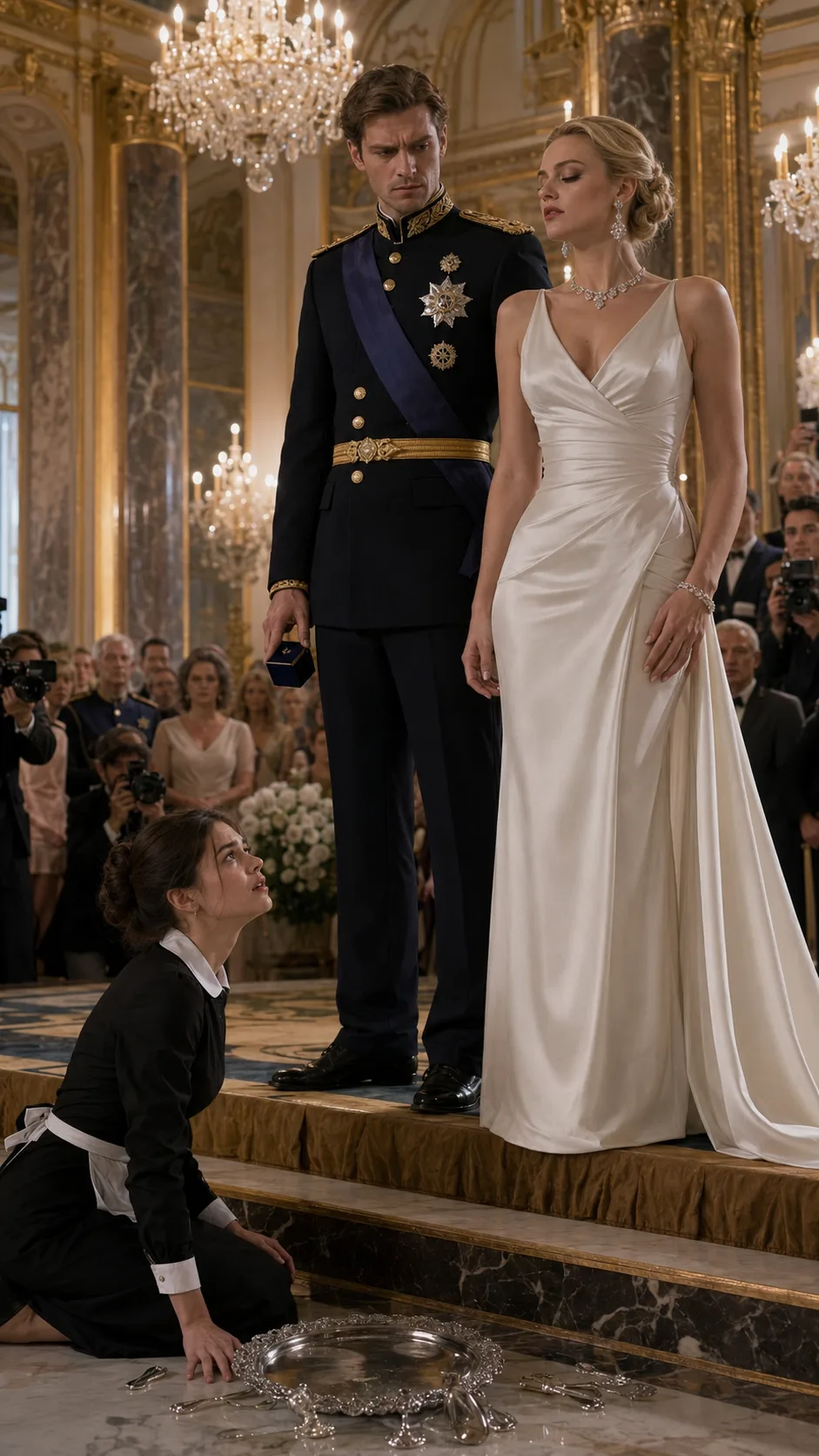
The Prince Refused the Billionaire Heiress—Then Chose the Maid Who Saved His Crown Before Everyone
Prince Adrian of Valmere had been trained since childhood to smile while being sold.
Chapter 1
Prince Adrian of Valmere had been trained since childhood to smile while being sold.
Not in chains.
Not in a market.
Nothing so honest.
He had been sold in banquet halls beneath crystal chandeliers, in council rooms where old men spoke of duty with clean hands and rotten hearts, in royal portraits where his face was painted beside women he had never met because a kingdom always needed alliances more than it needed love.
Valmere was a small country, too beautiful for its own survival.
It sat between snowy mountains and a silver coastline, with vineyards folded into green hills and a palace made of pale stone that tourists called romantic. On postcards, it looked like a fairy tale. In government ledgers, it looked like a body losing blood.
The royal treasury was empty.
The winter floods had destroyed three provinces. The fishing ports needed rebuilding. The national hospital project had stalled. And the House of Valmere, once proud enough to refuse help from
empires, now depended on loans, favors, and donors who liked seeing their names carved into marble.
That was how Cassandra Vale entered the palace.
She was not royal.
But her father owned banks in six countries, hotels in twelve, and enough media companies to make any scandal disappear or explode. Cassandra was twenty-five, beautiful in the polished way expensive people were beautiful, with golden hair, diamond earrings, and a smile that never reached her eyes.
The newspapers called her the woman who would save Valmere.
The Prime Minister called her a miracle.
Queen Helena called her “our future daughter.”
Prince Adrian called her nothing at all.
Because the woman he loved was standing behind the service door with a tray in her hands.
Her name was Clara Bennett.
She was twenty-three, brown-haired, quiet when people watched her, brave when no one did. She had worked in the palace for four
years, first in the laundry rooms, then in the east wing kitchens, then as an assistant to the royal household staff.
Most people passed her without seeing her.
Adrian had noticed her the night the entire kingdom almost turned against him.
Six months before the engagement announcement, a video had appeared online. It showed Adrian leaving a private club after midnight, laughing beside a woman who was not from court. Within an hour, tabloids called him reckless. By dawn, foreign investors were threatening to withdraw from Valmere’s reconstruction fund.
But the clip had been edited.
Adrian had not been partying. He had gone there to meet a whistleblower who claimed royal charity funds were being misused. The woman beside him was a journalist. The laughter had been taken from another moment. The scandal was manufactured.
No one believed him.
No one except Clara.
She had been cleaning the communications archive
when she noticed something strange: the timestamp on the leaked footage did not match the palace security logs. A car in the background of the video had entered the city two days after the supposed recording. Clara stayed up until morning comparing reflections in windows, street cameras, and delivery records.
Then she walked into Adrian’s office with shaking hands and proof.
“You don’t know me, Your Highness,” she had said.
Adrian looked up from a table covered in hostile headlines.
Clara placed a folder before him. “But someone wants the country to hate you. And they were careless.”
That folder saved his name.
More than that, it saved the reconstruction fund.
The palace never publicly credited her. Servants did not receive front-page praise. The official statement said the prince’s legal team had uncovered evidence of manipulation. Adrian hated that lie, but Clara only smiled softly and said, “As long as the truth survived, it’s enough.”
It was not enough for him.
From that day, he saw her everywhere.
In the library carrying old ledgers.
In the chapel lighting candles before sunrise.
In the garden helping an elderly groundskeeper gather fallen branches after a storm.
She never asked him for anything. That made her the only person in the palace who did not treat him like a crown with a pulse.
One evening, after a charity dinner, Adrian found her in the west corridor trying to repair a broken vase before the chief housekeeper noticed.
“You know,” he said, crouching beside her, “that vase is older than my family’s throne.”
Clara froze. “Then please don’t tell the throne I broke it.”
He laughed for the first time in weeks.
After that, their conversations became small, hidden things.
A few minutes in the library.
A shared umbrella during rain.
A cup of tea left on his desk when Parliament sessions ran past midnight.
He learned that Clara’s mother had been a seamstress, her father a schoolteacher, both gone now. She had come to the palace because it paid enough for her younger brother’s technical school tuition. She read history books on lunch breaks. She knew more about Valmere’s old laws than half the royal council.
And once, when Adrian asked if she believed in fairy tales, Clara said, “Only the dangerous kind.”
“What makes a fairy tale dangerous?”
She looked toward the throne room doors.
“When people forget that crowns are made by people, not by heaven.”
Adrian should have stepped away then.
He should have remembered who he was.
Instead, he fell in love.
Quietly.
Completely.
And impossibly.
Because three months later, Queen Helena summoned him to the Blue Council Room and told him he was marrying Cassandra Vale.
Adrian stood in the center of the room while his mother sat beneath a portrait of his dead father.
Around her, the council waited with folded hands and hungry eyes.
“The Vale family will provide two billion euros in infrastructure support,” Prime Minister Rowan said. “They will purchase government bonds, stabilize the national hospital fund, and invest in the northern rail project.”
“In exchange for my hand,” Adrian said.
Queen Helena’s mouth tightened. “In exchange for partnership.”
“No, Mother. Say it honestly.”
The room went silent.
The queen rose slowly. She was still elegant, still commanding, but exhaustion had made her thinner. Since King Edmund’s death, she had carried a country that blamed her for every closed school, every flooded road, every unpaid worker.
“If you refuse,” she said, “the reconstruction fund collapses by spring.”
“Find another investor.”
“We tried.”
“Tax the old estates.”
The nobles at the table shifted angrily.
Queen Helena’s voice hardened. “Do you think I have not fought every battle available to me? Do you think I came to this because I enjoy bargaining with billionaires?”
Adrian looked at the council.
No one met his eyes.
That was when he understood.
This was not a discussion.
It was a ceremony before the sacrifice.
“When?” he asked.
His mother looked away.
“The engagement will be announced at the Winter Restoration Gala.”
“That is in ten days.”
“Yes.”
“And Cassandra?”
“She has agreed.”
“I haven’t.”
Queen Helena’s expression broke for half a second. Not enough for the council to see. Enough for her son.
“Adrian,” she whispered, “sometimes love is not what saves a kingdom.”
He wanted to say that loveless bargains did not save kingdoms either. They only taught people to kneel before money.
But outside the palace, children were still studying in temporary classrooms. Families were still living in flood shelters. Hospitals were still turning away patients because the new wing had no funding.
So he said nothing.
And silence, in royal rooms, was often mistaken for obedience.
The next ten days became a performance.
Cassandra arrived with stylists, assistants, photographers, legal advisers, and a personal security team that treated palace guards like decorative furniture. She moved through Valmere Palace as if she had already purchased it.
She changed the flowers in the banquet hall.
She rejected the antique engagement ring because it looked “too modest.”
She demanded a designer gown be flown in from Milan.
When she saw Clara carrying linens outside Adrian’s office, Cassandra stopped.
“Who is that?”
Adrian followed her gaze. “A member of the household staff.”
Cassandra studied Clara the way a cat studied a bird with a broken wing.
“She looks familiar.”
Clara lowered her eyes and stepped aside.
Adrian’s jaw tightened. “Most people who work here become familiar if you actually look at them.”
Cassandra laughed lightly. “Careful, Your Highness. Compassion is charming in small doses. In public, it looks weak.”
After she left, Clara remained still beside the wall.
Adrian waited until the corridor emptied.
“I’m sorry,” he said.
Clara shook her head. “You don’t have to apologize for someone else’s manners.”
“I do if she is here because of me.”
Clara looked up then. There was pain in her face, but no accusation.
“Is it true?”
He could have lied.
He was trained to lie gently.
But he had never been able to do that with her.
“Yes,” he said. “They want me to marry her.”
Clara swallowed. “And will you?”
Adrian took one step closer. “Clara—”
“No.” Her voice trembled, then steadied. “Don’t answer me as Adrian. Answer me as the prince.”
That was the cruelest thing she could have asked.
Because Prince Adrian belonged to the kingdom.
And Adrian, the man, belonged to her in every way that mattered.
“I don’t know,” he said.
Clara nodded once, as if something inside her had already prepared for that wound.
“Then I hope the kingdom survives what it costs you.”
She walked away before he could stop her.
That night, Adrian found a white envelope under his study door.
Inside was a single photograph.
It showed Cassandra Vale in a private meeting with Lord Marwick, the palace finance minister.
At first, Adrian did not understand why it mattered.
Then he saw the second page.
A transfer record.
A shell company.
A payment routed through a media consulting firm.
The same firm involved in the scandal video that had nearly destroyed him six months earlier.
Adrian stared at the documents until the letters blurred.
Cassandra had not come to save Valmere.
She had helped create the crisis that made Valmere desperate enough to accept her.
At the bottom of the final page was a note written in Clara’s hand.
I found this in the donor archives. Be careful. They are not buying the crown. They are collecting it.
Adrian ran to the servants’ wing.
Clara was gone.
Not from the palace entirely, but from the east wing rooms. Her bed was stripped. Her locker empty. The chief housekeeper said Clara had been reassigned to event service for the gala, then placed on leave immediately afterward.
“By whose order?”
The older woman hesitated.
“Lady Cassandra’s office sent the request.”
Adrian turned cold.
The palace had many kinds of prisons.
Some had bars.
Some had contracts.
Some had velvet ropes and smiling guests.
The Winter Restoration Gala arrived under a sky full of snow.
By sunset, Valmere Palace glowed like a jewel. Every window burned gold. Black cars lined the courtyard. Reporters from across Europe crowded behind velvet barriers. Cameras flashed whenever a minister, noble, celebrity donor, or foreign ambassador entered the hall.
The engagement announcement was scheduled for nine.
At eight-thirty, Cassandra stood in the bridal salon wearing a white silk gown that looked almost royal. Diamonds circled her throat. Her father, Victor Vale, adjusted his cufflinks beside the fireplace.
Lord Marwick entered quietly.
“The prince has been distant,” Cassandra said without looking at him.
“Princes are ornamental,” Victor Vale replied. “Distance is irrelevant.”
Cassandra smiled into the mirror. “Not after tonight.”
Marwick’s face was pale. “There is a complication.”
Victor’s eyes narrowed.
“The Bennett girl,” Marwick said. “She may have accessed donor files.”
Cassandra’s smile vanished.
“I told you to remove her.”
“She is serving tonight. After the gala, she’ll be dismissed permanently.”
“After?” Cassandra turned. “Are you stupid?”
Marwick stiffened.
Cassandra stepped closer, her diamonds catching fire in the mirror light. “That girl ruined the first plan when she helped Adrian survive the scandal. I knew she was the one. Nobody in that palace legal team was clever enough to find the timestamp error.”
Victor Vale’s voice dropped. “Does she have proof?”
“Not enough to stop tonight,” Marwick said quickly. “The announcement will proceed. Once the contract is signed, the treasury loan becomes binding. The prince can dislike Cassandra in private as much as he wants.”
Cassandra’s expression softened into something cruel.
“He won’t dislike me forever. Men like Adrian always confuse guilt with love. Once I’m the only woman allowed beside him, he’ll learn.”
None of them noticed the small service panel behind the dressing screen.
None of them noticed Clara Bennett standing in the narrow passage beyond it, one hand pressed over her mouth, her phone recording every word.
She had not left.
She had been hiding.
Because the old palace had secrets older than the crown, and servants knew more doors than kings did.
At nine o’clock, the grand hall filled with music.
The royal family stood on the central platform beneath the Valmere banners. Queen Helena wore sapphire blue, her face composed but tired. Adrian stood beside her in formal black uniform, gold braid across his shoulder, the antique engagement ring resting in a velvet box before him.
Cassandra entered to applause.
She moved like victory.
Behind her, Clara stood near the service entrance in a plain black uniform, carrying a silver tray no one needed. Her hair was pinned back. Her face was calm, but Adrian saw the way her fingers shook around the tray edge.
Their eyes met once across the hall.
That one look nearly undid him.
Prime Minister Rowan stepped to the microphone.
“Tonight is a historic evening for Valmere,” he declared. “In a time of rebuilding, unity, and hope, we celebrate not merely an engagement, but a partnership between tradition and progress.”
Reporters raised cameras.
Victor Vale smiled from the front row.
Lord Marwick kept wiping sweat from his temple.
The prime minister continued speaking, but Adrian heard almost nothing.
He looked at the ring box.
Then at Cassandra.
Then at Clara.
And finally, at his mother.
Queen Helena’s eyes were fixed ahead, but her hand trembled slightly against her gown.
She knew he was suffering.
But she did not know why.
Not yet.
When the speech ended, Cassandra took her place beside Adrian.
She turned toward the cameras, perfect and shining.
The ring box was handed to him.
A thousand flashes exploded.
Adrian opened it.
The diamond inside caught the chandelier light.
Cassandra extended her hand.
Then a glass shattered near the service doors.
Everyone turned.
Clara had dropped the tray.
Silverware scattered across the marble floor.
A few guests laughed.
Cassandra slowly lowered her hand.
Her smile remained, but her eyes sharpened.
“Well,” she said, loud enough for nearby microphones to catch, “even the staff wanted to contribute something memorable.”
Clara knelt to gather the fallen pieces.
Adrian took one step forward.
Cassandra caught his sleeve.
“Leave it,” she whispered.
But Clara’s hand had closed around a fork, and her knuckles were white.
A reporter called, “Lady Cassandra, how do you feel joining the royal family?”
Cassandra’s gaze stayed on Clara.
“Oh, honored,” she said sweetly. “Though I must admit, some people should remember their place during royal occasions.”
A hush moved through the room.
Clara froze.
Cassandra tilted her head.
“She cleans floors,” Cassandra said, her voice bright and poisonous. “I was born to wear a crown.”
The words landed harder than the broken tray.
For one breath, no one moved.
Then Adrian closed the ring box.
The sound was small.
But in the silence, it felt like a door locking.
Cassandra turned toward him.
Adrian lifted the microphone from the stand.
“Then you should know,” he said, voice carrying through the hall, “a crown means nothing without honor.”
The room went utterly still.
Cassandra’s smile faltered.
“Adrian,” Queen Helena whispered.
He did not look away from Cassandra.
“For months,” Adrian continued, “this kingdom has been told that our survival depends on this engagement. We were told the Vale family came as benefactors. We were told their money would rescue Valmere from crisis.”
Victor Vale rose halfway from his chair. “Your Highness, this is not the time—”
“No,” Adrian said. “This is exactly the time.”
Murmurs spread through the reporters.
Adrian turned to Clara.
She stood slowly, face pale, the silver tray forgotten at her feet.
“Clara Bennett,” he said, “please come here.”
Gasps rippled through the hall.
Cassandra grabbed his arm. “Are you insane?”
Adrian gently removed her hand.
Clara did not move at first.
She looked like someone standing at the edge of a bridge, unsure whether the next step would save her or destroy her.
Then the chief housekeeper, an old woman who had served three generations of royals, stepped aside and gave Clara a path.
One by one, other staff members moved with her.
Not in front.
Beside her.
Cooks. Footmen. attendants. cleaners. guards.
The people who kept the palace alive while nobles took credit for its beauty.
Clara walked through them toward the platform.
Cassandra’s face twisted.
“This is humiliating,” she hissed.
Adrian looked at her. “Yes. I imagine it is.”
Clara reached the platform but did not climb the steps.
Adrian descended to her instead.
The gesture cracked something in the room.
Princes did not step down for maids.
Not in front of cameras.
Not in front of billionaires.
Not in kingdoms built on distance.
Adrian stood beside Clara and faced the hall.
“This woman saved my name when a false scandal nearly destroyed the reconstruction fund,” he said. “She found evidence my own advisers missed. She asked for nothing. She was never credited. Tonight, she found something else.”
Lord Marwick turned toward the side exit.
Two palace guards blocked him.
Adrian raised a hand.
The main screen behind the platform changed.
Instead of the royal engagement crest, it displayed bank transfers, shell company records, and then a paused audio file.
Cassandra went white.
Victor Vale’s jaw clenched.
Queen Helena stared at the screen as if it had become a window into betrayal.
Adrian pressed play.
Cassandra’s recorded voice filled the grand hall.
“That girl ruined the first plan when she helped Adrian survive the scandal…”
A wave of shock rolled through the guests.
The audio continued.
“Nobody in that palace legal team was clever enough to find the timestamp error…”
Reporters surged forward.
Cameras flashed so violently the hall looked struck by lightning.
Victor Vale shouted, “This is illegally obtained!”
Clara stepped forward.
“No,” she said.
Her voice was softer than Adrian’s, but the microphone caught it.
Everyone turned.
Clara looked terrified.
Then she looked at Cassandra.
And she stopped being small.
“The recording was made in a palace service passage,” Clara said. “A passage used by household employees during official event preparation. Lady Cassandra’s team ordered staff removed from nearby rooms, but they forgot the old access corridor behind the dressing salon.”
Cassandra laughed once, sharp and panicked.
“You are a maid.”
“Yes,” Clara said. “Which is why you never thought I mattered enough to notice.”
That line silenced even the reporters.
Adrian watched Clara with something close to awe.
She reached into the pocket of her uniform and removed a folded paper.
“But this is not only about me. And it is not only about the prince.”
She turned to Queen Helena.
“Your Majesty, six months ago, the scandal against Prince Adrian almost caused several emergency investors to withdraw. After that, Lord Marwick recommended the Vale family as the only possible replacement. But the crisis was engineered. The media firm that edited the prince’s video was paid through a Vale subsidiary.”
Lord Marwick shouted, “Lies!”
Clara opened the paper.
“And Minister Marwick received twelve million euros into an offshore account three days after the palace accepted Vale negotiations.”
The queen rose.
For the first time all evening, she did not look tired.
She looked royal.
“Minister Marwick,” she said, “is this true?”
He tried to speak.
No words came.
The prime minister backed away from him as if corruption were contagious.
Cassandra’s breathing quickened.
Victor Vale stepped into the aisle. “This country is bankrupt. Be careful how loudly you insult the only people willing to save you.”
Adrian turned toward him.
“That was your mistake,” he said. “You thought desperation made us yours.”
Victor smiled coldly.
“Without my money, your hospitals close. Your rail project dies. Your flood victims stay in shelters. You can enjoy your moral victory while your people freeze.”
The cruelty of it struck the room silent.
Because everyone knew part of it was true.
Valmere was wounded.
Pride would not rebuild roads.
Honor would not pour concrete.
Cassandra seized that silence.
She lifted her chin, rebuilding herself piece by piece in front of the cameras.
“You see?” she said, spreading her arms. “This is what happens when servants are allowed to whisper in royal ears. A girl who cleans floors thinks she understands economics. A prince confuses a crush with leadership.”
Clara flinched.
Adrian stepped closer to her, but Clara gently raised one hand.
She did not need him to rescue her from this sentence.
Not this time.
Cassandra walked toward the edge of the platform, eyes blazing.
“You think he loves you?” she asked Clara. “He pities you. Men like him always pity girls like you. But pity fades when the bills arrive.”
Clara’s face tightened.
Cassandra smiled.
“You will never be queen. You will never be accepted. You will never be anything but the little maid who embarrassed herself in a room full of her betters.”
Before Adrian could answer, another voice spoke from the rear of the hall.
“That is enough.”
An elderly man stood near the entrance, leaning on a black cane.
The room turned.
Queen Helena’s eyes widened.
“Professor Alden?”
The old man walked forward slowly.
He had once been the royal historian of Valmere, dismissed five years earlier after accusing the finance ministry of hiding public records. Most people considered him bitter. Some called him mad.
Clara looked at him in surprise.
“You came,” she whispered.
Professor Alden nodded. “You sent proof. I brought history.”
He handed a sealed leather folder to the queen’s chief guard.
Cassandra rolled her eyes. “What is this now? Another servant trick?”
Professor Alden looked at her as if she were a poorly written footnote.
“No, Miss Vale. A royal law.”
The folder was opened.
Inside lay an old document stamped with the seal of King Matthias II, dated nearly two hundred years earlier.
Professor Alden addressed the hall.
“During the famine of 1831, the Crown of Valmere nearly sold mining rights to a foreign merchant family in exchange for emergency grain. King Matthias refused the bargain after learning the merchants had caused shortages to force the sale. Afterward, he signed the Sovereign Integrity Act.”
Prime Minister Rowan looked startled. “That law was repealed.”
“No,” Alden said. “Buried. Not repealed.”
Queen Helena took the document.
Her eyes moved over the page.
Then she looked up slowly.
Adrian knew that expression.
It was the face his mother wore when she realized the board had changed beneath everyone’s feet.
“What does it say?” Adrian asked.
The queen’s voice was quiet but clear.
“It grants the crown emergency authority to freeze and seize domestic assets of any foreign financier proven to have manufactured national crisis for political or marital leverage against the sovereign line.”
Victor Vale’s face changed.
For the first time, fear entered his eyes.
“That is medieval nonsense.”
Professor Alden smiled. “Actually, it is constitutional monarchy.”
The attorney general, who had been standing near the ambassadors, stepped forward. “Your Majesty, if the evidence is verified, the act may still be enforceable under emergency anti-corruption provisions.”
Victor shouted, “You wouldn’t dare.”
Queen Helena looked at the man who had tried to buy her son, manipulate her country, and turn suffering citizens into bargaining chips.
“I have dared less for worse reasons,” she said.
Then she turned to the royal guards.
“Secure Lord Marwick. Notify the financial crimes bureau. Freeze all pending Vale-linked transfers until Parliament reviews the evidence.”
The hall erupted.
Reporters shouted questions.
Cassandra lunged toward Adrian.
“You can’t do this,” she snapped. “You need us.”
Adrian looked at the ring box still in his hand.
Then he opened it again.
For one wild second, Cassandra thought he was reconsidering.
Instead, Adrian removed the ring, walked to the center of the hall, and placed it on the marble floor between them.
“This engagement is over.”
Cassandra stared at the ring as if it were her own crown lying dead.
“You are choosing a maid over your kingdom?”
Adrian looked toward Clara.
Then toward the palace staff.
Then toward the citizens watching through live broadcast screens beyond the gates.
“No,” he said. “I am choosing the woman who protected my kingdom when its richest guests tried to own it.”
Clara’s eyes filled with tears, but she did not lower her head.
Adrian turned back to the microphone.
“I will not marry Cassandra Vale.”
A wave of sound rushed through the hall.
“And I will not pretend that noble blood is proof of noble character.”
Queen Helena watched him carefully.
Adrian took a breath.
There was no going back from what came next.
“I love Clara Bennett,” he said. “Not because she stood behind palace doors, but because she opened the ones everyone else tried to keep locked. I will not ask this kingdom to accept her because I command it. I ask Valmere to judge her by what she has done.”
Clara whispered, “Adrian…”
He turned to her, voice softening.
“You once told me a crown is made by people, not by heaven. Tonight, you reminded me that a kingdom is not saved by money without honor.”
The cameras caught everything.
The prince stepping down.
The maid standing upright.
The heiress trembling with rage.
The queen holding an old law like a sword.
Cassandra’s mask finally shattered.
“You think this is a fairy tale?” she spat. “Fine. Let the maid have her moment. By morning, every paper my family owns will call her a social climber, a liar, a palace rat. I will make sure the world laughs every time she stands beside you.”
Clara turned to her.
For the first time, there was no fear in her expression.
“You already tried to destroy someone with edited footage,” Clara said. “This time, the whole world is watching live.”
The reporters surged again.
Cassandra realized too late that her threat had been broadcast.
Victor Vale grabbed his daughter’s arm.
“Enough,” he said through his teeth.
But she tore free.
“No. They don’t get to do this to me.”
She pointed at Clara.
“You stole him.”
Clara looked at Adrian, then back at Cassandra.
“No,” she said. “You never had him. You had a contract.”
That was the sentence replayed across every news channel in Europe by midnight.
But the night was not finished.
As guards escorted Lord Marwick away, he suddenly shouted, “Ask the queen why she agreed so quickly!”
The hall froze again.
Queen Helena’s face went pale.
Adrian turned.
“What does he mean?”
Marwick laughed bitterly, dragged between two guards.
“You think she didn’t know the Vale deal was dirty? Maybe not all of it. But she knew enough. Ask her why Professor Alden was dismissed. Ask her who signed the order to bury that law.”
The queen closed her eyes.
Adrian felt the floor shift beneath him.
“Mother?”
Cameras turned toward her.
For once, Queen Helena did not perform.
She looked old.
And ashamed.
“Clear the hall,” Adrian said instinctively.
But Queen Helena raised a hand.
“No. They have heard every other truth tonight. They may hear mine.”
Adrian’s chest tightened.
The queen faced the room.
“Five years ago, after my husband died, Valmere’s debt was already worse than the public knew. Lord Marwick told me that if investors lost faith, pensions would collapse and hospitals would close. Professor Alden discovered the Sovereign Integrity Act while investigating old financial protections. Marwick advised me that reviving such a law would frighten donors.”
Professor Alden’s expression darkened.
The queen continued.
“I allowed him to dismiss the professor. I allowed the law to be archived. I told myself it was practical. I told myself a queen must sometimes choose stability over pride.”
Her voice broke slightly.
“But tonight my son and Clara Bennett have shown me what that choice became. Stability without truth is only a slower collapse.”
Adrian stared at her.
The anger came first.
Then grief.
Then something more complicated.
Because his mother had not created Cassandra’s scheme.
But fear had made room for it.
Queen Helena stepped down from the platform.
She stood before Clara.
“I owe you an apology,” the queen said.
Clara looked stunned. “Your Majesty—”
“No. Let me say it properly.” Helena’s voice carried through the silent hall. “You saved my son once. Tonight, you saved this crown from a bargain I was too afraid to question. And I allowed people like Cassandra Vale to treat you as invisible.”
Cassandra scoffed from near the aisle.
The queen ignored her.
Then, in front of every camera, Queen Helena bowed her head to Clara Bennett.
Not deeply.
Not theatrically.
But enough.
A queen acknowledging a maid.
The image traveled faster than scandal.
Outside the palace gates, where citizens had gathered to watch the gala broadcast on public screens, silence held for one stunned second.
Then someone began to clap.
Inside the hall, the first applause came from the staff.
The cooks.
The cleaners.
The guards.
The attendants.
Then the younger nobles.
Then the ambassadors.
Then, slowly, like a tide deciding which way history should move, the entire hall began to applaud.
Clara covered her mouth.
Adrian reached for her hand, but stopped just before touching it.
He would not turn this into another public claim made over her.
Clara saw the hesitation.
And she chose.
She placed her hand in his.
The applause grew louder.
Victor Vale pulled Cassandra toward the exit, but police officers were already waiting beyond the doors.
Not to arrest them yet.
Not publicly.
But to escort them into questioning.
Cassandra looked back once.
Her eyes landed on the ring abandoned on the marble floor.
Then on Clara’s hand in Adrian’s.
For all her diamonds, she had never looked poorer.
By morning, the world had divided into two camps.
Some called Adrian reckless.
Some called Clara a heroine.
Some said Queen Helena’s apology saved the monarchy.
Others said it proved the monarchy needed saving from itself.
But something unexpected happened by noon.
The citizens of Valmere began donating.
Not billion-euro checks.
Not enough to rebuild a country overnight.
But small transfers. Ten euros. Twenty. A hundred. Notes from fishermen, teachers, nurses, retired soldiers, flood victims who wrote, We have little, but at least this is ours.
Then came the second surprise.
European anti-corruption authorities opened investigations into Vale-linked media firms.
Several governments froze contracts.
Investors who had avoided Valmere began calling again, not because the kingdom looked rich, but because it had done something rare.
It had embarrassed money in public and survived.
Three days later, Parliament passed an emergency transparency bill.
Lord Marwick resigned from custody.
Victor Vale’s empire began bleeding stock value.
Cassandra disappeared from public view after a leaked clip showed her screaming at her father in a private airport lounge.
And Clara Bennett, who had once folded linens outside rooms where her fate was decided, was invited to testify before Parliament.
She wore a simple navy dress.
No tiara.
No borrowed diamonds.
When one older lord asked if she believed she was qualified to advise the crown, Clara looked at him calmly.
“No,” she said. “But I was qualified enough to notice when qualified men were lying.”
The clip went viral across the continent.
Adrian watched it from the palace library, smiling like a fool.
Queen Helena found him there.
For a moment, they stood in silence beneath shelves of old royal histories.
“You are angry with me,” she said.
“Yes.”
“You should be.”
He looked at her. “I also understand why you were afraid.”
“That does not excuse it.”
“No.”
Helena nodded slowly.
Then she placed something on the table.
The antique engagement ring.
Adrian’s expression hardened. “Mother—”
“I am not giving it to you for Clara.”
He paused.
The queen touched the velvet box.
“This ring has been treated like a contract for generations. Perhaps it should rest until this family remembers what vows are supposed to mean.”
Adrian softened.
“What happens now?”
Helena looked out the window, where reporters still crowded the gates.
“Now we rebuild. Publicly. Painfully. With audits, investigations, and far fewer comfortable lies.”
“And Clara?”
The queen smiled faintly.
“That depends on Clara.”
It was the wisest thing she had said in years.
Adrian found Clara in the old garden at dusk.
Snow had melted from the stone paths. The air smelled of wet earth and winter roses.
She stood near the fountain, reading a stack of parliamentary notes with a crease between her brows.
“You look terrifyingly official,” he said.
She glanced up. “You look unemployed.”
“I still have a crown.”
“Not a job, then. A family accessory.”
He laughed.
For a moment, they were back where they had begun—two people stealing quiet from a palace that wanted noise.
Then Clara’s smile faded.
“Adrian, I need to say something before the world writes the ending for us.”
He nodded.
“I love you,” she said.
The words struck him more deeply than the applause, the scandal, the victory.
“But I will not become a symbol people use without asking me,” Clara continued. “Not your rebellion. Not your redemption. Not proof that the monarchy is kind to ordinary people.”
Adrian stepped closer, careful and quiet.
“I don’t want a symbol.”
“You say that now.”
“I said it in front of every camera in Europe.”
“Yes,” she said. “That is exactly what worries me.”
He accepted that because she was right.
Public love could become another cage if people applauded loudly enough.
“What do you want?” he asked.
Clara looked toward the palace.
“I want to finish what I started. I want the donor archives opened. I want staff protections written into law so no Cassandra can remove a servant for knowing too much. I want my brother to finish school without reporters outside his dormitory. And I want to decide who I become before anyone calls me princess.”
Adrian felt something in him settle.
Not disappointment.
Respect.
“Then that is what we do.”
“No dramatic proposal?”
He smiled. “I have retired from public disasters.”
“Good.”
“Temporarily.”
She laughed despite herself.
He reached for her hand.
This time there were no cameras.
No reporters.
No kingdom watching.
Only the fountain, the winter roses, and two people who had survived the kind of fairy tale that did not end at the kiss, but at the first honest conversation after the fire.
Months passed.
The investigations widened.
Marwick’s offshore accounts exposed a network of bribed officials, paid editors, and silent aristocrats who had profited from Valmere’s weakness. Some were arrested. Some resigned. Some fled to countries with warmer weather and fewer extradition agreements.
The Vale family never recovered its old glow.
Victor Vale claimed he was the victim of royal ingratitude.
No one believed him for long.
Cassandra gave one interview in which she described herself as “betrayed by a prince manipulated by palace staff.” The interview might have helped her, except the journalist asked whether she regretted saying Clara cleaned floors while Cassandra was born to wear a crown.
Cassandra ended the interview early.
Clara did not respond.
She was too busy.
With Queen Helena’s approval, she helped create the Palace Transparency Office, an independent body allowing staff, contractors, and civil servants to report corruption without losing their jobs. Professor Alden returned as historical adviser. The chief housekeeper became the office’s first honorary patron, mostly because every minister in Valmere was afraid of her.
Adrian changed too.
He stopped letting the council hand him speeches five minutes before events.
He visited flood towns without photographers.
He fought Parliament over estate taxes and won narrowly after a speech Clara edited so brutally he accused her of treason against adjectives.
“You used the word noble seven times,” she said.
“I am literally noble.”
“That is not a defense. That is the problem.”
He loved her more for every correction.
A year after the gala, Valmere held the reopening ceremony for the national hospital’s northern wing.
No billionaire name was carved over the entrance.
Instead, a bronze plaque read:
Built by the People of Valmere, with accounts open to the People of Valmere.
Queen Helena unveiled it herself.
Adrian stood beside her.
Clara stood not behind them, but beside the hospital director, holding a folder and trying not to cry.
After the ceremony, a little girl from one of the flood provinces approached Clara with a paper crown made from gold craft paper.
“My mother says you told the prince no when everyone else told him yes,” the girl said.
Clara crouched. “Your mother makes me sound braver than I was.”
The girl placed the paper crown on Clara’s head.
“It’s okay,” she whispered. “This one means honor.”
Clara looked up.
Across the courtyard, Adrian was watching.
Not with pride of ownership.
Not with the satisfaction of a man whose choice had been proven right.
But with wonder.
As if he still could not believe the person he loved had walked out from behind a service door and changed the country.
That evening, there was no gala.
No chandeliers.
No billionaires.
Just a quiet dinner in the small dining room with Queen Helena, Professor Alden, Clara’s brother, the chief housekeeper, and several staff members who had become something like family.
After dessert, Adrian asked Clara to walk with him.
They went to the same garden where they had spoken after the scandal.
Spring had returned. The roses were open. The fountain reflected the first stars.
Adrian did not kneel.
Clara had warned him once that kneeling in a palace garden was suspicious behavior.
Instead, he stood beside her and opened his palm.
Inside was not the antique royal diamond.
It was a simple ring of Valmere silver, engraved with a tiny line from the Sovereign Integrity Act.
No crown without honor.
Clara stared at it.
Adrian’s voice was quiet.
“This is not an announcement. Not a contract. Not a rescue. Not a symbol. It is only a question from me to you.”
Clara’s eyes shone.
“And if I say not yet?”
“Then I will keep asking in increasingly tasteful ways at reasonable intervals.”
She laughed through tears.
Then she looked toward the palace, where every lit window held a memory of fear, duty, lies, and survival.
Finally, she looked back at him.
“Yes,” she said. “But not because you chose me in front of the palace.”
Adrian smiled. “No?”
“No.” Clara touched the ring. “Because after that, you let me choose myself.”
He slid the ring onto her finger.
No cameras captured it.
No reporters shouted.
No heiress watched in defeat.
But somewhere inside the palace, the old service doors remained open.
And for the first time in Valmere’s history, no one thought to close them.
THE END.
Chapter complete
You have reached the end of this chapter.
Continue reading
A few more worlds to get lost in after this chapter.