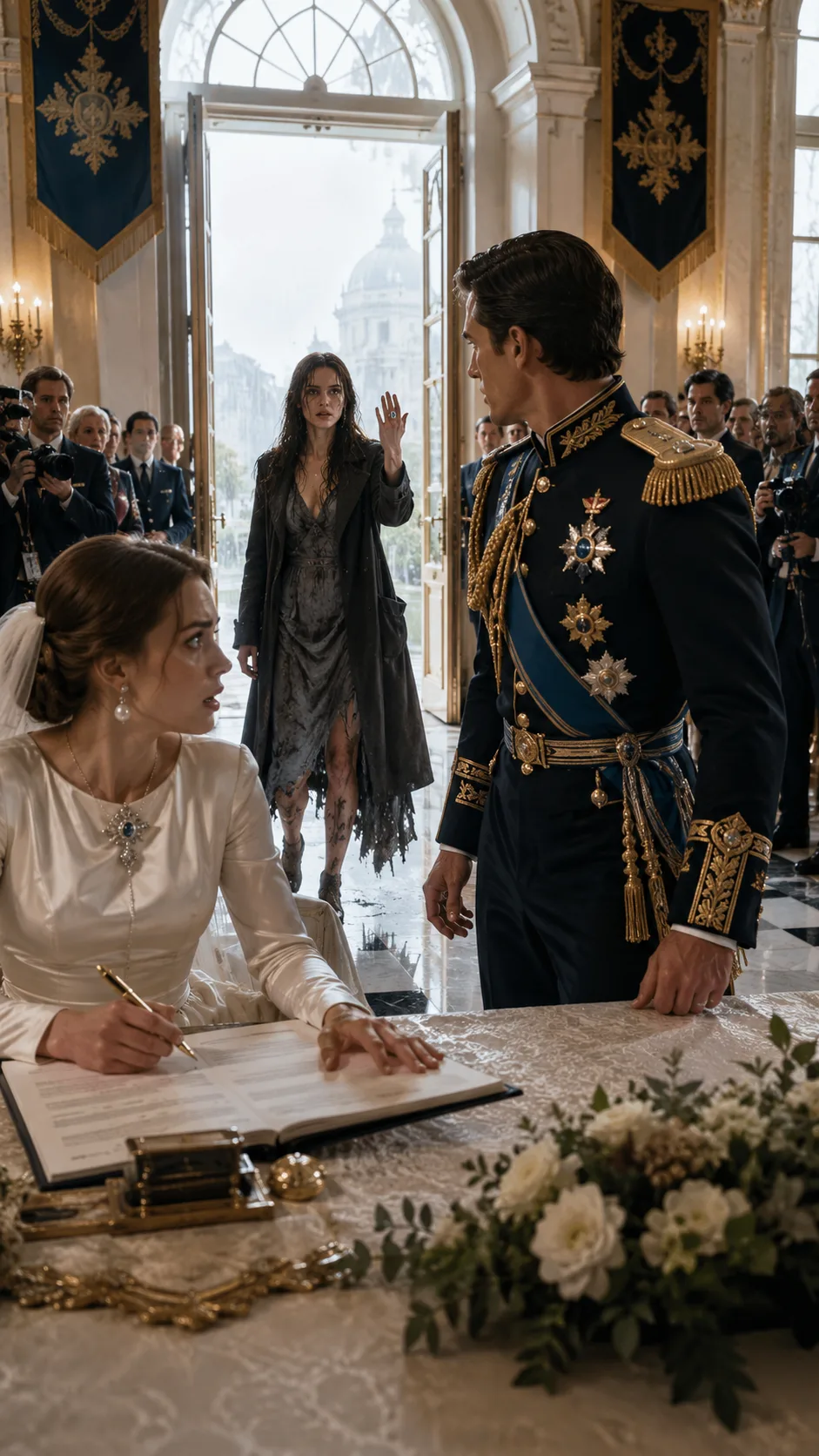
The Prince Married the Wrong Woman Before His Real Bride Walked In Holding the Ring They Tried to Erase Forever
The first time Princess Elena Vale disappeared from royal records, no one noticed.
Chapter 1
The Prince Married the Wrong Woman Before His Real Bride Walked In Holding the Ring They Tried to Erase Forever
The first time Princess Elena Vale disappeared from royal records, no one noticed.
Not the newspapers.
Not the ministers.
Not the foreign ambassadors who had once bowed to her when she was a child in pearl-buttoned coats, standing beside her father on the palace balcony.
Not even the people of Ardenne, who had grown up seeing her face beside the prince’s in state portraits and anniversary stamps.
The erasure began quietly.
A file removed from the royal archive.
A childhood portrait taken down from a corridor.
A signature declared invalid because the ink had faded.
A tutor paid to say she had never taught a girl named Elena.
A palace doctor transferred overseas after refusing to alter a birth certificate.
By the time anyone thought to ask why the late King’s only daughter had stopped appearing beside the royal family, Queen Marissa already had an answer prepared.
“Princess Elena is unwell,” she told the council, her voice soft with practiced grief. “She has
chosen privacy.”
Privacy became absence.
Absence became rumor.
Rumor became silence.
And silence, in a palace, could bury a person more completely than a grave.
Elena learned that inside the locked west wing of Briar House, an old royal villa hidden behind miles of black pine outside the capital. The queen had sent her there three months before the wedding treaty was to be signed, with two guards, one doctor, and a woman who introduced herself as a caretaker but carried keys like a prison warden.
At first, Elena thought it was another punishment.
Queen Marissa had never forgiven her for being born first.
Elena was the daughter of King Adrian’s first wife, Queen Isabelle, the woman the kingdom still remembered with flowers and hymns. Marissa had entered the palace two years after Isabelle’s death, smiling like a saint while studying every shadow where power might be hidden.
For years,
Marissa called Elena “my dear girl” in public and “your mother’s mistake” behind closed doors.
Elena endured it because her father was alive.
Then King Adrian died suddenly after a winter banquet.
And the palace changed before his body had even cooled.
The servants stopped meeting Elena’s eyes.
The guards no longer opened doors before she reached them.
Her father’s private secretary was dismissed.
Her mother’s rooms were sealed.
Her name, once spoken carefully, became dangerous.
The wedding treaty with Crown Prince Nicholas of Valoria had already been arranged before the king’s death. It was supposed to unite two old royal houses and end twenty years of border tension. Elena had met Nicholas only twice as a child, both times during formal visits, but she remembered him clearly: a tall boy with serious eyes, standing stiffly beside his father while Elena had hidden a wounded sparrow inside her coat.
He
had seen the bird.
He had said nothing.
Later, he slipped a folded napkin into her hand. Inside was bread.
That was the first secret they shared.
The second came ten years later, when Nicholas returned to Ardenne as a man.
He was twenty-nine then, heir to one of Europe’s richest monarchies, broad-shouldered, controlled, handsome in the way portraits tried and failed to capture. His face had sharpened with age. His eyes had not softened. But when he saw Elena across the palace conservatory, standing beneath the orange trees in a pale blue satin dress, something in his expression moved like a locked door opening.
“You still hide wounded things,” he said.
Elena glanced at the bandaged paw of the stray cat asleep in her lap.
“And you still pretend not to notice,” she replied.
That was how the treaty became something more dangerous than politics.
It became real.
They were careful. They were royal. They understood that affection, in their world, was never private for long. Still, love found small places to live.
A note slipped inside a diplomatic briefing.
A hand brushing beneath a dinner table.
A look across a chapel while priests discussed bloodlines and duty.
A winter afternoon when Nicholas found Elena crying in the old library after Marissa had ordered her mother’s portraits removed.
He did not comfort her with speeches.
He simply took off his gloves, picked up one fallen portrait, and rehung it himself.
When Queen Marissa entered and saw him standing beneath Queen Isabelle’s painted face, her expression did not change.
But Elena knew.
From that moment, Marissa understood that Nicholas could become Elena’s shield.
So she removed Elena before the marriage could make that shield legal.
The abduction happened on a rainy night.
Elena had been summoned to the queen’s private sitting room, where Marissa sat beside a silver tea tray and a stack of marriage documents.
“You will sign tomorrow,” Marissa said.
Elena remained standing. “The council agreed the ceremony would take place next month.”
“The council agrees with what I tell it to agree with.”
Elena looked at the documents. Her name had already been printed beneath Nicholas’s.
Princess Elena Isabelle Vale.
For a moment, the sight of it hurt more than Marissa’s cruelty. Her real name. Her mother’s name. The last proof that she still belonged to herself.
“You are rushing this because you’re afraid,” Elena said quietly.
Marissa lifted her teacup. “Careful.”
“You thought I would be easy to control after Father died. But if I marry Nicholas, Valoria will protect my claim. You won’t be regent anymore. You’ll be nothing but the king’s widow.”
The room went still.
Then Marissa smiled.
“Elena,” she said, almost tenderly. “You were always so much like your mother. Beautiful. Proud. And terribly bad at surviving.”
Elena remembered the tea only afterward.
The bitter almond taste.
The way the room tilted.
The queen’s pearl earrings swinging as she leaned close.
The last words Elena heard before darkness took her were whispered beside her ear.
“Do not worry, my dear. The prince will still marry Princess Elena.”
When she woke, she was no longer in the palace.
Briar House smelled of dust, rain, old wood, and medicine. Its windows were barred from the outside. Its phones were dead. Its staff spoke only when necessary. Her dresses had been replaced with plain gray wool. Her jewelry was gone.
All except one thing.
The ring.
Elena’s mother had given it to her when she was thirteen, two weeks before the fever took her life. It was not large, not gaudy, not made to impress reporters. A slim band of white gold, set with a pale sapphire cut like a drop of ice. Inside the band, nearly invisible unless turned beneath light, was the old Vale family crest.
Queen Isabelle had pressed it into Elena’s palm and closed her fingers over it.
“When a palace lies,” she had whispered, “blood remembers.”
Elena had worn it on a chain beneath her clothes ever since.
Marissa’s guards had searched her bags.
They had taken her papers.
They had taken her signet.
They had even taken a tiny embroidered handkerchief that had belonged to her mother.
But they had not found the ring, because Elena had sewn it into the hem of her dress years earlier after Marissa once tried to confiscate it.
In Briar House, the ring became more than memory.
It became evidence.
Each morning, Elena forced herself to stay calm.
Each night, she listened.
She learned the guards’ routines. Learned which one drank too much coffee. Which one called his wife at nine. Which one limped when it rained. Learned that the caretaker, Mrs. Voss, feared the queen more than she hated Elena.
Most importantly, Elena learned what Marissa had done.
The answer arrived in fragments.
A newspaper left on a breakfast tray by mistake.
A whisper between guards.
A radio announcement from the kitchen when someone forgot to turn it down.
Princess Elena Vale had returned to public life.
Princess Elena Vale had accepted Crown Prince Nicholas’s hand.
Princess Elena Vale would sign the civil marriage contract at noon on the first day of spring.
Elena saw the photograph three days before the ceremony.
It was printed on the front page of The Ardenne Herald.
A woman stood beside Nicholas on the palace steps, wearing a cream dress and Elena’s official sapphire brooch.
She had dark blonde hair arranged like Elena’s.
She had Elena’s approximate height.
From a distance, with the right veil, the right lighting, the right silence, she could pass for a princess most people had not seen clearly in months.
Her name was Clara Veyne.
Elena knew her.
Clara had been a junior lady-in-waiting in Marissa’s household, the daughter of a bankrupt nobleman and a mother who spent her life begging for invitations. She had once poured wine on Elena’s gown at a charity dinner and cried so convincingly that Elena apologized to her.
Now Clara was wearing Elena’s brooch.
And Nicholas was standing beside her like a statue.
Elena stared at the photograph until the ink blurred.
At first, anger came.
Then fear.
Then something sharper.
Because Nicholas’s hand was visible in the photo. His left hand. The one closest to Clara.
His fingers were not touching hers.
Not even slightly.
To the public, it looked formal.
To Elena, it was a message.
Nicholas knew something was wrong.
But knowing was not enough. Not in a kingdom where the queen controlled the papers, the palace guard, the registry office, and half the council.
If Clara signed Elena’s name on the marriage contract, the lie would become law before anyone could stop it. Marissa would control the queen consort of Valoria through fraud. Ardenne’s throne would be tied to a puppet. Elena would vanish from history.
So Elena stopped waiting to be rescued.
On the night before the signing, rain returned.
It struck Briar House in hard silver sheets, drowning the pine forest in mist. The guards retreated beneath the carriage awning to smoke. Mrs. Voss locked the upstairs hall at ten and went to her room with a bottle of tonic and a rosary.
Elena had stolen three things over the previous month.
A hairpin.
A kitchen knife no longer than her palm.
And the brass key to the laundry door, copied in wax from Mrs. Voss’s ring and filed slowly from a piece of curtain rod until it fit.
At 10:43, she cut the hem of her gray dress and removed the ring.
At 11:02, she unlocked her room.
At 11:17, she stepped into the laundry corridor barefoot, carrying her shoes in one hand.
The house groaned in the storm.
Once, a guard coughed outside the kitchen door, and Elena froze behind a linen cupboard with her heart pounding so hard she thought the shelves might shake.
She thought of Nicholas standing beside Clara.
She thought of her mother’s portrait removed from the palace wall.
She thought of Marissa whispering, “The prince will still marry Princess Elena.”
Then she moved.
The laundry door opened into the old garden, where weeds had swallowed the stone path. Elena ran through mud and rain until her lungs burned. Branches tore at her dress. Her hair came loose. Twice she fell. Once, she struck her knee against a rock so hard she tasted blood in her mouth, but she did not stop.
Beyond the pines was a service road.
Beyond the service road was a chapel village.
Beyond the village was the capital.
At dawn, a milk truck driver found her walking beside the road, soaked, shivering, and wearing a torn gray dress under a stolen stable coat.
He almost drove past.
Then Elena raised her hand and showed him the ring.
The man went pale.
“My mother had your portrait,” he whispered.
Elena could barely stand.
“Then help me reach the palace before noon.”
The civil signing took place in the Hall of Glass, a modern wing attached to the old palace after the war. It was chosen for cameras because sunlight poured through its arched windows and made every royal lie look holy.
By eleven thirty, the hall was full.
Foreign diplomats sat in the first rows. Ministers filled the second. Reporters waited behind velvet ropes, their cameras angled toward the signing table. The table itself was covered in white silk, with two gold pens placed beside the marriage register.
Queen Marissa stood near the center, dressed in pale silver, every inch the grieving widow guiding her stepdaughter into duty.
Clara Veyne stood beside her.
She looked almost perfect.
Almost.
The palace stylists had dressed her in a white satin gown with pearl earrings and a veil pinned low over her hair. The sapphire brooch rested at her collarbone. Her makeup softened the differences in her face. Her posture had been trained until she moved with measured royal calm.
But fear lived in the small places.
In the tightness at her mouth.
In the way her fingers pressed too hard around the bouquet.
In the way she avoided Nicholas’s eyes.
Nicholas stood on the other side of the signing table in a dark navy royal uniform with gold embroidery. He had been still for so long that the reporters had begun describing him as dignified. But his younger brother, Prince Thomas, standing behind him, knew better.
Nicholas was furious.
He had spent three months asking questions and receiving locked doors.
Elena’s letters had stopped.
Her private secretary had vanished.
Her ladies-in-waiting had been replaced.
Every request to meet his bride had been blocked by Marissa’s office with excuses about illness, exhaustion, religious retreat, and privacy.
Then Clara appeared.
Veiled.
Soft-spoken.
Always surrounded.
Never alone.
Nicholas knew it was not Elena the moment she failed to answer him in the conservatory.
He had asked, quietly, “Do you still feed sparrows?”
Clara smiled with perfect confusion.
“I prefer swans,” she said.
That was when Nicholas understood the scale of the crime.
But understanding a crime and proving it before a signing were two different things.
Marissa had trapped him carefully. If he accused Clara publicly without proof, Ardenne could claim Valoria had insulted its princess and collapse the treaty. If he refused to sign, war factions in both courts would celebrate. If he demanded a private examination, Marissa would delay until the papers were finished.
So Nicholas prepared one last defense.
He ordered Valorian intelligence to search every royal property Marissa had quietly sealed.
He sent Thomas to question dismissed servants.
He delayed the signing by insisting on revised witness language.
He did everything short of overturning the table.
But by eleven fifty-eight, Elena had not been found.
Queen Marissa knew it.
She touched Clara’s elbow.
“Smile,” she murmured. “You are about to become untouchable.”
Clara’s throat moved.
“I can’t do this,” she whispered.
Marissa’s hand tightened. Her smile never changed.
“You can, or your father’s debts become public before sunset.”
The archbishop stepped forward.
The hall quieted.
“Today,” he began, “before the witnesses of Ardenne and Valoria, before law and crown, we gather to recognize the civil union of Crown Prince Nicholas Alexander of Valoria and Princess Elena Isabelle Vale of Ardenne.”
Nicholas’s jaw tightened at Elena’s name.
Clara lowered her eyes.
The marriage register was opened.
The gold pen was placed in Clara’s trembling hand.
Marissa turned slightly toward the cameras, placing herself in the frame as the woman who had saved the kingdom from instability.
“Proceed,” she said.
Clara bent over the register.
Nicholas looked at the palace doors one last time.
Nothing.
Only guards.
Only cameras.
Only sunlight.
The pen touched paper.
Then the doors opened.
Not politely.
Not ceremonially.
They struck the walls with a sound like thunder.
Every camera turned.
A woman stood in the entrance of the Hall of Glass, soaked from rain, hair loose over her shoulders, gray dress torn at the hem, one knee streaked with mud, one hand pressed against the doorframe to keep herself upright.
For one second, no one recognized her.
She looked nothing like the polished portraits.
Nothing like the veiled girl at the table.
Nothing like a princess brought from a carriage.
Then she lifted her hand.
On her finger, beneath the pale daylight, the sapphire ring caught fire.
Queen Marissa went white.
Nicholas moved first.
“Elena,” he said.
The name traveled through the hall like a blade.
Clara dropped the pen.
Elena stepped forward.
Her voice was hoarse from rain and running, but it carried.
“Before she signs my name,” she said, staring at Clara, “ask her where she got my ring.”
The hall exploded.
Reporters surged against the velvet ropes. Ministers stood. Diplomats turned to one another in shock. Guards looked toward Marissa for orders and found her frozen.
Nicholas crossed the space between them so fast that protocol shattered behind him.
When he reached Elena, he did not embrace her. Not yet. He knew the cameras were watching. He knew the law needed more than feeling.
Instead, he stopped one step away and looked at her face as if forcing himself to confirm she was real.
“Elena,” he said again, lower this time. “Tell me where they kept you.”
“Briar House,” she answered. “Under your queen’s orders.”
Marissa recovered.
“This is absurd,” she said sharply. “That woman is an impostor.”
Elena laughed once.
It was not loud.
It was worse.
It was the sound of someone who had survived the lie too long to fear it anymore.
“You chose the wrong word,” Elena said. “There is already an impostor in this room.”
Clara began to cry.
Marissa turned on her with a glance.
“Stand straight.”
But Clara was shaking too hard.
Nicholas looked toward Thomas.
“Seal the doors.”
Thomas gave the order. Valorian security moved before Ardenne’s palace guards could react. The great doors shut. No one left.
Marissa’s mask cracked.
“You have no authority in my palace.”
Nicholas turned to her, his voice colder than the marble floor.
“This signing is a joint royal procedure under treaty law. Fraud against my crown gives me authority enough.”
Elena walked past him toward the table.
Every step hurt. Her wet shoes left marks on the polished floor. The reporters fell silent, sensing that the true violence in the room would not need blood.
Elena stopped across from Clara.
The false princess looked up at her with ruined makeup and terrified eyes.
“I’m sorry,” Clara whispered.
Elena studied her.
For a moment, pity threatened to rise.
Then Elena saw the sapphire brooch on Clara’s chest.
Her mother’s brooch.
She reached across the table and removed it.
Clara did not resist.
“This was buried with my mother’s things,” Elena said. “You had no right to wear it.”
Marissa stepped forward.
“Enough. Guards, remove her.”
No one moved.
Not because the guards had grown brave.
Because Nicholas had placed himself beside Elena.
And because every camera in the hall was now recording the queen ordering guards to remove a woman wearing the Vale family ring while another woman sat ready to sign her name.
Elena turned to the archbishop.
“Your Grace,” she said, “you baptized me in the north chapel when I was two weeks old. My mother cried because I screamed through the entire prayer. Do you remember?”
The old man’s face trembled.
“I remember,” he whispered.
Marissa snapped, “Sentiment is not proof.”
“No,” Elena said. “But this is.”
She removed the ring from her finger and placed it on the signing table.
The royal registrar, an elderly woman named Madam Laurent, had been silent until then. She stared at the ring as if it had risen from a grave.
“Madam Laurent,” Elena said, “please open the inheritance seal.”
The registrar hesitated.
Marissa’s face hardened.
“Do not touch that ring.”
Madam Laurent looked at the queen, then at the cameras, then at Nicholas.
Finally, she opened a black leather case beside the marriage register. Inside was the old Ardenne inheritance seal, a small mechanical crest used only for sovereign bloodline verification during royal marriages. It had not been needed in decades. Most people in the hall had forgotten it existed.
Marissa had not.
That was why she had searched Elena’s belongings.
But she had missed the ring.
Madam Laurent placed the sapphire band into the crest’s circular lock.
For one breath, nothing happened.
Then the ancient mechanism clicked.
A hidden panel opened beneath the seal, revealing a strip of vellum protected under glass.
The registrar read the inscription.
Her voice broke.
“Verified: Princess Elena Isabelle Vale. First daughter of King Adrian Vale and Queen Isabelle Vale. Primary blood heir of Ardenne.”
A sound moved through the hall — not applause, not shouting, but the collective intake of a kingdom realizing it had been lied to in daylight.
Clara covered her face.
Marissa stood perfectly still.
Nicholas looked at Elena, and the restraint he had held for months almost collapsed.
But Elena was not finished.
She turned to the reporters.
“My father died believing I would marry for peace,” she said. “My mother died leaving me proof of who I was. Queen Marissa locked me away, erased my records, and brought another woman here to sign my name.”
Marissa’s voice cut across the hall.
“You ungrateful child. Everything I did was to protect Ardenne.”
Elena faced her.
“No,” she said. “Everything you did was to own it.”
The queen’s composure finally shattered.
“You think love will save you?” Marissa hissed. “You think a prince will hand you a throne because you walked in wet and dramatic with a ring? You are still one woman against a palace.”
Nicholas stepped closer.
“She is not one woman.”
Thomas moved to his side.
Madam Laurent closed the marriage register.
The archbishop removed his ceremonial stole.
One by one, ministers who had spent months pretending not to see the truth lowered their eyes.
Elena looked at Clara.
“Who ordered you to take my place?”
Clara sobbed.
Marissa said, “Do not answer.”
Clara’s hands shook over the unsigned page.
“My father owed the queen money,” she whispered. “She promised to clear his debts. She said Princess Elena was unstable. She said the marriage had to happen for the kingdom.”
“Clara,” Marissa warned.
But Clara looked at the cameras.
“She told me if I refused, my family would be ruined.”
For the first time that day, Elena saw Clara not as a thief, but as another cage Marissa had built.
Still, cages did not erase choices.
“You were afraid,” Elena said. “So was I. But you still picked up the pen.”
Clara lowered her head.
“Yes.”
Elena turned to Madam Laurent.
“Strike this ceremony from the register.”
The registrar nodded.
Nicholas looked at Marissa.
“By treaty law, Valoria requests an immediate investigation into attempted royal fraud, unlawful confinement, identity falsification, and coercion.”
Marissa laughed bitterly.
“You request?”
Nicholas removed a sealed document from inside his uniform jacket and placed it on the table beside the ring.
“No,” he said. “I already filed it. With both courts. At sunrise.”
Marissa looked at the seal.
Valoria’s royal court.
Ardenne’s constitutional council.
The European Treaty Commission.
Her lips parted.
Nicholas’s eyes did not leave hers.
“I was waiting for proof,” he said. “She brought it herself.”
For a heartbeat, the queen looked older than fifty-five. Not defeated yet. Only exposed. A person who had lived so long behind curtains that daylight itself seemed violent.
Then the chief of palace security stepped forward.
Not Marissa’s captain.
Nicholas’s.
“Queen Marissa Vale,” he said, “under emergency treaty protection, you are to remain in this hall until the constitutional council arrives.”
“You cannot arrest me,” she said.
“No,” Elena said quietly. “But we can stop obeying you.”
That was the true end of Marissa’s reign.
Not handcuffs.
Not shouting.
Not a sword.
Only the moment the room understood her orders no longer mattered.
Two hours later, the council convened in emergency session. By sunset, Briar House had been searched. The guards confessed within the day. Mrs. Voss surrendered Elena’s stolen documents from a locked cabinet beneath the kitchen floor. Palace staff came forward with records they had hidden out of fear. The doctor who had been exiled returned by video statement and confirmed he had refused to alter Elena’s birth file.
Clara was detained, then released under protective testimony.
Her father’s debts became public anyway.
Marissa was removed from all state functions pending trial.
And Elena, who had begun the morning walking barefoot through rain, ended the night standing in her father’s study while Nicholas waited by the door.
For the first time, no guards stood between them.
The palace outside was in chaos. Ministers ran through corridors. Phones rang without pause. Reporters shouted beyond the gates. The kingdom had split open, and morning would bring consequences neither of them could fully predict.
But inside the study, it was quiet.
Elena stood before the empty space where her mother’s portrait had once hung.
Nicholas approached slowly.
“I searched,” he said.
“I know.”
“Not enough.”
She turned to him then.
He looked exhausted. Still controlled, still royal, but the pain had reached his eyes at last.
“Elena,” he said, “I knew it wasn’t you. But I could not find where she put you.”
“She made sure no one could.”
“I should have refused the signing.”
“And started a diplomatic crisis with no proof?” Elena shook her head. “You waited because you had to.”
“I hated every second.”
“So did I.”
For a moment, the distance between them held all the things they could not say in public.
Then Nicholas reached into his jacket and removed a folded napkin.
Old. Yellowed. Carefully preserved.
Elena stared.
Inside was a tiny pressed feather.
From a sparrow.
Her breath caught.
“You kept it?”
“You saved the bird,” he said. “I saved the evidence.”
A laugh escaped her, fragile and disbelieving.
Then the laugh broke into tears.
Nicholas crossed the final step and held her.
Not like a prince before a treaty.
Not like a man claiming a bride.
Like someone holding a person who had almost been erased and was still real.
Elena pressed her face against his uniform and finally let herself shake.
Outside, the palace bells began to ring.
Not for a wedding.
Not yet.
For the restoration of a princess the kingdom had been ordered to forget.
Six weeks later, the Hall of Glass was opened again.
This time, there were no veils.
No substitute bride.
No queen in silver smiling beside the cameras.
The marriage register lay on the same white silk table. The same sunlight poured through the arched windows. The same reporters stood behind velvet ropes.
But this time, Elena walked in through the front doors.
She wore a satin ivory gown with pearl earrings, her mother’s sapphire brooch restored at her collarbone, and the Vale ring on her right hand.
Nicholas waited beside the table in his navy royal uniform.
When she reached him, he did not ask if she was ready.
He knew better than to ask a woman who had run through a forest barefoot to reclaim her name whether she was ready to sign it.
Instead, he held out the pen.
Elena looked at the page.
Princess Elena Isabelle Vale.
This time, no hand trembled above it.
She signed.
Nicholas signed beside her.
The archbishop blessed the union.
The bells rang again.
And when the doors opened to the balcony, the people of Ardenne filled the square below, thousands of faces turned upward, waiting to see if the princess they had lost would forgive the kingdom that had forgotten her.
Elena stepped into the sunlight.
For a moment, she said nothing.
Then she lifted her hand.
The sapphire ring flashed blue above the crowd.
“My name was taken from me,” she said. “But it was never lost.”
The square fell silent.
Elena looked across the people, past the banners, past the cameras, toward the palace roof where her mother’s flag had been raised again for the first time in thirteen years.
“A crown does not belong to those who steal silence,” she said. “It belongs to those brave enough to tell the truth.”
Then Nicholas took her hand.
The crowd erupted.
Not because the story was perfect.
Not because betrayal had vanished.
But because, for once, the lie had reached the signing table and found the real bride already standing at the door.
THE END.
Chapter complete
You have reached the end of this chapter.
Continue reading
A few more worlds to get lost in after this chapter.