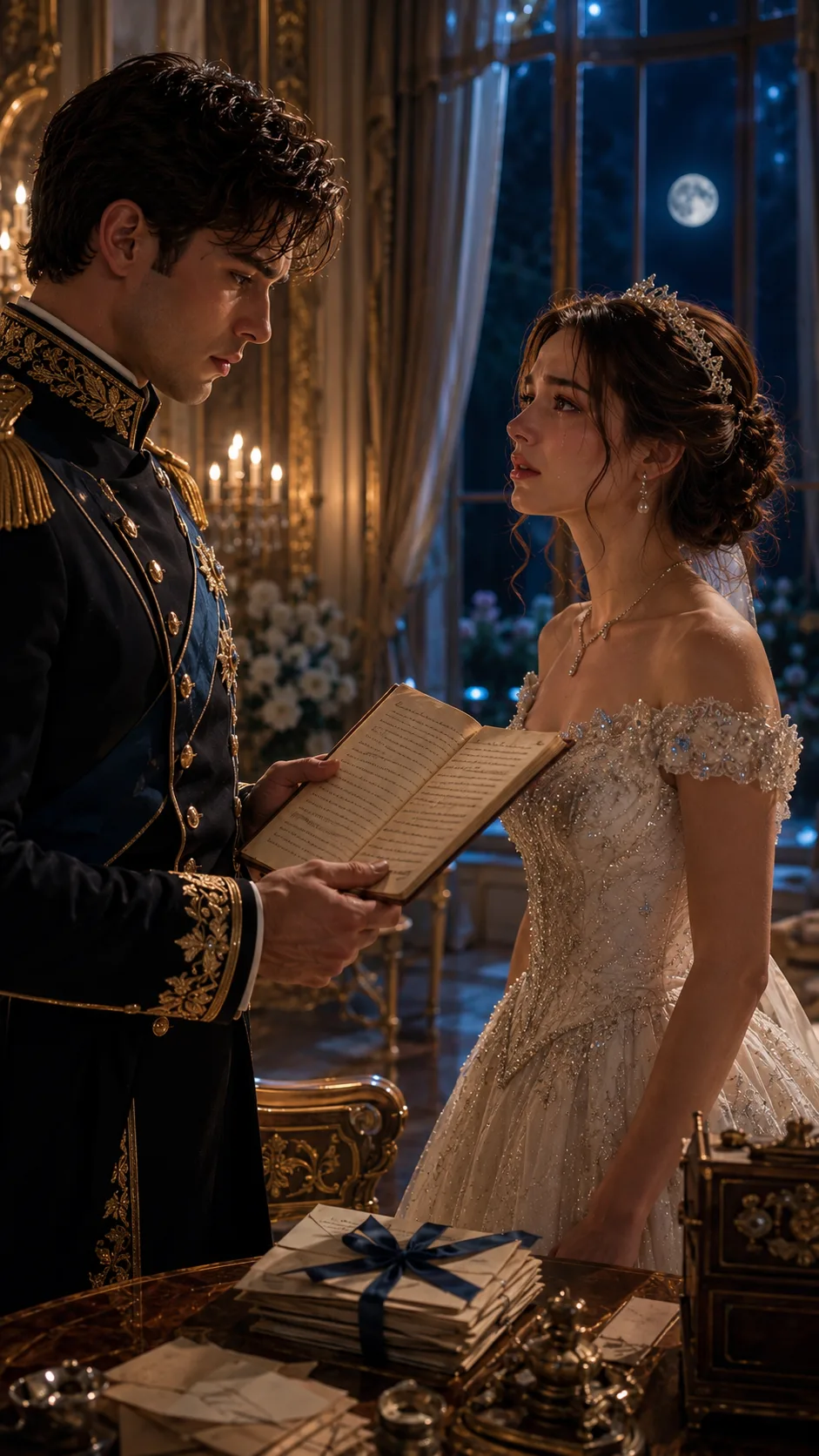
THE PRINCE MARRIED A PRINCESS OUT OF DUTY...
Chapter 1
THE PRINCE MARRIED A PRINCESS OUT OF DUTY...
BUT ON THEIR WEDDING NIGHT HE DISCOVERED SHE WAS THE GIRL WHO HAD CARRIED HIM THROUGH TEN YEARS OF LONELINESS
Prince Arthur had been twelve years old when the first letter appeared.
It was not delivered by a royal messenger. It bore no seal, no name, no address, and no clue that could lead him to the sender. It had simply been placed beneath the silver candlestick on the windowsill of his private study, folded carefully into three parts.
At first, Arthur thought it was a mistake.
Then he opened it.
You looked lonely today.
That was all it said.
Five words.
But they struck him harder than any command his father had ever given.
That day had been one of the worst days of his young life. He had failed his first formal sword trial in front of half the court. His father, King Edmund of Astoria, had not
shouted. That would have been easier. Instead, the king had simply looked at him as if Arthur had disappointed the entire bloodline.
“You are not a child,” the king had said coldly.
But Arthur was a child.
A lonely one.
That night, he read the mysterious letter ten times before hiding it inside a book of royal laws no one his age would ever willingly open.
The next letter came three weeks later.
Then another.
Then another.
They never came on a schedule. Sometimes months passed. Sometimes only days. But they always appeared when Arthur needed them most.
When he was mocked by older noble boys, a letter appeared.
When he cried silently after his mother’s funeral, a letter appeared.
When he confessed on paper that he sometimes wished he had been born as anyone other than a prince, a letter appeared the next morning.
You are allowed to be
tired, even if they call you strong.
Arthur never discovered who wrote them.
For ten years, the unnamed letters became the only place where he felt seen.
He grew taller. Colder. More disciplined. By twenty-eight, Prince Arthur was the perfect heir to Astoria: handsome, controlled, admired, and emotionally unreachable.
The court called him a future king.
Arthur secretly still kept every letter in a locked ivory box beneath his bed.
Then the council announced his marriage.
Princess Eleanor of Valoria.
A political bride.
A necessary alliance.
A woman he had never truly known.
Arthur did not protest. Princes were not raised to ask for love. They were raised to preserve kingdoms.
When he first met Eleanor, she was standing in the palace garden beneath a glass roof while rain slid down the panes above her. She wore a pale blue satin dress, pearl earrings, and a calm expression that revealed
nothing.
She curtsied.
“Your Highness.”
Arthur bowed.
“Princess Eleanor.”
That was all.
No spark.
No warmth.
No sign of fate.
Arthur decided immediately that she was exactly what the council wanted: graceful, obedient, and distant enough not to disturb his carefully ordered loneliness.
The wedding took place six weeks later.
Every newspaper in Europe called it the union of two ancient crowns. The cathedral overflowed with nobles, ambassadors, cameras, and jeweled women whispering behind silk gloves.
Arthur stood at the altar in a black royal uniform, his face unreadable.
Eleanor walked toward him slowly.
The crowd saw a beautiful princess.
Arthur saw a stranger.
When he placed the ring on her finger, he told himself this was duty. Nothing more.
But Eleanor’s hand trembled once.
Only once.
Arthur noticed.
He ignored it.
That night, after the celebrations ended, they were escorted to the royal bridal chamber, a vast room of white marble, velvet curtains, gold mirrors, and roses arranged so perfectly they looked unreal.
For a long moment, neither spoke.
Eleanor stood beside a small writing desk near the window. Arthur remained near the fireplace, still in his ceremonial uniform.
“You do not have to pretend,” she said softly.
Arthur looked at her.
“Pretend what?”
“That this is what you wanted.”
He was quiet.
Then he answered honestly.
“I wanted peace for the kingdom.”
A small sadness crossed her face, but it vanished so quickly he almost doubted it had been there.
“I understand.”
She turned toward the desk and opened a small wooden chest.
Arthur watched as she removed a leather-bound notebook.
“I have something that belongs to you,” she said.
He frowned.
“To me?”
Eleanor nodded and held it out.
Arthur stepped forward and took the book.
The moment he opened the first page, the world stopped.
The handwriting.
Thin, elegant, slightly tilted to the right.
He knew it better than he knew the royal crest.
His fingers tightened around the book.
No.
It was impossible.
He turned another page.
Then another.
Each page held copies of letters.
The same words that had saved him at twelve.
The same words that had carried him through grief, pressure, fear, and loneliness.
Arthur’s breath caught.
He looked up slowly.
Eleanor stood before him with tears shining in her eyes.
“It was you,” he whispered.
She did not deny it.
“It was always me.”
Arthur staggered back one step as if the truth had physically struck him.
For ten years, he had searched faces at court. Servants. Daughters of dukes. Foreign guests. Musicians. Tutors. He had imagined a hundred possibilities.
Never her.
Never the woman he had married out of duty.
“You wrote them?”
Eleanor nodded.
“The first one, when we were twelve. I saw you in the winter garden after your sword trial. You were trying not to cry.”
Arthur remembered that day with painful clarity.
“I never saw you.”
“I know,” Eleanor said. “I was too afraid to speak to you.”
“So you wrote a letter instead?”
“Yes.”
Arthur lowered his eyes to the notebook. His voice became rough.
“You saved my life more times than you know.”
A tear slipped down Eleanor’s cheek.
“I know more than you think.”
Then came the second twist.
Eleanor opened the chest again and removed a bundle of old letters tied with a faded blue ribbon.
Arthur froze.
Those were not her letters.
They were his.
Letters he had written but never sent.
Letters he had hidden.
Letters full of thoughts he had been too ashamed to give anyone.
“How do you have these?” he asked.
Eleanor’s lips parted, but she did not answer immediately.
An elderly royal servant entered quietly after a soft knock. It was Thomas, the old palace steward who had served Arthur since childhood.
Arthur turned to him.
Thomas bowed his head.
“I gave them to her, Your Highness.”
Arthur’s face hardened.
“You read my private letters?”
“No,” Thomas said gently. “I found them in the old west tower after your father ordered the room cleared. They were going to be burned.”
Arthur went still.
“Burned?”
Thomas nodded.
“Princess Eleanor asked me to preserve anything that belonged to the boy you used to be.”
Arthur looked back at Eleanor.
She whispered, “I did not want the palace to erase you.”
For the first time in years, Arthur had no armor left.
All his life, people had protected the prince.
Eleanor had protected the child.
The next morning, Arthur did not appear at breakfast.
Nor did Eleanor.
By noon, rumors spread across the palace. Some said the royal marriage had collapsed before sunrise. Others said Arthur had rejected his bride. The council grew nervous.
But behind the locked doors of the private library, Arthur and Eleanor sat on the floor surrounded by ten years of letters.
He read hers.
She read his.
They discovered they had grown up together without ever standing in the same room long enough to know it.
She had loved him before she knew the shape of his adult face.
He had trusted her before he knew her name.
But happiness in royal families rarely survives without a challenge.
Three days after the wedding, Lord Varrick, the most powerful advisor in Astoria, confronted Arthur before the council.
“This marriage must remain formal,” Varrick said. “Affection makes rulers weak.”
Arthur said nothing.
Varrick continued, “The princess of Valoria was chosen to secure peace, not to influence the throne.”
Eleanor stood silently beside Arthur.
Then Varrick made his mistake.
He placed one of the anonymous letters on the council table.
Arthur’s eyes sharpened.
“Where did you get that?”
Varrick smiled faintly.
“Your father knew about them.”
The room fell silent.
Arthur’s blood ran cold.
Varrick continued, “King Edmund ordered an investigation years ago. He believed the writer was dangerous. Too intimate. Too close to your mind.”
Arthur looked at Eleanor.
Her face had gone pale.
Varrick said, “When we discovered the letters came from Valoria, the king considered ending all communication between the kingdoms.”
Arthur’s voice dropped.
“And why didn’t he?”
Varrick hesitated.
That hesitation gave Eleanor the courage to speak.
“Because my father threatened to reveal the truth.”
Every head turned toward her.
Arthur stared.
“What truth?”
Eleanor’s hands trembled, but her voice held.
“That your mother sent the first request.”
Arthur stopped breathing.
“My mother?”
Eleanor nodded.
“Queen Helena knew you were lonely. She met my mother during a peace summit. She asked if there was a child in Valoria who might write to you without wanting power from you.”
Arthur’s face changed completely.
Eleanor continued, tears gathering again.
“She wanted you to have one friend who did not see a crown when they looked at you.”
Arthur gripped the back of a chair.
For years, he had believed the letters were a miracle.
They were not.
They were his mother’s final act of love.
Varrick tried to regain control.
“It changes nothing. The council must decide whether Princess Eleanor’s influence is safe.”
Arthur finally looked at him.
“No.”
The word was quiet, but it cut through the chamber.
Varrick stiffened.
Arthur picked up the letter from the table and held it against his chest.
“You do not get to call love a threat simply because you cannot command it.”
No one moved.
Then Arthur turned to the council.
“You arranged this marriage because you thought Eleanor was useful.”
He looked at his wife.
“But she was never a stranger to me.”
Eleanor’s eyes filled.
Arthur continued, “She knew the boy before any of you respected the prince.”
Varrick’s face tightened.
“This is sentiment.”
Arthur stepped closer.
“No. This is memory. And memory is stronger than fear.”
The council had expected a cold prince.
Instead, they saw a man finally choosing for himself.
But the final twist came that evening.
Eleanor found Arthur alone in the chapel where his mother was buried.
He was standing before Queen Helena’s marble statue, holding the first letter.
“I spent years wondering why someone stayed,” he said.
Eleanor walked to his side.
Arthur’s voice broke.
“It was because my mother asked someone to.”
Eleanor shook her head.
“No.”
He looked at her.
She took the letter gently from his hand.
“Your mother may have opened the door,” Eleanor said. “But I kept writing because I loved you.”
Arthur stared at her.
“I loved you before I knew whether you would become king,” she whispered. “Before I knew whether you would ever know my name. Before you belonged to me in any way.”
Arthur’s eyes reddened.
“You loved a ghost.”
“No,” Eleanor said. “I loved a boy who kept trying to be brave.”
For the first time since childhood, Arthur cried in front of someone.
Not as a prince.
Not as a future king.
As the boy from the winter garden.
Months later, Arthur was crowned King of Astoria.
Tradition demanded that the king ascend the steps alone.
Arthur did not.
Before the entire kingdom, he reached for Eleanor’s hand.
Gasps moved through the cathedral.
Varrick stood frozen among the nobles.
Arthur led Eleanor up the steps beside him.
When the crown was placed upon his head, he turned not to the council, not to the ambassadors, not even to the cheering crowd.
He turned to his wife.
Then he took a smaller crown from the archbishop’s cushion and placed it upon Eleanor’s head himself.
The cathedral fell silent.
Arthur spoke clearly.
“I was taught that kings are made by blood, law, and duty.”
He looked at Eleanor, his eyes shining.
“But I survived because one girl wrote to a lonely boy and asked for nothing in return.”
Eleanor covered her mouth as tears fell.
Arthur took her hand before the entire kingdom.
“So let history remember this: I did not marry a stranger.”
His voice softened.
“I married the person who found me before I knew I was lost.”
And for the first time in ten years, Eleanor did not have to hide behind a letter.
Arthur had finally found her.
And this time, he would never let her disappear again.
THE END.
Chapter complete
You have reached the end of this chapter.
Continue reading
A few more worlds to get lost in after this chapter.




