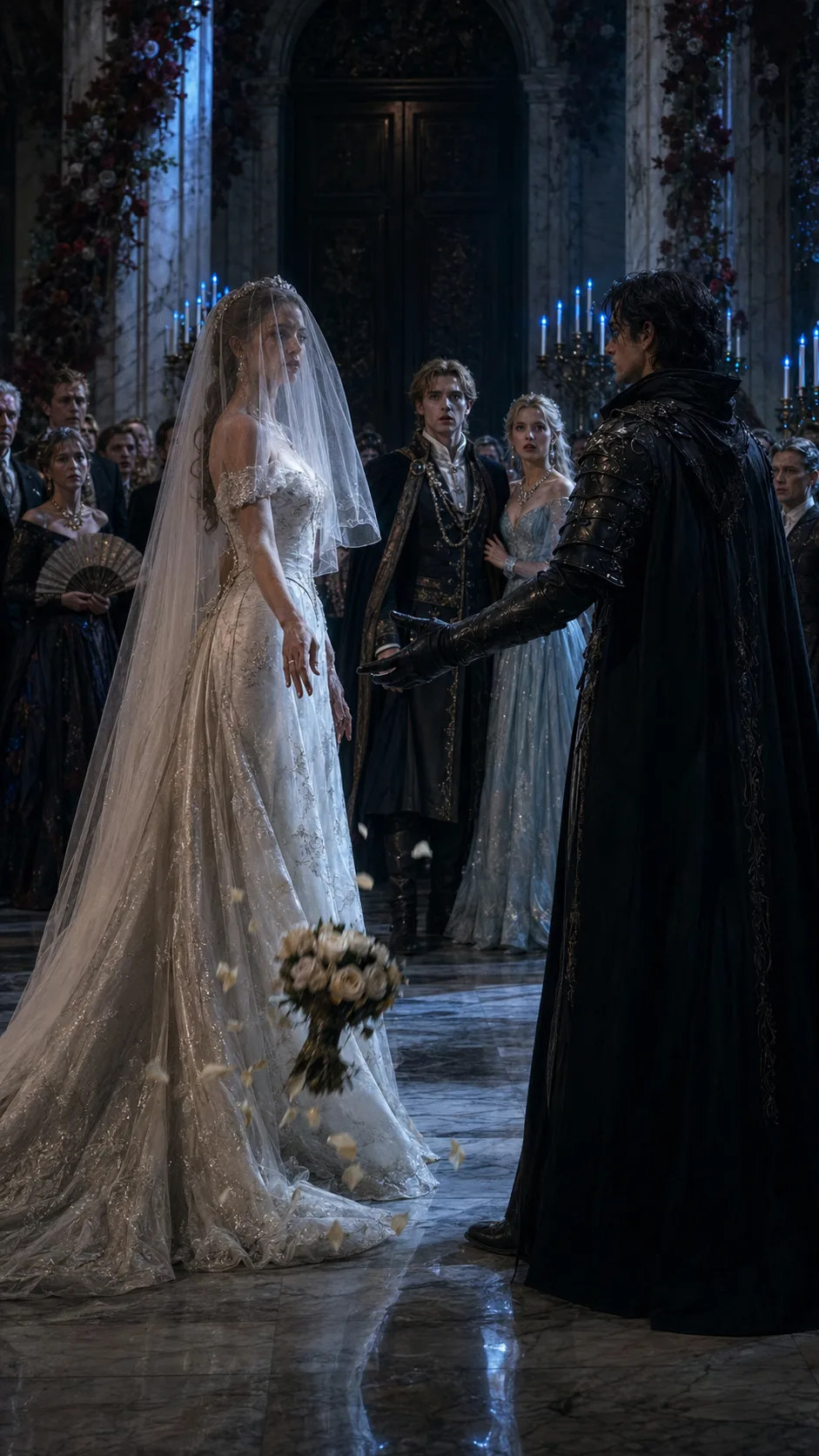
Seraphina held the bouquet too tightly.
Chapter 1
Seraphina held the bouquet too tightly.
The ribbon around the stems had been embroidered with two royal crests: the silver stag of her father’s kingdom and the golden hawk of Prince Adrian’s. They met in the center beneath a tiny crown stitched in thread so fine it shimmered every time the chapel candles moved.
A seamstress had shown it to her that morning with both hands.
“For unity, Your Highness.”
Seraphina had thanked her.
Then she had stood very still while six women fastened pearl buttons down the back of her gown and her mother watched from a velvet chair without saying whether she looked beautiful.
Beautiful did not matter.
Useful did.
The wedding gown was ivory silk, heavier than it looked, with a train that slid over the chapel floor like poured cream. Her veil covered her face, soft enough for the guests to see her mouth if they tried. The Archbishop said that made
her look humble. Her mother said it made her look pure.
Seraphina had thought it made her look trapped.
But she wore it.
She wore the diamond pins Adrian’s mother had sent. She wore the pearl earrings selected by her father’s council. She wore the faint blue sash of Adrian’s court, tied around her waist by a maid who kept glancing at the door.
Everyone glanced at the door.
No one said why.
The royal chapel had been prepared for a treaty dressed as a wedding. White roses climbed the marble pillars. Golden candles burned in rows along the aisle. Nobles from both kingdoms sat in divided pews, their brocade sleeves and jeweled gloves arranged with careful elegance.
Seraphina’s father, King Edric of Valehaven, sat in the front row with his crown on his head and a hand on his cane.
He had not kissed her forehead before the ceremony.
He had only said, “Stand straight.”
So she did.
Her mother, Queen Alinor, sat beside him in pale gold, chin lifted, fingers folded in her lap. The queen never fidgeted. She believed stillness was the last defense of royalty.
Across the aisle sat Queen Marcelline of Asterfell, Prince Adrian’s mother.
Marcelline wore dark emerald and a crown of sharp gold leaves. She had greeted Seraphina that morning with two fingers against her cheek.
“So young,” she had said.
Not kindly.
Behind Marcelline sat Princess Isolde, Adrian’s sister, who had never forgiven Seraphina for existing. Isolde had once told her during dinner that political brides should be grateful when anyone found a use for them.
Seraphina had answered, “How fortunate, then, that I am not decorative.”
There had been silence after that.
A long one.
Adrian had laughed into his wine cup and looked away.
That was Adrian.
He looked away
often.
For six months, Seraphina had studied him the way a prisoner studied locks. He was not cruel in the loud way. He did not shout. He did not strike tables or throw cups or humiliate servants.
He simply disappeared.
At banquets, his eyes followed the musicians instead of her. During court walks, he answered her with sentences short enough to be polite and long enough to avoid honesty. His letters arrived on thick paper smelling faintly of lavender wax, but the handwriting changed from month to month.
Advisors wrote most things.
She knew.
He knew she knew.
Neither of them said it.
Their marriage had been arranged after the southern border rebellion. Valehaven needed Asterfell’s cavalry. Asterfell needed Valehaven’s grain routes. Their fathers had turned bloodshed into negotiation, negotiation into treaty, and treaty into a bride.
Seraphina had not been asked.
Neither had Adrian, perhaps.
That thought had kept her patient longer than it should have.
The bells rang once.
Every noble in the chapel turned toward the rear doors.
They remained closed.
The Archbishop cleared his throat and adjusted the book on the altar.
Seraphina looked at the candle nearest her. A thread of wax had begun to slide down its side, slow and glossy.
The bells rang a second time.
Still no groom.
A whisper passed through the pews.
It moved like a little knife.
Her father did not move, but his thumb pressed harder against the silver wolf carved into the top of his cane.
Queen Marcelline’s mouth tightened.
Princess Isolde leaned toward her mother and murmured something that made Marcelline’s eyes flick toward Seraphina.
Seraphina kept her face still.
That had been her first lesson as a princess. Pain belonged behind doors. Shame belonged under jewels. Fear belonged nowhere.
The bells rang a third time.
The chapel doors did not open.
A child somewhere near the back coughed.
Someone’s fan snapped shut.
The sound cracked through the chapel hard enough to make Seraphina’s fingers close around the bouquet until one rose bent under her thumb.
Then the side doors opened.
Not the main doors.
The side doors.
Everyone turned.
Prince Adrian entered the chapel as if he had arrived at the wrong ceremony.
He wore his formal wedding coat, black velvet trimmed in gold, but a riding cloak hung over it, fastened crookedly at one shoulder. His boots were dusty. His fair hair, usually combed and oiled into court perfection, had been pushed back by wind and haste.
He was breathing fast.
Not from running.
From deciding.
Beside him stood Lady Mirelle.
Seraphina’s cousin.
Mirelle was twenty-one, pretty in a way that made people forgive her before she apologized. Pale blue dress. Loose golden curls. Small white gloves. She stood with one hand curled around Adrian’s arm, her thumb rubbing the fabric of his sleeve like she had done it many times before.
At her throat was a necklace.
Seraphina saw it before anyone else did.
Silver chain. Blue crystal. A tear-shaped stone framed by tiny diamonds.
Adrian had sent it to Seraphina three months ago as an engagement gift.
She had worn it once.
Only once.
The clasp had been loose. She remembered because a maid had pricked her finger trying to fix it. A tiny dot of blood had fallen on the dressing table, and the maid had started trembling as if she had wounded the treaty itself.
Seraphina had told her to breathe.
Now the necklace rested against Mirelle’s throat.
Perfectly clasped.
The chapel did not gasp.
Courts were too trained for that.
Instead, they leaned closer.
Velvet shifted. Jewelry clicked. Fans lifted. Eyes sharpened.
Seraphina looked at Adrian.
He stopped halfway down the aisle.
Not close enough to be forgiven.
Not far enough to escape.
“I cannot do this,” he said.
His voice carried.
It had been trained to.
The Archbishop’s hand froze over the book.
King Edric rose from the front pew.
“Prince Adrian,” he said, “choose your next words carefully.”
Adrian’s jaw worked once. He looked at his mother.
Queen Marcelline did not rise. She stared at him with the face of a woman watching a valuable vase slip from a table.
Adrian looked back at Seraphina.
For the first time since entering, his eyes met hers.
“I will not marry Princess Seraphina,” he said. “My heart belongs to Mirelle. We leave tonight.”
Mirelle lowered her eyes.
It was a practiced motion. Soft lashes. Downturned mouth. A picture of reluctant love.
She did not let go of Adrian’s arm.
That was what Seraphina noticed.
Not the betrayal.
The grip.
Mirelle had been in Seraphina’s rooms the night before, eating sugared almonds from a paper cone and saying how lucky Seraphina was to have a peaceful future secured before she turned twenty-five.
“You’ll be queen one day,” Mirelle had said.
Seraphina had answered, “Only if Adrian becomes king.”
Mirelle had smiled at the mirror.
“Men like him always do.”
Now that same smile hid behind lowered eyes.
A murmur moved through the chapel.
Seraphina heard pieces.
“Her cousin?”
“The necklace.”
“Poor thing.”
That one found her.
Poor thing.
She looked down at the bouquet.
One bent rose.
One ribbon creased under her glove.
A bead of pearl thread had loosened from the handle wrap. It clung to the lace over her thumb. She rubbed it once, and it fell to the marble.
Small sound.
Gone.
Adrian took a breath. The kind men take when they believe they are about to be noble.
“You deserve someone who truly wants you,” he said.
Seraphina lifted her eyes.
That sentence did more damage than the confession.
It offered her humiliation as kindness. It dressed abandonment in mercy. It assumed she would accept the insult because it had been delivered gently.
Her father’s face darkened.
Queen Alinor raised one hand to her mouth, but she did not speak.
Adrian’s mother stood.
The chapel obeyed her before she said a word. Even the whispers thinned.
Queen Marcelline smoothed one hand over the front of her gown.
“Then the wedding is dissolved,” she said. “No alliance can be built on a false vow.”
Several nobles from Asterfell nodded.
Too quickly.
They wanted out.
Not of the scandal. Of the responsibility.
A false vow. Such a clean phrase. It made Adrian sound honest. It made Mirelle sound brave. It made Seraphina sound like an unfortunate obstacle.
King Edric turned toward his daughter.
“Come down from there.”
He did not say her name.
Seraphina remained at the altar.
The Archbishop’s eyes moved between the kings and queens, his book still open, his lips pressed thin.
“Your Highness,” he said. “Perhaps—”
“Enough,” Edric said.
The word struck the marble.
Seraphina watched her father.
All her life, she had known the price of being his daughter. She had learned languages she did not like. She had memorized the names of border lords who would never respect her. She had sat through council dinners where old men discussed her marriage as if she were a bridge to be repaired.
She had endured.
Because Valehaven needed grain routes open.
Because soldiers needed to stop dying in the southern marsh.
Because queens were not built from romance.
They were built from endurance.
But endurance, she was beginning to understand, had been mistaken for permission.
Adrian shifted.
Mirelle whispered something to him.
Seraphina did not hear the words, but she saw his shoulders settle. Mirelle was comforting him. In the chapel where he had left another woman at the altar, she was comforting him.
A laugh rose somewhere in Seraphina’s chest.
It did not reach her mouth.
Then the candle nearest the last pew changed.
The flame turned blue.
Not pale blue.
Not moonlight.
A cold, deep blue, sharp at the center and dark around the edges.
The noblewoman beside it recoiled, her fan dropping into her lap.
Another candle changed.
Then another.
Blue flame traveled down both sides of the chapel aisle, one silent point of fire after another, until the golden warmth drained from the marble and every face looked carved from winter.
The whispers stopped.
The roses along the nearest pillar darkened.
White petals flushed pink, then red, then a deep crimson so rich it looked almost black where the blue light touched them.
Mirelle made a small sound.
The chapel doors slammed shut.
No hand touched them.
The impact shook dust from the carved arch above.
Several guards reached for their swords.
None drew them.
A shadow lengthened across the aisle.
It came from the back of the chapel, where the blue candles burned lowest and the doors stood sealed beneath iron hinges.
A man stepped forward.
Black armor beneath a long cloak. Dark hair falling near his jaw. A face too calm for a room full of enemies. His eyes carried a faint ember-glow, not bright enough to seem monstrous, only enough to make every human eye look fragile by comparison.
No herald announced him.
No one needed one.
Kael Veyron.
Demon King of the Ashen Realm.
The name had lived in Seraphina’s childhood like a warning under the bed. Mothers used it to quiet children. Priests used it to fill pews. Kings used it in speeches when they wanted applause from men too far from battle to know fear.
Kael the Oathbreaker.
Kael the Crownless.
Kael who had once burned the eastern watchtowers without sending a single soldier across the border.
Kael who had not been seen in any royal court for twelve years.
He walked down the aisle now as if the chapel had opened for him.
His boots made almost no sound on the marble.
The blue flames bent toward him.
Nobles pulled away from the aisle. Men who had boasted over wine about demon bloodlines now lowered their eyes. Women lifted jewels to their throats as if gold could ward off darkness.
Adrian stepped back.
Mirelle clutched his arm with both hands.
King Edric whispered, “Impossible.”
Kael did not look at him.
He passed the rows of nobles, the trembling guards, the Archbishop frozen beside his holy book, the queens in their jeweled crowns.
He stopped before the altar.
Before Seraphina.
For several seconds, he said nothing.
That silence belonged to him.
Not to the chapel.
Not to the kings.
Not to the prince who had broken the wedding.
To him.
Seraphina stood above him on the altar step, veil still covering her face, bouquet held against her waist, white gown glowing under blue fire.
Kael’s gaze did not move over her as the others had.
No pity.
No appraisal.
No calculation she could see.
Only recognition.
“I heard there was a bride left without a groom,” he said.
His voice was lower than Adrian’s. It did not need to be loud.
It filled the chapel anyway.
Seraphina looked down at him.
“And you came to mock me too?”
A few nobles stiffened at her tone.
Her father made a sharp movement, as if he might correct her manners in front of the Demon King.
Kael’s expression did not change.
“No,” he said. “I came to make an offer.”
King Edric stepped forward.
“You will speak to me, demon.”
Kael did not turn his head.
“I am not asking for your permission.”
The chapel held its breath.
Edric’s face colored, but his hand tightened around his cane instead of reaching for his sword.
Seraphina saw that.
So did everyone else.
Kael lifted one black-gloved hand toward her.
The gesture was simple.
Almost formal.
“Marry me,” he said, “and no one in this room will ever again speak your name with pity.”
The words did not strike like Adrian’s.
They did not soothe.
They opened a door.
Adrian let out a short laugh.
“You cannot be serious.”
Kael turned his head slightly.
Adrian stopped laughing.
Mirelle’s necklace flashed once in the blue light.
Seraphina looked at it.
Then at Adrian’s face.
He looked offended now. Not guilty. Not ashamed. Offended. As if her humiliation had been his scene, and someone darker had walked in and stolen the center of it.
That, more than anything, steadied her.
Adrian had expected tears.
Her father had expected obedience.
Queen Marcelline had expected disappearance.
Mirelle had expected to be chosen and forgiven for it because she had lowered her eyes prettily enough.
The whole chapel had expected Seraphina to descend from the altar broken, escorted away by women who would loosen her gown and murmur about dignity while the treaty collapsed around her.
Seraphina looked down at the bouquet.
White roses. Silver ribbon. Two royal crests stitched together by hands that had no say in what the crowns demanded.
Her fingers opened.
The bouquet fell.
It struck the marble with a soft, final sound.
Petals scattered across the floor.
One rolled toward Adrian’s boot.
He looked down at it.
Seraphina lifted both hands to her veil.
Her mother made a small motion.
“Seraphina.”
There was the name at last.
Too late.
Seraphina drew the veil back from her face.
The blue flame touched her skin. She could feel the cold of it across her cheeks, along the line of her throat, over the place where the necklace should have rested if Mirelle had not worn it instead.
The chapel watched her.
Not as a bride now.
Not quite.
She stepped down from the altar.
One step.
Then another.
Her gown pulled against the marble, the train dragging through fallen petals and candlelight.
Kael did not move toward her.
He waited.
That mattered.
She stopped before him.
His hand remained extended between them.
Close enough to take.
Far enough to refuse.
Adrian moved forward half a step.
“Seraphina.”
She looked at him.
He had said her name as if it belonged to him. As if saying it could return the shape of the scene to something he understood.
Mirelle’s face had gone pale under the blue fire. Her fingers rose to the necklace at her throat.
Seraphina saw the movement.
Good.
Let her remember she was wearing stolen proof.
“You wanted truth,” Seraphina said.
Her voice sounded strange in the chapel. Not loud. Not trembling. Just clear.
Adrian frowned.
“I gave you truth.”
“No,” she said. “You gave me a performance after the betrayal was already done.”
His mouth tightened.
Queen Marcelline snapped, “This is beneath royal dignity.”
Seraphina looked toward her.
“Was it beneath royal dignity when your son arrived late to his own wedding with my cousin on his arm?”
Several nobles looked down.
Princess Isolde’s fan stilled.
Queen Marcelline’s lips parted, but no answer came.
Seraphina turned to her father.
“You told me to come down.”
Edric held her gaze.
“I did.”
“I have.”
He understood then.
Not everything.
Enough.
His cane shifted against the floor.
“Do not be foolish.”
Seraphina almost smiled.
Foolish.
For six months, she had been obedient, polished, quiet, useful. She had accepted a man who did not want her, a court that disliked her, a future built from cold negotiations. That had been called duty.
Now one choice belonged to her, and they called it foolish.
Kael’s hand remained open.
Seraphina looked at it.
Black glove. Silver claw-rings over the knuckles. A faint scar crossing the wrist where the armor ended.
Not a savior’s hand.
Not a gentle hand.
A king’s hand.
Perhaps a dangerous one.
But it was offered to her.
Not demanded.
She placed her hand in his.
The blue flames rose.
Gasps broke across the chapel then. Real ones. Ugly ones. Human ones.
Adrian stepped back as if struck.
Mirelle’s necklace trembled at her throat.
King Edric’s face hardened into stone.
Queen Alinor lowered her hand from her mouth. For the first time all morning, she looked directly at her daughter.
Kael closed his fingers around Seraphina’s.
Careful.
He turned toward Adrian.
“You left her standing alone,” he said. “Remember this moment when the world kneels beside her.”
Adrian’s face changed.
Only slightly.
A small loss of color. A tightening at the corner of his mouth. A man who had tossed away a crown jewel and heard it land in another king’s hand.
“You think this makes her powerful?” Adrian said.
Kael’s gaze stayed on him.
“No. She was powerful before I entered.”
The chapel went quiet again.
Seraphina felt the weight of every eye.
This time it did not press her down.
She turned slowly, her hand still in Kael’s, and looked over the pews.
At the nobles who had whispered.
At the priests who had lowered their eyes.
At the queens who had measured her worth by alliances.
At her father, who had sold her patience as strength.
“I came here to become a wife,” she said.
Her voice carried to the doors.
“Instead, I will become a queen.”
Kael inclined his head.
Not to command her.
To acknowledge her.
Together, they walked down the aisle.
The chapel did not part quickly enough at first. Nobles stumbled backward, skirts tangling, boots scraping, jewels clattering against throats. Guards lowered their hands from their sword hilts. No one touched the Demon King.
No one touched her either.
At the place where Adrian stood, Seraphina paused.
He looked at her as if searching for the girl who had written polite replies to letters he had not composed.
He would not find her.
Mirelle’s hand tightened on his sleeve.
Seraphina looked at the necklace.
“Keep it,” she said.
Mirelle blinked.
Seraphina’s mouth curved faintly.
“It suits borrowed things.”
Mirelle’s eyes dropped.
Adrian said nothing.
That was his true talent.
Kael led Seraphina past them, toward the sealed chapel doors.
As they approached, the doors opened on their own.
Cold air entered first, carrying the scent of rain and ash.
Outside, beyond the marble steps, the royal courtyard had filled with people who had not been allowed inside. Servants. Stable boys. Guards. Musicians still holding silent instruments. A kitchen maid with flour on her sleeve.
They saw the bride emerge.
They saw the Demon King beside her.
They saw her hand in his.
No one cheered.
Not yet.
The silence was better.
It meant the world had not found a way to name what she had done.
Seraphina descended the steps with the train of her wedding gown trailing behind her.
At the bottom waited a black carriage with no horses.
Its wheels were rimmed in dull silver. Its windows reflected no faces. Blue flame burned in two lanterns near the door.
Kael opened the carriage door himself.
Before Seraphina stepped inside, she looked back.
Adrian stood framed in the chapel entrance, Mirelle beside him, Queen Marcelline behind them with one hand gripping the pew so hard her rings pressed into wood.
Her father stood farther back, half-hidden by candlelight.
He looked smaller from the courtyard.
Seraphina had never seen that before.
Kael’s voice came beside her.
“You may still refuse.”
She turned.
He was watching her, not the chapel.
“The offer was not a trap.”
Seraphina looked at the carriage. Then at the closed sky above the courtyard.
“And if I accept?”
“Then the Ashen Realm receives a queen.”
“No trial? No bargain written in blood? No demon trick?”
A flicker touched his mouth. Almost amusement.
“I find human contracts crueler.”
She looked back once more.
The chapel had been built to witness her obedience.
Now it would remember her leaving.
Seraphina stepped into the carriage.
Kael followed.
The door shut.
Inside, the carriage smelled faintly of smoke, leather, and winter cedar. The seats were black velvet. A small silver tray held a glass of water, untouched, and a folded white cloth.
Seraphina sat with her hands in her lap.
For the first time since morning, no one was staring at her.
That was when her fingers began to shake.
Not much.
Enough.
She folded them together.
Kael sat across from her. He saw the movement. He did not comment.
Outside, the carriage began to move without a jolt.
Through the dark window, Seraphina watched the royal chapel slide away. The white roses near the entrance had turned crimson all the way to their stems.
The courtyard blurred.
The palace gates opened.
No trumpets.
No farewell.
Only the sound of wheels over stone, though no horses pulled them.
After a long while, Kael spoke.
“You expected me to ask why.”
Seraphina looked at him.
“Most people do.”
“I know why.”
“Do you?”
He leaned back slightly.
“You were given to a man who did not value you. He returned you damaged in front of witnesses and expected gratitude for his honesty. Your father saw a failed treaty. His mother saw a scandal. Your cousin saw a victory. The room saw pity.”
Seraphina said nothing.
Kael’s eyes held the faint glow of banked coals.
“You saw an exit.”
She looked toward the window.
Beyond the palace road, the land dipped into pine forest. The sky had gone silver. Somewhere far behind them, bells began ringing again.
Not wedding bells.
Alarm bells.
Seraphina exhaled once through her nose.
“Will your court accept me?”
“No.”
The answer came without hesitation.
She looked back at him.
“At least you are honest.”
“My court will fear you first because you are human. They will doubt you because you are royal. They will test you because you arrived in a wedding dress.”
His gaze moved briefly to the ivory silk pooled around her feet.
“Then they will learn.”
Seraphina touched the torn ribbon at her waist.
“Learn what?”
“That you do not break where others expect you to.”
The carriage crossed the old bridge beyond Valehaven’s outer wall.
Seraphina had crossed that bridge twice in her life: once as a child, during a summer procession, and once six months ago when she rode to meet Adrian for the first time.
Both times, she had returned before sunset.
This time the bridge stretched ahead into dark forest.
No escort rode behind them.
No father called her back.
No priest declared the vow invalid.
The road narrowed beneath black pines.
In the glass of the carriage window, Seraphina saw herself.
A bride without a bouquet.
A princess without a treaty.
A woman with another king’s shadow beside her.
Her veil lay across her lap.
Slowly, she folded it.
Not carefully.
Just enough.
Kael watched the forest.
“You should know something before we arrive.”
Seraphina looked up.
“My kingdom is not kind.”
She gave a short laugh. It surprised even her.
“Neither was mine.”
His gaze returned to her.
For the first time, she saw something behind the ember-light. Not softness. Not warmth. Something quieter.
Respect, perhaps.
Or curiosity.
The carriage moved deeper into the trees.
The last bell from Valehaven faded behind them.
Seraphina looked down at her bare throat, where no engagement necklace rested. Then she reached for the blue sash of Asterfell tied around her waist.
The knot was tight.
It took effort.
One pull.
Then another.
The silk came loose.
She opened the carriage window and let the sash fall.
It vanished into the dark road behind them.
Kael said nothing.
That was why she almost thanked him.
She did not.
Not yet.
By dawn, the Ashen Realm would know its king had brought home a human bride from the altar of his enemy.
By noon, Valehaven would be drowning in council meetings.
By night, Adrian would understand that the woman he had pitied was no longer within reach of his apology.
Seraphina leaned back against the velvet seat.
Her gown was wrinkled. Her gloves were stained with pollen from the fallen bouquet. A pearl bead from the handle ribbon still clung to the lace near her wrist.
She picked it free.
Held it up.
Then let it drop to the carriage floor.
Tiny sound.
Gone.
Chapter complete
You have reached the end of this chapter.
Continue reading
A few more worlds to get lost in after this chapter.




