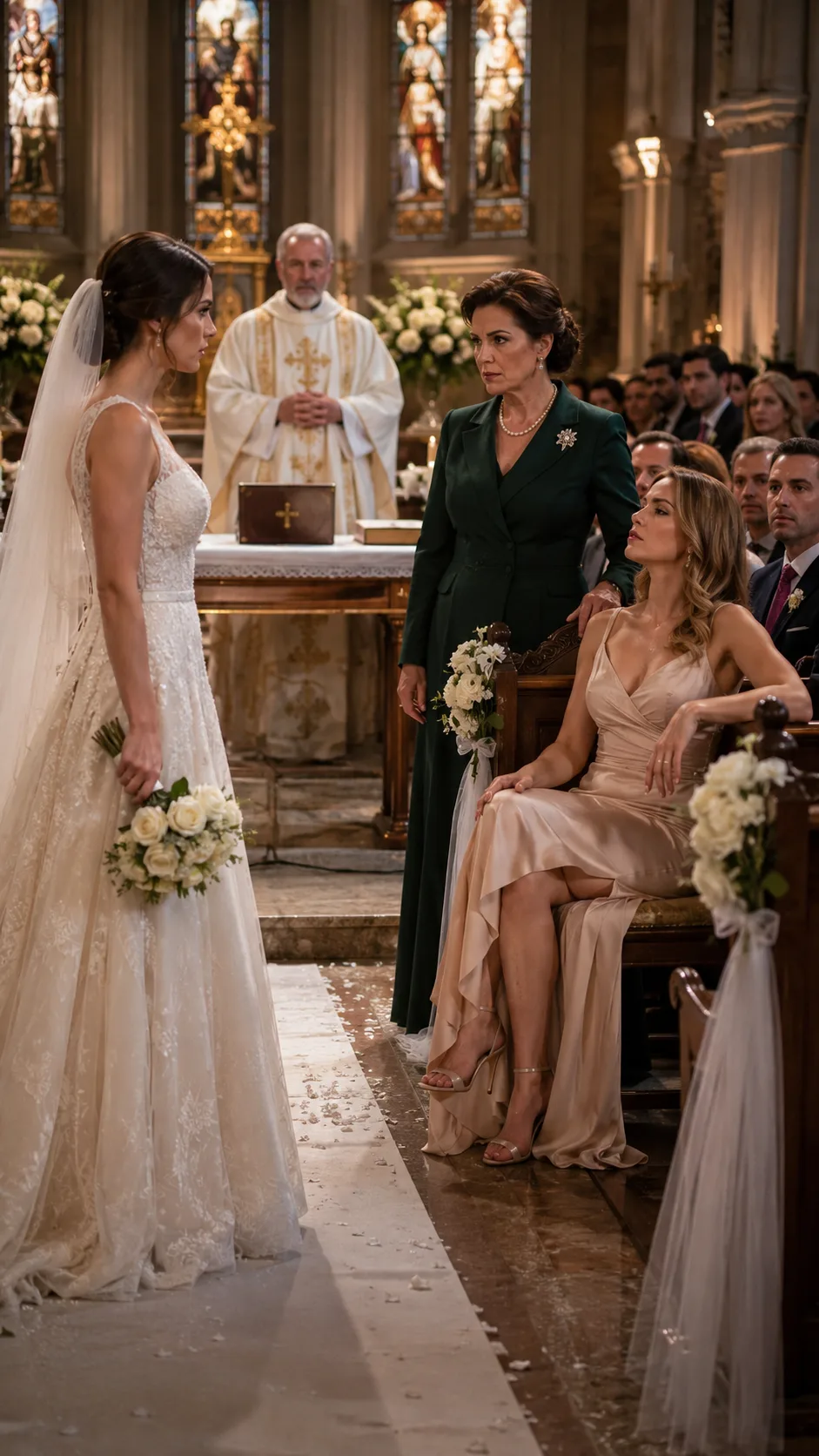
Clara Whitmore noticed the missing handkerchief before she noticed the woman sitting in her chair.
Chapter 1
Clara Whitmore noticed the missing handkerchief before she noticed the woman sitting in her chair.
It should have been tied around the carved armrest with a narrow ivory ribbon, the way Father Elias had promised. Her mother’s lace handkerchief, yellowed at the edges, folded twice, still faintly scented with cedar from the box Clara had kept under her bed since the funeral.
The chair was there.
The handkerchief was not.
Isabella was.
She sat in the front row of Saint Agnes Church with one leg crossed beneath a champagne satin dress, her blonde hair curled over one shoulder, one hand placed neatly on the chair arm. Not resting. Claiming. Her gold clutch sat beside her on the cushion, exactly where the lace handkerchief should have been.
Clara stopped at the edge of the aisle runner.
The string quartet kept playing.
Daniel stood near the altar in his black tuxedo, hands folded in front of him, eyes fixed somewhere near the polished marble floor. He did
not look at Clara first. That was the part her body registered before her mind had time to arrange it.
He looked at his mother.
Marianne Vale stood beside Isabella’s chair in an emerald dress cut sharp at the shoulders. Pearls sat tight around her throat. Her fingers rested on the back of the chair the way a museum guard might touch a rope barrier.
Clara’s father was already dead. Her mother was buried under a slate headstone thirty miles away. Marianne had married into the Whitmore family when Clara was nine and spent the next seventeen years teaching every room to make space for Isabella first.
A bigger slice of cake.
The window seat.
The college trip Clara had saved for.
The bedroom with the morning light.
Small thefts. Polished thefts. Thefts wrapped in words like harmony and fairness and family peace.
Clara had learned early that if she
objected too loudly, Marianne did not argue. She waited. Then she made Clara look unreasonable in front of people whose approval mattered.
So Clara had chosen a small wedding.
Ninety guests.
No ballroom. No country club. No glossy magazine photographer. Just Saint Agnes, where her parents had been married, where Clara had been baptized, where her mother had once taught her to fold prayer cards into the shape of fans during long Easter services.
She had chosen white roses because her mother hated lilies.
She had chosen Father Elias because he still remembered her mother’s laugh.
She had chosen the front family chair because there would be no mother there to sit in it.
“That chair is for her,” Father Elias had said the day before, when Clara handed him the handkerchief. “Not for grief. For witness.”
Clara had folded it into his palm.
Now it was gone.
The music
thinned around the edges. Not stopped. Just thinned.
Her bouquet felt heavier than it had in the vestibule.
White roses. Green stems. Ivory ribbon.
Clara kept walking.
The guests turned their heads in a soft wave as she moved down the aisle. Some smiled because they had not seen the chair yet. Some did not smile at all. Daniel’s sister looked from Clara to Isabella and lowered her program into her lap.
One paper corner bent.
Clara reached the front.
Isabella did not stand.
She tilted her chin upward just enough for Clara to see the small diamond pendant at her throat.
It was their mother’s.
Not Marianne’s. Not Isabella’s.
Their mother’s.
Clara had seen it last inside the locked jewelry box at her father’s house, three days after he died, before Marianne said the house needed to be “handled efficiently” and Isabella began wearing things that had not been given to her.
The pendant caught the church light.
A tiny flash.
Clara’s fingers tightened around the bouquet stems.
Marianne leaned toward the aisle with a smile made for guests, not for daughters.
“That seat belongs to family.”
Her voice was low, but the first two rows heard it.
Daniel’s jaw moved once. No word came out.
Father Elias stood behind the altar, white and gold vestments still, one hand resting near the open Bible. Beside it sat a brown leather folder. Clara had signed the church marriage record inside that folder two hours earlier in the sacristy. Her legal name. Daniel’s legal name. Two witnesses. A blue-ink signature that had smudged slightly at the end because the pen was old.
She remembered that tiny smear.
She remembered Father Elias frowning at the page.
“Someone brought an additional family note this morning,” he had said.
Clara had looked up.
“A note?”
He did not answer right away. The sacristy smelled like candle wax and old wood. A chipped mug sat near the window with three dead pencils inside it.
“Not now,” he had said. “Walk first.”
Clara had thought he meant the ceremony.
Now she looked at the folder.
Marianne noticed.
So did Daniel.
He finally lifted his eyes to Clara. They were not cruel eyes. That would have been easier. They were careful eyes. Managerial. The eyes he used when a waiter brought the wrong wine, when a contractor overcharged him, when his mother had said something sharp at dinner and he wanted everyone to pretend it had not landed.
He raised one hand slightly and angled it toward the side aisle.
A small gesture.
Move there.
Clara looked at the empty space beside the altar where her chair should have waited after the procession.
Then back to Isabella.
“You can stand with the bridesmaids,” Isabella said.
A few guests shifted.
Marianne’s smile did not change.
Clara did not answer. She looked down at the aisle runner. White fabric stretched beneath her gown, sprinkled with rose petals that had been placed too early and stepped on by ushers. One petal stuck to the damp edge of her shoe.
She moved her foot.
The petal stayed.
Daniel stepped closer, just half a step.
“Clara,” he said.
The way he said her name asked her to help him avoid a scene.
He had been asking that for months.
Help me get through dinner.
Help me keep Mom calm.
Help me not fight with Isabella.
Help me not choose in public.
The wedding had been planned inside those requests. Every decision had become a negotiation with Marianne’s comfort. The guest list had expanded because Isabella “needed support.” The reception seating had changed because Marianne “felt isolated.” The rehearsal dinner toast had been moved after Clara’s because Isabella had “prepared something meaningful.”
Clara had swallowed all of it.
Not today.
She lowered the bouquet.
Not dropped. Not thrown.
She placed it on the edge of the aisle runner, white roses against white cloth. The ribbon slipped loose and trailed near her shoe.
The string quartet faltered for one measure.
Then stopped.
That was when the room finally understood there was no polite version of what they were watching.
Marianne’s fingers pressed into the chair back.
“Do not embarrass this family.”
Clara looked at the pendant on Isabella’s throat.
“Which one?”
Isabella’s smile moved first. It did not disappear. It shifted. A little hard line near the corner of her mouth.
Marianne’s eyes narrowed.
Daniel turned toward Father Elias as if the priest could rescue the order of things with a prayer and a quiet command. Father Elias did not reach for the Bible.
He looked at the folder.
Marianne stepped into the aisle.
One step only.
Her emerald skirt brushed the pew end. Her palm lifted low, not high enough to seem aggressive, just high enough to stop Clara from moving forward.
“You will not make Daniel’s family look ridiculous in church,” Marianne said.
“My family is in this church too.”
Marianne gave a small glance toward the empty chair.
“No, Clara. Your family has been gone for a long time.”
There it was.
Not new. Not surprising. Just public.
A woman in the second row drew a breath through her nose and looked down. Daniel’s college friend stared at the floor. Isabella’s hand moved to the pendant, thumb brushing the diamond like she wanted Clara to see it again.
Clara turned toward Daniel.
He did not defend the sentence.
He did not correct it.
He did what he always did. He waited for the storm to pass without standing in the rain.
Clara lifted her chin toward the altar.
“Father Elias.”
The priest did not move yet.
Marianne’s hand stayed up.
“Clara,” Daniel said again.
A warning this time.
She did not look at him.
“Read the marriage file.”
The church became still in pieces.
First the front row.
Then the left side.
Then the back, where someone stopped rustling a program halfway through folding it.
Father Elias lowered his hand to the Bible.
For one second Clara thought he might continue the ceremony anyway. Churches did that sometimes. Families did worse than this every day and called it peace because there were flowers and witnesses and a photographer waiting outside.
Then Father Elias closed the Bible.
The sound was not loud.
It did not need to be.
Marianne’s hand dropped two inches.
Father Elias placed his palm on the leather folder.
“I cannot begin this ceremony.”
Daniel turned fully toward him.
“Father, we can speak privately.”
“No.”
One syllable.
The priest’s voice did not rise. It filled the space because everyone else had abandoned sound.
Isabella stood halfway from the chair, then sat again, as if she had changed her mind halfway through becoming visible.
Marianne recovered first.
She always did.
“This is a misunderstanding,” she said. “We are all under pressure.”
Father Elias looked at her for a long second.
“The church record is not pressure.”
Clara heard something small behind her. The flower girl had picked up the fallen bouquet ribbon and was rubbing it between two fingers. Her mother pulled her hand down gently.
Daniel came closer to the altar.
“Father, whatever paperwork issue there is, we can fix it after.”
Father Elias opened the folder.
The first page lifted.
Clara saw the blue ink before she saw the name. Her own signature rested at the bottom of the document, smudge and all. Above it, in Father Elias’s careful block letters, were the names entered for the sacramental record.
Bride: Clara Elaine Whitmore.
Groom: Daniel James Vale.
Witness: Rachel Whitmore, deceased, represented by memorial token.
Clara stared at that line.
Rachel Whitmore.
Her mother’s name.
Represented by memorial token.
The handkerchief.
Father Elias turned the page.
A loose folded note sat behind the first record. Cream paper. Marianne’s stationery. Clara knew it from holiday envelopes that arrived every year with Isabella’s name written first.
The priest did not hand it to Clara.
He placed it flat on the altar.
Marianne’s face changed by a millimeter.
Daniel noticed.
That was enough.
Father Elias tapped the note once with two fingers.
“This was brought to the sacristy this morning.”
Marianne’s lips parted.
“No.”
Father Elias unfolded it.
He did not read the whole thing aloud. He did not need to.
He read the line that mattered.
“Please remove any reference to Clara’s late mother from the ceremony and seat Isabella Vale in the bride’s family place. It will prevent unnecessary emotional behavior.”
The church received the words one by one.
Clara looked at Marianne.
Marianne looked at the note.
Daniel looked at his mother.
Isabella looked at the pendant.
Father Elias placed the note beside the record.
Then he reached into the inside pocket of the folder and withdrew the lace handkerchief.
The ribbon was still tied around it.
Not missing.
Held back.
Protected.
Clara’s knees did not bend. Her hands did not go to her face. She did not give Marianne the performance she could later describe over dinner.
She walked forward.
One step.
The edge of her gown brushed Marianne’s sleeve. Marianne moved because Clara did not ask her to.
Clara reached the altar and took the handkerchief from Father Elias.
The lace was warm from being inside the folder.
A ridiculous detail.
It mattered.
Isabella stood up from the chair.
“Clara, don’t make this ugly.”
Clara turned to her.
“You wore my mother’s necklace.”
Isabella’s hand went to her throat.
For the first time all morning, Daniel spoke without trying to manage the room.
“Isabella.”
Not a question.
A warning.
Marianne stepped between them slightly.
“It was only borrowed.”
Clara looked at the pendant.
“From a locked box?”
Marianne’s mouth tightened.
Daniel’s father, seated in the first pew, slowly lowered his program onto his knee. He had not spoken once during the planning. He had signed checks, nodded through dinners, and let Marianne set the table of everyone’s life. Now his hand stayed flat on the paper, fingers spread.
Father Elias did not let the room drift.
He placed the marriage record at the center of the altar and turned it outward.
“Her name is on the record.”
The words cut cleanly through the church.
Marianne reached toward the folder.
Father Elias slid it back with one hand.
“No.”
Clara looked at Daniel.
He looked smaller from three feet away.
Not physically. Daniel was tall, broad shouldered, polished in the way men are polished when their mothers teach them early that reputation is a second suit. But he had no line ready for this. No compromise. No half-apology that put the burden on Clara to be gracious.
His lips moved once.
Nothing came.
Father Elias continued.
“The memorial token was approved yesterday. The bride requested one chair for her mother. This note attempted to remove it.”
The guests did not erupt.
Real rooms rarely do.
They adjusted.
A woman in navy lowered her eyes. A man near the aisle shifted his body away from Marianne. Daniel’s cousin, the one who had toasted “family unity” at the rehearsal, placed his champagne-colored program under his chair like he no longer wanted to hold it.
Isabella’s grip tightened around the pendant chain.
Clara held out her hand.
“Take it off.”
Isabella’s face hardened.
“No.”
Daniel’s father stood.
The movement was slow. A knee stiff. A hand pressing the pew for balance. Yet it pulled more attention than any shout could have.
“Isabella,” he said. “Give it back.”
Marianne turned on him.
“Arthur.”
He did not look at her.
“Now.”
Isabella swallowed. Her fingers fumbled once at the clasp. The chain caught in her hair. For a second she looked young, not innocent, just young enough to have believed she could sit in any chair Marianne pointed to and be protected by it.
The clasp opened.
The pendant dropped into her palm.
Clara did not take it from her hand.
She held out the lace handkerchief instead.
“Put it there.”
Isabella stared.
Clara waited.
The whole church waited with her.
Isabella placed the necklace onto the lace.
Metal against old cloth.
A small sound.
That was the sound Clara remembered later. Not the Bible closing. Not the folder opening. The diamond pendant touching her mother’s handkerchief like it finally knew where it belonged.
Father Elias looked at Clara.
“Do you wish to continue?”
Daniel stepped forward too quickly.
“Clara, please.”
That word arrived late.
Please had not come when his mother erased her mother from the ceremony. Please had not come when Isabella sat in the chair. Please had not come when Marianne called the dead gone and the living inconvenient.
Clara looked at him.
His boutonniere had tilted. One white rose bud leaned almost sideways against his lapel. She had pinned it there herself twenty minutes before walking down the aisle. Her thumb had brushed the satin collar. He had kissed her forehead and said, “Almost done.”
Almost done.
Yes.
She reached for the record.
Father Elias did not stop her.
Clara placed the handkerchief and pendant on top of the page where her name was written. Then she took the pen lying beside the folder.
Daniel stared at it.
“Clara.”
She uncapped the pen.
No one moved.
She did not cross out her name. She did not tear the page. She did not perform ruin for people who had come dressed for celebration and found themselves in the middle of a family’s private rot.
She wrote one word in the margin beside her signature.
Withdrawn.
Then she placed the pen down.
Father Elias lowered his head once, not as a priest blessing a choice, but as a witness acknowledging it.
Daniel’s mouth opened.
“That is not—”
He did not finish.
Marianne turned away first. Her face remained composed from the side, but one hand reached for the pearls at her throat and missed them. Isabella sat down again in the chair that no longer belonged to anyone.
Clara picked up the handkerchief with the pendant folded inside.
She did not take the bouquet.
The flower girl still held the ribbon from it. Clara bent slightly and took the ribbon from the child’s small hand.
“Thank you.”
The child nodded with the seriousness only children can give to disasters adults make.
Clara walked back down the aisle alone.
No music followed her.
Only shoes on stone.
Two or three steps.
Then more.
At the doors, she stopped beside the guest book. The first page had been opened to a neat column of names. Marianne had insisted on the cream leather cover because “photos matter.” A fountain pen rested diagonally across the page.
Clara took it.
Under the last guest signature, she wrote her mother’s name.
Rachel Whitmore.
The ink bled slightly into the paper.
She left the pen uncapped.
Outside, the church steps were bright enough to make her blink. The photographer stood near the bottom with two cameras hanging from his shoulders, waiting for a bride and groom who would not come out together.
He lifted one camera halfway.
Clara shook her head once.
He lowered it.
Her maid of honor, Tessa, came through the doors two minutes later carrying Clara’s coat, phone, and the emergency kit Marianne had mocked during planning.
“You left the bouquet,” Tessa said.
“I know.”
“You want me to get it?”
“No.”
Tessa looked at the folded handkerchief in Clara’s hands. She did not ask.
The church doors opened again behind them. Voices leaked out. Not loud. Controlled. That was worse in some ways. Controlled voices meant people were already choosing versions.
Daniel came out alone.
He had removed his boutonniere.
The tiny pin hole remained in his lapel.
“Clara,” he said.
Tessa stepped back, not far.
Clara turned.
Daniel stopped three steps above her. He looked like a man who had prepared apologies in several categories and could not decide which one cost the least.
“I didn’t know about the note.”
Clara held the handkerchief with both hands.
“You knew about the chair.”
His gaze dropped.
One answer.
“I thought if we got through the ceremony, we could handle it after.”
“After what?”
He looked up.
“After everyone left.”
Clara nodded once.
The photographer shifted his weight at the bottom of the steps. A car passed on the street. Somewhere behind the church, a delivery truck beeped twice.
Daniel tried again.
“My mother went too far.”
“No,” Clara said. “She went where you let her stand.”
He flinched at that. Not much. Enough.
The church door opened once more. Arthur Vale appeared with Father Elias beside him. Marianne was not with them. Isabella was not with them either.
Arthur carried Clara’s bouquet.
He did not offer it like a romantic token. He held it carefully by the ribbon, awkward in his large hand, as if he had carried very few flowers in his life and knew this one had already been asked to do too much.
“I thought you might want this,” he said.
Clara looked at the bouquet.
White roses. Crushed slightly near the stems.
She took it because leaving it inside felt like surrendering one more object to the room.
“Thank you.”
Arthur nodded. His face had lost some of its ceremony. Without the program in his hand, without Marianne beside him, he looked older than he had from the pew.
“I should have spoken sooner.”
Clara did not rescue him from the sentence.
He accepted that.
Father Elias stepped down one stair.
“The church record will reflect no marriage took place.”
Daniel’s eyes closed briefly.
Marianne’s voice rose from inside the church, clipped and sharp, then cut off as the door shut behind a guest leaving too quickly.
Arthur looked back at the sound.
Then at Clara.
“The necklace is yours?”
“It was my mother’s.”
“I’ll see that the rest of her things are returned.”
Daniel looked at him.
“Dad.”
Arthur’s reply was quiet.
“Not now.”
That was the first time Clara had heard those words used against Daniel.
She put on her coat over the wedding dress. Tessa helped pull the fabric through the sleeves. The veil snagged at the collar, and Clara laughed once under her breath because the whole thing was absurd—the church, the chair, the diamond pendant, the woman in a wedding gown trying to get into a wool coat while her almost-husband stood three steps above her with no idea where to put his hands.
Tessa smiled without making it bigger than it was.
Clara descended the steps.
Daniel did not follow.
A week later, Marianne sent a message through Arthur. Not an apology. A paragraph about misunderstanding, pressure, optics, and how grief made people sensitive to symbolism.
Clara did not answer.
Two weeks later, a courier delivered a small cedar box to Clara’s apartment. Inside were three items: her mother’s pearl earrings, a silver compact with Rachel’s initials, and a stack of recipe cards tied with kitchen twine.
No letter.
No explanation.
The diamond pendant stayed in the lace handkerchief for a month before Clara put it on.
She wore it first to a Tuesday meeting with a client who did not know her story and did not need to. Then to the grocery store. Then to dinner with Tessa, who raised a glass of ginger ale because they had both had enough champagne to last several lifetimes.
Daniel called twice.
She let both calls ring out.
The third time, he sent a voice message.
“I should have chosen you before it became public.”
Clara played it once while standing at her kitchen counter, peeling an orange over the sink. The peel came off in one long uneven strip.
She deleted the message before the orange was finished.
In June, Saint Agnes mailed her a copy of the amended record. No marriage. No sacrament. No union recorded between Clara Elaine Whitmore and Daniel James Vale.
A separate note came from Father Elias, handwritten on plain paper.
The chair is still here when you need it.
Clara folded the note and placed it in the cedar box.
Months later, she returned to Saint Agnes alone. No gown. No veil. No guests. Just dark trousers, a cream sweater, and her mother’s pendant beneath the collar.
The church smelled the same.
Wax. Wood. Old stone.
The front row had been rearranged for a baptism. The carved chair sat near the side wall now, without flowers, without ribbon, without anyone guarding it.
Clara walked to it and tied the lace handkerchief around the armrest herself.
Not tight.
Just enough.
Then she sat beside it for a while, one hand resting on the empty chair.
No one moved her.
No one asked her to make room.
The seat stayed hers.
Chapter complete
You have reached the end of this chapter.
Continue reading
A few more worlds to get lost in after this chapter.