The tin cup rolled under the fish stall before the boy could catch it.
Chapter 1
The tin cup rolled under the fish stall before the boy could catch it.
He dropped to one knee, reached between two wooden crates, and pulled it back by the dented rim. A dead sardine tail stuck to the side. He wiped it against his sleeve, checked the inside, then placed it carefully into his old cloth sack like it was made of silver instead of rust.
The fishmonger watched him from behind a table slick with scales.
“Don’t stand there if you’re not buying,” she said.
The boy moved at once.
No answer.
No argument.
Ashkar Harbor had trained people to answer with their feet. Speak too much, and someone bigger noticed your voice. Stand too long, and someone charged you for the space. Look at the wrong ship, and you might wake up in its hold two days later, chained to an oar with your name gone.
The boy knew that before he reached the docks.
His mother had told him once,
while binding a cut on his arm with a torn strip of sailcloth, “Ashkar eats boys who think fairness has a face.”
He had not understood then.
He did now.
He was fifteen, though most people guessed younger. Hunger had a way of stealing years from the shoulders. His patched brown shirt clung to his back from sea rain. His trousers ended above his ankles, not because they were made that way, but because the rest had been torn away crossing the marsh road north of the harbor.
His boots were two different colors.
One had no lace.
Still, he kept walking.
Past the fish stalls. Past the rope makers. Past men with knives at their belts and women who counted coins faster than priests counted sins. He carried his cloth sack over one shoulder and kept one hand near the small tear inside the lining.
Not the bread.
Not
the cup.
The medallion.
He touched it through the cloth once, just to make sure it was still there.
The metal was cold.
Good.
The harbor opened before him in a forest of masts. Ships rocked against the docks, their sails tied down against the storm wind. Some were merchant vessels with clean rails and painted names. Some had no names at all. The ones without names made the dockworkers look away when they passed.
The boy stopped near a narrow gangplank leading to a ship with faded blue sails.
A man with a gray beard sat on a barrel by the rope post, trimming his nails with a short knife.
“I need passage across the Black Current,” the boy said.
The man did not look up.
“Coin?”
The boy swallowed and opened his sack.
He took out three copper pieces, a brass button, and a fishing hook wrapped in
string.
The man finally looked.
Then laughed once through his nose.
“That buys you a prayer.”
“I can work.”
“Every rat says that.”
“I can climb rigging. Clean decks. Patch sail. I can read maps if the letters aren’t too faded.”
That made the man pause.
His knife stopped against his thumbnail.
“Where’d you learn maps?”
The boy closed his fingers around the coins.
“My father.”
The man studied him longer now. His eyes moved over the patched shirt, the wet hair, the torn sack, the old rope tied around the boy’s waist as a belt.
Then his gaze dropped to the sack.
“What else you carrying?”
“Nothing worth stealing.”
“Then you won’t mind showing me.”
The boy took one step back.
Small step.
Enough.
The gray-bearded man smiled without warmth and stood from the barrel.
“Careful, boy.”
A bell rang from the far end of the dock before the man could reach him.
Not a church bell.
A ship bell.
The sound cut through rain, bargaining, gull cries, and boots on wet wood. One hard strike. Then another.
Men turned.
Women gathered their baskets closer.
The gray-bearded man sat back down.
His smile vanished.
The boy followed the movement of the crowd.
At the western pier, a black-sailed ship slid into view between two merchant vessels. Its hull was scarred from cannon fire. Its figurehead had once been a mermaid, but someone had carved the face away and replaced it with iron teeth.
A flag lifted in the storm wind.
Black cloth.
White hook.
Red eye.
People moved without being told.
Crates were dragged aside. Dockhands stepped back. Merchants lowered their voices and pulled children behind them.
The boy did not move fast enough.
A hand grabbed the back of his shirt and shoved him toward the fish stall.
“Out of the middle,” someone snapped.
He caught himself on a post.
His sack slipped.
He caught that too.
The black ship struck the dock with a heavy groan, and ropes flew out. Men in dark coats jumped down, boots hitting wet planks in a rhythm that made the harbor smaller. They were pirates, but not the loud kind who needed songs and waving blades to announce themselves.
These men laughed less.
That was worse.
Then Captain Dregor Blackfin stepped down.
The first thing the boy noticed was not the sword.
It was the way people gave him room before he asked for it.
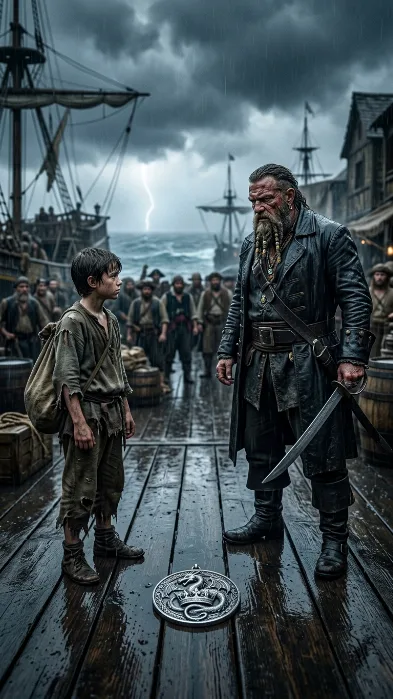
Dregor was huge in the shoulders, wrapped in a weathered black leather coat that hung almost to his boots. Gold rings threaded through his beard. A scar pulled one side of his mouth slightly lower than the other, so even when he wasn’t smiling, he looked like he was enjoying something cruel.
His cutlass rested at his hip.
Not drawn.
It did not need to be.
A dockmaster in a red vest hurried toward him, head bent, ledger pressed to his chest.
“Captain Blackfin. Your berth is ready. The tariffs—”
Dregor took the ledger, glanced at it, and tossed it into the harbor.
The dockmaster stared after it.
A few pirates laughed.
Dregor placed one hand on the man’s shoulder. His fingers looked heavy enough to crack bone.
“Your tariffs floated away.”
The dockmaster nodded.
“Yes, Captain.”
Dregor released him.
“Good man.”
The boy watched too long.
Dregor noticed.
Those dark eyes shifted through the rain and landed on him as if a hook had caught his shirt.
The boy lowered his gaze at once and turned to leave.
Too late.
“You.”
The word struck harder than a hand.
The boy stopped.
Around him, the harbor made space again. Not for him. Around him.
Dregor walked closer, one boot after another, slow enough for everyone to watch the distance shrink. His crew spread behind him, forming a loose wall of wet leather, knives, and yellow teeth.
“What are you?” Dregor asked.
The boy kept his hand around the strap of his sack.
“Looking for work.”
“That wasn’t the question.”
The boy said nothing.
Dregor leaned down just enough to inspect him. Rain slid from the captain’s hat brim and dripped onto the boy’s shoulder.
“Street rat,” Dregor said. “Dock rat, maybe. Hard to tell under the mud.”
A pirate behind him grinned.
The boy shifted his weight.
Dregor’s eyes sharpened.
“You got a name?”
The boy hesitated.
Too long.
Dregor reached out and hooked one finger under the boy’s collar, lifting the fabric so the crowd could see the thin neck beneath it.
“Names are for people,” Dregor said. “You look more like cargo.”
The first laugh came from a sailor near the blue-sailed ship.
Then another.
Then more.
The sound spread like spilled oil.
The boy stared at Dregor’s coat button, a dull brass thing shaped like a hook. He fixed his eyes there because if he looked at the crowd, his hands might shake.
No shaking.
His mother had taught him that too.
Dregor let go of the collar.
The shirt snapped back against the boy’s chest.
“You trying to board a ship?”
“Yes.”
“With what payment?”
The boy did not open the sack.
Dregor’s smile widened.
“Oh. A mystery fortune.”
He reached for the sack.
The boy stepped back.
The dock went quiet in a strange, quick way.
Dregor stopped smiling.
The boy knew the mistake as soon as he made it.
Captain Blackfin did not like people moving away from his hand.
The captain looked at the boy’s feet, then back at his face.
“Show me.”
“No.”
A murmur moved through the crowd.
Small word.
Dangerous word.
Dregor’s crew reacted before he did. One man spat into the water. Another touched the handle of a knife. The dockmaster took three steps backward and pretended to check a rope that did not need checking.
Dregor lowered his hand.
For half a breath, it seemed he might laugh.
Then he shoved the boy.
The boy hit the dock on one hip, hard enough that his teeth clicked. His sack landed beside him but stayed closed. He grabbed it with both hands and pulled it against his chest.
Dregor crouched in front of him.
“You say no to captains often?”
The boy pushed himself up.
“Only thieves.”
The dock stopped breathing.
Dregor’s face did not change at first. Rain rolled down the scar beside his mouth. His hand moved slowly to the cutlass hilt, not drawing it, just resting there.
Then he laughed.
Deep.
Low.
The kind of laugh men used when they wanted a crowd to know punishment was coming.
“A thief?” Dregor repeated. “Hear that, boys? The little dock rat has law in his mouth.”
His crew laughed with him.
The boy stood, holding the sack strap with one hand.
Dregor took one step closer.
“Maybe I should search him properly.”
“No,” the boy said.
Dregor struck him across the shoulder with the back of his hand.
Not a full blow.
A lesson.
The boy stumbled into a crate stacked with rope coils. One coil slipped and fell at his feet. He stayed upright.
Dregor tilted his head.
“Still standing.”
The boy looked down at the rope.
Then at the dock boards.
Then at Dregor’s boots.
His mother had once told him that big men trusted size too much. They forgot the ground belonged to everyone.
Dregor reached again for the sack.
This time the boy moved first.
He grabbed the loose rope coil and snapped it toward Dregor’s wrist. It caught the captain’s hand for a blink, just enough to pull his reach aside. Dregor’s crew shouted. The boy shoved past the nearest pirate, ducked under an arm, and grabbed a long wooden pole from beside the fish stall.
The crowd scattered back.
Dregor looked at the rope around his wrist.
Then at the boy holding the pole.
A red mark crossed the captain’s hand.
Small.
Public.
That made it worse.
Dregor pulled the rope free and dropped it.
“You want to play sailor?”
The boy held the pole with both hands.
He had used one before. Not as a weapon. To push marsh boats through shallow water. To knock fruit from high branches. To keep wild dogs at bay when the village wells dried and people started traveling in groups.
His grip was not perfect.
But it was firm.
Dregor drew his cutlass.
The sound changed the harbor again.
Metal against leather.
A blade under storm light.
The boy’s mouth dried.
The captain walked toward him.
“Apologize,” Dregor said.
The boy did not.
Dregor swung.
The boy threw himself sideways, boots slipping on wet wood. The blade cut through the edge of the fish stall canopy, sending a strip of canvas flapping loose in the rain. A woman screamed and ducked behind barrels.
The boy brought the pole up and struck Dregor’s sword arm.
Wood cracked against leather.
Dregor barely moved.
But he looked down at his sleeve.
The crowd saw the pause.
So did the boy.
Dregor swung again, heavier this time. The boy blocked with the pole. The force ran through his wrists and into his shoulders. Pain flashed white behind his eyes, but he kept hold.
No dropping.
Dregor pressed the blade down against the pole, forcing it lower inch by inch.
“You should have begged,” he said.
The boy’s knees bent.
The pole shook.
Then his foot slid against the fish oil on the dock.
Dregor leaned in, expecting him to fall.
The boy let himself drop.
He rolled under Dregor’s arm, came up beside him, and drove the pole into the back of the captain’s knee.
Dregor dropped one step.
Not down.
But lower.
Enough.
The harbor gasped.
Dregor turned, face darkening. Now the joke was gone. Now the crowd had seen Captain Blackfin forced to bend by a boy with a wooden pole.
His crew moved forward.
Dregor raised one hand.
They stopped.
He wanted this himself.
The boy backed away, breathing through his nose, pole held across his body. His sack hung from one shoulder again, the seam stretched where it had hit the dock earlier.
He did not notice the tear widening.
Dregor did.
The captain smiled again, but this time it had no humor in it.
He rushed.
The boy tried to pivot.
His heel caught in a gap between planks.
He pulled free, but the movement jerked the sack from his shoulder. It hit the dock, rolled once, and split open along the side.
The bread fell out first.
Then the folded shirt.
Then the flattened tin cup.
Then something silver slipped from the hidden lining.
The medallion struck the dock with a clear metallic sound.
Small.
Bright.
Impossible to ignore.
It rolled between the boy and Dregor, turning once through rainwater, and came to rest face-up on the dark plank.
The sea dragon curled around the crown.
Dregor stopped.
Not slowed.
Stopped.
His cutlass remained lifted halfway, but the strength behind it had gone somewhere else. His eyes fixed on the medallion. His mouth opened slightly, then closed.
The boy saw the look.
He had seen fear before. In hungry men. In merchants counting debts. In sailors watching storm walls rise on the horizon.
This was different.
This was memory with teeth.
Dregor lowered the blade.
A little.
No one spoke.
The boy stepped toward the medallion.
Dregor did not stop him.
That told the whole harbor more than any shout could.
Rain gathered in the carved lines of the silver disk. The sea dragon’s mouth circled the crown as if guarding it from the world. The boy bent, picked it up, and wiped it once with his thumb.
His father’s thumb had worn the same edge smooth.
Or that was what his mother had said.
Dregor stared at it.
“Where did you get that?”
His voice came out rougher than before.
The boy looked up.
“My father gave it to me.”
A sound moved through Dregor’s crew. Not laughter. Not words.
Just men understanding that a door had opened somewhere they did not want to enter.
Dregor took one step back.
“What was his name?”
The boy closed his fingers around the medallion.
“You know his name.”
Dregor’s grip tightened on the cutlass, but the blade pointed down now. Rainwater ran from the tip and struck the dock in steady drops.
The boy stepped closer.
The crowd shifted behind him, no longer laughing, no longer breathing together. The fishmonger held one hand over her mouth. The dockmaster stood near a post, staring at the medallion as if it might burn through the boy’s palm.
Dregor shook his head once.
“No.”
The boy kept walking.
One step.
Then another.
“He carried that crest before your flag had a name,” the boy said.
Dregor’s shoulders rose with a slow breath.
“Careful.”
“You were his first mate.”
The words landed harder than the pole had.
Dregor’s crew looked at their captain.
A bearded pirate near the back frowned.
“Captain?”
Dregor did not turn.
The boy stopped close enough that Dregor could strike him if he wanted. The cutlass was still there. The size difference was still there. The whole harbor could see it.
But the blade no longer owned the scene.
The medallion did.
“My mother said he trusted you,” the boy said.
Dregor’s jaw moved.
No answer came.
“She said you were there the night the Crown Fleet found him.”
The storm rolled overhead. Thunder trembled through the masts.
Dregor lifted the cutlass slightly.
Not high enough.
The boy noticed.
So did everyone else.
“She said one man knew the safe channel through Dead Lantern Reef,” the boy continued. “One man knew where his ship would hide.”
Dregor’s eyes cut toward the crowd now.
Too late.
Too many people had heard.
“You don’t know what you’re saying,” Dregor said.
The boy opened his hand.
The medallion lay in his palm, rain shining in its carved grooves.
“My father knew.”
Dregor stared at the silver.
A muscle jumped near his scar.
“He was no king,” Dregor said.
The boy stepped closer.
“To you.”
The harbor held still.
Dregor’s face twisted, but not with rage this time. The rage was trying to return and finding no place to stand.
“He would have led us all to the gallows,” Dregor said.
A lie can sound strong if spoken early.
This one came too late.
The boy reached into the torn lining of the sack and pulled out a folded oilskin packet, browned at the edges and tied with black thread. He had kept it hidden longer than he had kept food. Longer than coins. Longer than any piece of childhood that could be sold or stolen.
Dregor saw it and went pale under the rain.
The boy untied the thread.
Inside was a letter, the ink faded but still legible, the seal broken years ago.
He did not hand it over yet.
He read the first line aloud.
“If I do not return, then Dregor sold the tide beneath us.”
A woman in the crowd crossed herself.
One of Dregor’s crew stepped back.
The captain’s hand twitched.
The boy raised his eyes.
“You sold him for gold.”
Dregor’s throat moved.
The boy came closer, the medallion clenched in one hand, the letter in the other.
“You betrayed your captain.”
The cutlass slipped lower.
Its tip touched the dock.
A soft sound.
Smaller than the rain.
For the first time since his ship arrived, Captain Dregor Blackfin looked less like a monster and more like a man trapped inside the shape he had built around himself.
The boy held out the letter.
Dregor did not take it.
“Read it,” the boy said.
Dregor’s crew watched him.
The dockmaster watched him.
The merchants watched him.
The whole harbor watched the captain who had made them afraid for years.
Dregor reached out.
His fingers did not close right the first time. The paper bent under his thumb. He caught it before it fell.
Then he read.
No one heard the words from his mouth.
They watched his face instead.
The scar pulled tight. His eyes moved across the page once, then returned to the top. His shoulders sank by degrees, like the weight had been waiting years for permission to fall.
The boy stood in front of him, rain dripping from his hair, sack torn open at his feet.
Dregor finished the letter.
He looked at the medallion.
Then at the boy.
“What was your mother’s name?”
The boy did not answer at once.
Rain ran down his cheek and dropped from his chin.
“Elianora.”
Dregor closed his eyes.
One breath.
Then his knees struck the dock.
The sound was not loud, but every person there heard it.
Captain Dregor Blackfin, breaker of ships, taxless terror of Ashkar Harbor, knelt in front of a boy he had called a rat.
His cutlass lay beside him.
The boy looked down at him.
Not smiling.
Not shaking.
Just looking.
Dregor placed the letter on the wet plank between them.
“I thought they killed you both,” he said.
The boy picked up the letter before the rain could ruin it.
“You thought wrong.”
A pirate from Dregor’s crew stepped forward.
“Captain, get up.”
Dregor did not move.
The boy turned toward the black ship, then toward the blue-sailed merchant vessel, then toward the open water beyond the harbor mouth.
The storm had begun to break over the sea.
A line of pale light showed behind the clouds.
Dregor lifted his head.
“You want passage across the Black Current.”
The boy put the medallion back into the hidden lining of the sack. The seam was ruined now. Everyone had seen. Hiding it no longer mattered in the same way.
“Yes.”
Dregor looked toward his ship.
No one on his crew spoke now.
He stood slowly, but the old size did not return with him. His coat still hung heavy. His sword still lay within reach. His men still waited.
But the harbor had seen him kneel.
That could not be packed away.
“The Black Current eats small ships,” Dregor said.
“I know.”
“It eats good sailors.”
“I know.”
Dregor looked at the letter in the boy’s hand.
“Why cross it?”
The boy folded the oilskin carefully.
“My father’s ship went down beyond it.”
Dregor’s mouth tightened.
“There’s nothing left there.”
“You don’t know that.”
Dregor looked toward the sea.
For a while, no one disturbed him.
Then he bent, picked up his cutlass, and slid it back into its sheath.
His crew waited for an order.
He gave one.
“Clear the eastern deck.”
A pirate blinked.
“What?”
Dregor turned his head.
“The boy sails with us.”
No one moved.
Dregor’s voice dropped.
“Now.”
The crew scattered.
The dockmaster exhaled through his nose like he had been holding air since morning. The fishmonger bent to pick up a fallen basket. The gray-bearded man by the blue-sailed ship looked away first.
The boy did not thank Dregor.
Dregor did not ask him to.
He picked up his torn sack, placed the flattened tin cup inside, then tied the ripped seam with the same piece of black thread that had held the letter closed.
It would not last long.
But it held.
Dregor stepped aside, opening the path to the black ship.
The gangplank waited.
Wet.
Dark.
Real.
The boy walked past him.
At the base of the plank, he stopped and looked back at the harbor that had laughed at him. No one laughed now. Some would tell the story differently by nightfall. Some would say they knew from the start the boy was not ordinary. Some would say they had never laughed at all.
Ashkar was good at changing its face.
The boy climbed the gangplank anyway.
Behind him, Dregor followed at a distance no captain would normally allow.
At the top, the boy touched the medallion through the torn cloth.
Cold metal.
Still there.
The ship bell rang once as the black sails loosened against the storm wind.
This time, the harbor moved for him.
Chapter complete
You have reached the end of this chapter.
Continue reading
A few more worlds to get lost in after this chapter.




