The Photograph in Her Hospital Bed
Ethan Carter spilled coffee on his own shoe the moment he saw Sophie sitting alone by the hospital window.
Chapter 1
Ethan Carter spilled coffee on his own shoe the moment he saw Sophie sitting alone by the hospital window.
The paper cup slipped from his hand, hit the polished floor, and split open with a soft wet crack. Brown coffee spread toward the baseboard in a crooked line. A passing nurse glanced down, then at him, then kept moving because hospitals trained people not to stop for every small collapse.
Ethan did not bend to clean it.
He could not.
At the far end of the corridor, beside a tall window streaked with rain, sat his ex-wife.
Sophie.
She was wearing a pale hospital gown and a beige knitted cap pulled low over her head. A thin blanket covered her knees. Her hands rested folded in her lap, small and still. An IV stand stood beside her chair, clear liquid dripping through a tube toward her arm. Outside the window, Chicago looked gray and distant, the buildings blurred behind rain.
For several seconds, Ethan simply stared.
He had imagined
seeing Sophie again one day. Maybe at a grocery store. Maybe on a sidewalk. Maybe across a crowded restaurant with someone new sitting beside her. He had prepared himself for awkward politeness, for her turning away, for the sharp little wound of seeing that life had continued without him.
He had not prepared for this.
She looked smaller.
Not older.
Smaller.
As if some part of her had been quietly taken away.
Two months earlier, they had signed divorce papers across a conference table while a lawyer explained final details in a voice that made marriage sound like a business account. Ethan remembered the pen in Sophie’s hand. She had signed first. Her signature was still neat. Still controlled. She had pushed the papers toward him without looking up.
He had told himself that was mercy.
A clean ending.
No screaming.
No accusations.
No scene.
Now he stood in a
hospital corridor with coffee soaking into his shoe and realized clean endings were often just unfinished wounds.
“Sophie?”
His voice barely reached her.
She did not turn.
A housekeeping worker rolled a yellow caution sign toward the spilled coffee behind him. Ethan stepped around it and moved closer.
“Sophie.”
This time, her eyes shifted.
They found him slowly, as if recognition had to travel from somewhere far away.
For one brief second, she looked frightened.
Then her face closed.
“Ethan.”
Just his name.
Nothing else.
He stopped a few feet from her chair. Close enough to see the dark half-moons beneath her eyes. Close enough to see that the skin along her jaw had gone thin. Close enough to see the tape on the back of her hand where another line had been removed earlier.
“What are you doing here?” he asked.
The question was stupid.
He knew that as
soon as he heard it.
She was in a hospital gown. Attached to an IV. Sitting outside a treatment area alone.
But people asked stupid questions when the truth stood too close.
Sophie looked at the rain.
“Waiting.”
“For what?”
She moved one hand over the blanket, smoothing a wrinkle that did not need smoothing.
“An appointment.”
“What kind of appointment?”
She did not answer.
Ethan looked down the hallway. The sign on the wall read ONCOLOGY INFUSION — CHECK-IN DESK. He read it once. Then again. His mind refused to keep it.
He turned back to her.
“Sophie.”
Her mouth tightened.
“Don’t.”
“Don’t what?”
“Do that.”
“What am I doing?”
“Looking at me like that.”
He swallowed.
“Like what?”
She turned her face back toward the window.
“Like you just found a ghost.”
The sentence settled between them.
Behind him, the housekeeping worker placed paper towels over the spilled coffee. The smell of burnt coffee mixed with disinfectant and wet wool from someone’s coat. A child laughed somewhere near the elevator. The sound felt wrong in that corridor.
Ethan lowered himself into the chair beside her without asking.
Sophie’s fingers tensed.
He noticed.
He hated that he noticed too late.
“How long have you been coming here?”
She said nothing.
“Sophie.”
“It’s nothing.”
He almost laughed.
Not from amusement.
From the awful familiarity of it.
It’s nothing.
She had said the same thing after the first miscarriage, standing in the bathroom with her hands pressed flat against the sink while he pretended not to see the way her shoulders shook. She had said it after the second, when she spent a Sunday afternoon folding and unfolding a tiny yellow pair of baby socks that had never been worn. She had said it during the last year of their marriage whenever she went quiet at dinner, whenever she slept too much, whenever he came home late and found her sitting in the dark.
And he had accepted the answer because accepting it required less courage than asking again.
“You’re in oncology,” he said.
Her eyes closed.
Only for a second.
Then she opened them.
“I know where I am.”
“What happened?”
“Ethan.”
“What happened?”
A doctor appeared from the far end of the corridor carrying a blue folder. He was in his fifties, with silver hair, tired eyes, and the slow walk of someone who knew every hallway in the building. He saw Sophie first, then Ethan.
“Sophie,” he said. “There you are.”
Sophie straightened.
The movement was small, but Ethan saw it: her back stiffening, her chin lifting, her face turning into a mask.
The doctor stopped in front of them.
“I was looking for you.” His eyes moved to Ethan. “And you are?”
Ethan stood.
“Ethan Carter.”
The doctor’s expression changed.
Not dramatically.
Just enough.
Ethan had seen that look before, on people who knew more than they were supposed to say.
“Dr. Raymond Hale,” the doctor said.
Ethan waited.
Sophie whispered, “Please.”
The doctor looked at her.
She gave the smallest shake of her head.
Ethan’s chest tightened.
“What don’t I know?”
No one answered.
The rain tapped against the window.
“Sophie,” Ethan said, “what don’t I know?”
Dr. Hale exhaled through his nose.
“I think we should step into a consultation room.”
“No,” Sophie said.
“Sophie.”
“I said no.”
Her voice stayed low, but something inside it had sharpened. Ethan had forgotten that about her. Sophie had always been gentle, but gentleness was not weakness. She could refuse the world with one quiet sentence.
Dr. Hale did not argue.
He looked at Ethan.
“Sophie is being treated for acute myeloid leukemia.”
The corridor did not change.
That was the terrible thing.
No alarms rang.
No wall cracked.
No one stopped walking.
A nurse passed with a tray of medication cups. The housekeeping worker lifted the coffee-soaked towels into a plastic bag. The elevator chimed again.
Ethan stood there while the word leukemia opened underneath him.
“No,” he said.
It came out before thought.
Sophie turned her face away.
Dr. Hale’s voice remained careful.
“She was diagnosed several weeks ago.”
Several weeks.
Ethan looked at Sophie.
“When?”
Her fingers gripped the blanket.
“When did you find out?”
She stared at the window.
“Sophie.”
“Three days before the divorce was finalized.”
The words entered him slowly.
Three days.
Three days before they sat across from each other at the lawyer’s office.
Three days before he signed his name below hers.
Three days before he moved the last of his boxes into a one-bedroom apartment with thin walls and a broken bathroom fan.
Three days before she let him go without telling him her body was already at war.
“You knew?” he asked.
“Yes.”
“And you didn’t tell me?”
“No.”
“Why?”
She finally looked at him.
Her eyes were dry.
That made it worse.
“Because you had already left.”
He opened his mouth.
No defense came.
Dr. Hale looked down the hallway.
“This is not the right place.”
Sophie pushed herself up from the chair. Her hand found the IV pole. She stood too fast, swayed, and caught herself.
Ethan reached for her.
She flinched.
Not much.
But enough.
His hand stopped in the air.
She saw it.
So did he.
They stood frozen for one second, both looking at the space his hand had almost crossed.
Then she walked ahead with the IV pole.
Dr. Hale led them into a small consultation room with beige walls, a desk, two chairs, and a tissue box placed in the center as if sorrow could be scheduled properly.
Sophie sat first.
Ethan sat beside her but left space between them.
He hated the space.
He had made it.
Dr. Hale closed the door.
For several seconds, only the hum of the air conditioner filled the room. There was a crooked calendar on the wall showing a picture of Lake Michigan in summer. The bottom corner had curled away from the pin.
Dr. Hale opened the folder.
“Sophie’s condition is aggressive,” he said. “We started chemotherapy shortly after diagnosis. There have been complications. Infection risk. Severe fatigue. Her blood counts have been unstable.”
Ethan heard the words but could not hold all of them.
He watched Sophie instead.
She sat with her hands in her lap, eyes lowered, body still. Too still. Sophie used to move constantly when nervous. She would twist a ring, fold a napkin, smooth her sleeve, tap one finger against a mug. Now she seemed to have spent all her extra movement somewhere else.
“Is she going to be okay?” Ethan asked.
Dr. Hale did not answer quickly.
That answered too much.
“We are doing everything we can. But she may need a bone marrow transplant.”
Ethan turned toward Sophie.
“Who knows about this?”
She kept looking down.
“Sophie.”
“No one local.”
“Your mother?”
Her jaw tightened.
“She’s in Oregon.”
“Does she know?”
Silence.
Ethan stood because sitting became impossible.
“She doesn’t know?”
“I was going to tell her.”
“When?”
“When there was something certain to tell.”
“You have leukemia.”
“I know what I have.”
The first sharpness in her voice made him stop.
She looked up then. Not weak. Not fragile. Just exhausted past the point where politeness could cover the wound.
“I know exactly what I have,” she said. “I know the names of the medications. I know what my blood counts mean. I know which nurses are kind and which ones rush. I know how long it takes for nausea to start after infusion. I know which bus gets me here if rideshare prices are too high.” Her fingers tightened. “So please don’t say it like I forgot.”
Ethan stared at her.
“The bus?”
She looked away.
“You take the bus here?”
“Sometimes.”
“You come to chemo on the bus?”
“Not always.”
He pressed one hand over his mouth.
The motion did not stop anything.
He saw her standing at a bus stop in the rain. Sitting alone with a mask on. Carrying a tote bag with crackers, hospital papers, a bottle of water. He saw her doing it without calling him. Without calling anyone.
He saw all the mornings he had gone to work believing divorce had made both of them free.
“Sophie.”
“Don’t.”
“I’ll help.”
“No.”
“I can drive you. I can help with bills. I can—”
“No.”
“You can’t do this alone.”
“I have been.”
There it was again.
Plain.
Unraised.
A sentence with no decoration because truth did not need any.
Ethan lowered himself back into the chair.
Dr. Hale looked between them and stood.
“I’ll give you a few minutes.”
He left the room.
The door clicked shut.
Sophie stared at the tissue box.
Ethan stared at Sophie.
“I didn’t know,” he said.
“You didn’t ask.”
“I asked.”
“No. You asked when it was easy.” Her voice stayed quiet. “When I said I was tired, you accepted it. When I said I wasn’t hungry, you accepted it. When I stayed in bed too long, you said I needed rest. When I stopped brushing my hair because it was falling out, you said nothing.”
He remembered.
The bathroom sink.
The strands of hair caught in her brush.
He had seen them one morning before a meeting and told himself stress did that to people.
“I thought we were falling apart,” he said.
“We were.”
Her answer came quickly.
Then softer:
“But I was sick too.”
Ethan looked at his hands.
There were no words large enough to cover that.
“Why didn’t you tell me before we signed?”
She looked toward the door.
“Because you looked relieved.”
The sentence landed harder than accusation.
He had been relieved.
Not happy.
Never happy.
But relieved that the fighting had stopped. Relieved that neither of them had to sit across a dinner table pretending they knew how to talk. Relieved that the grief in their apartment would belong to memory instead of every room.
He had mistaken relief for healing.
Sophie looked back at him.
“I didn’t want to become the thing that trapped you.”
“You were my wife.”
“And you were tired of me.”
“No.”
She said nothing.
He wanted to deny it louder.
He could not.
He had not hated her. He had not wanted to hurt her. But he had treated her pain like weather. Something to wait out. Something unpleasant to avoid. Something he could not control and therefore did not have to face.
“I was grieving too,” he said.
“I know.”
That made it worse.
She knew.
She had always known.
“That’s why I let you go,” she said. “I thought maybe one of us should survive the marriage.”
Ethan looked up.
“Sophie.”
Her face changed at the sound of her name.
He reached for her hand slowly this time, giving her every chance to pull away.
She did.
Not sharply.
Just enough.
He let his hand fall.
A nurse knocked and opened the door slightly.
“Sophie, infusion is ready.”
Sophie stood.
Ethan stood too.
“You don’t have to come,” she said.
“I know.”
He followed anyway.
The infusion room was brighter than the hallway, but not warmer. Pale yellow walls. Recliner chairs. Thin curtains. A window overlooking the parking lot where rainwater gathered in uneven puddles. A vending machine hummed in the corner with one flickering light behind a row of pretzels.
Sophie chose the chair near the far wall.
A nurse with dark curly hair approached.
“Back again, sweetheart?”
Sophie tried to smile.
“Unfortunately.”
The nurse’s eyes moved to Ethan.
“This is Ethan,” Sophie said.
Just Ethan.
The nurse nodded.
“Angela,” she said.
Ethan sat in the chair beside Sophie while Angela prepared the line. He watched Sophie hold still as the needle went in. Watched her look toward the window rather than at her arm. Watched her swallow once, twice, as if the treatment had already reached her throat before the drip began.
For the next hour, neither of them said much.
Machines beeped.
A man two chairs over slept under a green blanket.
Angela adjusted a pump.
Sophie closed her eyes.
Ethan remembered the first apartment they shared after the wedding. The kitchen was too narrow for two people, but Sophie had insisted on dancing there one night while soup boiled over behind them. She had laughed when he slipped on a drop of broth. He had kissed her shoulder and told her they would need a bigger kitchen before they had children.
Children.
The word moved through him like a bruise being pressed.
They had wanted three.
Then two.
Then one.
Then just one successful heartbeat.
After the first miscarriage, people sent flowers. After the second, they sent fewer messages because grief made everyone clumsy. Ethan went back to work too soon. Sophie folded baby socks and placed them in a shoebox. Neither of them knew how to speak about the empty space without falling into it.
So they stopped speaking.
His phone buzzed.
Caleb.
Ethan stepped into the hallway.
“Where are you?” Caleb asked, voice rough. “You got lost?”
“I found Sophie.”
Silence.
“What do you mean?”
Ethan told him enough. Not all. Enough.
When he finished, Caleb exhaled.
“Call her mother.”
“She told me not to.”
“Call her mother.”
“It’s not my place.”
“She might die, Ethan.”
The words were blunt.
Ethan closed his eyes.
“Don’t say that.”
“Then act like it isn’t possible.” Caleb’s voice softened. “Her mom has a right to know.”
“Sophie will hate me.”
“She already has reasons. Give her one that keeps her alive.”
Ethan looked through the glass panel.
Sophie had fallen asleep in the recliner, her head tilted slightly to one side, one hand resting open on the blanket.
He found Diane Carter’s number buried in his contacts.
He stared at it for a long time.
Then he called.
Diane answered with surprise in her voice.
“Ethan?”
He nearly ended the call.
“Diane,” he said, “I need to tell you something about Sophie.”
By the time he finished, Diane was sobbing. She asked which hospital. She asked what doctor. She asked how long. Ethan answered what he could and admitted what he did not know.
Then Diane said something that made his skin turn cold.
“I knew something was wrong. She kept saying she didn’t want to be a burden. She sounded like her father.”
Ethan looked down the corridor.
“Her father?”
Diane went quiet.
“Ethan…”
“She told me he died of a heart attack.”
“That’s what we told people.”
“What happened?”
Diane breathed unsteadily.
“He had cancer. He refused treatment near the end. Sophie found him after he collapsed. She was seventeen.” A pause. “She made me promise not to talk about it. She hated how people looked at us afterward.”
Ethan pressed his forehead against the wall.
Five years of marriage.
He had not known.
“She thinks illness destroys everyone around it,” Diane said. “She thinks love turns into pity. She thinks staying becomes obligation.”
Ethan looked back at Sophie.
She was awake now.
And looking straight at him.
She knew.
He lowered the phone.
“I have to go,” he said.
Diane’s voice cracked.
“I’m booking a flight.”
He ended the call.
When he entered the infusion room, Sophie had already pulled the blanket off her lap.
“You called my mother.”
“I did.”
“I told you not to.”
“I know.”
“You had no right.”
“I know.”
“Then why?”
He stood beside her chair and did not defend himself.
“Because you shouldn’t disappear alone.”
Her eyes flashed.
“That wasn’t yours to decide.”
“No.”
The nurse looked over but did not come closer.
Sophie’s hand shook as she reached for the armrest.
“I want to go back to my room.”
Angela helped disconnect the temporary line when the infusion finished. Sophie refused Ethan’s arm. She walked slowly, one hand on the IV pole, shoulders straight as if pride alone could keep her upright.
Back in her room, she sat on the edge of the bed.
“I don’t want you here tonight.”
Ethan nodded.
“Okay.”
She looked at him, surprised.
“I’ll leave,” he said. “Diane is coming.”
Her jaw tightened.
“And I’ll come back tomorrow unless you tell the staff not to let me in.”
“I might.”
“I know.”
The rain had slowed outside. Water clung to the window in silver threads.
Sophie looked at him for a long time.
“Why now?”
He thought of every answer.
Because I’m guilty.
Because I’m scared.
Because I found you alone and realized I had become the kind of man who could leave you there.
Because I loved you badly, but I loved you.
He said the one that hurt cleanest.
“Because I should have stayed before.”
Her eyes lowered.
“Go.”
He went.
That night, Ethan sat on the floor of his apartment with the lights off.
The apartment had never become a home. It was a place he slept in. A place where one plate sat in the sink for days. A place where mail collected on the counter unopened. A place where he ate standing up because sitting alone at the table made the silence too obvious.
At 2:40 a.m., he opened the box he had avoided since moving.
Inside were photographs. Birthday cards. A scarf Sophie had forgotten. Their wedding invitation. A receipt from the furniture store where they had bought the couch neither of them kept.
At the bottom was the tiny yellow pair of baby socks.
He held them in both hands.
The socks had ducks on them.
He had forgotten that.
Morning arrived gray and thin.
At 8:17, his phone rang.
Unknown number.
“Mr. Carter?” a woman said. “This is St. Vincent Medical Center. Dr. Hale asked me to call.”
Ethan stood too fast.
“Is Sophie okay?”
“She’s stable. We have your preliminary donor screening results.”
“My what?”
“Dr. Hale ordered the compatibility panel you consented to yesterday.”
He remembered signing papers.
Barely.
“And?”
“You are a partial match. The doctor would like you to come in for further testing.”
Ethan grabbed his coat.
“I’m on my way.”
Diane was already at the hospital when he arrived.
She stood outside Sophie’s room with a small suitcase beside her, hair pinned loosely, coat buttoned wrong. When she saw Ethan, she crossed the hallway and slapped him.
The sound cracked through the corridor.
He did not move.
Then she grabbed his shoulders and pulled him into a hug.
“Thank you for calling,” she said.
Her body shook against him.
Over her shoulder, Ethan saw Sophie in the bed.
Watching.
Her face unreadable.
Dr. Hale met with them later that morning. Partial matches carried risks. Better matches were preferable. The registry search was ongoing. Family history mattered. Siblings mattered most.
“Does Sophie have siblings?” Dr. Hale asked.
Diane’s face changed.
So quickly Ethan might have missed it if he had not been watching.
“No,” Diane said.
Sophie looked at her mother.
The answer hung in the room a half-second too long.
Ethan remembered it later.
At the time, he only felt the door close.
“No siblings,” Dr. Hale said, writing it down.
Diane kept both hands folded in her lap.
Sophie looked tired enough not to question anything.
The days became a rhythm.
Ethan learned the hospital.
He learned where the good coffee was, though good only meant drinkable. He learned which elevator shook between floors three and four. He learned that Angela liked mint gum and kept extra blankets hidden in the bottom cabinet. He learned Sophie hated the smell of orange sanitizer but liked the blue lotion Diane brought from the pharmacy.
He learned how little help looked like from the outside.
A blanket tucked around feet.
A cup of ice chips.
Insurance forms.
A phone charger.
A hand offered and withdrawn when she did not want it.
Some days Sophie let him sit beside her.
Some days she told him to leave.
He left.
Then came back the next morning.
One afternoon, Caleb arrived with a paper bag full of snacks Sophie could not eat.
“I brought morale,” he said.
Sophie looked inside.
“Morale is barbecue chips?”
“Best kind.”
She almost smiled.
Caleb sat by the window while Ethan argued with insurance on the phone. Diane knitted something shapeless in the corner, though no one had asked her to knit. Sophie watched all of them as if the room had become too full and not full enough.
When Caleb stepped out to take a call, Sophie turned to Ethan.
“You told people.”
“Caleb knew some already.”
“You told the church.”
“He did.”
“You let them turn me into a prayer list.”
Ethan set down the papers in his hand.
“They care about you.”
“I didn’t want everyone looking at me like I’m already gone.”
He looked at her.
No answer came fast enough.
Sophie turned away.
“That’s what happened after my father,” she said. “People lowered their voices when I walked in. They brought casseroles. They touched my shoulder too much. They watched my mother like she might break in public.” Her fingers tightened around the blanket. “I hated it.”
Ethan sat slowly.
“You never told me about him.”
“You never liked talking about death.”
“I would have listened.”
She looked at him.
Would you?
She did not say it.
She did not have to.
“I wanted to be easy to love,” she said.
The sentence was so quiet he almost missed it.
Ethan looked at her hand.
“You were.”
“No. I was quiet.”
He had no defense.
Later that day, Sophie slept, and Diane asked Ethan to go to Sophie’s apartment for clothes.
The apartment was small, clean, and too quiet. A pair of shoes stood neatly by the door. A mug sat beside the sink with tea dried at the bottom. On the sofa, a book lay open with a hospital bracelet tucked between pages like a bookmark.
Ethan moved through the rooms carefully, as if trespassing.
In the bedroom, he opened the top drawer for pajamas.
He found letters.
A stack of envelopes tied with blue ribbon.
Each one had his name written across the front.
Ethan.
His hands went cold.
He should have closed the drawer.
He did not.
He untied the ribbon and opened the first letter.
It was dated three days after her diagnosis.
Ethan, I wanted to tell you tonight. You came home with your tie loosened and your eyes already somewhere else. I watched you put your laptop on the table before you looked at me. I lost courage. Maybe tomorrow.
He sat on the edge of the bed.
The second letter was dated the night he suggested divorce.
You said maybe we should end it. I thought I would feel angry. Mostly I felt tired. I kept thinking at least you wouldn’t have to watch what happens next.
He opened another.
I still reach for you when I wake up. Then I remember I chose silence. I don’t know if that was love or cowardice.
Another.
The nurse asked for my emergency contact today. I almost wrote your name. My hand did it before I stopped myself.
Ethan covered his mouth.
There were dozens.
Some short. Some pages long. Some with crossed-out lines. Some written so neatly they looked rehearsed. One had a water stain over the date. Another had only one sentence:
I don’t want to die as someone you were relieved to leave.
He found one envelope different from the others.
It was marked:
In case I don’t make it.
He did not open it.
He pressed it between his palms and sat in Sophie’s silent bedroom while traffic moved outside and someone in the apartment above dropped something heavy on the floor.
When he returned to the hospital, Sophie knew.
The moment he walked in, she looked at his face and said, “You found them.”
He froze in the doorway.
Diane had gone to get tea. Caleb was not there. The room was quiet except for the pump beside the bed.
“Yes.”
“You read them.”
“Some.”
“You shouldn’t have.”
“I know.”
“Then why did you?”
Ethan closed the door behind him.
“Because I’m still selfish. And because I needed to hear you.”
Her mouth tightened.
“I wrote those when I was scared.”
“You should have been scared with me.”
She looked down.
“I didn’t know how.”
He took the unopened envelope from his coat pocket.
“I didn’t read this.”
Her face went white.
“Throw it away.”
“No.”
“Ethan.”
“I won’t open it unless you ask me to. But I won’t throw it away while you’re still here.”
Her eyes fixed on the envelope.
For a moment, she looked less like a patient and more like the woman who had once stood in their kitchen holding baby socks, trying to decide whether hope was brave or foolish.
“Put it in the drawer,” she said.
He did.
Not the bedside drawer.
The one beneath it.
As if distance mattered.
That evening, she let him stay.
Not close.
But in the room.
He sat by the window while Diane returned and pretended not to notice the way Sophie’s face had changed.
Treatment grew harder.
A fever came first.
Then an infection.
One night alarms went off while Ethan was in the hallway filling a cup with ice. Nurses moved fast. A doctor was called. Sophie’s door stayed open just long enough for him to see her sitting upright, struggling to catch enough air, Angela holding her shoulders, Dr. Hale giving orders without raising his voice.
Then the door closed.
Ethan stood outside holding the cup of ice until his fingers went numb.
Caleb arrived near midnight with a jacket over his pajamas.
“You look terrible,” Caleb said.
Ethan stared at the door.
“She couldn’t breathe.”
Caleb stood beside him.
Neither spoke for several minutes.
Then Ethan whispered something he had not said since childhood.
“Please.”
Caleb looked at him.
“You praying?”
“Bargaining.”
“With God?”
“With anyone listening.”
At dawn, Dr. Hale came out.
“She’s stable.”
Ethan’s knees weakened.
Caleb caught his elbow.
Dr. Hale’s face remained serious.
“We need to move faster on transplant options.”
“Use me,” Ethan said.
“We still need confirmatory testing.”
“Then test me again.”
“We are.”
“What else?”
Dr. Hale hesitated.
“Family records. Sibling history. Biological relatives.”
Ethan looked toward the room.
“She doesn’t have siblings.”
Dr. Hale looked down at the file.
“That is what we were told.”
The phrase stayed with Ethan.
That is what we were told.
He did not know why.
Three days later, the envelope arrived.
No return address.
Only Sophie’s name.
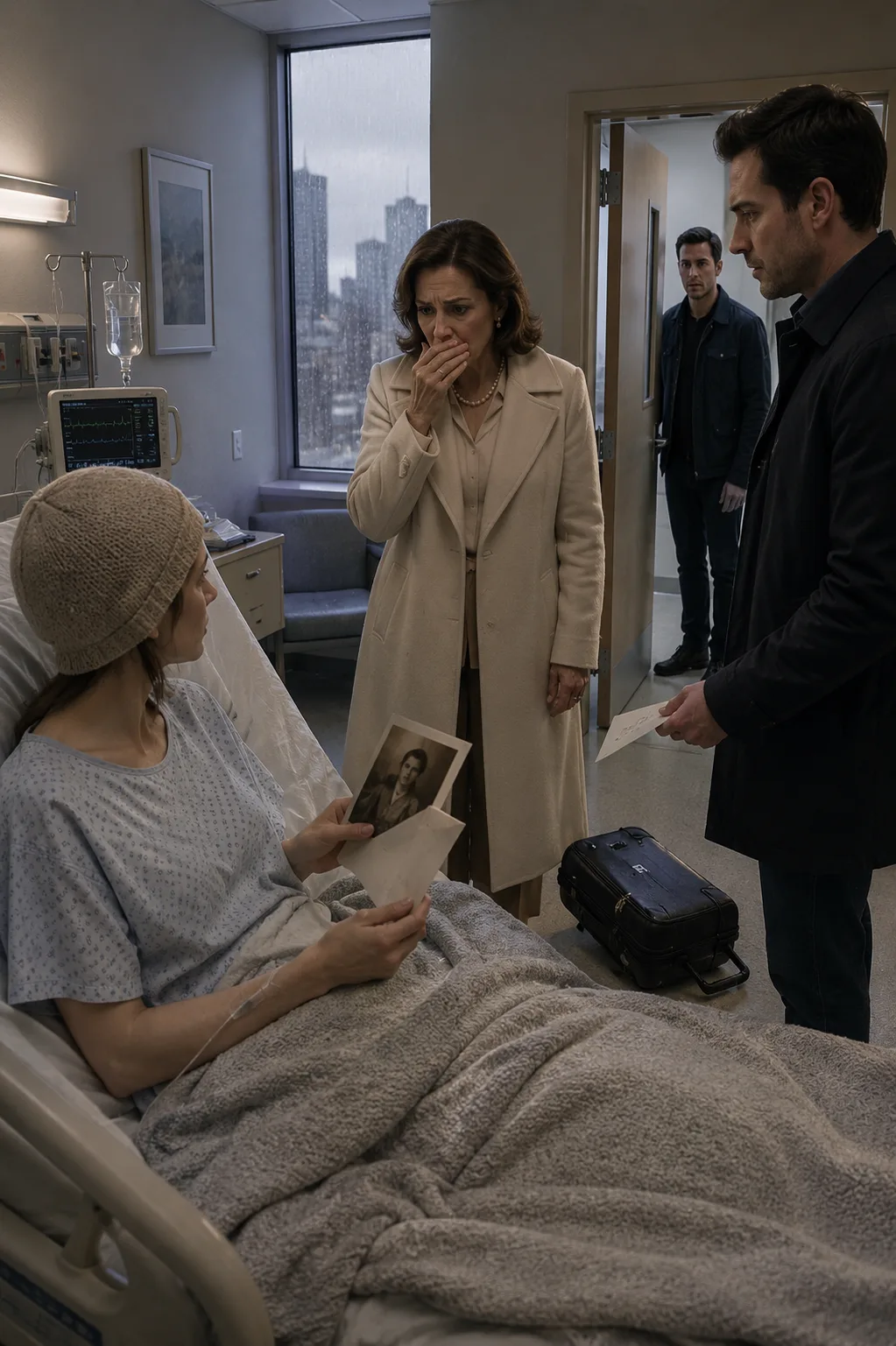
It came while Diane was downstairs calling relatives and Ethan was standing near the window. Sophie was awake, pale but alert, with a blanket pulled to her waist and the knitted cap slipping slightly over one ear.
A volunteer handed it to the nurse, who brought it in with lunch.
“This was left at the desk,” the nurse said.
Sophie frowned.
“For me?”
The nurse nodded and left.
Ethan looked at the envelope.
“Do you know who it’s from?”
“No.”
“Do you want me to—”
“No.”
She opened it herself.
Inside was a folded paper and a photograph.
Sophie looked at the photograph.
Her face changed so completely that Ethan stepped forward.
“Sophie?”
The paper slipped from her hand onto the blanket.
She stared at the photo as if something buried had climbed out of it.
Ethan picked up the paper.
Blank.
Then he turned the photograph over.
On the back, written in blue ink:
Ask your mother why she lied.
He turned the photograph to the front.
A young man stood by a lake, one hand in his jacket pocket, shoulders narrow, hair dark. He smiled awkwardly at whoever had taken the picture.
His eyes were Sophie’s.
The door opened.
Diane stepped in with tea.
She saw the photograph in Ethan’s hand.
The paper cup dropped first.
Tea splashed across the floor.
Then the suitcase she had been holding — for no reason Ethan understood — slipped from her other hand and hit the tile.
Sophie lifted her head.
“Mom.”
Diane stared at the photograph.
Her mouth opened.
No sound came.
Sophie’s fingers curled into the blanket.
“Mom, who is this?”
Diane did not move.
“Mom.”
Diane covered her mouth.
The hospital monitor beeped.
Rain moved down the window.
Ethan held the photograph between two fingers, afraid to grip it too hard.
Finally, Diane lowered her hand.
“Daniel.”
Sophie looked down at the photo, then back at her mother.
“Who is Daniel?”
Diane looked smaller than she had that morning. Her coat hung open. Her hair had loosened. One earring was missing.
“Your brother.”
The room stopped.
Sophie’s lips parted.
“I don’t have a brother.”
Diane reached for the visitor chair and held the back of it.
“You did.”
Ethan looked at Diane.
“What does that mean?”
Diane did not look at him.
Sophie spoke again, and this time the words came flat.
“What does that mean?”
Diane pulled the chair closer but did not sit.
“When you were very young, before you can remember, your father and I separated for a time.” She swallowed. “There was someone else. I became pregnant.”
Sophie did not blink.
“Daniel was born after your father and I reconciled. He agreed to take me back, but not with another man’s child.”
“No.”
The word came from Sophie like breath leaving her.
Diane gripped the chair harder.
“I was young. I was afraid. My sister knew a couple in Wisconsin. They couldn’t have children. They promised he would be loved.”
“You gave him away.”
Diane closed her eyes.
“Yes.”
Sophie stared at the photograph.
“You gave away my brother.”
“I thought I was saving the family.”
“No.”
Diane opened her eyes.
“Years later, I tried to find him. I was told he had died in an accident.”
Ethan’s chest tightened.
“By who?”
“The adoptive family.”
Sophie’s voice changed.
“You never told me.”
“I couldn’t.”
“You lied.”
“I did.”
Sophie pushed herself higher against the pillows. The effort made her breath catch, but she kept going.
“Dr. Hale asked if I had siblings.”
Diane looked at the floor.
“You said no.”
“I thought he was dead.”
“You said no.”
The repeated sentence struck harder the second time.
Diane started to cry, but Sophie did not soften.
Ethan looked again at the photograph.
A sibling.
A possible match.
A man who might have changed everything if someone had told the truth.
Then a voice came from the hallway.
“That depends on what she told you.”
Everyone turned.
A man stood in the doorway.
Older than the photograph.
But unmistakable.
Dark hair. Narrow shoulders. Sophie’s eyes.
He wore a navy jacket and held nothing in his hands.
Diane gripped the chair so hard it scraped backward on the tile.
“Daniel.”
The man did not look at her first.
He looked at Sophie.
“I’m sorry,” he said. “I didn’t mean to walk in like this.”
Sophie stared.
“You’re alive.”
“Yes.”
Diane took one step toward him.
Daniel did not move closer.
“I sent the envelope,” he said.
Ethan held the photograph down at his side.
Daniel finally looked at Diane.
“I wanted her to ask you before I came.”
Diane’s face folded.
“I thought you died.”
“I was told you didn’t want contact.”
“I tried.”
“Once.”
The word cut.
Diane stepped back.
Sophie looked between them.
“How did you find me?”
Daniel’s eyes returned to her.
“The registry. I registered years ago. Someone contacted me about a potential family match.” He paused. “Then I learned your name.”
Dr. Hale appeared behind him in the doorway. He looked from Daniel to Sophie, then to Diane.
“I was coming to speak with you,” he said.
Ethan already knew.
Sophie did too.
Daniel looked at her.
“I got tested.”
Her hand moved over the blanket.
“And?”
Daniel’s mouth tightened.
“I’m a strong match.”
Diane sat down hard.
Ethan placed one hand on the bed rail because the room tilted.
Sophie remained very still.
For so long that Daniel seemed unsure whether to stay or step back.
“I don’t expect anything,” he said. “I know I’m a stranger. I just… I’m here.”
Sophie looked at him.
Then at the photograph.
The old picture shook in Ethan’s hand, though he did not remember raising it.
Sophie held out her hand.
Not toward Ethan.
Toward Daniel.
The movement was small and weak, but the whole room followed it.
Daniel stepped closer.
Carefully.
He took her hand as if it might vanish.
Their fingers closed around each other.
Diane covered her mouth.
Sophie studied his face from only a few feet away.
“You have my eyes,” she said.
Daniel’s mouth pulled into something that nearly became a smile.
“I was thinking you have mine.”
Sophie gave a sound that was half laugh, half breath.
Then she asked, “Do you hate her?”
Diane bent forward.
Daniel looked at Diane.
For a long time, he said nothing.
“No,” he said. “But I don’t know what to do with her yet.”
Sophie looked down at their joined hands.
“That makes two of us.”
Dr. Hale stepped inside.
“We’ll need confirmatory testing. There are still many steps. But this is a significant development.”
Sophie looked at him.
“Significant?”
Dr. Hale’s face softened.
“It may give us the option we were hoping for.”
Hoping.
The word sounded dangerous in that room.
Sophie turned back to Daniel.
He still held her hand.
“Why did you come?”
His throat moved.
“Because when they told me I might have a sister who was sick, I packed a bag before I understood what I was doing.”
Sophie looked at the fallen suitcase near Diane’s chair.
Then at Daniel’s empty hands.
“You didn’t bring flowers?”
The question was so unexpected that Ethan looked at her.
Daniel blinked.
“I didn’t know if that would be too much.”
“My favorite flowers are yellow tulips.”
Daniel nodded once, very seriously.
“Yellow tulips.”
Diane began to cry without sound.
Sophie leaned back against the pillows, still holding Daniel’s hand.
Ethan stepped away from the bed.
Not far.
Just enough to let the new thing enter the room.
A brother.
A secret.
A betrayal.
A chance.
The transplant process began after confirmatory testing.
Daniel was a strong match.
Not perfect in the way fairy tales make things perfect. Nothing in that hospital became simple. But the doctors moved differently after that. Their words changed. Their timing changed. The door that had been closing stopped for a moment, then opened enough for everyone to see light through it.
Daniel signed the papers without hesitation.
Sophie resisted.
“You don’t have to do this,” she told him.
Daniel stood at the foot of the bed with both hands in his jacket pockets.
“I know.”
“You barely know me.”
“I know.”
“You could get hurt.”
He looked at Ethan.
Then back at her.
“I spent thirty-one years not being your brother. I’m trying to catch up.”
Sophie turned away.
Ethan stood near the window and said nothing.
That night, Sophie asked him to stay after Diane and Daniel left.
Ethan closed the door.
The room was dim except for the light above the bed and the glow of the monitor.
“You heard everything,” she said.
“Yes.”
“You heard what my mother did.”
“Yes.”
“You probably think I should forgive her because she’s here now.”
“No.”
Sophie looked at him.
He moved closer but did not sit until she nodded.
“I think people who arrive late still have to answer for being absent,” he said.
Her face changed.
They both heard the sentence at the same time.
It belonged to more than Diane.
Ethan looked down.
“I know,” he said.
Sophie’s hand moved toward the lower drawer.
“The envelope.”
He knew which one.
The one marked In case I don’t make it.
He took it out and held it.
“You want me to read it?”
She looked at the ceiling.
“I want to hear it while I’m still here.”
His fingers tightened around the paper.
“Sophie.”
“Please.”
He opened it.
The paper inside had been folded twice.
His voice shook from the first line.
Ethan, if you are reading this, then I did not get the ending I wanted.
He stopped.
Sophie nodded.
He continued.
Please don’t turn me into a regret you carry forever. We failed each other, but we also loved each other. For five years, you were my home. Even when that home became quiet, I remembered the warmth.
Ethan had to stop again.
Sophie looked toward the window.
He forced himself to continue.
I need you to know something. I was pregnant when I received the diagnosis. I lost the baby before I found the courage to tell you.
The page dropped into his lap.
The room went silent.
Sophie closed her eyes.
“There was another?” Ethan asked.
She nodded.
His hands shook.
“When?”
“The week after diagnosis.”
He stood because he could not breathe sitting down. He walked to the window. The city lights outside blurred through the rain.
Three.
Three children they never held.
Three losses hidden under silence, distance, illness, grief.
Sophie said, “I’m sorry.”
Ethan turned.
“No.”
Her lips pressed together.
“No,” he said again, and his voice broke on the word. “Don’t apologize for surviving pain alone after I made myself impossible to reach.”
She covered her face.
He crossed the room slowly.
This time, when he sat beside her and reached for her, she did not pull away.
He held her carefully.
Not to fix anything.
There was no fixing that room.
They cried without hiding from each other for the first time in years. For the children. For the marriage. For the missed signs. For the years they had mistaken silence for kindness.
The next morning, Daniel arrived with yellow tulips.
Too many.
Two bouquets stuffed into one glass vase because the gift shop had not had enough of one kind, so he had bought every yellow flower that looked close.
Sophie stared at them.
“Those are not all tulips.”
Daniel looked offended.
“The woman said they were emotionally similar.”
Sophie laughed.
It was weak.
But it was real.
The transplant preparation was harder than anyone wanted to say aloud.
Doctors explained everything. Conditioning treatment. Infection risk. Graft-versus-host disease. Waiting. Blood counts. Isolation. The body weakened before it could rebuild. The cure itself had teeth.
Daniel donated.
He joked before the procedure. Then went pale when the nurse placed the line. Caleb stayed with him and told him he looked heroic in the least attractive way possible.
Ethan stayed with Sophie.
Diane stayed too, though Sophie often spoke to her only when necessary. Diane accepted it. She knitted squares that did not match. She answered questions when Sophie asked and stayed silent when Sophie did not.
One evening, Sophie asked, “Did Dad know Daniel was alive?”
Diane looked at the yarn in her lap.
“He knew Daniel existed.”
“That isn’t what I asked.”
Diane put the knitting down.
“He knew I gave him away. He agreed to keep the secret.”
“Because he was ashamed?”
“Yes.”
“Of Daniel?”
Diane’s voice lowered.
“Of me. Of himself. Of what people would say.”
Sophie watched her mother.
“You let shame erase a child.”
Diane nodded.
No defense.
The lack of defense made the room colder.
Daniel visited Sophie before the transplant.
He stood by her bed, hands clasped, trying to look calm.
“You look nervous,” she said.
“I am nervous.”
“I’m the one getting your cells.”
“I know. I’m nervous for them. They’re socially awkward.”
Sophie smiled.
He pulled a small photo from his pocket.
“I brought something.”
He handed it to her.
It showed a woman sitting at a piano, laughing at someone outside the frame.
“My adoptive mother had this,” Daniel said. “She said it was our biological mother.”
Sophie looked at the photo.
“Do you know her name?”
“Elise.”
Sophie touched the edge of the picture.
“She knew about me?”
“I don’t know how much. I know she asked about you once. My adoptive mother said she seemed young. Scared.”
Sophie stared at the piano in the photo.
“So many scared adults,” she said. “So many children paying for it.”
Daniel looked down.
“Yes.”
The transplant happened on a Thursday.
There was no dramatic music. No magical light. No sudden declaration that everything would be fine. There was a bag, a line, nurses checking numbers, Dr. Hale watching carefully, Daniel sitting in another room recovering, Diane praying under her breath though she had never been good at prayer, Caleb pacing until Angela threatened to make him sit.
Ethan sat beside Sophie and held her hand.
She let him.
“Are you scared?” he asked.
She looked at the bag.
“Yes.”
“Me too.”
“I know.”
That was enough.
The weeks after were brutal.
Sophie’s body fought.
Then weakened.
Then fought again.
Some days she barely spoke. Some days her mouth was too dry. Some days fever made her drift in and out of sleep. Ethan learned the exact sound of the monitor when her heart rate changed. He learned which footsteps belonged to Angela. He learned that hope could be an exhausting thing to carry.
Daniel recovered but came as often as the doctors allowed. He sat outside isolation windows and held up handwritten signs until Sophie pointed weakly and mouthed, No text. He turned the sign around, remembered hospital rules about visible writing in photos because Sophie had teased him about it, then put it away.
Ethan laughed so hard he had to leave the room.
Diane and Daniel began speaking in fragments.
At first only about practical things.
Parking.
Coffee.
Doctor updates.
Then about years.
Daniel’s childhood in Wisconsin. His adoptive mother’s garden. The lake in the photograph. The day he found out he was adopted. The years he wondered whether being unwanted was a place inside the body.
Diane listened.
Sometimes she answered.
Sometimes she cried.
Daniel did not comfort her at first.
Later, he handed her napkins without looking at her.
That became something.
On day twenty-one after transplant, Dr. Hale entered with a folder.
Ethan stood.
Sophie opened her eyes.
Daniel was by the window, wearing a mask and holding another bouquet of yellow tulips. Diane sat in the corner, one knitted square on her lap.
Dr. Hale looked tired.
But his mouth was different.
“The early results are promising,” he said.
No one spoke.
Sophie’s fingers tightened around Ethan’s.
“What does that mean?”
“It means Daniel’s cells are beginning to engraft.”
Daniel turned away and pressed one hand to the window frame.
Diane bent forward.
Ethan looked at Sophie.
She closed her eyes, but this time she did not disappear behind them.
“Say it again,” she said.
Dr. Hale did.
Recovery came slowly.
Not like a door opening.
Like a lock being picked by patient hands.
Sophie sat up longer.
Then stood.
Then walked three steps with Ethan on one side and Daniel on the other.
“You two look ridiculous,” she said.
Daniel looked at Ethan.
“She means strong and supportive.”
“She means ridiculous,” Ethan said.
“I do,” Sophie said.
She reached the door and touched the frame.
Three steps back to bed took longer.
No one mentioned it.
A month later, she made it to the window.
Two months later, she left the room for a short walk.
Three months later, Dr. Hale used the word remission.
He said it carefully.
Doctors respected fragile words.
Sophie sat very still.
Diane covered her mouth.
Daniel cried first.
Loudly.
Caleb, who had come with balloons despite hospital rules about too many balloons, pointed at him.
“I knew you were the crier.”
Daniel wiped his face with his sleeve.
“I donated marrow. I’m allowed.”
Sophie laughed.
Then she cried too, but quietly, with one hand over her mouth and the other still holding Ethan’s.
Ethan did not say anything.
He only held on.
When Sophie left the hospital, rain was falling again.
The same kind of rain as the day Ethan had found her by the window. But she was not sitting alone this time. She walked through the sliding doors wearing a soft blue coat, boots Diane had bought, and a knitted hat Daniel insisted was fashionable because the store clerk said so.
Daniel waited by the curb with yellow tulips.
Caleb held a balloon that said WELCOME HOME, though it had twisted upside down and looked like a warning from another language.
Diane stood behind them, nervous, hands folded in front of her.
Ethan offered Sophie his arm.
She looked at it.
Then at him.
For one second, he prepared himself for no.
She took it.
Not because she could not walk.
Because she chose to.
Life after crisis did not become simple.
People wanted it to.
They wanted clean forgiveness. Clean romance. A hospital miracle followed by music and a ring. They wanted Sophie to embrace Diane and say she understood. They wanted Ethan to kneel beside a hospital bed and be forgiven because he had stayed when it mattered.
Sophie gave them none of that.
She moved into Daniel’s guest room.
Ethan returned to his apartment.
Diane rented a small place fifteen minutes away and came when Sophie allowed her. Sometimes Sophie let her stay for dinner. Sometimes she asked her to leave after ten minutes. Diane left without arguing.
Daniel met Diane for coffee once.
Then again.
The first meeting lasted twelve minutes.
The second lasted twenty-seven.
The third, he brought the photograph from the lake and asked who had taken it.
Diane told him.
Her sister.
The one who had arranged everything.
Daniel listened without touching his cup.
Healing did not look warm from the outside.
It looked like people sitting in rooms they had once avoided, saying ugly truths without leaving.
Ethan went to counseling alone.
The first session, he spoke about Sophie’s illness.
The therapist asked about the marriage.
He spoke about work.
The therapist asked about grief.
He spoke about the miscarriages.
Then stopped.
The room had a clock that ticked too loudly.
At the third session, he said, “I stopped touching her after the second baby.”
The therapist did not rescue him from the sentence.
So he had to sit with it.
Later, Sophie agreed to attend counseling with him.
Not to rebuild.
To understand.
That was what she said.
They sat on opposite ends of a couch in a small office with plants that looked recently watered. Sophie wore a cream sweater and held a paper cup of tea. Ethan kept both hands on his knees.
The therapist asked, “What do you want from these sessions?”
Sophie answered first.
“I want to stop confusing silence with peace.”
Ethan looked at her.
Then he answered.
“I want to stop leaving before I move.”
Sophie looked down at her tea.
No one praised them.
No one said that was enough.
It was a start.
Months passed.
Sophie grew stronger.
Her hair came back in soft curls. She complained about them daily and secretly touched them whenever she passed a mirror. Daniel began calling her every morning, sometimes only to say, “Still alive?” and she would answer, “Unfortunately for you.” Diane brought soup, learned not to overstay, and slowly stopped apologizing with every sentence because Sophie told her apologies could become another way to demand comfort.
Ethan stayed close but not too close.
He drove her when she asked.
He left when she asked.
He stopped assuming presence meant access.
One snowy evening in December, Sophie invited him to dinner at Daniel’s house while Daniel was away visiting his adoptive mother.
She cooked soup.
It was too salty.
Ethan ate two bowls.
“You don’t have to pretend,” she said.
“I’m not pretending.”
“Ethan.”
“It tastes like survival.”
She stared at him.
Then laughed so hard she had to set down her spoon.
After dinner, she placed a small wooden box on the table.
Ethan recognized it before he touched it.
His old wedding ring was inside.
He had thought he lost it during the move.
Sophie sat across from him, hands folded around her mug.
“You left it in the drawer,” she said.
“I thought it was gone.”
“You did lose it.” She looked at the ring. “Just not the way you thought.”
He did not pick it up.
Not immediately.
“What does this mean?”
“It doesn’t mean we go back.”
“I know.”
“I don’t want our old marriage.”
“I don’t either.”
“I don’t want to be loved because I almost died.”
His throat tightened.
“No.”
“And I don’t want you to think donating love or time or guilt earns a door back in.”
He nodded.
She looked down at her hands.
“I want something new. Maybe with you. Maybe slowly. Maybe badly at first.” Her mouth pulled faintly to one side. “Probably badly.”
He let out a breath that almost became a laugh.
“What do you need from me?”
“Don’t rush me.”
“I won’t.”
“Don’t disappear when I’m difficult.”
“I’ll try.”
She looked at him.
“Don’t say try if you mean leave.”
He held her gaze.
“I mean stay and learn how.”
That was the first honest promise.
Not dramatic.
Not beautiful enough for a wedding card.
But Sophie nodded.
A year later, they stood in Daniel’s backyard beneath a small white arch that leaned slightly to the left no matter how many times Caleb tried to fix it.
There were no grand decorations. No crowded ballroom. No performance. Only yellow tulips in glass jars, folding chairs borrowed from Daniel’s neighbor, a playlist Caleb had made and then ruined by adding eight breakup songs as a joke.
Sophie wore a cream dress with sleeves. Her hair, short and curled, framed her face. She walked down the small garden path with Daniel beside her.
Diane sat in the front row.
Her hands were folded around a tissue.
She and Sophie were not fixed.
But they were there.
Dr. Hale stood near the back pretending he had not rearranged clinic appointments to attend. Angela came too and cried before the ceremony started, then blamed allergies.
When Sophie reached Ethan, Daniel placed her hand in his and leaned close.
“I’m emotional and underqualified,” he said.
Sophie whispered, “We know.”
Everyone in the front row laughed.
The vows were short.
Ethan held Sophie’s hands and looked at the woman he had found alone by a hospital window.
“I promise not to disappear into silence,” he said.
Her fingers tightened around his.
Sophie looked at him.
“I promise not to call distance protection.”
Daniel sniffed loudly.
Caleb handed him a tissue without looking.
After the ceremony, Diane approached Sophie with a small envelope.
Sophie looked at it.
“What is this?”
“Daniel’s hospital bracelet,” Diane said. “From when he was born.”
Daniel went still.
Diane held it out with both hands.
“I kept it.”
Sophie took the envelope.
She did not hug Diane.
But her fingers brushed her mother’s.
That was enough for one day.
Two years later, Sophie gave birth on a rainy April morning.
The hospital room was different this time.
No oncology pumps.
No sealed envelopes.
No old photographs waiting to undo a life.
Only a bassinet, a wrinkled blanket, a nurse checking numbers, and a newborn girl with an angry cry that made Daniel put both hands over his face.
“She has Sophie’s lungs,” he said.
Caleb stood near the window holding a stuffed rabbit.
“She has Ethan’s serious forehead.”
“That is not a medical diagnosis,” Daniel said.
“It’s visible.”
Diane sat in the corner, wiping her eyes with a handkerchief she had brought for exactly that purpose and tried to pretend she had not.
Sophie held the baby against her chest.
Her face was tired, pale, alive.
Ethan stood beside the bed and looked at them both.
For years, he had thought endings were final.
Divorce papers.
Hospital corridors.
Letters marked in case I don’t make it.
A photograph from another life.
But some endings were only locked doors. Some opened later. Some opened with pain. Some opened because someone finally stopped walking away.
Sophie looked up at him.
“Ethan.”
He bent closer.
“Are you breathing?”
He laughed, and his eyes burned.
“Barely.”
They named her Hope.
Not because life had been kind.
Not because every wound became beautiful.
But because hope had stayed when everyone was too tired to hold it.
Later, when the room grew quiet, rain moved down the window in thin silver lines. Sophie slept with Hope tucked safely beside her. Daniel had fallen asleep in the chair with yellow tulips across his lap. Caleb snored softly near the door. Diane sat awake, watching her daughter and granddaughter as if she did not trust herself to blink.
Ethan stood by the window for a while.
Then he walked back to the bed, sat beside his wife, and placed one hand gently over the blanket.
This time, he stayed. THE END
Chapter complete
You have reached the end of this chapter.
Continue reading
A few more worlds to get lost in after this chapter.




