Emma kept Grace’s funeral program folded in the pocket of her coat because she did not know where else to put it.
Chapter 1
Emma kept Grace’s funeral program folded in the pocket of her coat because she did not know where else to put it.
The paper had softened from the rain. The ink on the edge had bled into a faint blue smear, right across Grace’s printed smile. Emma noticed it while standing outside the church, under the stone archway, watching people gather in small careful circles with black umbrellas and lowered voices.
David stood closest to the hearse.
Of course he did.
He wore a black suit that fit too well for a man who had supposedly not slept in three days. His tie was slightly loose, his hair touched by rain, his face arranged into the kind of grief that made older women press napkins into his hands and tell him Grace would have wanted him to be strong.
Emma watched him lean one palm on the side of the hearse as if he could not hold himself upright.
Two men moved toward him.
One caught his elbow. The other touched his
back.
David covered his mouth and bent forward.
A sound came out of him.
People looked away.
Emma did not.
The church bells rang once behind her. A girl from Grace’s office cried into a tissue. Someone’s umbrella turned inside out in the wind, and the small metal ribs clicked like fingers snapping.
Grace would have laughed at that.
Emma looked down.
The funeral program bent in her fist.
Grace Calder had been thirty-one years old when her car left the road after a company party and struck the concrete divider on the north exit ramp. That was what the police report said. That was what the newspapers wrote in three neat paragraphs under a photograph pulled from her company profile. Beloved project manager. Bright future. Tragic accident.
David had repeated those words near the casket.
“Tragic accident.”
His voice had cracked on the second word.
People had cried harder
after that.
Emma had stood in the second row, beside Grace’s cousin Marlene, staring at the closed casket and the white lilies arranged across the lid. Grace hated lilies. She said they smelled like hospital hallways and apology cards.
Nobody had asked Emma.
Nobody had asked much of anything.
By the time she drove home that night, her black dress was wrinkled under her coat, her shoes were damp, and the funeral flowers on the passenger seat had begun shedding petals onto the floor mat. She parked outside her apartment building and sat there with both hands on the steering wheel until the motion-sensor light above the garage clicked off.
Dark.
Then her phone buzzed.
At first, Emma thought it was Marlene checking if she had made it home. Or one of the women from the office asking whether she had photos from the reception. People did that after funerals.
They reached for scraps because the actual person was gone.
The screen lit up in her lap.
Grace Calder.
Voice message.
11:47 p.m.
Emma stared at the name until the phone dimmed.
She tapped it awake again.
Grace’s contact photo appeared beside the notification. It was an old picture from a beach trip three summers earlier: Grace in sunglasses too large for her face, Emma beside her with salt in her hair, both of them laughing at something now lost.
Emma’s thumb hovered over the message.
The car heater clicked. A raindrop rolled down the windshield. Somewhere in the parking garage, a pipe knocked once against the wall.
She played it.
Static came first.
Then Grace’s voice filled the car.
“Emma, if you’re hearing this, I didn’t die the way they said.”
Emma stopped breathing through her mouth.
The message continued.
There was a tremor in Grace’s voice, but not the kind Emma knew from panic. Grace sounded controlled. Too controlled. Like someone who had rehearsed what to say because there would be no second chance.
“I found something at work. It’s not just missing money. It’s invoices, shell accounts, campaign donations. People are moving funds through Halden Meyer like the company is a sink with no drain.”
Emma gripped the phone tighter.
Halden Meyer was Grace’s company, a consulting firm with glass offices, private elevators, and framed magazine covers in the lobby. Grace had worked there for six years. David worked there too, though in a different division, and people loved saying they were the firm’s golden couple.
Grace had hated that phrase.
The recording crackled.
“I was going to give everything to you tomorrow morning. I thought you were the only person outside the company who wouldn’t be afraid of them.”
A car passed on the street above the garage ramp. Its headlights slid briefly across Emma’s windshield and disappeared.
Grace inhaled on the recording.
“Don’t trust David.”
Emma’s fingers went cold around the phone.
“He will cry the hardest at the funeral.”
The message ended.
Emma sat there until the screen went black.
Then she played it again.
And again.
By the fourth time, she had stopped hearing Grace’s voice as something impossible. It became evidence. A thing with timestamps and file data and a number attached to it.
She forwarded it to herself. Then to her old email. Then to a cloud folder Grace had made her use after Emma once lost an entire tax document because she saved it only on her laptop.
Grace had said, “You organize your spices alphabetically but trust one hard drive with your life?”
Emma had rolled her eyes.
Now she checked that the file had uploaded three times.
Only then did she go upstairs.
Her apartment smelled faintly of wet wool and the lemon cleaner she had used that morning before the funeral, because she had needed something for her hands to do. The flowers went on the kitchen counter. The program stayed in her coat pocket. She did not turn on the living room light.
She sat at the kitchen table and listened one more time.
“Don’t trust David.”
At 12:26 a.m., Emma called Grace’s phone.
It rang once.
Then it went to voicemail.
Grace’s recorded greeting played. Bright, rushed, annoyed at herself for not answering.
“Hi, you’ve reached Grace. Leave me something useful.”
The beep came.
Emma did not speak.
She hung up.
The next morning, David called before nine.
Emma let it ring.
A minute later, a text came through.
David: Are you okay? Yesterday was a lot. Grace would want us to look after each other.
Emma stared at the message while standing barefoot in her kitchen, one hand wrapped around a mug of coffee she had not tasted.
Grace would want.
That was the kind of phrase David used when he wanted to own a room. He borrowed the dead and made them speak for him.
She typed nothing.
Another message arrived.
David: I know you two were close. If you need anything from her apartment before her family clears it out, let me know. I have the spare key for now.
Emma set the mug down.
Didn’t pick it back up.
Grace’s apartment was on the twelfth floor of a building with a doorman who remembered birthdays and accepted holiday cookies in a silver tin. Emma had been there hundreds of times. She knew the scuffed brass edge inside the elevator where someone had dragged furniture. She knew the faint garlic smell that drifted from 12B every Sunday afternoon. She knew Grace’s door by the tiny chip in the paint beside the peephole.
The doorman looked up when she entered.
“Miss Sloane.”
“Hi, Victor.”
His eyes moved over her black coat, her pale face, the funeral shoes she had worn again because they were still by the door and she had not wanted to choose another pair.
“Mr. Voss was here early,” Victor said.
Emma stopped with one hand on the visitor book.
“David?”
Victor nodded. “With two men. Said the family requested help clearing personal items.”
“What time?”
“Seven-thirty.”
Emma looked at the elevator.
Grace’s message had arrived at 11:47 the previous night. David had been at the apartment by 7:30 the next morning.
Too fast.
She signed her name.
Victor lowered his voice. “He took several boxes.”
Emma capped the pen and placed it back in the holder. The chain attached to it dragged across the desk with a small plastic scrape.
“Did he say he was coming back?”
Victor hesitated.
“He said no one else should be allowed up without him.”
Emma looked at him.
Victor looked back, then reached under the desk and pressed the elevator access button.
The doors opened.
“Twelfth floor,” he said.
The elevator ride took twenty-six seconds. Emma counted every one.
Grace’s door was locked, but Emma still had the emergency key Grace had hidden with her years ago, after a bad breakup and a worse bottle of cheap tequila. Emma kept it on a small silver ring in her wallet, behind a grocery loyalty card.
The key turned.
Inside, the apartment did not look like Grace’s apartment anymore.
That was the first wrong thing.
Grace had never been messy, but she believed rooms should show signs of being occupied. A cardigan over a chair. A mug near the window. A stack of books on the floor because the shelves were full. Receipts tucked inside novels. Hair ties in the fruit bowl. One earring on the bathroom sink, the other three feet away for no known reason.
Now the rooms looked staged for a rental listing.
The entry table was empty. Grace’s green umbrella was gone. The ceramic dish shaped like a lemon, where she kept spare keys and coins and one ancient peppermint, was gone too.
Emma walked through the living room.
The bookshelf had gaps.
The framed certificates were missing from the hallway.
The laptop was gone from the desk.
No.
Emma checked the bedroom. The closet doors stood open. Grace’s work blazers were missing. So were the shoeboxes at the top shelf, the gray storage bin under the bed, and the small fireproof document case Emma had once helped her carry from the hardware store.
The bathroom cabinet was empty except for a single bobby pin and a bottle cap.
David had not cleared personal items.
He had searched.
Emma returned to the living room and stood still.
Think like Grace.
Grace labeled leftovers by date. Grace kept receipts for umbrellas. Grace hid birthday gifts so well she once forgot one until the following March. Grace did not trust obvious hiding places.
Emma scanned the room again.
The big things were gone. The desk. The files. The computer.
But one picture remained on the bookshelf.
One.
A framed photo of Emma and Grace at Cape May, both of them barefoot on a windy boardwalk, Emma holding two paper cups of coffee, Grace mid-laugh with her head tilted back. The frame was not where it used to be. It had been moved to the second shelf, turned slightly toward the wall.
Emma crossed the room.
Her fingers paused on the frame.
Then she lifted it.
The cardboard backing bulged at one corner.
Emma turned the metal tabs, slid the backing loose, and found a microSD card taped flat against the cardboard with a strip of clear tape.
A laugh escaped her, but it had no sound in it.
Grace, you brilliant nightmare.
She took the card, slipped it into the adapter on Grace’s old camera dock, then froze.
The laptop was gone.
Emma searched the apartment again, not because she expected David to have missed Grace’s main computer, but because she needed to move. Under the sofa, nothing. Behind the books, nothing. Kitchen drawers, empty of anything useful. Bedroom nightstand, cleared.
Then she remembered the old travel laptop.
Grace hated throwing electronics away. She once claimed every device deserved “a retirement period.”
Emma knelt by the sofa and pushed one hand beneath the low velvet frame. Dust clung to her sleeve. Her fingers touched a flat rectangle taped against the underside.
The laptop came free with a soft rip of old duct tape.
Small. Old. Scratched at the corner.
The charger was taped beside it.
Emma plugged it into the kitchen outlet and waited through the slow boot screen. The apartment stayed quiet around her. The refrigerator clicked on. Somewhere above, a chair dragged across a floor.
The desktop appeared.
Password.
Emma typed Grace’s birthday.
Wrong.
She typed the name of Grace’s childhood dog.
Wrong.
She sat back.
Then she typed: LeaveMeSomethingUseful
The screen opened.
Emma covered her mouth with one hand.
There were only three folders on the desktop.
TAXES.
PHOTOS.
EMMA READ THIS FIRST.
The third folder contained one text file.
Not yet, Grace had typed at the top.
Use the card first.
Emma opened the card.
The first videos were short and useless at a glance. Elevator footage. A hallway. A parking garage. A blurry shot of a manila envelope on a desk.
Then came a file named Party_Final.
Emma clicked it.
The video opened in a dark office, shot from a low angle, probably from a phone placed behind a stack of files. The bottom corner showed the polished edge of a conference table. Two men stood near the windows with the city lights behind them.
One was Victor Halden, the company director.
The other was David.
Not grieving. Not broken. Not even restless.
He stood with one hand in his pocket, his white shirt sleeves rolled once at the wrists, speaking like a man discussing calendar conflicts.
Victor poured whiskey into a glass.
David said, “She copied the ledger.”
Victor’s face turned toward him. “Where is it?”
“If I knew that, we wouldn’t be having this conversation.”
Victor set the bottle down. The glass made a small tap against the table.
“She goes to the police, we both go down.”
David rubbed a thumb across his jaw.
“She won’t make it to the police.”
Emma’s hand moved to the edge of the laptop.
On the screen, Victor stared at David.
David continued.
“There’s a party tomorrow. She’ll drink. She’ll drive. People will remember her leaving tired.”
Victor said nothing for three seconds.
Then he asked, “And the car?”
David looked toward the window.
“I know a guy.”
Emma pushed back from the table so fast the chair hit the cabinet behind her.
The video kept playing.
Victor walked closer to David, lowering his voice. “You understand what you’re saying?”
David looked at him then.
“She was going to ruin me before the wedding.”
There it was.
Not them.
Me.
Emma stopped the video. Copied it. Uploaded it. Sent it to herself. Sent it to another account. Then another. Her hands moved cleanly now, one task after another.
The phone rang.
David Voss.
His name filled the screen like a stain.
Emma did not answer.
It stopped.
Rang again.
She looked at the apartment door.
The chain lock hung loose. She had not put it on after entering.
The phone kept vibrating against the table.
Emma picked it up.
Pressed answer.
She said nothing.
For a moment, there was only breathing on the other end. Not heavy. Not rushed.
Then David spoke.
“You should not have listened to that message.”
Emma looked at the laptop screen.
David and Victor stood frozen in the paused video, their faces washed in cold office light.
A soft sound came from the hallway outside Grace’s apartment.
Leather against carpet.
Emma stepped away from the kitchen table.
“David,” she said.
The door handle moved.
Not a knock.
Not a warning.
The handle turned down slowly, as if whoever stood outside had all the time in the world.
Emma’s eyes went to the chain lock again.
Too far.
David’s voice remained in her ear. “Open the door.”
Emma backed toward the kitchen.
The old laptop sat open on the table. The microSD card adapter lay beside it. The funeral program in her coat pocket pressed against her ribs with every step.
“I know you’re in there,” David said.
The handle turned again.
The latch clicked once.
Emma looked around the kitchen. Marble counter. Knife block. Coffee maker. A folded dish towel with tiny blue stripes. Grace had bought that towel during a weekend trip and argued that kitchen linens counted as souvenirs.
A strange detail.
A real one.
Emma grabbed the laptop first and set it on the floor behind the island, out of sight from the door. Then she snatched the microSD card and slipped it into her coat pocket.
Her phone was still connected.
David exhaled.
“Emma.”
She pressed speaker.
His voice filled the apartment.
“You don’t understand what you found.”
Emma looked toward the door.
The gap widened by an inch.
A black sleeve appeared. David’s hand curled around the inside edge.
Emma’s thumb moved across the phone screen.
She opened Grace’s message.
David took one step into the apartment.
Only one.
The warm hallway light outlined his shoulder. His face remained partly in shadow, but Emma saw enough: neat hair, set jaw, the same funeral tie loosened at his throat.
He looked first at Emma.
Then at the kitchen table.
Then at the empty adapter beside the laptop charger.
His hand tightened on the door.
Emma pressed play.
Grace’s voice came through the speaker.
“Emma, if you’re hearing this, I didn’t die the way they said.”
David stopped.
It was a small stop. A half step that never completed. His shoe hovered near the threshold, then settled back.
Emma held the phone between them.
Grace’s voice continued.
“I found something at work.”
David moved his eyes from the phone to Emma.
“Turn that off.”
Emma did not.
The recording played on, each sentence entering the apartment like a person Grace had sent in her place.
“Don’t trust David. He will cry the hardest at the funeral.”
David’s face changed at that.
Not much.
His lips pressed together. His eyes shifted toward the hallway, toward whatever witness might be close enough to hear.
Victor, the doorman downstairs, would not hear.
Grace would.
Emma tapped another file.
The office video began playing from the laptop speaker on the floor behind the island. David’s recorded voice filled the kitchen, lower and clearer than the phone.
“She won’t make it to the police.”
David looked down.
For the first time since entering, he did not look polished.
His left hand lifted, then dropped. His right hand reached toward his pocket.
“Don’t,” Emma said.
He looked at her.
The word had come out steady.
David’s fingers stopped above his pocket.
On the laptop, Victor asked, “And the car?”
David’s recorded voice answered.
“I know a guy.”
David stepped forward.
Emma stepped back, but not away from him. Toward the center of the kitchen. Toward the rug under Grace’s small breakfast table.
There was one more part of the message. Emma had not played it in the car. She had stopped after the warning about David because her hands had not been able to hold the phone properly.
Now she let it continue.
Static.
Then Grace again, quieter.
“If he comes looking for you, check under the kitchen floor.”
David’s head turned.
Just slightly.
Toward the rug.
That was enough.
Emma saw it.
He knew.
She lowered the phone.
The apartment narrowed around them. Door open. Hallway light behind David. Cold city light through the living room windows. The old laptop speaking from the floor like a witness hiding behind furniture.
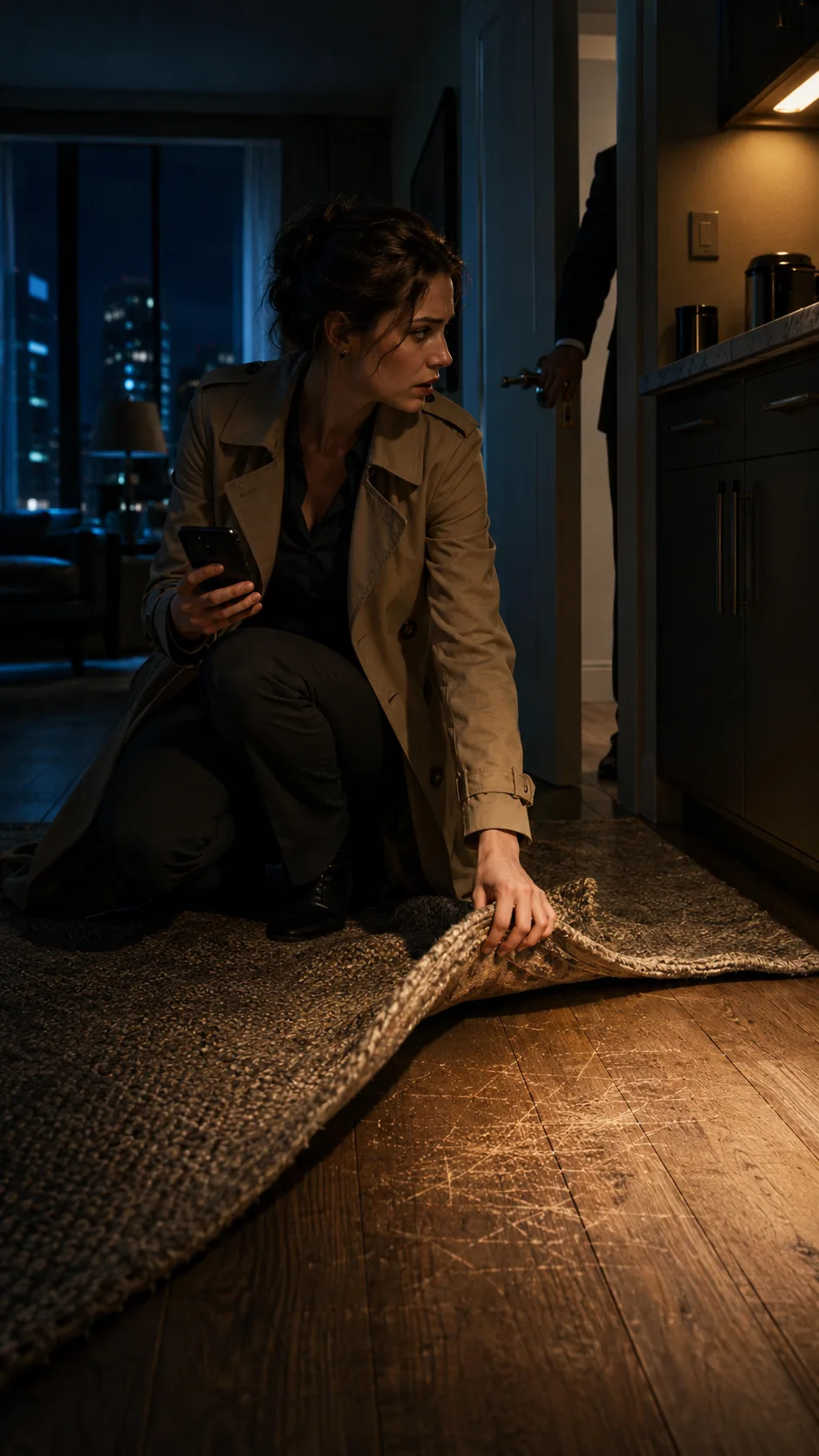
Emma bent down.
David moved.
“Emma.”
She grabbed the edge of the rug.
It was heavier than she expected. Grace had bought it secondhand from a woman in Queens and insisted the stain near one corner was “character.” Emma pulled hard. The table legs scraped. One chair tilted and hit the cabinet.
David crossed the room in two strides.
Emma yanked again.
The rug folded back.
The wooden floor beneath was scratched.
Not random scuffs.
Letters.
Deep, jagged, carved with something sharp enough to tear grooves through the varnish.
HE HAS MY PHONE.
Emma stared at the words.
David stopped three feet away.
The phone in Emma’s hand was still on speaker. Grace’s message had ended, but the open line with David remained connected. His own breathing came through the speaker a second late, small and trapped.
Emma lifted the phone.
“You still have it,” she said.
David’s face drained of all its careful grief.
Behind him, in the hallway, the elevator bell chimed.
Both of them turned.
Victor stood outside the apartment door with a maintenance man beside him, both holding key rings, both looking past David at the exposed floor.
David’s hand went to his pocket again.
This time, Emma raised the phone higher.
“Touch it,” she said, “and they hear everything again.”
The maintenance man stepped back into the hallway.
Victor did not.
He looked at the floor.
Then at David.
Then at Emma.
“Miss Sloane,” he said, “I called the police when I saw him come in.”
David’s mouth opened.
No sound came out.
The office video continued behind the island, still playing in its grainy loop.
“She won’t make it to the police.”
The sentence landed again.
Victor heard it.
The maintenance man heard it.
David heard himself.
Emma stood in Grace’s kitchen, one hand holding the phone, the other still gripping the rolled edge of the rug. The carved words lay between them, raw and ugly in the warm light.
David took one step back.
Then another.
His heel hit the doorframe.
For weeks after, Emma could not remember the police entering as one clear event.
She remembered pieces.
A woman officer asking her to sit, then realizing Emma would not move away from the floor. A male officer taking the laptop with gloved hands. Victor standing near the door with both palms flat against his own chest, as if reminding himself not to touch anything. The maintenance man whispering into his phone in the hallway and then stopping when an officer looked at him.
David did not cry when they put him in handcuffs.
That was the thing Emma remembered most clearly.
No bending over the casket. No hand over his mouth. No shaking shoulders.
He stood still in the hallway while the officers read him his rights. His tie had slipped crooked, and one side of his collar stuck up under his coat.
He looked at Emma once.
Not at the floor.
Not at the phone.
At Emma.
She looked back until the elevator doors closed between them.
The apartment remained full after he was gone. Officers moved through rooms. Cameras flashed. Evidence markers appeared beside the rug, the laptop, the adapter, the strip of tape from the photo frame. Grace’s hidden systems unfolded one by one.
The phone had not been in Grace’s apartment.
It had been with David the whole time.
He had taken it after the crash, expecting to erase what mattered. He had not known Grace scheduled the message from a secure app before the party, set to send after her funeral if she did not cancel it.
Grace had known him too well.
The police found her phone in David’s locked desk drawer two hours later, wrapped inside a silk pocket square he had worn at the funeral reception.
Clean.
Careful.
Not careful enough.
The investigation reached Halden Meyer by morning. News vans arrived before lunch. Victor Halden resigned before anyone asked him publicly to do it. By evening, three executives had lawyers, two accounts were frozen, and David’s photo no longer appeared on the company’s leadership page.
Grace’s apartment stayed sealed for nine days.
Emma returned on the tenth with Marlene and a detective who said they could collect personal items not marked as evidence. The place smelled different. Dust, old coffee, fingerprint powder, the faint chemical sharpness left behind by strangers doing official work.
Marlene cried in the bedroom.
Emma did not go in right away.
She stood in the kitchen and looked at the floor.
The rug had been taken.
The carved words remained.
HE HAS MY PHONE.
The detective had offered to photograph the floor again before the landlord repaired it. Emma asked for a copy.
Marlene came out holding Grace’s blue sweater against her chest.
“She told me once you were the only person who noticed when she was lying,” Marlene said.
Emma looked at the exposed floorboards.
“She was bad at lying.”
Marlene gave a small sound that almost became a laugh.
“No. She was good. You were better.”
Emma crouched beside the place where the rug used to be and ran one finger near the carved letters without touching them. Grace must have done it before the party. Or after she came home that final night. Maybe she had known David would search the obvious places. Maybe she had known he would take the phone.
Maybe she had known Emma would come.
On the counter, someone had left Grace’s lemon-shaped key dish. David’s men had missed it after all. It sat empty except for one old peppermint with a twisted wrapper and three pennies darkened with age.
Emma picked it up.
The ceramic lemon was heavier than it looked.
Six months later, Emma testified in a courtroom with wood-paneled walls and bad coffee in paper cups outside the door.
David sat at the defense table in a navy suit. No black. No funeral tie. His hair had grown longer at the sides, and he had lost the smoothness that made people want to believe him before he spoke.
He did not look at her when the prosecutor played Grace’s message.
The courtroom listened to the dead woman’s voice.
“Emma, if you’re hearing this, I didn’t die the way they said.”
Someone in the back row made a sound and covered it with a cough.
Emma kept her hands folded on the rail in front of her. Her nails were short. She had cut them the night before because she knew she would pick at them until they bled if she did not.
The prosecutor played the office video next.
David watched the table.
Victor Halden had already taken a deal. His testimony filled two days and emptied whatever remained of the company’s polished reputation. He described accounts, meetings, pressure, signatures. He described David as a man who wanted access, money, and a wife who would not look too closely.
Emma did not look at David during that part.
She looked at the jury.
One woman held a pen so tightly her knuckles paled. A man in the second row leaned forward with his elbows on his knees. Another juror looked at the screen, then at David, then back again.
David’s lawyer tried to suggest Grace had been unstable. Overworked. Paranoid. Confused by financial documents she did not fully understand.
The prosecutor placed a photograph of the kitchen floor on the screen.
HE HAS MY PHONE.
The lawyer stopped using the word confused after that.
When the verdict came, David stood.
The foreperson read each count.
Guilty.
Guilty.
Guilty.
David blinked once after the third one. His mother, seated two rows behind him, put one hand over her mouth. Victor Halden stared at the floor from the witness area, though nobody had asked him to stand.
Emma sat still.
Marlene reached for her hand.
Emma let her.
After sentencing, reporters waited outside the courthouse with cameras and questions shaped like hooks. Emma gave them nothing dramatic. She walked down the courthouse steps with Marlene beside her, Grace’s cousin on one side, Victor the doorman on the other because he had come even though nobody asked him to.
A reporter called, “Emma, what would you say to Grace if she could hear you?”
Emma stopped.
The microphones lifted.
For a second, the street noise thinned around her: taxis, shoes on concrete, a bike bell somewhere near the curb.
She looked at the cameras.
Then she said, “She left me something useful.”
That was all.
A year after the funeral, Emma drove to Cape May with Grace’s ashes in a small blue urn Marlene had chosen because it matched the sweater Grace loved. The beach was nearly empty. Wind pressed Emma’s coat against her legs. The boardwalk coffee stand was closed for the season, its metal shutter pulled down and rattling faintly.
Emma carried two paper cups anyway.
One was empty.
She set it on the sand beside the urn and sat with her knees drawn up, watching the gray water fold over itself.
Her phone buzzed once in her pocket.
For a sharp second, her hand went still.
Then she took it out.
Marlene had sent a photo of Grace’s lemon-shaped key dish sitting on a sunny windowsill, now filled with spare keys and wrapped candies.
Emma smiled without showing her teeth.
She opened Grace’s old contact.
For months she had not changed it. Grace Calder still sat in her phone with the beach photo and the number David had stolen and the last message that had torn his life open.
Emma pressed edit.
Her thumb hovered over delete.
She did not delete it.
Instead, she changed the contact name.
Grace — Useful.
The wind lifted hair across Emma’s face. She let it.
The empty paper cup tipped over beside her and rolled once in the sand before stopping against her shoe.
Emma picked it up.
Then she sat there until the tide came closer.
Grace was still gone.
But her voice had stayed.
Chapter complete
You have reached the end of this chapter.
Continue reading
A few more worlds to get lost in after this chapter.




