Tristan hid the bread under his shirt before the guards saw him.
Chapter 1
Tristan hid the bread under his shirt before the guards saw him.
It was not even a full piece. Just the broken heel of a loaf, hard at the edges, still damp from the rain that had followed him through the market streets. He had taken it from behind the baker’s stall when the baker turned to shout at a cart driver, and now it sat against his ribs like a warm stone.
He kept one hand over it.
Not because he thought it was worth much.
Because it was all he had.
The city of Valemont did not look at boys like Tristan unless they were in the way. On ordinary days, he could disappear between fish carts, horse troughs, alley smoke, and piles of wet straw without anyone caring where he slept or what he stole. But this was not an ordinary day.
This was the Festival of Crowns.
Every bell tower in the capital had been scrubbed clean. Every
street near the Royal Cathedral had been swept until the mud had nowhere to hide except beneath the feet of people who were not supposed to be there. Noble banners hung from balconies, red and gold and blue and white, dripping rainwater into the gutters. Knights rode past in polished armor. Priests moved in pairs, their white robes gathered carefully above the puddles.
Tristan stayed low beside the fountain across from the cathedral steps.
Three other street children were already there, huddled beneath the stone wings of an angel statue whose face had cracked years ago. One of them, a girl named Mara, watched the royal carriages arrive with her knees tucked under her chin.
“You’ll get caught,” she said.
Tristan did not answer.
“You always look too long.”
He looked away from the cathedral doors.
Too late.
The doors had opened.
Light spilled down the steps, warm and gold,
cutting through the rain. Music came after it, deep and slow, the kind that belonged to people who had never listened for footsteps behind them. Inside, beyond the rows of guards and noble shoulders, Tristan saw the center of the cathedral.
The altar.
The black stone.
And the sword.
Even from across the square, he knew what it was. Everyone in Valemont knew. Children whispered about it under bridges. Old women crossed themselves when the cathedral bells rang at midnight. Drunk soldiers told the story badly outside taverns.
The Holy Sword.
It had been buried in black stone since the first emperor died. No hand had moved it. No king had lifted it. No prince had won it. The priests said it would return only when the true blood of the empire stood before it.
Tristan had never believed that part.
True blood sounded like something rich people invented to
explain why they got to sit on chairs carved from gold while children fought dogs for scraps behind kitchens.
Still, he looked.
He could not help it.
A guard shoved someone near the base of the steps. A beggar with one bad leg stumbled backward and hit the fountain wall. Another guard laughed and waved his spear toward the alley.
“Clear the square.”
People moved quickly.
Tristan stayed one breath too long.
The guard’s eyes found him.
There.
Tristan turned at once, but the bread under his shirt shifted. He grabbed it through the cloth. The movement made him slower. Boots splashed behind him.
A hand closed around the back of his tunic.
The bread fell.
It hit the wet stones and broke open, pale crumbs dissolving into rainwater.
The guard dragged him upright.
“You deaf?”
Tristan shook his head.
“Then move.”
The guard shoved him toward the cathedral steps instead of the alley. It was not mercy. It was convenience. The nearest empty space was through the line of guards at the side entrance, where servants carried candles and baskets of incense into the cathedral.
Tristan tried to twist away.
The guard tightened his grip.
“Walk.”
So Tristan walked.
Bare feet on cold stone.
Rain down his neck.
Bread gone.
Inside the cathedral, the air changed.
The city outside smelled of horses, fish, wet wool, smoke, and hunger. The cathedral smelled of beeswax, incense, polished wood, old stone, and flowers that had been cut before dawn. Hundreds of candles burned along the walls. Their flames trembled whenever the great doors opened behind another noble family.
Tristan had never been inside.
He had seen the cathedral from rooftops and gutters. He had slept behind one of its outer walls in winter, curled near a vent where warm air sometimes breathed out after midnight. But he had never crossed its marble floor.
His first step left a dark footprint.
A woman in silver silk saw it.
Her mouth tightened.
Not much.
Enough.
The guard pulled Tristan between two pillars and bent toward his ear.
“Stay there until the aisle clears. Then out.”
Tristan nodded.
He would have obeyed. He wanted nothing from that place now except to leave before someone searched him and decided a hungry boy deserved a worse lesson than losing bread.
But the ceremony had already begun.
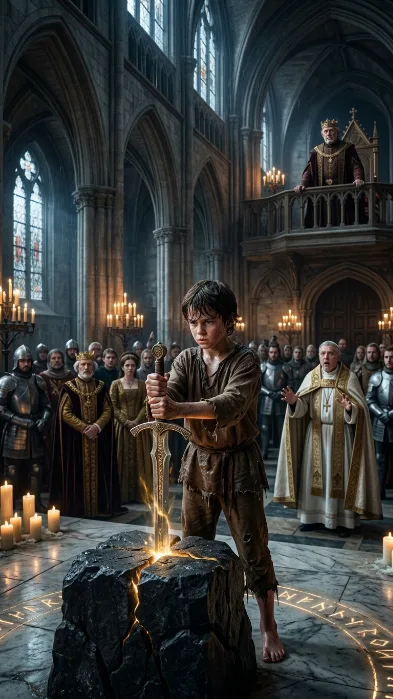
The High Priest stood before the altar with both hands raised. His robes were white and gold, heavy with embroidered suns. Around him stood royal knights in silver armor, princes in deep blue cloaks, dukes with rings on every finger, ladies with pearls at their throats, and children dressed like miniature kings.
At the far end, above the main steps, King Aldric sat on the Lion Throne.
He looked larger than the statues behind him.
His crown was not tall, but it was wide and heavy, made of dark gold with red stones set into the front. His beard was trimmed square. His robe was crimson, almost black where the candlelight did not touch it. One hand rested on the carved arm of the throne. The other held a ceremonial chain of office.
He did not look at Tristan.
That was normal.
Then the High Priest spoke.
“By crown, by blood, by oath, and by blade, we gather under the eyes of the First Emperor.”
The crowd lowered their heads.
Tristan lowered his too, because everyone else did.
A boy near the front glanced back at him. Younger than Tristan, maybe nine, with a velvet cap and a gold clasp shaped like a lion. His eyes moved from Tristan’s muddy feet to his torn shirt. He whispered something to the girl beside him.
She looked.
Then she smiled into her sleeve.
Tristan stared at the floor.
Do not move.
That was the rule. In alleys, in kitchens, at market stalls, outside guardhouses. Do not move unless told. Do not speak unless asked. Do not meet the eyes of someone who can have you beaten and then forget you before supper.
The High Priest continued.
“The Holy Sword remains the witness of the empire. It has rejected ambition. It has rejected false hands. It has rejected pride.”
King Aldric’s fingers stopped moving on the throne arm.
For the first time, Tristan saw the king’s eyes shift toward the altar.
Not the priest.
The sword.
The Holy Sword stood buried halfway into the black stone. Its blade was dull in the candlelight, not rusted, not clean, but strange, as if light refused to rest on it. The hilt was gold, shaped like wings folded inward. A red jewel sat in the pommel.
A jewel like the stones in the king’s crown.
Tristan blinked rainwater from his lashes.
The guard beside him stepped away to speak to another soldier. Only a few feet. Enough.
Tristan could leave.
He glanced toward the side passage. Servants moved through it carrying trays of silver cups. Beyond them, an open door showed gray rain and the alley between the cathedral and the chapel kitchens.
He took one step.
No one noticed.
Then another.
The marble was slick beneath his bare feet.
A servant turned suddenly with a tall candle stand. Tristan pulled back to avoid it. His heel slid in the water he had tracked inside. His shoulder struck the base of a pillar.
A nobleman hissed.
“Careful.”
Tristan tried to regain his balance.
His hand shot out.
He expected cold stone.
Instead, his fingers closed around warm metal.
The cathedral bells rang.
All of them.
The sound did not begin like ordinary bells. It struck the room at once, from above, below, inside the walls, behind the stained glass, from towers across the city that no hand had touched. The great bronze bells roared over the High Priest’s words and swallowed the music whole.
People cried out.
A knight dropped his spear. It clattered against the floor and rolled toward the altar steps.
Tristan stood frozen beside the black stone.
His hand was on the sword.
The Holy Sword.
The guard who had dragged him inside turned white around the mouth.
“Get away from that.”
But his voice sounded small beneath the bells.
Tristan tried to let go.
The hilt warmed under his palm.
A thin gold line appeared where the blade entered the black stone.
Then another.
The High Priest stopped breathing through his mouth. His hands lowered slowly from the air. His gaze locked on Tristan’s fingers as if the boy’s skin had become a written sentence he could not read fast enough.
The nobles shifted.
Silk whispered. Armor creaked. Someone in the back said a prayer too quickly.
The bells kept ringing.
King Aldric rose from the throne.
No one else moved after that.
His robe fell around him in a heavy red wave. The chain in his hand struck the armrest once and stilled. From where Tristan stood, the king looked carved from shadow and gold, but his face had changed.
Only a little.
Enough.
The prince beside him leaned forward. He was older than Tristan by maybe five years, dressed in blue velvet with a silver belt. His hair was dark like the king’s. He looked at the sword as if it had betrayed him.
“Father,” he said.
The king lifted two fingers.
The prince closed his mouth.
The High Priest took one step toward Tristan.
The runes beneath the altar flashed.
He stopped.
Every candle flame along the altar bent sideways, pointing toward the boy.
Tristan’s hand trembled on the hilt.
He wished the bread had stayed hidden. He wished he had run with Mara. He wished he had never looked through the cathedral doors.
A guard reached for him.
King Aldric spoke.
“Do not touch him.”
The guard froze, arm still raised.
The king descended one step from the throne platform.
His eyes never left Tristan.
“What is your name?”
The question crossed the cathedral like a blade laid flat.
Tristan swallowed.
His tongue felt too large for his mouth.
“Tristan.”
A murmur moved through the crowd.
No family name.
No title.
No place.
Only Tristan.
King Aldric’s jaw tightened.
“Who brought you here?”
The guard lowered his head.
“I did, Your Majesty. He was loitering outside. I meant to remove him after the procession.”
A few nobles turned away, as if the matter had been explained. A dirty boy had been dragged in. A mistake. A servant problem. A thing that could be corrected with quiet hands and a side door.
But the sword still glowed under Tristan’s palm.
The king saw it.
So did everyone else.
A woman near the front crossed herself with shaking fingers. The old duke beside her gripped his cane until his knuckles pressed white beneath the skin.
The High Priest whispered one word.
“Blood.”
The king turned his head.
The priest said nothing more.
Rain struck the stained-glass windows in long silver lines. Outside, the bells of the city still answered one another. Inside, the floor beneath the altar hummed.
Tristan tried again to release the sword.
The glow followed his fingers.
He pulled his hand back.
The black stone cracked louder.
People stepped away.
Not many.
Just enough to leave a widening circle around him.
The prince stepped down from the platform.
“I will test it.”
King Aldric’s head moved sharply.
“No.”
The prince stopped, but his face hardened.
“Then why does it answer him?”
The question landed badly.
No one looked at the king.
That made it worse.
Aldric moved down another step. The candlelight showed the lines at the corners of his mouth now. Not old lines. Tight ones.
He looked at Tristan with the careful patience of someone approaching a wild animal.
“Boy.”
Tristan lifted his eyes.
“Come forward.”
The guard beside Tristan shifted, ready to pull him away.
The king’s voice cut colder.
“Let the boy approach.”
The room parted.
No one wanted to be the one standing between a beggar child and the Holy Sword now. Nobles moved back. Knights adjusted their shields. The High Priest stepped aside with his robe gathered in both hands. The aisle from Tristan to the altar became clear, polished, and terrible.
Tristan looked down at his feet.
Mud. Rainwater. Blood from a cut he had not noticed near his heel.
Then he looked at the altar.
The Holy Sword stood waiting.
He took one step.
The bells stopped.
The silence after them was worse.
His wet foot touched the first altar step. He climbed it slowly, aware of every eye on his back, every jewel, every ring, every polished boot, every hand that had never needed to steal bread.
At the top, the black stone was higher than his waist. The sword rose from it, taller than he was, its hilt glowing now as if something inside it had woken and was looking through the gold.
The High Priest spoke from behind him.
“No child outside royal blood may touch the blade.”
King Aldric answered without turning.
“He already has.”
No one replied.
Tristan stood before the sword.
He kept his hands at his sides.
The king watched him.
“Place both hands on the hilt.”
Tristan looked back.
“I didn’t mean to touch it.”
His voice cracked on the last word.
A few nobles near the front exchanged glances. The prince stared at him with open dislike now, his mouth pressed into a line. A knight near the altar rested one hand on his sword, though no one had ordered him to draw.
King Aldric’s expression did not move.
“Place both hands on the hilt.”
Tristan obeyed.
The Holy Sword warmed beneath both palms.
Not hot.
Alive.
The black stone gave a low sound under his fingers. Gold light spread through the cracks, crawling outward, down the altar, across the first step, into the grooves of the marble floor.
The High Priest’s face lost its color.
He backed away.
“Your Majesty.”
The king ignored him.
“Pull.”
Tristan shook his head once.
A small movement.
“No.”
The entire cathedral heard it.
The prince took another step forward.
“You refuse the king?”
Tristan’s grip tightened by accident.
The sword answered with a pulse of light so strong several candles went out at once.
The prince stopped.
Tristan looked at the king. There was rain in his hair, dirt on his cheek, and a bruise darkening under one eye from a fight two nights before behind the butcher’s stall. He looked nothing like the boys in velvet near the front row.
“I don’t want it,” he said.
That was the truth.
He wanted bread.
A dry corner.
Mara not to get caught stealing apples.
Winter to end without taking another child from the bridge.
He did not want a sword that made kings stare like that.
King Aldric came down the last step from the throne platform. His boots touched the cathedral floor. Knights moved with him, but he lifted a hand and they stopped.
He stood below the altar now, looking up at Tristan.
“Pull.”
This time it was not a command for the room.
It was a trap.
Tristan felt it without understanding it. If the sword did not move, the king could laugh and order him whipped for touching what he should never have touched. If it did move—
He did not know what happened if it moved.
The High Priest did.
His lips formed another silent prayer.
The old duke with the cane lowered himself to one knee, not all the way, just enough that his balance seemed to fail him. A noblewoman pressed both hands to her mouth. The servant holding the candle stand had not moved for so long wax had run over his fingers.
King Aldric’s eyes sharpened.
“Now.”
Tristan looked at the sword.
His hands were too small for the hilt. His fingers barely wrapped around the gold. The jewel in the pommel caught the light, red as the stones in the crown, red as the banners, red as the small cut on his heel.
He pulled.
Nothing happened.
A breath moved through the crowd.
The prince smiled.
Barely.
Tristan let go of the breath he had been holding.
Then the stone cracked from top to bottom.
The sound rolled through the cathedral like thunder under the floor.
Gold light burst from the split. The sword shifted upward in Tristan’s hands, just a finger’s width, then more. The weight should have pulled him forward. It did not. The blade rose as if the stone itself had released it.
The prince’s smile vanished.
King Aldric took one step back.
Only one.
But everyone saw.
Tristan pulled again.
The Holy Sword came free.
Light filled the cathedral.
Not soft light. Not candlelight. It struck the pillars, ran up the arches, flashed across armor, burst through the stained glass from the inside and turned the rain beyond it gold. Every banner above the throne bent toward Tristan. The Lion Throne groaned as if the wood had shifted in its own bones.
The High Priest fell to both knees.
His hands hit the marble.
“My blood returns,” he said.
The words were not loud.
They did not need to be.
The black altar changed beneath Tristan’s feet. Ancient letters burned across its surface, bright and clean, cutting through centuries of soot and prayer oil.
THE SWORD SHALL RETURN ONLY WHEN MY BLOOD RETURNS.
No one spoke.
The letters glowed brighter.
The king stared at them.
Then at Tristan.
Then at the sword in the boy’s hands.
His face drained until the crown looked too heavy for him.
A sound came from the front row. The prince had stepped backward into a candle stand. Wax spilled onto the marble. He did not notice.
The High Priest bowed his head so low his forehead almost touched the floor.
The knights closest to the altar looked at one another.
One by one, their hands left their weapon hilts.
The first knight knelt.
His armor struck the marble.
Then another.
Then five more.
Nobles followed badly, awkwardly, some too proud to understand their own knees, some too quick, some trembling so hard their jewels clicked together. The woman in silver silk knelt beside the footprint Tristan had left earlier. Her dress touched the wet mark.
The old duke with the cane lowered his head.
The servant dropped the candle stand. It clattered once, but no one scolded him.
King Aldric remained standing.
For a few seconds, he was the only one.
Tristan held the sword with both hands. Its blade was too long for him, angled slightly downward, the golden light wrapping around his torn sleeves. He did not raise it. He did not know how.
The king looked at the High Priest.
The priest did not look back.
He was still kneeling.
“My lord,” the prince said.
The words came thin.
King Aldric’s hand moved toward his own sword.
Every knight in the first row lifted their eyes.
Not their heads.
Just their eyes.
The king’s hand stopped.
Tristan saw that.
He saw the king’s fingers curl, then uncurl. He saw the crown tilt slightly when Aldric lowered his chin. He saw the man who had owned every room in the empire find no safe place to stand.
At last, King Aldric bent one knee.
Slowly.
The cathedral watched him do it.
His robe spread across the marble like spilled wine. The crown stayed on his head, but it no longer looked like part of him. It looked borrowed.
Tristan did not understand why his throat hurt.
He looked down at the sword.
The glow had softened.
The runes on the floor continued to burn in a circle around him. They did not burn his feet. The cut on his heel had stopped bleeding.
The High Priest lifted his head.
“Child,” he said.
Tristan looked at him.
The old man’s face had changed. Not kinder. Not safer. Only stripped of all the certainty he had worn when the ceremony began.
“What was your mother’s name?”
The question touched something in Tristan that hunger had not managed to take.
He tightened his grip on the sword.
He could see his mother only in pieces now. A hand smoothing his hair. A song with no ending. A blue cloth tied around her wrist. The smell of smoke. Someone shouting through fire. Her body curled over his in the dark, covering him from falling beams.
He had been five.
Maybe six.
He remembered one name.
“Elaine,” he said.
The High Priest closed his eyes.
Several nobles whispered at once.
The old duke with the cane made a sound like the air had left him.
King Aldric’s head lifted.
“No.”
It was the first word he had spoken since the sword came free.
The High Priest turned toward him.
“She was the emperor’s daughter.”
The prince stared at his father.
The cathedral seemed to grow colder.
Tristan looked between them.
“My mother worked in a laundry house.”
No one answered him.
The High Priest’s mouth pressed flat. He looked at the king, and for the first time since Tristan had entered the cathedral, the old priest did not look afraid of the boy.
He looked afraid of what the adults had done.
“Princess Elaine vanished twelve years ago,” the priest said. “The court was told she died at sea.”
King Aldric rose too quickly.
“That is enough.”
But it was not.
The sword lit again.
Not bright this time. Sharp.
The letters on the altar changed.
A second line appeared beneath the first.
BLOOD HIDDEN IN ASH SHALL STAND BEFORE THE LIAR KING.
The room broke open in whispers.
Liar king.
Liar king.
Liar king.
The words traveled from noble to knight, from knight to servant, from servant to prince, until they no longer sounded like whispers at all.
King Aldric’s face tightened around the bones.
“Seize him.”
No one moved.
The order hung above the altar and died there.
The king turned on the nearest captain.
“I said seize him.”
The captain was kneeling, one fist against the marble. He looked at the sword. Then at Tristan. Then at the glowing words on the altar.
His head lowered.
“I cannot.”
The king’s hand struck him across the face.
The sound cracked through the cathedral.
Still, the captain did not rise.
The prince stepped back from his father as if the space between them had become a visible thing.
Tristan held the sword tighter. The blade responded with a quiet hum. The sound ran up his arms and settled in his chest, not as strength exactly, but as permission.
The High Priest stood with difficulty.
His knees had left dark marks in the dust on the marble.
He turned to the crowd.
“By the law of the First Emperor,” he said, “the sword recognizes blood before crown.”
King Aldric’s mouth opened.
The priest raised one hand.
“The ceremony is over.”
No one cheered.
This was not that kind of ending.
The rain still struck the stained glass. Candles still smoked where they had gone out. The servant still stood beside the fallen candle stand, wax cooling across his fingers. The woman in silver silk stayed on her knees, her hem wet and dirty now.
Tristan looked at the side passage.
The door to the rain was still there.
For a wild second, he thought he could run.
Back to the fountain. Back to Mara. Back to alleys where no one asked his mother’s name like it could break a kingdom.
Then the Holy Sword grew heavier in his hands.
Not too heavy to hold.
Too heavy to pretend.
The High Priest approached him slowly and stopped a few steps away.
“Your Highness,” he said.
Tristan flinched.
The old man saw it.
He lowered his voice.
“Tristan.”
That was better.
The boy looked at him.
“What happens now?”
The High Priest did not answer quickly.
Behind him, King Aldric stood surrounded by men who no longer knew whether they were guards or witnesses. The prince stared at the floor. The nobles kept their heads lowered because lifting them meant choosing what they believed.
At last, the priest said, “Now everyone tells the truth.”
Tristan looked at the king.
Aldric looked back.
For the first time, the man on the throne looked smaller than the boy on the altar.
Outside, the bells began again.
One tower first.
Then another.
Then all of Valemont.
By sunset, the story had already left the cathedral.
It passed through kitchens before it reached council rooms. It crossed the square faster than the guards could seal the gates. It moved with servants carrying water, with stable boys tightening saddles, with old women selling candles, with soldiers who had seen their captain refuse the king.
By nightfall, no one told it the same way.
Some said the orphan had lifted the sword above his head and called down lightning.
He had not.
Some said King Aldric begged forgiveness before the altar.
He had not.
Some said the Holy Sword burned every liar in the room.
It had not.
The truth was quieter.
A hungry boy had touched a sword.
A king had gone pale.
A room full of people had looked at the same words and failed to look away.
Tristan did not sleep in the palace that night, though they gave him a chamber with a carved bed large enough for three boys his size. He sat on the floor instead, wrapped in a blanket too soft to trust, watching rain crawl down the window glass.
The Holy Sword rested across two velvet stands beside the wall.
He had asked them to take it away.
No one would.
A tray of food sat near the bed. Roasted chicken, white bread, pears, cheese, sugared nuts, and a cup of milk in a silver goblet. Tristan had eaten too fast at first and then stopped when his stomach turned against him.
In his pocket, he kept a piece of bread.
Not stolen this time.
Saved.
Near midnight, someone scratched softly at the door.
Tristan stood at once, hand going toward the sword before he knew he had moved.
A servant opened the door.
Mara slipped inside behind him.
She wore a dry cloak that did not belong to her and boots that were much too large. Her hair had been combed, badly. She held a pear in one hand and looked around the chamber as if expecting someone to shout.
When she saw Tristan, she stopped.
“So,” she said. “You touched a sword.”
Tristan looked at her.
Then at the pear.
Then back at her.
“I lost the bread.”
Mara stared for half a second.
Then she laughed.
Not loudly.
Not long.
But enough to make the room less golden and less strange.
She tossed him the pear.
He caught it with both hands.
Outside the palace, the bells had finally gone quiet. Somewhere below, men argued behind closed doors. Somewhere else, King Aldric still had a crown and fewer allies than he had woken with. The High Priest had sent riders before dusk. The old duke had sworn a statement. The prince had not spoken since leaving the cathedral.
None of it fit inside Tristan’s hands.
The pear did.
He sat on the floor beside Mara and split it with a small knife the servant had left on the tray. The cut came out uneven. Juice ran over his thumb.
Mara took her half.
“Are you a prince now?”
Tristan looked at the sword.
Its blade no longer glowed.
But the room still felt built around it.
“I don’t know.”
Mara bit into the pear.
“Princes probably know.”
Tristan almost smiled.
Almost.
He looked out the rain-streaked window toward the city roofs, the alleys, the fountain, the cathedral spire cutting into the dark. For years, the city had been a place that pushed him from doorway to doorway.
Now every door would open.
That did not make it safer.
He touched the blue strip of cloth tied around his wrist. It was the only thing he still had from his mother. The fabric had faded until it was nearly gray.
“Elaine,” he said under his breath.
Mara did not ask.
She only sat beside him and ate slowly, like they had both learned to do when food might need to last.
At dawn, the bells would ring for him.
At dawn, men who had ignored him would kneel.
At dawn, the empire would begin deciding whether to protect him, use him, crown him, or bury him under another lie.
But for that one hour, he was still a barefoot boy with rain in his hair and bread in his pocket.
The sword had chosen him.
He had not chosen the sword.
Chapter complete
You have reached the end of this chapter.
Continue reading
A few more worlds to get lost in after this chapter.




