The Old Man Asked for Sixty Days.
Chapter 1
The Old Man Asked for Sixty Days.
The Billionaire Laughed Until He Heard the Voice on the Phone
Don José Franco counted the pills in Mrs. Alma’s cookie tin before he counted the days left on the notice.
There were seven white tablets, three yellow ones, and one small blue pill she had wrapped in a napkin because the bottle cap no longer closed properly. The tin itself had once held butter cookies from Christmas, but that had been years ago. Now it sat beside her bed like a private pharmacy, dented on one side, lined with folded paper, guarded more carefully than jewelry.
“You’re missing two,” José said.
Mrs. Alma waved one thin hand from her chair. “I cut them in half.”
“You shouldn’t.”
“And you shouldn’t carry groceries up four flights with that knee.”
He gave her the look he used when children lied badly.
She gave it back.
So he said nothing and closed
the tin.
Outside her room, 117 Laurel Street groaned in the afternoon heat. The old building always made sounds: pipes complaining behind walls, footsteps passing overhead, a baby coughing somewhere near the stairwell, a radio playing softly in apartment 3B. It was not beautiful. Nobody would paint it on a postcard. The plaster cracked near the ceiling, and the stair rail had been repaired with tape in two places.
But it was alive.
That was what men like Máximo Del Valle never understood.
They looked at a building and saw land.
José looked at it and saw Gloria sitting by the window every morning with her recovery medal in her palm. He saw Brandon coming home at midnight, still wearing his delivery jacket, his daughters asleep under one blanket. He saw Maritza walking slowly now, one hand under her belly, trying to smile before anyone could ask whether she had
somewhere else to go.
He saw little Iker hiding under the kitchen table whenever adults raised their voices.
He saw people.
The notice had been taped to the front door nine days earlier.
DEMOLITION SCHEDULED.
Eleven days remaining.
No one had read it aloud at first. They had only stood in front of it while the paper fluttered in the weak wind, as if not speaking the words could keep them from becoming true.
Brandon had been the first to tear it down.
José had taken it from his hand and smoothed the corners.
“Don’t rip it,” he said.
“They’re throwing us out.”
“Yes.”
“Then why should I care about their paper?”
“Because paper is how men like that pretend cruelty is clean.”
The next nine days became a line of waiting rooms.
José went to government offices where clerks stamped documents without looking at his face. He sat under
flickering lights beside people holding folders to their chests. He called numbers that sent him to other numbers. He wrote letters in careful handwriting because he did not trust computers, then asked a neighbor’s daughter to type them.
No answer.
He went to legal aid. He went to the borough office. He went to a community housing desk where a woman with tired eyes read the notice twice and said, “I’m sorry.”
That was the phrase people used when they were done helping.
By the ninth evening, the families gathered in the hallway because Gloria’s apartment was too small for everyone.
Maritza leaned against the wall near the stairs. Brandon stood with his arms crossed. Mrs. Alma sat on a plastic chair someone had carried out for her. The children sat on the floor, quiet in the way children became quiet when they knew adults were afraid.
José held the folded notice in both hands.
“We still have eleven days,” he said.
Brandon laughed once through his nose. “Eleven days to go where?”
Nobody answered.
A baby whimpered behind someone’s shoulder.
Gloria looked at José. “What do we do now?”
He looked at their faces.
Not all at once.
One by one.
Some people believed courage was loud. José had learned it was often just the act of standing in a hallway with bad news and refusing to drop your eyes.
“I’ll go to him myself.”
The hallway changed.
Even the children seemed to hear the weight of the sentence.
“To who?” Maritza asked.
José folded the paper with slow hands.
“Máximo Del Valle.”
Brandon pushed away from the wall. “You think a man like that will listen to you?”
“No.”
“Then why go?”
José put the notice into his satchel.
“Because if he refuses, I want him to remember he did it while looking at a human being.”
No one spoke after that.
Later, when the building settled into night, José stood outside beneath the broken streetlight and made one call.
The voice answered on the third ring.
“You’re calling late, Pepe.”
José closed his eyes at the nickname. Only one person still called him that.
“I’m going tomorrow.”
A long silence.
“To Del Valle?”
“Yes.”
“You know what kind of man he is.”
“I know what kind of man his father tried not to raise.”
The voice on the other end breathed through his nose.
“Do you want me there?”
“No. Not yet.”
“Pepe.”
“I want to try my way first.”
“You always do.”
José looked up at the windows of 117 Laurel Street. A small silhouette moved behind a curtain. Someone turned off a lamp.
“I want to see if he has any decency left.”
“And if he doesn’t?”
José rubbed his thumb over the cracked edge of his phone.
“Then I’ll put him on.”
The voice turned hard.
“Do that.”
The next morning, José wore his cleanest shirt.
It was white once. Age had softened it to the color of old paper. He brushed his jacket with both hands, then stopped when he realized brushing would not change anything. At the door, Gloria pressed two boiled eggs wrapped in foil into his hand.
“For the metro,” she said.
“I ate.”
“No, you didn’t.”
He took them.
Downstairs, Iker waited near the front entrance, holding a toy truck with one missing wheel.
“Are you going to stop the machines?” the boy asked.
José crouched slowly. His knee clicked.
“I’m going to ask.”
“Adults always ask before they do bad things?”
José looked at the child’s face. Seven years old, maybe. Too young to understand property law. Old enough to understand fear.
“Some do,” José said.
Iker nodded, though he clearly did not believe him.
The Del Valle Capital tower rose above Paseo de la Reforma like a glass knife.
José stood outside for almost a full minute before entering. Not because he was afraid of the building. He had slept in worse places than a lobby could offer. But he wanted to remember the first breath before the door opened.
Inside, the air was cold enough to make his fingers stiff.
The receptionist looked up.
Then down.
Her eyes moved from his jacket to his shoes to the satchel in his hand.
“I’m here to see Mr. Del Valle,” José said.
“Do you have an appointment?”
“No.”
Her smile tightened. “Mr. Del Valle does not take unscheduled meetings.”
“Tell him it’s about Laurel 117.”
That changed something.
Not much.
Just enough.
She picked up the phone, turned slightly away, and spoke in a low voice. José could still hear the man on the other end.
“Send him up,” the voice said. “I want to see this.”
The elevator doors reflected José back at himself.
Old jacket.
Gray hair.
Satchel.
For a second, he saw another man in the reflection. Younger. Standing outside a hospital room twenty-two years earlier, hands covered in dust after the accident that had taken his wife and, he thought, his son.
He blinked.
The elevator opened.
The thirty-fourth floor did not smell like people lived there. It smelled like polished stone, expensive coffee, and flowers replaced before they could wilt.
A young assistant led him down a hallway lined with glass offices. People glanced up as he passed. Some looked away too quickly. One man watched José’s shoes leave faint dust on the floor.
At the end of the hall, the boardroom waited.
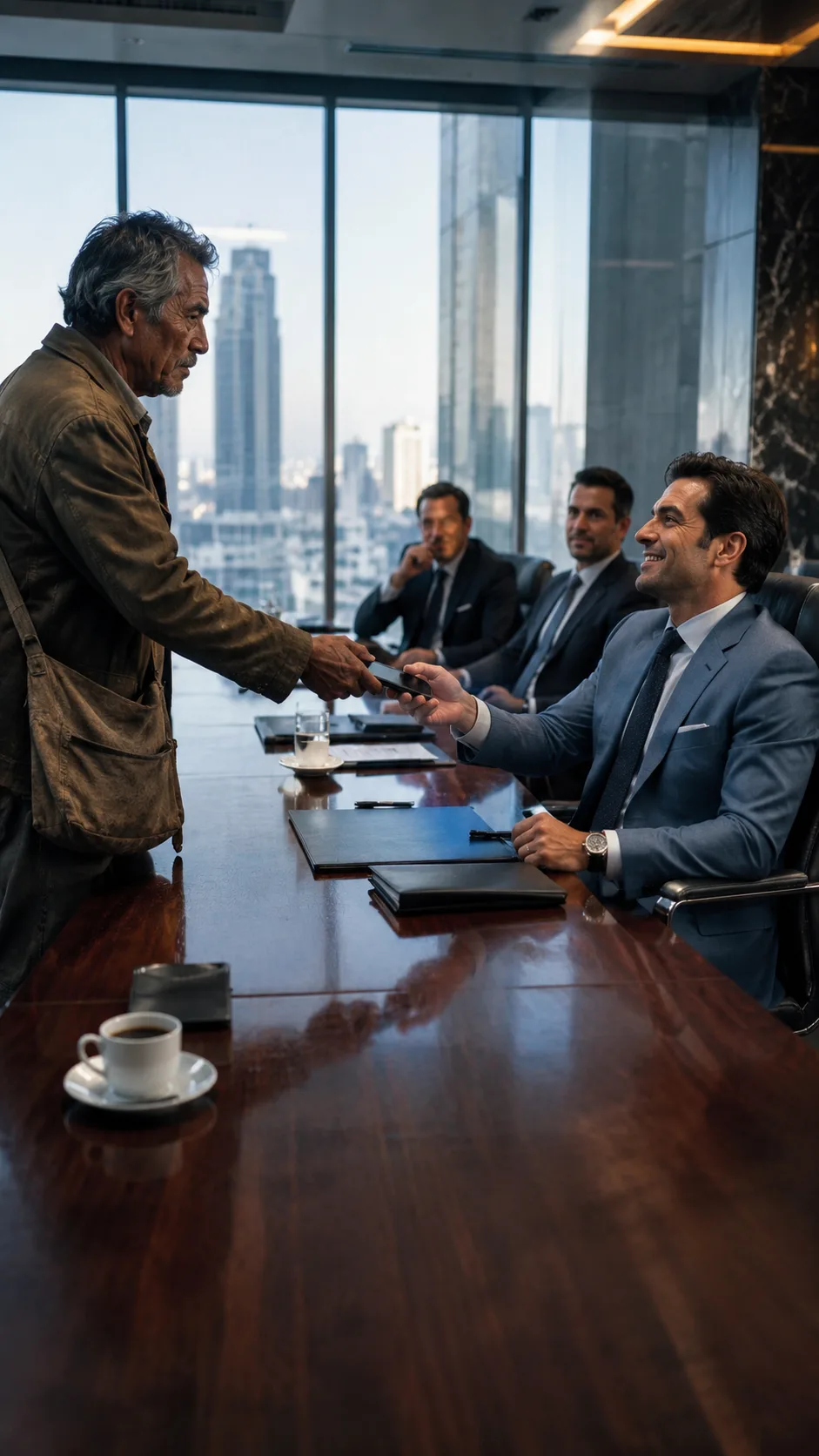
Máximo Del Valle sat at the head of the table.
He was younger than José expected and more polished than any man had a right to be at that hour. Light-blue suit. Dark tie. Hair styled back. Watch bright at his wrist. He did not stand when José entered.
Around him sat three assistants.
Two young men with sharp haircuts.
One woman with pearl earrings.
All three had notebooks open.
No one had a pen in hand.
That told José enough.
“Don José Franco,” Máximo said, tasting the name like cheap wine. “Please. Tell us why you’re here.”
José did not sit.
He set his satchel on the floor beside him and removed the folder.
“I’m here for the families at 117 Laurel Street.”
Máximo leaned back. “Go on.”
So José did.
He told him about Gloria, who had been sober for three years and still kept her medal in a cracked plastic frame because some victories were too fragile to leave in drawers.
He told him about Brandon, who slept four hours most nights and still walked his daughters to school every morning.
He told him about the Baptistes, Edmundo and Celina, who had packed two suitcases months ago because their son in Cancún kept promising, “Soon.”
He told him about Mrs. Alma’s medicine tin.
About Maritza’s baby.
About Iker under the table.
He did not shout.
He did not beg.
He did not decorate the truth. Truth did not need ribbon.
When he finished, the room had grown very still.
Máximo tapped one finger on the table.
“Sixty days,” José said. “That is all I am asking.”
Máximo looked at his assistants, then back at José.
“Sixty days.”
“Yes.”
“For people who have no valid lease?”
“For people,” José said.
One assistant lowered his face.
Not enough.
José saw the smile.
Máximo’s own smile softened in a way that made the room colder.
“Don José,” he said, “I understand your concern.”
No, you don’t, José thought.
But he said nothing.
“Unfortunately,” Máximo continued, “business is business. The permits are valid. The contracts are valid. The schedule is fixed. Delays cost money. Money affects investors. Investors affect jobs. Jobs affect families too, if we want to be sentimental about it.”
The woman with pearls nodded.
José looked at her until she stopped.
“Children live there,” he said.
“Children live everywhere.”
The sentence landed flat on the table.
Nobody picked it up.
José’s hand tightened on the strap of his satchel. He could feel the rough fabric under his thumb.
“No,” he said. “But you are choosing to crush them.”
Máximo’s face changed.
The smile did not disappear.
It sharpened.
“You came here wearing a torn jacket,” he said, “carrying sad stories and copied letters, hoping I would confuse emotion with obligation.”
José watched him.
“Men like you always believe there is some hidden lever,” Máximo said. “Some secret justice. Some dramatic ending where the poor man speaks from the heart and the rich man changes.”
The first assistant laughed.
Then the second.
Then the woman with pearls smiled because her boss had allowed it.
Máximo laughed last.
Fully.
Comfortably.
Like cruelty had been poured into crystal and served cold.
“You know what your problem is?” Máximo asked.
José did not answer.
“You think poverty makes people noble. It doesn’t. It makes them inconvenient.”
The room went quiet.
Even the assistants seemed to understand he had gone further than performance required.
But Máximo was enjoying himself now.
He leaned forward.
“This is real life, Don José. Not a story your neighbors tell their children so they can sleep in a condemned building. In real life, the permits are signed. The demolition crew arrives when scheduled. And there is nothing you can do.”
Nothing.
José looked down at the table.
The polished wood reflected his hands.
Old hands.
Hands that had held his wife’s face when she was too weak to open her eyes. Hands that had carried his son’s football shoes from a hospital room because the nurses said there was no reason to keep them there. Hands that had fixed locks, carried rice, lifted children, folded notices, buried pain so deep that even he sometimes forgot where he had put it.
He touched the white thread loose from his sleeve.
Then he reached into his jacket pocket.
Máximo saw the phone and laughed again.
“Oh,” he said. “Now comes the hidden lever.”
The assistants laughed faster this time.
José turned the phone in his hand.
“Then you won’t mind if I make a call.”
Máximo spread his hands. “Call whoever you want.”
José dialed.
Once.
Twice.
The call connected.
“Pepe,” the voice said. “I’m here. How did it go?”
José looked at Máximo.
“He refused.”
The laughter in the room thinned.
José held the phone out.
“He wants to speak with you.”
Máximo stared at the phone for one second too long.
Then pride made the decision.
He reached out with a lazy smile and took it.
“Yes?” he said. “This is Máximo Del Valle.”
The room seemed to shrink around the table.
A pause.
Then the voice on the phone said, “Hello, son.”
Máximo stopped breathing.
It was not dramatic.
No gasp.
No shout.
Only a small failure in his body. The phone shifted against his ear. His fingers tightened until the skin over his knuckles turned pale. His smile stayed in place for half a second after the rest of him had abandoned it.
Then it fell.
“That’s impossible,” he said.
José closed his eyes.
The voice continued, calm and old and carved from something harder than anger.
“You buried my name, Máximo. Not me.”
The assistant with the sharp haircut looked at the other one.
The woman with pearls slowly lowered her pen though she had never used it.
Máximo stood so quickly his chair rolled back and struck the wall behind him.
“Where are you?”
“Close enough.”
At that moment, the boardroom doors opened.
Two federal investigators stepped in first.
Dark suits.
Badges.
Folders.
Behind them came an old man with silver hair and a cane.
Esteban Del Valle walked slowly, but no one in that room mistook slowness for weakness. His face carried the same bones as Máximo’s. The same eyes. The same chin. But where Máximo’s expression had always been polished into charm, Esteban’s looked stripped down to judgment.
Máximo’s mouth opened.
No word came out.
Finally, he said, “Father.”
Esteban looked at him.
“I heard enough.”
José opened his satchel and removed a faded photograph.
He placed it on the table.
In the photo, a younger Máximo stood beside Esteban Del Valle, both men wearing dark suits at a company event. Máximo had been smiling then. Esteban had not.
One investigator placed documents beside the photograph.
Shell companies.
Hidden ownership trails.
Transfers through old corporate structures.
Bribes disguised as consulting fees.
Pressure on borough officials.
Falsified relocation notices.
The room had been built for signatures, not consequences.
Now it held both.
Máximo shook his head. “You have no authority here.”
Esteban turned toward him.
“I have the only authority you forgot to steal properly.”
The investigator opened another folder.
Esteban took a document from inside and placed it in front of José.
A deed.
José stared at it.
He did not touch it.
Esteban’s voice changed when he spoke to him. Not soft. Not sentimental. Just human.
“I signed it this morning. 117 Laurel Street now belongs to the housing trust.”
Máximo lunged one step forward.
“No.”
The investigator moved between them.
“No, you can’t do that,” Máximo said. His voice broke on the second word. He heard it. Everyone did.
Esteban rested both hands on the top of his cane.
“You hid the purchase under my old company structure because you thought a dead man could not object.”
Máximo’s eyes darted around the room.
At his assistants.
At the investigators.
At José.
At the glass walls, where the city kept shining as if nothing had happened.
“You were dead,” he said.
“No,” Esteban said. “I was protected.”
“You let me build this.”
“I let you reveal yourself.”
Máximo slammed his hand on the table. Coffee trembled in its cup.
“You abandoned me.”
Esteban’s face did not move.
“I gave you time.”
Máximo looked at José then, and the hatred on his face had nowhere elegant left to hide.
“You,” he said.
José looked back.
For a moment, the whole room seemed to wait for the old man from Laurel Street to answer.
He did.
“I asked for sixty days.”
That was all.
The woman with pearls began to cry quietly. Not loudly. Not for the families. For herself, maybe. For the career she had built beside a man whose empire now had investigators standing inside it.
The assistants backed away from the table.
Máximo kept shouting after that. At the investigators. At his father. At the documents. At the room itself, as if volume could make paper unsigned.
José barely heard him.
He was looking at the deed.
117 Laurel Street.
Housing trust.
Protected.
Not sixty days.
For good.
That evening, José returned by metro.
He missed his stop once because he kept looking at the folded paper in his hand, reading the same line until the words blurred. A woman beside him asked whether he was all right. He nodded, then stood at the wrong station and had to sit back down.
By the time he reached Laurel Street, the sun had lowered behind the buildings.
Everyone was waiting.
They had tried not to look like they were waiting, but they were. Brandon stood near the entrance with his phone in his hand. Gloria sat on the bottom step. Maritza leaned against the doorway. Mrs. Alma had come downstairs with help from two neighbors. Iker sat on the floor with his broken truck.
José walked toward them.
No one asked at first.
They saw his face and became afraid of hope.
Gloria stood. “What happened?”
José unfolded the paper.
His hands shook.
Not much.
Enough.
“The building is yours now,” he said.
Nobody moved.
Brandon frowned. “What?”
“The building belongs to a housing trust. It cannot be demolished. Not by Del Valle. Not by anyone who wants to throw you out for profit.”
Maritza covered her mouth with both hands.
Mrs. Alma crossed herself once.
Then again.
Brandon dropped into a crouch like his legs had stopped working.
Iker looked at the adults, then at José. “So the machines aren’t coming?”
José crouched in front of him.
This time, his knee hurt badly.
“No,” he said. “The machines aren’t coming.”
The boy threw both arms around his neck.
That was what broke him.
Not the boardroom.
Not Máximo’s laughter.
Not Esteban’s return.
A child’s small arms around his neck in a hallway with cracked plaster and bad lighting.
José held him and cried without trying to hide it.
People came closer. Gloria put her hand on his shoulder. Brandon covered his face. Maritza sat down on the step because standing had become too much. Mrs. Alma kept whispering prayers so fast the words ran into each other.
The building made its usual sounds around them.
Pipes.
Footsteps.
A radio.
A baby.
Alive.
One week later, José was fixing the stair rail when someone knocked on the front door.
Three knocks.
Not hurried.
Not official.
He wiped his hands on a rag and opened it.
A young man stood outside carrying a small duffel bag.
He had a scar near his temple. His left leg carried weight carefully, as if old pain had taught it manners. Under one arm, he held a soccer ball.
For several seconds, José did not understand what he was seeing.
The young man smiled through a face that had aged in José’s memory without permission.
“Dad.”
The rag slipped from José’s hand.
No one in the hallway moved.
The young man took one step forward.
“Dad, it’s me.”
José’s lips formed the name before sound reached it.
“Daniel?”
The soccer ball fell softly against the young man’s hip.
“I’m sorry it took so long.”
José touched his son’s face with both hands.
Carefully.
Like the world might take him back if he held too tightly.
There were explanations later.
Hospitals.
Debt.
Records changed.
Letters lost.
A recovery that had taken Daniel from one city to another, then farther still. Shame. Confusion. Men who had used disaster to hide other crimes. Esteban’s investigation had found a name in an old file, then a hospital transfer, then a trail no one had cared enough to follow.
But in the doorway, none of that mattered yet.
José only touched the scar near his son’s temple and breathed like a man learning how.
“I thought I lost everything,” he said.
Daniel shook his head.
“No, Dad. You kept saving strangers until life brought me home.”
Behind them, Gloria stood with one hand over her mouth. Brandon’s daughters peeked around his legs. Mrs. Alma had come out again, wrapped in a blue sweater though the evening was warm.
Iker looked at the soccer ball.
Daniel noticed and held it out.
“You play?”
The boy nodded.
The ball had scratches across the leather. One panel was faded almost white.
Iker took it like treasure.
Gloria wiped her cheek with the back of her hand.
“Welcome home,” she said.
Daniel looked past José into the hallway of 117 Laurel Street.
Cracked walls.
Old stairs.
Laundry lines.
Children.
Neighbors.
A place the powerful had almost erased because they never saw what stood inside it.
José stepped back and opened the door wider.
For the first time in twenty-two years, he did not feel like a man who had survived loss by accident.
He felt like a man who had been walking, through grief and hunger and humiliation, toward this exact doorway.
The hallway was crowded.
The building was old.
The family was bigger now.
THE END.
Chapter complete
You have reached the end of this chapter.
Continue reading
A few more worlds to get lost in after this chapter.




