The Night Three Silent Boys Chose a Broken Man
Rain turned the glass walls of Hale Industries into mirrors of gray light.
Chapter 1
Rain turned the glass walls of Hale Industries into mirrors of gray light.
On the fifteenth floor, Jonathan Hale sat alone behind a desk too large for any man who felt as small as he did that night.
The city glittered beneath him. Cars moved like distant sparks through wet streets. Office towers blinked in the dark, full of people who had already gone home to families, dinners, warm kitchens, and ordinary problems.
Jonathan had none of that waiting for him.
Only paper.
Stacks and stacks of paper.
Three hundred and twenty-eight termination notices lay across his desk in neat rows, each one carrying a name, a position, a department, and a polite corporate sentence that somehow made ruin sound professional.
Effective immediately.
He signed the first one.
Then the second.
Then the third.
His silver pen moved across the pages with the same empty rhythm as the rain against the windows.
He told himself there was no choice.
The board had made
that clear. Hale Industries was collapsing. The company his father had built from a rented warehouse and one old truck was now drowning in debt, lawsuits, failed divisions, and emergency meetings where men in expensive suits said “sacrifice” while protecting their own bonuses.
Jonathan had fought them for months.
At least, he told himself he had.
But tonight, sitting under the cold lights of his office, he no longer knew if fighting and delaying were the same thing.
His father’s portrait hung in the lobby downstairs.
Edward Hale.
Founder. Builder. Legend.
Employees still spoke about him like he might walk through the front doors tomorrow morning, shake every hand, remember every name, and fix the company by sheer force of character.
Jonathan looked down at the next notice.
Maria Alvarez.
Custodial services.
Night shift.
He froze.
The pen hovered over the paper.
He knew Maria. Not well. Not the way
his father would have known her. But he had seen her many nights pushing her cleaning cart through the executive floor long after everyone else had gone home.
Quiet woman.
Blue uniform.
Tired eyes.
Always polite.
Always invisible to the people who should have noticed her most.
Jonathan set the notice aside without signing it.
Then he heard the door click.
It opened only a few inches.
“Sorry, sir…”
Maria stood in the doorway, one hand on the handle, the other holding the strap of her worn canvas bag.
“I just came to pick up my boys.”
Jonathan blinked, his mind still trapped inside the papers.
“Your boys?”
Maria stepped farther into the office.
And that was when he saw them.
Three little boys stood beside her in a straight line.
Same dark hair.
Same solemn eyes.
Same blue shirts.
Triplets.
They looked about five years old, but there was
something strangely still about them. They did not whisper, laugh, fidget, or hide behind their mother. They simply watched Jonathan with a seriousness that felt far too old for their small faces.
Maria lowered her eyes.
“Daycare closed early. My neighbor usually watches them, but her husband got sick. I couldn’t miss my shift.”
Jonathan looked at her.
Then back at the termination notices.
“You should have told someone.”
Maria gave him a small, tired smile.
“Some people can afford to miss work, Mr. Hale.”
The sentence landed quietly.
That made it worse.
Jonathan had no answer.
Maria turned to the boys.
“Ethan. Lucas. Daniel. Stay with me.”
But they did not stay.
One of the boys stepped forward.
Then another.
Then all three began walking toward Jonathan’s desk.
Maria stiffened.
“Boys. No. Come back.”
They ignored her.
Jonathan sat perfectly still.
The first boy reached him and placed one small hand on his knee. The second touched his loosened tie and tugged it gently. The third wrapped his arms around Jonathan’s leg and rested his cheek against the fabric of his trousers.
Jonathan stopped breathing for a second.
Maria went pale.
“I’m so sorry. They never do this.”
Jonathan looked down at the child holding his leg.
The boy looked back at him.
No fear.
No hesitation.
Just recognition.
As if he had found someone he had been searching for.
One of the boys climbed carefully into Jonathan’s lap and settled there with complete trust.
Jonathan did not know what to do with his hands.
He had chaired hostile board meetings. He had negotiated contracts worth hundreds of millions. He had stood in front of cameras and lied smoothly enough to make investors clap.
But this small boy leaning against his chest terrified him more than all of them.
Because the child trusted him.
And Jonathan no longer trusted himself.
Maria covered her mouth.
“They don’t go near strangers,” she whispered. “Not ever.”
Jonathan looked at the papers.
Then at the boy in his lap.
“Let them stay,” he said.
Maria blinked.
“Sir?”
“It’s okay.”
The boy reached for Jonathan’s silver pen.
Jonathan handed it to him.
The child smiled.
It was sudden and bright, and it changed something in the room.
For the first time all night, Jonathan’s office did not feel like a place where lives were being quietly ended on paper. It felt human.
One boy leaned against his side. Another stood beside the desk, studying the termination notices with a small frown. The third patted Jonathan’s cheek with clumsy gentleness.
Then the boy whispered, “You sad.”
Jonathan swallowed.
Maria closed her eyes.
The rain kept falling.
Jonathan tried to answer like a CEO. Like a man trained to control his face, his voice, his posture.
But the only thing that came out was the truth.
“Yes,” he said. “I’m sad.”
The boy leaned forward and kissed his cheek.
Then the second boy did the same.
Then the third.
Three small kisses.
Three tiny acts of mercy in a room full of corporate death.
Jonathan lowered his head.
For several seconds, no one spoke.
Maria wiped her face quickly, as if ashamed to be seen crying.
“I don’t know why they’re acting like this,” she said.
Jonathan looked at the boys.
Then at Maria.
“Where is their father?”
Her expression changed.
Closed.
“He left,” she said. “When he found out there were three.”
Jonathan stared at her.
Maria gave a laugh without humor.
“Some men don’t want difficult things.”
Jonathan almost replied.
But his eyes fell again on the stack of termination notices.
Three hundred and twenty-eight people.
Three hundred and twenty-eight families.
Three hundred and twenty-eight difficult things.
And he had been about to let them go with a signature.
The shame rose in him like heat.
He pushed the papers away.
“Maria,” he said, “what would you do if someone gave you one real chance to fight back?”
She looked at him carefully.
“Men like you usually ask questions like that right before they disappoint people.”
Jonathan almost smiled.
“Fair.”
He opened the lowest drawer of his desk and pulled out a battered leather folder.
Maria did not move closer at first.
Then Jonathan opened it.
Inside were old corporate documents, handwritten notes from his father, and financial records that had kept him awake for weeks.
“This company isn’t as broke as they say,” Jonathan said.
Maria stared at him.
“What?”
“The board says we have to cut jobs to survive. They say the company is bleeding too fast. But money has been moving through subsidiaries. Supplier contracts were changed. Losses were exaggerated. Assets were transferred before quarterly review.”
Maria’s eyes narrowed.
“That sounds illegal.”
“It is,” Jonathan said. “If I can prove why they did it.”
“And can you?”
Jonathan’s jaw tightened.
“Not yet.”
He turned one page and tapped a section of old company charter language.
“My father created something before he died. A worker equity trust. If the company was ever being gutted from the inside, the CEO could activate it, freeze certain transfers, and put ownership protection into the hands of employees.”
Maria looked from the page to him.
“Then why haven’t you done it?”
“Because activating it means giving up my controlling stake.”
She stared at him.
“My voting power. My leverage. Maybe my position. The board would come after me with everything they have.”
Maria said nothing.
Jonathan looked at the boys.
One was drawing circles on a blank notepad.
One was sleeping against the side of his chair.
One still stood beside Maria, holding her uniform pant leg.
“The vote is tomorrow morning,” Jonathan said. “If they win, the layoffs go through, two divisions are sold, and the company will never recover.”
Maria’s voice dropped.
“What do you need?”
Jonathan looked at her then.
Really looked.
Not as a cleaner.
Not as an employee name on a payroll list.
As someone who had survived hard things and still showed up.
“My father kept private archives on the twelfth floor. The board locked the executive records room last year. But the custodial team still has access to the utility corridor behind it.”
Maria’s face tightened.
“You want me to break into a locked room?”
“I want you to retrieve a gray archive box labeled Founder’s Contingency — E.H.”
“That could get me fired.”
Jonathan glanced at the termination notices.
“Tomorrow, they’re firing you anyway.”
The words hung there.
Maria looked down at her sons.
Jonathan continued, quieter now.
“They don’t notice you. That’s why you can help. Men like that talk freely in front of people they think don’t matter.”
Something passed across Maria’s face.
Not surprise.
Recognition.
She knew exactly what it meant to be treated like furniture.
Jonathan pushed the leather folder toward her.
“If you say no, I won’t blame you.”
Maria stood still for a long moment.
Then one of the boys reached up and placed his small hand inside hers.
She looked at him.
Then at Jonathan.
“All right,” she said.
The next hour moved like a storm held behind glass.
Jonathan returned to signing enough paperwork to avoid suspicion, though his hand no longer moved like a defeated man’s. Maria left through the service corridor with the triplets, her face calm but her fingers tight around the access badge clipped to her uniform.
At 12:17 a.m., Jonathan’s office phone rang once.
Then stopped.
That was the signal.
He left immediately.
The executive floor was dark.
Only emergency lights glowed along the carpeted hallway. Jonathan moved quickly to the service elevator, took it down three floors, and stepped onto twelve.
Maria was waiting near the utility door.
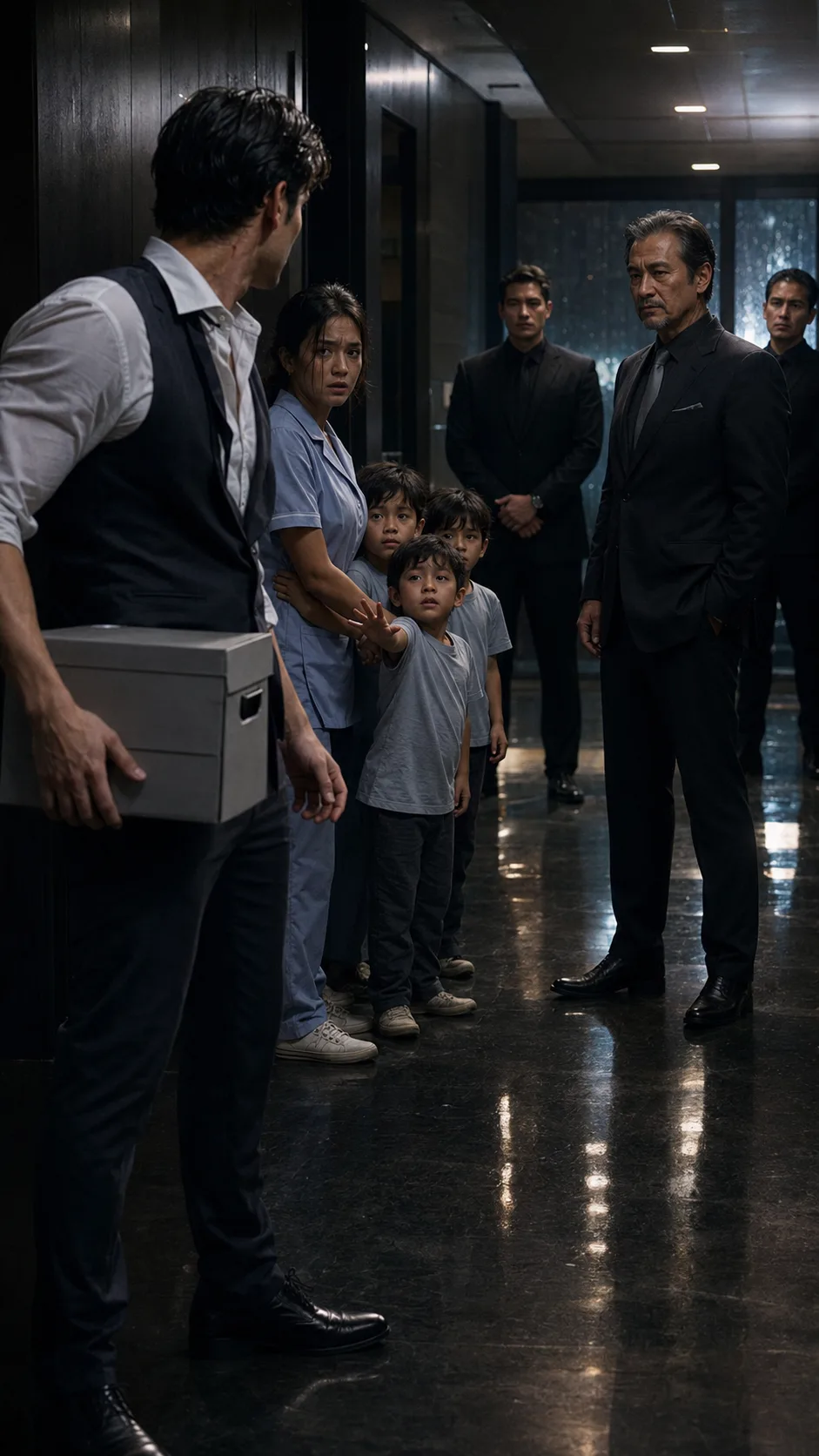
The triplets sat on a bench behind her, bundled together beneath Jonathan’s suit jacket. They looked tiny under it.
In Maria’s hands was a gray archive box.
Jonathan’s pulse jumped.
“You found it?”
Maria nodded.
“And something else.”
She set the box on the floor and opened the lid.
Inside were folders, trust certifications, ledgers, sealed documents, and an encrypted flash drive taped under the cardboard flap.
But on top of everything lay a single envelope.
Jonathan’s full name was written across it in his father’s handwriting.
His hand shook slightly as he picked it up.
He opened it.
The letter inside was short.
Jonathan,
If you are reading this, the theft has begun from inside the house.
Do not protect the men who speak most loudly about saving the company. They are the ones preparing to eat it.
Trust the person in the room with no power.
They are the only one with nothing to gain by lying.
— Dad
Jonathan read it once.
Then again.
Maria watched his face.
“What does it mean?”
Jonathan folded the letter carefully.
“It means he knew.”
A sound came from the end of the hallway.
Footsteps.
Several.
Fast.
Maria turned.
Jonathan stepped in front of her and the children.
Three security officers appeared first.
Then Victor Sloane walked out of the shadows.
He was the board’s outside risk consultant, though Jonathan had never believed that title meant anything honest. Sloane was tall, polished, gray at the temples, with the kind of smile men used when they already knew how the room would end.
His eyes went straight to the box.
“There you are,” Sloane said. “I was afraid you’d found it.”
Maria pulled the boys behind her.
Jonathan kept the box at his side.
“You manufactured the losses.”
Sloane sighed.
“Jonathan.”
“You drained money through shell contracts. You exaggerated the losses. You pushed the layoffs to force an emergency sale.”
“You won’t prove intent.”
Jonathan lifted the envelope.
“My father left enough.”
Sloane’s smile faded a little.
“Your father left many things he should have destroyed.”
Jonathan’s body went cold.
“What does that mean?”
Sloane looked past him.
At Maria.
Then at the boys.
A strange silence entered the hallway.
Sloane tilted his head.
“You still don’t see it?”
Maria’s grip tightened around her sons.
“See what?” Jonathan asked.
Sloane’s smile returned.
Sharper this time.
“Why those boys chose you.”
Jonathan did not answer.
Sloane stepped closer, slow and controlled.
“Twenty-nine years ago, Edward Hale had an affair with a woman who worked in this building. Housekeeping. She disappeared before the scandal could reach the press. There was a child.”
Maria went still.
“No,” she whispered.
Sloane ignored her.
“The child was placed elsewhere. Names were changed. Records were buried. Money moved quietly for years.”
Jonathan stared at Maria.
Maria stared back at him.
Neither of them could speak.
Sloane glanced down at the triplets.
“Blood recognizes blood in strange ways, doesn’t it?”
One of the boys peeked out from behind Maria’s uniform.
Jonathan’s chest tightened.
Sloane’s voice lowered.
“She isn’t only your employee, Mr. Hale.”
Maria shook her head, but no sound came out.
Sloane smiled.
“She’s your sister.”
The hallway seemed to collapse into silence.
Jonathan looked at Maria’s face, at the shape of her eyes, at the line of her jaw, at things he had never allowed himself to notice because men like him were trained not to notice people like her.
The triplets stood frozen behind her.
Then the smallest boy stepped forward.
His lower lip trembled.
He reached one hand toward Jonathan.
And in a voice barely louder than the rain outside, he said,
“Uncle?”
Jonathan nearly dropped the box.
Maria covered her mouth.
Sloane watched them both, satisfied.
“That touching moment won’t save you,” he said. “Hand over the documents.”
Jonathan looked at him.
Then at the children.
Something inside him settled.
Not calmly.
Not gently.
Like a door locking.
“No.”
Sloane’s expression hardened.
“You are outnumbered.”
Jonathan placed the archive box behind him, closer to Maria.
“You followed a night cleaner and three children through a service corridor because you were afraid of what was in this box.”
Sloane said nothing.
Jonathan took one step forward.
“That means I’m not outnumbered. You are exposed.”
One of the security officers shifted.
Just slightly.
But Jonathan saw it.
So did Sloane.
Jonathan raised his voice.
“Every hallway camera on this floor records to an independent server. My father installed it after the fire in 2008. The board never removed it because they never knew it existed.”
Sloane’s smile vanished.
Jonathan continued.
“You just admitted you knew about these documents. You admitted my father should have destroyed them. You came here with security to take them from me before the vote.”
Sloane’s eyes sharpened.
Jonathan reached into his pocket and lifted his phone.
A red recording light glowed on the screen.
Maria stared.
Sloane looked at the phone.
For the first time, fear touched his face.
Jonathan said, “You should have remembered something about my father.”
Sloane’s jaw tightened.
“He hated thieves?” Sloane said.
Jonathan shook his head.
“He hated men who underestimated working people.”
Maria moved then.
Quietly.
She reached into the archive box and pulled out the flash drive.
Sloane lunged one step forward.
Jonathan blocked him.
“Don’t.”
The security officers did not move.
Sloane turned on them.
“Take it.”
No one obeyed.
One guard looked at Jonathan.
Then at Maria.
Then at the three boys standing behind her under the oversized suit jacket.
Finally, he stepped back.
Sloane’s face twisted.
“You have no idea what you’re doing.”
Jonathan looked him straight in the eyes.
“I’m saving my father’s company.”
“No,” Sloane snapped. “You’re giving it away.”
Jonathan looked at Maria.
At the woman who had cleaned his office while carrying a truth no one had ever given her.
At the boys who had walked into his worst night and chosen him before he knew why.
Then he looked back at Sloane.
“No,” Jonathan said. “I’m giving it back.”
By dawn, the emergency boardroom at Hale Industries was full.
Directors arrived angry.
Lawyers arrived nervous.
Security arrived silent.
Maria sat beside Jonathan at the long table, still wearing her blue cleaning uniform. The triplets were asleep in a private waiting room nearby, watched by Jonathan’s assistant, who had cried twice since hearing what had happened.
Victor Sloane was not in the room.
He was already with federal investigators.
The board chair tried to delay the vote.
Jonathan did not let him.
He placed the founder’s documents on the table. Then the ledgers. Then the recorded conversation. Then the original worker equity trust certification signed by Edward Hale himself.
A lawyer read the authorization language aloud.
The room grew colder with every sentence.
The trust could be activated by the CEO under emergency threat of internal asset theft.
Executive ownership would be diluted.
Employee protection would be triggered.
Certain transfers would be frozen.
Mass layoffs would be suspended pending review.
Jonathan signed first.
This time, his hand did not shake.
When he finished, he handed the pen to Maria.
The board chair stiffened.
“She has no authority here.”
Jonathan looked at him.
“She has more than you.”
Maria stared at the document.
“My name isn’t Hale,” she whispered.
Jonathan took his father’s letter from his pocket and placed it beside her hand.
“It should have been.”
Maria held the pen for a long time.
Then she signed as witness.
Not as a cleaner.
Not as someone invisible.
As family.
By noon, the news had broken.
Hale Industries would not lay off three hundred and twenty-eight workers.
A federal investigation had been opened into financial misconduct by board-linked consultants and shell vendors.
The worker equity trust had been activated.
Jonathan Hale had surrendered controlling ownership.
Reporters called it reckless.
Analysts called it historic.
Employees called it something else.
They called it Edward’s promise.
That evening, Jonathan returned to the lobby for the first time without rushing past his father’s portrait.
Maria stood beside him.
The triplets stood between them, each holding one of Jonathan’s fingers.
For a while, no one spoke.
Then Maria looked up at the portrait.
“Did he know about me?”
Jonathan answered honestly.
“I don’t know.”
Maria nodded slowly.
It was not forgiveness.
Not yet.
Maybe not ever.
But it was a beginning.
One of the boys tugged Jonathan’s hand.
“Uncle Jonathan?”
Jonathan looked down.
The boy pointed toward the portrait.
“Is he family too?”
Jonathan looked at Edward Hale’s painted face.
The man who had built an empire.
The man who had hidden a daughter.
The man who had left behind both a wound and a way to repair part of it.
Jonathan squeezed the boy’s hand.
“Yes,” he said. “But family has to earn the name.”
Maria looked at him.
For the first time, she smiled.
Small.
Real.
Outside, the rain had stopped.
Sunlight broke across the lobby windows, spilling gold over the marble floor where employees had begun to gather.
Not because they had been called.
Not because cameras were waiting.
But because word had spread.
The company had survived the night.
And the people who were supposed to be invisible had saved it.
THE END.
Chapter complete
You have reached the end of this chapter.
Continue reading
A few more worlds to get lost in after this chapter.




