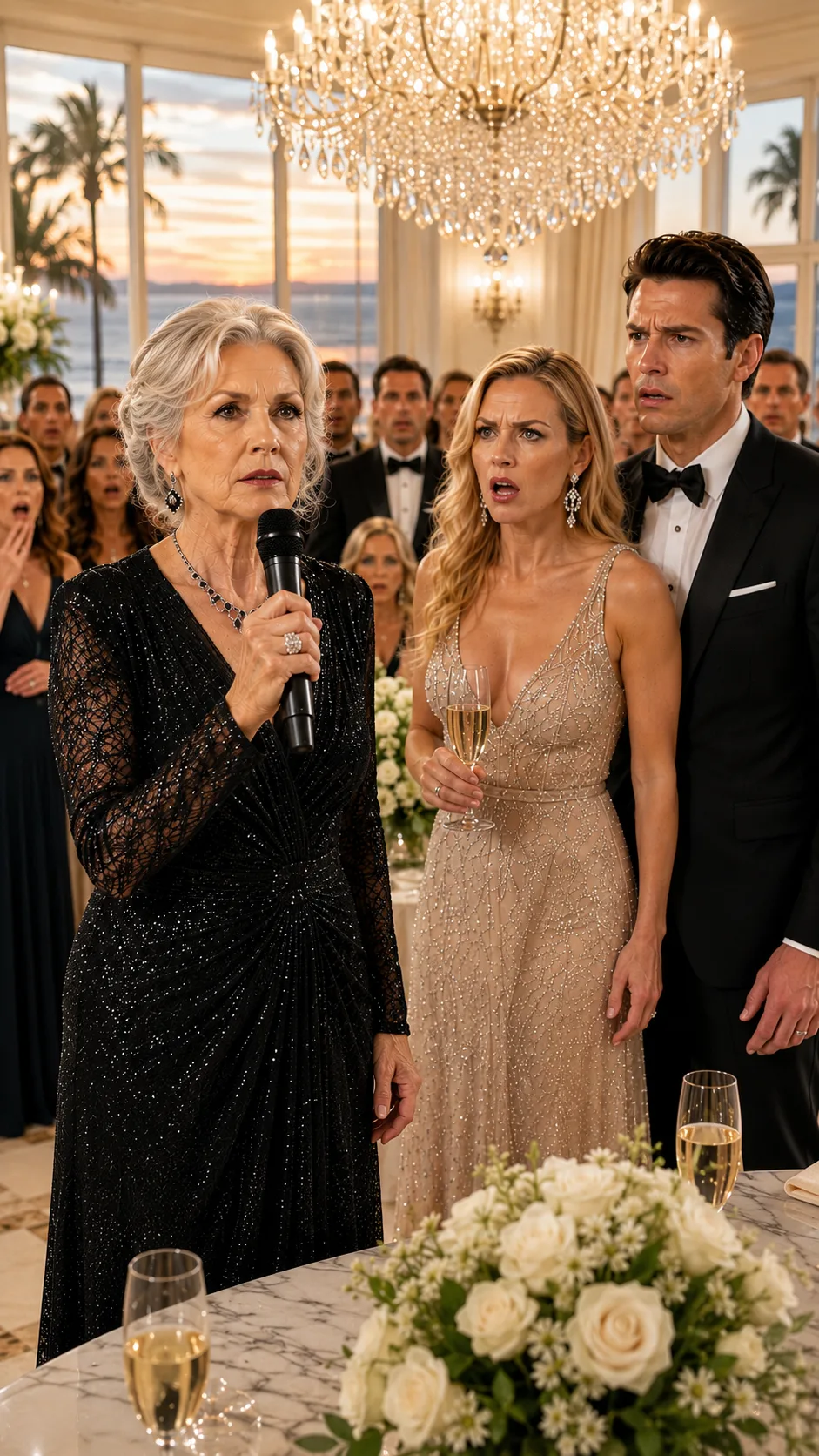
The night Rose Whitmore realized her son was waiting for her to disappear, she was standing beneath a crystal chandelier in her own Malibu mansion, holding a glass of champagne she no longer wanted to drink.
Chapter 1
The night Rose Whitmore realized her son was waiting for her to disappear, she was standing beneath a crystal chandelier in her own Malibu mansion, holding a glass of champagne she no longer wanted to drink.
Two hundred people had come to celebrate her seventieth birthday.
Politicians. Hotel investors. Old friends. Former employees who still called her Mrs. Whitmore with affection in their voices. Magazine editors. Charity board members. People who had watched her build the Whitmore Hotel Group from a single struggling seaside inn into one of the most powerful luxury hotel brands in California.
The room glittered with wealth.
White orchids spilled from silver vases. A string quartet played near the windows. Beyond the glass walls, the Pacific Ocean rolled black and endless beneath the moon.
Everyone was smiling.
Everyone except Rose.
At the center of the room stood her son, Andrew, handsome in a custom navy suit, one hand around his wife’s waist, laughing as if the entire evening belonged to him.
Vanessa Whitmore looked perfect, as always.
Thirty-six years old. Golden hair. Diamond earrings. A champagne silk gown that caught every flash
of every camera. She had built her fame online by filming her life inside Rose’s world—private jets, oceanfront estates, hotel suites, charity galas, lunches in Paris.
She called it “family legacy content.”
Rose had never liked that phrase.
Because Vanessa had not built the legacy.
Andrew had not built it either.
Rose had.
She had built it while raising Andrew alone after his father died. She had built it through sleepless nights, brutal negotiations, betrayals, lawsuits, recessions, and men who smiled at her across conference tables while quietly hoping she would fail.
But she had not failed.
She had won.
And somehow, that victory had become the very thing that taught her son he never needed to become strong.
At first, Andrew’s entitlement had been easy to excuse.
He was young.
He had lost his father.
He had grown up surrounded by wealth, so maybe he did not understand what
it had cost.
Rose told herself that love meant patience.
Then Andrew became a man.
Then he married Vanessa.
And patience began to feel like self-betrayal.
“Mom,” Andrew had said three weeks before the party, while scrolling through his phone at lunch, “you really should start thinking about transition planning.”
Rose had looked at him over her tea.
“Transition planning?”
“You know. Stepping back. Letting the next generation take over.”
Vanessa smiled without looking up from her camera.
“Your audience would love that, Rose. A graceful queen passing the crown.”
Rose had smiled politely.
But something inside her had gone still.
The next generation.
The crown.
As if Rose were already a portrait on the wall.
As if she were not sitting there, breathing, thinking, leading, living.
That was the strange thing about being rich and old.
People did not always wait for you to die.
Sometimes, they started dividing
you while you were still speaking.
At the birthday party, Vanessa took the microphone after dessert.
Rose had not expected a speech from her.
Andrew looked pleased.
Vanessa lifted her champagne glass and smiled toward the crowd.
“Tonight, we celebrate Rose Whitmore,” she said brightly. “An icon, a visionary, and the woman who built everything this family has.”
Applause filled the room.
Rose nodded once.
Then Vanessa laughed softly.
“And of course, we all know that one day Andrew will take over all of this.”
A few guests chuckled.
Andrew laughed too.
Rose’s fingers tightened around her glass.
Vanessa turned slightly, her smile widening for the cameras.
“Hopefully,” she added, “that day is not too far away.”
The room froze.
The string quartet faltered.
A fork clicked against a plate.
Somewhere near the windows, an older woman gasped quietly.
Rose did not move.
She simply looked at her son.
Andrew’s smile faded, but not because he was offended.
Because he knew other people expected him to be.
He looked at Vanessa.
Then at the guests.
Then back at his mother.
And said nothing.
Not one word.
That silence told Rose the truth more clearly than any insult could have.
In that moment, she understood.
Andrew did not see her as his mother anymore.
Vanessa did not see her as a living woman.
To them, Rose Whitmore was a delay.
A signature that had not yet happened.
A fortune with a heartbeat.
Rose placed her untouched champagne glass on a passing tray.
Then she stepped forward and took the microphone from Vanessa’s hand.
Her daughter-in-law blinked.
The entire room held its breath.
Rose smiled.
It was a small smile.
Elegant. Controlled. Terrifying.
“Thank you, Vanessa,” Rose said. “That was very revealing.”
No one laughed.
Andrew’s face tightened.
Rose turned to the crowd.
“I have spent forty years building things people said a woman could not build. Hotels. Careers. Foundations. A life.” Her voice remained calm. “Tonight, I realize I have one more thing to build.”
She looked directly at Andrew.
“Distance.”
Then Rose handed the microphone back, turned, and walked out of her own birthday party.
By sunrise, every gossip column in California had a version of the story.
By noon, Vanessa had posted a tearful video about being misunderstood.
By evening, Andrew had called his mother sixteen times.
Rose did not answer.
One month later, Rose Whitmore announced she was taking an extended private sabbatical.
She resigned from all daily leadership positions.
She appointed a temporary management committee.
She canceled public appearances.
Then she vanished.
No interviews.
No hotel visits.
No charity galas.
No family dinners.
Her Malibu mansion was closed.
Her New York penthouse was empty.
Her Paris apartment was rented quietly to a diplomat.
Andrew told people his mother needed rest.
Vanessa told her followers Rose was “entering her soft life era.”
But privately, Andrew was panicking.
Not because his mother was gone.
Because the papers were gone too.
The transfer agreements he had assumed existed.
The estate plans he thought were obvious.
The board approvals he believed were only a formality.
Nothing was where he expected it to be.
Six months later, Andrew walked into a special shareholder meeting wearing the confident expression of a man who had rehearsed his victory in the mirror.
He believed the company would finally become his.
Instead, Rose’s longtime attorney stood at the front of the room and opened a slim leather binder.
“Mrs. Whitmore prepared this structure two years ago,” the attorney said. “The majority of her personal holdings were placed into an independent trust.”
Andrew’s face changed.
Vanessa sat beside him, perfectly still.
“The trust cannot be controlled, sold, inherited directly, or redirected by Mr. Andrew Whitmore,” the attorney continued.
Andrew stood.
“That’s impossible.”
The attorney looked at him calmly.
“It is not.”
Vanessa gripped his sleeve.
“What does that mean?” she whispered.
The attorney turned a page.
“In order to receive a meaningful equity position, Mr. Whitmore must complete ten years of employment within the company, beginning at a standard operational level, with performance reviews conducted by an independent committee.”
Andrew stared at him.
“A standard operational level?”
“Yes.”
“What does that mean?”
The attorney paused.
“It means your mother did not leave you a throne, Mr. Whitmore. She left you an entrance.”
Vanessa went pale.
Andrew laughed once, sharply.
“This is ridiculous. I’m her son.”
“Yes,” the attorney said. “That is why she gave you the chance to earn what others spend their lives earning.”
The room was silent.
For the first time in his life, Andrew Whitmore had no shortcut.
No mother to call.
No check to request.
No signature to pressure.
No future guaranteed simply because he had been born near it.
Meanwhile, Rose was in Italy.
Not in hiding.
In peace.
She had bought a small villa on the Amalfi Coast, painted pale yellow, with blue shutters and lemon trees growing along the stone path.
It was not the largest home she had ever owned.
It was simply the first one that felt entirely hers.
She woke each morning to sunlight on the sea.
She learned to make pasta from an elderly neighbor named Lucia.
She took painting lessons from a retired art professor who did not care who she was.
She walked through markets in linen dresses and sandals.
Sometimes, people recognized her.
Most did not.
She liked both.
For forty years, Rose had been needed.
Needed to lead. Needed to decide. Needed to rescue. Needed to provide. Needed to fix what others broke.
Now, no one needed her before breakfast.
At first, the silence frightened her.
Then it healed her.
Two years passed.
Andrew changed slower than he wanted to admit.
The first months were ugly.
He blamed Rose.
He blamed Vanessa.
He blamed the attorneys.
He blamed the board.
He blamed everyone except the man in the mirror.
Vanessa left when the lifestyle stopped looking effortless.
Her followers never saw the worst of it.
They only saw her smiling in new cities, beside new men, using the phrase “growth season” as if it had not been funded by someone else’s mother.
Andrew, for the first time, had to apply for a position inside the company his mother built.
He was not welcomed as a prince.
He was placed in hotel operations.
Guest complaints. Vendor schedules. Linen shortages. Staff training. Night audits.
At first, he hated it.
Then something unexpected happened.
He met people who had worked for Rose for twenty years.
People who remembered her walking kitchens at midnight.
People who remembered her learning housekeepers’ names.
People who remembered her sending checks quietly when employees had sick children, flooded homes, dying parents.
“She was tough,” one manager told Andrew. “But she saw people.”
Andrew had no answer.
Because he was beginning to understand that he had never really seen her.
Not as a woman.
Not as a mother.
Only as a source.
Two years after Rose disappeared, Andrew found her.
Not through investigators.
Not through pressure.
Through a handwritten postcard she sent to an old hotel chef who had once made Andrew pancakes when he was six.
The chef gave Andrew the address after staring at him for a long time.
“Don’t go there asking for money,” the chef said.
Andrew swallowed.
“I’m not.”
When Andrew arrived at Rose’s villa, she was on the terrace, painting the sea.
Her hair was silver now, pinned loosely at the back of her neck. She wore a white linen shirt with paint on the cuff. She looked smaller than he remembered.
But not weaker.
Never weaker.
“Hello, Andrew,” she said.
He stood there like a boy who had forgotten how doors worked.
“Mom.”
Rose set down her brush.
For a moment, neither of them moved.
Then Andrew’s face broke.
“I thought you abandoned me.”
Rose looked at him for a long time.
The sea wind moved gently between them.
“No,” she said. “I stopped funding a grown man.”
Andrew flinched.
But he did not argue.
That was how Rose knew something had changed.
The old Andrew would have defended himself.
The old Andrew would have accused her of cruelty.
The old Andrew would have reminded her he was her only son.
This Andrew simply lowered his head.
“I deserved that,” he said.
Rose studied him.
“Yes,” she replied.
He laughed through tears, because there was nothing else to do.
“I lost Vanessa.”
“I know.”
“I lost most of my friends.”
“I imagine they were expensive.”
A broken smile crossed his face.
Then it disappeared.
“I started at the hotel.”
“I know.”
“I’m not good at it yet.”
“No,” Rose said. “You probably are not.”
He looked up.
“But I’m trying.”
Rose’s eyes softened.
“That matters.”
Andrew sat across from her on the terrace.
For the first time in years, he did not ask for anything.
Not money.
Not forgiveness.
Not rescue.
He simply told her the truth.
That he had been spoiled.
That he had mistaken inheritance for love.
That he had laughed at Vanessa’s speech because part of him agreed with her.
That he had spent his life waiting to receive what his mother had spent her life becoming.
Rose listened.
She did not interrupt.
When he finished, the sun had lowered over the water.
“I’m sorry,” Andrew said.
Rose nodded.
“I believe you.”
His eyes filled again.
“Will you come home?”
Rose looked toward the sea.
“No.”
The answer was gentle.
But final.
Andrew inhaled slowly.
“Will you ever give me the company?”
Rose turned back to him.
“No.”
This time, the word landed harder.
“You may earn a place in it,” she said. “You may become useful. You may become respected. You may even become good. But I will not hand you a life simply because you refused to build one.”
Andrew looked down at his hands.
They were softer than hers had ever been.
“I understand,” he whispered.
Rose smiled faintly.
“For the first time, I think you might.”
He stayed for dinner.
Lucia brought pasta.
Rose opened wine.
They did not fix everything.
Real life did not work that way.
But something quiet began.
Not a reunion built on money.
Not a family performance for cameras.
Just a mother and son learning how to speak without a fortune standing between them.
The next morning, Andrew flew back to California.
Rose stayed in Italy.
She painted badly.
Cooked better.
Laughed more.
Sometimes she missed her son.
But she no longer missed the version of herself who believed love meant endless rescue.
Three months later, Rose sat on her balcony at sunset, wrapped in a cream shawl, watching the Mediterranean turn gold.
Her phone buzzed.
A message from Andrew.
Mom, I got promoted to junior operations manager today.
A second message appeared.
First thing I ever earned myself.
Rose read the words twice.
Then she smiled.
Not because her son had become rich.
Not because he had inherited power.
Not because the family name had been preserved.
She smiled because somewhere across the world, Andrew Whitmore had finally taken his first real step into manhood.
And Rose understood then that the greatest gift she had ever given him was not the hotels.
Not the houses.
Not the hundreds of millions of dollars people had whispered about for years.
It was the one thing he had hated her for giving him.
The chance to become someone without her money.
Below the balcony, the sea moved endlessly against the rocks.
Rose picked up her paintbrush.
For the first time in her life, she did not feel guilty for being happy.
And when the sun disappeared behind the water, Rose Whitmore did not go inside to answer anyone’s call.
She stayed exactly where she was.
Free.
THE END.
-There are things people said I should have noticed sooner.-
Chapter complete
You have reached the end of this chapter.
Continue reading
A few more worlds to get lost in after this chapter.




