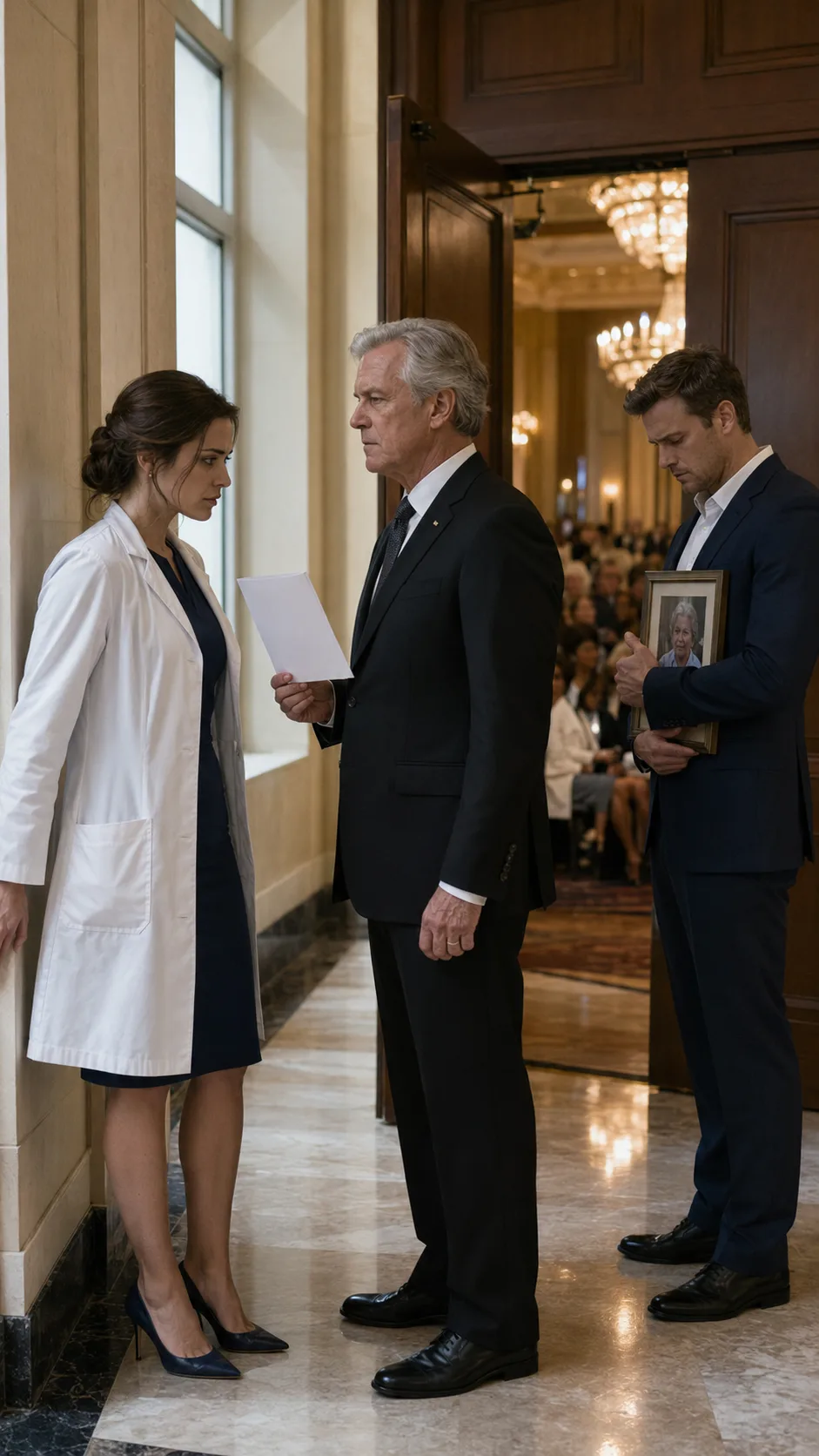
THE NIGHT HER FATHER GAVE HER MIRACLE TO HER BROTHER BEFORE THE FIRST PATIENT STOOD UP
PART 3 — THE SURGEON THEY COULD NOT HIDE
I stood under the stage lights with Mrs.
Chapter 2
THE NIGHT HER FATHER GAVE HER MIRACLE TO HER BROTHER BEFORE THE FIRST PATIENT STOOD UP
PART 3 — THE SURGEON THEY COULD NOT HIDE
I stood under the stage lights with Mrs.
Alvarez’s note in Daniel’s hand and the award shaking between mine.
For years, I had imagined what it would feel like if my father finally had no choice but to see me.
I thought it would feel like victory.
Instead, it felt like grief.
Grief for the little girl who brought home perfect grades and watched her father ask Daniel about soccer. Grief for the teenager who won scholarships and still heard, “Don’t get too proud.” Grief for the woman who became a surgeon and still waited for one dinner where her father said, “I’m proud of you,” without turning it into a lesson about humility.
I looked at Martin Scott.
He looked older now.
Not weaker. Not sorry.
Just exposed.
I turned to the technician near the stage curtain. “Please change the slide.”
The technician froze.
Dr. Grant spoke from the front row. “Change it.”
The screen went black.
Then my name appeared.
Presented by Dr. Abigail Scott
The applause rose slowly, then fiercely, until the chandelier above us seemed to tremble.
I closed my eyes for one second.
When I opened them, Daniel was standing beside me, but not in front of me.
That mattered.
I leaned toward the microphone.
“My father once told me legacy needs a man standing in front of it.”
The room quieted.
“I believed him longer than I should have.”
Martin’s jaw tightened.
“I believed excellence would make me undeniable. I believed if I worked harder, stayed calmer, spoke softer, and achieved more, I might finally earn a place in the family I was born into.”
My voice stayed steady.
“But tonight, I learned something. Some people do not fail to see you because you are invisible. They fail to see you because seeing you would prove them wrong.”
A low murmur passed
through the audience.
I turned toward Daniel.
“My brother could have taken this moment.”
Daniel’s eyes lowered.
“But he didn’t. Not when it mattered most.”
He looked at me, and for the first time, I did not see the favorite son. I saw another child my father had shaped with fear.
Daniel stepped to the microphone.
“I spent my life being rewarded for standing where Abby should have stood,” he said. “I told myself I hadn’t asked for it. But silence can still become a choice.”
My father’s face hardened. “Daniel, stop.”
Daniel looked at him.
“No.”
One word.
Quiet.
Final.
The room went still.
Daniel continued, “You told me carrying the Scott name meant protecting it. But Abby made that name worth hearing tonight.”
My father’s hands curled at his sides.
“You think applause is loyalty?” Martin said. His voice carried through the hall. “You think these people will
stay when things become difficult? Family is what remains when the room empties.”
I looked at him for a long moment.
“Then why,” I asked, “did I feel most alone at our family table?”
He flinched.
It was small, but everyone saw it.
The cameras caught it. The donors caught it. Daniel caught it.
For once, my father had no lecture strong enough to cover the truth.
Mrs. Alvarez squeezed my hand.
I looked at the award.
Then I looked at my team — Lena, Dr. Grant, the residents who had stayed past midnight, the nurses who had corrected me when exhaustion made me careless, the patients who trusted me when the procedure was still only a possibility.
“This breakthrough was never about the Scott name,” I said. “It was about people who were told hope had run out.”
The screen changed behind me.
Photos appeared one by one.
Mrs. Alvarez holding her granddaughter.
Robert Hill walking slowly in a hospital garden.
Elaine Brooks smiling beside her daughter after six weeks of recovery.
“These are the people I operated on,” I said. “These are the lives my team fought for. And if there is any legacy here tonight, it belongs to every patient who trusted us before the world believed us.”
This time, the applause did not feel like thunder.
It felt like release.
Dr. Grant placed her hand on my shoulder.
“Take your bow, Doctor,” she whispered.
Doctor.
Not daughter.
Not sister.
Not someone’s legacy.
Me.
I bowed my head.
When I lifted it, my father was walking toward the exit.
For one second, I almost called after him.
The old instinct rose inside me — fix it, soften it, make him less angry, save the family from the truth.
Then Daniel touched my elbow.
“Let him go,” he said.
So I did.
Martin Scott walked out alone.
The doors closed behind him.
And for the first time in my life, I did not follow.
By morning, the video was everywhere.
Some people called Daniel a hero. He hated that.
“I waited too long,” he told me two days later, sitting across from me in the hospital cafeteria with untouched coffee between us. “Don’t let them turn me into the good guy.”
I studied him.
“I won’t,” I said.
He nodded, accepting that.
Then he said, “Can I still earn being your brother?”
That question hurt more than I expected.
Because for most of my life, I had wanted to hate him. Hating him would have been easier than admitting we had both been children in a house where love came with assigned seats.
“You can start,” I said.
And he did.
Daniel stepped down from three committees where my father had placed him. He joined my research team as a surgeon, not a symbol. He corrected reporters when they praised him too much. He said my name first. Every time.
My father disappeared from public events.
For six weeks, I heard nothing from him.
Then an email arrived.
You deserved your name on the screen.
I stared at that sentence for almost ten minutes.
Then I replied.
Yes. I did.
Nothing more.
A month later, I found him in the lobby of the new research wing, standing beneath the sign the hospital had installed that morning.
The Abigail Scott Cardiac Innovation Lab.
He looked smaller without an audience.
Older without certainty.
He held two paper cups of coffee.
“I didn’t know what you drink anymore,” he said.
I looked at the cup.
Black coffee.
Wrong.
“You never knew,” I said.
His eyes dropped.
“I know.”
We sat on a bench near the windows, surrounded by the quiet movement of doctors and nurses changing shifts.
For a while, neither of us spoke.
Then he said, “When you were seven, you built a hospital out of cereal boxes.”
I turned toward him.
“You remember that?”
He nodded slowly. “You told me every room needed a window, so patients would know the world was still waiting for them.”
My throat tightened.
He looked at the lab sign again.
“I should have seen you then.”
It was not enough.
It could never be enough.
But it was the first honest thing he had given me without asking for something in return.
“You can start by seeing me now,” I said.
He nodded.
There was no perfect hug. No instant forgiveness. No magic ending that erased years of being made smaller.
But I did not need that anymore.
The next morning, I walked into my lab with my name on the door, my brother beside me, my team waiting, and another patient scheduled for surgery.
Before I scrubbed in, Mrs. Alvarez’s granddaughter sent me a photo.
It was Mrs. Alvarez at home, sitting at a kitchen table, smiling beside a birthday cake.
The message said:
She made it to my birthday because of you.
I held the phone to my chest and closed my eyes.
That was the real applause.
Not the ballroom.
Not the cameras.
Not my father’s approval.
A woman got more time with her family.
And no one could take my name from that.
When I walked into the operating room, Daniel was already there.
He looked at me and said, “Lead surgeon?”
I smiled.
“Always.”
Then I lifted my hands for the gloves, steady and ready.
The world had finally seen me.
But the miracle was not that my father saw me too late.
The miracle was that I no longer needed him to see me first.
THE END.
Chapter complete
You have reached the end of this chapter.
Continue reading
A few more worlds to get lost in after this chapter.




