The Night He Left Me in the Snow
The cold hit like a judgment.
Chapter 1
The cold hit like a judgment.
It did not creep in slowly.
It slammed into my face the moment Caleb Rowe opened the truck door and told me to get out.
I was eleven years old.
The road behind us had disappeared beneath the blizzard. Snow whipped across the windshield in violent white sheets, and the dark pine trees of western Montana stood on both sides like silent witnesses.
For almost an hour, Caleb had driven without speaking.
No radio.
No questions.
No explanation.
Just the growl of the old truck engine and the broken heater coughing weak air into the cab.
I sat frozen in the passenger seat, clutching the torn sleeve of my jacket with both hands. My sneakers were already damp. My toes had gone numb miles ago. Beside me, Caleb stared straight ahead, his face hard and empty.
Then he pulled over.
The truck stopped in the middle of nowhere.
“Get out,”
he said.
He did not shout.
That was what frightened me most.
If Caleb had yelled, I might have believed this was just another one of his storms. Another drunken rage. Another ugly night that would eventually pass.
But his voice was calm.
Flat.
Final.
I turned toward him slowly.
“What?”
His jaw tightened.
“I said get out, Noah.”
My heart began pounding so hard I could hear it in my ears.
I looked out the window. There was nothing. No houses. No lights. No town. Only snow, darkness, and trees.
“Caleb, please,” I whispered. “I didn’t do anything.”
He finally looked at me.
There was no anger in his eyes.
Only exhaustion.
And something colder than hate.
His hand shot out and grabbed the front of my jacket.
Before I could scream, he shoved me out of the truck.
I hit the snow hard.
The air flew from my
lungs. Ice rushed down my collar and burned against my skin. I rolled onto my side, coughing, my fingers clawing at the frozen road.
The door slammed.
The truck engine roared.
“Please!” I cried, staggering to my feet. “Please don’t leave me!”
The truck lurched forward.
Then something heavy tumbled from the back of the truck and landed in the snow beside me.
A sharp bark cut through the storm.
“Ranger!”
My dog leaped up from the drift, shaking snow from his black-and-brown fur. His ears stood high. His body shook with cold and fury as he barked after the truck.
For one second, the brake lights glowed red through the snow.
Hope tore through my chest.
Maybe Caleb would stop.
Maybe he would realize what he had done.
Maybe he would remember that he was still human.
But the truck only sped away.
The red lights vanished into the
blizzard.
And then there was only silence.
Ranger pressed against my leg.
I dropped to my knees and wrapped my arms around his neck.
He was warm.
Alive.
Real.
The only thing in the world that had not abandoned me.
“We have to walk,” I whispered.
I had no idea where.
But I knew one thing.
If we stayed there, we would die.
So I stood up.
And Ranger walked beside me.
The road disappeared beneath the snow within minutes. The wind pushed against us like invisible hands trying to turn us back. My fingers burned, then went numb. My feet felt like blocks of wood inside my soaked sneakers.
Every few minutes, I looked behind me.
I kept thinking I would see Caleb’s headlights.
I never did.
Ranger suddenly stopped.
He turned toward the trees.
His body went stiff.
“What is it?” I whispered.
He did not bark.
That scared me more.
Ranger only went quiet when something was truly wrong.
Then he moved off the road.
I followed him because I had nothing else to trust.
We pushed through snowdrifts and broken branches until I saw something dark ahead.
A cabin.
It was old and half-buried under snow. One shutter hung loose. The roof sagged on one side. The porch looked like it had not held a human footstep in years.
But it had a door.
And that was enough.
I shoved it open with my shoulder.
The hinges groaned.
Inside, it was still freezing, but the wind could not reach us anymore.
There was a rusted stove, an overturned chair, a broken table, and a pile of old blankets in the corner. They smelled like dust and mice.
I did not care.
I wrapped one around myself and pulled Ranger close.
For the first time since Caleb had stopped the truck, I allowed myself to think about my mother.
Elise Rowe.
My mother had been sick for months. Not the kind of sickness people noticed all at once. It was quieter than that. She coughed into her sleeve. She moved slower. She apologized too often.
Caleb drank more.
The bills piled higher.
The shouting got worse.
And somehow, I became the thing he blamed.
I remembered my mother standing between us.
Again and again.
Her voice trembling but firm.
“Don’t touch him, Caleb.”
Then, two nights before, I had woken up and seen Caleb outside under the yard light, scrubbing something dark from the back bumper of his truck.
I had not understood it then.
In the cabin, wrapped in a filthy blanket while snow screamed against the walls, I began to feel that everything was connected.
Then Ranger lifted his head.
Voices.
Outside.
Men shouting through the storm.
I froze.
A flashlight beam swept across the cracked window.
Ranger stood in front of me, growling low in his throat.
A man’s voice shouted, “Check the old line shack!”
Before I could move, the door burst open.
A man in a sheriff’s winter coat stood in the doorway, flashlight raised.
Snow blew around him like smoke.
He saw me.
His face changed instantly.
“Dear God,” he breathed. “It’s a boy.”
After that, everything became broken pieces.
Strong arms lifting me.
A warm truck.
A woman wrapping towels around my hands.
A radio crackling.
“We found him. And the dog.”
Found me.
As if people had already been searching.
When I woke up, the ceiling was white.
The room smelled like medicine.
A hospital.
For one terrible second, I thought I had dreamed the snow.
Then I saw the bandages around my fingers.
And Ranger sleeping on a blanket near the heater.
A woman sat beside my bed.
She had tired eyes, silver in her dark hair, and a sheriff’s jacket over the back of her chair.
“My name is Sheriff Lena Voss,” she said gently. “You’re safe now.”
My throat hurt when I spoke.
“Where’s my mom?”
Something painful moved across her face.
“She’s alive,” Sheriff Voss said. “But she’s in another hospital.”
My chest tightened.
“What happened?”
She leaned closer.
“That’s what I need you to help me understand.”
So I told her.
About the truck.
The road.
Caleb’s hand on my jacket.
Ranger jumping after me.
The more I spoke, the more the truth spilled out. Caleb’s drinking. His anger. My mother’s fear. The strange phone calls. The night I saw him washing the bumper.
Sheriff Voss did not interrupt.
When I finished, she sat very still.
Then she said, “Noah, the men who found you were not only searching because of the storm.”
I stared at her.
“They were looking for a vehicle connected to a hit-and-run.”
My stomach dropped.
“The victim was a woman,” she said carefully. “She was found near Millhaven. She was still alive when the ambulance took her.”
I could barely breathe.
“Your mother.”
“No,” I whispered. “Caleb said she was at her sister’s.”
“I know what he said.”
“Did he do it?”
Sheriff Voss did not answer right away.
But her silence told me everything.
My mother had tried to leave him.
She had called a domestic violence hotline from a grocery store pay phone. She had made a plan. She had hidden documents. She was going to take me and run.
Caleb found out.
He followed her during the storm.
Her car went off the highway.
The marks on the side of her vehicle matched his truck.
He left her there.
Then he came home.
Woke me up.
And drove me into the mountains.
I was not a child he forgot.
I was a witness he tried to erase.
For two days, I stayed in the hospital.
I stopped sleeping.
Every time I closed my eyes, I saw the truck door opening. Caleb’s hand. The red lights disappearing into the snow.
Only Ranger could calm me down.
He would push his nose under my hand until I remembered that I was still alive.
On the third day, Sheriff Voss came into my room.
Her expression was different.
Softer.
“Your mother is awake.”
I started crying before I even understood why.
She drove me to the hospital in Helena.
Ranger rode in the back seat beside a deputy who kept sneaking him crackers.
My mother looked so small in the hospital bed.
Bruises marked one side of her face. Her arm was in a cast. Tubes surrounded her. But when she saw me standing in the doorway, her eyes filled with tears.
“Noah.”
I ran to her.
She pulled me against her with one arm and held me like someone might still take me away.
“I’m sorry,” she whispered into my hair. “I’m so sorry.”
“It’s okay,” I lied.
“No,” she said, crying harder. “It isn’t.”
When she was strong enough to speak, she told Sheriff Voss the rest.
Caleb had debts.
Huge debts.
He had taken insurance policies without explaining them.
He had forged signatures on papers connected to land my mother inherited from her father.
Mountain land.
Land everyone once thought was worthless.
Then she found an envelope hidden under the floorboards in Caleb’s shed.
Inside were property maps, old survey papers, letters from a mining company, and notes about rare earth deposits.
A lot of them.
Enough to make the land worth millions.
Sheriff Voss’s face hardened.
“Caleb knew?”
My mother closed her eyes.
“I think he knew enough.”
That was when I understood.
Caleb had not left me in the snow only because he hated me.
He had left me there because I was standing between him and a fortune.
And somehow, that hurt even more.
Caleb disappeared.
For six days, police searched for him.
They checked roads, hunting cabins, bars, friends’ houses, and abandoned work sites.
On the seventh day, they found his truck near the Idaho border.
It had been wiped clean.
But not clean enough.
They found dog hair in the back.
They found traces that connected him to my mother’s crash.
Still, Caleb was gone.
Reporters began calling me the boy who survived the blizzard with his loyal dog.
I hated that.
It made the story sound simple.
It made survival sound heroic.
It did not show the nightmares.
It did not show my mother flinching every time a door slammed.
It did not show me lying awake, listening for tires in the driveway.
Then, on the ninth night, Ranger began to growl.
We were staying in a safe house on the edge of town.
My mother was asleep upstairs.
I was on the couch under a blanket, staring at the dark window, when Ranger lifted his head toward the back door.
The porch light was off.
But I saw movement.
A shadow outside the kitchen window.
The back door handle turned.
Once.
Twice.
My blood went cold.
Then a voice came softly through the wood.
“Noah.”
Caleb.
“Open the door, buddy. I just want to talk.”
Ranger exploded into barking.
I grabbed the emergency phone Sheriff Voss had given us and pressed the speed dial with shaking fingers.
The dispatcher answered.
I could barely speak.
“He’s here,” I whispered. “He’s here.”
Outside, Caleb’s voice became sharper.
“They’ve been lying to you. Your mother doesn’t understand what she’s done.”
Ranger planted himself between me and the door.
Then another voice cut through the darkness.
“Step away from the door, Caleb.”
Sheriff Voss.
Everything happened fast.
Caleb ran.
Deputies shouted.
Flashlights swept across the yard.
There was a crash near the fence.
A gunshot cracked through the night.
I screamed.
My mother screamed upstairs.
Then Sheriff Voss’s voice rang out again.
“Drop it!”
A few moments later, silence returned.
The longest silence of my life.
When the door finally opened, Sheriff Voss stood there with snow on her shoulders.
“It’s over,” she said.
But her face told me something else.
Behind her, under a deputy’s flashlight, Caleb was being pulled from the snow.
In his gloved hand was a folder.
Old.
Yellowed.
Water-stained.
Maps.
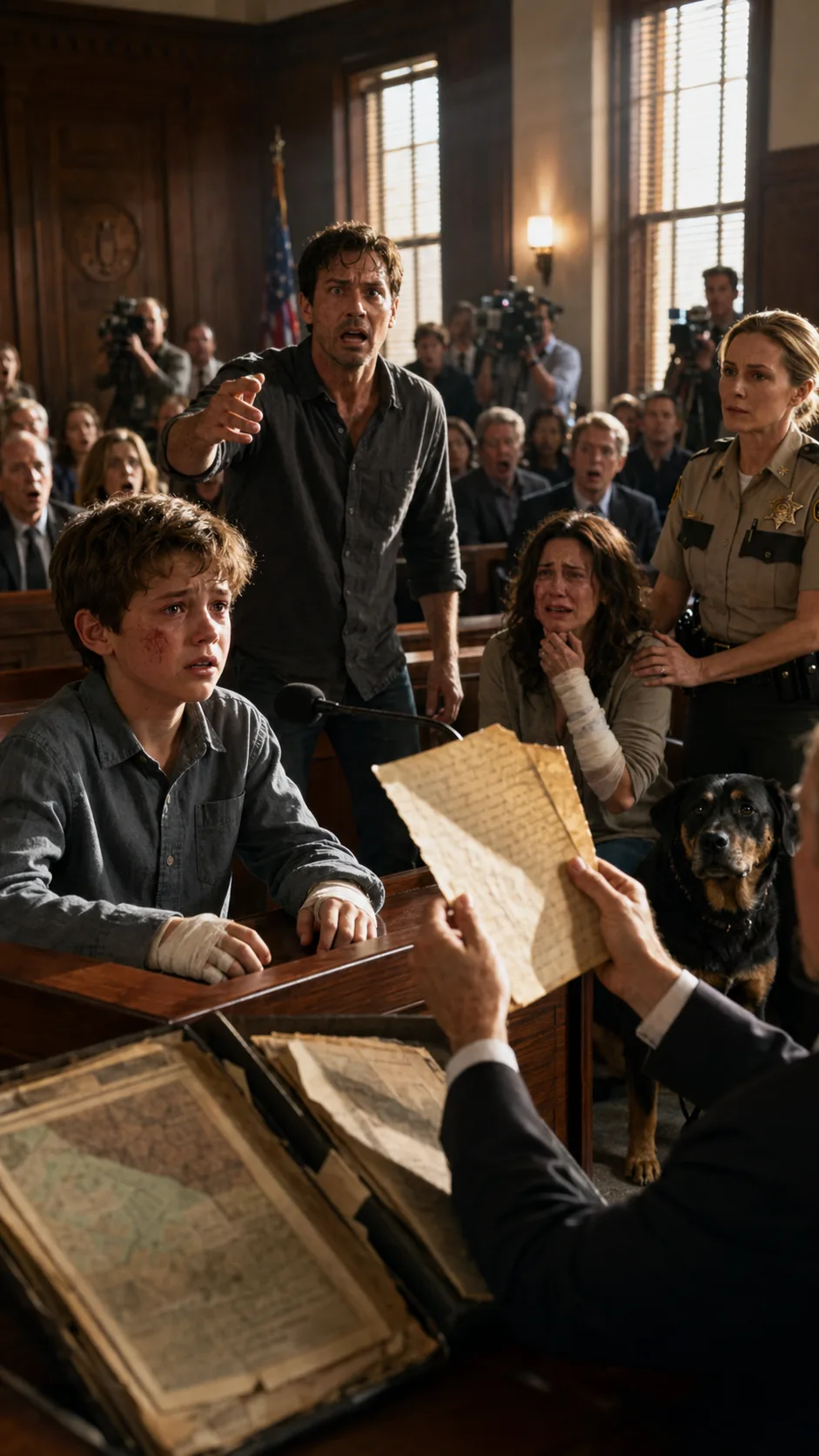
The trial began in spring.
By then, the snow had melted, but the cold had not left me.
Caleb was charged with attempted murder, child endangerment, domestic abuse, witness tampering, and fleeing the law.
My mother testified first.
She was calm.
Precise.
Devastating.
Then it was my turn.
I told the courtroom about the truck.
The road.
The storm.
Caleb’s voice.
Ranger leaping after me.
I thought I would fall apart, but every time my voice shook, I looked toward the back of the courtroom.
Ranger sat beside Sheriff Voss.
Steady.
Watching.
Like proof that I had survived.
Caleb never looked at me.
Not once.
Until the prosecutor brought out the folder.
Inside were survey maps, mineral estimates, draft contracts, and handwritten notes.
Proof that Caleb had been negotiating with a private extraction company, planning to take control of my mother’s land after her death.
People gasped.
The judge ordered silence.
Then the prosecutor opened the final sealed item in the folder.
A letter.
Not from Caleb.
From my grandfather.
Written twenty-three years earlier.
Addressed to me.
Noah.
I frowned.
“That’s impossible,” I whispered.
My grandfather died before I was born.
The judge read the opening line aloud.
If this letter reaches my grandson Noah, then the truth stayed buried longer than I hoped…
The courtroom went still.
My mother made a broken sound behind me.
The letter explained everything.
My grandfather had hidden the mineral rights inside a trust.
Not under my mother’s name.
Not under Caleb’s.
Under the name of a future heir.
A grandson.
Me.
The land was mine.
The minerals were mine.
Everything Caleb wanted had never truly belonged to my mother.
It belonged to the child he had thrown into the snow.
The courtroom erupted.
Reporters stood.
My mother sobbed.
Sheriff Voss placed a hand on her shoulder.
And Caleb finally looked at me.
For the first time, I saw fear in his eyes.
Not guilt.
Not sorrow.
Fear.
The fear of a man realizing the child he tried to erase had been the one person he could never afford to lose.
Then Caleb suddenly jumped to his feet.
“He was never supposed to know!” he shouted.
The words crashed through the courtroom like thunder.
The judge slammed the gavel.
But it was too late.
Everyone had heard him.
That was the moment the case ended.
Caleb Rowe was sentenced to seventy-three years in prison.
The mineral rights were placed under court protection until I turned eighteen. My mother used emergency funds from the trust to buy a small blue house outside Helena with a fenced yard for Ranger.
People called us lucky.
They were wrong.
Lucky is finding money in an old coat.
Lucky is missing a bus and avoiding an accident.
What happened to us was not luck.
It was survival.
And survival always has a cost.
Years later, after I turned eighteen, Sheriff Voss drove me and my mother back to that mountain road.
Ranger came too.
He was old by then, gray around the muzzle, but he still sat tall in the back seat like he was guarding the whole world.
The snow was gone.
The pines were green.
The sky was bright and painfully beautiful.
We found the bend in the road.
The place where Caleb had opened the truck door.
I stood there for a long time.
Then I knelt and placed my hand against the earth.
Not because I forgave him.
Not because I needed closure.
But because the ground he had chosen as my grave had become the place where my life refused to end.
Ranger leaned against my side.
My mother took my hand.
And under the wide Montana sky, with no storm left to outrun, I finally understood the truth.
Caleb had abandoned me in the snow because he thought I was the weakest thing in that truck.
He was wrong.
THE END.
Chapter complete
You have reached the end of this chapter.
Continue reading
A few more worlds to get lost in after this chapter.




