The morning Rose Bennett won eighty million dollars, she was standing in the checkout line at Miller’s Grocery with a loaf of white bread, a carton of eggs, and exactly twelve dollars and forty-three cents in her purse.
Chapter 1
The morning Rose Bennett won eighty million dollars, she was standing in the checkout line at Miller’s Grocery with a loaf of white bread, a carton of eggs, and exactly twelve dollars and forty-three cents in her purse.
She had not gone there to change her life.
She had gone there because her knees hurt too badly to drive all the way to the big supermarket outside town, and because Thursday was the day Miller’s marked down bruised apples.
At sixty-seven, Rose had learned to live small.
Small house. Small meals. Small hopes.
She lived in a weathered blue bungalow on the edge of Waverly, Texas, where the front porch sagged a little on the left side and the mailbox still had her late husband’s name faintly scratched beneath hers.
BENNETT.
Thomas Bennett had been gone twenty-eight years.
Sometimes, when the evening wind pushed through the screen door just right, Rose could almost hear his boots on the porch.
“Rosie,” he used to say, “that boy of ours is going to do big things.”
And Ryan had.
Rose had made sure of it.
She had waited tables for
more than thirty years at Dot’s Diner, pouring coffee for truckers at five in the morning, smiling through aching feet, hiding grocery money inside coffee cans so Ryan could have school shoes that didn’t look secondhand.
When Thomas died, Ryan was nine.
Too young to understand that funerals were expensive.
Too young to understand that grief did not stop the electric bill.
Too young to understand why his mother came home smelling like grease, coffee, and lemon cleaner every night.
So Rose made sure he never had to understand.
She packed his lunches.
Ironed his shirts.
Stayed up late helping him memorize spelling words.
Cheered at every debate tournament.
Cried quietly in her car the day he received a scholarship to the University of Texas.
And when Ryan Bennett became one of the most talked-about attorneys in Dallas, Rose told everyone at Dot’s Diner until they laughed and said, “Rose,
honey, we know. You told us yesterday.”
She didn’t care.
Her boy had made it.
But success did something to Ryan.
At first, he called every Sunday.
Then every other Sunday.
Then only on holidays.
Then only if Rose called first.
When he married Emily Whitmore, daughter of one of the wealthiest families in Dallas, Rose wore her best lavender dress and sat in the third row at the wedding, even though she later learned the front row had been “reserved for immediate family.”
She remembered that phrase.
Immediate family.
As if she had not spent her whole life being exactly that.
Emily was beautiful, polished, and cold in a way Rose could never explain without sounding jealous.
She called Rose “Mrs. Bennett” for the first six months.
Then “Ryan’s mother.”
Never Mom.
Never Rose.
At Thanksgiving dinners, Emily corrected the way Rose held her wineglass.
At charity events, Ryan
introduced her quickly, then moved on.
At Christmas, Rose’s handmade pecan pie sat untouched on a marble counter while caterers passed around imported desserts with names she couldn’t pronounce.
Still, Rose made excuses for him.
“He’s busy.”
“He’s under pressure.”
“Dallas changes people.”
“He’ll come around.”
But the year Rose fell in her kitchen, those excuses broke.
It happened on a Tuesday morning.
She was reaching for a can of peaches on the top shelf when her slipper caught on the loose rug near the stove. She went down hard, her hip striking the tile, the sound of her own cry startling her more than the pain.
She lay there for nearly two hours before her neighbor, Mr. Alvarez, heard her calling through the open kitchen window.
At the hospital, Rose asked the nurse to call Ryan.
“He’s my son,” she said. “He’ll come.”
Ryan answered on the third try.
The nurse held the phone to Rose’s ear.
“Mom?” Ryan sounded distracted. Papers rustled behind his voice.
“Ryan,” Rose whispered. “I fell. I’m at county hospital.”
There was a pause.
Not a long one.
But long enough.
“I’m in the middle of a trial,” he said. “Is it serious?”
Rose stared at the fluorescent light above her bed.
“I don’t know yet.”
“Can you text me the details?”
“I’m scared, honey.”
Another pause.
Then Ryan sighed.
“Mom, I really can’t leave right now. I’ll call later.”
He did not call later.
He sent a text at 9:47 p.m.
Hope you’re okay. Important court day tomorrow. Rest up.
Rose read it three times.
Then she turned her phone face down on the hospital blanket and cried without making a sound.
After that, something inside her became quiet.
Not broken.
Just quiet.
By Christmas, she had convinced herself to try one last time.
She baked Ryan’s favorite cinnamon cookies, wrapped them in a red tin, and drove three and a half hours to Dallas through sleet and gray December rain.
The Whitmore-Bennett house looked like something from a magazine.
Tall windows. White stone. Gold lights glowing along the driveway.
Rose parked her old Buick behind a row of black luxury cars and carried the cookie tin to the front door.
Emily opened it.
Her smile froze.
“Rose,” she said. “You should have called.”
“Merry Christmas, sweetheart.” Rose lifted the tin. “I thought I’d surprise Ryan.”
Behind Emily, laughter spilled from the dining room.
Rose saw a long table.
Crystal glasses.
Candles.
Men in suits.
Women in silk dresses.
Then she saw Ryan.
He stood near the staircase in a navy sweater, holding a glass of wine.
Their eyes met.
For one second, Rose saw the little boy who used to run into her arms after school.
Then Emily stepped slightly in front of the doorway.
“We have guests,” Emily said.
Rose looked past her.
“Ryan?”
Ryan walked over slowly.
Not smiling.
Not angry.
Worse.
Uncomfortable.
“Mom,” he said quietly, “tonight isn’t a good time.”
“It’s Christmas.”
“I know. But this was planned.”
Rose held the tin tighter.
“I drove a long way.”
Ryan glanced back at the guests, then lowered his voice.
“You should go home and rest. I’ll call when things slow down.”
Rose waited.
For an invitation.
For an apology.
For anything.
None came.
So she nodded.
“All right,” she said.
Ryan reached for the cookie tin.
“I can take those.”
Rose pulled it back gently.
“No,” she said. “I think I’ll keep them.”
She walked back to her car as snow began to fall.
By the time she reached Waverly, the cookies were still warm in the tin.
She never drove to Dallas again.
Two years passed.
Ryan did not visit.
Emily sent a Christmas card with a printed family photo and no handwritten message.
Rose placed it in a drawer with the others.
Not because she wanted to keep them.
Because she wanted proof.
That became Rose’s strange little habit.
She wrote things down.
Every missed call.
Every birthday forgotten.
Every holiday spent alone.
Every time she needed her son and got silence instead.
She bought a small brown notebook from Miller’s Grocery and wrote on the first page:
Do not let loneliness rewrite the truth.
It was not revenge.
Rose did not hate Ryan.
A mother’s love, she had discovered, did not disappear when a child became selfish.
It simply learned to sit farther from the door.
Then came the lottery ticket.
The cashier at Miller’s, a college girl named Jenna, held up the orange Powerball slip.
“Jackpot’s huge this week, Miss Rose. Want one?”
Rose laughed.
“Honey, I’ve got better odds of marrying George Strait.”
Jenna grinned. “You never know.”
Rose looked at the bread, the eggs, and the bruised apples in her basket.
Then she looked at the single dollar bill in her hand.
“All right,” she said. “One ticket.”
She forgot about it until the following Sunday, when Mr. Alvarez knocked so hard on her door she thought something was on fire.
“Rose!” he shouted. “Check your ticket!”
She opened the door in her robe.
“What?”
“The numbers! Waverly sold the winning ticket!”
Rose stared at him.
The ticket was on her kitchen counter beneath a church bulletin and an overdue water bill.
Her hands trembled as she read the numbers off the television.
Powerball 17.
She read them again.
Then again.
Mr. Alvarez grabbed the counter.
“Rose,” he whispered. “That’s you.”
Rose sat down hard in the kitchen chair.
The room tilted.
The old refrigerator hummed.
Somewhere outside, a dog barked.
Rose Bennett, who had counted pennies for most of her life, had just won eighty million dollars.
By noon, the news vans arrived.
By three, the whole town knew.
By sunset, America knew.
WAITRESS FROM SMALL TEXAS TOWN WINS $80 MILLION POWERBALL JACKPOT.
Reporters camped outside her house.
Neighbors brought casseroles.
People Rose had not spoken to in twenty years suddenly remembered her phone number.
And then, at 7:12 p.m., her phone rang.
Ryan.
Rose stared at the screen until it stopped.
Then it rang again.
Ryan.
Again.
Ryan.
On the fourth call, she answered.
“Hello?”
“Mom!”
His voice was breathless.
Too warm.
Too bright.
Like a man stepping into a room where he had already rehearsed his smile.
“Mom, I saw the news. I can’t believe it. Are you okay?”
Rose sat at the kitchen table with the brown notebook closed beside her.
“I’m fine.”
“Why didn’t you call me?”
Rose looked out the window at the reporters near the curb.
“I suppose I got busy.”
Silence.
Then Ryan laughed softly.
“Mom, come on. This is incredible. Emily and I were just saying we need to come down immediately.”
Rose said nothing.
“I’ve missed you,” Ryan added.
There it was.
The sentence she had waited years to hear.
But it arrived wearing the wrong shoes.
Two days later, Ryan and Emily stood on her porch.
Ryan carried flowers.
Emily carried a gift basket wrapped in gold ribbon.
Rose opened the door.
“Mom,” Ryan said, and before she could move, he hugged her.
It was the first time he had hugged her in years.
Rose closed her eyes.
For one dangerous second, she let herself enjoy it.
Emily stepped forward, smiling too widely.
“Mom,” she said. “You look wonderful.”
Mom.
Rose almost laughed.
Instead, she invited them in.
They sat in her small living room beneath framed photographs of Ryan as a boy.
Ryan looked around as if noticing the house for the first time.
“You shouldn’t be alone here,” he said.
Emily nodded quickly. “Absolutely not. This place is charming, but you need security now.”
“Security?” Rose asked.
“People get strange when money is involved,” Emily said.
Rose folded her hands in her lap.
“Do they?”
Ryan leaned forward.
“Mom, I want you to move in with us.”
Rose looked at him.
“You do?”
“Of course. We have plenty of room. You can have the guest suite. We’ll take care of everything.”
Emily touched Rose’s arm.
“You deserve to be pampered.”
The word sat between them like perfume sprayed over something rotten.
Ryan continued, “And I can help manage the money. There are tax issues, investment decisions, charities—”
“Charities?” Rose asked.
“Eventually,” Ryan said quickly. “But first we protect it. Protect you.”
Rose reached for her teacup.
Her hand was steady.
“That’s kind.”
Ryan smiled, relieved.
“So you’ll think about it?”
“I will.”
For the next week, Ryan called every day.
Sometimes twice.
Emily sent photos of the guest suite.
She sent links to decorators.
She sent a message that read:
We are so excited to finally have you close to us, Mom.
Rose wrote that one in the notebook too.
Not because she was angry.
Because she was awake.
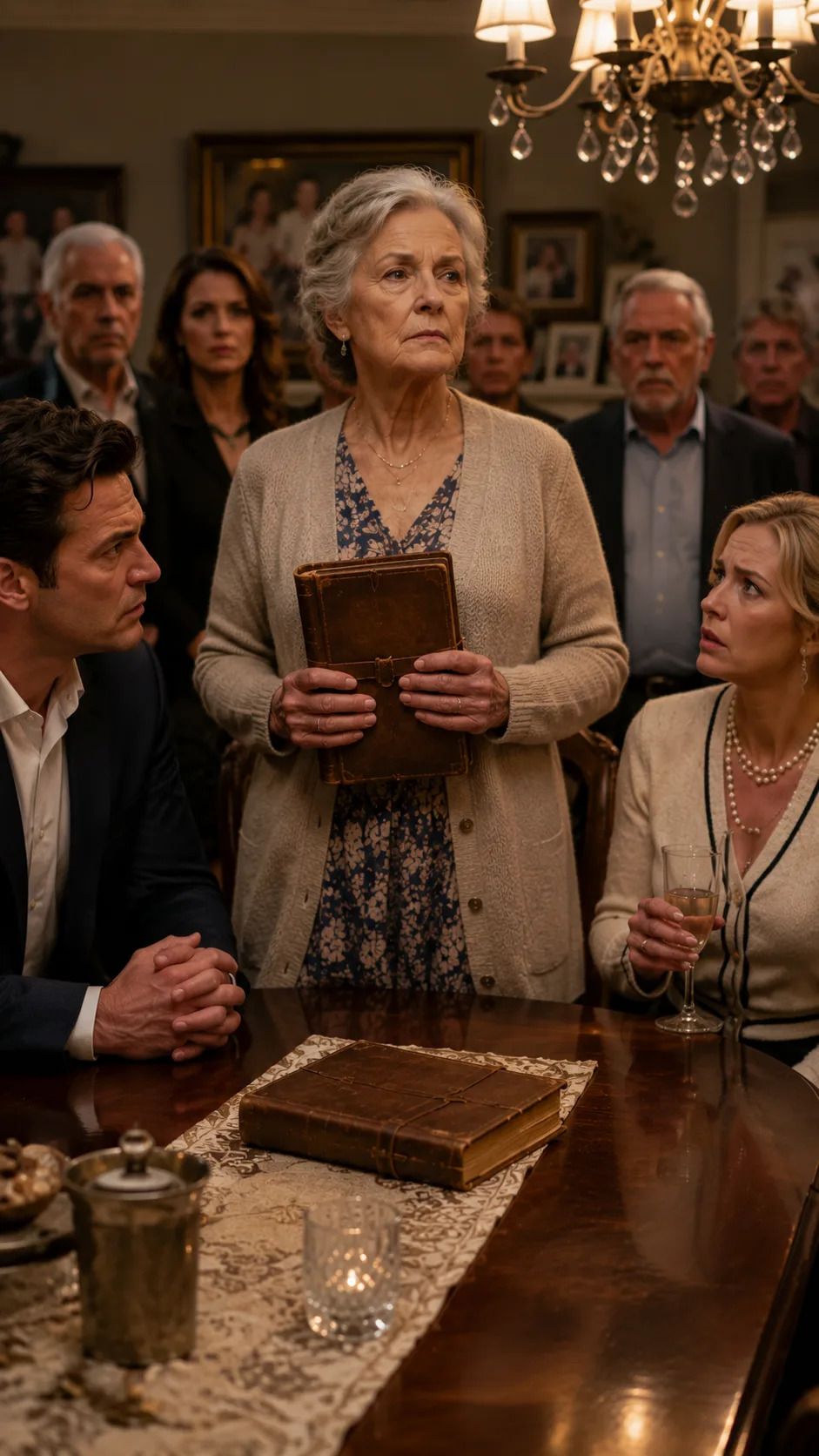
A week after claiming the prize privately through a legal trust, Rose invited Ryan, Emily, Mr. Alvarez, her pastor, two old friends from Dot’s Diner, and a local financial advisor named Margaret Cole to her house for dinner.
Ryan arrived in a tailored suit.
Emily wore pearls.
They brought champagne.
Ryan kissed Rose’s cheek.
“You look happy,” he said.
“I am,” Rose replied.
Dinner was polite.
Too polite.
Ryan told stories about childhood fishing trips with his father, though Rose remembered Ryan had hated fishing.
Emily laughed at everything Rose said.
Too loudly.
After dessert, Ryan cleared his throat.
“Mom, before everyone goes, maybe this is a good time to talk about plans.”
Rose looked around the table.
“Plans?”
Ryan smiled gently.
“For the future. Your future. Family decisions.”
Mr. Alvarez lowered his fork.
Emily placed her hand over Ryan’s.
“We just want what’s best for you,” she said.
Rose stood.
Everyone quieted.
She walked to the sideboard and picked up the brown notebook.
Ryan’s smile faded slightly.
“This,” Rose said, “is not a will.”
Ryan blinked.
“I didn’t say it was.”
“No,” Rose said. “But you were hoping.”
Emily’s face tightened.
Rose opened the notebook.
“I started writing in this after I fell in my kitchen two years ago.”
Ryan looked down.
Rose turned a page.
“May 4. Called Ryan from the hospital. He said he had court.”
The room became very still.
“December 25,” Rose continued. “Drove to Dallas. Emily said I should have called. Ryan said he would call when things slowed down.”
Emily’s cheeks flushed.
“Rose, that’s not fair—”
Rose lifted one hand.
Emily stopped.
“March 9. Birthday text sent. No reply.”
Ryan swallowed.
“Mom…”
“July 16. Doctor appointment. Needed a ride. Asked three days before. No answer.”
Ryan’s eyes shone now, but Rose did not stop.
“Thanksgiving. Ate soup alone. Ryan posted family photo online. Caption said, ‘Grateful for everyone at our table.’”
No one moved.
Rose closed the notebook.
“I wrote these things down because lonely people lie to themselves. We tell ourselves we misunderstood. We tell ourselves our children are busy. We tell ourselves love is still there, just hidden under work and stress and distance.”
Her voice did not rise.
That made it worse.
Ryan stared at the table.
Rose looked at him.
“Then I won money.”
Emily’s fingers tightened around her napkin.
“And suddenly,” Rose said, “my phone remembered how to ring.”
Ryan stood slowly.
“That’s not why I came.”
Rose looked at him with tired kindness.
“Ryan.”
One word.
His name.
And it broke him more than any accusation could have.
He sat back down.
Rose turned to Margaret Cole.
“Margaret, would you explain?”
Margaret opened a folder.
Ryan’s head snapped up.
Rose smiled faintly.
“Don’t worry. It isn’t what you think.”
Margaret adjusted her glasses.
“Mrs. Bennett has decided to place the majority of her winnings into the Rose Bennett Foundation. The foundation will provide emergency care support for elderly people living alone, transportation for medical visits, holiday meal programs, and scholarships for low-income students in rural Texas.”
Ryan stared at her.
Emily whispered, “Majority?”
Rose nodded.
“Most of it.”
Ryan’s face went pale.
“Mom, that’s… generous. But you can’t just—”
“I can.”
“You need family guidance.”
“I needed family when I was lying on a hospital floor.”
The room froze.
Rose’s voice remained soft.
“I don’t need someone to care for me because I have eighty million dollars. I needed someone to care when I had nothing to offer.”
Ryan covered his mouth.
His shoulders shook once.
Emily looked at the floor.
Rose continued, “I’m not cutting you out of my life. I’m not punishing you. I’m not closing the door.”
She paused.
“But I am locking the vault.”
Ryan began to cry.
Not loudly.
Not dramatically.
Just a quiet, ugly kind of crying that made him look nine years old again.
“I’m sorry,” he whispered.
Rose believed him.
But belief was not the same as surrender.
“I know,” she said.
Ryan looked up.
“I forgot who helped me become somebody.”
Rose’s eyes filled.
“No, sweetheart,” she said. “You forgot I was somebody before you became one.”
That sentence traveled around Waverly faster than the lottery news.
Some people said Rose was too harsh.
Some said Ryan deserved worse.
Rose ignored all of them.
Money made people loud.
Truth made them louder.
In the months that followed, Ryan tried.
At first, Rose suspected the money still had a shadow over every visit.
So she watched.
He came without Emily sometimes.
He fixed the porch rail.
He drove her to the doctor.
He sat with her during storms because he remembered she disliked thunder after Thomas died.
He brought dinner from Dot’s Diner, not expensive food from Dallas.
Sometimes he talked.
Sometimes he just sat.
The first Christmas after the lottery, Ryan came alone.
No guests.
No pearls.
No champagne.
He brought a red tin.
Inside were cinnamon cookies.
Burned slightly at the edges.
Rose laughed until she cried.
Ryan cried too.
A year after winning, Rose sat on her repaired porch in the golden Texas sunlight while a reporter from a national magazine asked if she regretted giving so much money away.
Rose looked across the yard.
Ryan was kneeling near the flower bed, helping Mr. Alvarez plant yellow roses.
He was wearing jeans.
His sleeves were rolled up.
Dirt streaked one cheek.
For the first time in years, he looked like her son instead of someone trying not to be.
“Mrs. Bennett?” the reporter asked. “Do you ever feel angry?”
Rose smiled.
“I won the lottery twice.”
The reporter leaned forward.
“How do you mean?”
Rose watched Ryan stand, wipe his hands on his jeans, and wave at her from the yard.
“The first time,” Rose said, “I won eighty million dollars.”
“And the second?”
Rose’s smile softened.
“The second time, my son finally understood his mother was not a wallet.”
The reporter wrote that down.
But Rose was no longer looking at her.
She was looking at Ryan walking toward the porch with a glass of iced tea in one hand and a plate of cookies in the other.
“Mom,” he called, “you want the burned one or the really burned one?”
Rose laughed.
“Bring me the worst one.”
Ryan grinned.
And for once, he came when she called.
Money had changed Rose Bennett’s life.
But the lesson it carried changed Ryan’s.
And on warm Texas evenings, when the sun dropped low and the porch boards glowed gold beneath her feet, Rose no longer listened for a phone that did not ring.
She listened to her son’s truck pulling into the driveway.
Not because he needed money.
Not because cameras were watching.
Not because Emily reminded him.
But because, finally, he remembered the way home.
THE END.
-My son ignored my calls for nearly two years. Then I won eighty million dollars.-
Chapter complete
You have reached the end of this chapter.
Continue reading
A few more worlds to get lost in after this chapter.




